1861 Indian Head Penny Coin Value: How Much Is It Worth?
The 1861 Indian Head penny is a Civil War-era copper-nickel cent struck exclusively at the Philadelphia Mint. Guide values for a regular business strike range from about $30 in G4 (a heavily worn but readable coin) to around $527 in MS63 (a choice uncirculated example with original surfaces).
Proofs, major varieties, and mint errors require separate evaluation and are not covered by that span.
Fast Way to Identify Your 1861 Indian Head Penny
Want a quick read on your 1861 Indian Head cent? Upload clear photos of the front and back, and our identifier can offer a preliminary take on which version you have — business strike or proof — along with general condition observations.
It is not a substitute for professional authentication or certified grading, but it gives you a solid starting point.
1861 Indian Head Penny Value
Upload both sides of your 1861 Indian Head Penny.
Front Obverse
Upload photo
Back Reverse
Upload photo
Which 1861 Indian Head Penny Versions Are Worth Money?
- The regular 1861 business strike guides near $30 in G4 and around $527 in MS63 — original uncirculated surfaces carry a real premium over worn examples.
- Proof 1861 Indian Head cents guide near $1,878 in PR63; confirm proof manufacture through surface and rim characteristics, not just a shiny appearance.
- Error categories such as doubled die obverse, repunched date, die cracks, cuds, and clashed dies have been reported for this date and can affect value depending on severity and authentication.
- Copper-nickel composition sets the 1861 apart from later bronze issues; do not mix up their pricing scales.
Step 1: Identify Your 1861 Indian Head Penny Mint Mark and Version
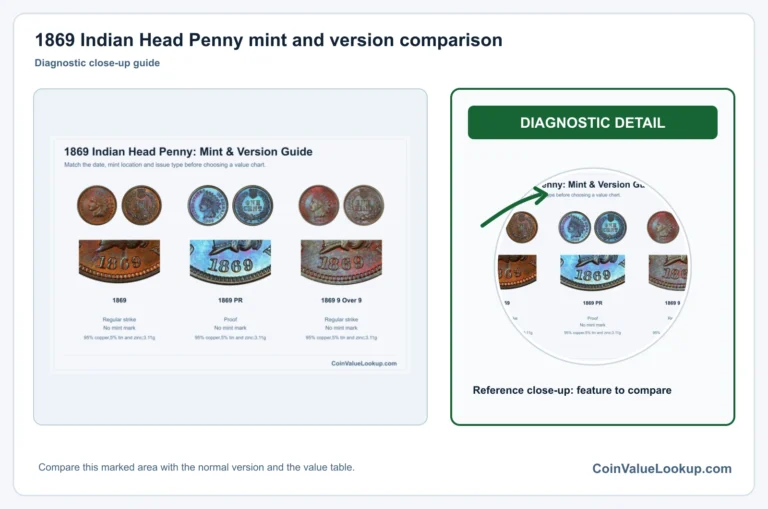
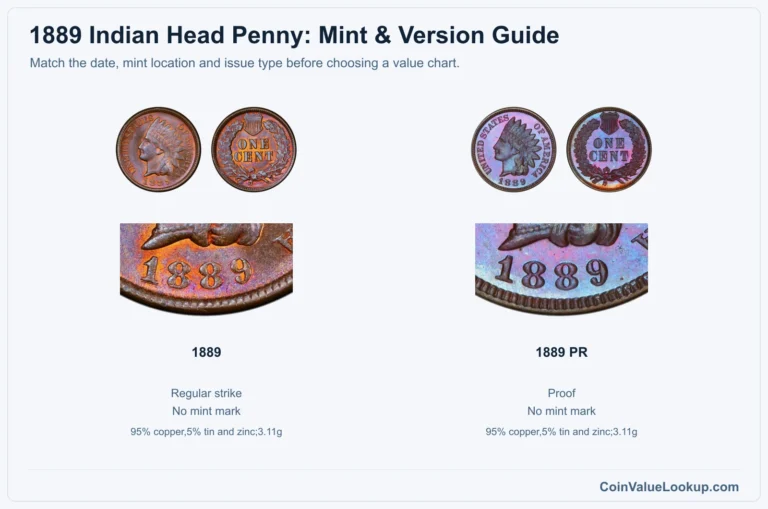
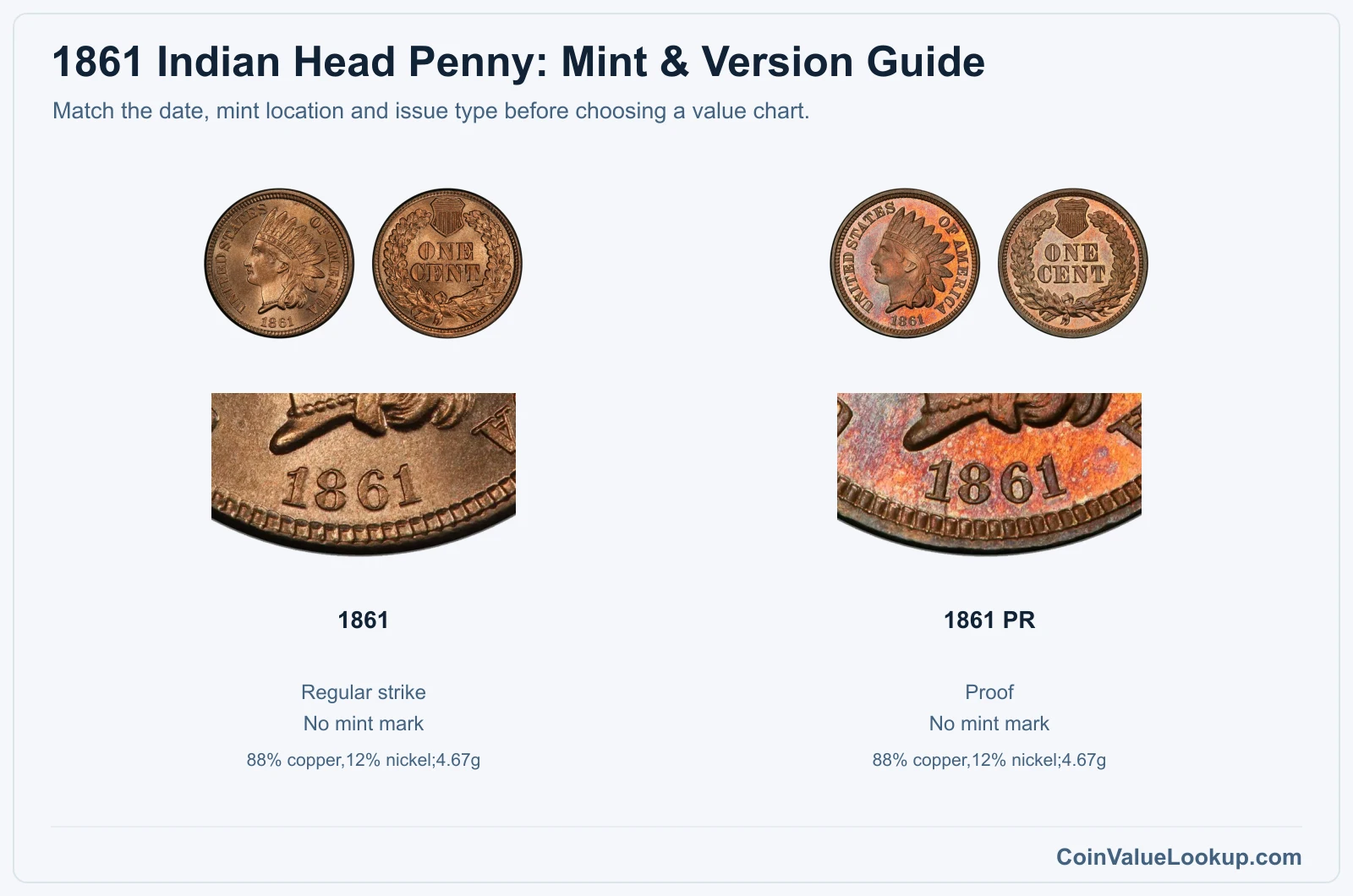
Every regular 1861 Indian Head cent was struck in Philadelphia. There is no mintmark to look for.
If you see a small "L" on the ribbon behind the neck on later dates, that is the designer's initial, not a mint identifier — and it does not appear on the 1861 issue anyway.
The obverse shows a Liberty head wearing a feathered headdress with LIBERTY inscribed on the headband. The reverse features an oak wreath enclosing a small shield at the top, with ONE CENT in the center.
If your coin has a wheat-ear reverse or a different portrait, you are looking at a different series entirely.
This date was struck in a copper-nickel alloy (88% copper, 12% nickel) weighing about 4.67 grams. It will look pale compared to the bronze Indian cents made from 1864 onward.
Do not confuse the two metals when checking values — copper-nickel and bronze issues are priced on completely separate scales.
Proof examples exist for 1861, but proof is a method of manufacture, not a grade above Mint State. A business strike that someone polished to a mirror finish is still a business strike.
Genuine proofs have specific surface characteristics, squared rim geometry, and manufacturing details that go beyond simple shininess. If you suspect you have a proof, professional authentication is the safest route.
Step 2: Check Your 1861 Indian Head Penny Grade
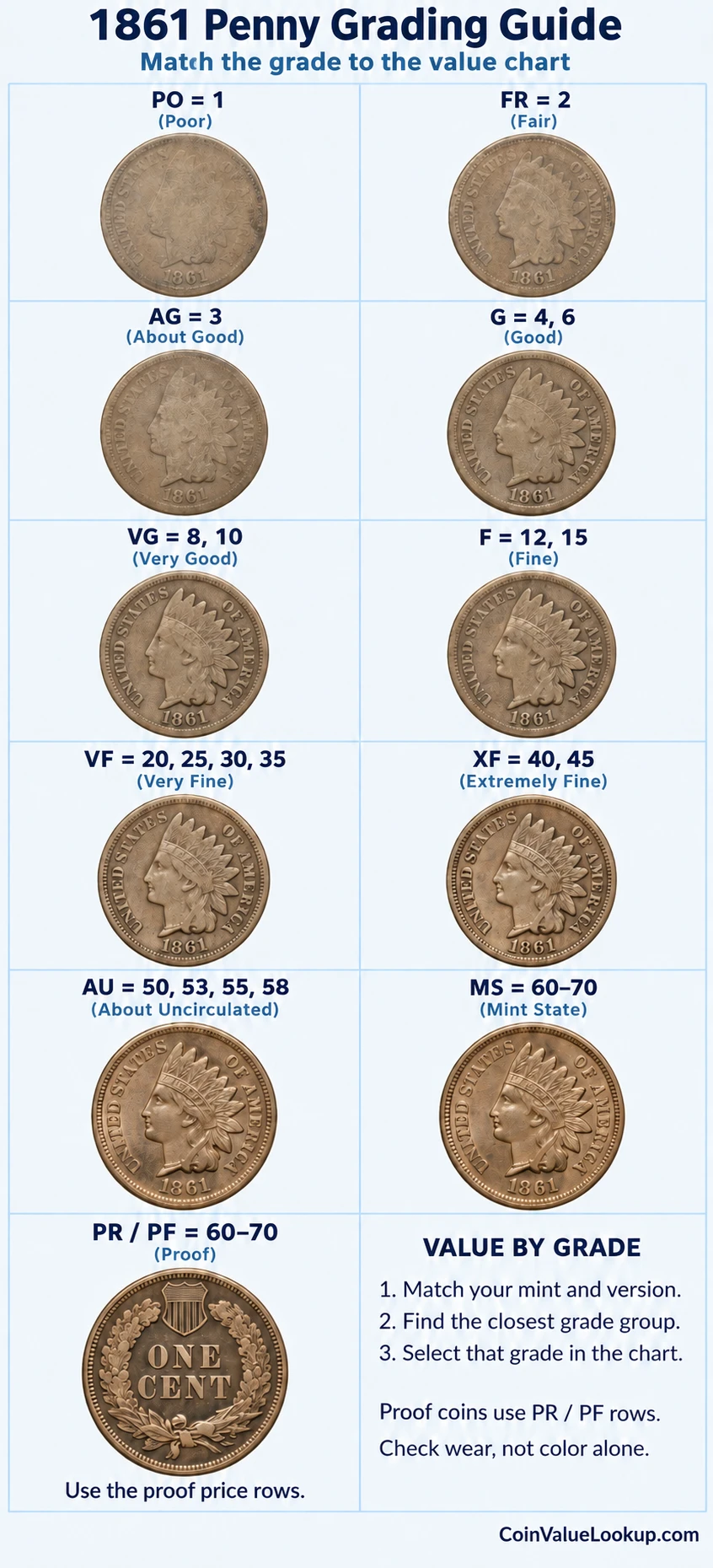
Start with the headband. On a well-struck 1861 cent, the word LIBERTY should be fully visible at higher grades and progressively faded with wear.
In G4, you may see only partial letters. By MS63, the full inscription is sharp and the surrounding surfaces retain original luster.
Check the feather tips above the headband and the hair curls below the ear — these are the first places to lose detail from circulation. Then flip the coin and examine the wreath leaves and the small shield at the top of the reverse.
High-point wear shows up there quickly.
Here is where it gets tricky: some 1861 cents left the mint with a soft strike, meaning the feathers or hair may look flat even without any wear at all. Do not downgrade a coin based on one weak area if the rest of the surfaces show full luster and no contact wear.
Look at the overall picture.
Use the comparison image to match your coin's wear pattern against known grade examples. Pay attention to luster — a coin with original mint glow across the fields is a very different animal from one that has been cleaned or has environmental damage.
Cleaned coins and those with corrosion or scratches trade for significantly less than problem-free examples at the same technical grade.
Step 3: Check 1861 Indian Head Penny Value by Mint and Version
1861 Indian Head Penny
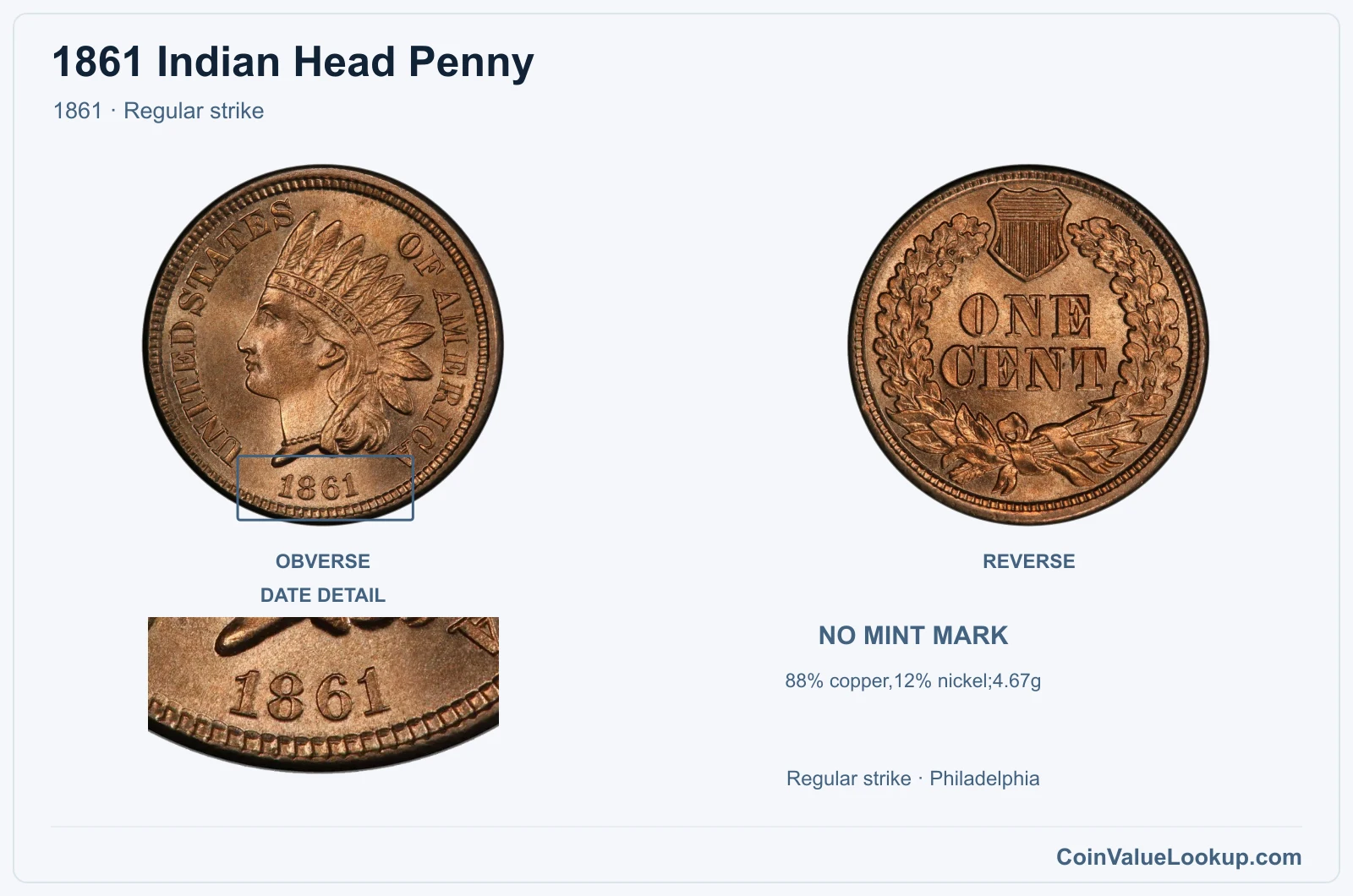
The standard 1861 Indian Head cent is a Philadelphia business strike in copper-nickel, weighing about 4.67 grams. Every regular example lacks a mintmark.
Guide values run approximately $30 at G4 — a coin with heavy wear but legible features — up to around $527 at MS63, where the coin retains full design detail and original luster.
Condition drives the spread here. A mid-grade example in VF or EF will fall somewhere between those anchors.
Original, problem-free surfaces matter enormously; a cleaned or corroded coin at the same technical grade will trade for less. Do not borrow pricing from rare varieties or proof issues when evaluating a standard strike.
| Range | Grade | Price | Auction Records | Appraisal |
|---|---|---|---|---|
| PO | PO 1 | — | Coin Identifier | |
| FR | FR 2 | — | Coin Identifier | |
| AG | AG 3 | — | Coin Identifier | |
| G | G 4 | — | Coin Identifier | |
| G 6 | — | Coin Identifier | ||
| VG | VG 8 | Coin Identifier | ||
| VG 10 | — | Coin Identifier | ||
| F | F 12 | — | Coin Identifier | |
| F 15 | — | Coin Identifier | ||
| VF | VF 20 | Coin Identifier | ||
| VF 25 | Coin Identifier | |||
| VF 30 | Coin Identifier | |||
| VF 35 | Coin Identifier | |||
| XF | XF 40 | Coin Identifier | ||
| XF 45 | Coin Identifier | |||
| AU | AU 50 | Coin Identifier | ||
| AU 53 | Coin Identifier | |||
| AU 55 | Coin Identifier | |||
| AU 58 | Coin Identifier | |||
| MS | MS 60 | — | Coin Identifier | |
| MS 61 | Coin Identifier | |||
| MS 62 | Coin Identifier | |||
| MS 63 | Coin Identifier | |||
| MS 64 | Coin Identifier | |||
| MS 65 | Coin Identifier | |||
| MS 66 | Coin Identifier | |||
| MS 67 | Coin Identifier | |||
| MS 68 | Coin Identifier | |||
| MS 69 | — | — | — | |
| MS 70 | — | — | — |
1861 Indian Head Penny — PR
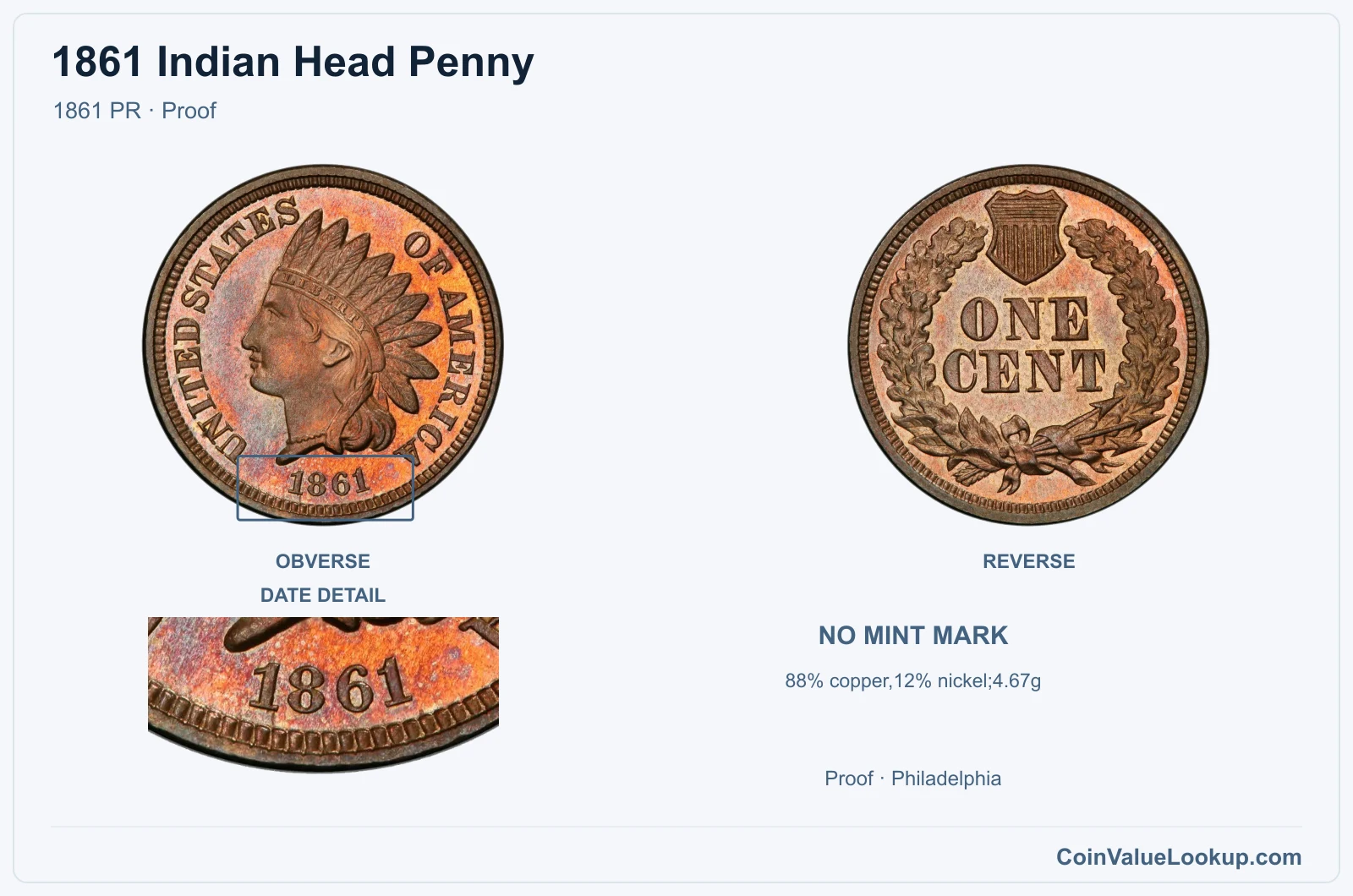
The 1861 proof Indian Head cent was a specially manufactured coin from the Philadelphia Mint, also in copper-nickel at 4.67 grams. A guide estimate places the PR63 value near $1,878.
That is a different universe from a business strike.
Identifying a genuine proof takes more than a glance. Look for deeply mirrored fields, sharp squared rims, and exceptionally crisp design details that result from the proof manufacturing process — not from polishing after the fact.
A business strike that has been buffed shiny is still a business strike, and treating it as a proof is an expensive mistake.
Coin Value Lookup is a handy place to start comparing values across Indian Head cent dates and finishes before deciding whether to pursue professional authentication.
| Range | Grade | Price | Auction Records | Appraisal |
|---|---|---|---|---|
| PR | PR 1 | — | Coin Identifier | |
| PR 2 | — | Coin Identifier | ||
| PR 3 | — | Coin Identifier | ||
| PR 4 | — | Coin Identifier | ||
| PR 6 | — | Coin Identifier | ||
| PR 8 | — | Coin Identifier | ||
| PR 10 | — | Coin Identifier | ||
| PR 12 | — | Coin Identifier | ||
| PR 15 | — | Coin Identifier | ||
| PR 20 | — | Coin Identifier | ||
| PR 25 | — | Coin Identifier | ||
| PR 30 | — | Coin Identifier | ||
| PR 35 | — | Coin Identifier | ||
| PR 40 | — | Coin Identifier | ||
| PR 45 | — | Coin Identifier | ||
| PR 50 | — | Coin Identifier | ||
| PR 53 | — | Coin Identifier | ||
| PR 55 | — | Coin Identifier | ||
| PR 58 | — | Coin Identifier | ||
| PR 60 | — | Coin Identifier | ||
| PR 61 | — | Coin Identifier | ||
| PR 62 | Coin Identifier | |||
| PR 63 | Coin Identifier | |||
| PR 64 | Coin Identifier | |||
| PR 65 | Coin Identifier | |||
| PR 66 | Coin Identifier | |||
| PR 67 | — | — | — | |
| PR 68 | — | — | — | |
| PR 69 | — | — | — | |
| PR 70 | — | — | — |
1861 Indian Head Penny Error List
1. 1861 Indian Head Penny — Die Break / Cud
A die break or cud on an 1861 Indian Head cent shows up as a raised blob of metal, usually connected to the rim. It forms when a chunk of the die itself breaks away, leaving a void that fills with metal during striking.
The result is an irregular raised area that displaces part of the normal design.
To confirm a genuine cud, look for a smooth, raised mass that merges seamlessly into the rim — not a post-mint dent or ding. Corrosion bumps, rim damage from being dropped, and interior die chips can all mimic a cud at first glance.
A true cud has a clean boundary where the normal design abruptly stops.
No specific price range is adopted for this category. Value depends on the size, location, and visual impact of the break, along with the coin's overall condition and professional authentication.
2. 1861 Indian Head Penny — Doubled Die Obverse
A doubled die obverse on the 1861 Indian Head cent means the obverse die received a misaligned secondary impression during its own manufacture, producing consistent doubling across affected design elements. You will typically see separation or notching on letters like LIBERTY or on the date numerals — the key word is consistent, not random.
Compare your coin to a normal 1861 cent under the same lighting. Genuine hub doubling shows a directional shift that repeats across multiple features.
Machine doubling, by contrast, tends to look like flat shelving on one side of a letter with no real separation. Worn die contours and odd reflections can also fool you.
No adopted price range exists for this error on the 1861 date. Each example is assessed individually based on the strength of the doubling, the coin's condition, and whether it has been authenticated by a recognized service.
3. 1861 Indian Head Penny — Repunched Date
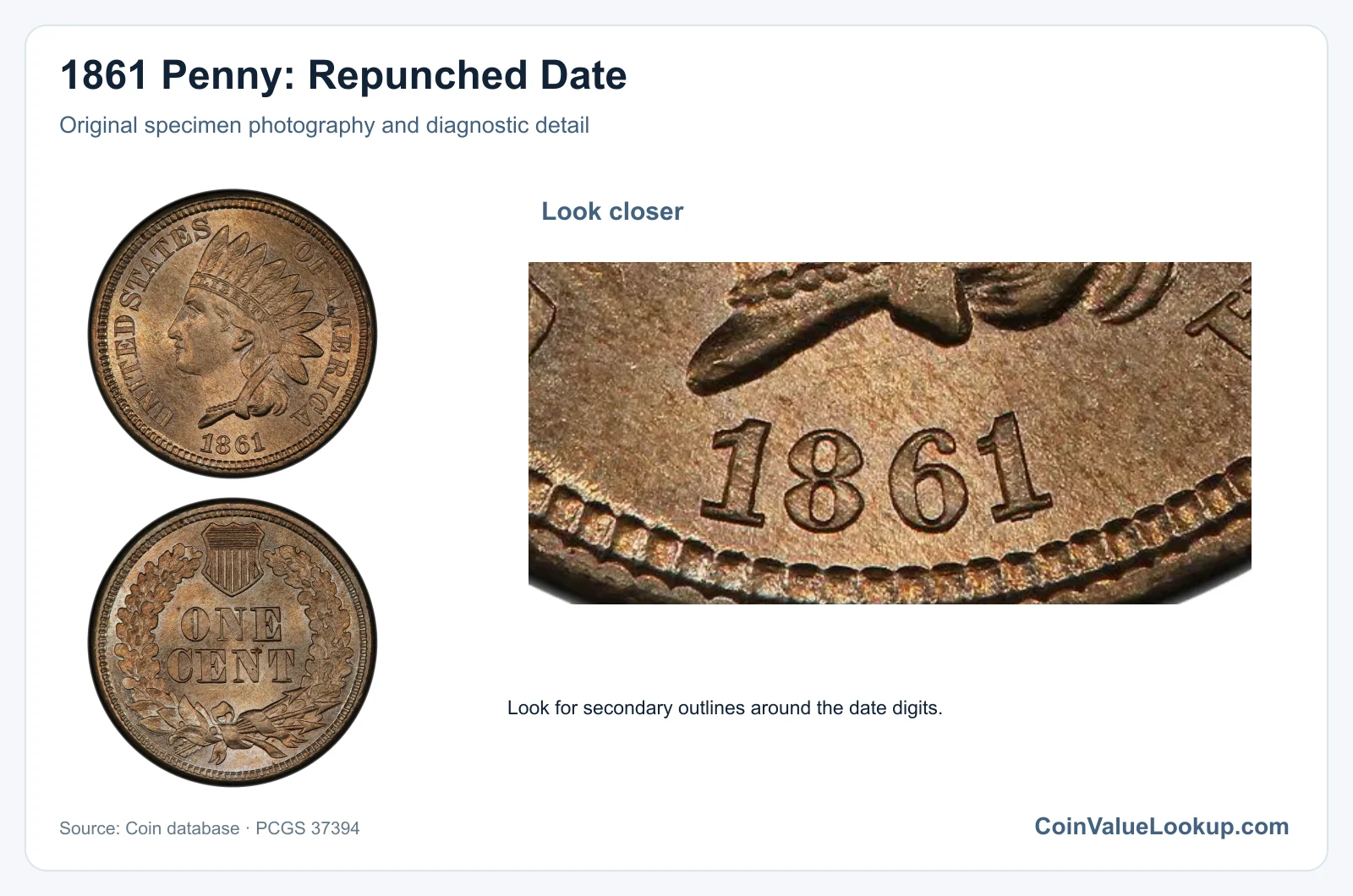
A repunched date on an 1861 Indian Head cent occurs when the date numerals were punched into the working die more than once, with a slight positional shift between strikes. The telltale sign is remnants of the earlier punch — ghost images of one or more digits sitting slightly offset from the final date position.
This is a die variety, not the same thing as a doubled die. The doubling here is limited to the date area because only the date punch was applied twice, whereas a doubled die affects a broader portion of the design.
Look closely at the bases and tops of the 1, 8, 6, and 1 for faint secondary outlines.
Do not confuse a damaged or corroded date with a repunched date. Post-mint scratches near the numerals can mimic the look.
Pricing depends entirely on the specific variety, its visual prominence, and professional authentication of the coin.
4. 1861 Indian Head Penny — Die Crack
Die cracks on 1861 Indian Head cents appear as thin, raised lines running across the coin's surface. They form when the steel die develops a stress fracture during use, and that crack fills with metal on every subsequent strike.
The result is a fine raised ridge that can cross open fields, cut through lettering, or run from the rim inward.
To tell a genuine die crack from post-mint damage, remember: die cracks are raised above the surface. A scratch or scrape is incuse — pressed into the metal.
Corrosion lines may also look linear, but they lack the clean, consistent profile of a die crack and usually show pitting nearby.
No specific price range is supported for die cracks on this date. Collector interest and value depend on the crack's length, position, and visual drama, along with the coin's grade and authentication status.
5. 1861 Indian Head Penny — Clashed Dies
Clashed dies occur when the obverse and reverse dies strike each other without a planchet between them. The impact transfers design elements from one die onto the face of the other.
On the finished coin, you will see faint ghost images of the opposite side's design — traces of the wreath on the obverse fields, or hints of the portrait on the reverse.
These transferred features line up with where the opposing design would sit during a normal strike. That alignment is the key diagnostic.
Random raised lines, scratches, or a brockage (where a struck coin gets stuck and impresses the next planchet) can mimic a clash but will not align consistently with the opposite design.
No adopted price data is available for clashed-die examples of the 1861 Indian Head cent. Value is assessed individually based on the clarity of the clash, the coin's overall condition, and professional authentication.