1869 Indian Head Penny Coin Value: How Much Is It Worth?
An 1869 Indian Head penny is a low-mintage post-Civil War bronze cent that attracts steady collector demand. Selected guide values for the regular business strike range from about $117 in G4 (a heavily worn but readable coin) to around $1,064 in MS63 (a choice uncirculated example with original luster).
Proofs and the recognized 1869/69 repunched-date variety carry their own pricing, and mint errors require separate evaluation.
Fast Way to Identify Your 1869 Indian Head Penny
The quickest way to start figuring out what your 1869 Indian Head penny might be worth is to upload clear photos of the front and back. Our identifier can offer a preliminary read on the coin's version and condition from those images alone.
Snap both sides in good light, avoid glare, and keep the entire rim visible for the best results.
1869 Indian Head Penny Value
Upload both sides of your 1869 Indian Head Penny.
Front Obverse
Upload photo
Back Reverse
Upload photo
Which 1869 Indian Head Penny Versions Are Worth Money?
- The 1869/69 repunched-date variety shows remnants of an earlier date punch beneath the final digits and guides around $175 in G4, climbing to roughly $2,033 in MS63.
- Regular 1869 business strikes in uncirculated condition (MS63) guide near $1,064, reflecting genuine scarcity for this low-mintage date.
- Proof 1869 Indian cents guide around $458 in PR63; confirm true proof surfaces and rim geometry before applying proof pricing.
- Mint errors such as die breaks, misplaced dates, and die cracks on this date are reported and valued individually based on severity and authentication.
Step 1: Identify Your 1869 Indian Head Penny Mint Mark and Version
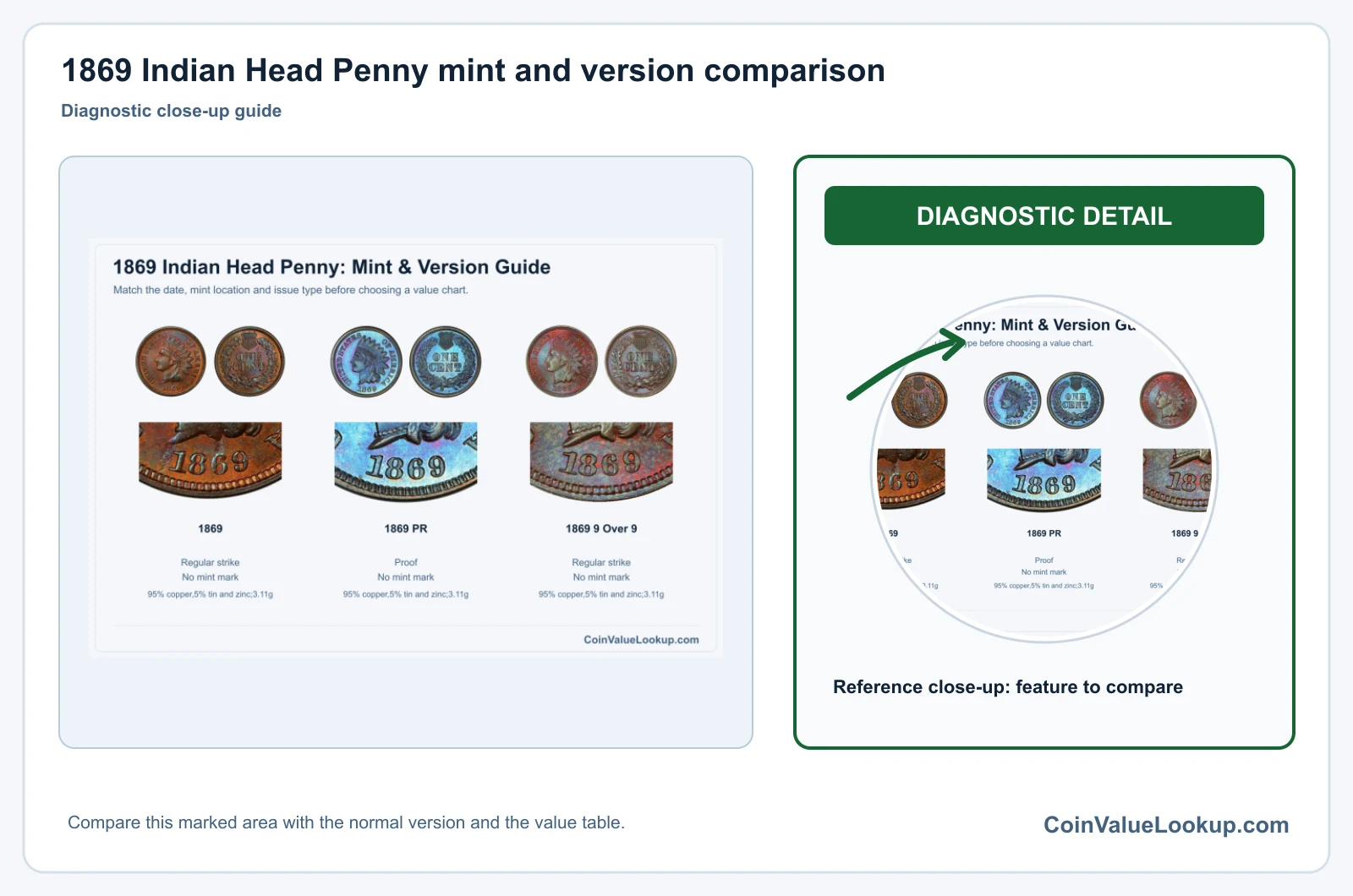
Every regular 1869 Indian Head cent was struck at Philadelphia. There is no mintmark on this coin.
The small "L" on the lower headdress ribbon is the engraver's initial, not a mint identifier, so do not confuse it with a mintmark.
The obverse shows the Indian portrait with a feathered headdress and the word LIBERTY inscribed on the headband. The reverse displays an oak wreath surrounding a shield and the denomination ONE CENT.
If your coin has a wheat-ear reverse or a plain Flying Eagle design, it is a different series entirely.
There are three pricing branches for 1869: the standard business strike, the proof, and the 1869/69 repunched-date variety. The older "1869/8" description you may see in some references has been replaced by the corrected 1869/69 attribution.
Always match your coin to the right branch before checking a value.
Proof status is a manufacturing method, not a grade above uncirculated. A proof will show squared-off rims, mirrored fields, and specific die characteristics.
Simply polishing a business strike does not create a proof, no matter how shiny it looks.
Step 2: Check Your 1869 Indian Head Penny Grade
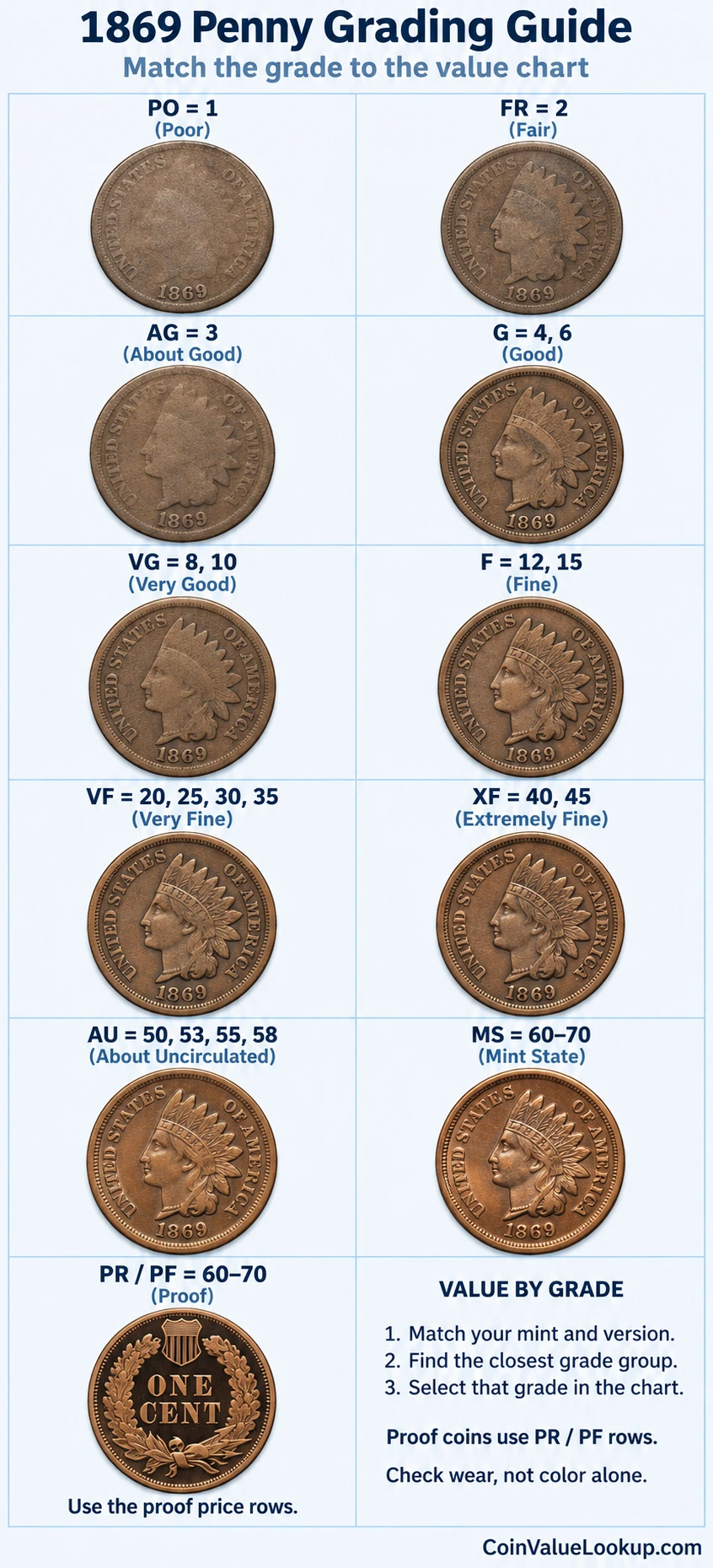
Start with the headband. On a well-worn coin, the letters of LIBERTY disappear progressively; at G4, the outline of the portrait and date remain but most fine detail is gone.
By contrast, an MS63 coin retains full feather separation, sharp hair curls above the ear, and unbroken original luster across the fields.
Check the feather tips and the diamond pattern at the ribbon crossing. These are high-relief areas that show friction first.
A soft original strike, however, can leave feathers mushy even on an uncirculated piece, so look at luster flow and contact marks rather than one isolated detail.
On the reverse, the leaf veins and shield lines wear in sequence. Compare your coin against the reference image to gauge where it falls.
Bronze color designations like BN, RB, and RD describe how much original red copper tone remains; they are not different materials.
Cleaning, corrosion, and tooling all reduce a coin's market appeal regardless of remaining detail. An honest, moderately worn coin almost always outperforms a harshly cleaned one at auction.
Step 3: Check 1869 Indian Head Penny Value by Mint and Version
1869 Indian Head Penny
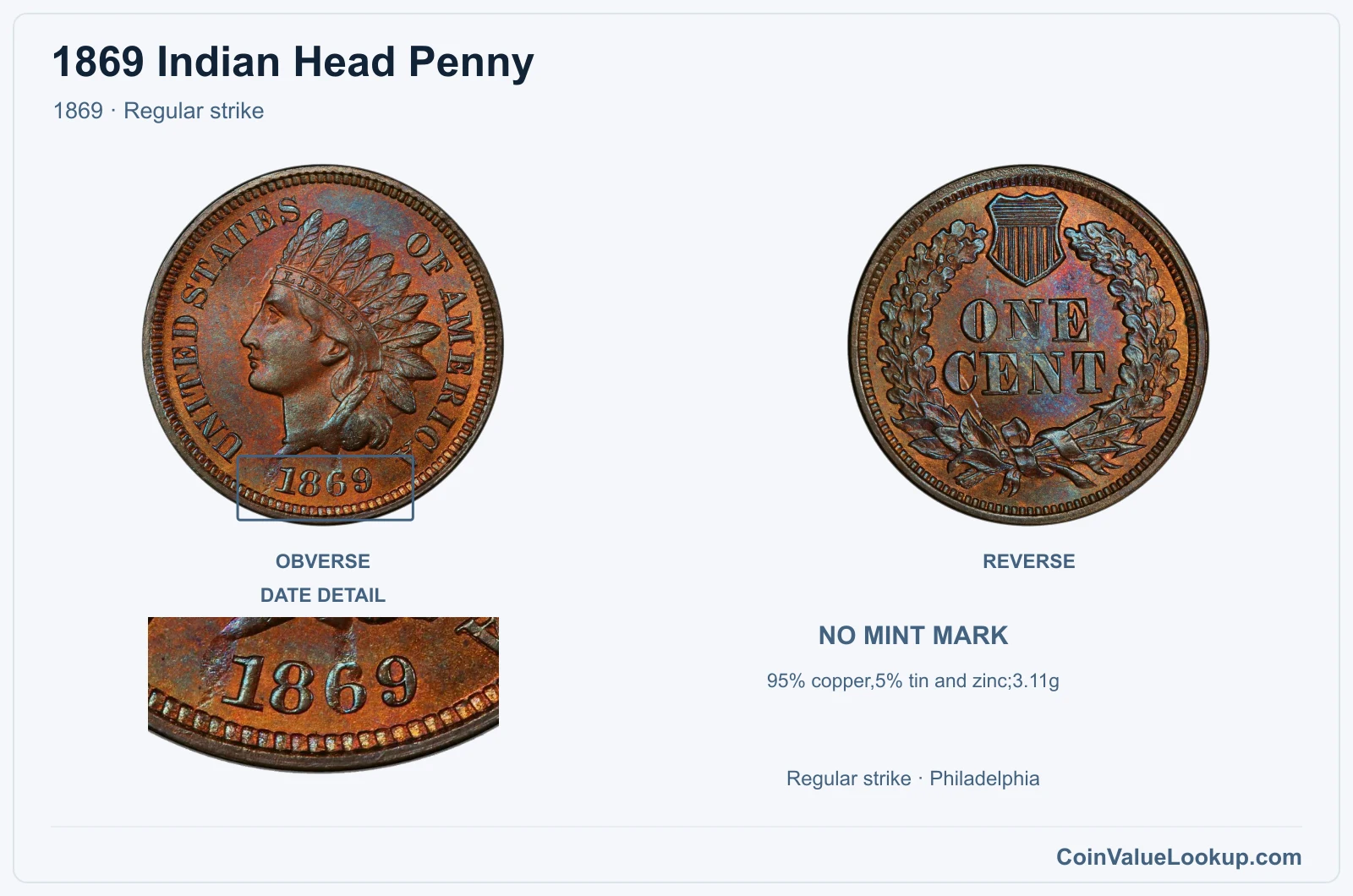
The standard 1869 Indian Head cent is a Philadelphia business strike in bronze (95% copper, 5% tin and zinc, weighing 3.11 grams). No mintmark appears on this coin.
Guide values run from about $117 in G4 to approximately $1,064 in MS63, per USA Coin Book.
Be careful not to borrow pricing from the 1869/69 repunched-date variety. That is a separate branch with higher values.
Compare your date digits closely against a known ordinary example. Original surfaces without cleaning or damage are essential for full market value at any grade.
| Range | Grade | Price | Auction Records | Appraisal |
|---|---|---|---|---|
| PO | PO 1 | — | Coin Identifier | |
| FR | FR 2 | — | Coin Identifier | |
| AG | AG 3 | Coin Identifier | ||
| G | G 4 | Coin Identifier | ||
| G 6 | Coin Identifier | |||
| VG | VG 8 | Coin Identifier | ||
| VG 10 | Coin Identifier | |||
| F | F 12 | Coin Identifier | ||
| F 15 | Coin Identifier | |||
| VF | VF 20 | Coin Identifier | ||
| VF 25 | Coin Identifier | |||
| VF 30 | Coin Identifier | |||
| VF 35 | Coin Identifier | |||
| XF | XF 40 | Coin Identifier | ||
| XF 45 | Coin Identifier | |||
| AU | AU 50 | Coin Identifier | ||
| AU 53 | Coin Identifier | |||
| AU 55 | Coin Identifier | |||
| AU 58 | Coin Identifier | |||
| MS | MS 60 | Coin Identifier | ||
| MS 61 | Coin Identifier | |||
| MS 62 | Coin Identifier | |||
| MS 63 | Coin Identifier | |||
| MS 64 | Coin Identifier | |||
| MS 65 | Coin Identifier | |||
| MS 66 | Coin Identifier | |||
| MS 67 | — | — | — | |
| MS 68 | — | — | — | |
| MS 69 | — | — | — | |
| MS 70 | — | — | — |
1869 Indian Head Penny — PR
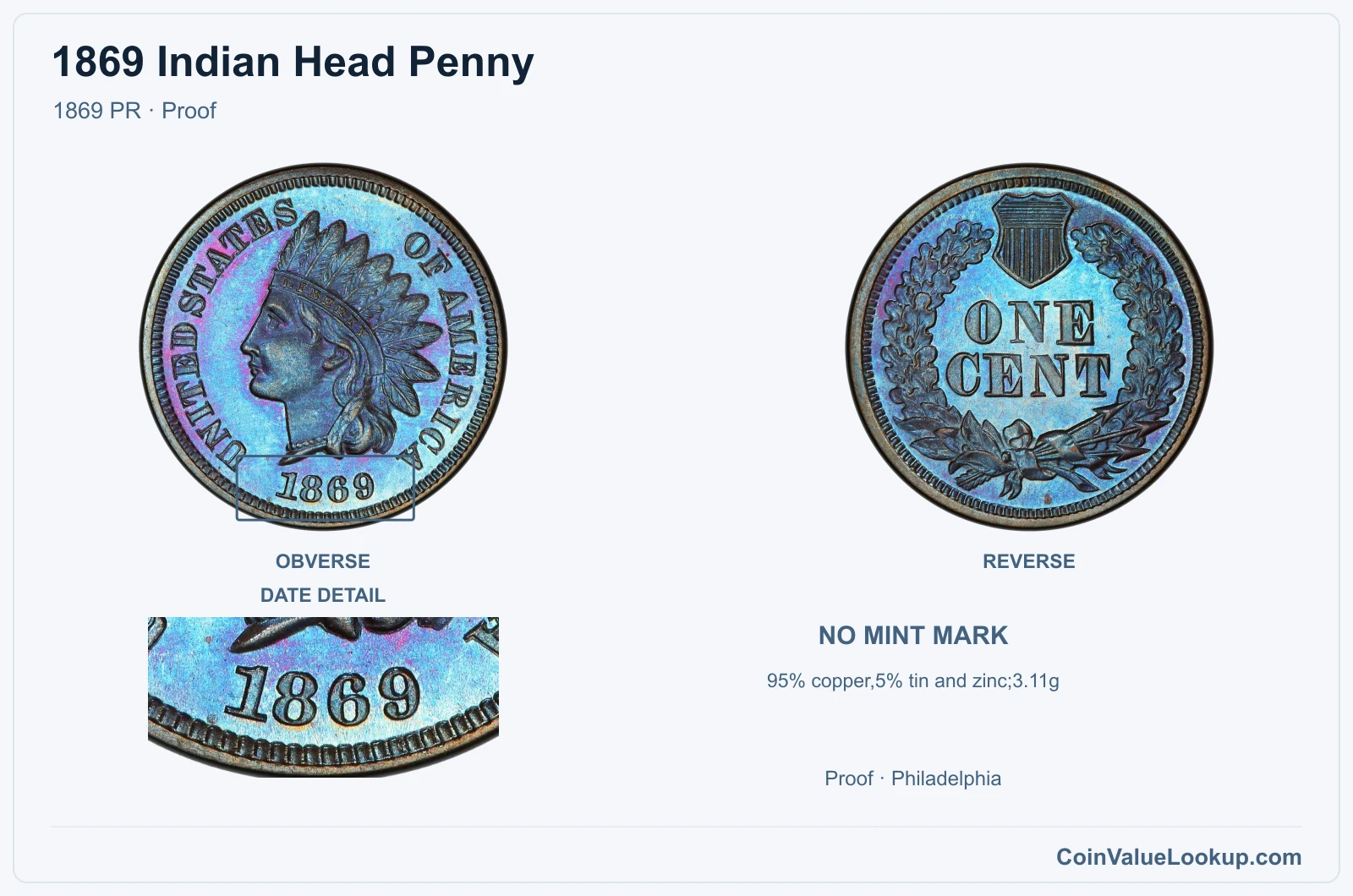
Philadelphia also struck proof versions of the 1869 Indian Head cent, using the same bronze composition and weight. A PR63 example guides around $458 according to USA Coin Book.
Verifying proof status means more than seeing a shiny coin. Look for squared-off, knife-edge rims, deeply mirrored fields, and consistent die polish lines.
A business strike that someone buffed on a cloth will show hairlines and uneven reflectivity. If you are unsure, professional authentication is the safest route before applying proof pricing.
Coin Value Lookup is a handy starting point for looking up guides on Indian cents and other series, so you can compare your coin's details against published references before deciding on next steps.
| Range | Grade | Price | Auction Records | Appraisal |
|---|---|---|---|---|
| PR | PR 1 | — | Coin Identifier | |
| PR 2 | — | Coin Identifier | ||
| PR 3 | — | Coin Identifier | ||
| PR 4 | — | Coin Identifier | ||
| PR 6 | — | Coin Identifier | ||
| PR 8 | — | Coin Identifier | ||
| PR 10 | — | Coin Identifier | ||
| PR 12 | — | Coin Identifier | ||
| PR 15 | — | Coin Identifier | ||
| PR 20 | — | Coin Identifier | ||
| PR 25 | — | Coin Identifier | ||
| PR 30 | — | Coin Identifier | ||
| PR 35 | — | Coin Identifier | ||
| PR 40 | — | Coin Identifier | ||
| PR 45 | — | Coin Identifier | ||
| PR 50 | — | Coin Identifier | ||
| PR 53 | — | Coin Identifier | ||
| PR 55 | — | Coin Identifier | ||
| PR 58 | — | Coin Identifier | ||
| PR 60 | — | Coin Identifier | ||
| PR 61 | — | Coin Identifier | ||
| PR 62 | Coin Identifier | |||
| PR 63 | Coin Identifier | |||
| PR 64 | Coin Identifier | |||
| PR 65 | Coin Identifier | |||
| PR 66 | Coin Identifier | |||
| PR 67 | — | — | — | |
| PR 68 | — | — | — | |
| PR 69 | — | — | — | |
| PR 70 | — | — | — |
1869 Indian Head Penny — 9 Over 9
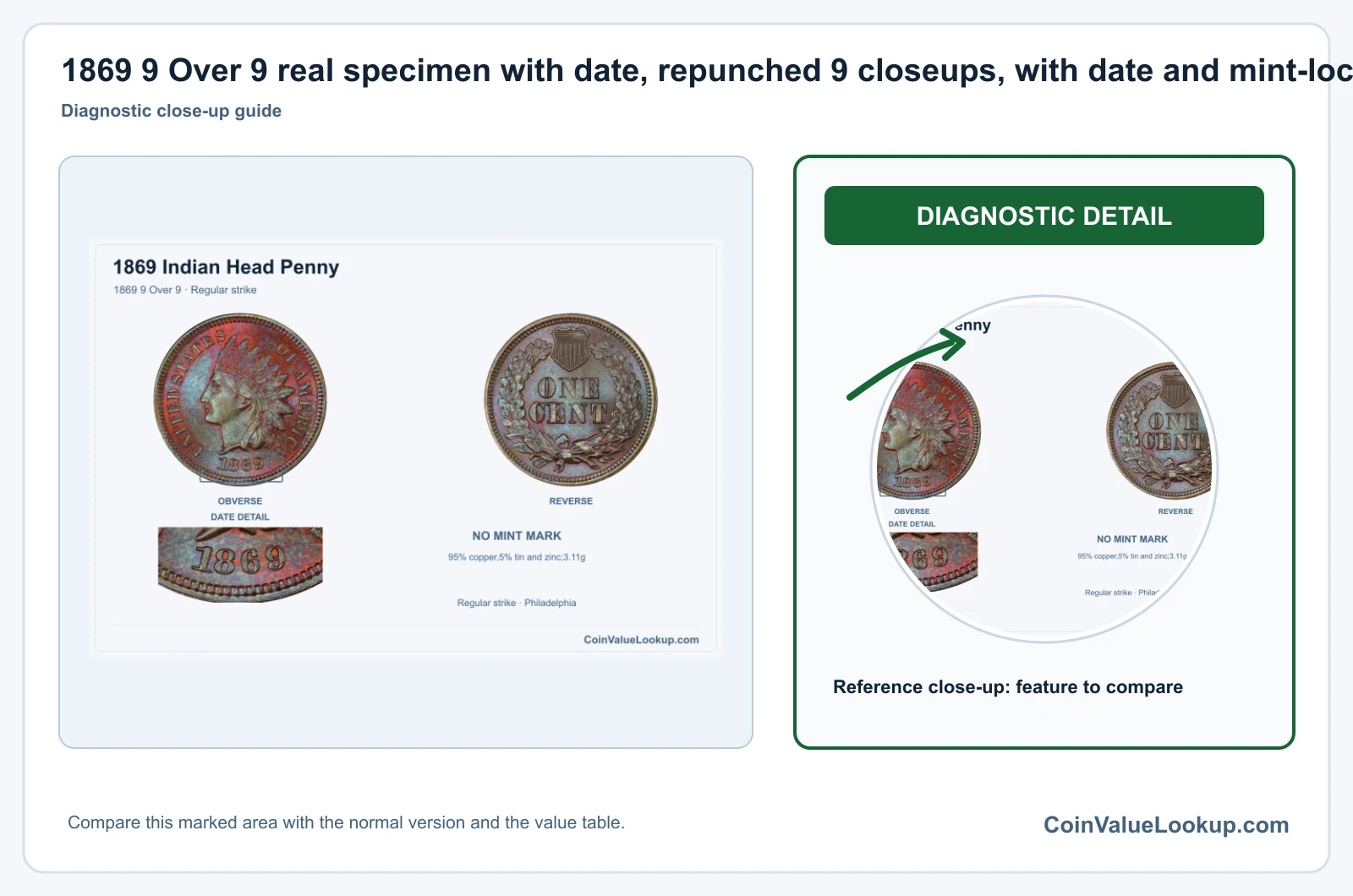
The 1869/69 repunched-date variety is the marquee collectible for this year. During production, the date punch was impressed more than once in slightly different positions, leaving visible remnants of an earlier "9" beneath or beside the final digit.
Older references called this an 1869/8 overdate, but that attribution has been corrected.
Guide values reflect the premium: about $175 in G4 and roughly $2,033 in MS63, per USA Coin Book. That is a significant jump over the regular date at every grade level.
To confirm the variety, examine the lower curve of the final 9 under magnification for traces of the first punch. Compare it side by side with a standard 1869 date photo so the doubled outline is unmistakable.
Ordinary-issue reference: Ordinary-issue reference only: The table below shows prices for the 1869 Indian Cent (regular strike). It does not represent the value of the specific 1869 9 Over 9 variety or its variety premium. Year, mint, metal and strike type are matched; the specific variety is not priced by this table.
Range Grade
Price1869 Indian Cent — Ordinary-Issue Reference (Regular Strike) (BN) Price1869 Indian Cent — Ordinary-Issue Reference (Regular Strike) (RB) Price1869 Indian Cent — Ordinary-Issue Reference (Regular Strike) (RD) Auction Records Appraisal PO PO 1
—
Coin Identifier FR FR 2
—
Coin Identifier AG AG 3
Coin Identifier G G 4
Coin Identifier
G 6
Coin Identifier VG VG 8
Coin Identifier
VG 10
Coin Identifier F F 12
Coin Identifier
F 15
Coin Identifier VF VF 20
Coin Identifier
VF 25
Coin Identifier
VF 30
Coin Identifier
VF 35
Coin Identifier XF XF 40
Coin Identifier
XF 45
Coin Identifier AU AU 50
Coin Identifier
AU 53
Coin Identifier
AU 55
Coin Identifier
AU 58
Coin Identifier MS MS 60
Coin Identifier
MS 61
Coin Identifier
MS 62
Coin Identifier
MS 63
Coin Identifier
MS 64
Coin Identifier
MS 65
Coin Identifier
MS 66
Coin Identifier
MS 67
—
—
—
—
—
MS 68
—
—
—
—
—
MS 69
—
—
—
—
—
MS 70
—
—
—
—
—
1869 Indian Head Penny Error List
1. 1869 Indian Head Penny — Die Break / Cud
A die break, or cud, occurs when a piece of the die itself chips away. On the struck coin this shows up as a raised, featureless blob of metal, typically connected to the rim.
The displaced area will lack any normal design detail where the die fragment was missing.
To confirm a genuine cud on an 1869 Indian cent, look for a smooth, raised lump with a clear boundary where normal design resumes. A rim dent, corrosion patch, or interior die chip can mimic this at first glance, but those will not produce a uniformly raised, flat area that merges into the rim edge.
No standard price range is adopted for this error on the 1869 date. Value depends on the size and location of the break, overall coin grade, and third-party authentication.
Each piece needs individual assessment.
2. 1869 Indian Head Penny — Misplaced Date
A misplaced date happens when a digit from the date punch is partially impressed in the wrong area of the die, usually among the denticles or near the base of the portrait, well away from the final date position. On an 1869 Indian cent, you would look for a ghostly outline of a numeral where no number belongs.
The key diagnostic is shape. A genuine misplaced digit will mirror the form of one of the date numerals, even if only a fragment is visible.
Die chips, random scratches, and tiny bumps do not replicate the precise curves of a "1," "8," "6," or "9."
No adopted price range exists for this category on the 1869 date. Authenticated examples are assessed individually based on clarity of the misplaced digit, the coin's condition, and error severity.
3. 1869 Indian Head Penny — Repunched Date
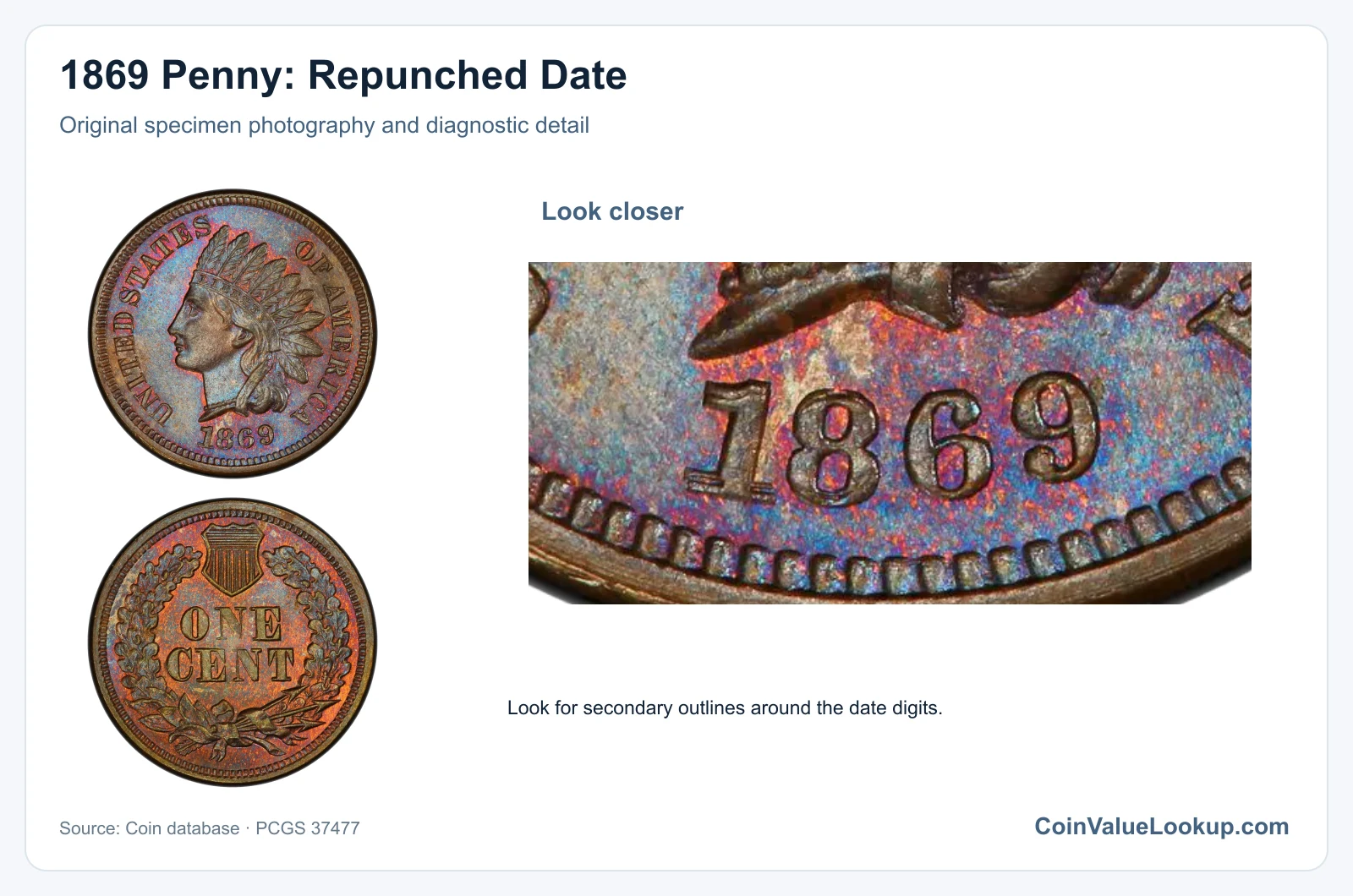
A repunched date on an 1869 Indian Head cent shows remnants of an earlier date-punch impression beside or beneath the final numerals. This is a die-making artifact, not a doubled die, because only the date was punched separately from the rest of the design.
Under magnification, look for secondary outlines or notches on any of the four digits. The extra impression will follow the contour of the numeral, distinguishing it from machine doubling, which tends to produce flat, shelf-like displacement, or from post-strike damage that leaves irregular scratches.
Repunched-date pieces on this year are valued individually. Authentication confirms the variety and separates it from lookalikes.
The major 1869/69 variety is priced as its own branch; lesser repunching may carry different premiums depending on visibility and demand.
4. 1869 Indian Head Penny — Die Crack
A die crack appears as a thin, raised line running across the coin's field or through the design elements. It forms when the steel die develops a stress fracture during use, and the crack fills with metal during each strike.
On an 1869 Indian cent, note where the line begins and ends, since location and length affect collector interest.
The line will be raised above the surrounding surface because it corresponds to a recessed crack in the die. That distinguishes it from an incuse scratch, which is pressed into the coin's surface, or from corrosion trails that follow irregular, branching paths.
No standard price range is adopted for die cracks on this date. A crack through a prominent design element or one that spans a large portion of the coin may attract a premium, but each example requires individual assessment based on severity, location, and authenticated condition.