1796 Liberty Cap Large Cent Coin Value: How Much Is It Worth?
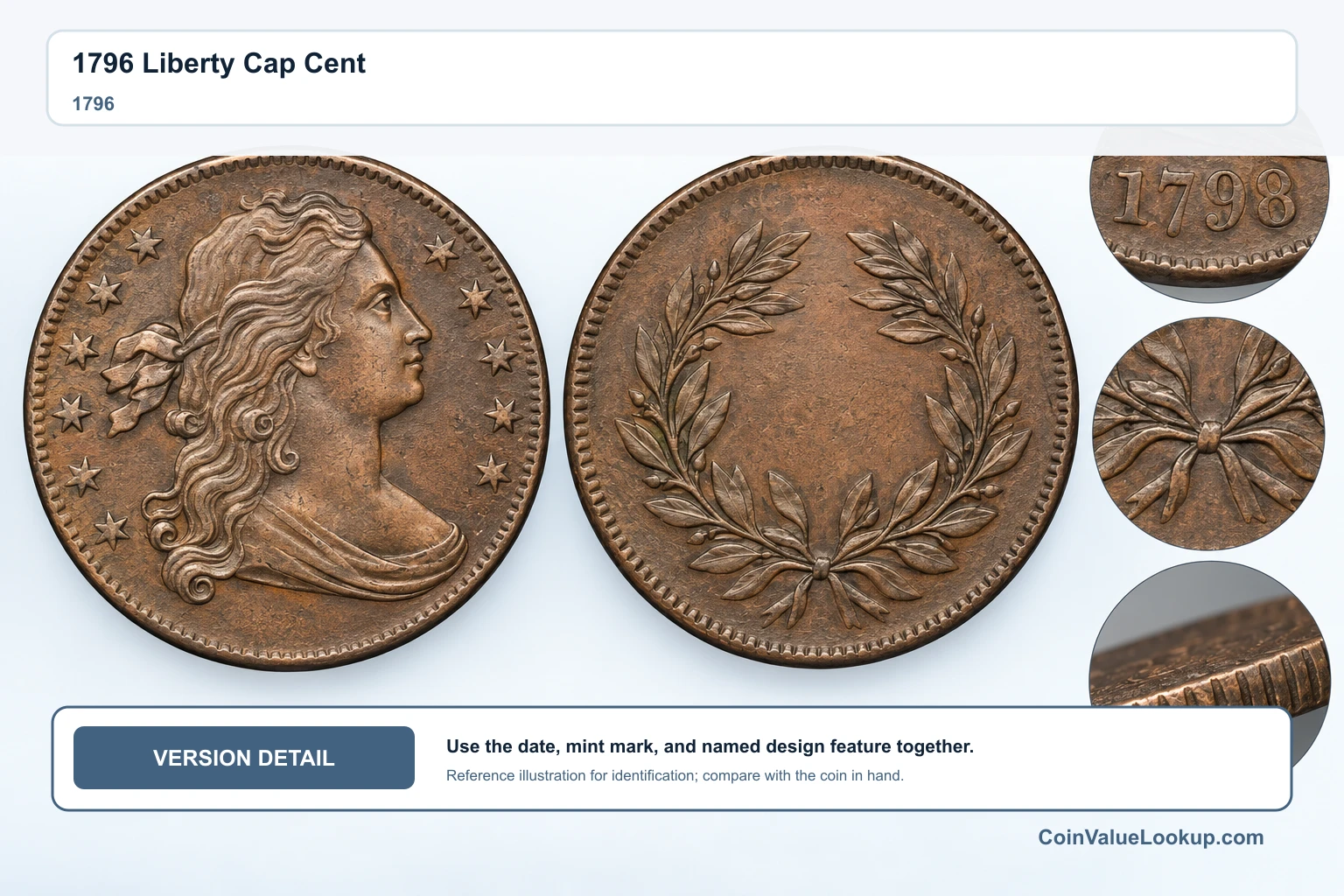
A 1796 Liberty Cap Large Cent is one of the earliest American copper coins, and even well-worn examples carry real value. Guide estimates from USA Coin Book range from about $859 in G4 to $827,744 in MS65 for the Philadelphia business strike.
Those figures cover the ordinary listed branch only; rare die varieties and major errors require separate evaluation based on their specific identity and condition.
Fast Way to Identify Your 1796 Liberty Cap Large Cent
The fastest way to start figuring out what your 1796 Large Cent is worth is to upload clear photos of the front and back. Our identifier can give you a preliminary read on your coin's design type and general category.
Sharp, well-lit images help distinguish key details like the portrait style, wreath type, and legend wording.
1796 Liberty Cap Large Cent Value
Upload both sides of your 1796 Liberty Cap Large Cent.
Front Obverse
Upload photo
Back Reverse
Upload photo
Which 1796 Liberty Cap Large Cent Versions Are Worth Money?
- Both Liberty Cap and Draped Bust designs exist dated 1796; confirming which series your coin belongs to is the essential first step for accurate pricing.
- The LIHERTY variety, where a blundered die punch makes the B resemble an H, is a recognized collectible die variety worth identifying on your coin.
- Guide estimates for the ordinary 1796 Flowing Hair branch run from $859 at G4 to $827,744 at MS65 per USA Coin Book; your coin's exact grade and surfaces determine where it falls.
- Mint errors such as die cracks, cuds, off-center strikes, clips, and laminations are reported for this date and can affect value depending on severity and authentication.
Step 1: Identify Your 1796 Liberty Cap Large Cent Mint Mark and Version
Two distinct design types were struck in 1796: the Liberty Cap and the Draped Bust. This article covers the Liberty Cap series specifically, so make sure you are looking at the right design before applying any values.
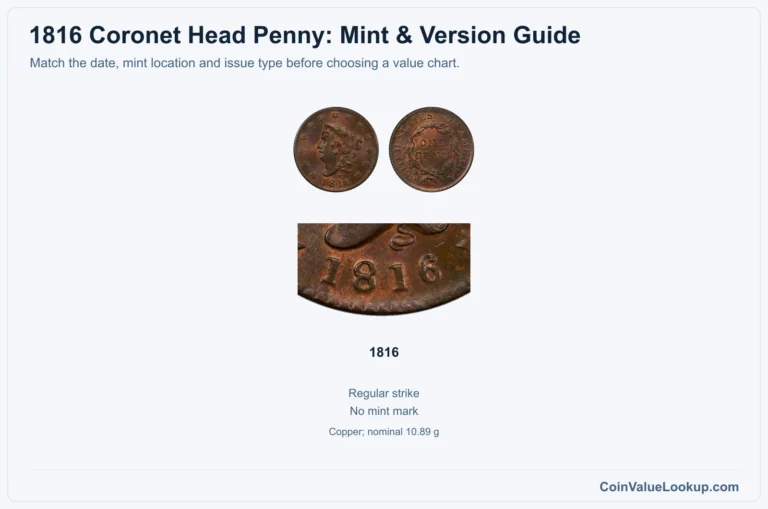
On the Liberty Cap type, Liberty faces right with a pole and cap behind her head.
All 1796 cents were struck at Philadelphia. There is no mintmark to look for.
If someone offers you a 1796 cent with a mintmark, walk away briskly.
Distinguish this Liberty Cap design from the Draped Bust design introduced later in 1796. The LIHERTY variety belongs to the separate Draped Bust series.
That is a die-cutting error from the original production, not post-mint damage.
Inspect date-punch shapes, wreath leaf details, and edge characteristics. Weight should be around 10.89 grams for a full copper planchet, but wear, corrosion, and original production tolerances mean weight alone does not prove authenticity.
Use it as supporting evidence alongside visual examination.
Step 2: Check Your 1796 Liberty Cap Large Cent Grade
Start by examining the portrait. On a well-worn coin the hair strands above Liberty's forehead merge into a flat mass, and the cheek loses its rounded contour.
A coin grading around Good (G4) will show a clear outline and date but little interior detail.
Move to the reverse wreath. Individual leaf veins disappear first, then the leaves themselves flatten into the background.
Lettering sharpness matters too; soft or mushy letters at the rims may indicate a weak strike rather than circulation wear.
Do not confuse wear from use with surface problems. Porosity, corrosion pitting, and old cleaning scratches reduce a coin's market appeal even if the remaining detail looks sharp.
A coin with VF detail but heavy corrosion will sell for far less than a clean VF example.
Compare your coin against the grade reference image on this page. BN, RB, and RD refer to color on copper surfaces, not different metals.
Most surviving 1796 cents are fully brown. Proof is a manufacturing method, not a grade above Mint State.
Step 3: Check 1796 Liberty Cap Large Cent Value by Mint and Version
1796 Liberty Cap Large Cent
The 1796 Liberty Cap Large Cent was struck at Philadelphia in copper, with no mintmark. Liberty faces right beneath a pole and cap on the obverse, while the reverse shows the denomination inside a wreath.
USA Coin Book guide estimates place a G4 example around $859 and an MS65 near $827,744. Most survivors sit in the lower circulated grades, so the high-end figure reflects extreme rarity in top condition.
Both the Liberty Cap and the Draped Bust designs were produced this year, so correctly identifying which type you hold is critical. Look for the pole and liberty cap behind the portrait on this version.
For Liberty Cap cents, die attribution and surface condition matter when comparing values.
If you are researching other early copper cents or want to compare values across different dates, Coin Value Lookup is a helpful place to start. You can browse guides organized by denomination and series to see how your coin fits into the broader picture of early American coinage.
Range Grade
Price1796 Liberty Cap Cent BN,1796 Liberty Cap Cent RB Price1796 RB Auction Records Appraisal PO PO 1
Coin Identifier FR FR 2
Coin Identifier AG AG 3
Coin Identifier G G 4
Coin Identifier
G 6
Coin Identifier VG VG 8
Coin Identifier
VG 10
Coin Identifier F F 12
Coin Identifier
F 15
Coin Identifier VF VF 20
Coin Identifier
VF 25
Coin Identifier
VF 30
Coin Identifier
VF 35
Coin Identifier XF XF 40
Coin Identifier
XF 45
Coin Identifier AU AU 50
Coin Identifier
AU 53
Coin Identifier
AU 55
Coin Identifier
AU 58
Coin Identifier MS MS 60
—
Coin Identifier
MS 61
Coin Identifier
MS 62
Coin Identifier
MS 63
—
Coin Identifier
MS 64
Coin Identifier
MS 65
—
Coin Identifier
MS 66
Coin Identifier
MS 67
—
—
—
—
MS 68
—
—
—
—
MS 69
—
—
—
—
MS 70
—
—
—
—
Grade-by-grade prices for this exact issue are currently unavailable.
1796 Liberty Cap Large Cent Error List
1. 1796 Liberty Cap Large Cent — Die Crack
A die crack shows up as a thin raised line running across the coin's surface, cutting through fields or design elements. On a 1796 copper cent these can be subtle because the soft metal and two-plus centuries of wear may obscure fine lines.
Look for a raised ridge that follows a consistent path, not a random scratch.
The key difference from damage is direction and texture. A die crack is raised above the surface because the crack in the steel die became a tiny channel that filled with copper during striking.
A scratch or tool mark is incused, sitting below the surface. Corrosion lines tend to be irregular and pitted rather than sharp.
No supported price range is available for this error on the 1796 date. Value depends on the crack's prominence, the coin's overall grade, and authentication by a recognized service.
2. 1796 Liberty Cap Large Cent — Die Break / Cud
A cud is a raised blob of metal, usually connecting to the rim, caused by a piece of the die breaking away entirely. On a 1796 Large Cent a cud can appear anywhere along the border, leaving a smooth, featureless lump where design details should be.
A smaller interior die break may show a raised irregular area within the devices.
Do not confuse a cud with a rim bump from being dropped or a corrosion blister. A genuine cud has a flat or slightly convex surface continuous with the coin's metal, and the surrounding design flows into it naturally.
A rim dent typically shows displaced metal with sharp edges.
There is no adopted numeric price range for cuds on this date. Each example needs individual assessment considering the cud's size, location, eye appeal, and the coin's authenticated grade.
3. 1796 Liberty Cap Large Cent — Off-Center Strike
An off-center strike happens when the planchet is not properly seated between the dies. The result is a crescent-shaped blank area on one side of the coin, with the design shifted in the opposite direction.
On a 1796 cent, any surviving off-center example would be exceptionally rare simply because so few coins from this year exist in any form.
The date must remain visible for the coin to be attributed to 1796, which limits how dramatic the misalignment can be and still retain collector interest. Look for an unstruck crescent with a natural, curved edge where no design was imparted.
A clipped planchet or post-mint flattening can mimic an off-center appearance. The distinction is that an off-center coin has a complete, uniform rim on the struck portion, while damage shows irregular distortion.
No specific price data is available; assessment depends on the degree of offset, date visibility, and professional authentication.
4. 1796 Liberty Cap Large Cent — Clipped Planchet
A clipped planchet error means a piece of the original copper blank was missing before the coin was struck. This can appear as a curved bite (from an overlapping punch in the blanking press), a straight edge, or a ragged section.
On the struck coin you will often see weakness in the design directly opposite the clip, where metal could not flow fully into the die.
Compare the edge texture at the clip to the rest of the coin. A genuine clip typically shows the original planchet edge or a smooth, slightly tapered boundary, while a filed notch or deliberate cut leaves tool marks and sharp angles.
Corrosion eating into the rim can also look like a clip but will show pitting and uneven surfaces.
No numeric price range is supported for clipped 1796 cents. The size and location of the clip, combined with the coin's authenticated grade, determine value on a case-by-case basis.
5. 1796 Liberty Cap Large Cent — Lamination / Split Planchet
A lamination error occurs when layers within the copper planchet separate, leaving a peeling flap, a missing section, or a visible split along the edge. On a 1796 Large Cent, look for a thin layer of metal lifting away from the surface or a shallow void where a flap has broken off.
Photographing the edge alongside the affected face helps document the separation.
The lookalike to watch for is deliberate scraping, old corrosion, or a coin that has been intentionally cut or shaved. A genuine lamination follows the metal's internal structure and usually has smooth, rounded edges where it separates, rather than the sharp gouges left by a tool.
Corrosion tends to pit the surface unevenly instead of lifting a clean layer.
No adopted price range exists for lamination errors on this date. Each coin requires individual evaluation based on the extent of the separation, remaining surfaces, and professional authentication.