1974 Lincoln Penny Coin Value: How Much Is It Worth?
Most 1974 Lincoln pennies you pull from a jar are worth face value in circulated condition. A USA Coin Book guide estimate places an uncirculated no-mintmark example at about $1.24 in MS65, and a standard proof at $1.24 in PR65.
The real action is in authenticated mint errors, which can reach thousands of dollars for the right combination of misstrikes. Sorting your coins by mint, finish and surface condition is the first step toward knowing what you actually have.
Fast Way to Identify Your 1974 Lincoln Penny
Snap a clear photo of the front and back of your 1974 penny and upload both images here. Our identifier can give you a preliminary read on the mint, finish and general version so you know where to focus.
It is not a substitute for professional authentication or exact grading, but it will point you in the right direction fast.
1974 Penny Value
Upload both sides of your 1974 Lincoln Penny.
Front Obverse
Upload photo
Back Reverse
Upload photo
Which 1974 Lincoln Penny Versions Are Worth Money?
- The 1974-S business strike in MS65 carries a guide estimate of $6.25, notably higher than the no-mintmark or D at the same grade.
- Authenticated striking errors such as off-center strikes, wrong-planchet strikes and die varieties can be worth far more than normal coins.
- A 1974-S cent struck on a Philippine aluminum blank sold for $19,200 at auction (PCGS MS61, January 2023), an exceptional combined error.
- A 1974-S cent with an obverse cud and retained die fragment sold for $9,000 (NGC MS63 RB, April 2021).
- Original high-grade surfaces with full Red copper color matter more than the common date alone.
- Experimental aluminum cents are historical artifacts, not something you will find in pocket change.
Step 1: Identify Your 1974 Lincoln Penny Mint Mark and Version
The 1974 Lincoln cent carries Lincoln's portrait on the obverse and the Memorial reverse, with a plain (smooth) edge. Normal composition is 95% copper and 5% zinc, weighing about 3.11 grams.
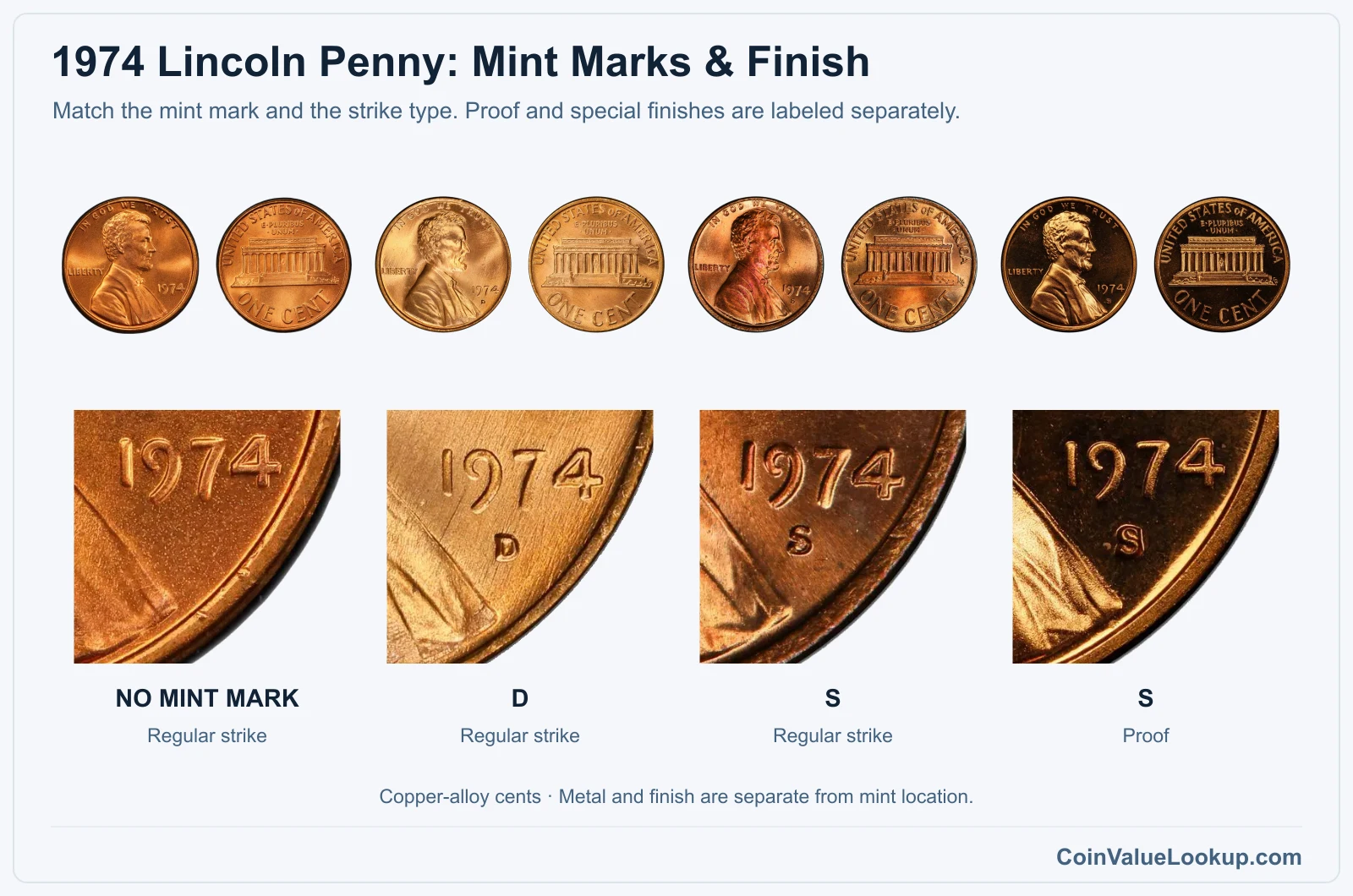
Three catalog branches exist for business strikes: no mintmark, D (Denver) and S (San Francisco). The mintmark sits below the date on the obverse.
A missing mintmark does not by itself prove a coin was struck at any particular facility.
San Francisco also produced proof coins in 1974, so an S-mint penny could be either a business strike or a proof. Proofs have mirror-like fields and sharply detailed devices; that mirror finish is a manufacturing method, not a grade above Mint State.
Do not confuse the two.
Copper-color designations you may see on certified holders, BN (Brown), RB (Red-Brown) and RD (Red), describe how much original copper color remains. They are not different alloys.
You may have heard about 1974 aluminum cents. Those were experimental pieces the Mint produced while Congress considered switching compositions.
They were never adopted for circulation, and the Mint has actively recovered surviving specimens. If your penny looks silvery, a plated or chemically altered copper cent is far more likely than an aluminum pattern.
Step 2: Check Your 1974 Lincoln Penny Grade
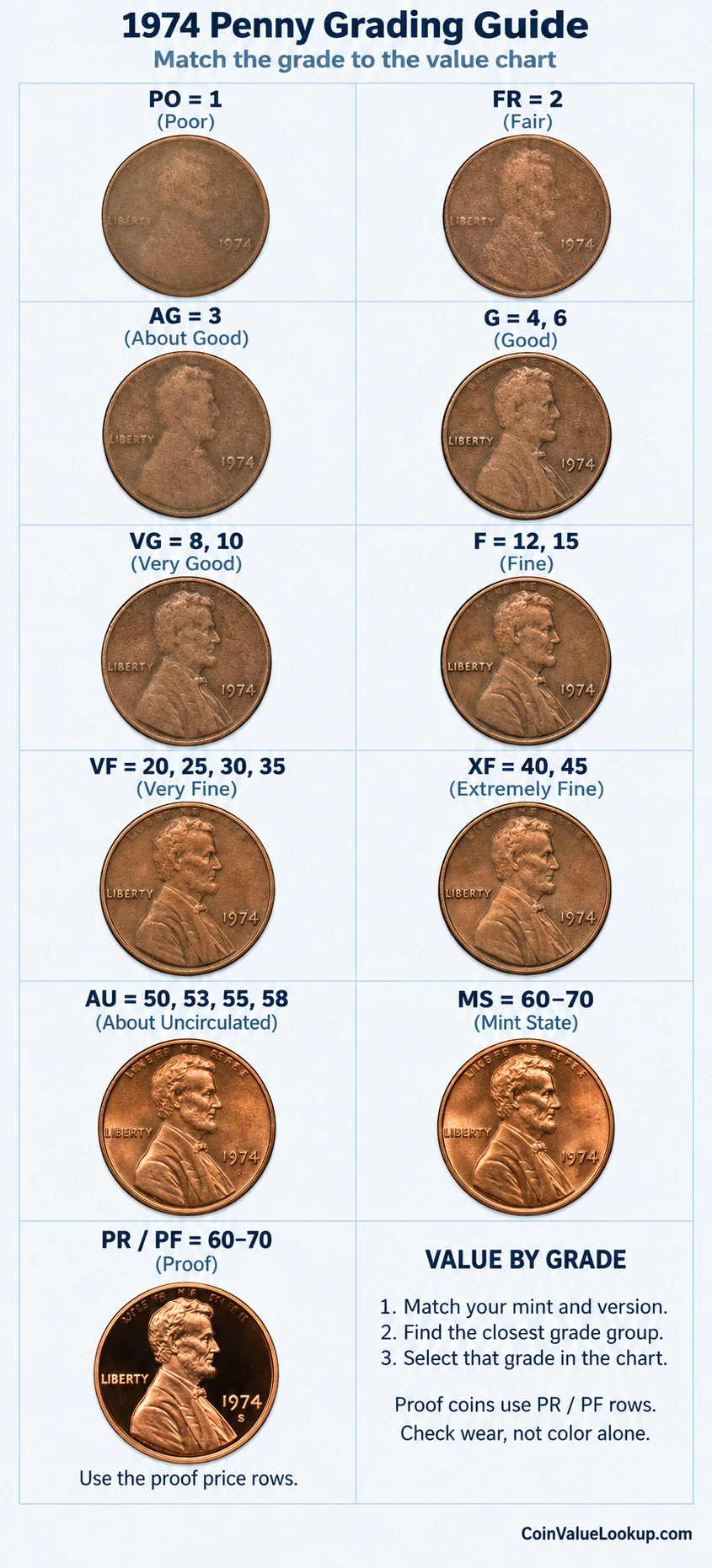
Start with Lincoln's cheek, jawline and the hair detail above his ear. On a well-worn coin those areas flatten first and merge together.
Flip it over and check the Memorial roof and the columns between the openings.
The difference between About Uncirculated and Mint State comes down to luster, not just high-point wear. If the original mint luster is broken on the cheek or jaw under direct light, the coin has circulated, even if it looks sharp otherwise.
Compare yours side by side with the reference image to calibrate your eye.
For proofs, look for hairlines from mishandling, spots or any damage to the reflective fields. Color alone does not set the grade, but original Red surfaces on either a business strike or proof do carry a premium over brown or spotted examples.
Never clean a copper coin or try to remove toning; that permanently damages the surface and tanks the value.
Step 3: Check 1974 Lincoln Penny Value by Mint and Version
1974 Lincoln Penny
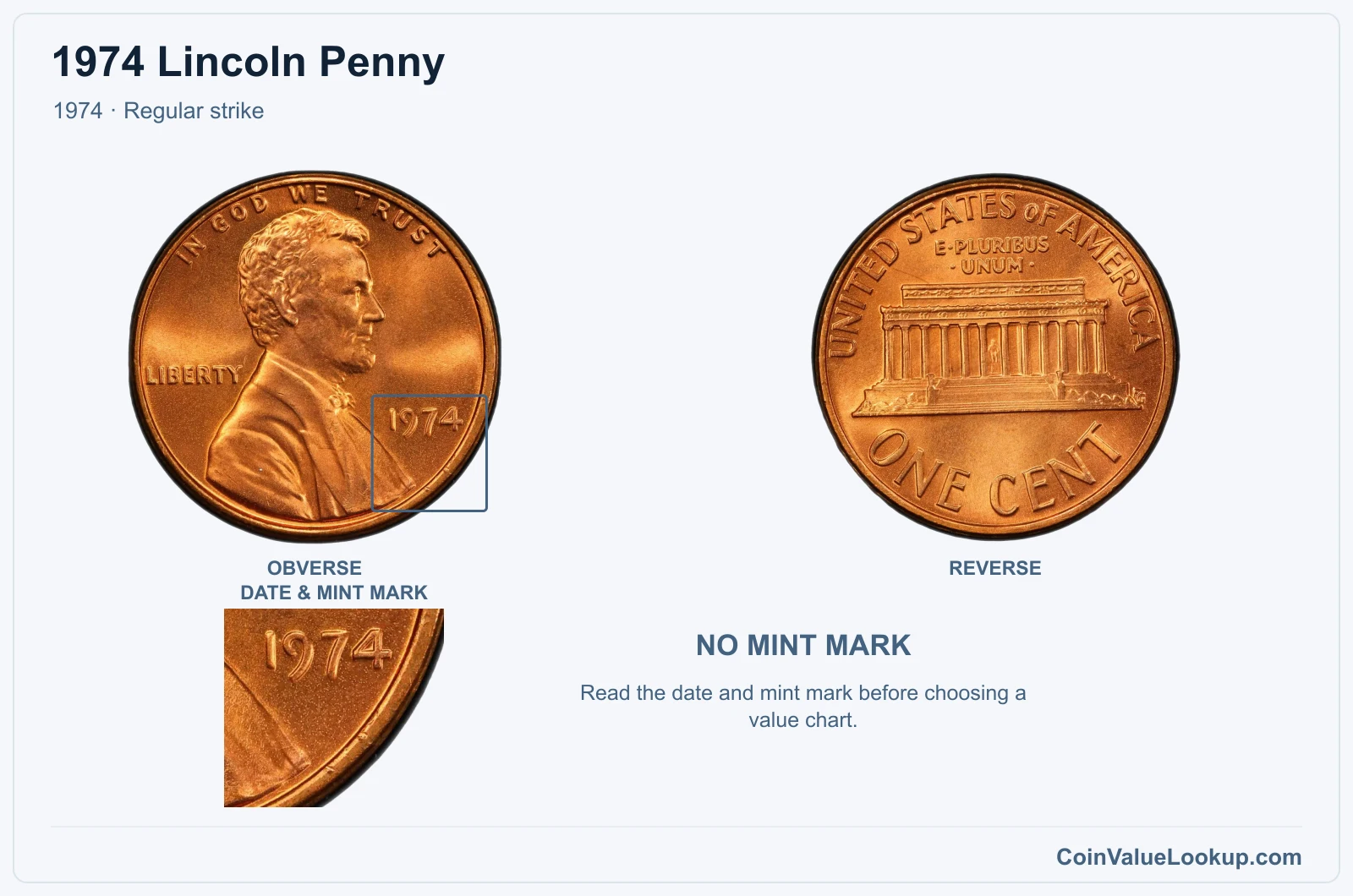
The no-mintmark 1974 cent is the most common branch you will encounter. It is a business strike in the standard 95% copper / 5% zinc composition.
A USA Coin Book guide estimate puts it at roughly $1.24 in MS65. In circulated grades it is essentially worth face value.
To confirm this version, check below the date for the absence of a mintmark and verify the coin has normal copper color and weight. Make sure you are not looking at a proof with mirror fields; proofs are a separate category, not a fancier uncirculated coin.
| Range | Grade | Price | Auction Records | Appraisal |
|---|---|---|---|---|
| PO | PO 1 | — | Coin Identifier | |
| FR | FR 2 | — | Coin Identifier | |
| AG | AG 3 | — | Coin Identifier | |
| G | G 4 | — | Coin Identifier | |
| G 6 | — | Coin Identifier | ||
| VG | VG 8 | — | Coin Identifier | |
| VG 10 | — | Coin Identifier | ||
| F | F 12 | — | Coin Identifier | |
| F 15 | — | Coin Identifier | ||
| VF | VF 20 | — | Coin Identifier | |
| VF 25 | — | Coin Identifier | ||
| VF 30 | — | Coin Identifier | ||
| VF 35 | — | Coin Identifier | ||
| XF | XF 40 | — | Coin Identifier | |
| XF 45 | — | Coin Identifier | ||
| AU | AU 50 | — | Coin Identifier | |
| AU 53 | — | Coin Identifier | ||
| AU 55 | — | Coin Identifier | ||
| AU 58 | — | Coin Identifier | ||
| MS | MS 60 | — | Coin Identifier | |
| MS 61 | — | Coin Identifier | ||
| MS 62 | — | Coin Identifier | ||
| MS 63 | — | Coin Identifier | ||
| MS 64 | — | Coin Identifier | ||
| MS 65 | Coin Identifier | |||
| MS 66 | Coin Identifier | |||
| MS 67 | Coin Identifier | |||
| MS 68 | — | Coin Identifier | ||
| MS 69 | — | — | — | |
| MS 70 | — | — | — |
1974 Lincoln Penny — Aluminum
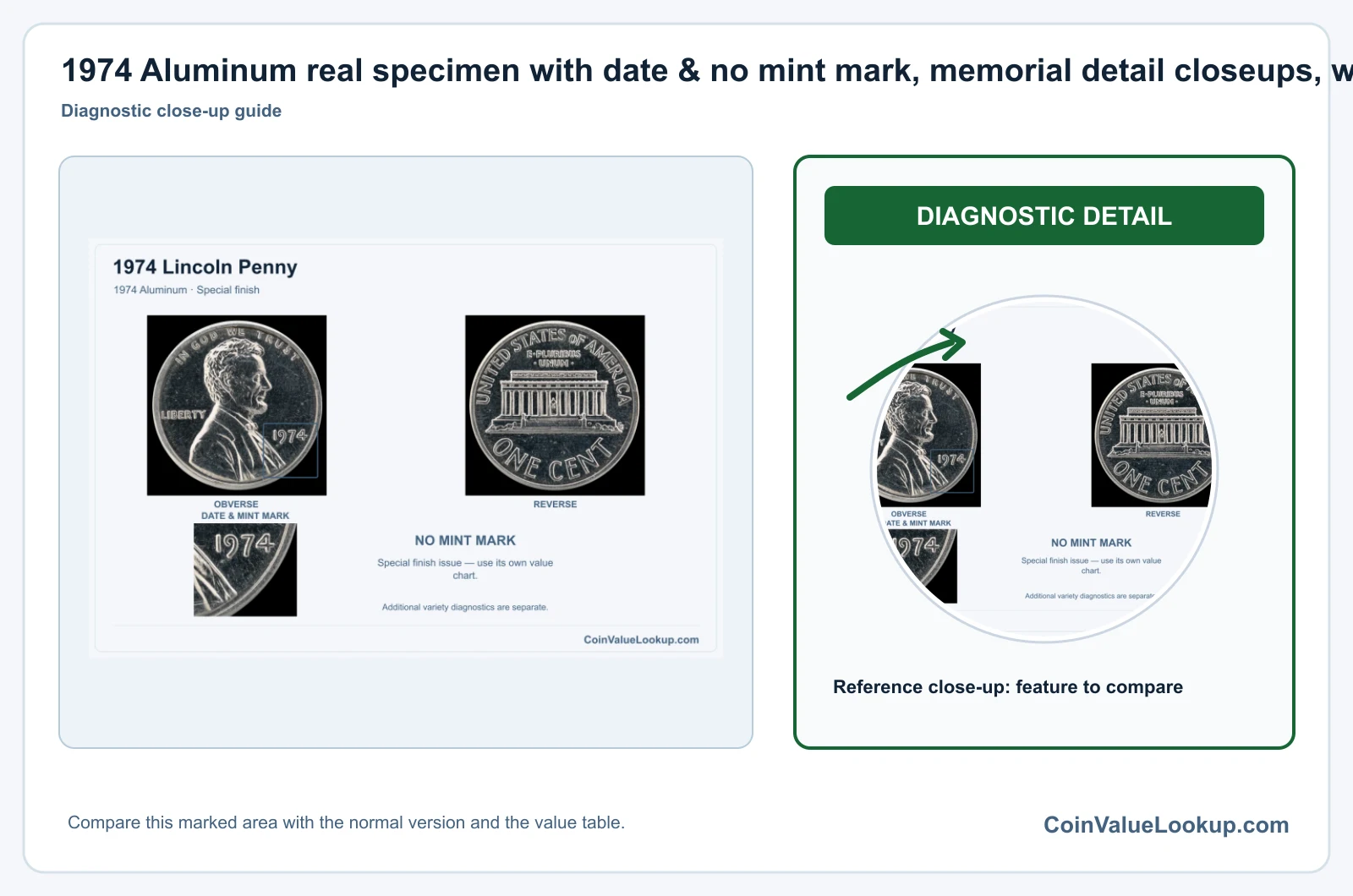
In 1974 the U.S. Mint experimentally struck Lincoln cents in an aluminum alloy while Congress debated a composition change. The proposal was never adopted, and these pieces were not released for normal circulation.
The Mint has confirmed the return of at least the Denver specimen as recently as 2016.
These experimental strikes are historical curiosities, not coins you should expect to find in change or at a coin shop. No normal retail price or graded price series applies to them.
If your 1974 penny appears silver-colored, it is almost certainly a plated or chemically altered copper cent rather than one of these rare aluminum patterns. Do not assume a silvery surface means aluminum.
| Range | Grade | Price | Auction Records | Appraisal |
|---|---|---|---|---|
| PO | PO 1 | — | Coin Identifier | |
| FR | FR 2 | — | Coin Identifier | |
| AG | AG 3 | — | Coin Identifier | |
| G | G 4 | — | Coin Identifier | |
| G 6 | — | Coin Identifier | ||
| VG | VG 8 | — | Coin Identifier | |
| VG 10 | — | Coin Identifier | ||
| F | F 12 | — | Coin Identifier | |
| F 15 | — | Coin Identifier | ||
| VF | VF 20 | — | Coin Identifier | |
| VF 25 | — | Coin Identifier | ||
| VF 30 | — | Coin Identifier | ||
| VF 35 | — | Coin Identifier | ||
| XF | XF 40 | — | Coin Identifier | |
| XF 45 | — | Coin Identifier | ||
| AU | AU 50 | — | Coin Identifier | |
| AU 53 | — | Coin Identifier | ||
| AU 55 | — | Coin Identifier | ||
| AU 58 | — | Coin Identifier | ||
| MS | MS 60 | — | Coin Identifier | |
| MS 61 | — | Coin Identifier | ||
| MS 62 | — | Coin Identifier | ||
| MS 63 | — | — | — | |
| MS 64 | — | — | — | |
| MS 65 | — | — | — | |
| MS 66 | — | — | — | |
| MS 67 | — | — | — | |
| MS 68 | — | — | — | |
| MS 69 | — | — | — | |
| MS 70 | — | — | — |
1974 Lincoln Penny — D
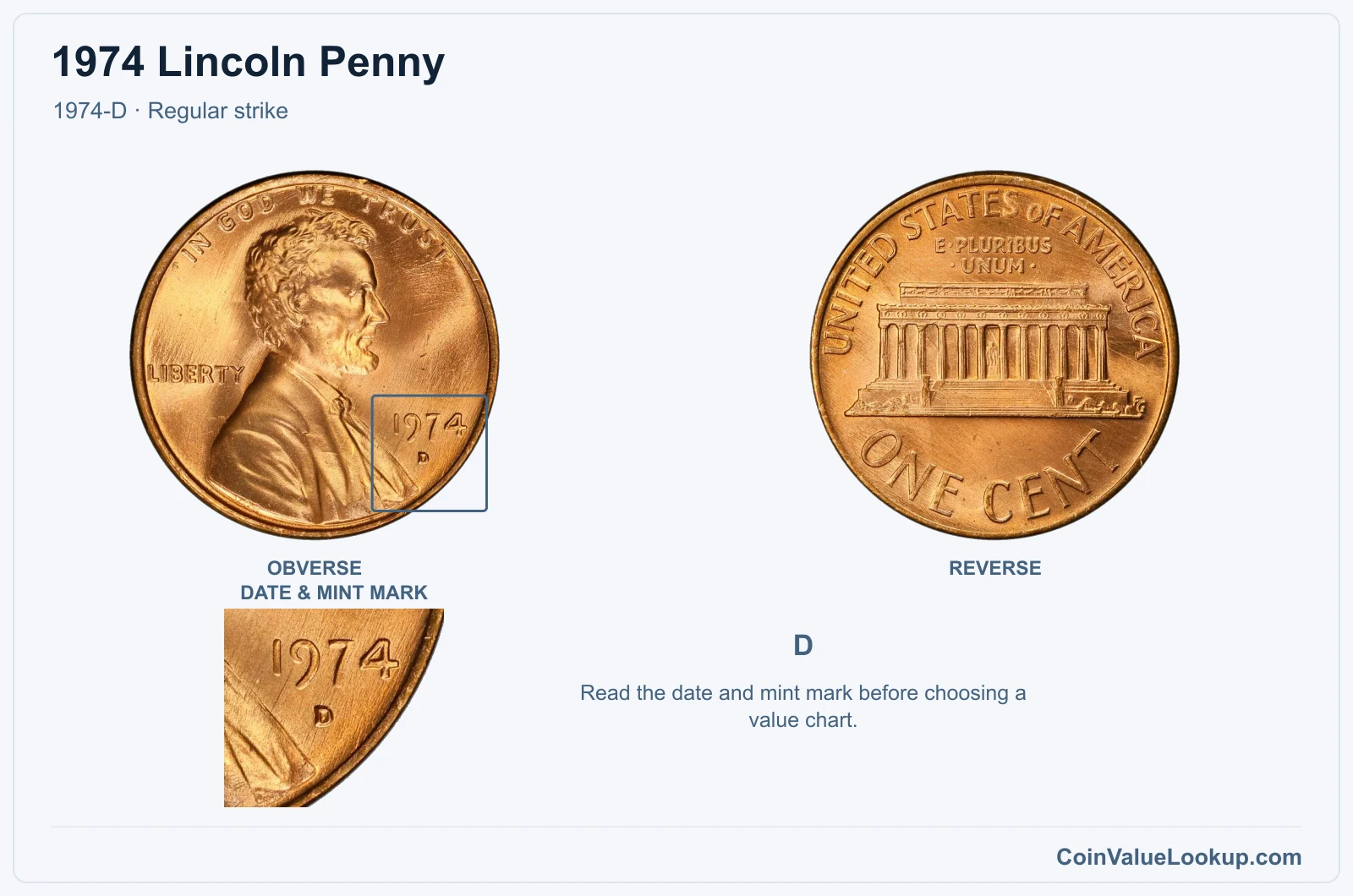
The 1974-D comes from the Denver Mint and carries a small D mintmark below the date. Composition and design are the same as the no-mintmark issue: 95% copper, 5% zinc, about 3.11 grams.
A USA Coin Book guide estimate places it at around $1.24 in MS65. Circulated examples are common and worth face value.
When evaluating one, match the grade, copper color and surface condition rather than assuming any D-mint coin is special. Full original Red luster helps at the higher uncirculated grades.
| Range | Grade | Price | Auction Records | Appraisal |
|---|---|---|---|---|
| PO | PO 1 | — | Coin Identifier | |
| FR | FR 2 | — | Coin Identifier | |
| AG | AG 3 | — | Coin Identifier | |
| G | G 4 | — | Coin Identifier | |
| G 6 | — | Coin Identifier | ||
| VG | VG 8 | — | Coin Identifier | |
| VG 10 | — | Coin Identifier | ||
| F | F 12 | — | Coin Identifier | |
| F 15 | — | Coin Identifier | ||
| VF | VF 20 | — | Coin Identifier | |
| VF 25 | — | Coin Identifier | ||
| VF 30 | — | Coin Identifier | ||
| VF 35 | — | Coin Identifier | ||
| XF | XF 40 | — | Coin Identifier | |
| XF 45 | — | Coin Identifier | ||
| AU | AU 50 | — | Coin Identifier | |
| AU 53 | — | Coin Identifier | ||
| AU 55 | — | Coin Identifier | ||
| AU 58 | — | Coin Identifier | ||
| MS | MS 60 | — | Coin Identifier | |
| MS 61 | — | Coin Identifier | ||
| MS 62 | — | Coin Identifier | ||
| MS 63 | — | Coin Identifier | ||
| MS 64 | Coin Identifier | |||
| MS 65 | Coin Identifier | |||
| MS 66 | Coin Identifier | |||
| MS 67 | Coin Identifier | |||
| MS 68 | — | Coin Identifier | ||
| MS 69 | — | — | — | |
| MS 70 | — | — | — |
1974 Lincoln Penny — D Aluminum
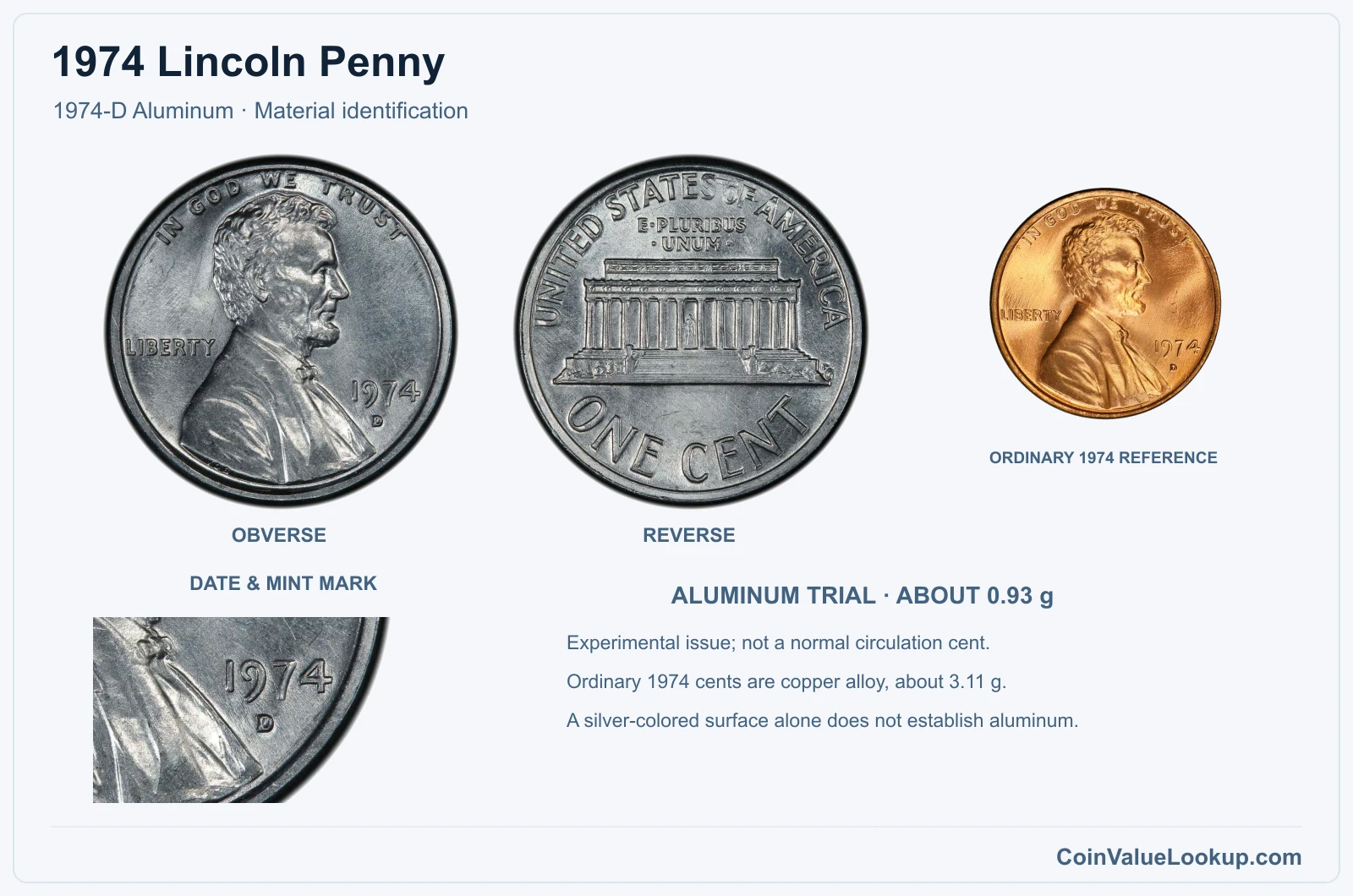
Like its Philadelphia counterpart, the 1974-D aluminum cent was an experimental Mint product struck during the aluminum-composition trial. Denver specimens were produced but never authorized for release.
The Mint documented the return of the Denver aluminum specimen in 2016.
No standard retail price or grading history exists for this issue. It belongs in the category of federal experimental pieces, not collectible circulating coins.
A silver-toned 1974-D penny in your pocket is overwhelmingly more likely to be plated copper than aluminum. Professional authentication would be required for any legitimate claim.
Coin Value Lookup is a good starting point if you want to look up guide values for other dates and denominations in the Lincoln cent series.
| Range | Grade | Price | Auction Records | Appraisal |
|---|---|---|---|---|
| PO | PO 1 | — | Coin Identifier | |
| FR | FR 2 | — | Coin Identifier | |
| AG | AG 3 | — | Coin Identifier | |
| G | G 4 | — | Coin Identifier | |
| G 6 | — | Coin Identifier | ||
| VG | VG 8 | — | Coin Identifier | |
| VG 10 | — | Coin Identifier | ||
| F | F 12 | — | Coin Identifier | |
| F 15 | — | Coin Identifier | ||
| VF | VF 20 | — | Coin Identifier | |
| VF 25 | — | Coin Identifier | ||
| VF 30 | — | Coin Identifier | ||
| VF 35 | — | Coin Identifier | ||
| XF | XF 40 | — | Coin Identifier | |
| XF 45 | — | Coin Identifier | ||
| AU | AU 50 | — | Coin Identifier | |
| AU 53 | — | Coin Identifier | ||
| AU 55 | — | Coin Identifier | ||
| AU 58 | — | Coin Identifier | ||
| MS | MS 60 | — | Coin Identifier | |
| MS 61 | — | Coin Identifier | ||
| MS 62 | — | Coin Identifier | ||
| MS 63 | — | Coin Identifier | ||
| MS 64 | — | — | — | |
| MS 65 | — | — | — | |
| MS 66 | — | — | — | |
| MS 67 | — | — | — | |
| MS 68 | — | — | — | |
| MS 69 | — | — | — | |
| MS 70 | — | — | — |
1974 Lincoln Penny — S
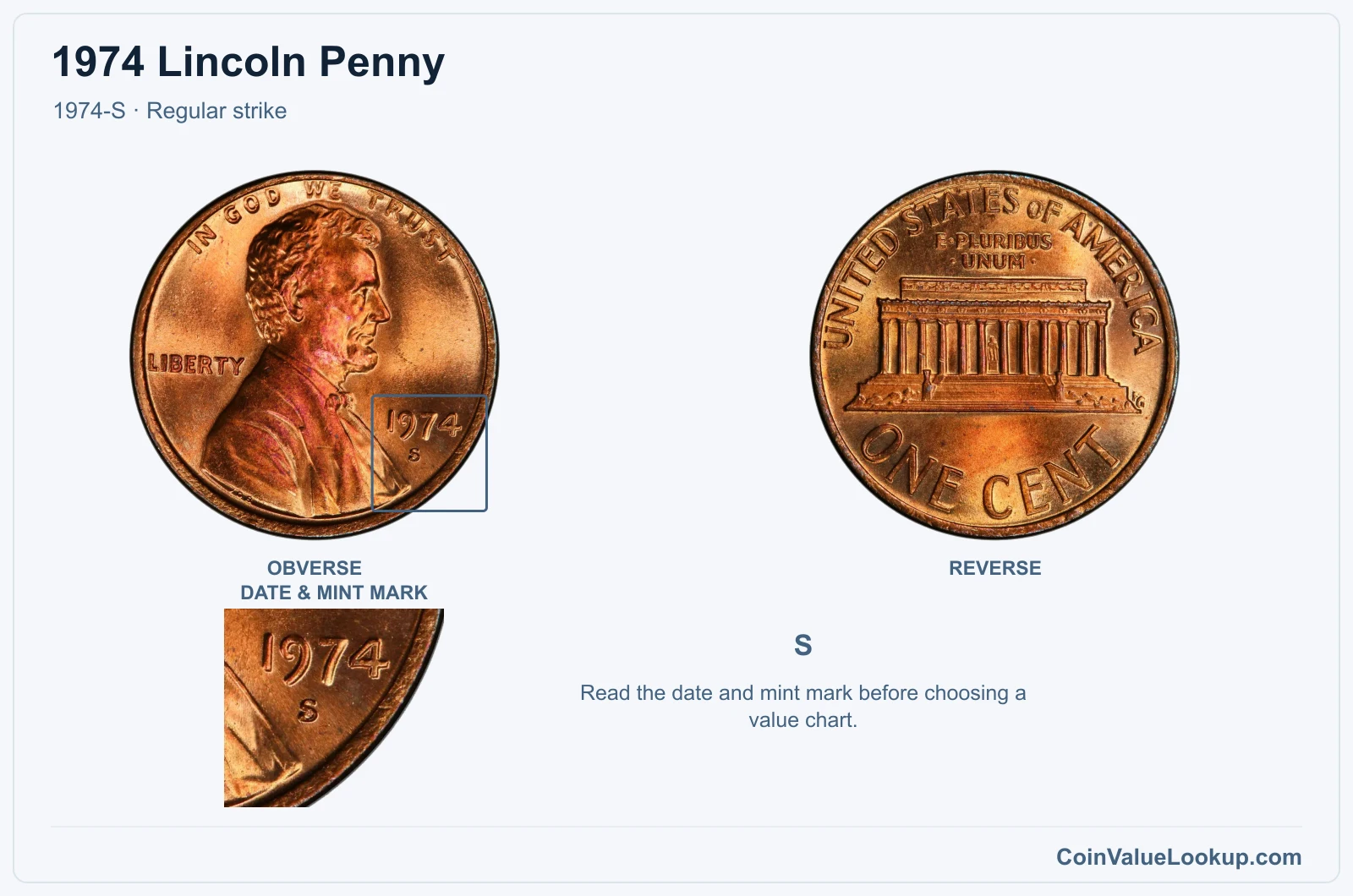
The 1974-S business strike is the San Francisco Mint's regular-issue cent, not to be confused with the proof version also bearing an S mintmark. Check for normal luster rather than mirror fields to confirm you have a business strike.
This version carries a higher guide estimate than the no-mintmark or D, sitting at about $6.25 in MS65 according to USA Coin Book. That premium reflects lower production and collector interest in S-mint business strikes from this era.
Circulated pieces are still low-value, but a sharp uncirculated example with original Red surfaces is worth setting aside.
| Range | Grade | Price | Auction Records | Appraisal |
|---|---|---|---|---|
| PO | PO 1 | — | Coin Identifier | |
| FR | FR 2 | — | Coin Identifier | |
| AG | AG 3 | — | Coin Identifier | |
| G | G 4 | — | Coin Identifier | |
| G 6 | — | Coin Identifier | ||
| VG | VG 8 | — | Coin Identifier | |
| VG 10 | — | Coin Identifier | ||
| F | F 12 | — | Coin Identifier | |
| F 15 | — | Coin Identifier | ||
| VF | VF 20 | — | Coin Identifier | |
| VF 25 | — | Coin Identifier | ||
| VF 30 | — | Coin Identifier | ||
| VF 35 | — | Coin Identifier | ||
| XF | XF 40 | — | Coin Identifier | |
| XF 45 | — | Coin Identifier | ||
| AU | AU 50 | — | Coin Identifier | |
| AU 53 | — | Coin Identifier | ||
| AU 55 | — | Coin Identifier | ||
| AU 58 | — | Coin Identifier | ||
| MS | MS 60 | — | Coin Identifier | |
| MS 61 | — | Coin Identifier | ||
| MS 62 | — | Coin Identifier | ||
| MS 63 | Coin Identifier | |||
| MS 64 | Coin Identifier | |||
| MS 65 | Coin Identifier | |||
| MS 66 | Coin Identifier | |||
| MS 67 | Coin Identifier | |||
| MS 68 | — | — | — | |
| MS 69 | — | — | — | |
| MS 70 | — | — | — |
1974 Lincoln Penny — S PR
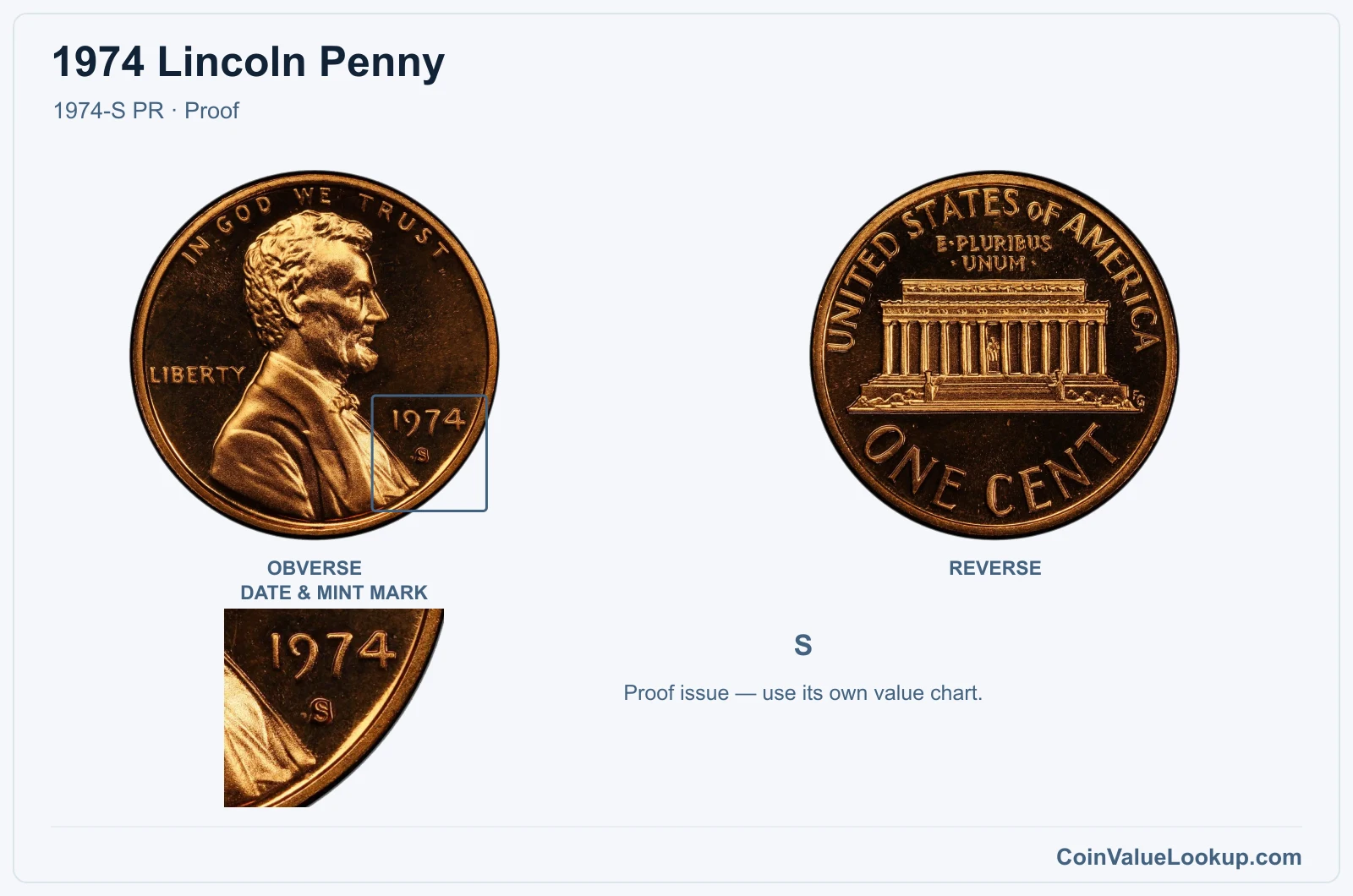
The 1974-S proof was produced at San Francisco for collector sets. It features mirror fields and frosted devices, and the S mintmark appears below the date.
A USA Coin Book guide estimate puts it at about $1.24 in PR65.
Proof is a manufacturing finish, not a grade above Mint State. Cameo and Deep Cameo contrast descriptions refer to the degree of frost on the devices against the mirror fields.
Hairlines, spots and haze reduce the effective grade. Keep these in their original holders when possible; bare handling introduces hairlines quickly.
| Range | Grade | Price | Auction Records | Appraisal |
|---|---|---|---|---|
| PR | PR 1 | — | Coin Identifier | |
| PR 2 | — | Coin Identifier | ||
| PR 3 | — | Coin Identifier | ||
| PR 4 | — | Coin Identifier | ||
| PR 6 | — | Coin Identifier | ||
| PR 8 | — | Coin Identifier | ||
| PR 10 | — | Coin Identifier | ||
| PR 12 | — | Coin Identifier | ||
| PR 15 | — | Coin Identifier | ||
| PR 20 | — | Coin Identifier | ||
| PR 25 | — | Coin Identifier | ||
| PR 30 | — | Coin Identifier | ||
| PR 35 | — | Coin Identifier | ||
| PR 40 | — | Coin Identifier | ||
| PR 45 | — | Coin Identifier | ||
| PR 50 | — | Coin Identifier | ||
| PR 53 | — | Coin Identifier | ||
| PR 55 | — | Coin Identifier | ||
| PR 58 | — | Coin Identifier | ||
| PR 60 | — | Coin Identifier | ||
| PR 61 | — | Coin Identifier | ||
| PR 62 | — | Coin Identifier | ||
| PR 63 | — | Coin Identifier | ||
| PR 64 | — | Coin Identifier | ||
| PR 65 | — | Coin Identifier | ||
| PR 66 | Coin Identifier | |||
| PR 67 | Coin Identifier | |||
| PR 68 | — | Coin Identifier | ||
| PR 69 | — | Coin Identifier | ||
| PR 70 | — | — | — |
1974 Lincoln Penny Error List
1. 1974 Lincoln Penny — Philippine Aluminum Blank Error
This is one of the most dramatic 1974 cent errors on record. A 1974-S business strike was produced on a Philippine sentimo aluminum blank instead of the normal copper planchet.
The result is a small, lightweight coin with only the reverse struck, making it uniface.
The key diagnostics are the tiny blank size, aluminum-colored metal and the presence of only one struck face. The S mintmark and date confirm the attribution.
A PCGS MS61 example sold for $19,200 at auction in January 2023, reflecting the extreme rarity of this combined wrong-planchet and uniface error.
Do not confuse this with the experimental no-mintmark or D aluminum cents, which are a completely different story. A plated copper penny or a chemically stripped coin may look silver, but it will weigh around 3.1 grams and show both sides struck normally.
Professional authentication is essential for a claim this unusual.
2. 1974 Lincoln Penny — Cud with Retained Die Fragment
A cud is a raised, flat blob connected to the rim where a piece of the die broke away. On this 1974-S business strike, the obverse cud is paired with something rarer: an actual retained fragment of the broken die embedded into the reverse surface.
To identify this error you need to photograph both sides. The obverse shows the rim-connected raised area, while the reverse shows the die fragment pressed into the coin, with a visible boundary where it meets normal metal.
This combination is what drives the value.
An NGC MS63 Red-Brown example sold for $9,000 in April 2021. That price reflects the unusual pairing, not a simple die break.
Ordinary small die cracks, solder blobs or glued-on metal can mimic these features, so authentication by a major grading service is the only way to confirm the error.
3. 1974 Lincoln Penny — Off-Center Strike
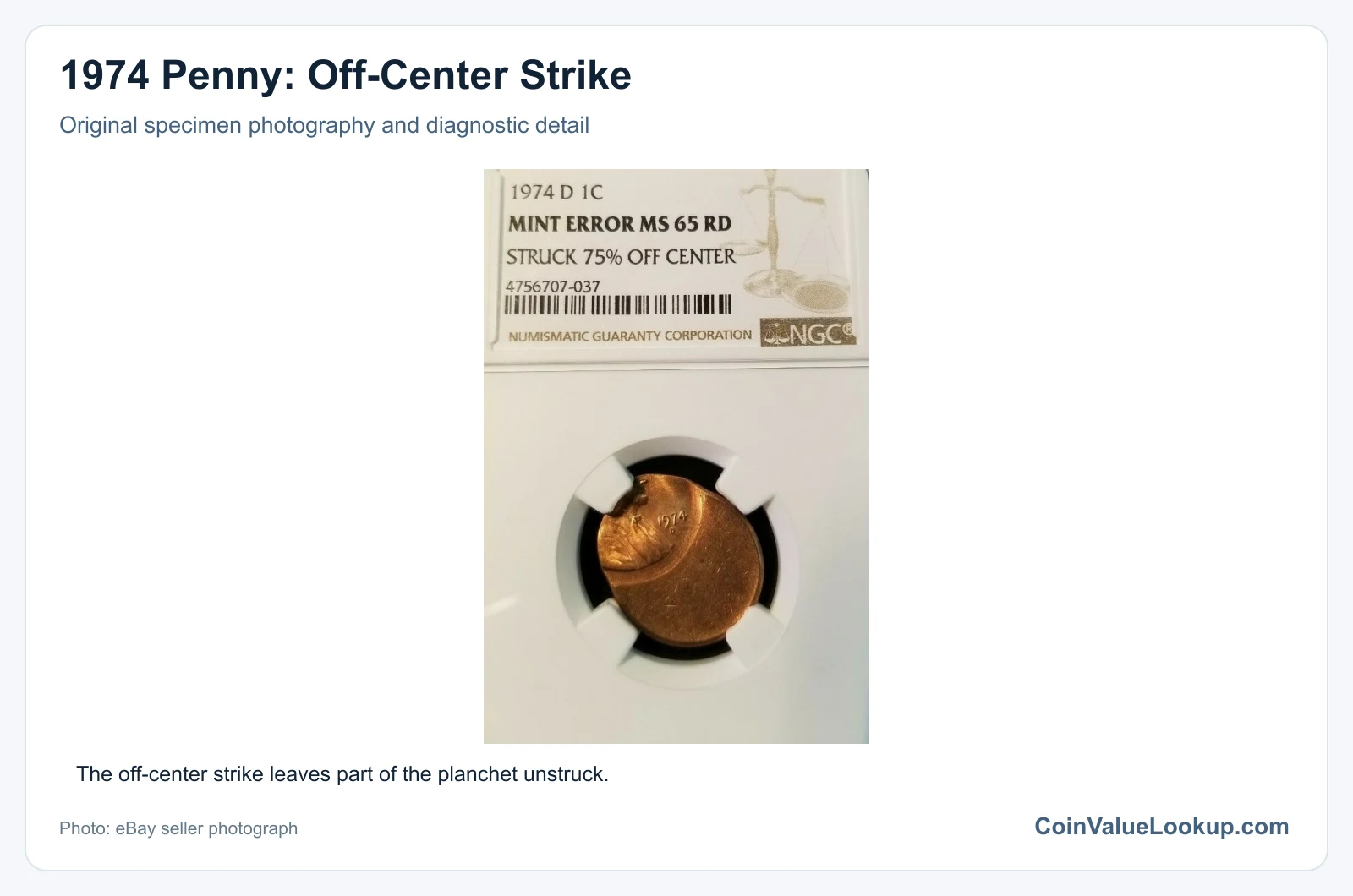
An off-center strike happens when the blank is not properly seated between the dies. The 1974 no-mintmark cent has been documented with strikes as far as 85% off center, leaving most of the coin as a blank crescent with only a small wedge of design visible.
The critical detail for value is whether the date is readable. A dateless off-center blank is worth far less because it cannot be attributed to a specific year.
Look for the retained date, the strike boundary where design meets blank, and the full original planchet edge.
An ANACS MS63 Red-Brown example at 85% off center sold for $60 in January 2022. That is a single auction result for one specific coin, not a universal price.
A misaligned die strike, a trimmed coin or a bare undated blank can all look similar at first glance, so compare carefully before jumping to conclusions.
4. 1974 Lincoln Penny — Doubled Die Obverse
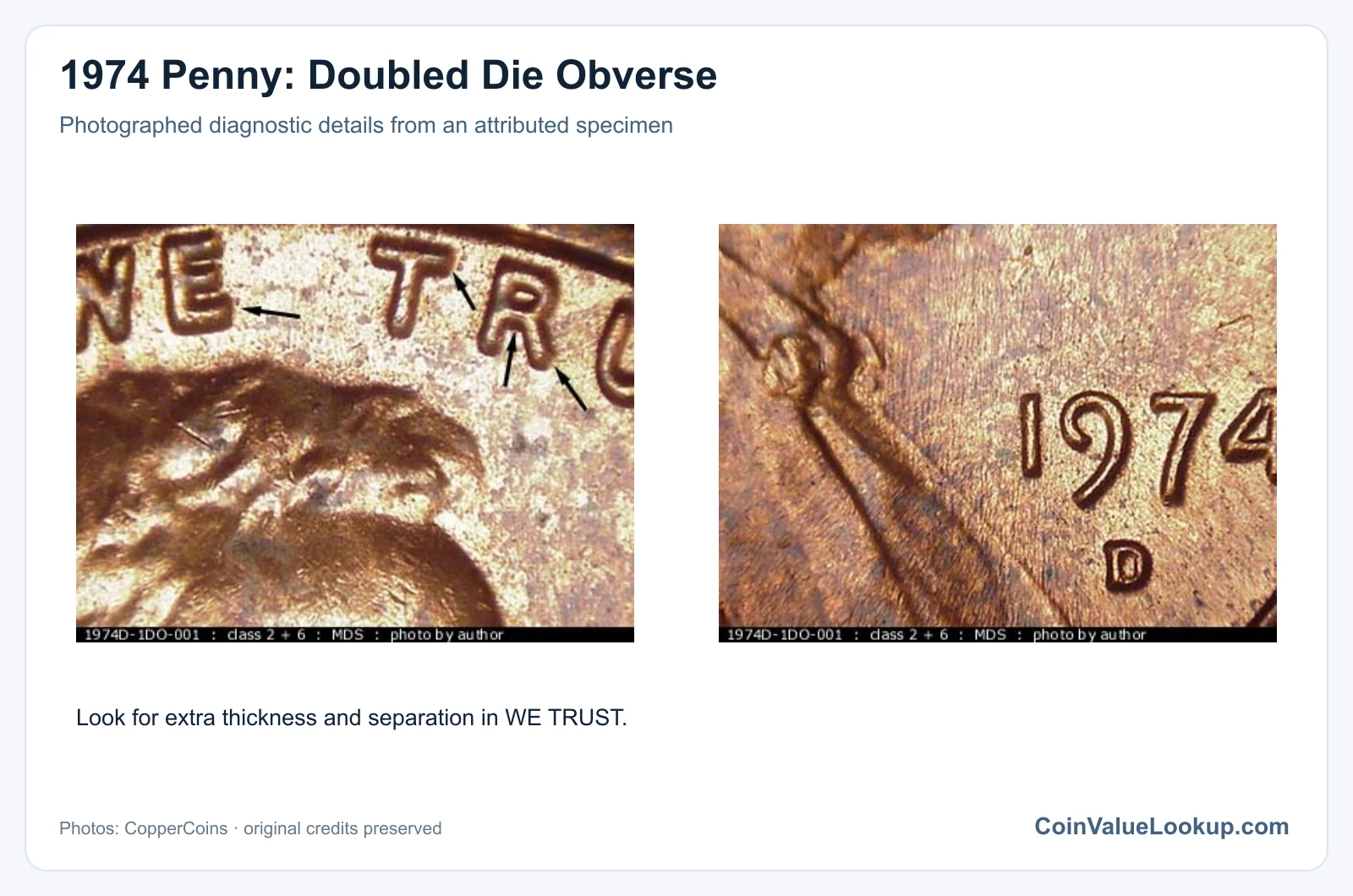
A doubled die obverse on a 1974-S cent shows consistent doubling in the lettering or design elements on the front of the coin. This is not the same as machine doubling, which produces flat, shelf-like distortion without the crisp separation of a true doubled die.
To check, compare the obverse lettering, date numerals and Lincoln's profile against a normal 1974-S under the same lighting and magnification. Look for clear, consistent separation or notching on multiple design elements rather than isolated smearing.
No specific price range is adopted for this variety. The value of any doubled die depends on the visibility of the doubling, the coin's overall condition, and the particular die pair involved.
Machine doubling, reflections and worn-die contours are the most common lookalikes, so careful comparison is essential before drawing any conclusions.
5. 1974 Lincoln Penny — Repunched Mintmark
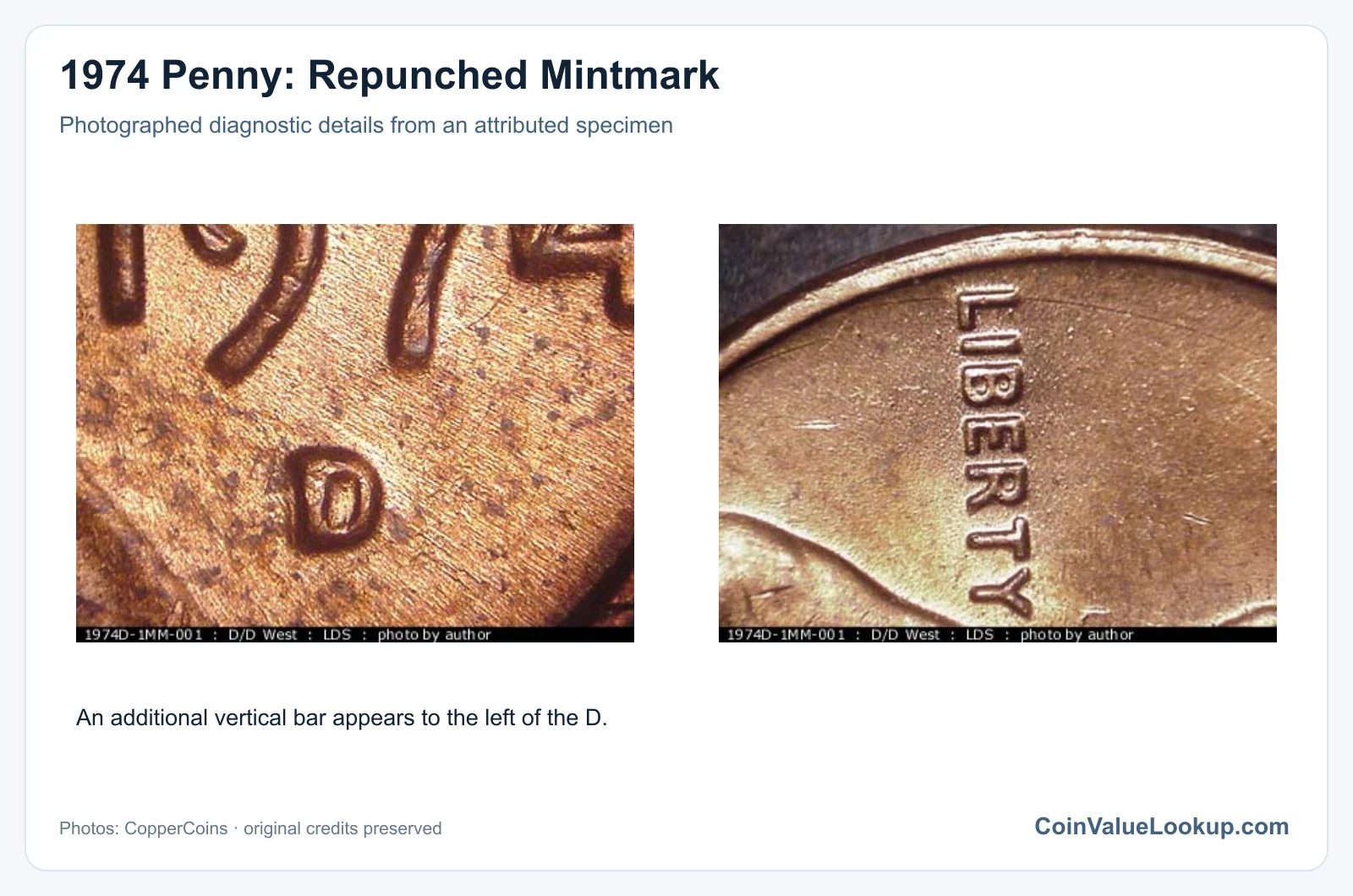
A repunched mintmark on a 1974-D cent shows traces of a second or shifted D punch beneath or beside the final mintmark position. During production, mintmarks were sometimes applied more than once, leaving overlapping impressions.
Inspect the D below the date at high magnification. You are looking for remnants of a separately positioned punch, not simple mechanical spread.
A normal D should be clean and singular; a repunched example will show a partial second impression at a different angle or offset.
No specific price range is adopted for this variety. Condition, the clarity of the repunching, and the specific die all affect what a collector will pay.
The most common lookalikes are machine doubling around the mintmark, die chips filling or distorting the letter, and simple corrosion or environmental damage. Always compare against a confirmed normal D at matching magnification.
6. 1974 Lincoln Penny — Clipped Planchet
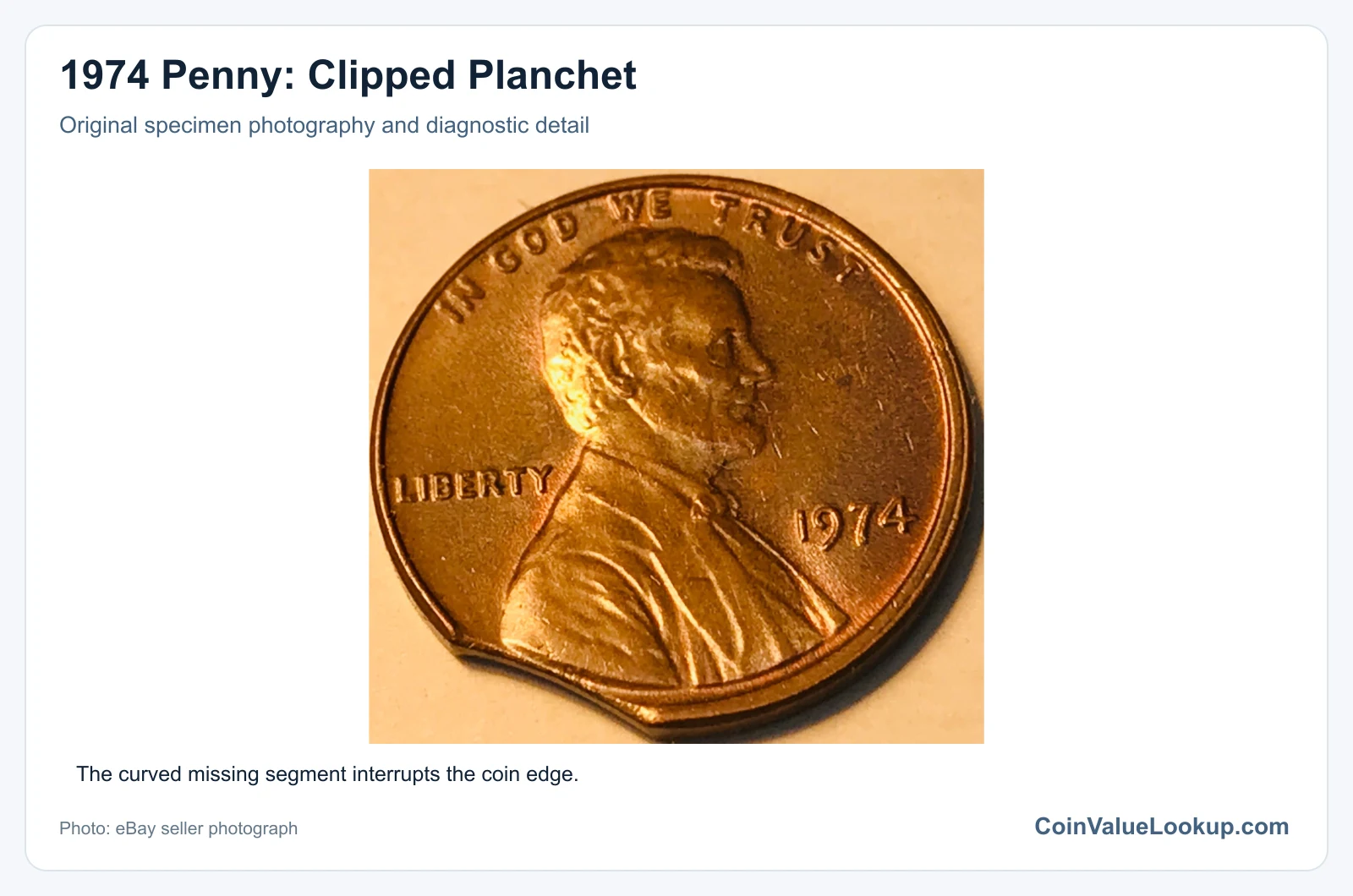
A clipped planchet error occurs when the blank is incompletely punched from the metal strip before striking. The resulting coin is missing a curved, straight or irregular section of its edge.
Look at the edge for a smooth, factory-cut boundary rather than a rough, post-strike gouge. Genuine clips often show a corresponding area of design weakness on the opposite side of the coin, called the Blakesley effect.
The missing area should have consistent metal flow and no tool marks.
No specific price range is adopted for clipped 1974 cents. The size and type of clip, along with the coin's grade, determine collector interest.
A filed notch, an edge cut from a counting machine, or simple corrosion can look like a clip to the untrained eye, so examine the edge texture and the weakness pattern carefully before reaching a conclusion.
7. 1974 Lincoln Penny — Struck on a Dime Planchet
A 1974 cent struck on a dime planchet is a wrong-metal error where a Roosevelt dime blank ended up in the cent press. The result is a Lincoln cent design on a smaller, lighter, clad planchet.
Start by weighing the coin: a normal 1974 cent is about 3.11 grams, while a dime planchet weighs roughly 2.27 grams. The coin will also be noticeably smaller in diameter, and the edge may show the clad layering typical of dime stock.
Color alone is not proof; plated, cut or chemically altered cents can also look silver.
No specific price range is adopted for this error. Value depends on condition, how much design detail transferred and whether professional authentication confirms the planchet identity.
The most common lookalikes are cents that have been plated with silver-colored metal or trimmed down to a smaller size after leaving the Mint.
8. 1974 Lincoln Penny — D over S Mintmark
A 1974-D/S over-mintmark cent reportedly shows remnants of an S-shaped punch beneath the final D mintmark. This would indicate the die originally received an S for San Francisco before being corrected with a D for Denver.
Under magnification, look closely at the mintmark area for curved traces that do not match the shape of a normal D. The bottom serifs of an S may peek out from under the D's profile, particularly at the lower portion of the letter.
No specific price range is adopted for this variety. The coin's grade, the clarity of the underlying S, and independent authentication all affect its value.
An ordinary repunched D, a die chip near the mintmark, or post-mint damage can mimic an over-mintmark appearance, so side-by-side comparison with a confirmed normal D is critical. Professional attribution would be needed to support any claim.