1986 Roosevelt Dime Coin Value: How Much Is It Worth?
Most 1986 Roosevelt dimes you pull from pocket change are worth face value — ten cents. In uncirculated condition at MS 65, guide estimates from USA Coin Book place both the Philadelphia and Denver strikes at about $3.08.
The San Francisco proof starts around $4.96 at PR 65. Before you toss one back in the jar, check the mint mark and look for known errors that can push value well beyond those modest numbers.
Fast Way to Identify Your 1986 Roosevelt Dime
Want a quick read on your 1986 dime? Snap a clear photo of the front and back under good lighting, then upload both images to our identifier for a preliminary look.
It can help you figure out the mint mark, general condition, and whether you might have something unusual worth a closer examination.
1986 Roosevelt Dime Value
Upload both sides of your 1986 Roosevelt Dime.
Front Obverse
Upload photo
Back Reverse
Upload photo
Which 1986 Roosevelt Dime Versions Are Worth Money?
- Well-preserved Philadelphia or Denver business strikes with sharp torch bands can carry a small premium above face value, with MS 65 examples guided at roughly $3.08.
- San Francisco proofs with strong contrast between frosted devices and mirror fields are collectible; PR 65 examples start around $4.96 per USA Coin Book.
- A 1986-P dime struck 95% off center sold at Heritage Auctions for $528 in January 2022 — dramatic mint errors on dated coins command serious attention.
- A 1986-P double-struck dime with a 70% off-center second impression brought $288 at Heritage Auctions in April 2022.
Step 1: Identify Your 1986 Roosevelt Dime Mint Mark and Version
Start by confirming the date reads 1986 and the coin shows Roosevelt's portrait on the obverse with a torch flanked by olive and oak branches on the reverse. The composition is copper-nickel clad, weighing about 2.27 grams and measuring roughly 17.9 mm across.
There is no silver in these.
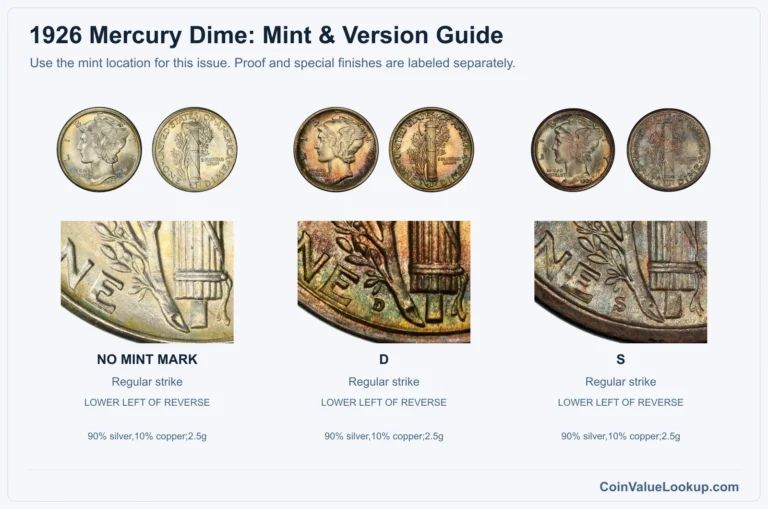
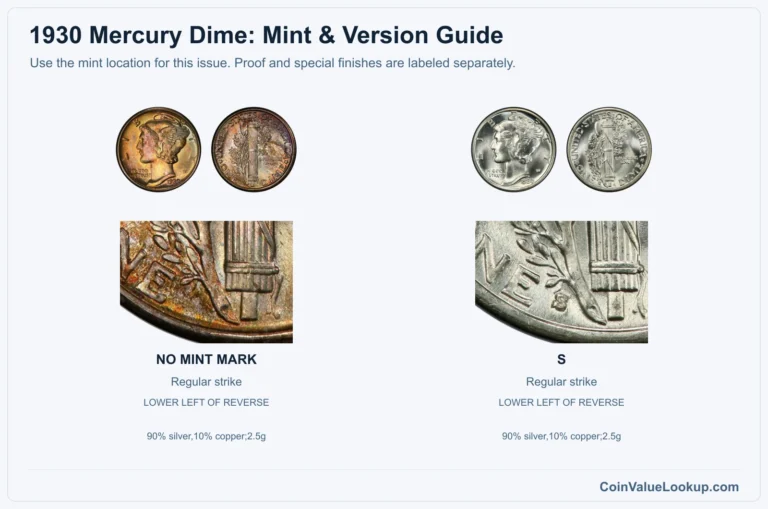
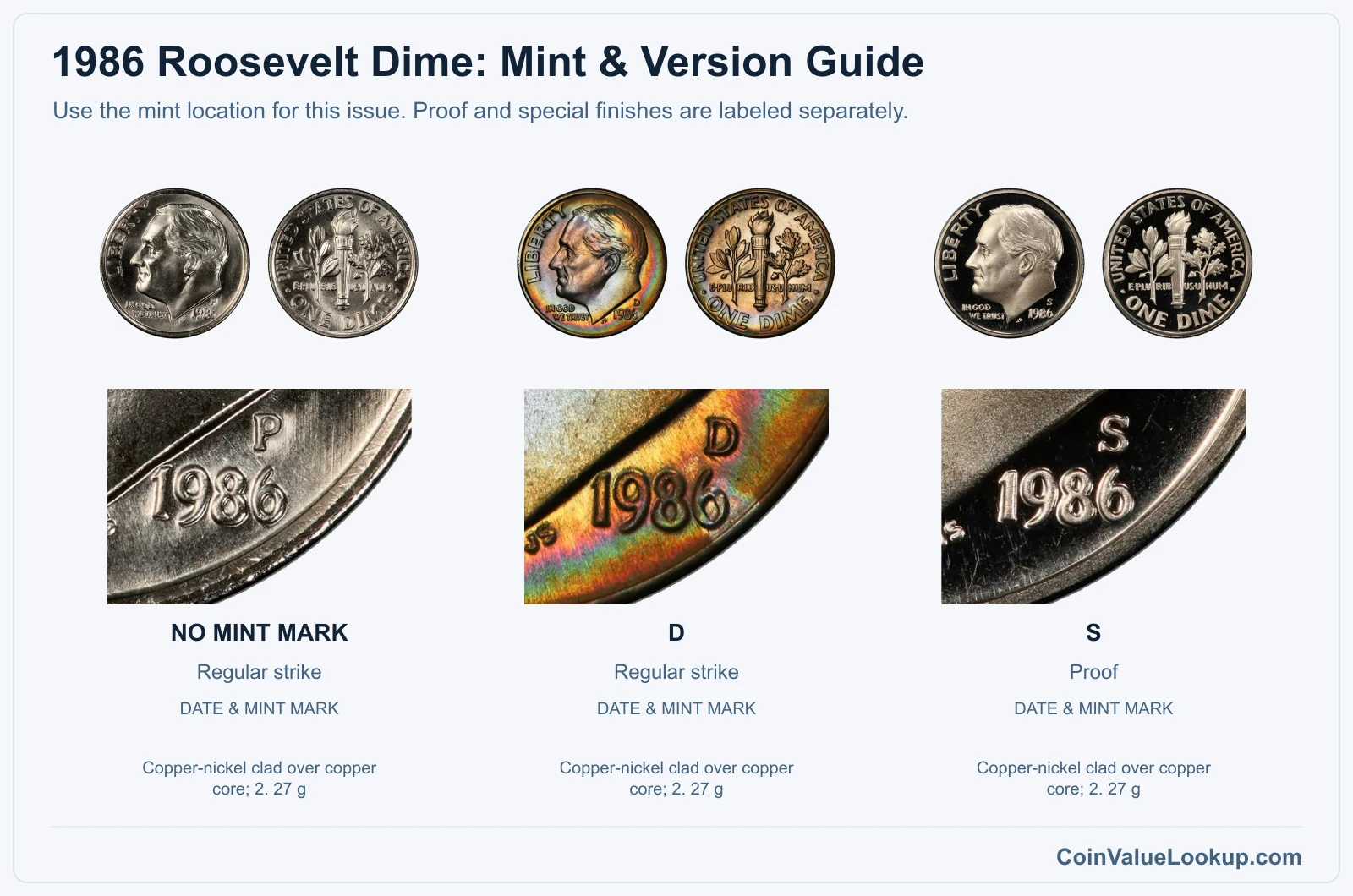
Now check the mint mark. It sits on the obverse near the date.
A "P" means Philadelphia, a "D" means Denver, and an "S" indicates a San Francisco proof. Business strikes carry P or D; the S version was sold in proof sets and has a mirror-like finish by design — that proof finish alone is not an error.
If your coin has no mint mark at all, look again carefully with magnification. By 1986 the Philadelphia mint was stamping its P on dimes, so a genuinely blank mint-mark area would be unusual and worth professional verification.
Step 2: Check Your 1986 Roosevelt Dime Grade
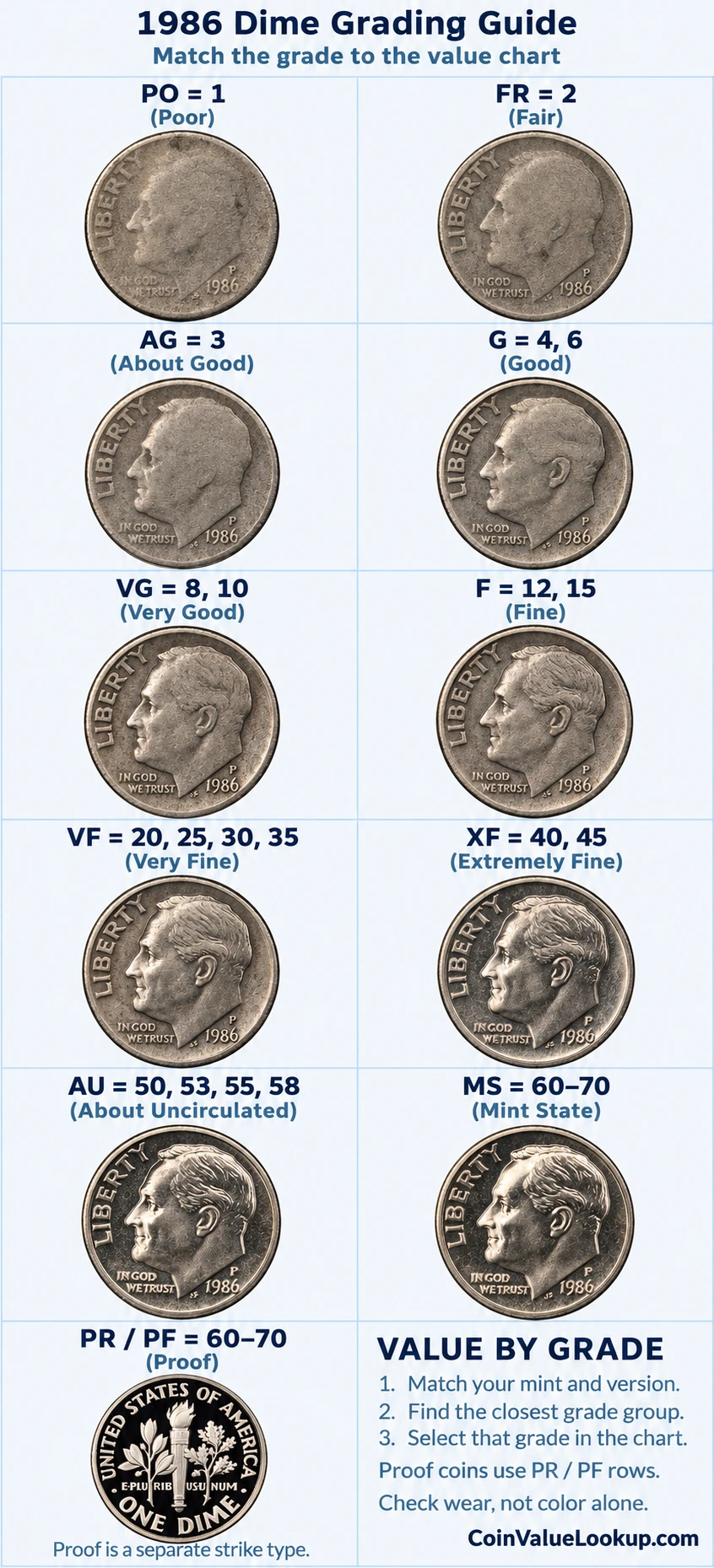
Focus on Roosevelt's cheek and jawline first — that is where wear shows up earliest. Then check the hair detail above his ear.
On the reverse, the torch lines and surrounding leaves lose crispness as a coin circulates.
A coin with full original luster and no contact marks sits in the Mint State range. Scratches, cleaning, or dull spots pull the grade down even if the design looks sharp.
Use the comparison image to match your coin's wear pattern against known grade examples.
You may hear the term "Full Bands" — that refers to clearly separated horizontal bands on the torch. It is a strike designation that can add a premium on well-struck pieces, but it is not an error.
Proof coins are graded on the PR scale, and cameo or deep-cameo contrast describes frosted devices against mirror fields — again a manufacturing characteristic, not a higher grade tier.
Step 3: Check 1986 Roosevelt Dime Value by Mint and Version
1986 Roosevelt Dime — P Business Strike
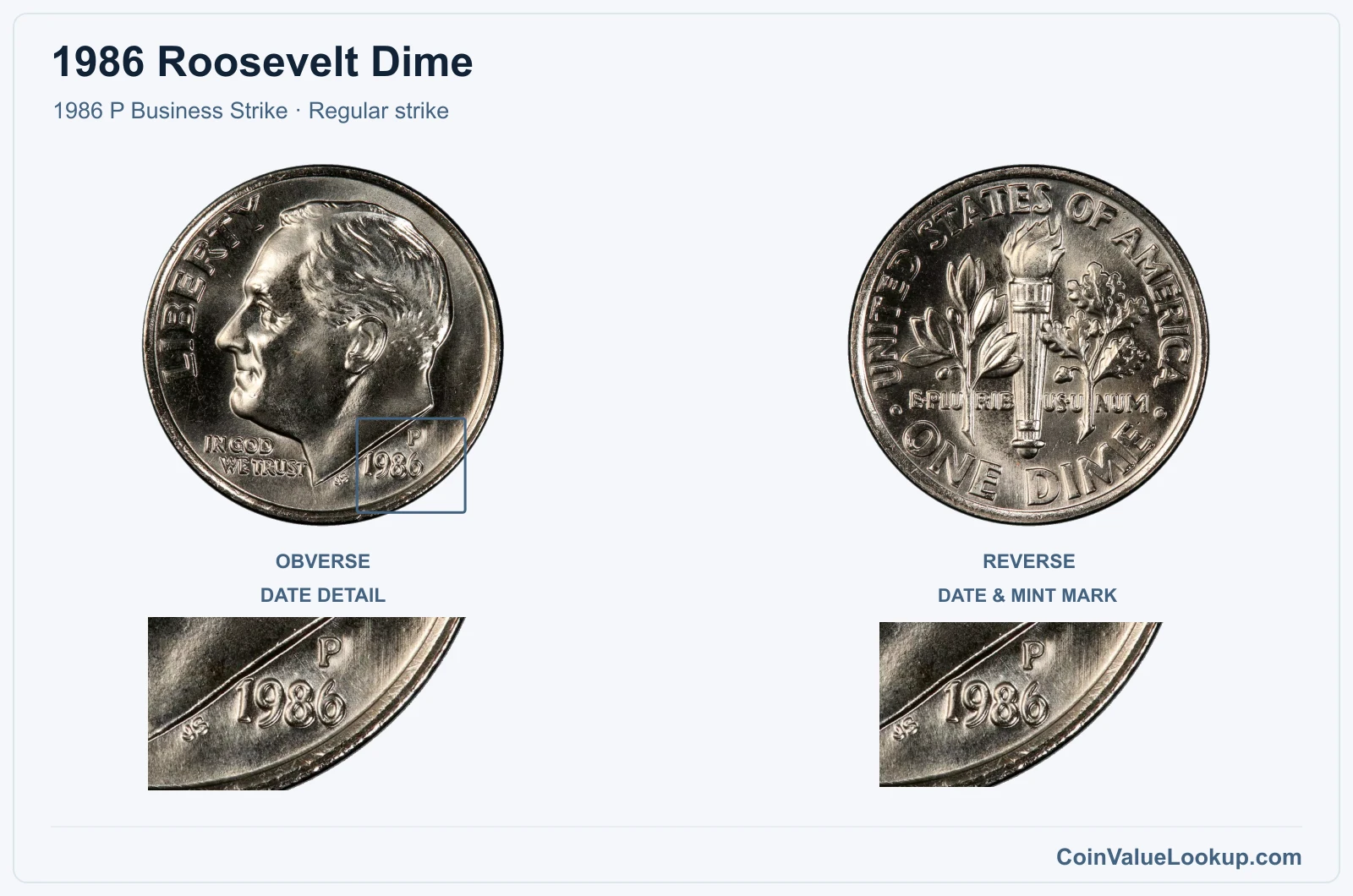
The 1986 P dime was struck at Philadelphia and carries a small "P" mint mark on the obverse near the date. It is standard copper-nickel clad, weighing about 2.27 grams.
In everyday circulation these are worth ten cents, no more.
At MS 65 the USA Coin Book guide estimate is $3.08. To reach that level the coin needs full luster with minimal bag marks.
Look for complete torch detail and clean fields — a sharp, original example is always more desirable than a bright but cleaned one.
Range Grade
Price Auction Records Appraisal PO PO 1
—
Coin Identifier FR FR 2
—
Coin Identifier AG AG 3
—
Coin Identifier G G 4
—
Coin Identifier
G 6
—
Coin Identifier VG VG 8
—
Coin Identifier
VG 10
—
Coin Identifier F F 12
—
Coin Identifier
F 15
—
Coin Identifier VF VF 20
—
Coin Identifier
VF 25
—
Coin Identifier
VF 30
—
Coin Identifier
VF 35
—
Coin Identifier XF XF 40
—
Coin Identifier
XF 45
—
Coin Identifier AU AU 50
—
Coin Identifier
AU 53
—
Coin Identifier
AU 55
—
Coin Identifier
AU 58
—
Coin Identifier MS MS 60
—
Coin Identifier
MS 61
—
Coin Identifier
MS 62
Coin Identifier
MS 63
—
Coin Identifier
MS 64
—
Coin Identifier
MS 65
—
Coin Identifier
MS 66
Coin Identifier
MS 67
Coin Identifier
MS 68
Coin Identifier
MS 69
—
—
—
MS 70
—
—
—
1986 Roosevelt Dime — D Business Strike
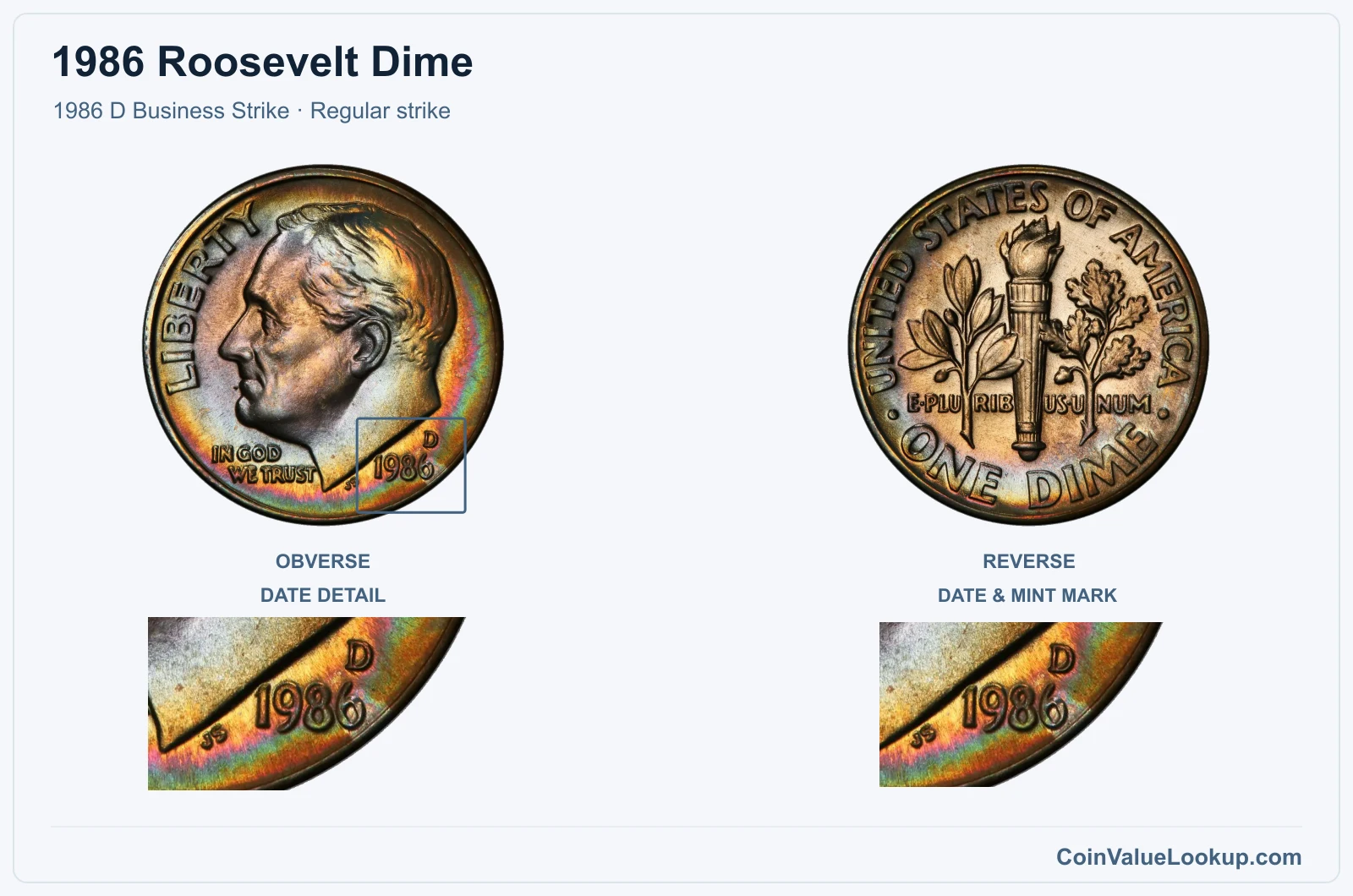
Denver's 1986 D dime is the same composition and weight as its Philadelphia counterpart, distinguished by the "D" mint mark beside the date. Circulated pieces trade at face value.
The USA Coin Book guide puts an MS 65 example at $3.08, identical to the P issue. Finding one with strong torch bands and undisturbed surfaces in an old roll or mint set is your best bet for a coin that grades well.
Check both sides under magnification for hidden contact marks.
Coin Value Lookup is a handy starting point if you want to look up guides for other Roosevelt dime dates or denominations while you are sorting through a batch.
Range Grade
Price Auction Records Appraisal PO PO 1
—
Coin Identifier FR FR 2
—
Coin Identifier AG AG 3
—
Coin Identifier G G 4
—
Coin Identifier
G 6
—
Coin Identifier VG VG 8
—
Coin Identifier
VG 10
—
Coin Identifier F F 12
—
Coin Identifier
F 15
—
Coin Identifier VF VF 20
—
Coin Identifier
VF 25
—
Coin Identifier
VF 30
—
Coin Identifier
VF 35
—
Coin Identifier XF XF 40
—
Coin Identifier
XF 45
—
Coin Identifier AU AU 50
—
Coin Identifier
AU 53
—
Coin Identifier
AU 55
—
Coin Identifier
AU 58
—
Coin Identifier MS MS 60
—
Coin Identifier
MS 61
—
Coin Identifier
MS 62
—
Coin Identifier
MS 63
Coin Identifier
MS 64
—
Coin Identifier
MS 65
Coin Identifier
MS 66
Coin Identifier
MS 67
Coin Identifier
MS 68
—
Coin Identifier
MS 69
—
—
—
MS 70
—
—
—
1986 Roosevelt Dime — S Proof
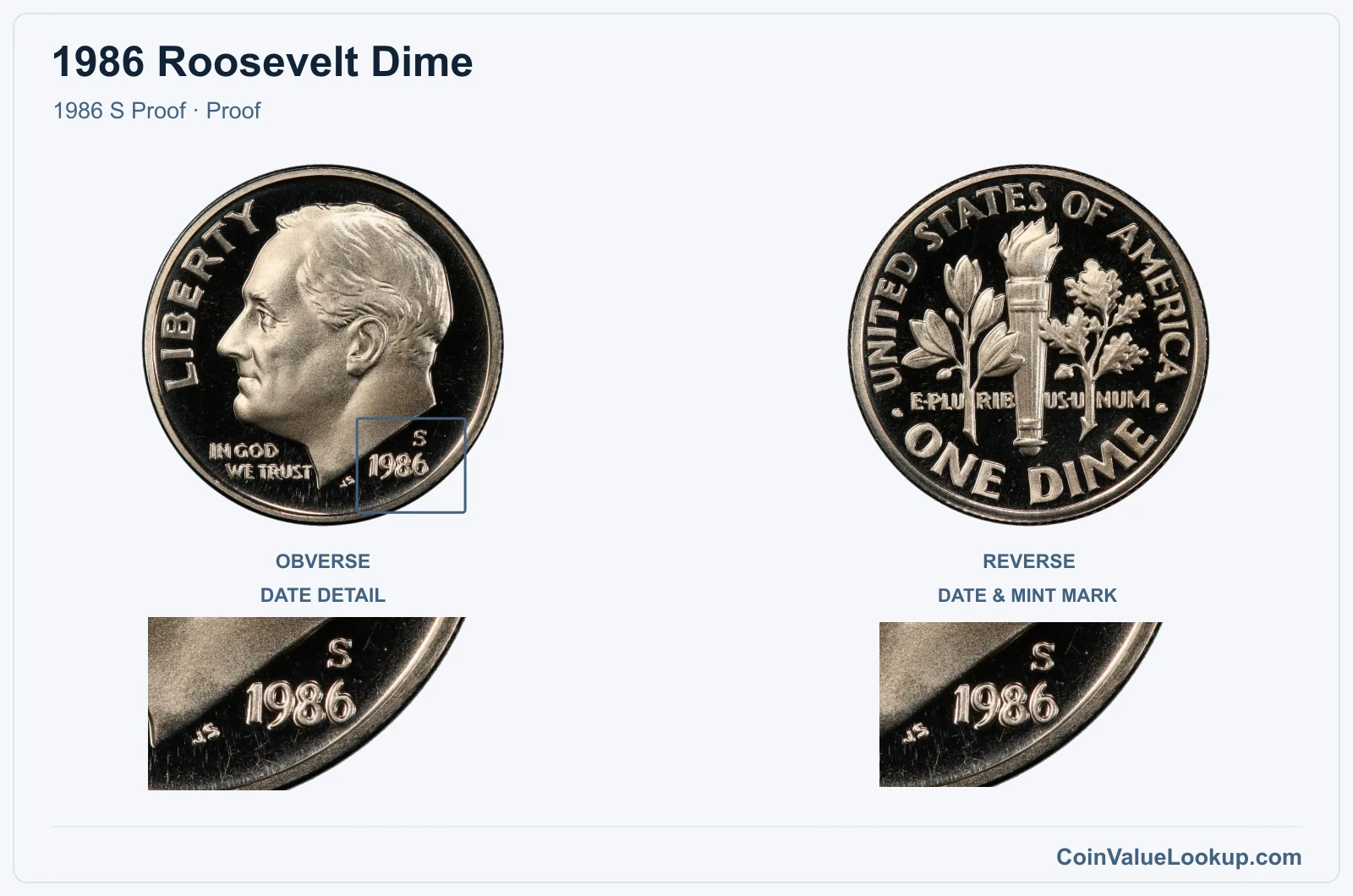
San Francisco struck the 1986 S proof dime for collector sets. These have mirror fields and sharply detailed devices — that is by design, not a sign of special rarity.
The "S" mint mark appears on the obverse.
At PR 65 the USA Coin Book guide estimate is $4.96. Higher-graded examples with strong cameo contrast between frosted portraits and reflective fields can be worth more, though exact premiums depend on the certified grade.
Keep the coin in its original government packaging or a holder to protect those delicate mirror surfaces from fingerprints and haze.
Range Grade
Price Auction Records Appraisal PR PR 1
—
Coin Identifier
PR 2
—
Coin Identifier
PR 3
—
Coin Identifier
PR 4
—
Coin Identifier
PR 6
—
Coin Identifier
PR 8
—
Coin Identifier
PR 10
—
Coin Identifier
PR 12
—
Coin Identifier
PR 15
—
Coin Identifier
PR 20
—
Coin Identifier
PR 25
—
Coin Identifier
PR 30
—
Coin Identifier
PR 35
—
Coin Identifier
PR 40
—
Coin Identifier
PR 45
—
Coin Identifier
PR 50
—
Coin Identifier
PR 53
—
Coin Identifier
PR 55
—
Coin Identifier
PR 58
—
Coin Identifier
PR 60
—
Coin Identifier
PR 61
—
Coin Identifier
PR 62
—
Coin Identifier
PR 63
—
Coin Identifier
PR 64
—
Coin Identifier
PR 65
—
Coin Identifier
PR 66
—
Coin Identifier
PR 67
—
Coin Identifier
PR 68
Coin Identifier
PR 69
Coin Identifier
PR 70
Coin Identifier
1986 Roosevelt Dime Error List
1. 1986 Roosevelt Dime — Off-Center Strike
This error occurred on a 1986-P business strike that was fed into the press misaligned. The reference specimen is a dramatic 95% off center, struck toward roughly the 10:30 position — meaning only a tiny sliver of the design was actually impressed, with the vast majority of the planchet left blank.
Because the date must still be readable for definitive attribution, confirming a 95% off-center piece as specifically 1986 requires careful examination, typically by a grading service. An ANACS-certified MS 64 example sold at Heritage Auctions for $528 in January 2022.
Watch out for undated coins assigned an arbitrary year, or planchets trimmed or punched after minting. Genuine off-center strikes show smooth unstruck areas where the die never contacted the metal.
2. 1986 Roosevelt Dime — Double Strike with Off-Center Second Strike
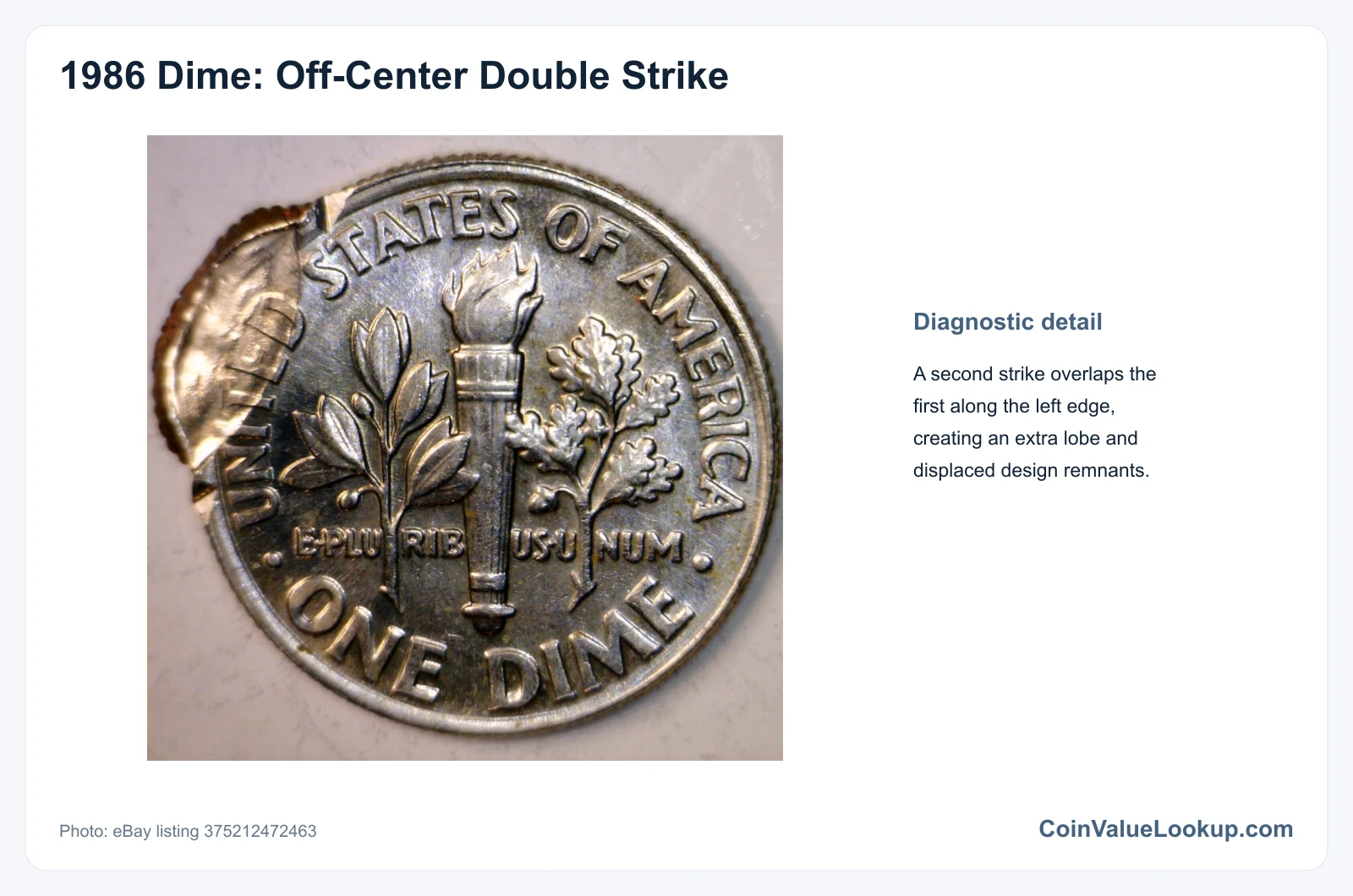
A double-struck 1986-P dime shows two separate impressions from the dies. The reference specimen received a normal first strike, then a second strike about 70% off center.
That second impression is uniface — design appears on only one side — because the other face was blocked during the second hit.
You can see both the original, centered design and the overlapping off-center image. This is very different from minor letter doubling or die deterioration.
An ANACS AU 58 example sold for $288 at Heritage Auctions in April 2022.
Small-scale die doubling or machine doubling on letters does not qualify. A genuine double strike physically reshapes the coin with a second, visible impression that overlaps the first.
3. 1986 Roosevelt Dime — Doubled Die Obverse
Doubled die obverse varieties for 1986 dimes have been reported. On a genuine doubled die, you will see consistent separation or notching on obverse lettering or design elements — the doubling repeats in the same direction across multiple features because it originated on the die itself.
Compare your coin's obverse letters and date to a known normal example under the same lighting and magnification. Machine doubling, which is flat and shelf-like, is far more common and essentially adds nothing to value.
No specific price is adopted here because value depends on the exact variety, how visible the doubling is, and the coin's overall condition. If you spot promising doubling, professional attribution is the smart next step.
4. 1986 Roosevelt Dime — Doubled Die Reverse
Doubled die reverse varieties have also been reported for 1986 dimes. Look at the reverse legends — ONE DIME, UNITED STATES OF AMERICA, E PLURIBUS UNUM — and the torch or branch details for consistent directional doubling.
A true doubled die reverse will show the same doubling pattern across multiple elements because the error was baked into the die during its manufacture. Machine doubling, reflections, or random contact damage can mimic this but lack that consistency.
No adopted price is available. The coin's value would depend on the specific doubled die, the strength of the doubling, and the grade.
Third-party certification with attribution is the clearest way to confirm what you have.
5. 1986 Roosevelt Dime — Broadstrike
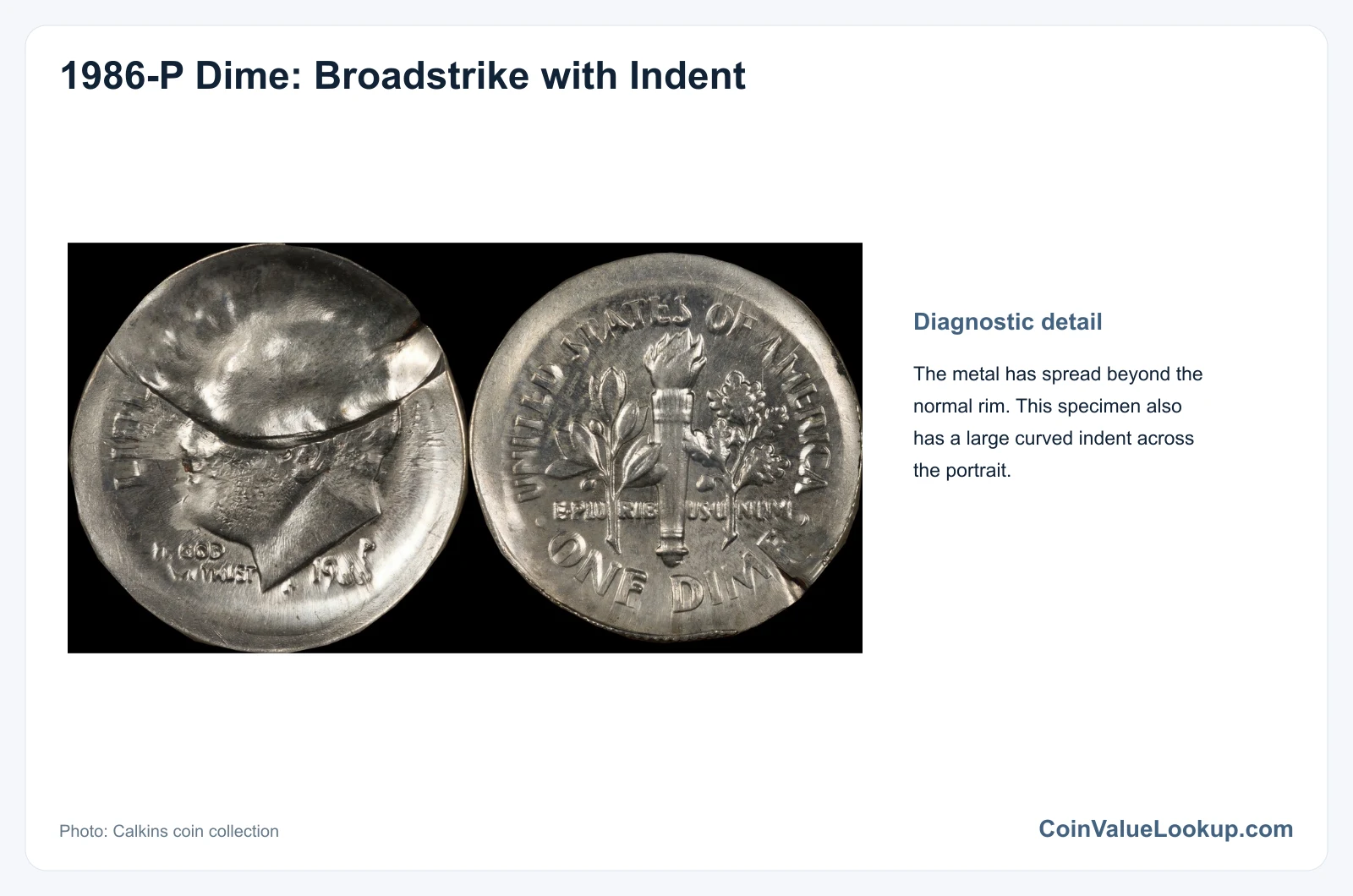
A broadstrike happens when the collar die — the ring that constrains a coin's edge and diameter during striking — fails to engage. The result is a dime that spreads outward, looking slightly larger than normal with a smooth or missing rim profile.
The design is fully centered, which distinguishes a broadstrike from an off-center error. Post-mint damage like hammering or rolling a coin flat can mimic the spread, but a genuine broadstrike retains proper metal flow and full design detail across the expanded planchet.
No specific price is adopted for this error on 1986 dimes. Value depends on how pronounced the spread is and the coin's condition.
Certification helps confirm the error is genuine.
6. 1986 Roosevelt Dime — Clipped Planchet
A clipped planchet error means the blank was incomplete before it entered the press. The missing portion can be curved, straight, or ragged, depending on where the strip was misstruck during blank production.
Look for a section of the rim and adjacent design that is simply absent, along with metal-flow weakness on the opposite side of the coin — this "Blakesley effect" is a strong authenticator. A filed notch, deliberate edge cut, or corrosion eating away metal will not produce that corresponding weakness.
No adopted price is available for 1986 clipped dimes. Larger clips with readable dates tend to carry more premium.
Professional grading can confirm the clip is a genuine mint error rather than post-strike damage.
7. 1986 Roosevelt Dime — Wrong Planchet / Off-Metal Strike
A wrong planchet error means the 1986 dime dies struck a blank intended for a different denomination or even a different country's coin. The resulting piece will differ noticeably in weight, diameter, edge characteristics, or all three compared to the standard 2.27-gram copper-nickel clad dime blank.
Weigh your coin on a precision scale and measure its diameter. If they do not match normal dime specs, compare against known planchet types.
Plating loss, corrosion, acid treatment, or deliberate alteration can change a coin's appearance and weight, so careful diagnosis matters.
No specific price is adopted here. These errors are scarce and highly individual, so value depends entirely on the specific wrong planchet involved and the coin's condition.
Professional authentication is essential.