1856 Liberty Seated Half Dollar Coin Value: How Much Is It Worth?
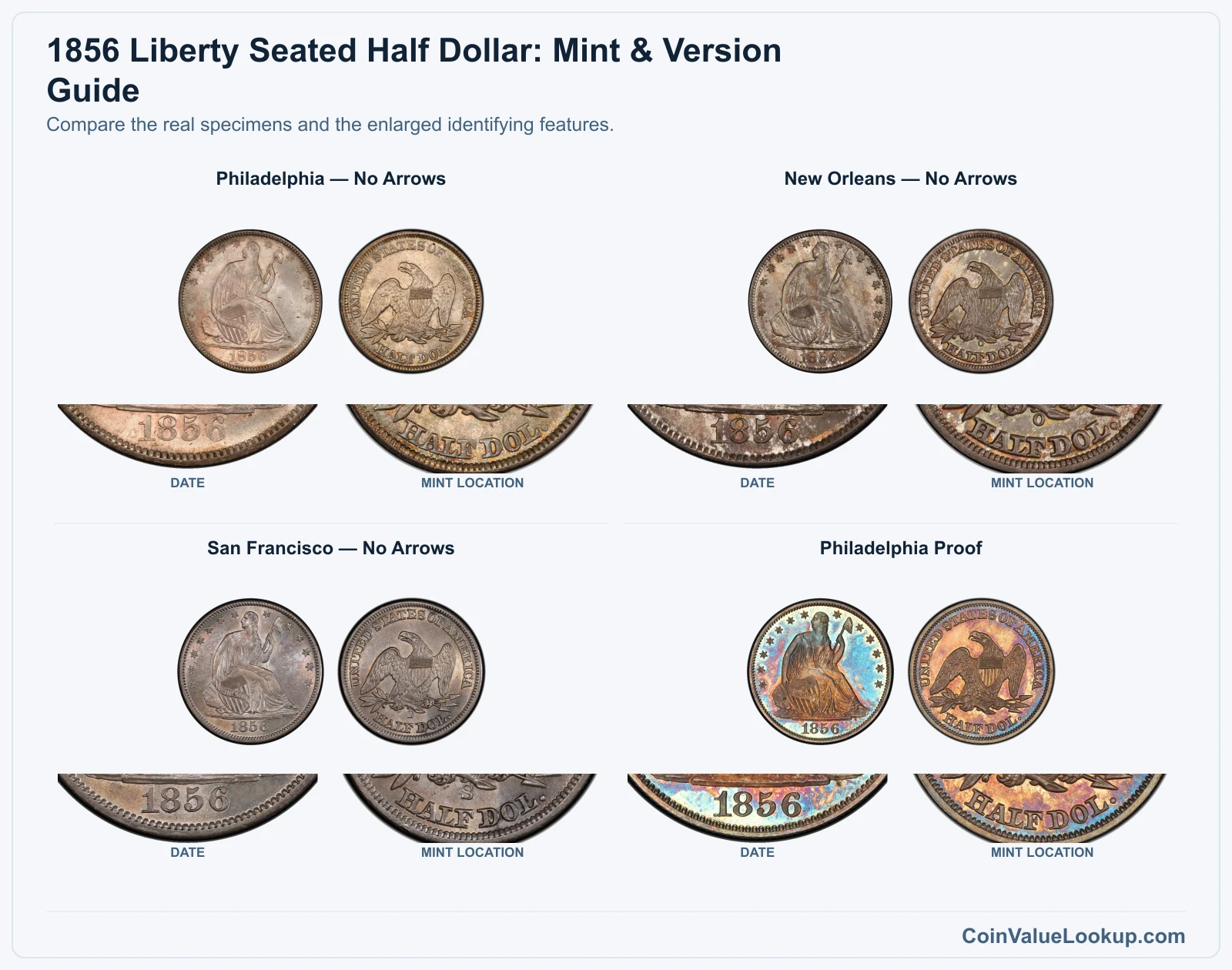
An 1856 Liberty Seated Half Dollar in circulated condition can range from roughly $79 in Good-4 to around $456 in About Uncirculated-50 for a Philadelphia issue, according to guide estimates. San Francisco coins carry a premium, and Proofs occupy their own category entirely.
The value you actually realize depends on grade, mint and the specific version you hold.
Fast Way to Identify Your 1856 Liberty Seated Half Dollar
Snap clear photos of both sides of your coin and upload them here for a preliminary identification. That means the full obverse with Liberty and the date, plus the reverse showing the eagle and any mintmark beneath it.
Good lighting and a steady hand make a real difference in spotting details that matter.
1856 Liberty Seated Half Dollar Value
Upload both sides of your 1856 Liberty Seated Half Dollar.
Front Obverse
Upload photo
Back Reverse
Upload photo
Which 1856 Liberty Seated Half Dollar Versions Are Worth Money?
- San Francisco (S mintmark) coins carry significantly higher guide values than Philadelphia or New Orleans at every grade level, making them the first thing to check.
- Philadelphia Proof issues are scarce collector pieces with a guide value around $7,830 at PR-63, well above any circulation strike.
- Repunched date varieties exist for both Philadelphia and New Orleans issues and can add a premium depending on visibility and condition.
- Die break and cud errors from Philadelphia are documented for this date and attract error collectors.
Step 1: Identify Your 1856 Liberty Seated Half Dollar Mint Mark and Version
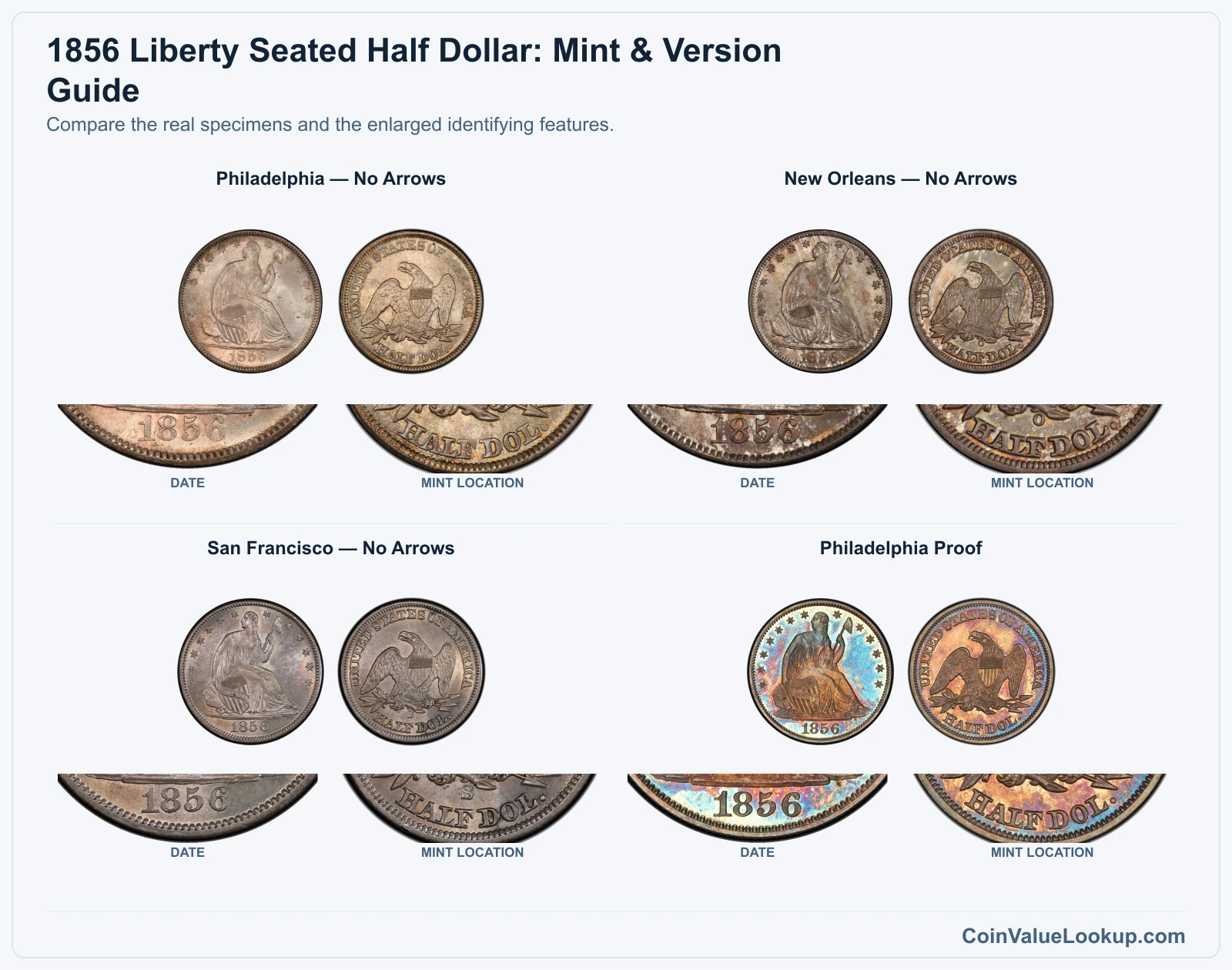
The 1856 half dollar shows the Seated Liberty design on the obverse and a heraldic eagle with HALF DOL on the reverse. There is no IN GOD WE TRUST motto on this date.
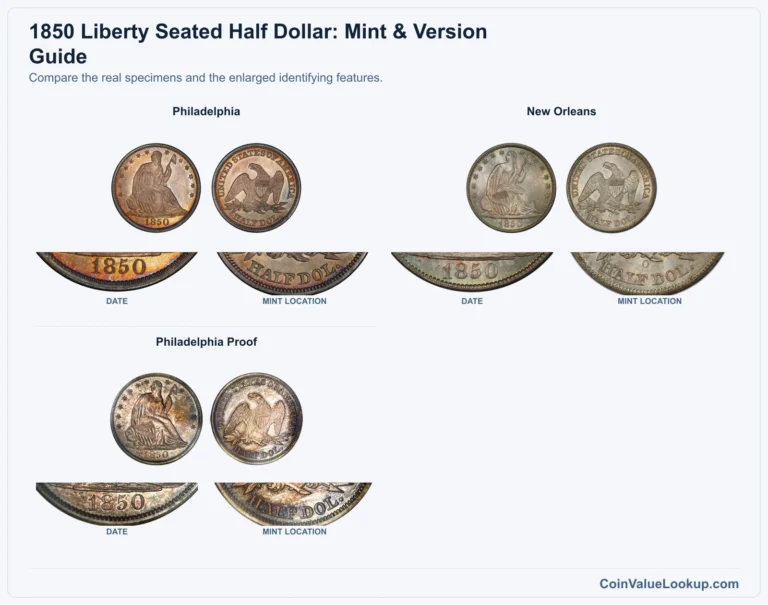
Look below the eagle on the reverse for a mintmark. No letter means Philadelphia, an O means New Orleans, and a large S means San Francisco.
All three mints struck coins in 90% silver and 10% copper at the reduced 12.44-gram standard adopted in 1853.
The 1856 issue has no arrows flanking the date and no rays on the reverse, even though the weight stays at the lighter post-1853 standard. Arrows appeared only on 1853 coins (with rays) and 1854–55 coins (without rays) to signal the weight change, so their absence in 1856 does not mean the coin returned to the heavier pre-1853 weight.
Proofs exist from Philadelphia and are a separate manufacturing type. Mirror-like fields alone do not make a coin a Proof; cleaned or lightly circulated business strikes can fool you.
Genuine Proofs show specific surface characteristics on both sides and rims that require careful comparison.
Step 2: Check Your 1856 Liberty Seated Half Dollar Grade
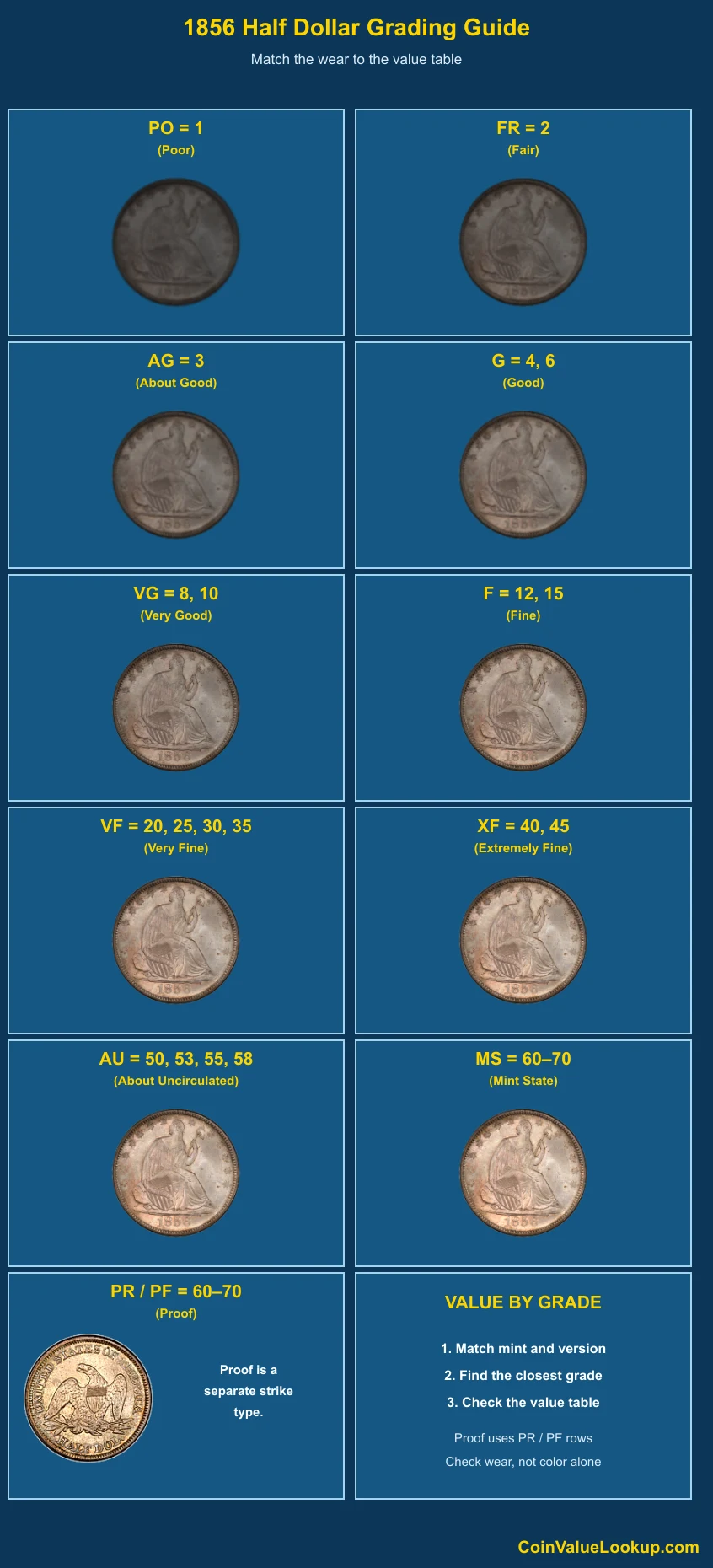
Start with Liberty herself. On a well-worn coin (Good-4 territory), her outline and the date are visible but most interior detail is gone.
Move up to Very Fine-20 and you should see distinct lines in the shield on her lap, texture in her gown at the knee, and feather separation on the eagle's breast and wings.
At About Uncirculated-50, only the slightest friction appears on the highest points: Liberty's breast, knee, and the eagle's head and claws. Full original luster should be present in the protected areas.
One thing to watch for is weak strikes versus actual wear. A weakly struck coin can look flat at the centers even without circulation.
Wear breaks luster and smooths high points uniformly; a weak strike leaves luster intact but skips detail in the middle. Compare your coin to the grading image for this type to see the difference.
Photograph both faces and the edge, and whatever you do, do not clean the coin. Even a gentle wipe can damage the surface and reduce its grade.
Step 3: Check 1856 Liberty Seated Half Dollar Value by Mint and Version
1856 Liberty Seated Half Dollar — Philadelphia — No Arrows
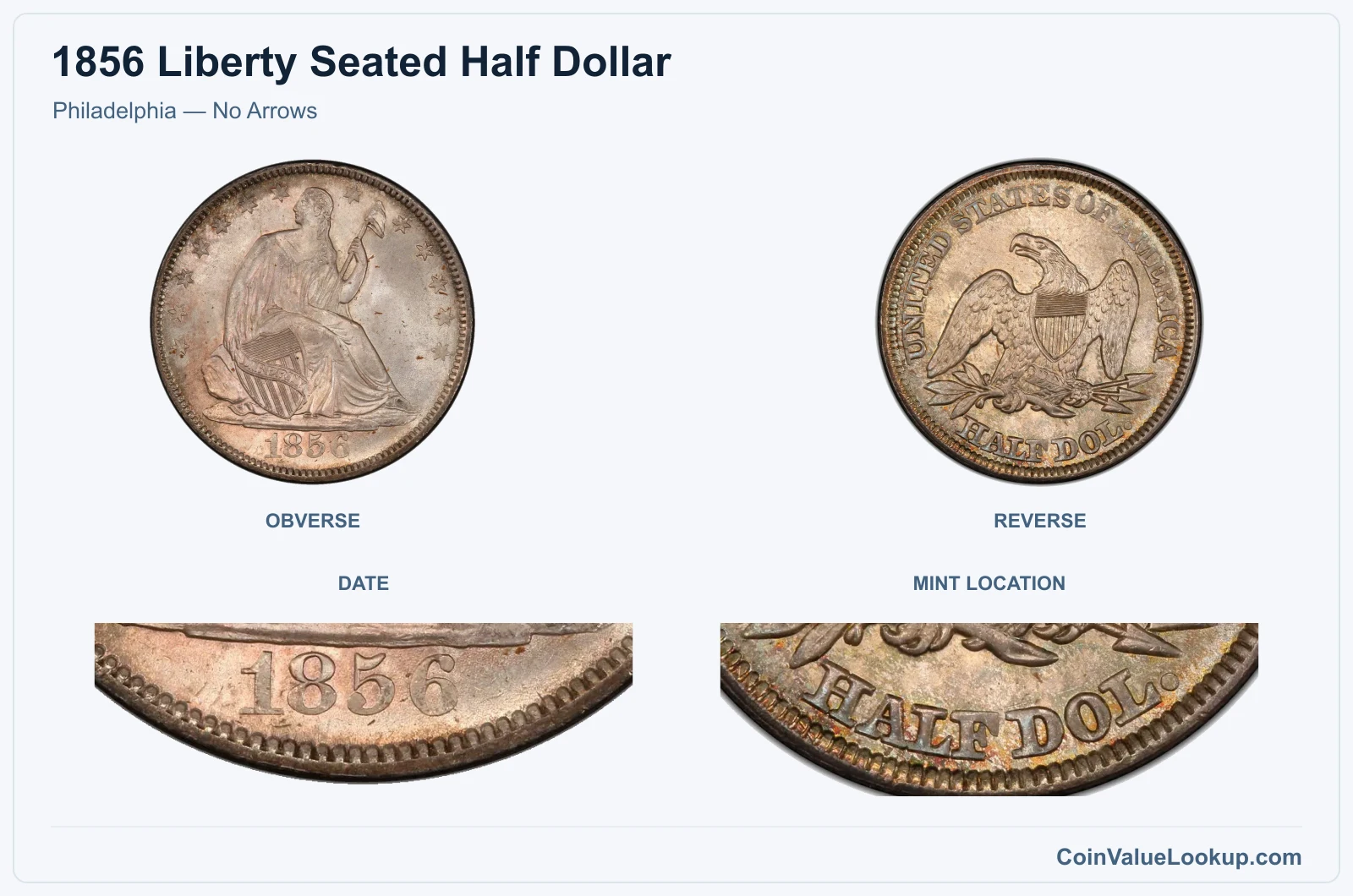
The Philadelphia issue has no mintmark on the reverse. It was struck for general circulation in 90% silver at 12.44 grams, the reduced weight standard that began in 1853.
Guide estimates place a Good-4 example around $79, a Very Fine-20 around $236, and an About Uncirculated-50 near $456.
These are the most commonly encountered 1856 half dollars. Look for a clean field below the eagle with no letter present.
The design carries no arrows beside the date and no motto above the eagle, which is standard for this transitional period.
Ordinary-issue reference: Ordinary-issue reference only: The table below shows prices for the 1856 Liberty Seated Half Dollar (regular strike). It does not represent the value of the specific Philadelphia — No Arrows variety or its variety premium. Year, mint, metal and strike type are matched; the specific variety is not priced by this table.
Range Grade
Price Auction Records Appraisal PO PO 1
—
Coin Identifier FR FR 2
—
Coin Identifier AG AG 3
—
Coin Identifier G G 4
—
Coin Identifier
G 6
—
Coin Identifier VG VG 8
—
Coin Identifier
VG 10
Coin Identifier F F 12
—
Coin Identifier
F 15
—
Coin Identifier VF VF 20
—
Coin Identifier
VF 25
Coin Identifier
VF 30
Coin Identifier
VF 35
Coin Identifier XF XF 40
Coin Identifier
XF 45
Coin Identifier AU AU 50
Coin Identifier
AU 53
Coin Identifier
AU 55
Coin Identifier
AU 58
Coin Identifier MS MS 60
—
Coin Identifier
MS 61
Coin Identifier
MS 62
Coin Identifier
MS 63
Coin Identifier
MS 64
Coin Identifier
MS 65
Coin Identifier
MS 66
Coin Identifier
MS 67
—
—
—
MS 68
—
—
—
MS 69
—
—
—
MS 70
—
—
—
1856 Liberty Seated Half Dollar — New Orleans — No Arrows
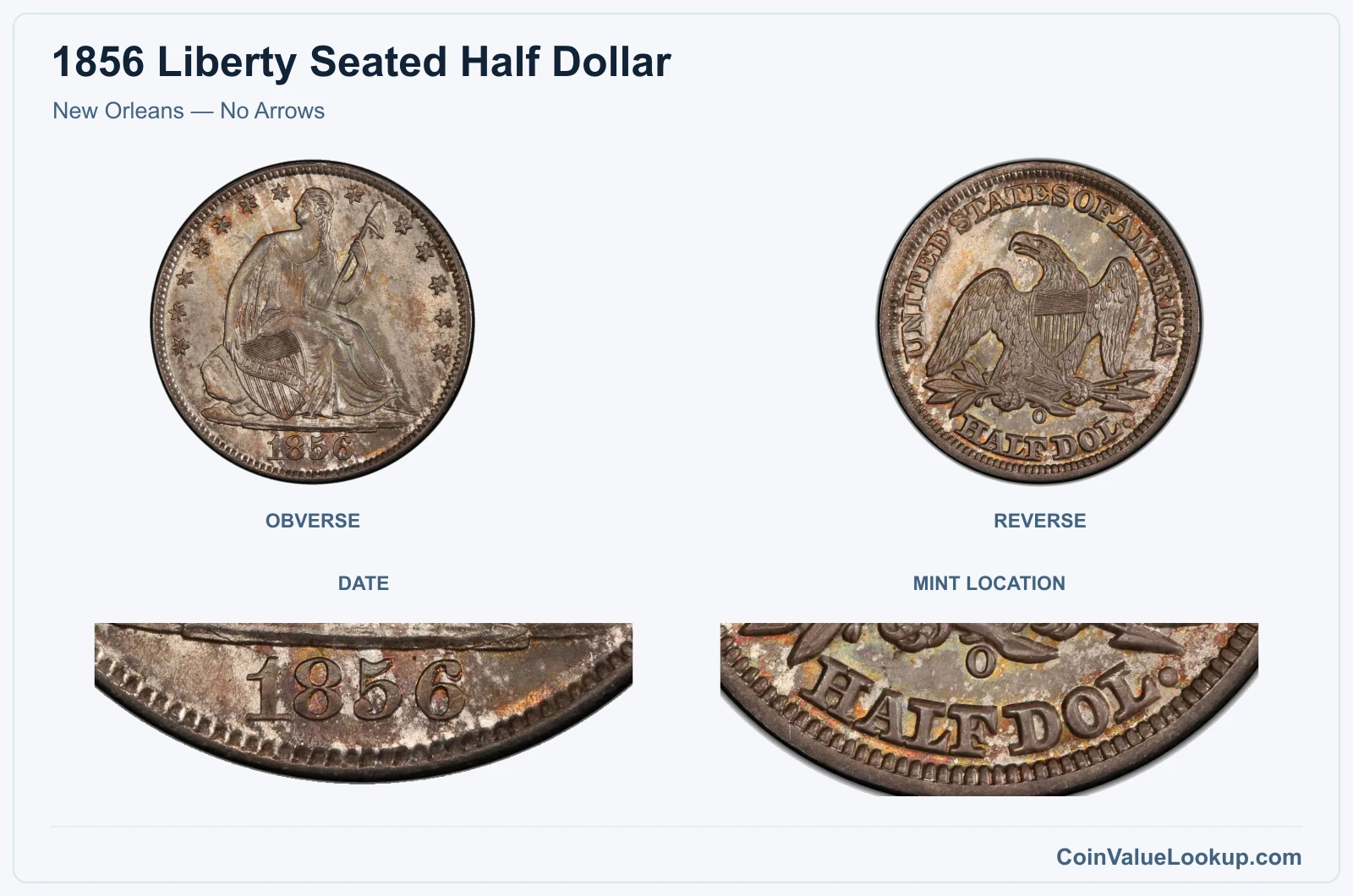
New Orleans coins carry a small O mintmark below the eagle on the reverse. Same silver composition and weight as Philadelphia.
Guide values line up closely with Philadelphia strikes: roughly $79 at Good-4, $236 at Very Fine-20, and $456 at About Uncirculated-50. The O mintmark can sometimes be faint or partially obscured by wear, so tilt the coin under good light.
Repunched date varieties have been reported for New Orleans issues of this year, specifically involving the digits 5 and 6. Those are covered separately in the error section below.
Ordinary-issue reference: Ordinary-issue reference only: The table below shows prices for the 1856-O Liberty Seated Half Dollar (regular strike). It does not represent the value of the specific New Orleans — No Arrows variety or its variety premium. Year, mint, metal and strike type are matched; the specific variety is not priced by this table.
Range Grade
Price Auction Records Appraisal PO PO 1
—
Coin Identifier FR FR 2
—
Coin Identifier AG AG 3
—
Coin Identifier G G 4
Coin Identifier
G 6
—
Coin Identifier VG VG 8
—
Coin Identifier
VG 10
Coin Identifier F F 12
—
Coin Identifier
F 15
Coin Identifier VF VF 20
Coin Identifier
VF 25
Coin Identifier
VF 30
Coin Identifier
VF 35
Coin Identifier XF XF 40
Coin Identifier
XF 45
Coin Identifier AU AU 50
Coin Identifier
AU 53
Coin Identifier
AU 55
Coin Identifier
AU 58
Coin Identifier MS MS 60
Coin Identifier
MS 61
Coin Identifier
MS 62
Coin Identifier
MS 63
Coin Identifier
MS 64
Coin Identifier
MS 65
Coin Identifier
MS 66
Coin Identifier
MS 67
—
—
—
MS 68
—
—
—
MS 69
—
—
—
MS 70
—
—
—
1856 Liberty Seated Half Dollar — San Francisco — No Arrows
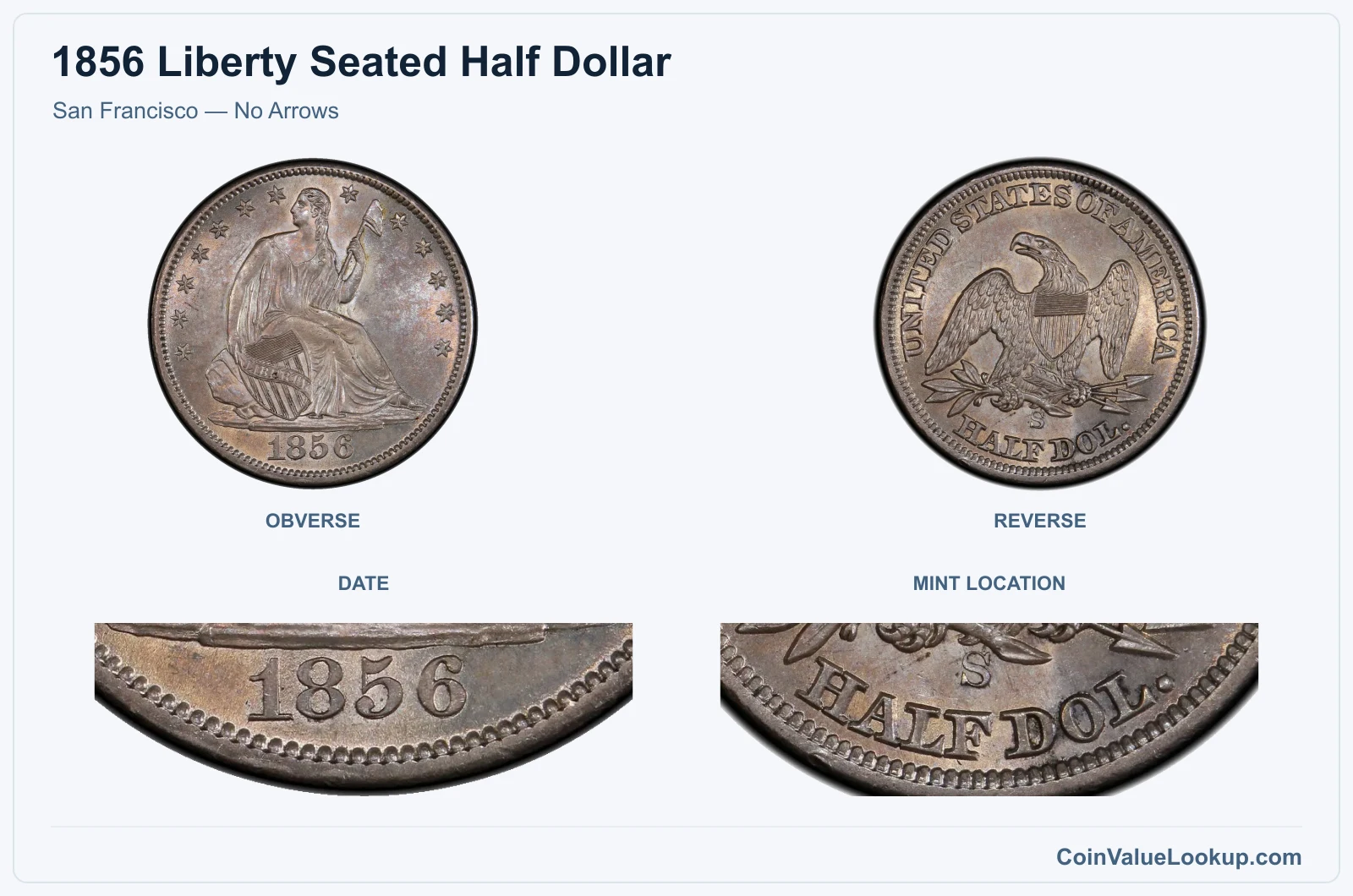
San Francisco coins display a large S mintmark below the reverse eagle, and this is where things get interesting for your wallet. Guide values run noticeably higher: about $136 at Good-4, $574 at Very Fine-20, and a steep jump to roughly $2,786 at About Uncirculated-50.
The premium reflects lower availability compared to the eastern mints. Same 90% silver composition and 12.44-gram weight.
If you spot that big S below the eagle, you are holding the scarcest regular-issue mint for this date. Condition matters even more here because the price curve steepens dramatically as grades improve.
Coin Value Lookup is a good starting point if you want to look up other dates in this series or compare values across different Liberty Seated denominations.
Ordinary-issue reference: Ordinary-issue reference only: The table below shows prices for the 1856-S Liberty Seated Half Dollar (regular strike). It does not represent the value of the specific San Francisco — No Arrows variety or its variety premium. Year, mint, metal and strike type are matched; the specific variety is not priced by this table.
Range Grade
Price Auction Records Appraisal PO PO 1
—
Coin Identifier FR FR 2
—
Coin Identifier AG AG 3
Coin Identifier G G 4
—
Coin Identifier
G 6
Coin Identifier VG VG 8
Coin Identifier
VG 10
Coin Identifier F F 12
Coin Identifier
F 15
Coin Identifier VF VF 20
Coin Identifier
VF 25
Coin Identifier
VF 30
Coin Identifier
VF 35
Coin Identifier XF XF 40
Coin Identifier
XF 45
Coin Identifier AU AU 50
Coin Identifier
AU 53
Coin Identifier
AU 55
Coin Identifier
AU 58
Coin Identifier MS MS 60
Coin Identifier
MS 61
—
Coin Identifier
MS 62
Coin Identifier
MS 63
Coin Identifier
MS 64
Coin Identifier
MS 65
—
—
—
MS 66
—
—
—
MS 67
—
—
—
MS 68
—
—
—
MS 69
—
—
—
MS 70
—
—
—
1856 Liberty Seated Half Dollar — Philadelphia Proof
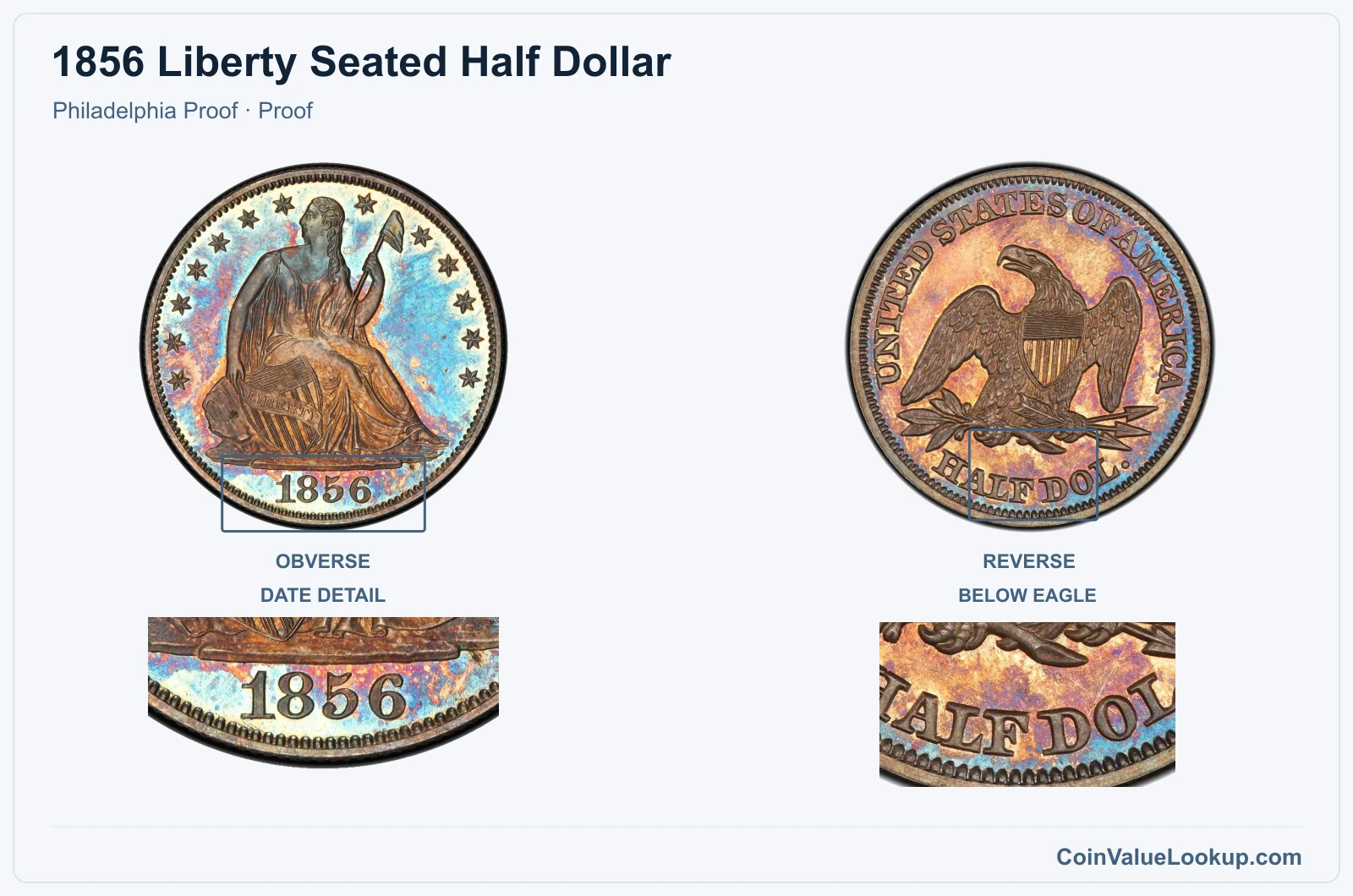
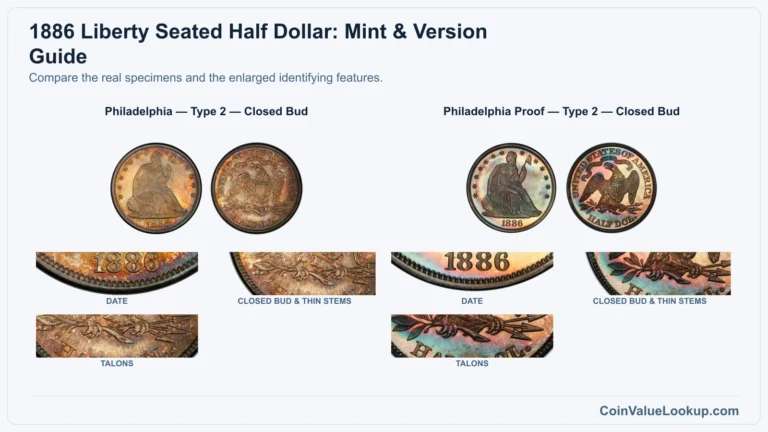
Philadelphia Proof half dollars from 1856 are scarce collector pieces produced with specially prepared dies on polished planchets. They carry the same design as the regular Philadelphia issue but display deeply mirrored fields and sharp, squared-off rims.
A guide estimate for a PR-63 example sits around $7,830. Do not assume a shiny coin is a Proof.
Cleaned circulation strikes can mimic mirror surfaces, but they lack the consistent reflectivity, precise edge detail, and die characteristics of genuine Proof manufacture. Any Proof candidate deserves professional examination.
Cameo and Deep Cameo designations describe the degree of contrast between frosted devices and reflective fields; they are surface-contrast labels within the Proof category, not separate versions.
Range Grade
Price Auction Records Appraisal PR PR 1
—
Coin Identifier
PR 2
—
Coin Identifier
PR 3
—
Coin Identifier
PR 4
—
Coin Identifier
PR 6
—
Coin Identifier
PR 8
—
Coin Identifier
PR 10
—
Coin Identifier
PR 12
—
Coin Identifier
PR 15
—
Coin Identifier
PR 20
—
Coin Identifier
PR 25
—
Coin Identifier
PR 30
—
Coin Identifier
PR 35
—
Coin Identifier
PR 40
—
Coin Identifier
PR 45
—
Coin Identifier
PR 50
—
Coin Identifier
PR 53
—
Coin Identifier
PR 55
—
Coin Identifier
PR 58
—
Coin Identifier
PR 60
Coin Identifier
PR 61
—
Coin Identifier
PR 62
—
Coin Identifier
PR 63
Coin Identifier
PR 64
Coin Identifier
PR 65
Coin Identifier
PR 66
Coin Identifier
PR 67
—
—
—
PR 68
—
—
—
PR 69
—
—
—
PR 70
—
—
—
1856 Liberty Seated Half Dollar Error List
1. 1856 Liberty Seated Half Dollar — Repunched Date
Repunched date varieties have been reported on both Philadelphia and New Orleans 1856 half dollars. On Philadelphia coins, look for evidence of a recut numeral 1 and a dramatically doubled 6 in the date.
New Orleans examples may show repunching on the digits 5 and 6.
To spot one, examine the date under magnification. You are looking for traces of a second impression slightly offset from the final position, giving numerals a shadowed or thickened appearance.
This is different from machine doubling, which tends to produce flat, shelf-like displacement, or simple damage where the metal is pushed rather than struck twice by the die.
No single price applies to all repunched dates. Value depends on the visibility of the doubling, the overall condition of the coin, and which specific repunching is present.
A bold, dramatic repunch on a high-grade coin will command far more attention than a subtle trace on a worn example.
2. 1856 Liberty Seated Half Dollar — Die Break / Cud
Die break and cud errors are documented for 1856 Philadelphia half dollars. A cud is a raised, unstruck blob of metal at the rim caused by a piece of the die breaking away.
Some Philadelphia examples have been cataloged as sawtooth cuds, where the break produces an irregular, jagged profile along the rim edge.
To identify one, look for a raised lump that connects to the rim. The area will feel smooth or blobby compared to the surrounding design.
Do not confuse a cud with a rim dent, which is depressed rather than raised, or with corrosion and interior die chips that sit away from the rim.
Pricing depends on the size of the cud, its location, and the coin's overall grade. No fixed price range can be stated here.
A large, dramatic cud in a visible area on a well-preserved coin will naturally draw more collector interest than a tiny chip.
3. 1856 Liberty Seated Half Dollar — Lamination / Split Planchet
A lamination or split planchet error has been reported on an 1856 Philadelphia half dollar. This type of error occurs when a flaw within the planchet causes a layer of metal to separate, sometimes remaining partially attached as a raised flake, sometimes peeling away entirely in a clamshell pattern.
The reported example shows a partially attached flake with visible metal texture underneath. One asking price of $399.99 has been noted, but that is a seller's asking price, not a confirmed sale or a reliable market range.
When examining your coin, look for a thin layer of metal lifting away from the surface with original metal texture visible beneath. Do not confuse this with scraping, corrosion pitting, or deliberate cuts into the surface.
Corrosion tends to be rough and porous, while a genuine lamination reveals clean, layered metal separation. Value depends on the size of the affected area, whether the flake is still attached, and the coin's condition.