1856 Liberty Seated Dollar Coin Value: How Much Is It Worth?
The 1856 Liberty Seated Dollar is a classic mid-nineteenth-century silver piece that draws steady collector attention. Guide estimates for explicitly listed grades range from about $830 in Good-4 to around $13,790 in MS63, based on USA Coin Book figures — these are not guaranteed offers.
A proof finish version also exists for this date. Before assigning any value, confirm the mint, design variant and whether you hold a business strike or a proof, because the two branches carry very different market profiles.
Fast Way to Identify Your 1856 Liberty Seated Dollar
The quickest way to start figuring out what you have is to upload clear photos of both the front and the back of your coin. Our identifier can give you a preliminary read on the year, mint and design type from those images alone.
It will not authenticate errors, assign a precise grade or replace professional certification, but it will point you in the right direction before you dig deeper.
1856 Liberty Seated Dollar Value
Upload both sides of your 1856 Liberty Seated Dollar.
Front Obverse
Upload photo
Back Reverse
Upload photo
Which 1856 Liberty Seated Dollar Versions Are Worth Money?
- The 1856 Proof (PR) is the key branch to check — proof Seated Dollars of this era were made in tiny quantities and require professional authentication to confirm.
- A business-strike 1856 in MS63 condition carries a guide estimate around $13,790, so uncirculated survivors with original surfaces command a serious premium over circulated examples.
Step 1: Identify Your 1856 Liberty Seated Dollar Mint Mark and Version
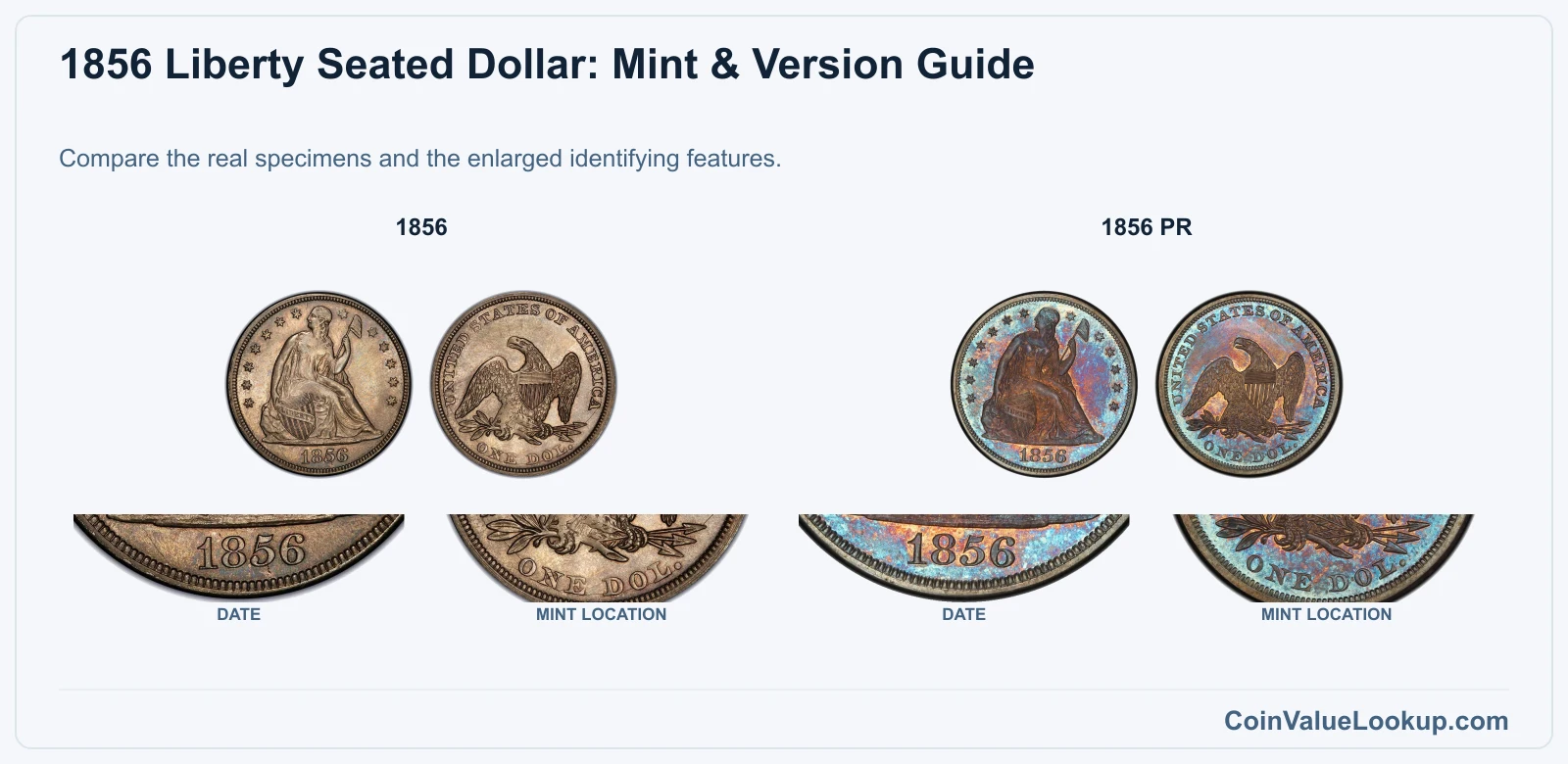
Every 1856 Seated Dollar was struck at Philadelphia, so there is no mintmark to hunt for. Branch-mint Liberty Seated Dollars carry a small letter on the reverse beneath the eagle and above the ONE DOL.
inscription, but for this date you will find that space blank.
The coin is 90% silver and 10% copper, with a standard weight around 26.73 grams. If yours feels noticeably light or does not respond to a magnet test correctly, consider whether it is a contemporary counterfeit or an altered coin.
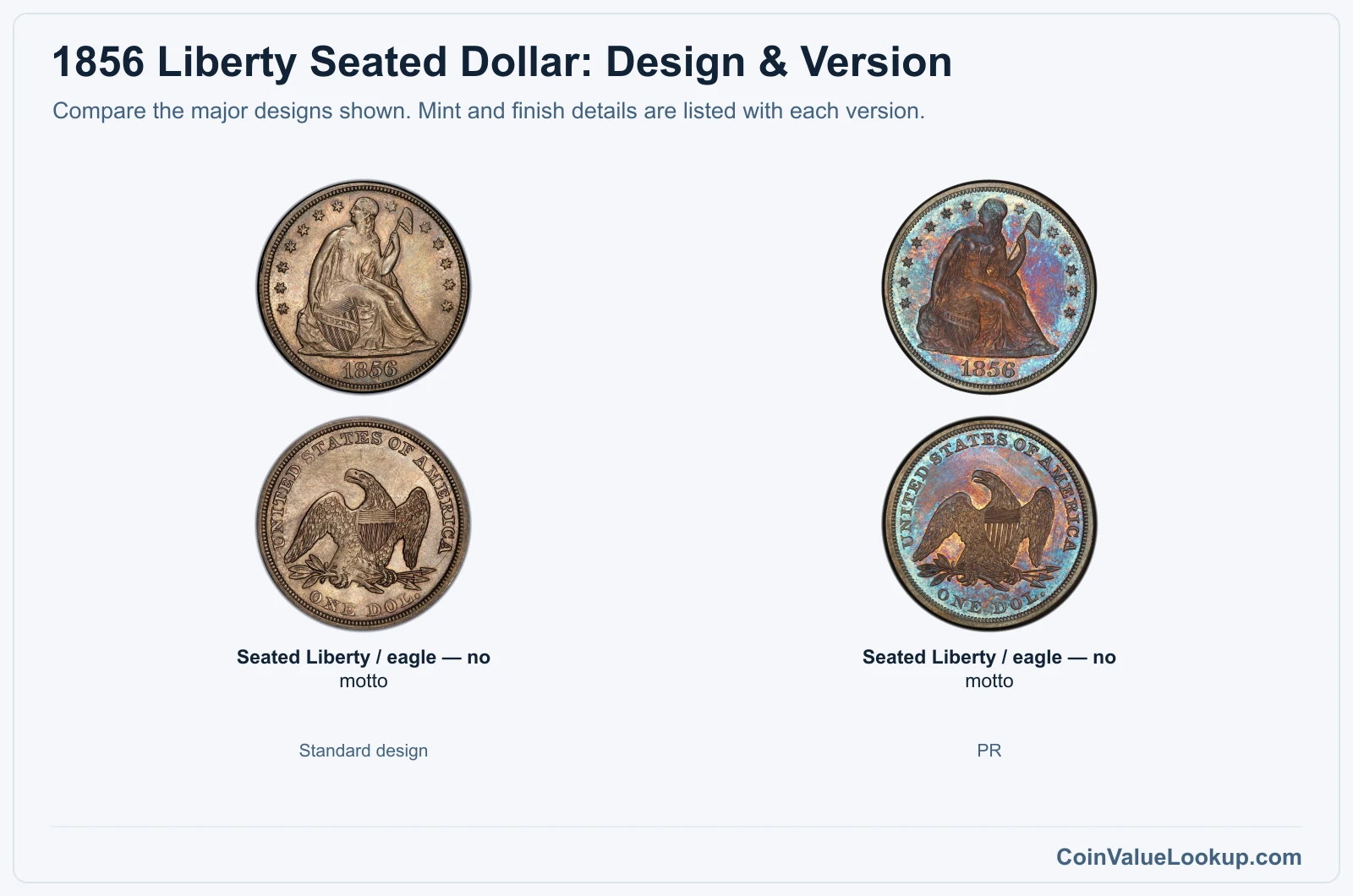
The obverse shows Liberty seated on a rock, holding a staff with a liberty cap, with a shield at her side and thirteen stars around the border. The reverse depicts a heraldic eagle with no motto above it — the IN GOD WE TRUST motto was not added to this series until later.
Two collectible branches exist for the 1856 date: the regular business strike and the proof. That distinction matters enormously.
A proof is a special manufacturing finish using polished dies and planchets, not simply a coin that looks shiny or grades high. Confirming proof status usually requires professional authentication.
Step 2: Check Your 1856 Liberty Seated Dollar Grade
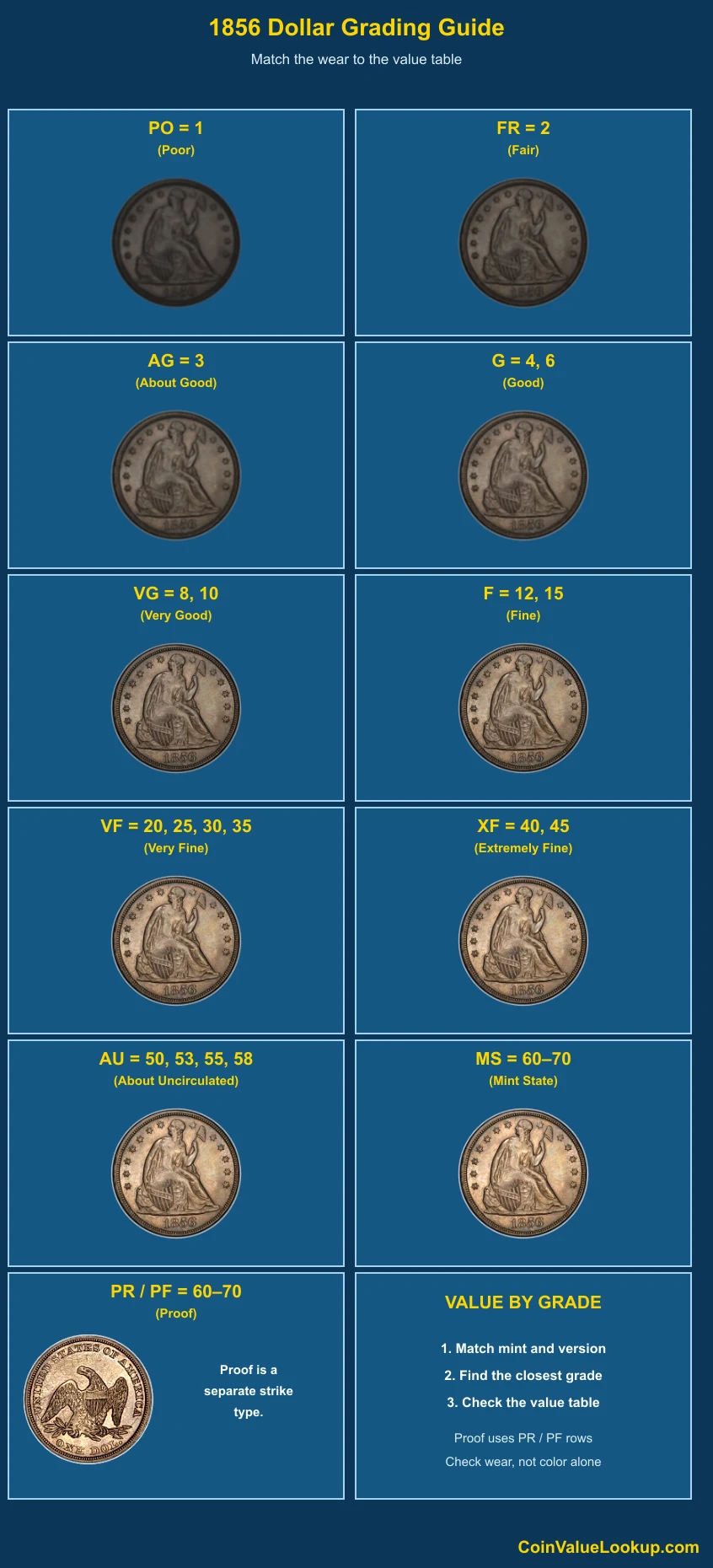
Start by examining the high points on Liberty: her head, the area across her breast, the knee and the lines on the shield. These wear first and tell you the most about circulated grade.
On the reverse, check the eagle's breast feathers and the tips of the wings.
Do not judge grade from the head alone. Seated Dollars sometimes show a weakly struck head even on higher-grade pieces, which is a strike characteristic, not wear.
Look at multiple high points together.
For a coin around Good-4, the outline of Liberty is visible but interior detail is mostly gone, and the rim may be worn into some lettering. At About Uncirculated, you will see only the slightest friction on the knee and breast, with nearly full luster in protected areas.
Mint State coins retain complete original luster with no friction, though contact marks and strike quality still vary.
Compare your coin against a genuine same-type grading image — the reference photo shown nearby is helpful for exactly this. Keep business strikes and proofs separate when comparing; proof surfaces have a different visual baseline and should never be graded on the same wear scale as circulation strikes.
Step 3: Check 1856 Liberty Seated Dollar Value by Mint and Version
1856 Liberty Seated Dollar
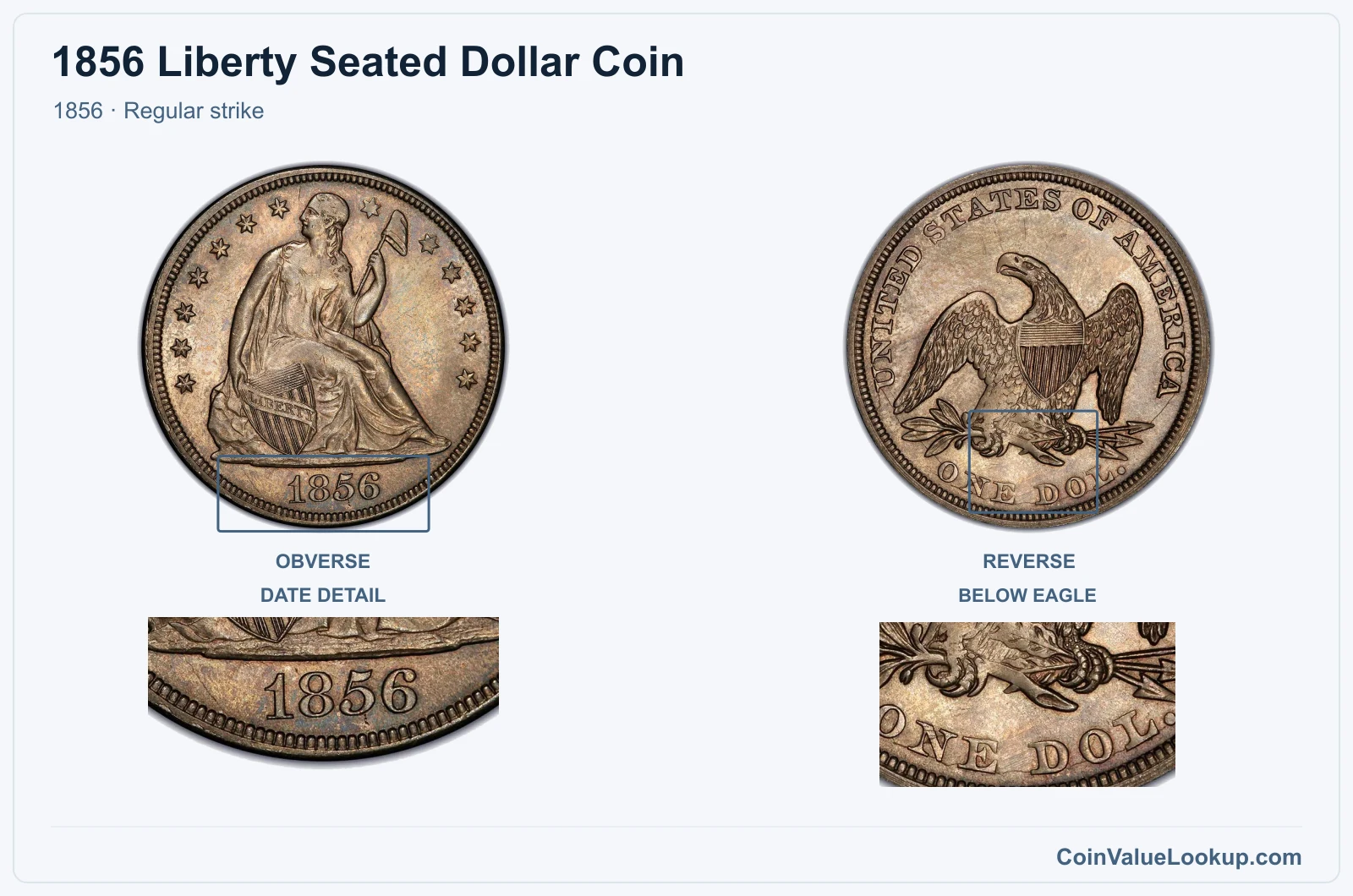
The regular 1856 business strike was produced at Philadelphia with no mintmark. It features the Seated Liberty obverse and no-motto eagle reverse in 90% silver.
USA Coin Book guide estimates place this coin at about $830 in Good-4 and roughly $13,790 in MS63 — those are reference points, not sale guarantees.
Original surfaces matter here. A coin that has been cleaned, polished or whizzed loses much of its appeal and its comparability to published guide values.
If you can see hairline scratches under light or the surfaces look unnaturally bright and uniform, cleaning is likely. Match mint, design and condition carefully before relying on any published figure.
Coin Value Lookup is a useful starting point if you want to look up guides for other dates and denominations in this series or across U.S. coinage.
Range Grade
Price Auction Records Appraisal PO PO 1
—
Coin Identifier FR FR 2
—
Coin Identifier AG AG 3
Coin Identifier G G 4
—
Coin Identifier
G 6
—
Coin Identifier VG VG 8
—
Coin Identifier
VG 10
—
Coin Identifier F F 12
Coin Identifier
F 15
Coin Identifier VF VF 20
Coin Identifier
VF 25
Coin Identifier
VF 30
Coin Identifier
VF 35
—
Coin Identifier XF XF 40
Coin Identifier
XF 45
Coin Identifier AU AU 50
Coin Identifier
AU 53
Coin Identifier
AU 55
Coin Identifier
AU 58
Coin Identifier MS MS 60
Coin Identifier
MS 61
Coin Identifier
MS 62
Coin Identifier
MS 63
Coin Identifier
MS 64
Coin Identifier
MS 65
—
—
—
MS 66
—
—
—
MS 67
—
—
—
MS 68
—
—
—
MS 69
—
—
—
MS 70
—
—
—
1856 Liberty Seated Dollar — PR
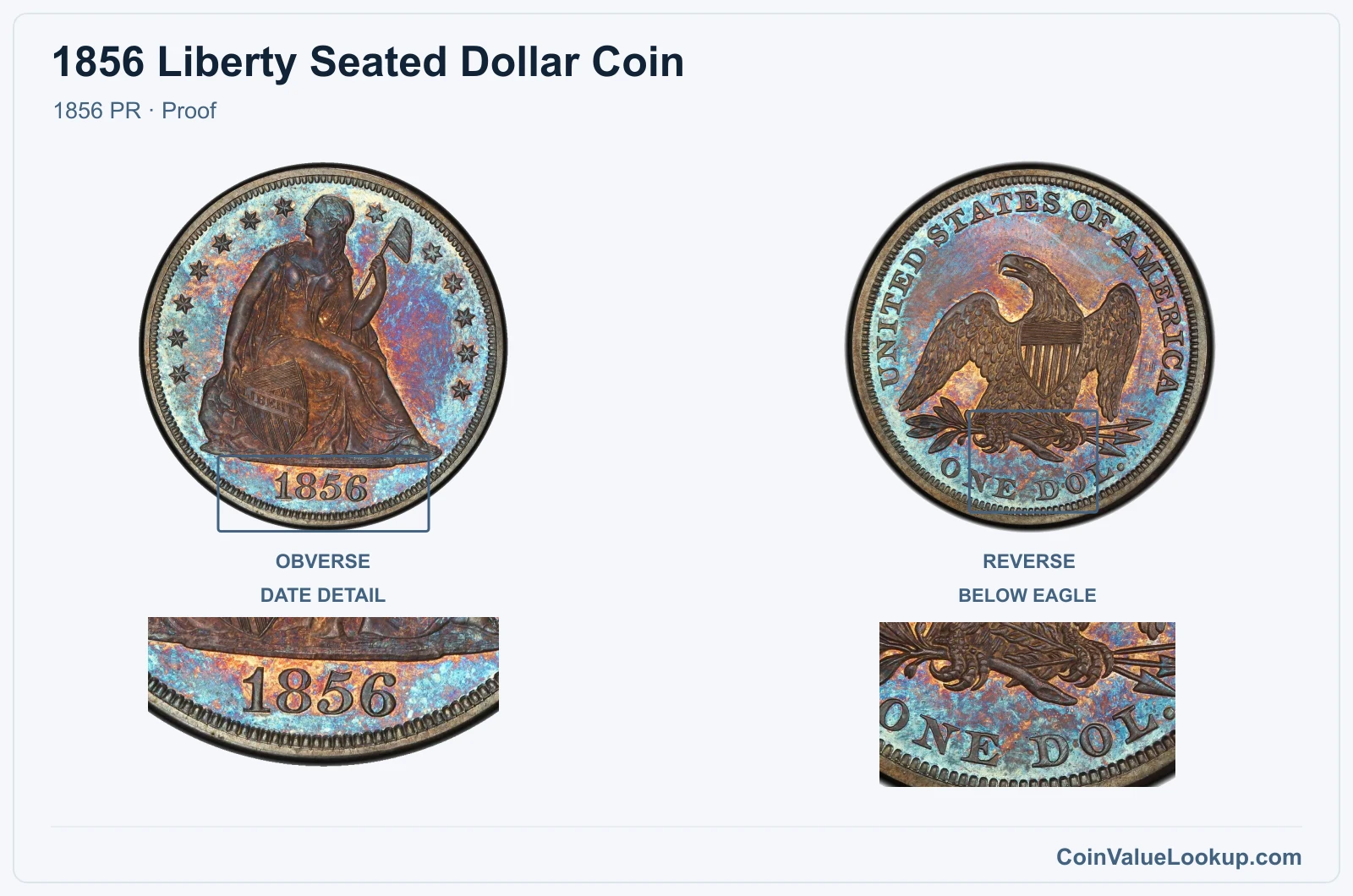
The 1856 Proof is the same Philadelphia design — Seated Liberty obverse, no-motto eagle reverse, 90% silver — but struck with a proof manufacturing process using specially prepared dies and planchets. That gives the surfaces a mirror-like field and sharply detailed devices that differ visibly from even the finest business strikes.
No supported numeric price range was adopted for this version, so value depends heavily on the individual coin's authenticated identity, its condition and any notable characteristics. Professional grading services such as PCGS or NGC are essentially required to confirm proof status on a coin this old, because decades of handling can obscure the original finish.
Do not pay a proof premium based on appearance alone or an unverified seller claim.
Range Grade
Price Auction Records Appraisal PR PR 1
—
Coin Identifier
PR 2
—
Coin Identifier
PR 3
—
Coin Identifier
PR 4
—
Coin Identifier
PR 6
—
Coin Identifier
PR 8
—
Coin Identifier
PR 10
—
Coin Identifier
PR 12
—
Coin Identifier
PR 15
—
Coin Identifier
PR 20
—
Coin Identifier
PR 25
—
Coin Identifier
PR 30
—
Coin Identifier
PR 35
—
Coin Identifier
PR 40
—
Coin Identifier
PR 45
—
Coin Identifier
PR 50
—
Coin Identifier
PR 53
—
Coin Identifier
PR 55
—
Coin Identifier
PR 58
—
Coin Identifier
PR 60
Coin Identifier
PR 61
Coin Identifier
PR 62
Coin Identifier
PR 63
Coin Identifier
PR 64
Coin Identifier
PR 65
Coin Identifier
PR 66
Coin Identifier
PR 67
—
—
—
PR 68
—
—
—
PR 69
—
—
—
PR 70
—
—
—