1980 Susan B. Anthony Dollar Coin Value: How Much Is It Worth?
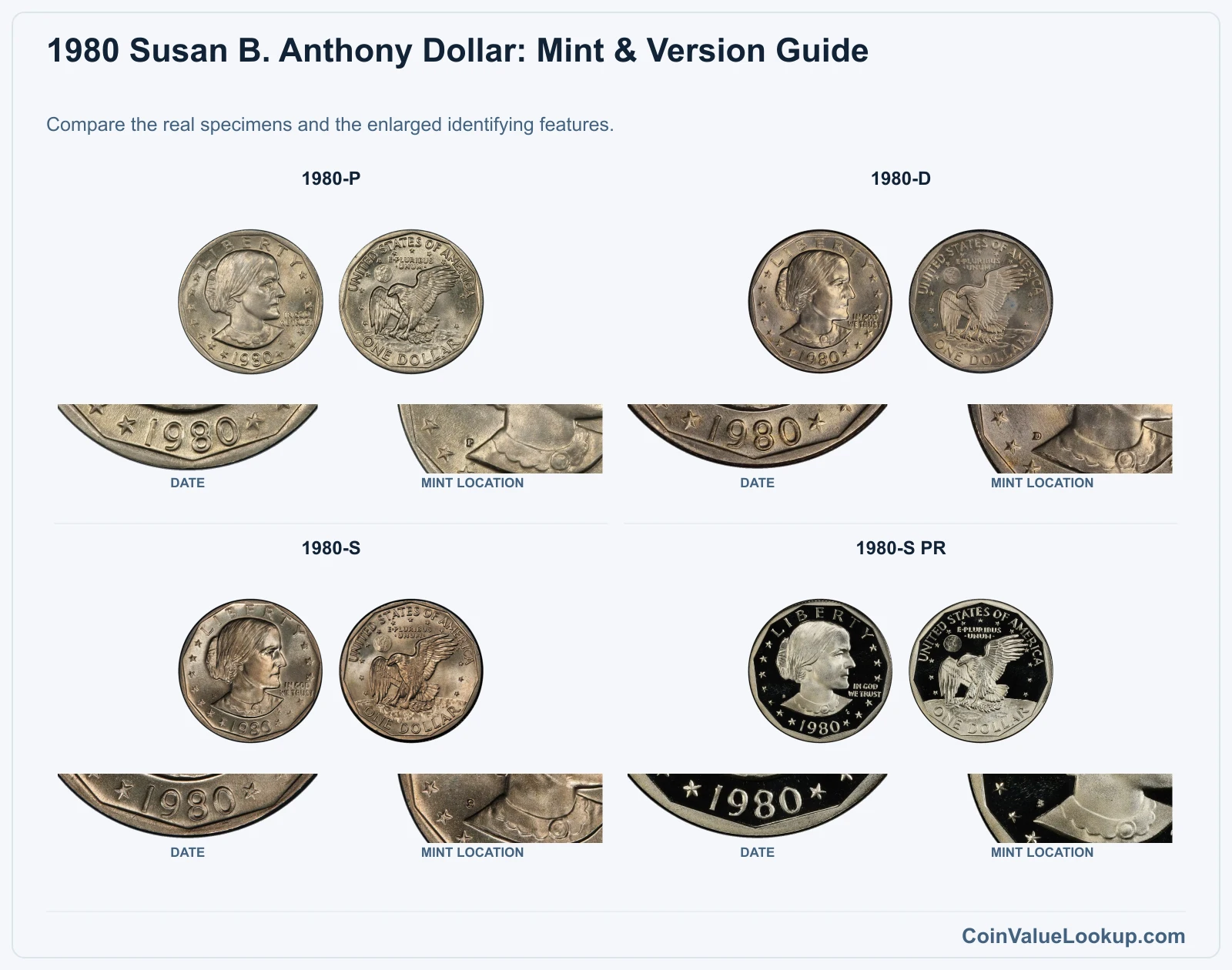
The 1980 Susan B. Anthony Dollar is a copper-nickel clad coin struck at three mints.
Most examples are common, and guide estimates for the versions covered here range from about $7.29 in MS63 to $15.00 for a proof in PR65. Before judging what yours is worth, you need to identify the mint, finish and condition.
The proof issue from San Francisco stands apart from the business strikes, and a few error categories have been reported for this year.
Fast Way to Identify Your 1980 Susan B. Anthony Dollar
The quickest way to start is to upload clear photos of both the front and back of your coin. Our identifier can give you a preliminary read on the mint, finish and general version based on those images.
It won't authenticate errors or assign an exact grade, but it narrows your search right away so you know which branch to research further.
1980 Susan B. Anthony Dollar Value
Upload both sides of your 1980 Susan B. Anthony Dollar.
Front Obverse
Upload photo
Back Reverse
Upload photo
Which 1980 Susan B. Anthony Dollar Versions Are Worth Money?
- The 1980-S Proof (PR) carries a guide estimate of about $15.00 at PR65, the highest single-grade anchor among the versions listed here.
- Check for the 1980-S mintmark carefully — the business-strike S version has a guide estimate of $14.00 at MS63, roughly double the P and D business strikes at the same grade.
Step 1: Identify Your 1980 Susan B. Anthony Dollar Mint Mark and Version
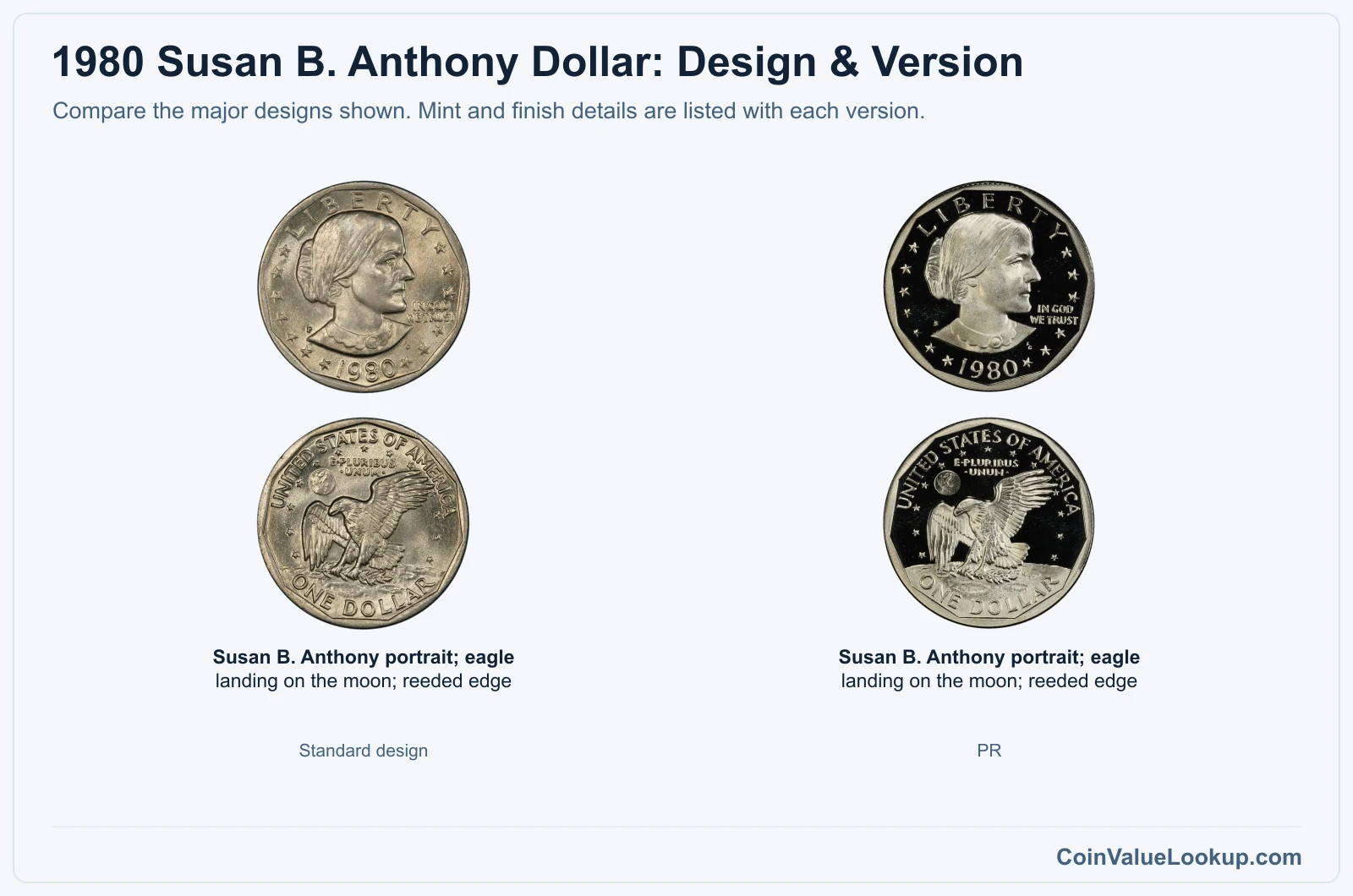
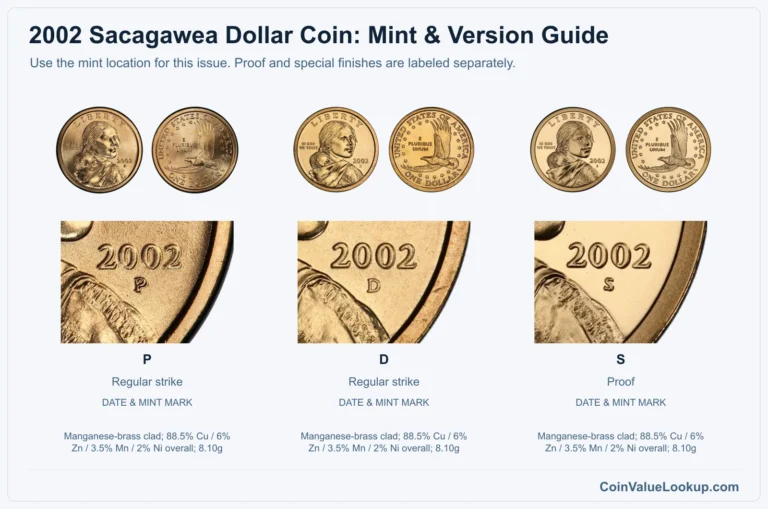
Look on the obverse, near Susan B. Anthony's shoulder truncation, for the mintmark.
A "P" means Philadelphia, "D" means Denver, and "S" means San Francisco. All three mints produced business strikes in 1980, and the San Francisco facility also made proof coins sold in collector sets.
Every 1980 Susan B. Anthony Dollar is copper-nickel clad over a copper core.
There is no silver content. Each coin weighs 8.10 grams and measures 26.50 mm with a reeded edge.
The design shows Anthony's portrait on the front and an eagle landing on the moon on the back. Separating the proof from a business strike is the key distinction.
A proof is a special manufacturing finish with sharp detail and mirror-like fields, not simply a shiny coin. If your coin came from a sealed government proof set, that is a strong clue.
A loose coin that just looks clean is almost certainly a business strike.
Coin Value Lookup is a good place to start when you want to look up guides for other denominations and years. If you are sorting through a group of coins, it can save you a lot of back-and-forth searching.
Step 2: Check Your 1980 Susan B. Anthony Dollar Grade
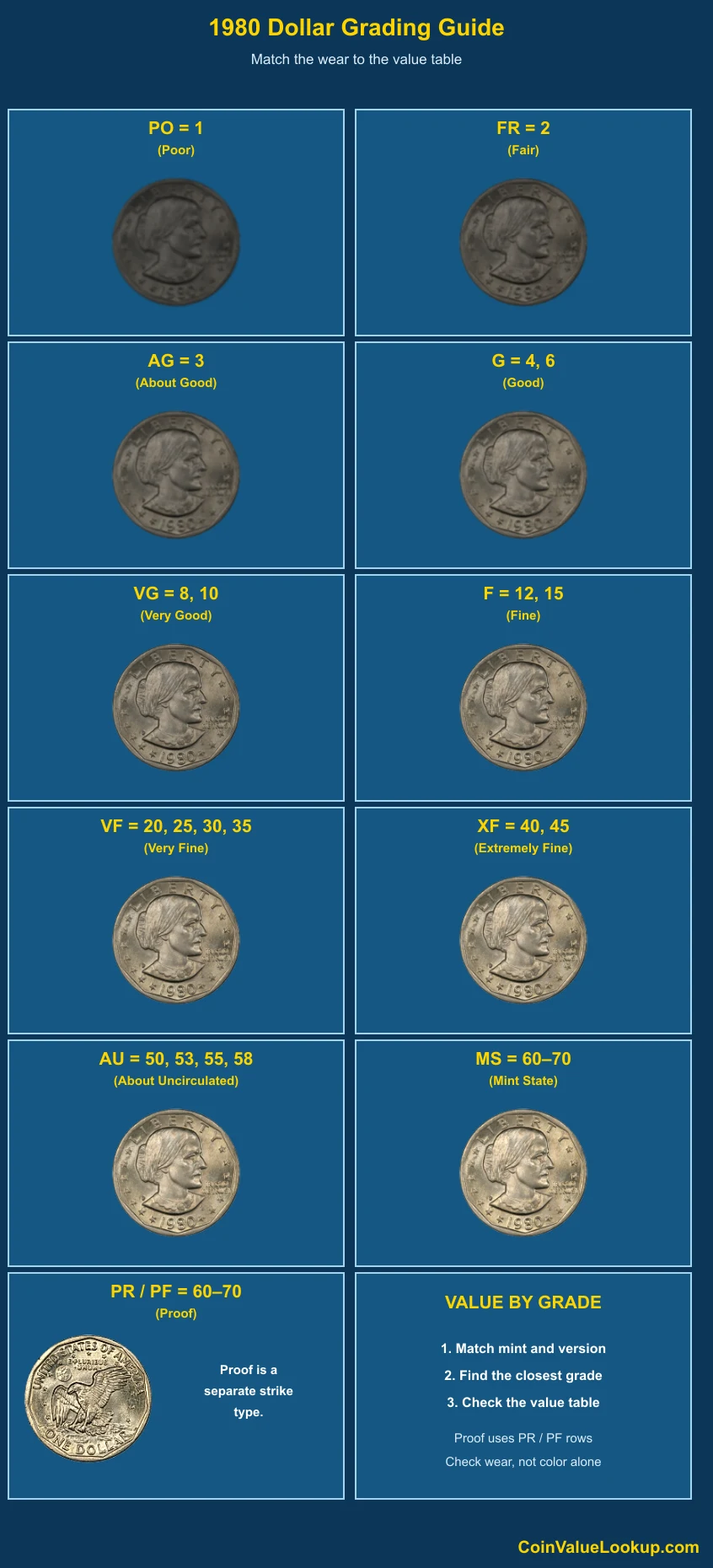
On business strikes, check the cheek first. It is the highest point of the obverse and shows friction before anything else.
Then look at the hair detail above the ear: worn coins lose the fine strands there quickly. Flip the coin over and inspect the eagle's breast feathers for the same kind of smoothing.
A coin with full luster and no contact marks or bag scuffs is in the Mint State range. One with slight rub on the cheek but otherwise bright fields sits around AU.
Obvious flatness on both high points means a lower circulated grade.
For proofs, the grading focus shifts. Hairlines from mishandling, haze from improper storage, and contact marks from loose capsules all reduce the grade independently of cameo contrast.
Compare your coin to the reference image, keeping business strikes and proofs in separate mental categories because they wear differently.
Step 3: Check 1980 Susan B. Anthony Dollar Value by Mint and Version
1980 Susan B. Anthony Dollar — P
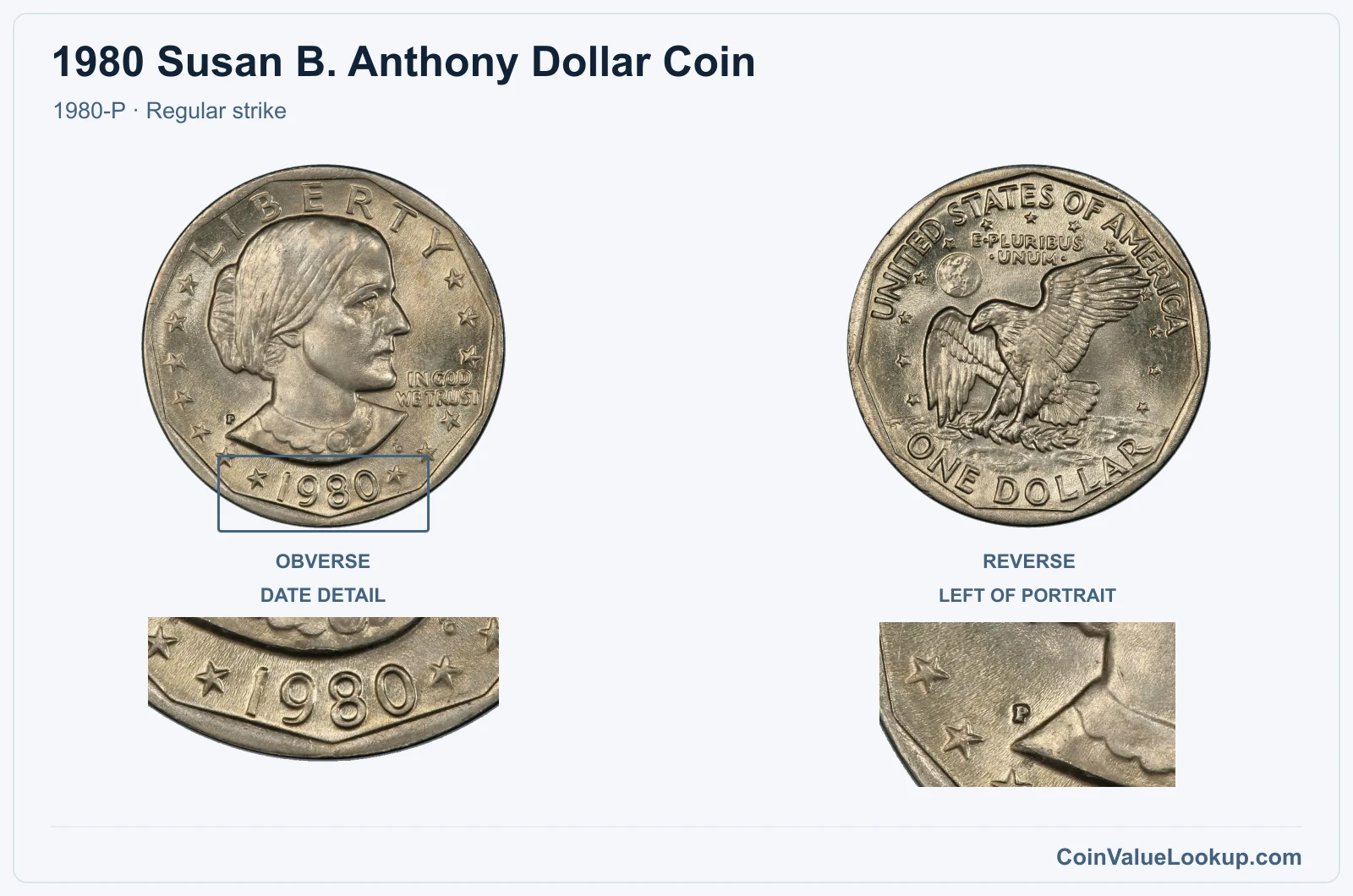
The 1980-P is the Philadelphia business strike. Look for the small "P" mintmark on the obverse near the shoulder.
This is a copper-nickel clad coin with no silver. A USA Coin Book guide estimate places it around $7.29 in MS63.
Most examples you encounter in change or old rolls will be well below that grade, and cleaning or polishing reduces collector appeal. Confirm original surfaces and luster before comparing to any published value.
Range Grade
Price Auction Records Appraisal PO PO 1
—
Coin Identifier FR FR 2
—
Coin Identifier AG AG 3
—
Coin Identifier G G 4
—
Coin Identifier
G 6
—
Coin Identifier VG VG 8
—
Coin Identifier
VG 10
—
Coin Identifier F F 12
—
Coin Identifier
F 15
—
Coin Identifier VF VF 20
—
Coin Identifier
VF 25
—
Coin Identifier
VF 30
—
Coin Identifier
VF 35
—
Coin Identifier XF XF 40
—
Coin Identifier
XF 45
—
Coin Identifier AU AU 50
—
Coin Identifier
AU 53
—
Coin Identifier
AU 55
—
Coin Identifier
AU 58
—
Coin Identifier MS MS 60
—
Coin Identifier
MS 61
—
Coin Identifier
MS 62
—
Coin Identifier
MS 63
Coin Identifier
MS 64
—
Coin Identifier
MS 65
Coin Identifier
MS 66
Coin Identifier
MS 67
Coin Identifier
MS 68
Coin Identifier
MS 69
—
—
—
MS 70
—
—
—
1980 Susan B. Anthony Dollar — D
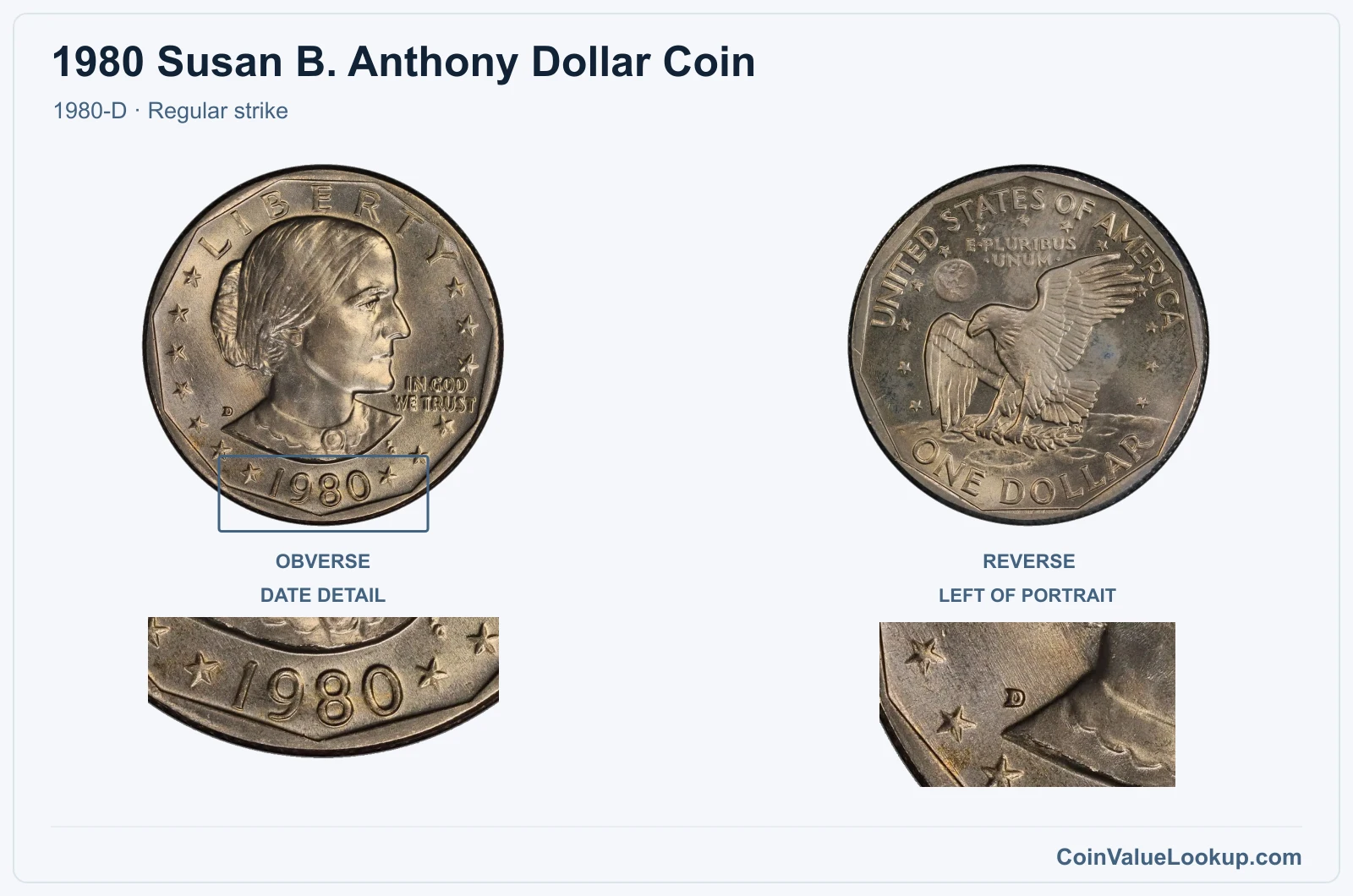
The 1980-D was struck at Denver. The "D" mintmark sits in the same obverse location near the shoulder truncation.
It shares the same copper-nickel clad composition, weight and diameter as the P and S business strikes. The guide estimate from USA Coin Book is about $7.29 at MS63, identical to the Philadelphia version at that grade.
Original, unpolished surfaces matter here just as much.
Range Grade
Price Auction Records Appraisal PO PO 1
—
Coin Identifier FR FR 2
—
Coin Identifier AG AG 3
—
Coin Identifier G G 4
—
Coin Identifier
G 6
—
Coin Identifier VG VG 8
—
Coin Identifier
VG 10
—
Coin Identifier F F 12
—
Coin Identifier
F 15
—
Coin Identifier VF VF 20
—
Coin Identifier
VF 25
—
Coin Identifier
VF 30
—
Coin Identifier
VF 35
—
Coin Identifier XF XF 40
—
Coin Identifier
XF 45
—
Coin Identifier AU AU 50
—
Coin Identifier
AU 53
—
Coin Identifier
AU 55
—
Coin Identifier
AU 58
—
Coin Identifier MS MS 60
—
Coin Identifier
MS 61
—
Coin Identifier
MS 62
—
Coin Identifier
MS 63
Coin Identifier
MS 64
—
Coin Identifier
MS 65
Coin Identifier
MS 66
Coin Identifier
MS 67
Coin Identifier
MS 68
—
—
—
MS 69
—
—
—
MS 70
—
—
—
1980 Susan B. Anthony Dollar — S
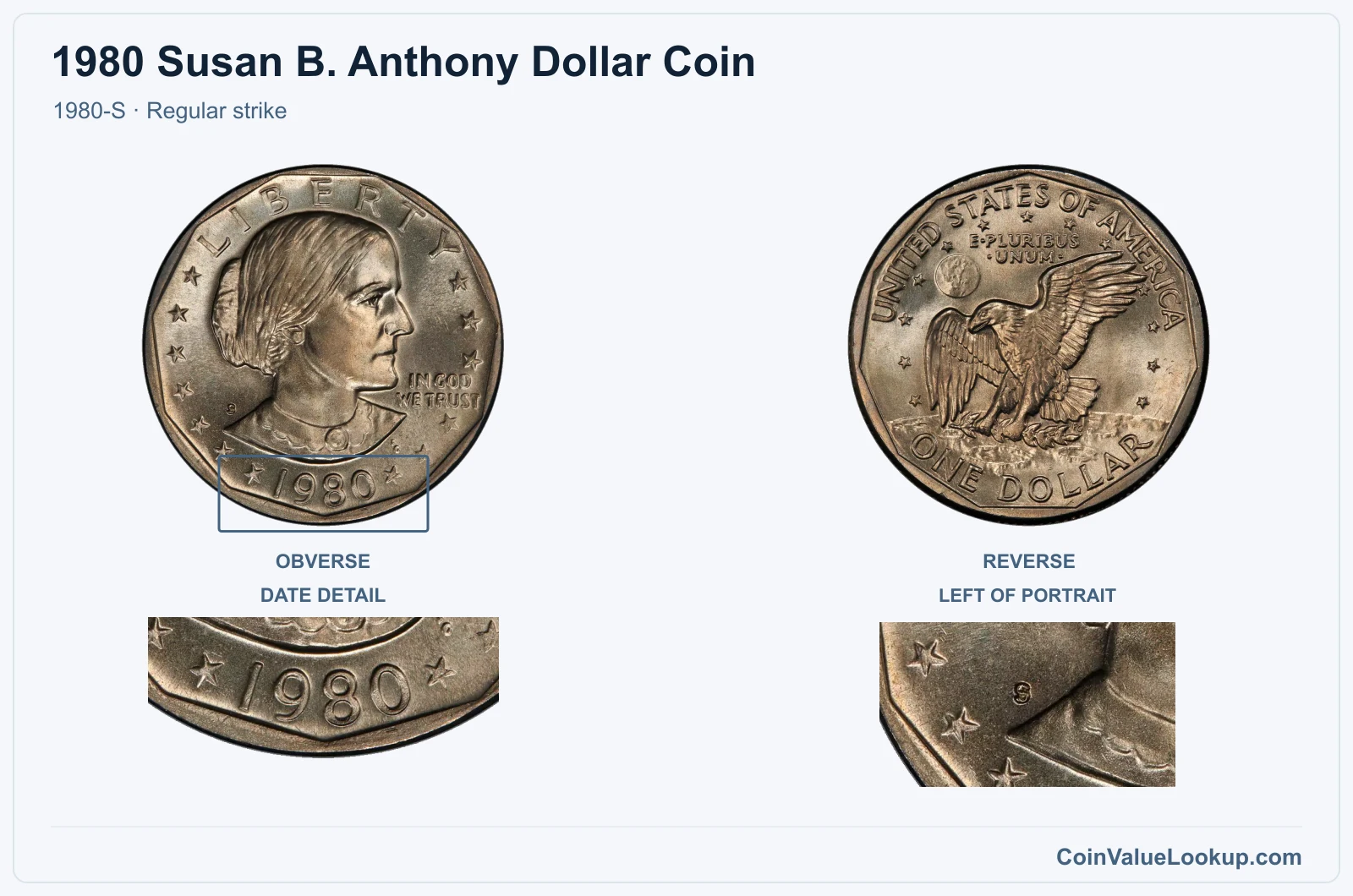
The 1980-S business strike came from San Francisco and carries a "S" mintmark on the obverse. This version has a noticeably higher guide estimate than the P or D at the same grade — about $14.00 in MS63 per USA Coin Book.
That premium makes it worth checking your S-mint coins carefully to see whether they are business strikes or proofs. Business strikes lack the mirror fields and sharp frosted devices of a proof.
Confirm the finish before assuming the higher value applies.
Range Grade
Price Auction Records Appraisal PO PO 1
—
Coin Identifier FR FR 2
—
Coin Identifier AG AG 3
—
Coin Identifier G G 4
—
Coin Identifier
G 6
—
Coin Identifier VG VG 8
—
Coin Identifier
VG 10
—
Coin Identifier F F 12
—
Coin Identifier
F 15
—
Coin Identifier VF VF 20
—
Coin Identifier
VF 25
—
Coin Identifier
VF 30
—
Coin Identifier
VF 35
—
Coin Identifier XF XF 40
—
Coin Identifier
XF 45
—
Coin Identifier AU AU 50
—
Coin Identifier
AU 53
—
Coin Identifier
AU 55
—
Coin Identifier
AU 58
—
Coin Identifier MS MS 60
—
Coin Identifier
MS 61
—
Coin Identifier
MS 62
—
Coin Identifier
MS 63
—
Coin Identifier
MS 64
Coin Identifier
MS 65
Coin Identifier
MS 66
Coin Identifier
MS 67
Coin Identifier
MS 68
—
—
—
MS 69
—
—
—
MS 70
—
—
—
1980 Susan B. Anthony Dollar — S PR
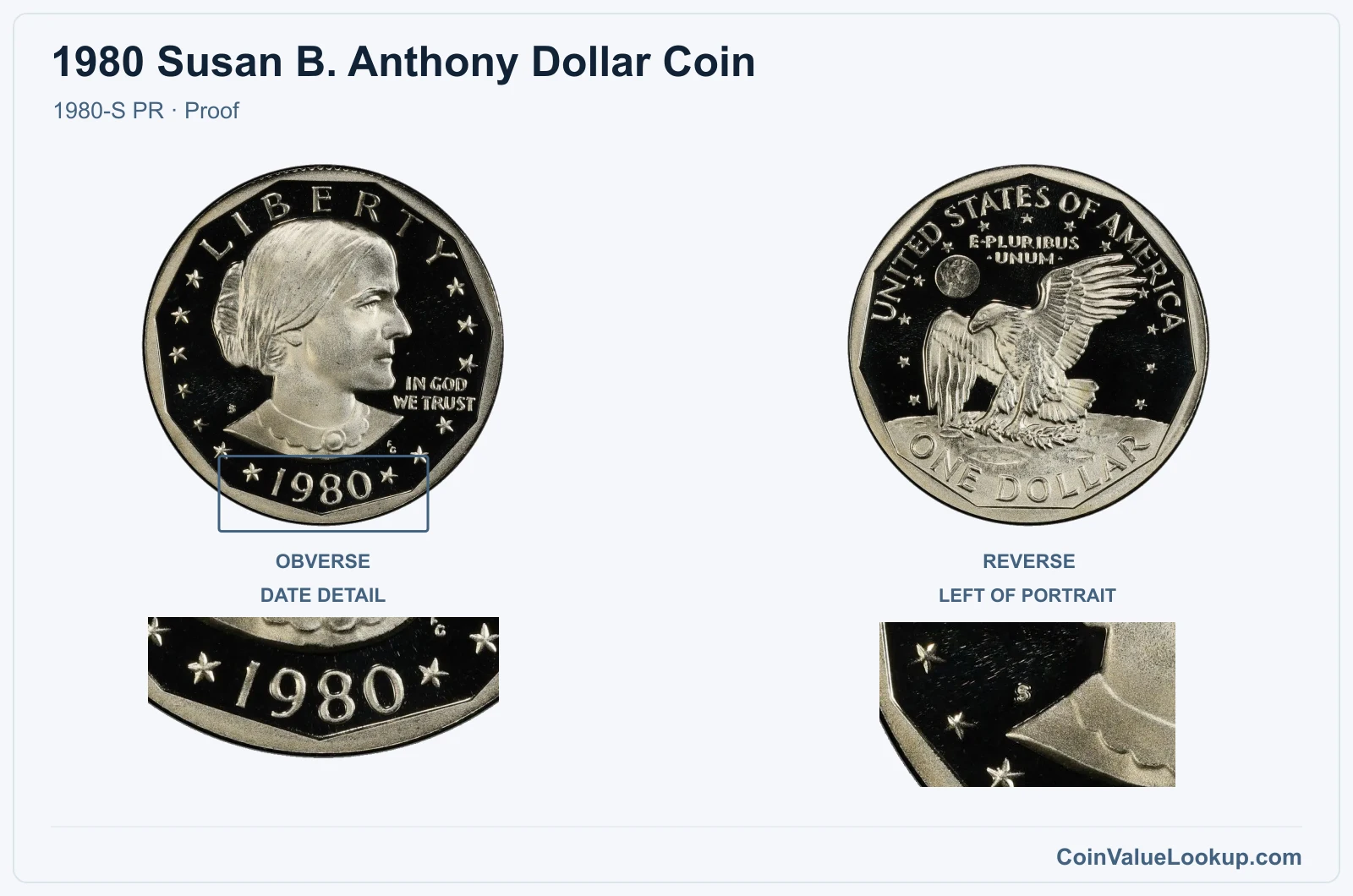
The 1980-S Proof was manufactured at San Francisco using polished dies and specially prepared planchets. A proof is a finish, not a grade above Mint State.
These coins typically display mirror-like fields and sharp design details. The USA Coin Book guide estimate is about $15.00 at PR65.
Most were sold in government proof sets, so finding one loose and with heavy hairlines suggests mishandling after purchase. Cameo contrast can add appeal, but the packet does not supply separate cameo pricing.
Match the mintmark, confirm the mirror finish, and grade hairlines and haze separately from design sharpness.
Range Grade
Price Auction Records Appraisal PR PR 1
—
Coin Identifier
PR 2
—
Coin Identifier
PR 3
—
Coin Identifier
PR 4
—
Coin Identifier
PR 6
—
Coin Identifier
PR 8
—
Coin Identifier
PR 10
—
Coin Identifier
PR 12
—
Coin Identifier
PR 15
—
Coin Identifier
PR 20
—
Coin Identifier
PR 25
—
Coin Identifier
PR 30
—
Coin Identifier
PR 35
—
Coin Identifier
PR 40
—
Coin Identifier
PR 45
—
Coin Identifier
PR 50
—
Coin Identifier
PR 53
—
Coin Identifier
PR 55
—
Coin Identifier
PR 58
—
Coin Identifier
PR 60
Coin Identifier
PR 61
—
Coin Identifier
PR 62
—
Coin Identifier
PR 63
—
Coin Identifier
PR 64
—
Coin Identifier
PR 65
—
Coin Identifier
PR 66
—
Coin Identifier
PR 67
Coin Identifier
PR 68
Coin Identifier
PR 69
Coin Identifier
PR 70
Coin Identifier
1980 Susan B. Anthony Dollar Error List
1. 1980 Susan B. Anthony Dollar — Repunched Mintmark
A repunched mintmark on the 1980-S occurs when the "S" was impressed more than once into the working die in slightly different positions. Under magnification, you may see traces of a second punch offset from the primary mintmark — a partial extra serif or a shadow outline alongside the main letter.
Do not confuse this with machine doubling, which leaves flat, shelf-like distortion rather than a distinct second impression. A die chip or localized corrosion around the mintmark can also mimic an extra punch.
Compare your coin to a normal 1980-S at the same magnification. Condition, the clarity of the secondary punch, and demand among variety collectors all affect value, but no specific price range is available here for this error.
2. 1980 Susan B. Anthony Dollar — Wrong Planchet / Off-Metal Strike
A wrong planchet error means the 1980 Susan B. Anthony Dollar die struck a blank intended for a different denomination or possibly a different composition.
These are rare and dramatic when genuine.
To check, weigh and measure your coin carefully. A normal SBA dollar is 8.10 grams and 26.50 mm.
If your coin deviates significantly in weight, diameter or edge character while still showing the Anthony design, a wrong-planchet strike is possible. The design may be incomplete if the blank was smaller than intended.
Watch out for coins that have been plated, acid-treated, corroded or deliberately altered to look unusual. Those post-mint changes do not qualify.
No specific price is available here; value depends on the specific wrong planchet, condition and verification.
3. 1980 Susan B. Anthony Dollar — Off-Center Strike
An off-center strike happens when the planchet is not properly seated between the dies. The result is a displaced design with an unstruck crescent of blank metal on one side.
A small percentage off-center may be subtle, while a large shift is obvious.
The most collectible off-center errors still show a readable date, because that confirms the year. Without the date, attribution gets harder and desirability drops.
Look for a smooth, unstruck crescent — not a rough or filed edge, which would suggest post-mint damage.
Do not confuse a clipped planchet or one-sided die misalignment with an off-center strike. Value depends on the degree of misalignment, date visibility, and overall condition.
No adopted price range is available for this error.
4. 1980 Susan B. Anthony Dollar — Broadstrike
A broadstrike occurs when the coin is struck without the normal retaining collar that forms the reeded edge. The metal spreads outward under pressure, producing a coin that is wider than normal with a smooth or irregular rim instead of clean reeding.
The full design is usually present, which distinguishes a broadstrike from an off-center strike where part of the design is missing entirely. Check the edge carefully: a genuine broadstrike will lack the standard reeded edge pattern and the coin's diameter will exceed the normal 26.50 mm.
Coins flattened after minting — by a train, a vise or similar abuse — can look superficially similar but usually show distortion inconsistent with a single die strike. No specific price is available for this error; value depends on the degree of spread and the coin's condition.
5. 1980 Susan B. Anthony Dollar — Double / Multiple Strike
A multiple-strike error on a 1980 Susan B. Anthony Dollar means the coin received two or more impressions from the dies.
Each successive strike may land in a different position or at a different rotation, producing overlapping or displaced design elements that are clearly separate from one another.
This is different from a doubled die, which is a single strike from a die that already carries doubled features. On a multiple-strike coin, you should see distinct, often dramatically offset, repetitions of the entire design rather than just slightly thickened lettering.
Post-mint alterations — someone pressing a coin against another object — can create misleading impressions. Genuine multiple strikes show consistent metal flow from the minting process.
Value varies with the number of strikes, their visual impact and condition, but no adopted price is available here.
6. 1980 Susan B. Anthony Dollar — Clipped Planchet
A clipped planchet error means a portion of the blank was missing before the coin was struck. The clip can be curved, straight or ragged depending on how the blank was mis-punched from the metal strip at the mint.
Look for a section of the coin that is simply absent, with the adjacent edge showing a smooth, natural contour rather than tool marks. Metal flow from the strike often creates a weak area in the design directly opposite the clip, which is a useful confirmation.
Filed notches, deliberate edge cuts and corrosion-eaten edges are common lookalikes. Those will lack the characteristic opposite-side weakness and usually show rough or inconsistent metal texture.
Condition and the size of the clip affect value, but no specific price is available here.
7. 1980 Susan B. Anthony Dollar — Improper Annealing
Improper annealing is a planchet error caused by problems during the heat-treatment step before striking. The coin may display unusual surface discoloration, a dark or streaky appearance, or an abnormal texture that is unlike ordinary toning or wear.
To screen for this, compare the coin's surface and edge to a normal 1980 SBA dollar under the same lighting. Improperly annealed coins often have a distinctive woodgrain-like or blotchy pattern across the fields.
The main lookalikes are environmental toning from years in a damp holder, chemical corrosion and heat damage applied after minting. Surface appearance alone is a screening clue rather than proof of the cause, so professional evaluation is advisable for any coin you suspect.
No adopted price range is available for this error; value depends on the severity and overall condition.