1961 Franklin Half Dollar Coin Value: How Much Is It Worth?
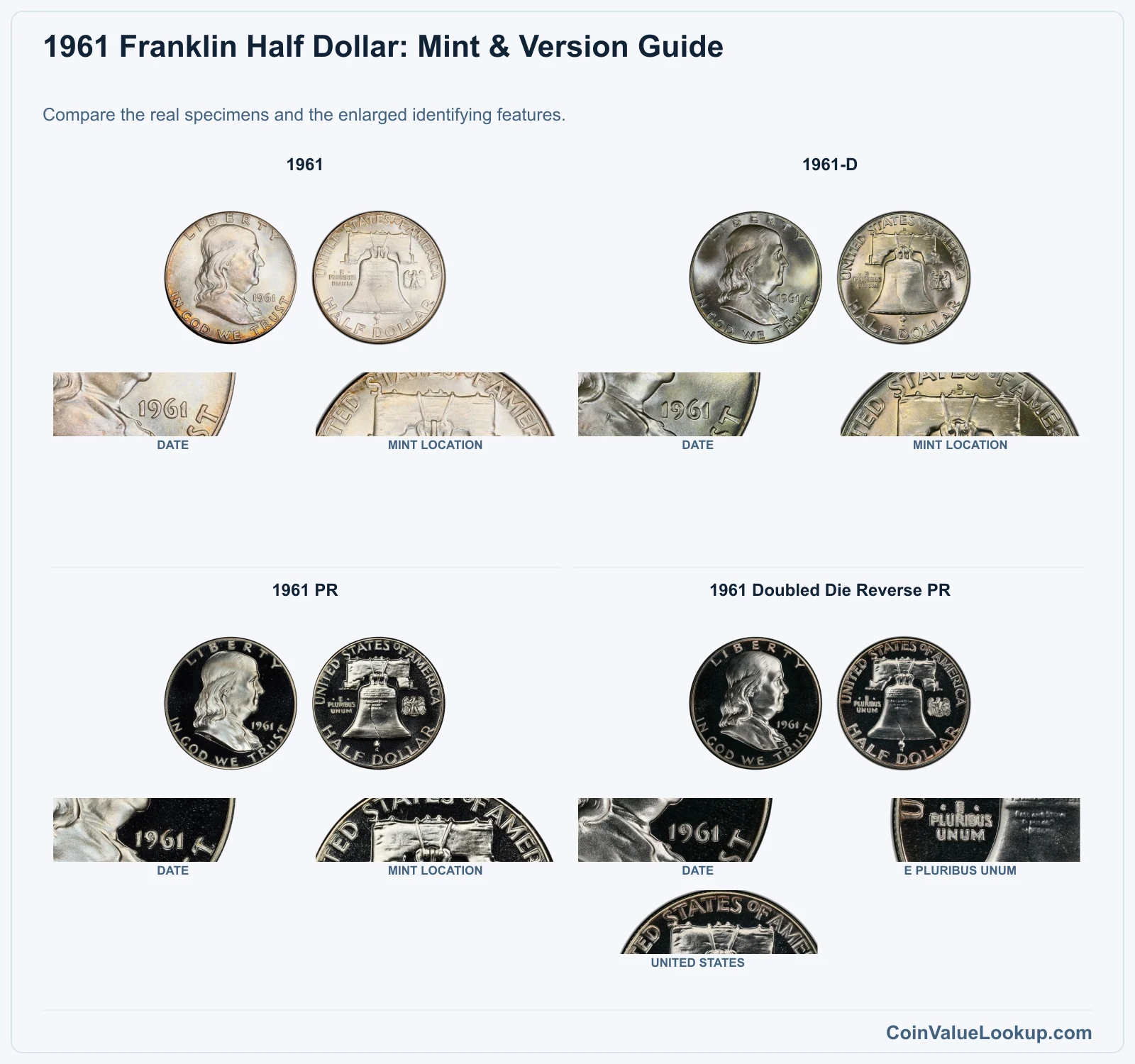
The 1961 Franklin Half Dollar is a 90% silver coin that still turns up in collections and estate finds regularly. Guide estimates for the year's branches range from about $32.00 in well-worn grades to around $140.00 for higher-end examples, depending on mint, condition and version.
These are guide anchors from USA Coin Book, not guaranteed sale prices or current silver-melt quotes. Proof issues and the listed doubled die reverse variety add further layers worth checking.
Fast Way to Identify Your 1961 Franklin Half Dollar
Want a quick read on what you have? Upload clear photos of the front and back of your 1961 Franklin Half Dollar and our identifier will give you a preliminary take on the version and condition.
It is not a substitute for professional authentication or certified grading, but it is a solid starting point before you dig deeper.
1961 Franklin Half Dollar Value
Upload both sides of your 1961 Franklin Half Dollar.
Front Obverse
Upload photo
Back Reverse
Upload photo
Which 1961 Franklin Half Dollar Versions Are Worth Money?
- The 1961-D business strike reaches an estimated $140.00 at MS65 per the USA Coin Book guide, the highest listed guide figure among the regular branches for this date.
- The 1961 Doubled Die Reverse proof is a recognized variety with no adopted price range; value depends on authenticated identity, condition and the strength of the doubling.
- Philadelphia business strikes in problem-free condition guide at $78.00 in MS65, well above the $32.00 Good-4 anchor, so condition improvement pays off.
- The 1961 proof at PR65 guides around $48.00, but proofs with strong cameo contrast or minimal hairlines may command individual premiums beyond the standard guide figure.
Step 1: Identify Your 1961 Franklin Half Dollar Mint Mark and Version
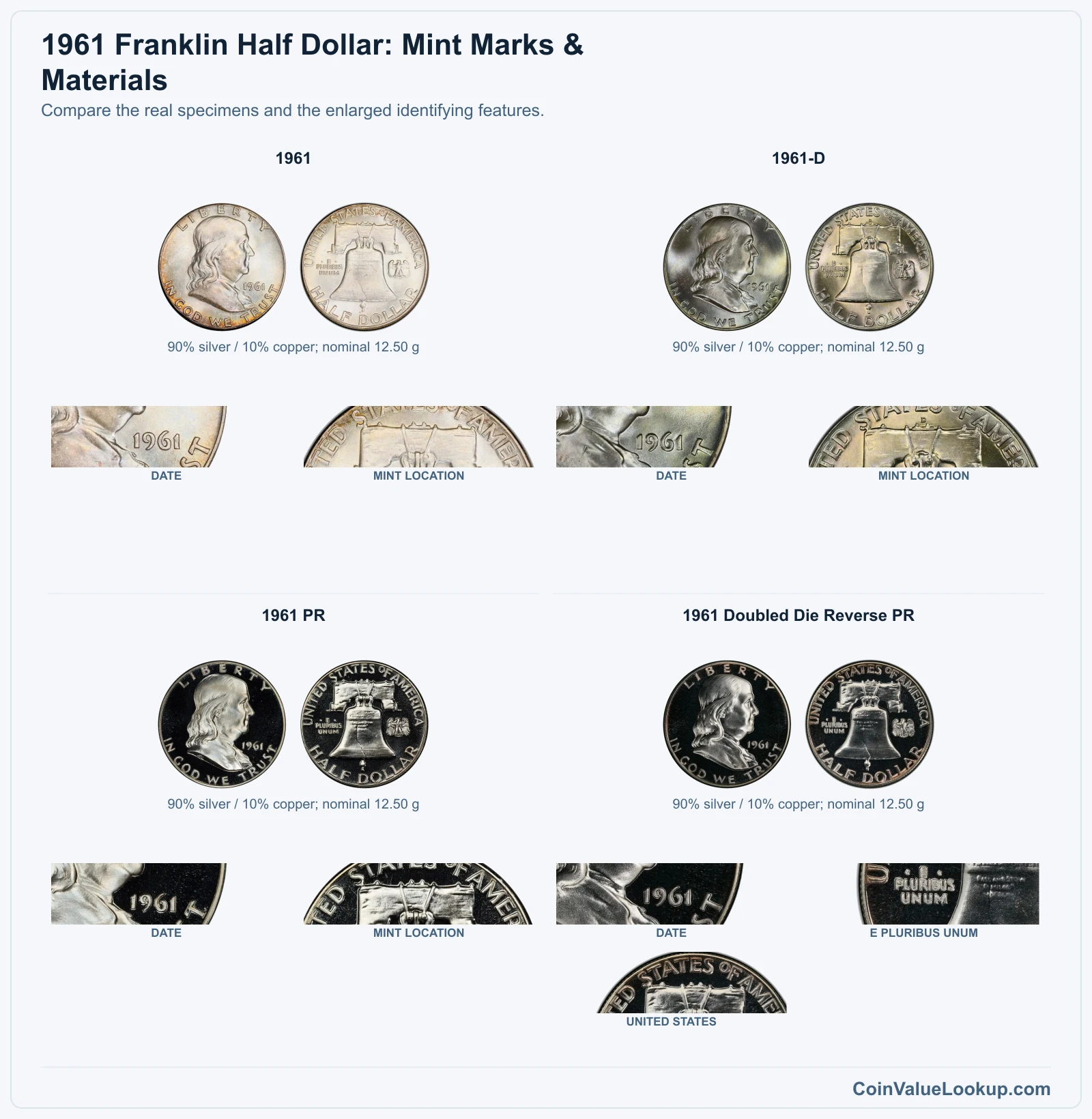
Four branches exist for this date: the 1961 Philadelphia business strike, the 1961-D Denver business strike, the 1961 Philadelphia proof, and the 1961 Doubled Die Reverse proof.
Flip the coin over and look above the Liberty Bell, just below the words E PLURIBUS UNUM. If there is no mintmark, the coin was struck at Philadelphia.
A small "D" means Denver.
Separating a proof from a business strike matters here. Genuine proofs have deeply mirrored fields and razor-sharp design details.
A polished circulated coin is not a proof, no matter how shiny it looks.
The alloy is 90% silver and 10% copper, weighing a nominal 12.50 grams. Toning may change the surface color but does not alter the underlying metal.
Cleaned or damaged coins carry less value than problem-free examples of the same grade, even though the silver content is identical.
Step 2: Check Your 1961 Franklin Half Dollar Grade
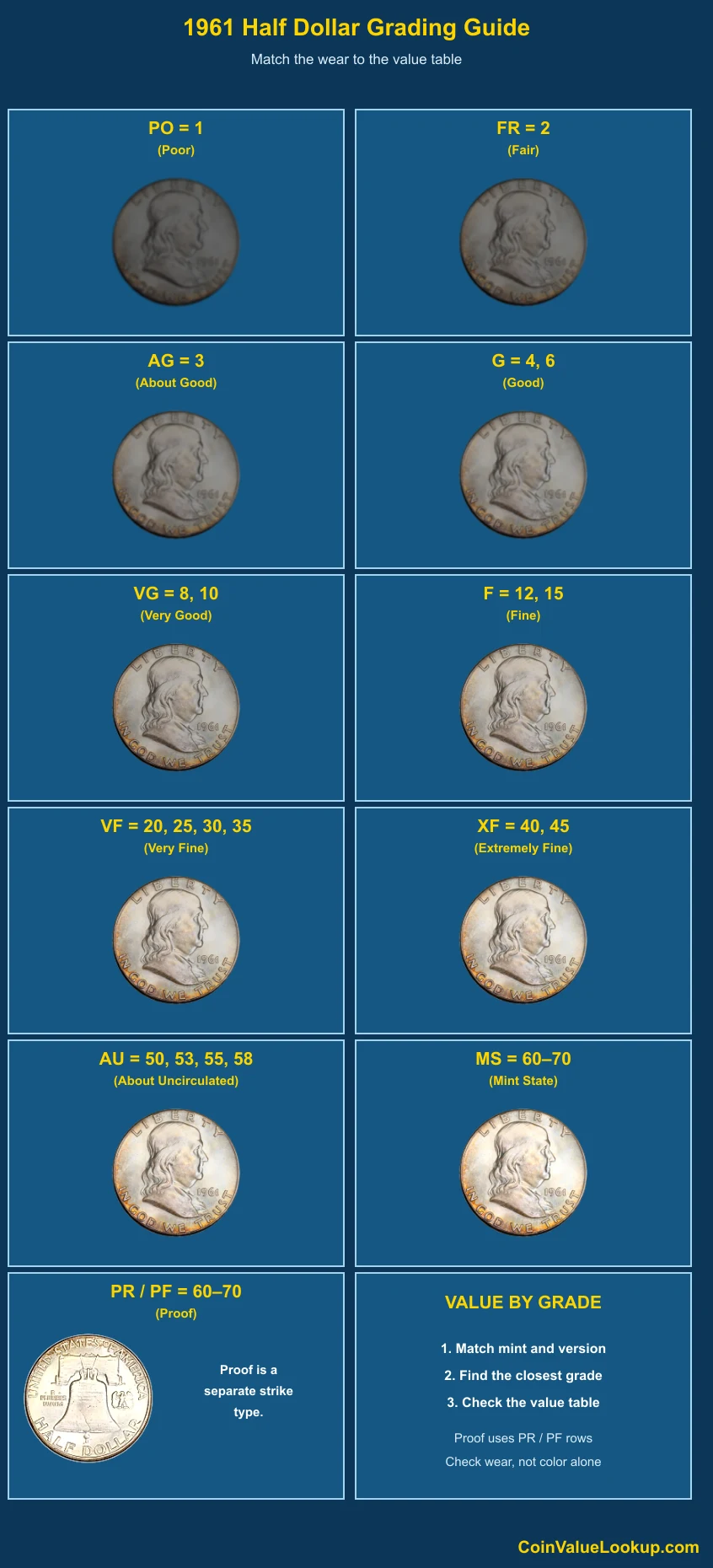
Start with Franklin's cheek and the hair just behind his ear. On a lightly circulated coin these areas show the first flattening.
A coin grading around Good-4 will have major design outlines visible but most fine detail gone.
Move to the shoulder area and then flip to the reverse. Check the lettering around the Liberty Bell, the rim sharpness, and the lower bell lines.
Full Bell Lines is a strike-detail designation that can add a premium, but it requires complete, unbroken lines at the bottom of the bell under magnification. It is not a separate mint or metal, just a quality filter on the strike.
Contact marks are different from wear. Look for scattered bag marks on the cheek and fields versus the smooth, even loss that comes from circulation.
The comparison image for this type helps you calibrate where your coin falls.
For proofs, grade the surfaces separately. Hairlines from improper handling, haze and the degree of cameo contrast between frosted devices and mirrored fields all matter.
A proof with heavy hairlines can grade lower than a sharp business strike.
Step 3: Check 1961 Franklin Half Dollar Value by Mint and Version
1961 Franklin Half Dollar
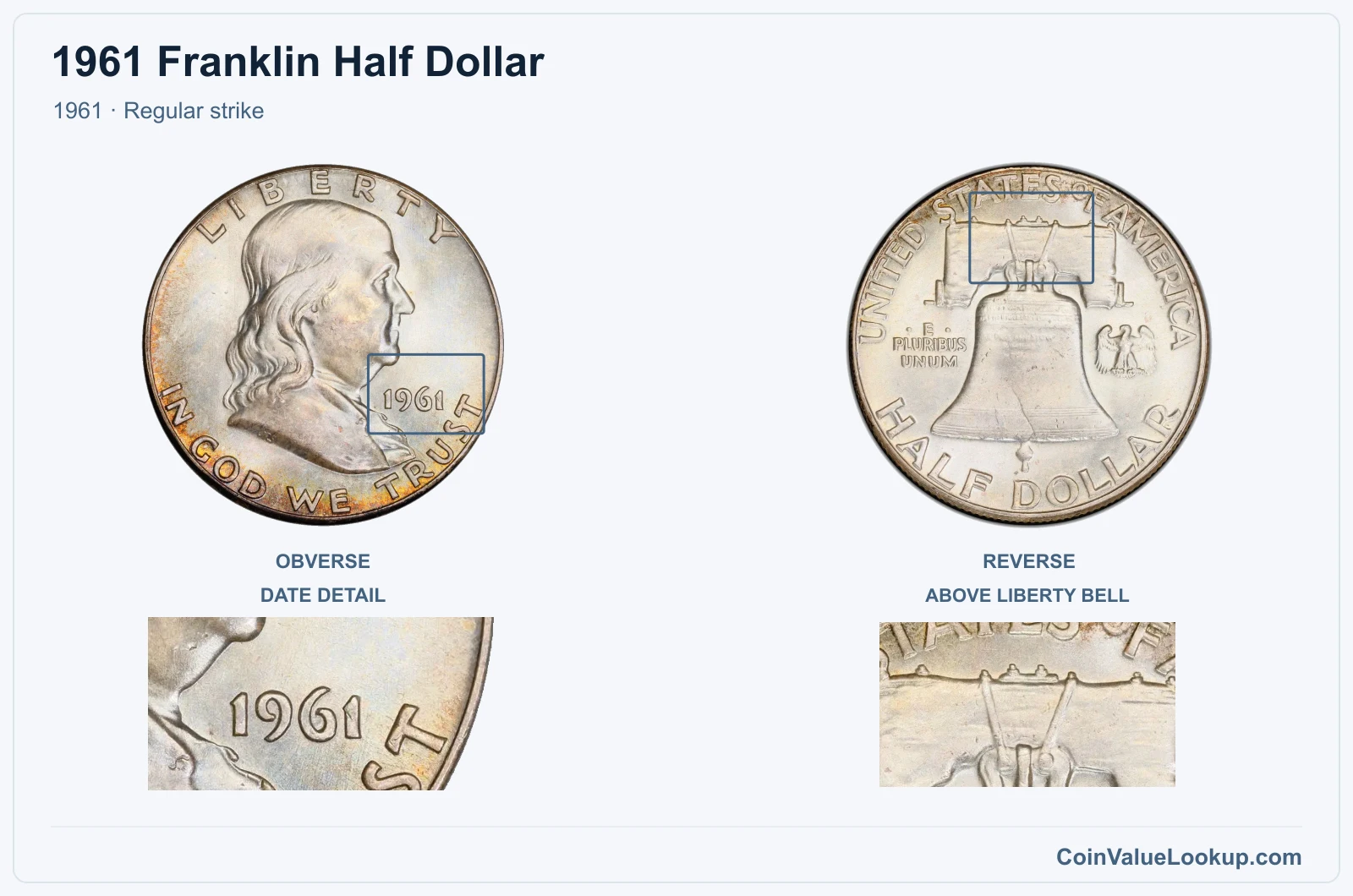
The 1961 Philadelphia business strike has no mintmark on the reverse. It carries the standard Franklin portrait obverse and Liberty Bell reverse shared by the series.
In heavily worn condition around Good-4, the USA Coin Book guide places this coin at roughly $32.00. Jump to Mint State 65 and the same guide lists about $78.00.
The silver content provides a floor, but cleaned or damaged pieces do not match problem-free examples even at the same technical grade.
Full Bell Lines can push the premium higher on well-struck examples, though the FBL designation applies to strike quality, not a different coin type. Confirm original surfaces and accurate grade before comparing to any chart.
Range Grade
Price Auction Records Appraisal PO PO 1
—
Coin Identifier FR FR 2
—
Coin Identifier AG AG 3
—
Coin Identifier G G 4
—
Coin Identifier
G 6
—
Coin Identifier VG VG 8
—
Coin Identifier
VG 10
—
Coin Identifier F F 12
—
Coin Identifier
F 15
—
Coin Identifier VF VF 20
—
Coin Identifier
VF 25
—
Coin Identifier
VF 30
—
Coin Identifier
VF 35
—
Coin Identifier XF XF 40
—
Coin Identifier
XF 45
—
Coin Identifier AU AU 50
—
Coin Identifier
AU 53
—
Coin Identifier
AU 55
Coin Identifier
AU 58
—
Coin Identifier MS MS 60
Coin Identifier
MS 61
—
Coin Identifier
MS 62
Coin Identifier
MS 63
Coin Identifier
MS 64
Coin Identifier
MS 65
Coin Identifier
MS 66
Coin Identifier
MS 67
—
—
—
MS 68
—
—
—
MS 69
—
—
—
MS 70
—
—
—
1961 Franklin Half Dollar — D
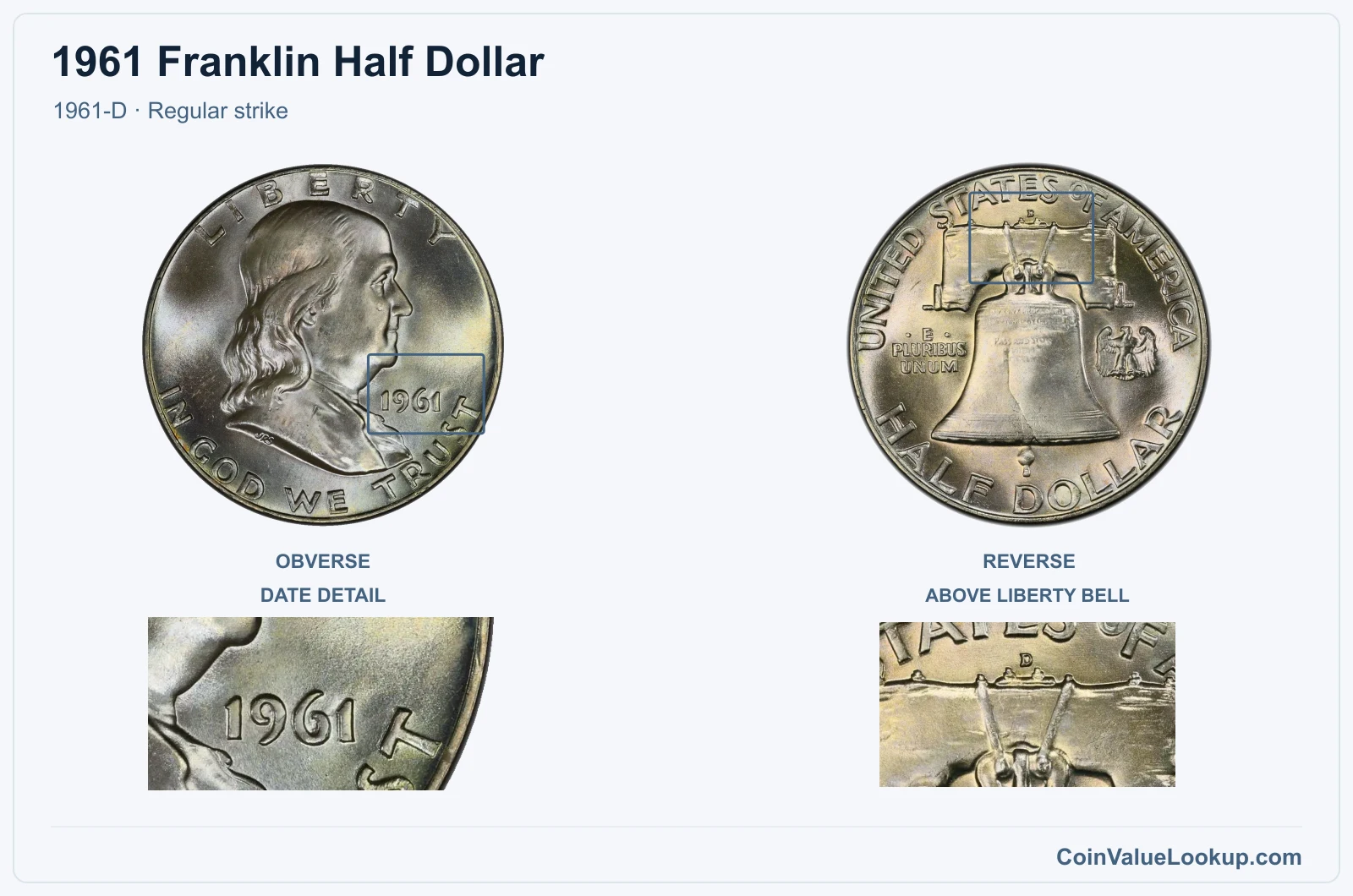
Look for the small "D" mintmark above the Liberty Bell on the reverse. The Denver issue is the higher-valued business strike for 1961.
USA Coin Book guides this at $32.00 in Good-4 and $140.00 in MS65. That MS65 number is the top listed guide figure among the regular branches for the year, which makes well-preserved Denver coins worth a careful second look.
Coin Value Lookup is a good place to compare values across different Franklin Half Dollar dates and mints if you are building a set or just curious about what else is out there.
As always, silver content sets a baseline, but original surfaces and the absence of cleaning or damage matter. Full Bell Lines examples, confirmed under magnification, carry additional appeal among specialists.
Range Grade
Price Auction Records Appraisal PO PO 1
—
Coin Identifier FR FR 2
—
Coin Identifier AG AG 3
—
Coin Identifier G G 4
—
Coin Identifier
G 6
—
Coin Identifier VG VG 8
—
Coin Identifier
VG 10
—
Coin Identifier F F 12
—
Coin Identifier
F 15
—
Coin Identifier VF VF 20
—
Coin Identifier
VF 25
—
Coin Identifier
VF 30
—
Coin Identifier
VF 35
—
Coin Identifier XF XF 40
—
Coin Identifier
XF 45
—
Coin Identifier AU AU 50
—
Coin Identifier
AU 53
Coin Identifier
AU 55
Coin Identifier
AU 58
Coin Identifier MS MS 60
—
Coin Identifier
MS 61
Coin Identifier
MS 62
Coin Identifier
MS 63
Coin Identifier
MS 64
Coin Identifier
MS 65
Coin Identifier
MS 66
Coin Identifier
MS 67
Coin Identifier
MS 68
—
—
—
MS 69
—
—
—
MS 70
—
—
—
1961 Franklin Half Dollar — PR
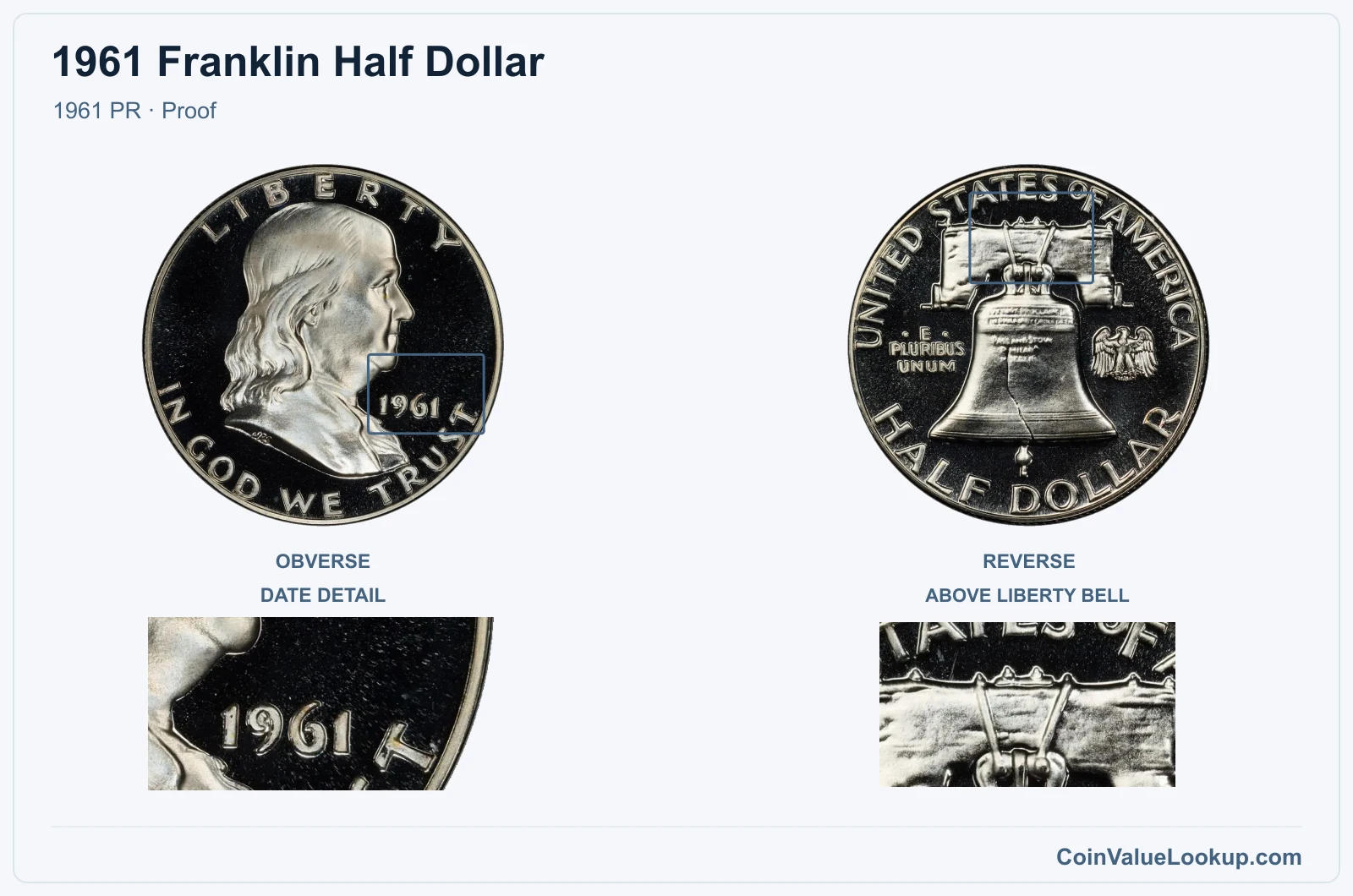
The 1961 proof was struck at Philadelphia with no mintmark, using specially prepared dies and planchets. Fields should be deeply mirrored and devices sharp.
At PR65, the USA Coin Book guide lists approximately $48.00. Proofs with heavier hairlines or haze will grade lower.
Those with strong cameo contrast between frosted devices and mirror fields may earn individual premiums, though no separate cameo price is adopted here.
Do not confuse a polished circulated coin with a proof. The difference is in the manufacturing process, not how much someone buffed it afterward.
Examine the fields under a light source: a genuine proof reflects like a dark mirror.
Range Grade
Price Auction Records Appraisal PR PR 1
—
Coin Identifier
PR 2
—
Coin Identifier
PR 3
—
Coin Identifier
PR 4
—
Coin Identifier
PR 6
—
Coin Identifier
PR 8
—
Coin Identifier
PR 10
—
Coin Identifier
PR 12
—
Coin Identifier
PR 15
—
Coin Identifier
PR 20
—
Coin Identifier
PR 25
—
Coin Identifier
PR 30
—
Coin Identifier
PR 35
—
Coin Identifier
PR 40
—
Coin Identifier
PR 45
—
Coin Identifier
PR 50
—
Coin Identifier
PR 53
—
Coin Identifier
PR 55
Coin Identifier
PR 58
—
Coin Identifier
PR 60
—
Coin Identifier
PR 61
—
Coin Identifier
PR 62
Coin Identifier
PR 63
Coin Identifier
PR 64
Coin Identifier
PR 65
Coin Identifier
PR 66
Coin Identifier
PR 67
Coin Identifier
PR 68
Coin Identifier
PR 69
Coin Identifier
PR 70
—
—
—
1961 Franklin Half Dollar — Doubled Die Reverse PR
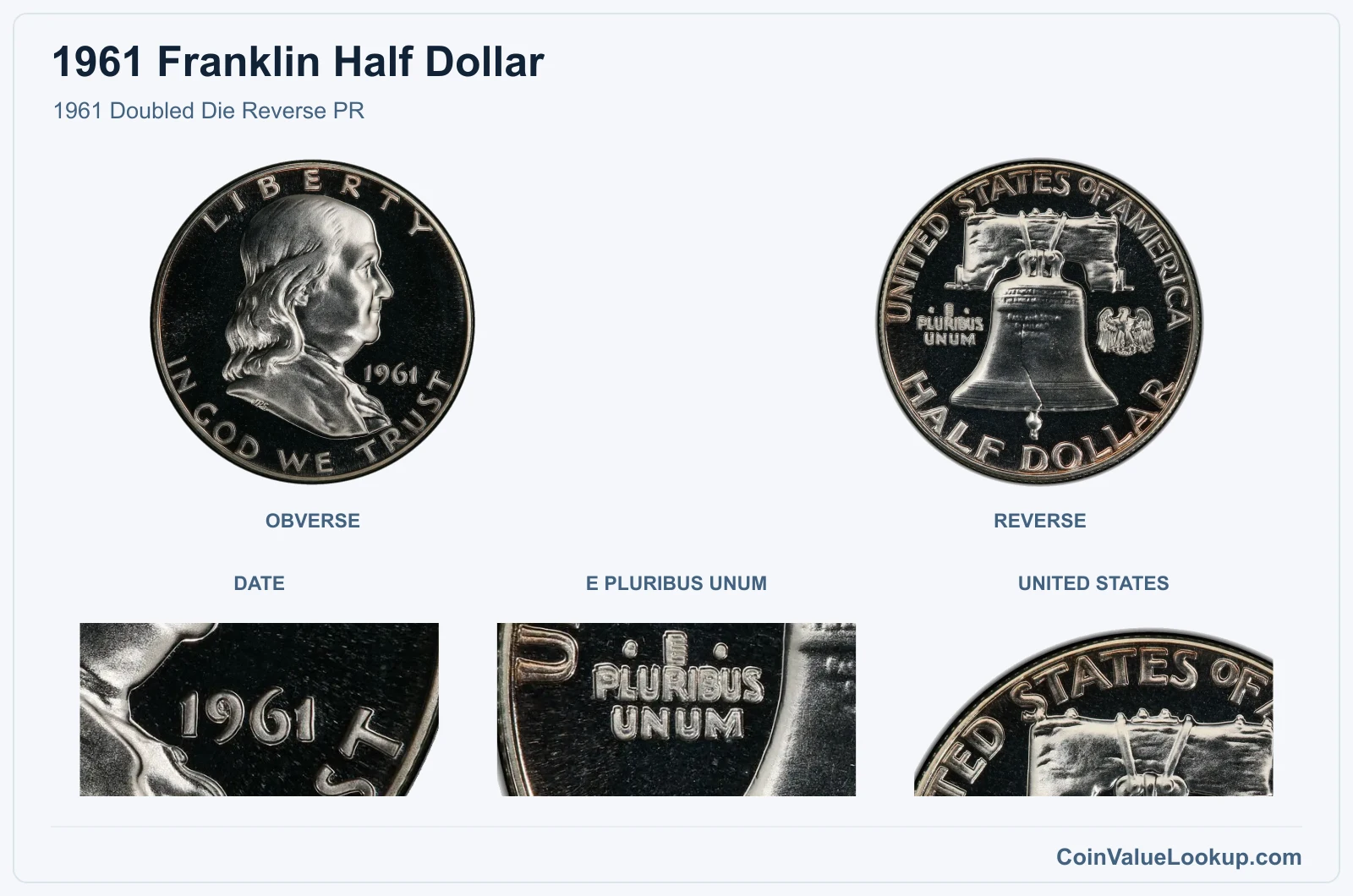
This is a proof-only doubled die reverse variety from the Philadelphia mint. The coin shares the mirrored fields and sharp devices of a standard 1961 proof, but the reverse die was impressed more than once at slightly different angles, leaving visible doubling in the lettering.
To check for it, magnify the reverse legends and compare them against a normal 1961 proof. True die doubling produces a consistent spread across the affected elements.
It looks different from flat, shelf-like mechanical doubling, which is a less significant strike anomaly.
No adopted numerical price range is available for this variety. Value depends on the authenticated identity of the die, the strength and visibility of the doubling, and the overall condition of the proof surfaces.
Individual assessment by a qualified grading service is the practical path to establishing what a specific example is worth.
Range Grade
Price Auction Records Appraisal PR PR 1
—
Coin Identifier
PR 2
—
Coin Identifier
PR 3
—
Coin Identifier
PR 4
—
Coin Identifier
PR 6
—
Coin Identifier
PR 8
—
Coin Identifier
PR 10
—
Coin Identifier
PR 12
—
Coin Identifier
PR 15
—
Coin Identifier
PR 20
—
Coin Identifier
PR 25
—
Coin Identifier
PR 30
—
Coin Identifier
PR 35
—
Coin Identifier
PR 40
—
Coin Identifier
PR 45
—
Coin Identifier
PR 50
—
Coin Identifier
PR 53
—
Coin Identifier
PR 55
—
Coin Identifier
PR 58
—
Coin Identifier
PR 60
Coin Identifier
PR 61
—
Coin Identifier
PR 62
—
Coin Identifier
PR 63
—
Coin Identifier
PR 64
Coin Identifier
PR 65
Coin Identifier
PR 66
Coin Identifier
PR 67
Coin Identifier
PR 68
Coin Identifier
PR 69
—
—
—
PR 70
—
—
—
1961 Franklin Half Dollar Error List
1. 1961 Franklin Half Dollar — Doubled Die Reverse
A Doubled Die Reverse has been reported on the 1961 proof Franklin Half Dollar. The doubling appears in the reverse legends and design contours, caused by a misaligned hub impression during die production.
To look for it, place your coin under magnification and compare the reverse lettering to a known normal proof. Consistent, uniform spread across multiple letters is the hallmark of genuine die doubling.
Machine doubling, by contrast, tends to produce flat, shelf-like displacement without the same crisp secondary image.
Reflections on proof surfaces can also mimic doubling under certain lighting, so tilt the coin and observe whether the apparent spread moves with the light or stays fixed. If it stays fixed, it is part of the die.
No adopted price range is available. Value depends on visibility, condition and authenticated identification of the specific die.
2. 1961 Franklin Half Dollar — Bugs Bunny Die Clash
The so-called Bugs Bunny variety has been reported on the 1961 Franklin Half Dollar. It results from a die clash, where obverse and reverse dies strike each other without a planchet between them, transferring design elements onto the wrong die.
On affected coins, look at Franklin's mouth and lip area under magnification. You will see raised lines that resemble protruding teeth.
These marks come from the Liberty Bell's design elements imprinted onto the obverse die during the clash event.
Compare to a normal 1961 portrait side by side. Random scratches, raised lines from a damaged die, or post-mint contact can mimic the look, but the genuine clash marks follow predictable shapes corresponding to the reverse design.
No numerical price range is adopted for this variety. Condition, the clarity of the clash marks, and the specific mint all influence what a given example might bring.
3. 1961 Franklin Half Dollar — Off-Center Strike
Off-center strikes have been reported for the 1961 Franklin Half Dollar. This error occurs when the planchet is not properly seated in the collar before the dies come together, producing a displaced design with an unstruck crescent of blank metal along one edge.
The percentage of off-center shift and whether the date remains visible are the two biggest factors collectors care about. A coin struck 5% off-center is far less dramatic than one at 15% or more, and a missing date sharply reduces desirability.
Do not confuse an off-center strike with a clipped planchet, which shows a curved bite from the blank-cutting process, or with a coin that was flattened unevenly after leaving the mint. The off-center piece retains its full thickness in the struck area and shows no collar mark on the displaced side.
No adopted price range is available. Each example requires individual evaluation based on the degree of displacement and overall condition.
4. 1961 Franklin Half Dollar — Broadstrike
Broadstrikes have been reported on the 1961 Franklin Half Dollar. This error happens when the coin is struck outside the retaining collar that normally confines the metal and forms the reeded edge.
The result is a coin that spreads outward, appearing slightly larger in diameter with a distorted or absent rim.
To identify one, look at the edge profile. A genuine broadstrike will lack normal reeding and the design will extend closer to or beyond where the rim should be.
The full design is still present, just expanded.
A broadstrike is different from an off-center strike, where part of the design is missing entirely. It is also different from a coin that was hammered flat after minting, which would show irregular surface damage rather than clean outward metal flow from the strike.
No numerical price range is adopted. Value depends on the degree of spread, the visual impact and the coin's overall condition.