1987 Kennedy Half Dollar Coin Value: How Much Is It Worth?
The 1987 Kennedy half dollar carries a face value of 50 cents, and most circulated clad examples are worth exactly that. Collector guide estimates for well-preserved or proof specimens range from roughly $4.96 to $6.25, depending on the mint, finish and grade.
Before checking any price chart, you need to identify whether your coin is a Philadelphia business strike, a Denver business strike or a San Francisco proof — and whether it shows any mint-made errors.
Fast Way to Identify Your 1987 Kennedy Half Dollar
The quickest way to start figuring out what you have is to upload clear photos of the front and back of your coin. Our identifier can give you a preliminary read on the mint, finish and general condition.
Snap both sides under even lighting, avoid glare, and keep the coin flat. That gets you pointed in the right direction before diving into the details below.
1987 Kennedy Half Dollar Value
Upload both sides of your 1987 Kennedy Half Dollar.
Front Obverse
Upload photo
Back Reverse
Upload photo
Which 1987 Kennedy Half Dollar Versions Are Worth Money?
- Check the mintmark first — P, D or S tells you which version and price column to use.
- San Francisco proofs and high-grade original P or D coins are the branches most likely to carry a premium over face value.
- Mint-made errors such as doubled dies, clipped planchets and die breaks have been reported for 1987 and are worth inspecting for.
Step 1: Identify Your 1987 Kennedy Half Dollar Mint Mark and Version
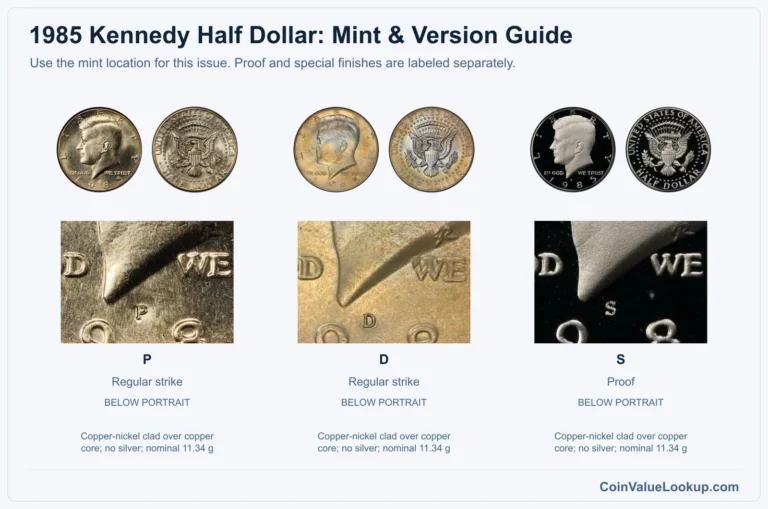
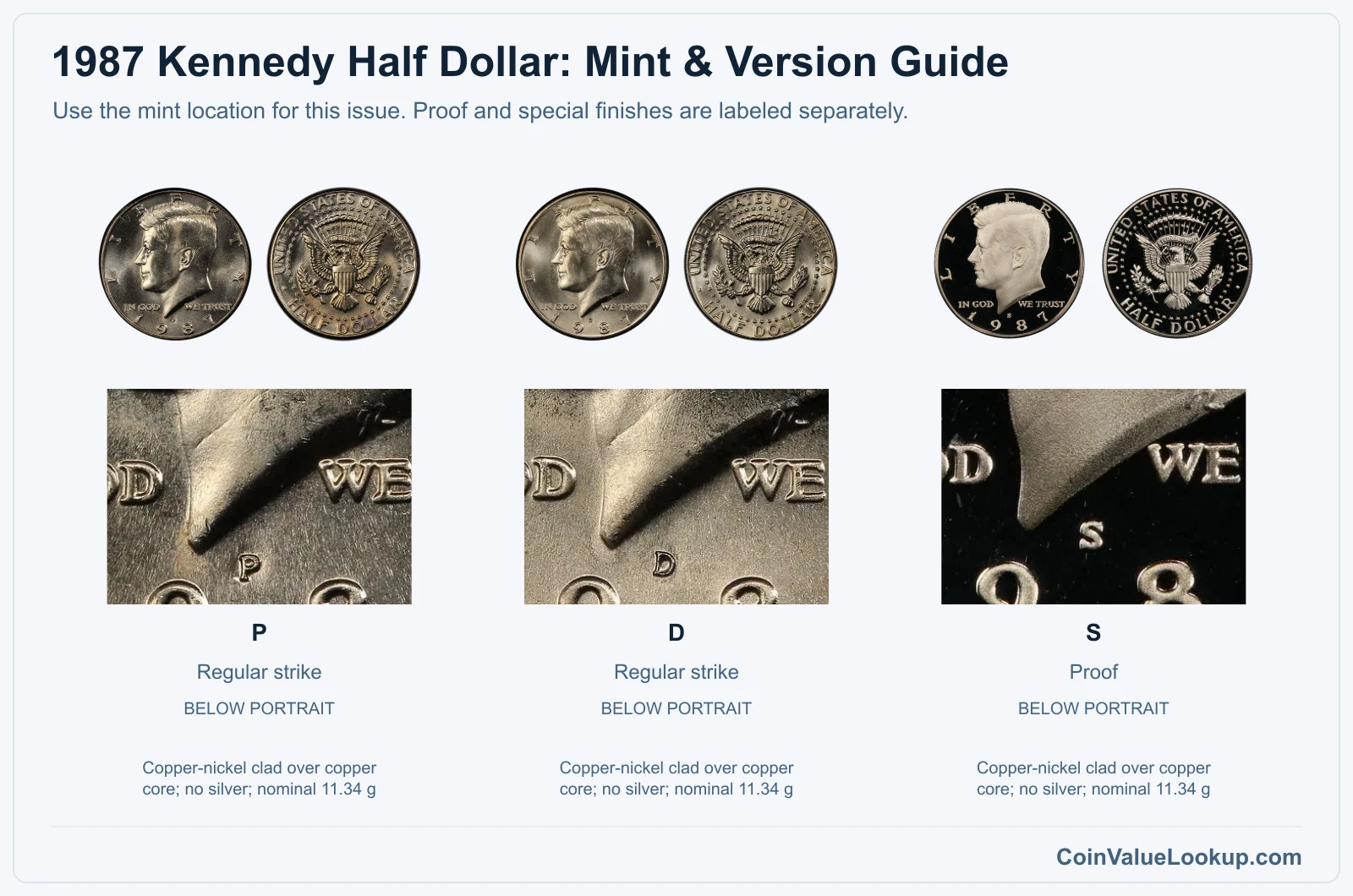
Flip the coin face-up and look just below Kennedy's portrait, above the date. That is where the mintmark sits.
A "P" means Philadelphia, a "D" means Denver, and an "S" means San Francisco. Philadelphia coins struck before 1980 carry no mintmark at all, but by 1987 the P was standard.
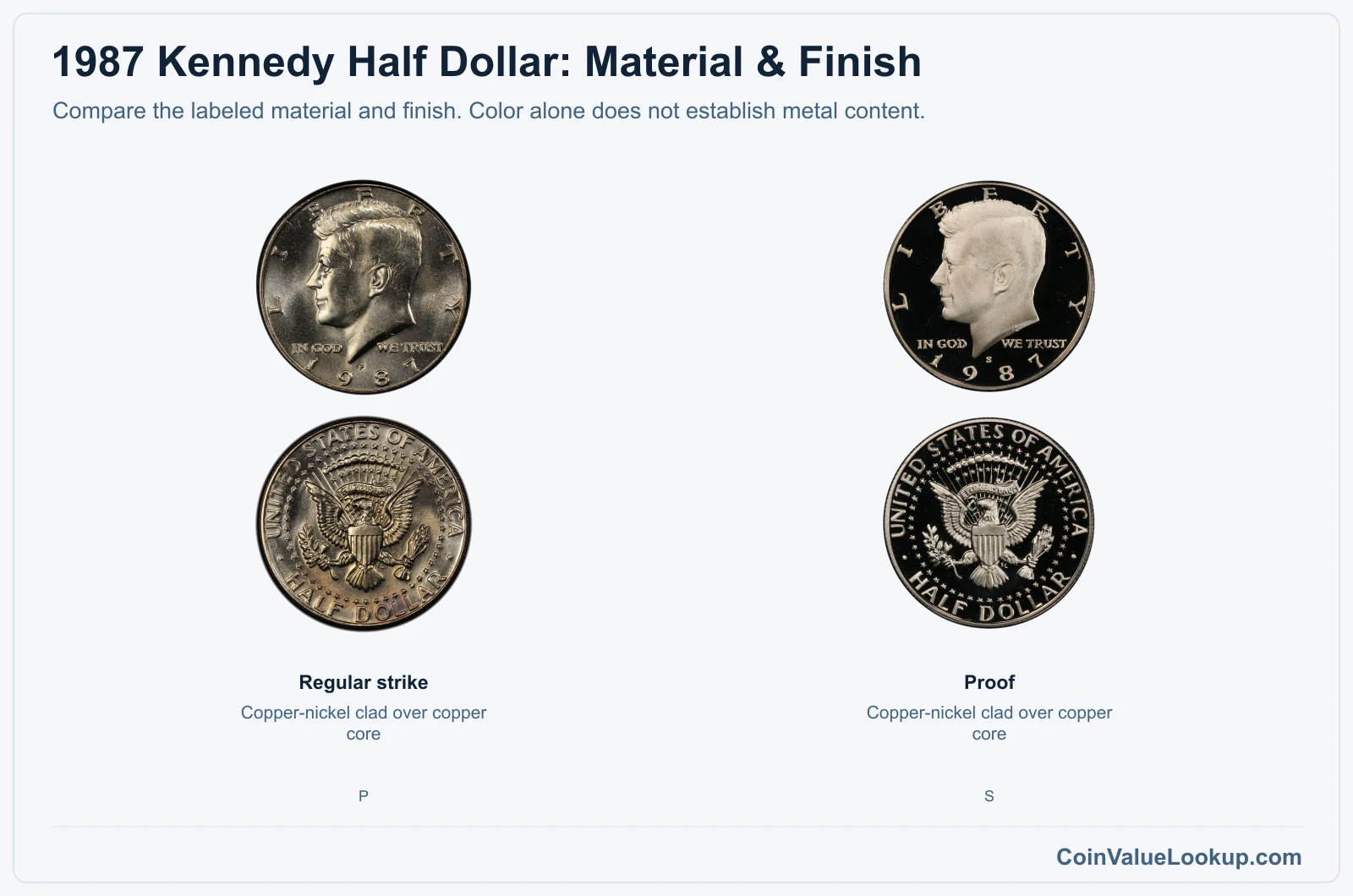
All three 1987 versions — P, D and S — are copper-nickel clad. None contain silver.
Do not assume a half dollar is silver just because it looks shiny or has edge toning; lighting and environmental exposure can fool you.
To double-check, look at the edge. A clad coin shows a visible copper-colored stripe sandwiched between the outer layers.
Weight should be around 11.34 grams. If you received the coin in a sealed government proof set with an "S" mintmark, you have the proof version.
Original packaging matters here.
Step 2: Check Your 1987 Kennedy Half Dollar Grade
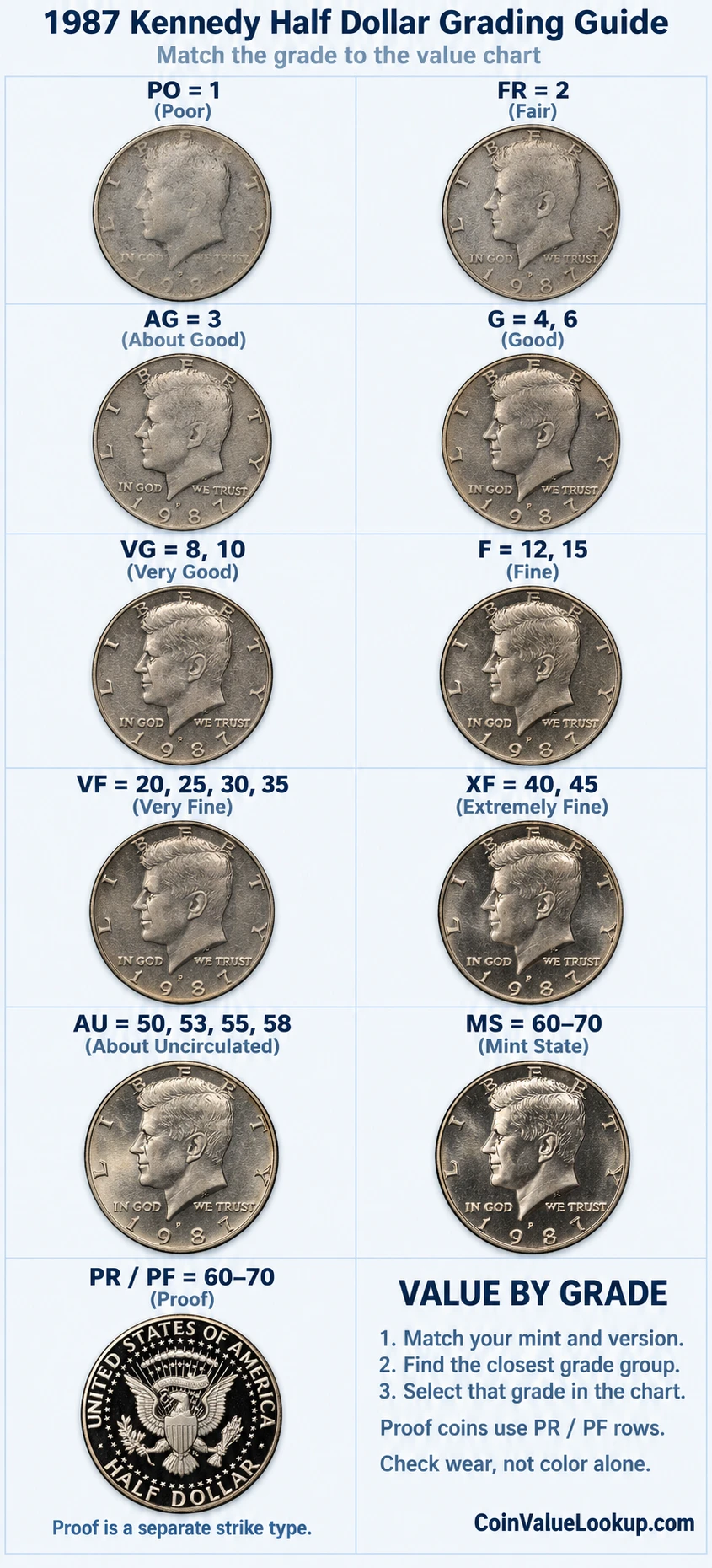
Start with Kennedy's cheek and jawline on the obverse. These are the highest points of the design and the first to show smoothing from wear.
Then look at the hair detail above his ear — on a well-preserved coin, individual strands are sharp and distinct.
On the reverse, check the eagle's breast feathers and the tops of the wings. Flat spots there signal moderate wear.
Do not confuse bag marks with circulation wear. Mint State coins pulled from original bags often have small nicks and contact marks from jostling against other coins.
Those lower the technical grade but are not the same as a coin that spent time in a cash register.
Proofs get their own treatment. Look for hairlines from improper handling, haze across the mirror fields, and contact marks on frosted devices.
A proof with heavy hairlines grades lower than one with clean, reflective surfaces. Use the comparison image to see how these differences look side by side on actual 1987 Kennedy halves.
Step 3: Check 1987 Kennedy Half Dollar Value by Mint and Version
1987 Kennedy Half Dollar — P — clad business
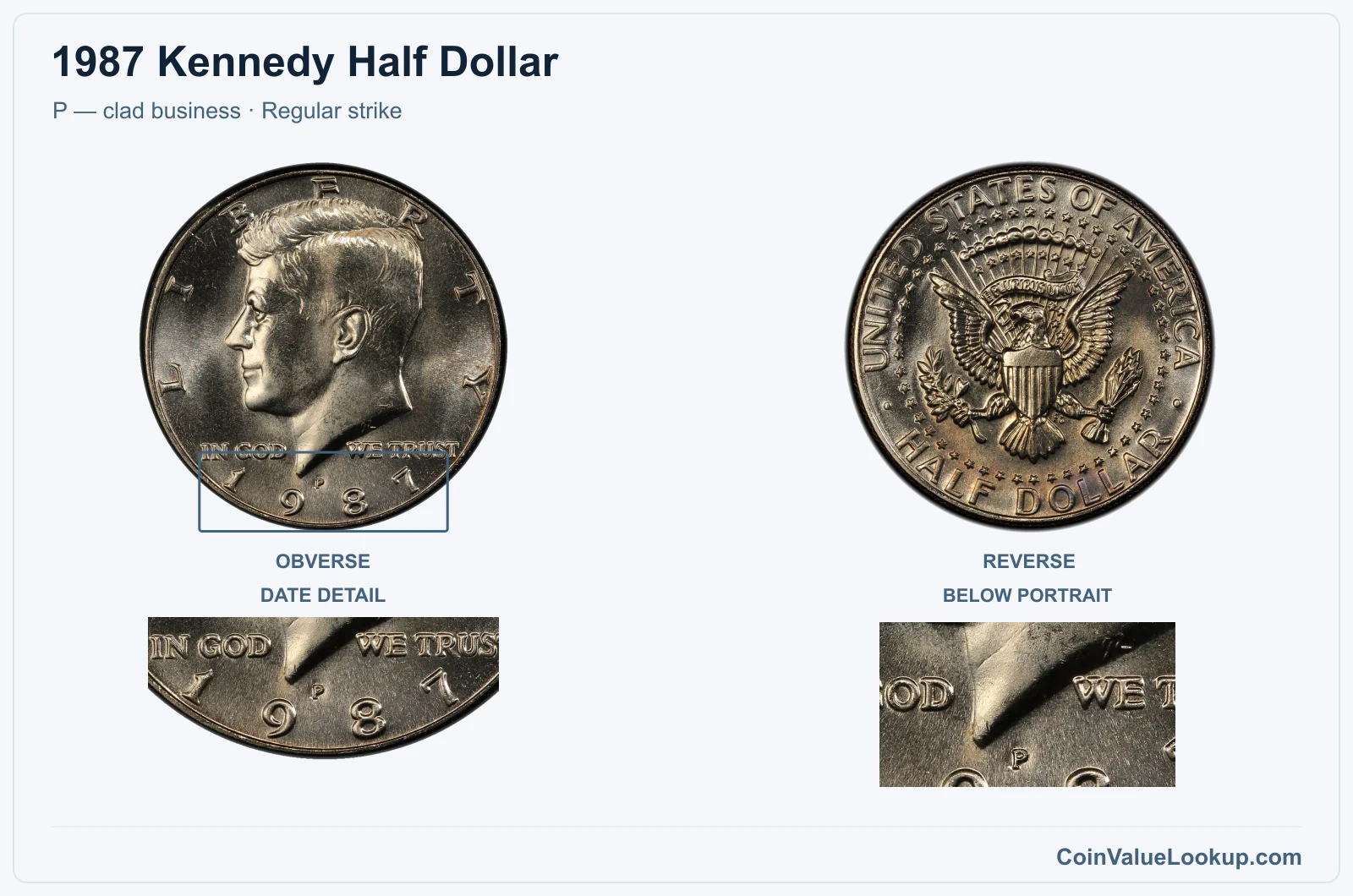
The 1987-P is a copper-nickel clad business strike from Philadelphia, identified by the small "P" below Kennedy's portrait. It was produced primarily for collector mint sets rather than mass circulation, so the total distribution is lower than many Kennedy half dollar dates.
That said, a lower mintage does not automatically make every example valuable.
Worn pieces are face-value coins. Where a coin survives in original, high-grade condition — think sharp hair detail, minimal bag marks, full luster — it enters collector territory.
A USA Coin Book guide estimate places an MS65 example at approximately $6.25. That is a guide figure, not a guaranteed offer; actual transaction prices depend on the individual coin.
Range Grade
Price Auction Records Appraisal PO PO 1
—
Coin Identifier FR FR 2
—
Coin Identifier AG AG 3
—
Coin Identifier G G 4
—
Coin Identifier
G 6
—
Coin Identifier VG VG 8
—
Coin Identifier
VG 10
—
Coin Identifier F F 12
—
Coin Identifier
F 15
—
Coin Identifier VF VF 20
—
Coin Identifier
VF 25
—
Coin Identifier
VF 30
—
Coin Identifier
VF 35
—
Coin Identifier XF XF 40
—
Coin Identifier
XF 45
—
Coin Identifier AU AU 50
—
Coin Identifier
AU 53
—
Coin Identifier
AU 55
—
Coin Identifier
AU 58
—
Coin Identifier MS MS 60
—
Coin Identifier
MS 61
—
Coin Identifier
MS 62
—
Coin Identifier
MS 63
Coin Identifier
MS 64
Coin Identifier
MS 65
Coin Identifier
MS 66
Coin Identifier
MS 67
Coin Identifier
MS 68
Coin Identifier
MS 69
—
—
—
MS 70
—
—
—
1987 Kennedy Half Dollar — D — clad business
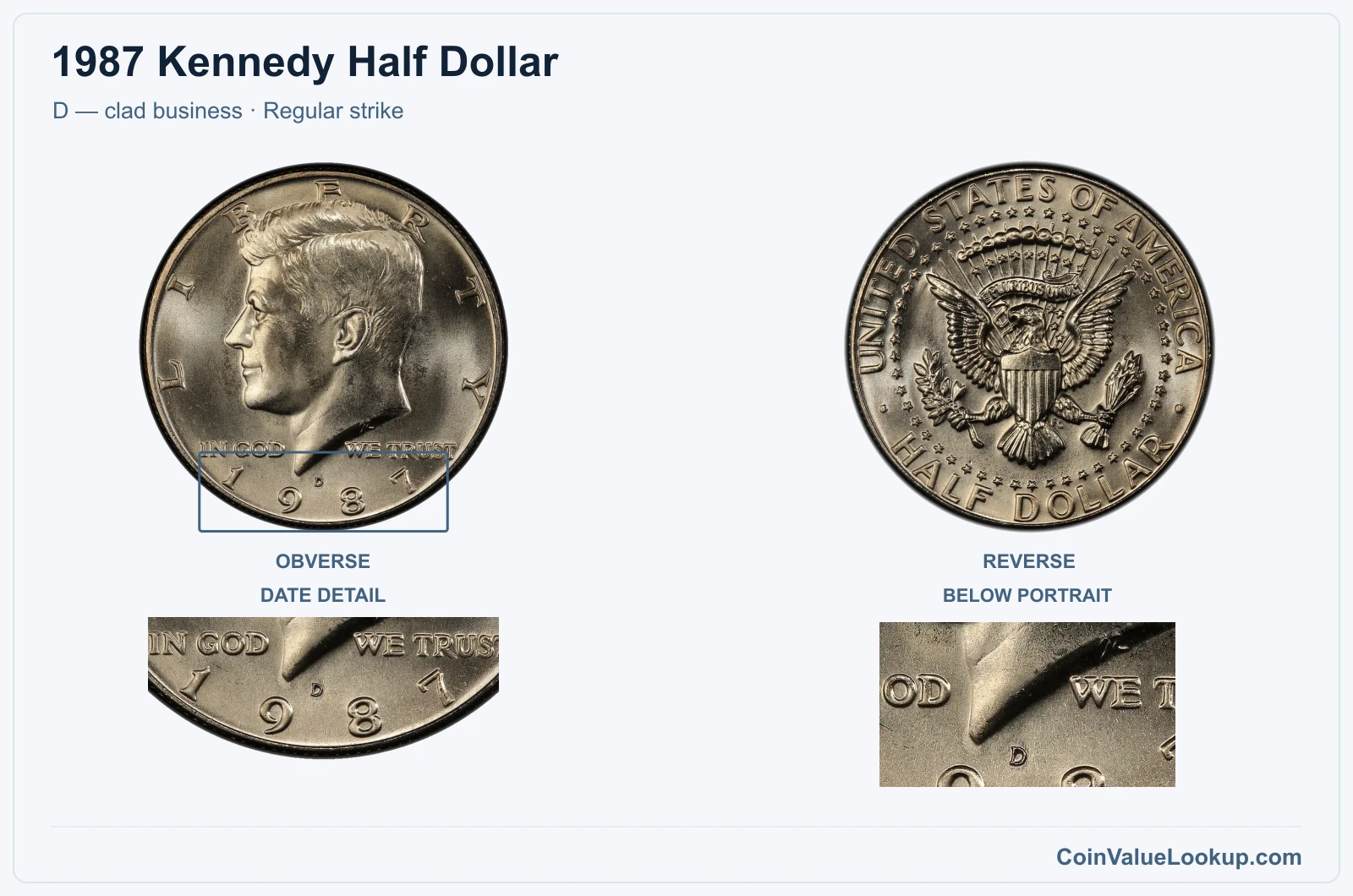
The 1987-D comes from Denver and carries a "D" mintmark beneath Kennedy's portrait. Same copper-nickel clad composition, same 11.34-gram target weight, same design.
Like its Philadelphia sibling, this date saw limited general circulation and was largely distributed through mint sets.
A circulated 1987-D is a 50-cent coin. Original high-grade survivors are where a modest premium appears.
The USA Coin Book guide estimate for MS65 is around $6.25. Condition is everything here — look for full strike detail on the hair and eagle, clean fields and strong original luster before expecting any premium above face value.
Coin Value Lookup is a good starting point if you are working through other dates or denominations in a collection. You can look up guides for different Kennedy half dollar years in one place.
Range Grade
Price Auction Records Appraisal PO PO 1
—
Coin Identifier FR FR 2
—
Coin Identifier AG AG 3
—
Coin Identifier G G 4
—
Coin Identifier
G 6
—
Coin Identifier VG VG 8
—
Coin Identifier
VG 10
—
Coin Identifier F F 12
—
Coin Identifier
F 15
—
Coin Identifier VF VF 20
—
Coin Identifier
VF 25
—
Coin Identifier
VF 30
—
Coin Identifier
VF 35
—
Coin Identifier XF XF 40
—
Coin Identifier
XF 45
—
Coin Identifier AU AU 50
—
Coin Identifier
AU 53
—
Coin Identifier
AU 55
—
Coin Identifier
AU 58
—
Coin Identifier MS MS 60
—
Coin Identifier
MS 61
—
Coin Identifier
MS 62
—
Coin Identifier
MS 63
—
Coin Identifier
MS 64
Coin Identifier
MS 65
Coin Identifier
MS 66
Coin Identifier
MS 67
Coin Identifier
MS 68
Coin Identifier
MS 69
—
—
—
MS 70
—
—
—
1987 Kennedy Half Dollar — S — clad proof
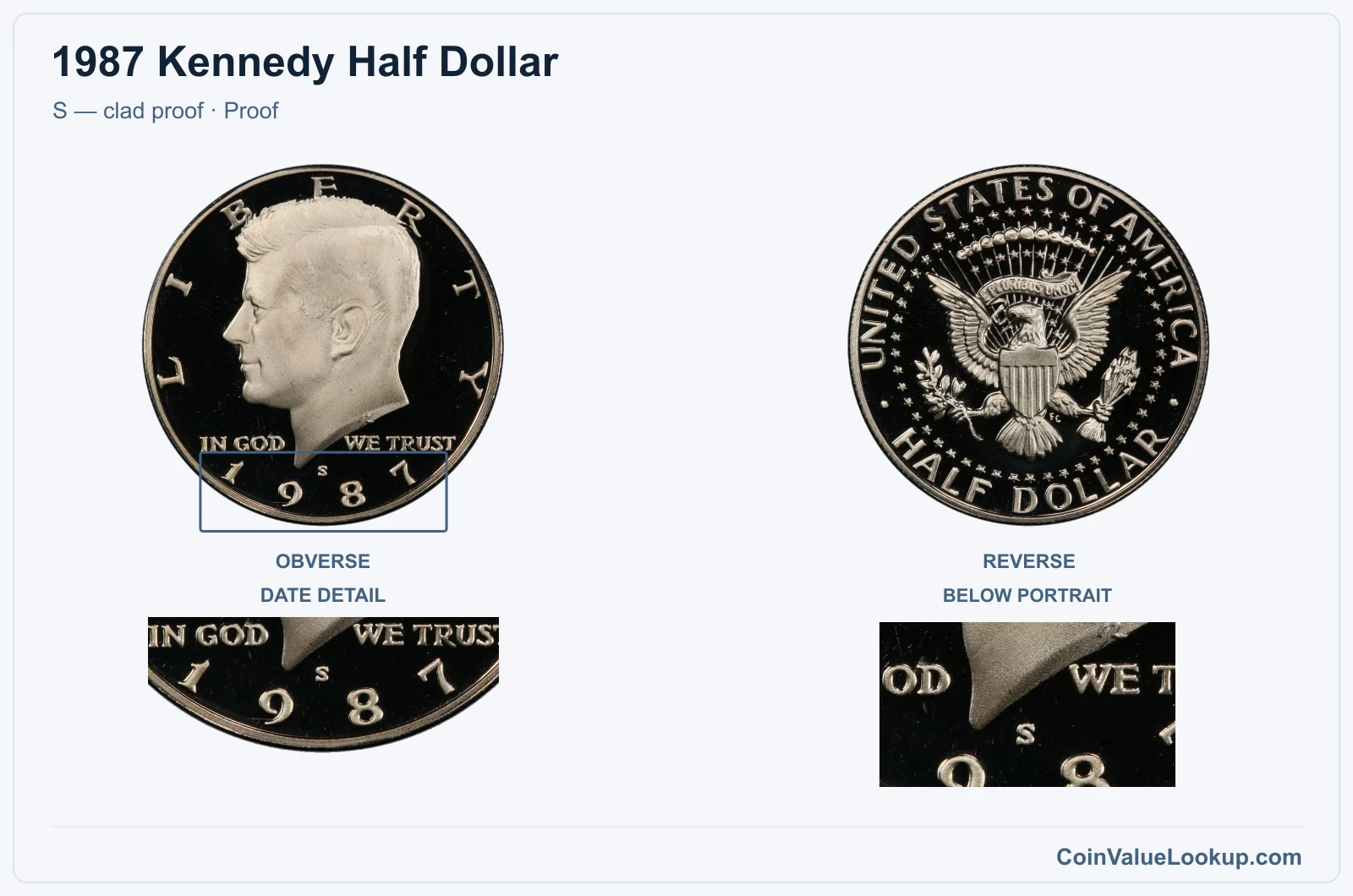
The 1987-S is a clad proof struck at the San Francisco Mint. It carries an "S" mintmark and was sold in sealed proof sets, not released into circulation.
The composition is still copper-nickel clad — no silver content.
You can spot a proof by its mirror-like fields and sharply frosted portrait and eagle devices. If those features are present and the coin came from an original government proof set, you almost certainly have the right version.
The USA Coin Book guide estimate places a PR65 example at about $4.96. Hairlines, haze and handling marks are the main grade-reducers for proofs, so a clean example will always be worth more than one that has been loose in a drawer for decades.
Range Grade
Price Auction Records Appraisal PR PR 1
—
Coin Identifier
PR 2
—
Coin Identifier
PR 3
—
Coin Identifier
PR 4
—
Coin Identifier
PR 6
—
Coin Identifier
PR 8
—
Coin Identifier
PR 10
—
Coin Identifier
PR 12
—
Coin Identifier
PR 15
—
Coin Identifier
PR 20
—
Coin Identifier
PR 25
—
Coin Identifier
PR 30
—
Coin Identifier
PR 35
—
Coin Identifier
PR 40
—
Coin Identifier
PR 45
—
Coin Identifier
PR 50
—
Coin Identifier
PR 53
—
Coin Identifier
PR 55
—
Coin Identifier
PR 58
—
Coin Identifier
PR 60
—
Coin Identifier
PR 61
—
Coin Identifier
PR 62
—
Coin Identifier
PR 63
—
Coin Identifier
PR 64
—
Coin Identifier
PR 65
—
Coin Identifier
PR 66
—
Coin Identifier
PR 67
—
Coin Identifier
PR 68
Coin Identifier
PR 69
Coin Identifier
PR 70
Coin Identifier
1987 Kennedy Half Dollar Error List
1. 1987 Kennedy Half Dollar — Doubled Die Obverse
A doubled die obverse on a 1987 Kennedy half dollar shows consistent doubling on obverse lettering or design elements. Under magnification, look for separation or notching on letters like LIBERTY or IN GOD WE TRUST.
The doubling should repeat in the same direction across multiple characters — that consistency is what separates a genuine doubled die from machine doubling.
Machine doubling tends to produce a flat, shelf-like distortion on one side of the letter rather than a clean second image. Reflections and photographic artifacts can also mimic the effect, so always compare under steady, direct light against a known normal coin.
No specific price range is available for this variety. Value depends on the strength of the doubling, the affected area and the coin's overall condition.
Individual assessment is the only reliable path here.
2. 1987 Kennedy Half Dollar — Clipped Planchet
A clipped planchet error occurs when the blank disc fed into the press is incomplete — a curved, straight or irregular portion of metal is missing before the coin is struck. On a 1987 Kennedy half dollar, look for a section of the rim and adjacent design that simply is not there, along with possible weakness in the design directly opposite the clip.
The edge at the clip site typically shows a different texture from the rest of the rim. A filed notch, deliberate cut or corrosion damage will usually leave tool marks, rough surfaces or discoloration that a genuine clip does not.
No adopted price range is available. The size and location of the clip, plus the coin's condition, all influence what a collector might pay.
Larger clips affecting major design elements tend to draw more interest.
3. 1987 Kennedy Half Dollar — Die Break / Cud
A die break or cud error on a 1987 Kennedy half dollar appears as a raised, irregular blob of metal. A true cud connects to the rim — it forms when a piece of the die literally breaks away, leaving an unsupported area that fills with metal during striking.
Look for a smooth, featureless raised area that interrupts the normal design and touches the rim. The boundary between the cud and the remaining design should be fairly sharp.
Interior die chips exist too, but those sit away from the rim and are generally smaller.
Do not confuse a cud with a rim dent or corrosion buildup. Damage after striking tends to push metal inward or leave pitting, while a cud is raised and was part of the original strike.
No numerical price range is available; value depends on the cud's size, location and the coin's overall condition.
4. 1987 Kennedy Half Dollar — Misaligned Die
A misaligned die error means one of the two dies was not centered properly over the planchet during striking. On a 1987 Kennedy half dollar, this shows up as a crescent of extra-wide rim on one side and a narrow or missing rim on the opposite side — but the design itself is complete.
This is different from an off-center strike, where part of the design is entirely absent. It is also different from a rotational misalignment, where the obverse and reverse are twisted relative to each other.
Check both sides: on a standard misalignment, only one face is shifted.
Tilted photographs and post-mint rim damage can mimic the look, so compare carefully. No price range is adopted for this category.
The degree of displacement and the coin's preservation determine collector interest.
5. 1987 Kennedy Half Dollar — Clashed Dies
Clashed dies happen when the obverse and reverse dies strike each other without a planchet between them. The impact transfers faint traces of one design onto the opposite die, and those ghost impressions then appear on subsequently struck coins.
On a 1987 Kennedy half dollar, look for faint outlines of the eagle or shield in the open fields around Kennedy's portrait, or traces of Kennedy's profile behind the eagle on the reverse. The transferred features should line up with where the opposing design would sit during a normal strike.
Do not mistake random scratches, raised lines from die polishing or contact marks for a die clash. Genuine clash marks follow the geometry of the opposite die.
No numerical price is available for this error. Visibility, strength and the coin's condition all factor into what a collector would consider paying.