1981 Kennedy Half Dollar Coin Value: How Much Is It Worth?
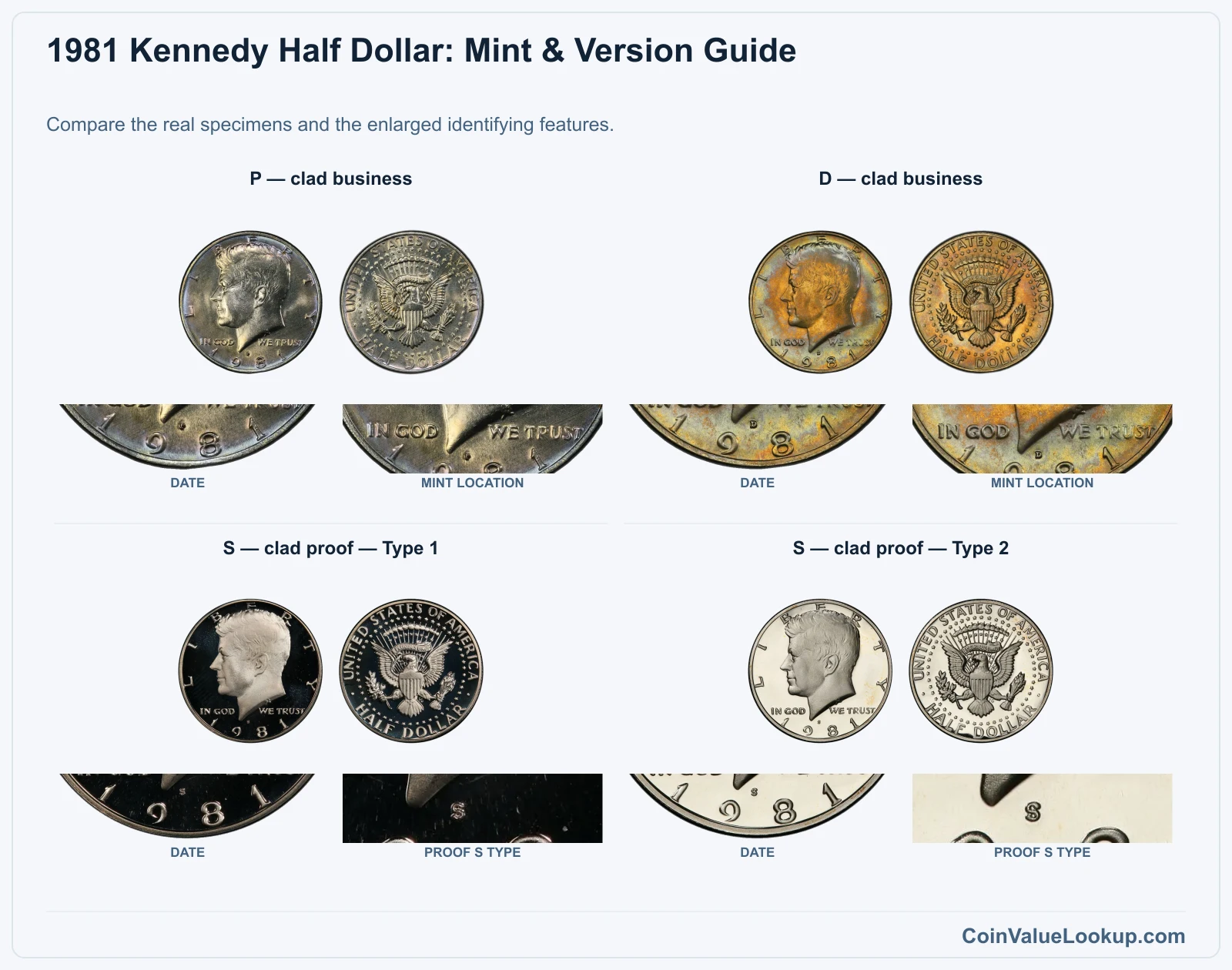
The 1981 Kennedy half dollar carries a face value of fifty cents, and most circulated clad examples are worth exactly that. Collector guide estimates from USA Coin Book place the different mint and finish combinations between roughly $3.62 and $38.00 at specific grades, so the version you hold matters.
Before checking any price chart, you need to identify whether your coin is a regular business strike, a proof, and which mintmark it carries.
Fast Way to Identify Your 1981 Kennedy Half Dollar
Snap a clear photo of the front and back of your 1981 half dollar and upload both images. Our identifier can give you a preliminary read on the mintmark, finish type and general condition — a solid starting point before you dig deeper.
Good lighting and a steady hand help more than an expensive camera.
1981 Kennedy Half Dollar Value
Upload both sides of your 1981 Kennedy Half Dollar.
Front Obverse
Upload photo
Back Reverse
Upload photo
Which 1981 Kennedy Half Dollar Versions Are Worth Money?
- The 1981-S Type 2 (Clear S) clad proof is the key date branch, with a USA Coin Book guide estimate of $38.00 at PR65 — far above the other versions.
- Check whether your S-mint proof is Type 1 or Type 2 by comparing the mintmark punch shape, not just whether the loops appear open.
- Business strikes from Philadelphia and Denver in high original Mint State condition carry modest collector premiums over face value.
- Mint-made errors such as doubled dies, off-center strikes and die cracks can add value depending on visibility and condition.
Step 1: Identify Your 1981 Kennedy Half Dollar Mint Mark and Version
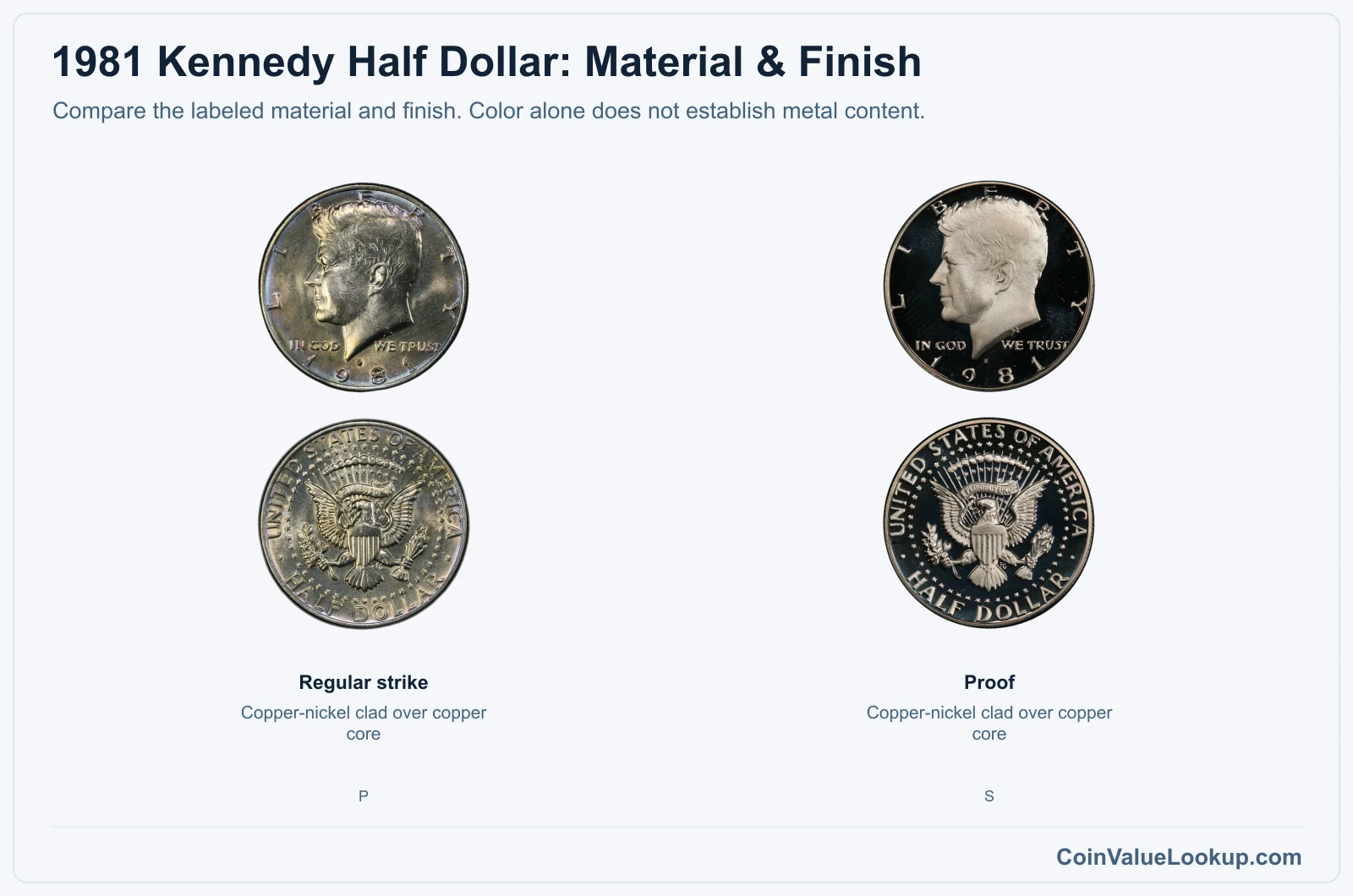
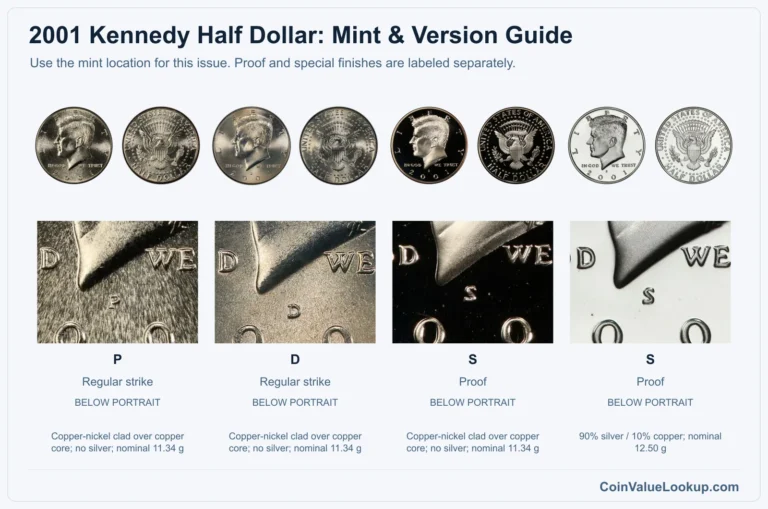
Look beneath Kennedy's portrait on the obverse, just above the date. You will find either a P, a D or an S mintmark.
Philadelphia coins carry the P mint letter starting in 1980, so a 1981 half should not be unmarked.
A D means Denver. An S means San Francisco, and those are proof coins struck for collectors.
All 1981 Kennedy halves are copper-nickel clad over a copper core. None contain silver.
Do not assume a half dollar is silver just because it looks shiny or has a certain tone — lighting and toning can fake that appearance.
If you have an S-mint proof, you have one more step. The 1981 proof run includes two mintmark punch styles: Type 1 (sometimes called Filled S) and Type 2 (Clear S).
The Type 2 S has flatter, bulbous serif terminals. Do not judge it solely by whether the interior loops look open; compare your coin side-by-side with a correctly dated reference image.
This distinction is the single biggest value difference in the 1981 Kennedy series.
The initials FG on the reverse near the eagle's tail feathers stand for designer Frank Gasparro. Faint or partially missing initials caused by normal die wear or grease are not automatically a recognized variety.
Step 2: Check Your 1981 Kennedy Half Dollar Grade
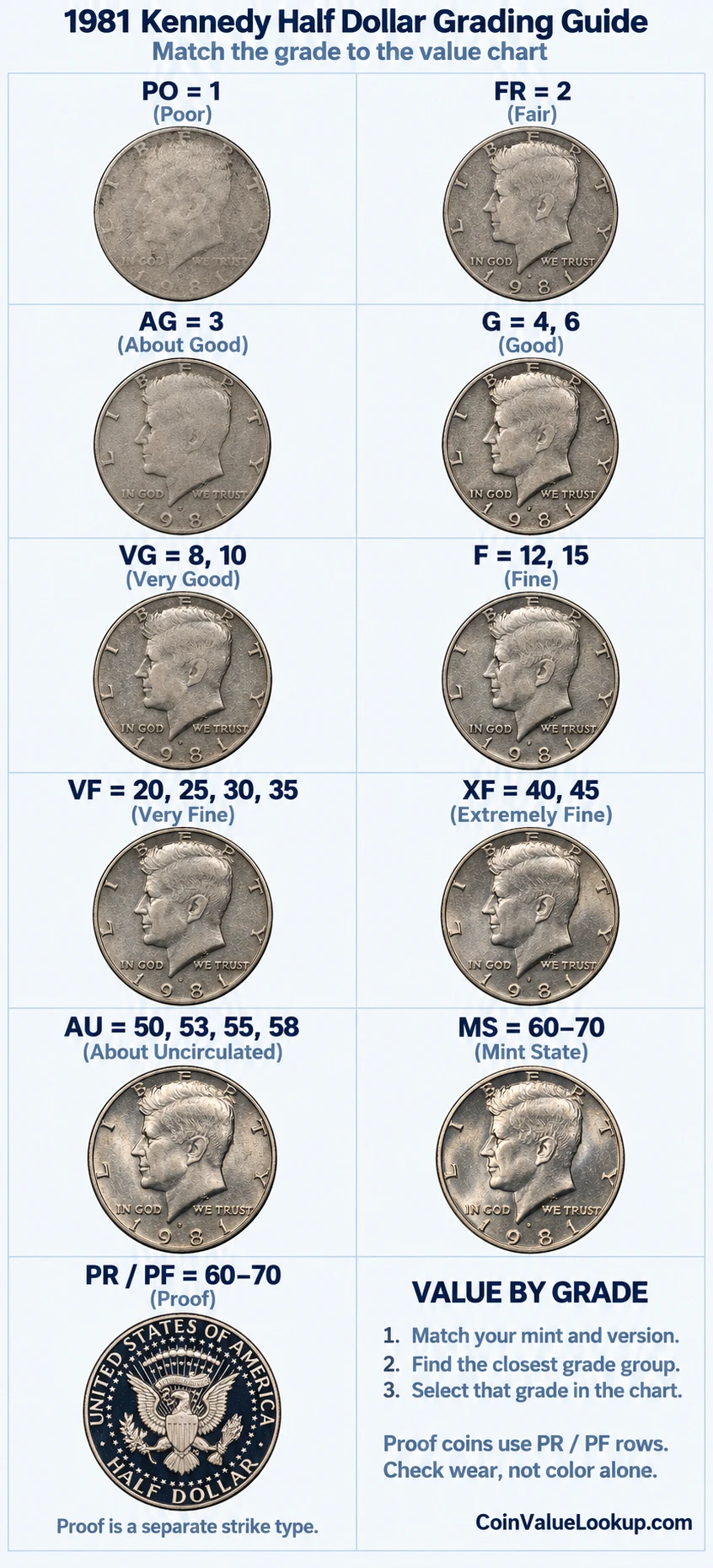
Start with Kennedy's cheek and the hair above his ear. On a well-circulated coin, those areas go flat first, losing fine strand detail before the rest of the portrait.
The jaw line softens next.
On the reverse, check the eagle's breast feathers and the tops of the wings. Smooth patches there confirm moderate wear.
Mint State coins can still look rough. Bag marks — contact dings from coins banging together in storage — drag down the grade without being true circulation wear.
A coin covered in tiny nicks may technically be uncirculated yet grade lower than a lightly worn piece that stayed in a roll.
Proofs follow different rules. Look for hairlines from cleaning or mishandling, haze across the mirror fields, and contact marks on the frosted devices.
Compare your coin against the reference image to calibrate where it falls on the grading spectrum.
Step 3: Check 1981 Kennedy Half Dollar Value by Mint and Version
1981 Kennedy Half Dollar — P — clad business
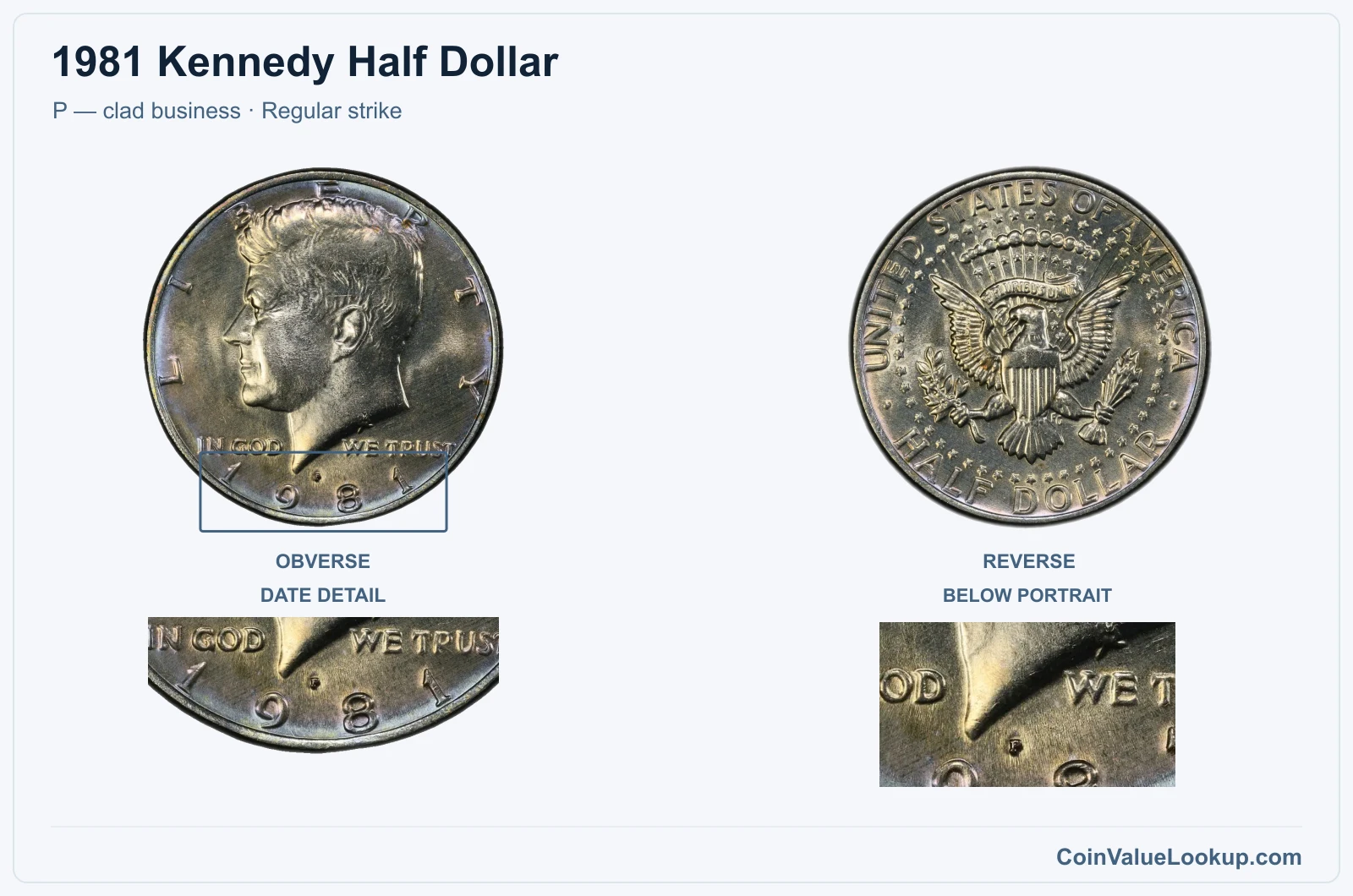
The 1981-P is the Philadelphia business strike. It carries a P mintmark beneath Kennedy's portrait — standard practice from 1980 onward.
The coin is copper-nickel clad, weighing about 11.34 grams, and contains no silver.
In circulated condition, this coin spends at face value. A USA Coin Book guide estimate places an MS65 example at about $3.62.
That is a modest premium reflecting the difficulty of finding one free of bag marks and handling. Most 1981-P halves you encounter in change or bank rolls will not reach that grade.
Range Grade
Price Auction Records Appraisal PO PO 1
—
Coin Identifier FR FR 2
—
Coin Identifier AG AG 3
—
Coin Identifier G G 4
—
Coin Identifier
G 6
—
Coin Identifier VG VG 8
—
Coin Identifier
VG 10
—
Coin Identifier F F 12
—
Coin Identifier
F 15
—
Coin Identifier VF VF 20
—
Coin Identifier
VF 25
—
Coin Identifier
VF 30
—
Coin Identifier
VF 35
—
Coin Identifier XF XF 40
—
Coin Identifier
XF 45
—
Coin Identifier AU AU 50
—
Coin Identifier
AU 53
—
Coin Identifier
AU 55
—
Coin Identifier
AU 58
—
Coin Identifier MS MS 60
Coin Identifier
MS 61
Coin Identifier
MS 62
—
Coin Identifier
MS 63
Coin Identifier
MS 64
Coin Identifier
MS 65
Coin Identifier
MS 66
Coin Identifier
MS 67
Coin Identifier
MS 68
—
—
—
MS 69
—
—
—
MS 70
—
—
—
1981 Kennedy Half Dollar — D — clad business
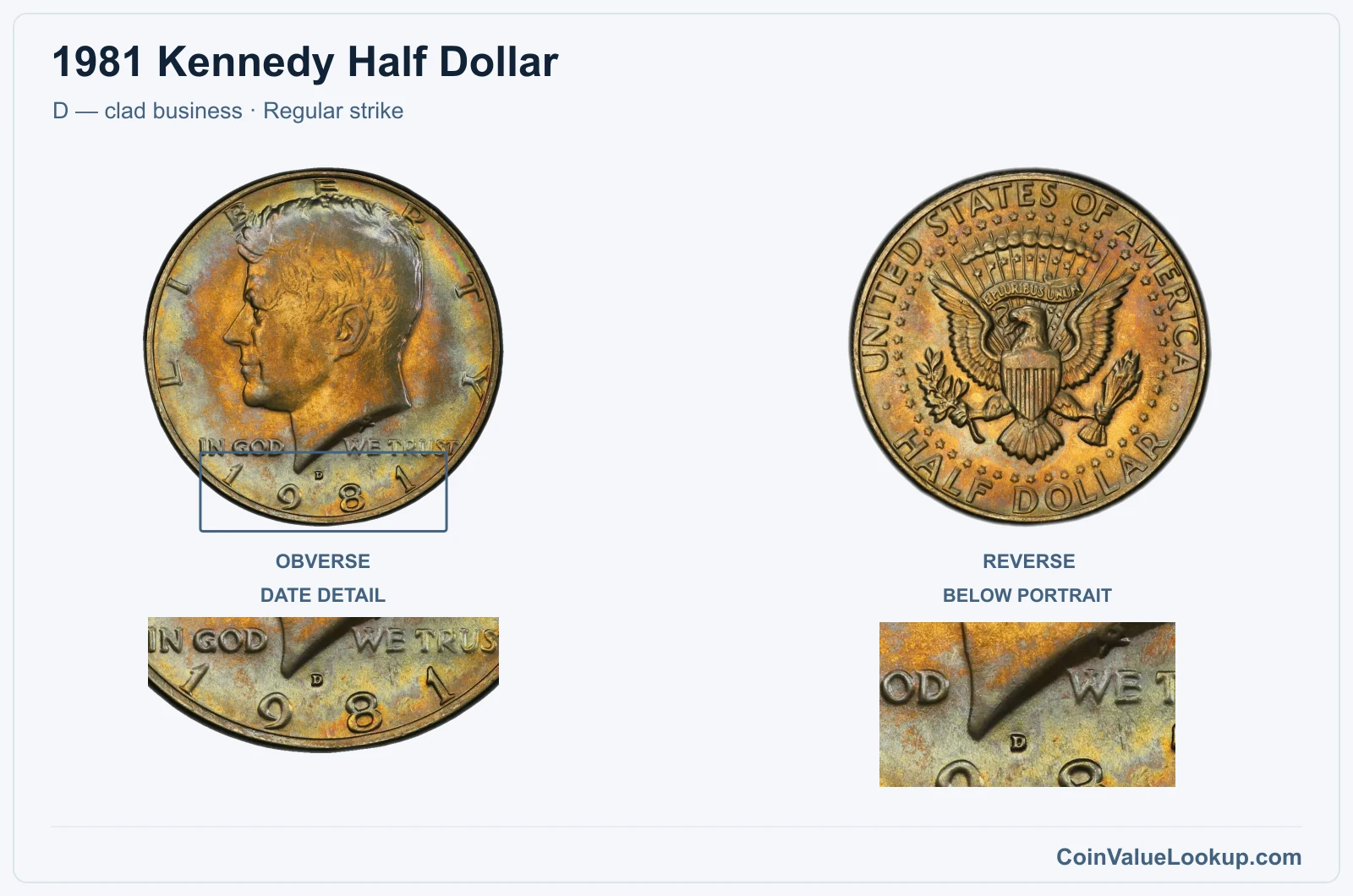
The 1981-D was struck at the Denver Mint and shows a D mintmark beneath Kennedy's portrait. Same copper-nickel clad composition, same 11.34-gram weight, no silver content.
Like the Philadelphia issue, worn examples are face-value coins. The USA Coin Book guide estimate at MS65 is about $3.62.
Finding a clean, well-struck example with minimal contact marks is the only path to a collector premium. Roll-searching is how most people locate high-grade survivors from this era.
Range Grade
Price Auction Records Appraisal PO PO 1
—
Coin Identifier FR FR 2
—
Coin Identifier AG AG 3
—
Coin Identifier G G 4
—
Coin Identifier
G 6
—
Coin Identifier VG VG 8
—
Coin Identifier
VG 10
—
Coin Identifier F F 12
—
Coin Identifier
F 15
—
Coin Identifier VF VF 20
—
Coin Identifier
VF 25
—
Coin Identifier
VF 30
—
Coin Identifier
VF 35
—
Coin Identifier XF XF 40
—
Coin Identifier
XF 45
—
Coin Identifier AU AU 50
—
Coin Identifier
AU 53
—
Coin Identifier
AU 55
—
Coin Identifier
AU 58
—
Coin Identifier MS MS 60
—
Coin Identifier
MS 61
—
Coin Identifier
MS 62
—
Coin Identifier
MS 63
—
Coin Identifier
MS 64
—
Coin Identifier
MS 65
Coin Identifier
MS 66
Coin Identifier
MS 67
Coin Identifier
MS 68
—
—
—
MS 69
—
—
—
MS 70
—
—
—
1981 Kennedy Half Dollar — S — clad proof — Type 1
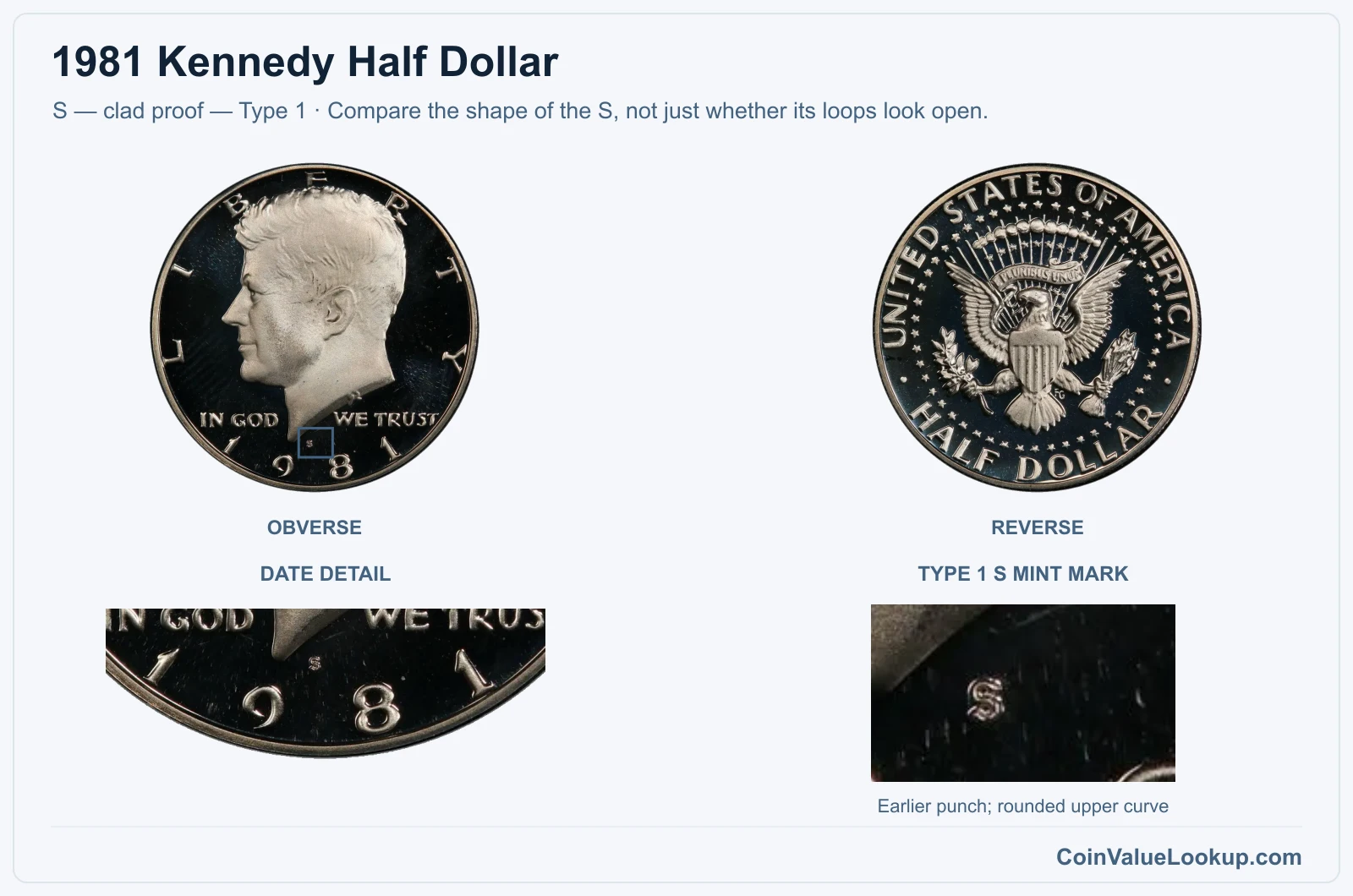
This is the 1981-S Type 1 clad proof, sometimes labeled "Filled S" because the mintmark punch has a particular style. San Francisco struck these for collector proof sets, not for circulation.
Look for mirror-like fields and frosted raised devices — the hallmarks of a proof finish. The S mintmark sits below Kennedy's portrait.
On a Type 1, the S has a specific shape; compare it directly with a Type 2 reference rather than guessing.
Coin Value Lookup is a useful starting point if you want to look up other Kennedy half dollar years or denominations while you research your coin.
A USA Coin Book guide estimate puts this version at about $3.62 in PR65. Hairlines, haze and fingerprints on the mirror surface are the main grade killers for proofs like this one.
Range Grade
Price Auction Records Appraisal PR PR 1
—
Coin Identifier
PR 2
—
Coin Identifier
PR 3
—
Coin Identifier
PR 4
—
Coin Identifier
PR 6
—
Coin Identifier
PR 8
—
Coin Identifier
PR 10
—
Coin Identifier
PR 12
—
Coin Identifier
PR 15
—
Coin Identifier
PR 20
—
Coin Identifier
PR 25
—
Coin Identifier
PR 30
—
Coin Identifier
PR 35
—
Coin Identifier
PR 40
—
Coin Identifier
PR 45
—
Coin Identifier
PR 50
—
Coin Identifier
PR 53
—
Coin Identifier
PR 55
—
Coin Identifier
PR 58
—
Coin Identifier
PR 60
Coin Identifier
PR 61
—
Coin Identifier
PR 62
—
Coin Identifier
PR 63
—
Coin Identifier
PR 64
—
Coin Identifier
PR 65
—
Coin Identifier
PR 66
Coin Identifier
PR 67
Coin Identifier
PR 68
Coin Identifier
PR 69
Coin Identifier
PR 70
Coin Identifier
1981 Kennedy Half Dollar — S — clad proof — Type 2
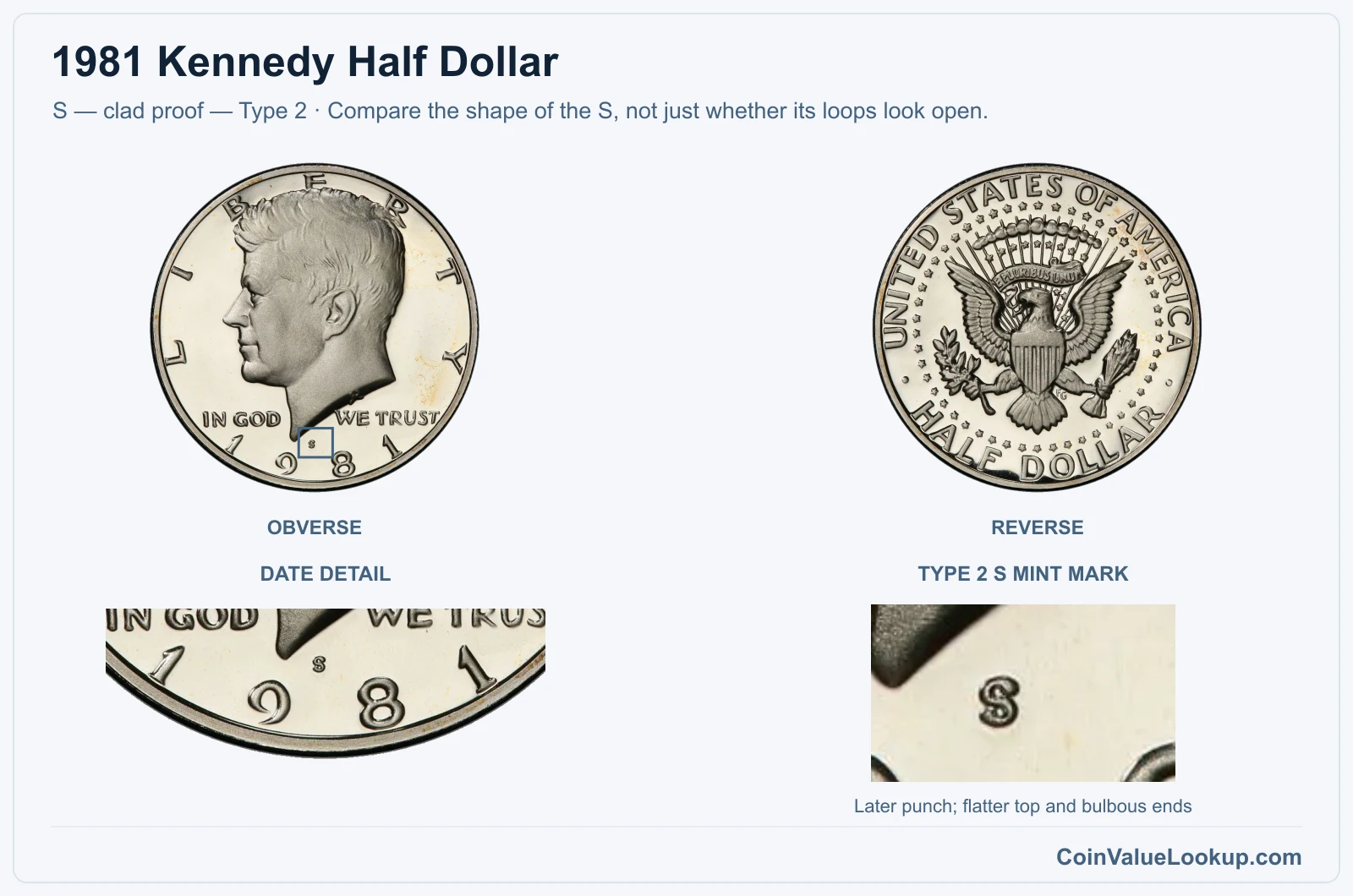
The 1981-S Type 2 clad proof — also called "Clear S" — is the version collectors actually hunt for. The mintmark punch used here has flatter, bulbous terminals compared to the Type 1.
Do not identify it based solely on whether the S looks "open" inside its loops; the shape of the serifs is the real tell. Compare it against a known Type 2 reference image at the same magnification.
This is still a copper-nickel clad coin with no silver content. A USA Coin Book guide estimate at PR65 is about $38.00, roughly ten times the Type 1 proof.
That premium exists because the Type 2 punch was used on a smaller portion of the 1981 proof run, making it less common in the marketplace. Condition still matters: proof hairlines and haze will affect what a buyer will pay.
Range Grade
Price Auction Records Appraisal PR PR 1
—
Coin Identifier
PR 2
—
Coin Identifier
PR 3
—
Coin Identifier
PR 4
—
Coin Identifier
PR 6
—
Coin Identifier
PR 8
—
Coin Identifier
PR 10
—
Coin Identifier
PR 12
—
Coin Identifier
PR 15
—
Coin Identifier
PR 20
—
Coin Identifier
PR 25
—
Coin Identifier
PR 30
—
Coin Identifier
PR 35
—
Coin Identifier
PR 40
—
Coin Identifier
PR 45
—
Coin Identifier
PR 50
—
Coin Identifier
PR 53
—
Coin Identifier
PR 55
—
Coin Identifier
PR 58
—
Coin Identifier
PR 60
—
Coin Identifier
PR 61
—
Coin Identifier
PR 62
—
Coin Identifier
PR 63
—
Coin Identifier
PR 64
—
Coin Identifier
PR 65
—
Coin Identifier
PR 66
—
Coin Identifier
PR 67
Coin Identifier
PR 68
Coin Identifier
PR 69
Coin Identifier
PR 70
Coin Identifier
1981 Kennedy Half Dollar Error List
1. 1981 Kennedy Half Dollar — Doubled Die Obverse
A doubled die obverse on the 1981 Kennedy half dollar shows consistent doubling on obverse design elements — letters, the date, or parts of Kennedy's profile. Under magnification, look for separation or notching that appears uniform across affected areas rather than a flat, shelf-like displacement.
The key distinction is between a genuine doubled die and machine doubling. Machine doubling produces flat, shelf-like distortion typically on one side of raised elements.
A real doubled die shows rounded, distinct secondary impressions. Reflections and worn die contours can also mimic doubling to the untrained eye.
Value depends on the visibility of the doubling, the specific die involved, and the coin's overall condition. No reliable numerical price range is available for this error, so individual assessment is necessary.
2. 1981 Kennedy Half Dollar — Doubled Die Reverse
A doubled die reverse affects the back of the coin — reverse legends, the eagle's features, or other design details. Compare your coin's reverse lettering and contours against a normal 1981 half under the same lighting and magnification.
Genuine doubled die reverses display consistent, directional separation on affected elements. Machine doubling, by contrast, creates flat shelving that lacks the rounded secondary image of a true hub doubling event.
Random damage or corrosion can also create misleading appearances.
The value of a doubled die reverse depends on which die is involved, how dramatic the doubling appears, and the coin's condition. No adopted numerical price range is available, so each example needs individual evaluation based on those factors.
3. 1981 Kennedy Half Dollar — Off-Center Strike
An off-center strike occurs when the coin blank is not properly seated between the dies at the moment of striking. The result is a displaced design with a blank, unstruck crescent along part of the rim.
The most collectible examples retain a fully visible date despite the misalignment.
Do not confuse an off-center strike with a clipped planchet, which shows a curved bite from the blank-cutting process, or with post-mint damage where someone flattened or bent the coin. A genuine off-center error affects the entire design uniformly in one direction.
The percentage of off-center displacement and whether the date remains readable are the two biggest factors in desirability. No specific price range is adopted for this error on the 1981 half dollar; each piece must be assessed individually.
4. 1981 Kennedy Half Dollar — Die Crack / Die Chip
Die cracks and die chips have been reported on the 1981-D Kennedy half dollar. A die crack shows up as a thin raised line on the coin's surface, running where the die itself fractured.
A die chip appears as a small raised blob where a piece of the die broke away, leaving a void that fills with metal during striking.
Distinguish these from incuse scratches (which are recessed into the surface, not raised), corrosion, or debris stuck to the coin. Genuine die cracks and chips are raised because they come from damage to the die, not to the coin after it left the press.
A rim-connected crack is different from an interior chip; large rim breaks are sometimes called cuds.
Value varies with size, location and coin condition. No numerical price range is adopted for this error.