2017 Roosevelt Dime Coin Value: How Much Is It Worth?
Most 2017 Roosevelt dimes pulled from circulation are worth face value — ten cents. In mint-state condition, a USA Coin Book guide estimate places a 2017-P or 2017-D at about $2.50 in MS65.
San Francisco proof and special-issue versions carry higher guide values, with the S silver proof estimated at $16 in PR65. Identifying your coin's exact mint, metal and finish is the first step toward knowing what you have.
Fast Way to Identify Your 2017 Roosevelt Dime
Snap a clear photo of the front and back of your 2017 dime and upload both images. Our identifier can give you a preliminary read on the mintmark, finish type and general condition.
It is not a substitute for professional grading or authentication, but it is a solid starting point for figuring out which version you are holding.
2017 Roosevelt Dime Value
Upload both sides of your 2017 Roosevelt Dime.
Front Obverse
Upload photo
Back Reverse
Upload photo
Which 2017 Roosevelt Dime Versions Are Worth Money?
- Well-preserved P or D business strikes with fully separated torch bands can command a premium over ordinary mint-state examples.
- S silver proofs, struck in 90% silver and weighing 2.50 grams, carry a higher guide value — about $16 in PR65 — compared to standard clad versions.
- The S enhanced uncirculated clad dime, with its distinctive laser-frosted finish, is a separate collectible issue worth individual assessment based on authenticated identity and condition.
Step 1: Identify Your 2017 Roosevelt Dime Mint Mark and Version
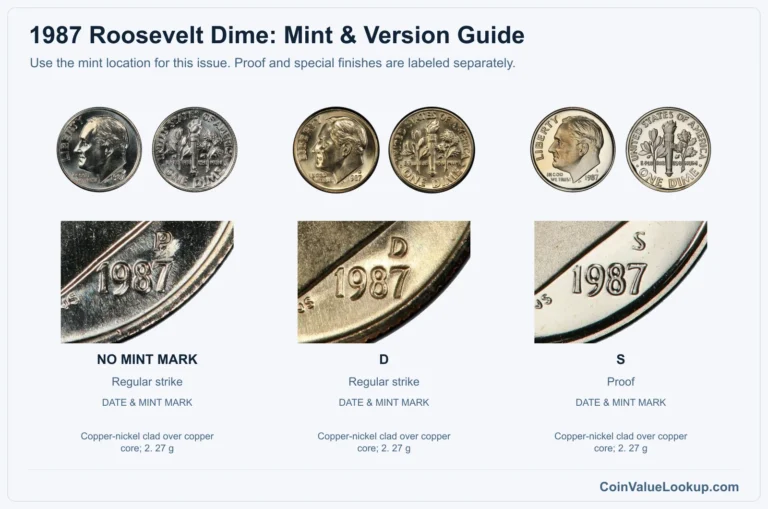
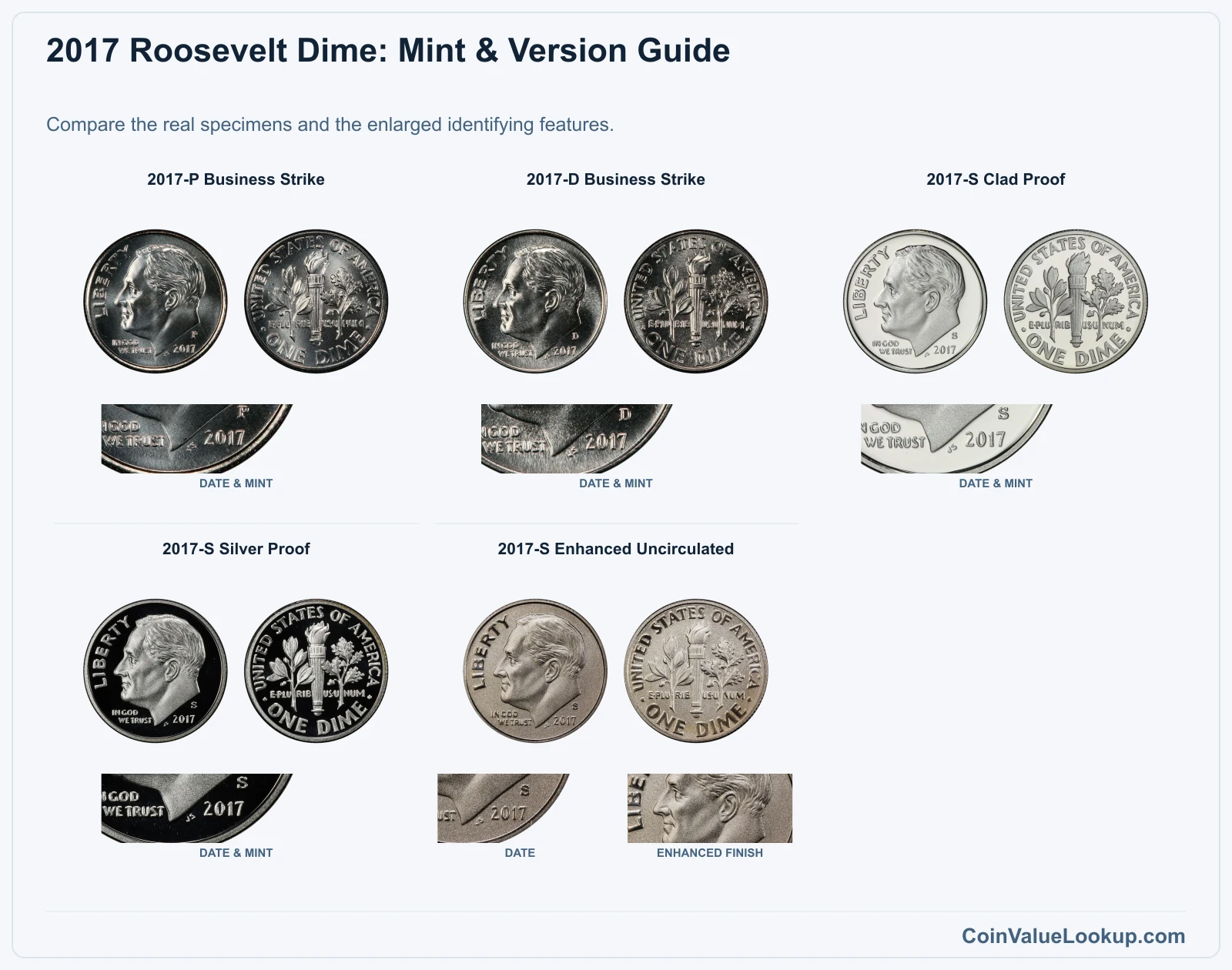
Start with the date. You need "2017" on the obverse below Roosevelt's chin.
Next, find the mintmark — it sits just above the date. A "P" means Philadelphia, a "D" means Denver, and an "S" means San Francisco.
The mintmark alone does not tell the whole story for S-mint coins. San Francisco produced three distinct 2017 dimes: a clad proof, a 90% silver proof and an enhanced uncirculated clad version.
These look different from each other and require separate identification.
Weight helps. A standard clad dime (P, D or S clad) weighs 2.27 grams.
The silver proof weighs 2.50 grams. If you have a kitchen scale accurate to 0.01 g, that difference is easy to spot.
Check the edge, too. A clad dime shows a visible layered edge.
The silver proof has a uniform silver-colored edge with no visible stripe. Packaging matters: silver proofs and enhanced uncirculated coins originally came in specific U.S. Mint sets, so original government packaging is strong supporting evidence.
The enhanced uncirculated version has laser-frosted design areas combined with unpolished fields, giving it a texture distinct from the mirror-field, frosted-device look of a proof. Do not confuse one for the other — they are separate manufacturing finishes.
Step 2: Check Your 2017 Roosevelt Dime Grade
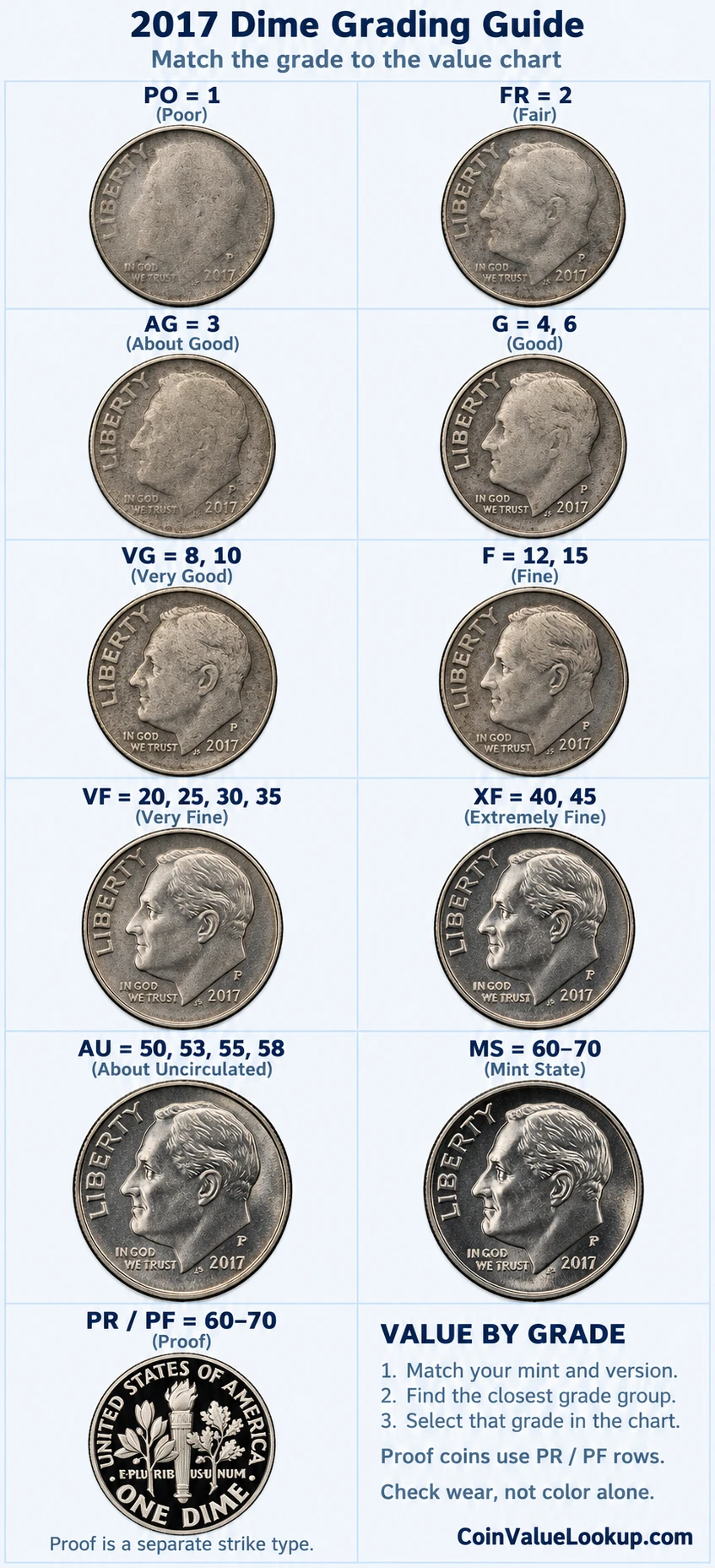
Look at Roosevelt's cheekbone and jawline first. On a well-preserved coin, these areas show complete original luster with no flatness or rub.
Hair detail above the ear is another early-wear checkpoint.
On the reverse, inspect the torch and the two branches flanking it. The horizontal bands on the torch are the key detail collectors watch for — when both pairs of bands show full, clean separation, the coin may qualify for a Full Bands designation.
That is a strike quality indicator, not a grade, so a coin can be high-grade without Full Bands if the strike was simply soft.
Use the comparison image to judge your coin against known grade examples of the same finish. A proof should be compared to other proofs; a business strike to other business strikes.
Original mint luster has a cartwheel effect when tilted under a light. A cleaned coin may look shiny but lacks that rotating glow.
Minor bag marks are expected on business strikes and do not automatically disqualify a coin from mint-state grades. Deep gouges, rim dings and scratches are another story.
Step 3: Check 2017 Roosevelt Dime Value by Mint and Version
2017 Roosevelt Dime — P Business Strike
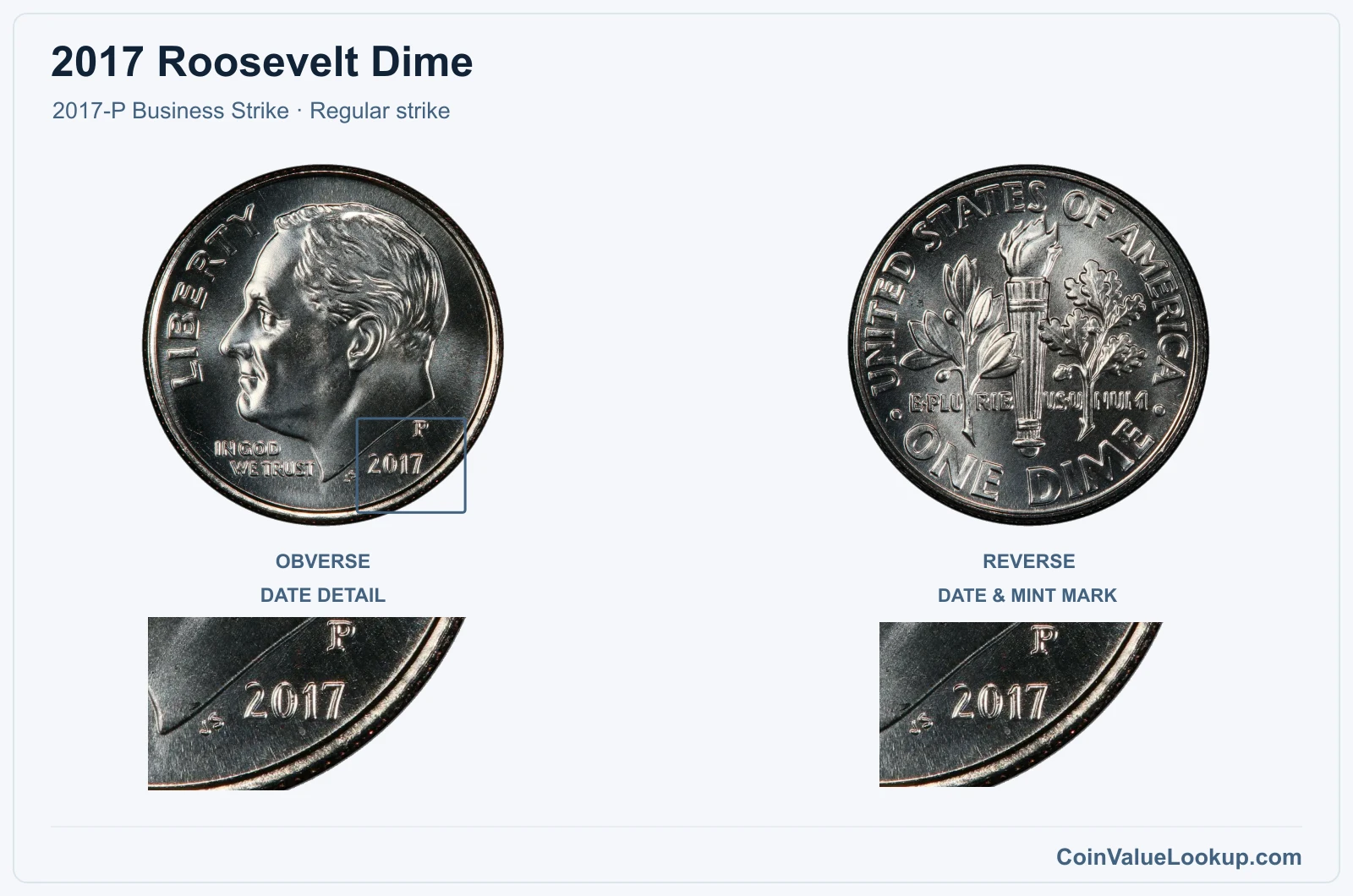
The 2017-P dime was struck at Philadelphia in copper-nickel clad over a copper core. It weighs 2.27 grams and carries a "P" mintmark above the date.
This is the version most people find in pocket change.
A USA Coin Book guide estimate puts an MS65 example at about $2.50. Circulated pieces are worth face value.
If your coin shows strong torch band separation and clean surfaces, it could grade higher and be worth a closer look from a professional service.
Range Grade
Price Auction Records Appraisal PO PO 1
—
Coin Identifier FR FR 2
—
Coin Identifier AG AG 3
—
Coin Identifier G G 4
—
Coin Identifier
G 6
—
Coin Identifier VG VG 8
—
Coin Identifier
VG 10
—
Coin Identifier F F 12
—
Coin Identifier
F 15
—
Coin Identifier VF VF 20
—
Coin Identifier
VF 25
—
Coin Identifier
VF 30
—
Coin Identifier
VF 35
—
Coin Identifier XF XF 40
—
Coin Identifier
XF 45
—
Coin Identifier AU AU 50
—
Coin Identifier
AU 53
—
Coin Identifier
AU 55
—
Coin Identifier
AU 58
—
Coin Identifier MS MS 60
—
Coin Identifier
MS 61
—
Coin Identifier
MS 62
—
Coin Identifier
MS 63
—
Coin Identifier
MS 64
—
Coin Identifier
MS 65
—
Coin Identifier
MS 66
—
Coin Identifier
MS 67
—
Coin Identifier
MS 68
—
Coin Identifier
MS 69
—
—
—
MS 70
—
—
—
2017 Roosevelt Dime — D Business Strike
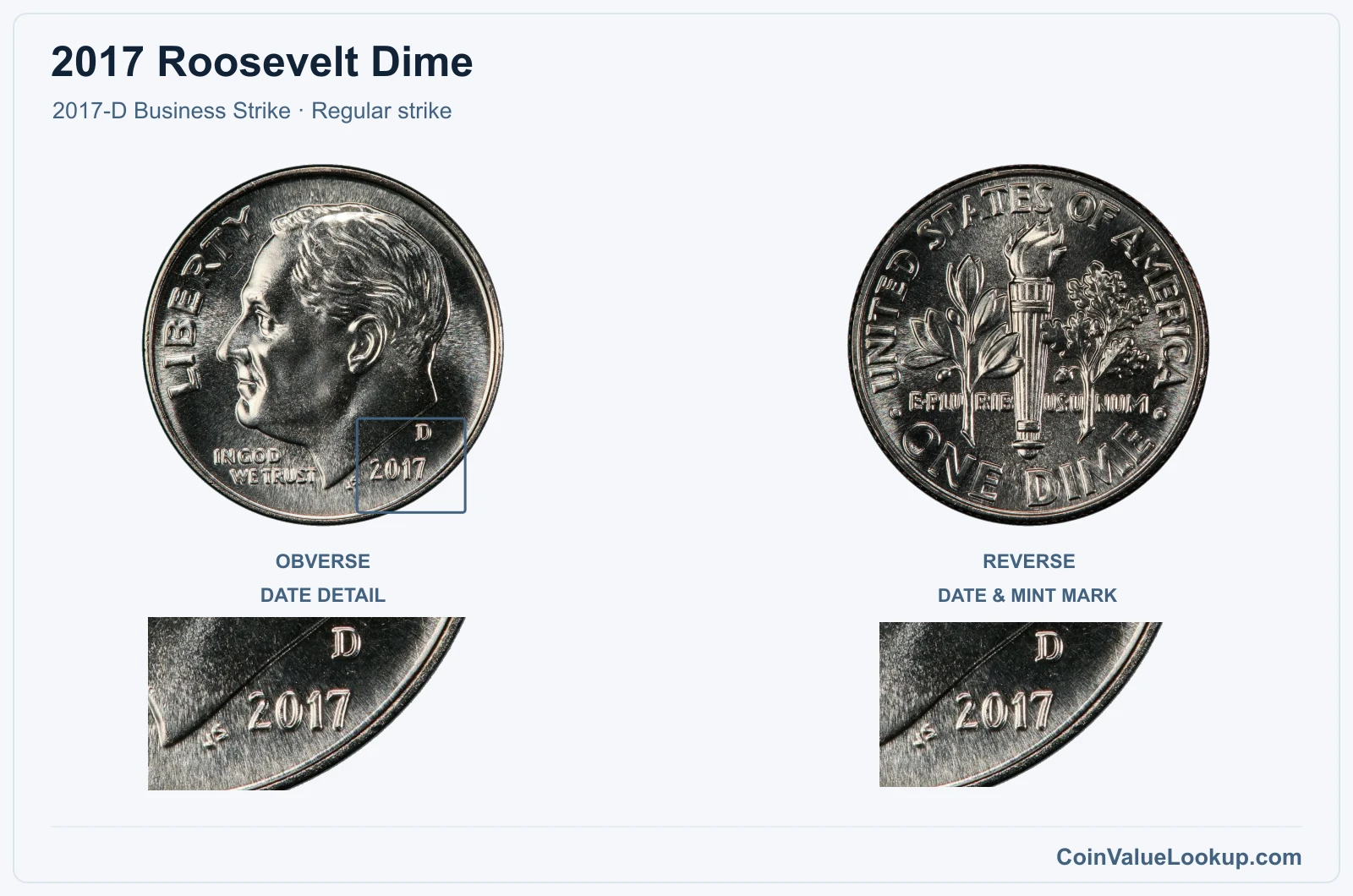
Denver's 2017-D dime is the same copper-nickel clad composition and 2.27-gram weight as its Philadelphia twin. Look for the "D" mintmark above the date to confirm origin.
The USA Coin Book guide estimate is also $2.50 in MS65. Circulated examples trade at ten cents.
As with the P-mint, coins showing sharp Full Bands detail and minimal contact marks are the ones worth setting aside.
Range Grade
Price Auction Records Appraisal PO PO 1
—
Coin Identifier FR FR 2
—
Coin Identifier AG AG 3
—
Coin Identifier G G 4
—
Coin Identifier
G 6
—
Coin Identifier VG VG 8
—
Coin Identifier
VG 10
—
Coin Identifier F F 12
—
Coin Identifier
F 15
—
Coin Identifier VF VF 20
—
Coin Identifier
VF 25
—
Coin Identifier
VF 30
—
Coin Identifier
VF 35
—
Coin Identifier XF XF 40
—
Coin Identifier
XF 45
—
Coin Identifier AU AU 50
—
Coin Identifier
AU 53
—
Coin Identifier
AU 55
—
Coin Identifier
AU 58
—
Coin Identifier MS MS 60
—
Coin Identifier
MS 61
—
Coin Identifier
MS 62
—
Coin Identifier
MS 63
—
Coin Identifier
MS 64
—
Coin Identifier
MS 65
—
Coin Identifier
MS 66
—
Coin Identifier
MS 67
—
Coin Identifier
MS 68
—
Coin Identifier
MS 69
—
—
—
MS 70
—
—
—
2017 Roosevelt Dime — S Clad Proof
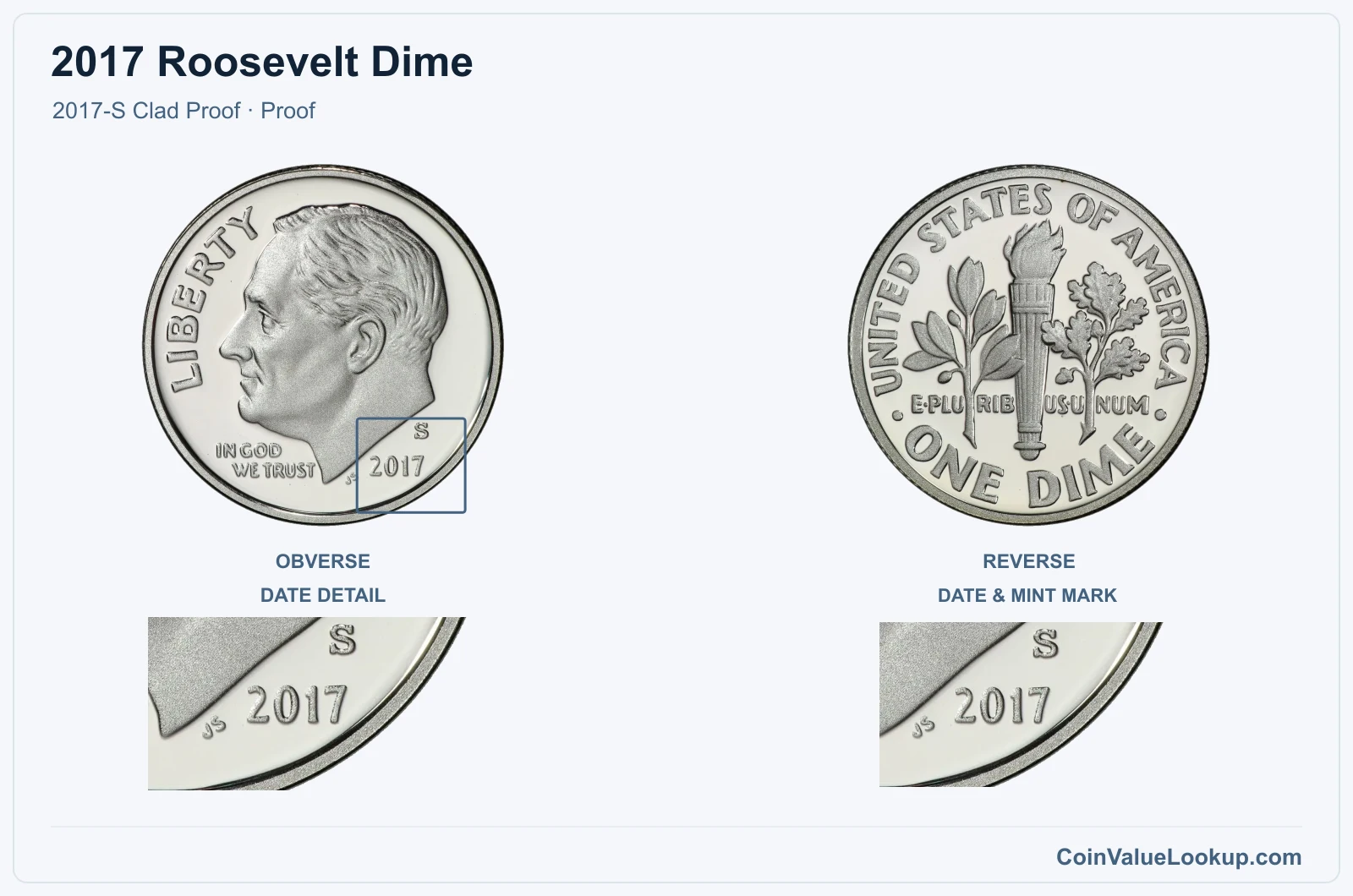
San Francisco struck a clad proof dime in 2017, made of the same copper-nickel clad over copper core at 2.27 grams. Proof finish means mirror-like fields with frosted design devices — that contrast is an intentional manufacturing feature, not wear or an error.
The USA Coin Book guide places a PR65 example at about $6.26. These originally shipped in standard clad proof sets from the U.S. Mint.
If yours is loose and you want to confirm it is a proof rather than a shiny business strike, check for the mirror-field finish and the "S" mintmark.
Coin Value Lookup is a handy place to look up guide values for Roosevelt dimes and other U.S. coins when you are sorting through a collection.
Range Grade
Price Auction Records Appraisal PR PR 1
—
Coin Identifier
PR 2
—
Coin Identifier
PR 3
—
Coin Identifier
PR 4
—
Coin Identifier
PR 6
—
Coin Identifier
PR 8
—
Coin Identifier
PR 10
—
Coin Identifier
PR 12
—
Coin Identifier
PR 15
—
Coin Identifier
PR 20
—
Coin Identifier
PR 25
—
Coin Identifier
PR 30
—
Coin Identifier
PR 35
—
Coin Identifier
PR 40
—
Coin Identifier
PR 45
—
Coin Identifier
PR 50
—
Coin Identifier
PR 53
—
Coin Identifier
PR 55
—
Coin Identifier
PR 58
—
Coin Identifier
PR 60
—
Coin Identifier
PR 61
—
Coin Identifier
PR 62
—
Coin Identifier
PR 63
—
Coin Identifier
PR 64
—
Coin Identifier
PR 65
—
Coin Identifier
PR 66
—
Coin Identifier
PR 67
—
Coin Identifier
PR 68
—
Coin Identifier
PR 69
—
Coin Identifier
PR 70
—
Coin Identifier
2017 Roosevelt Dime — S Silver Proof
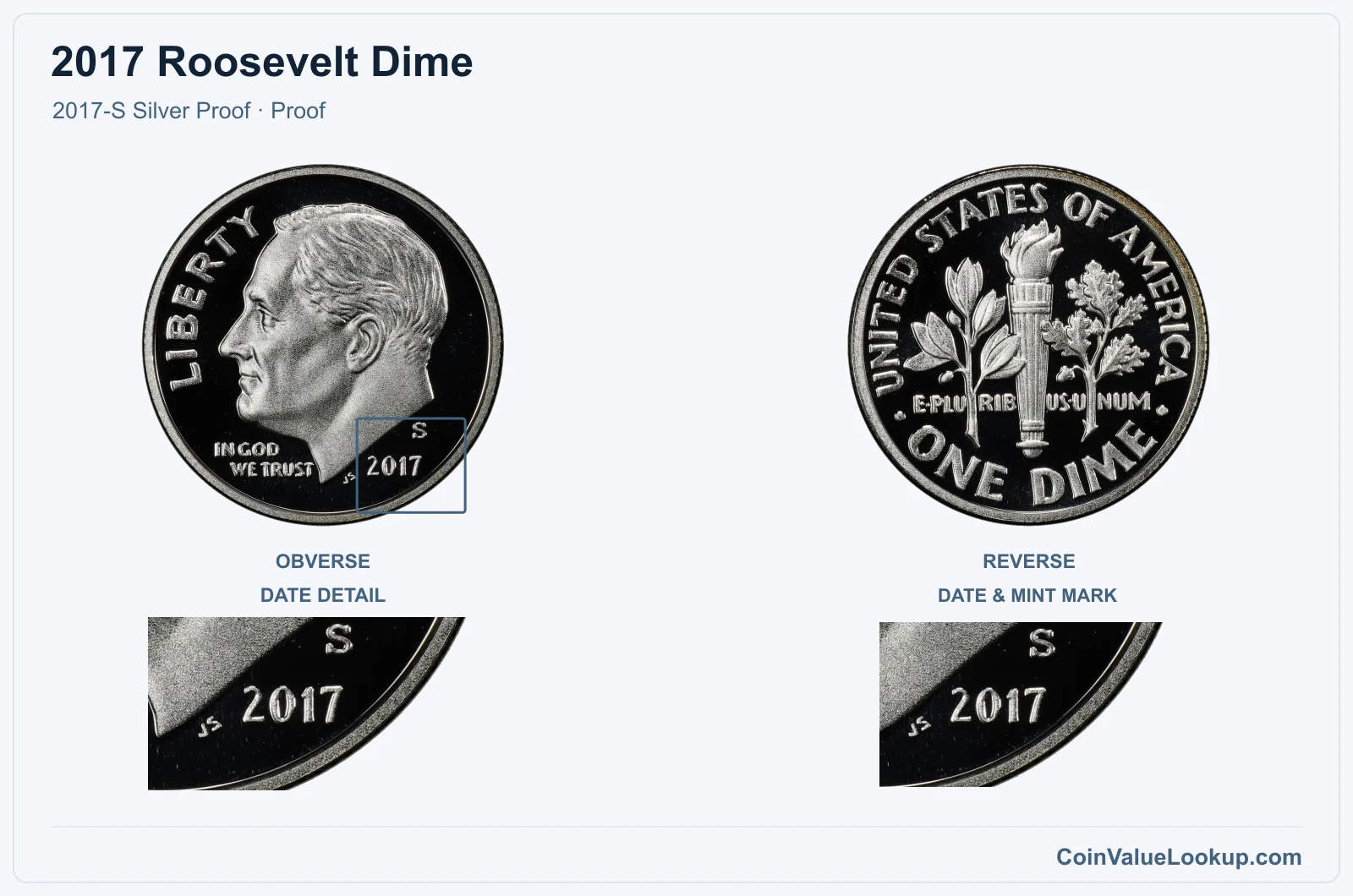
The 2017-S silver proof dime is composed of 90% silver and 10% copper, weighing 2.50 grams — noticeably heavier than the 2.27-gram clad versions. It carries the "S" mintmark and was produced as a proof, with mirror fields and frosted devices.
A USA Coin Book guide estimate places it at $16 in PR65, making it the highest-priced version among those with adopted guide values. The uniform silver edge — no copper stripe — is the quickest physical tell.
Original packaging from the U.S. Mint silver proof set is strong confirmation. Without packaging, use weight, edge color and finish together to distinguish it from the clad proof.
Range Grade
Price Auction Records Appraisal PR PR 1
—
Coin Identifier
PR 2
—
Coin Identifier
PR 3
—
Coin Identifier
PR 4
—
Coin Identifier
PR 6
—
Coin Identifier
PR 8
—
Coin Identifier
PR 10
—
Coin Identifier
PR 12
—
Coin Identifier
PR 15
—
Coin Identifier
PR 20
—
Coin Identifier
PR 25
—
Coin Identifier
PR 30
—
Coin Identifier
PR 35
—
Coin Identifier
PR 40
—
Coin Identifier
PR 45
—
Coin Identifier
PR 50
—
Coin Identifier
PR 53
—
Coin Identifier
PR 55
—
Coin Identifier
PR 58
—
Coin Identifier
PR 60
—
Coin Identifier
PR 61
—
Coin Identifier
PR 62
—
Coin Identifier
PR 63
—
Coin Identifier
PR 64
—
Coin Identifier
PR 65
—
Coin Identifier
PR 66
—
Coin Identifier
PR 67
—
Coin Identifier
PR 68
—
Coin Identifier
PR 69
—
Coin Identifier
PR 70
—
Coin Identifier
2017 Roosevelt Dime — S Enhanced Uncirculated
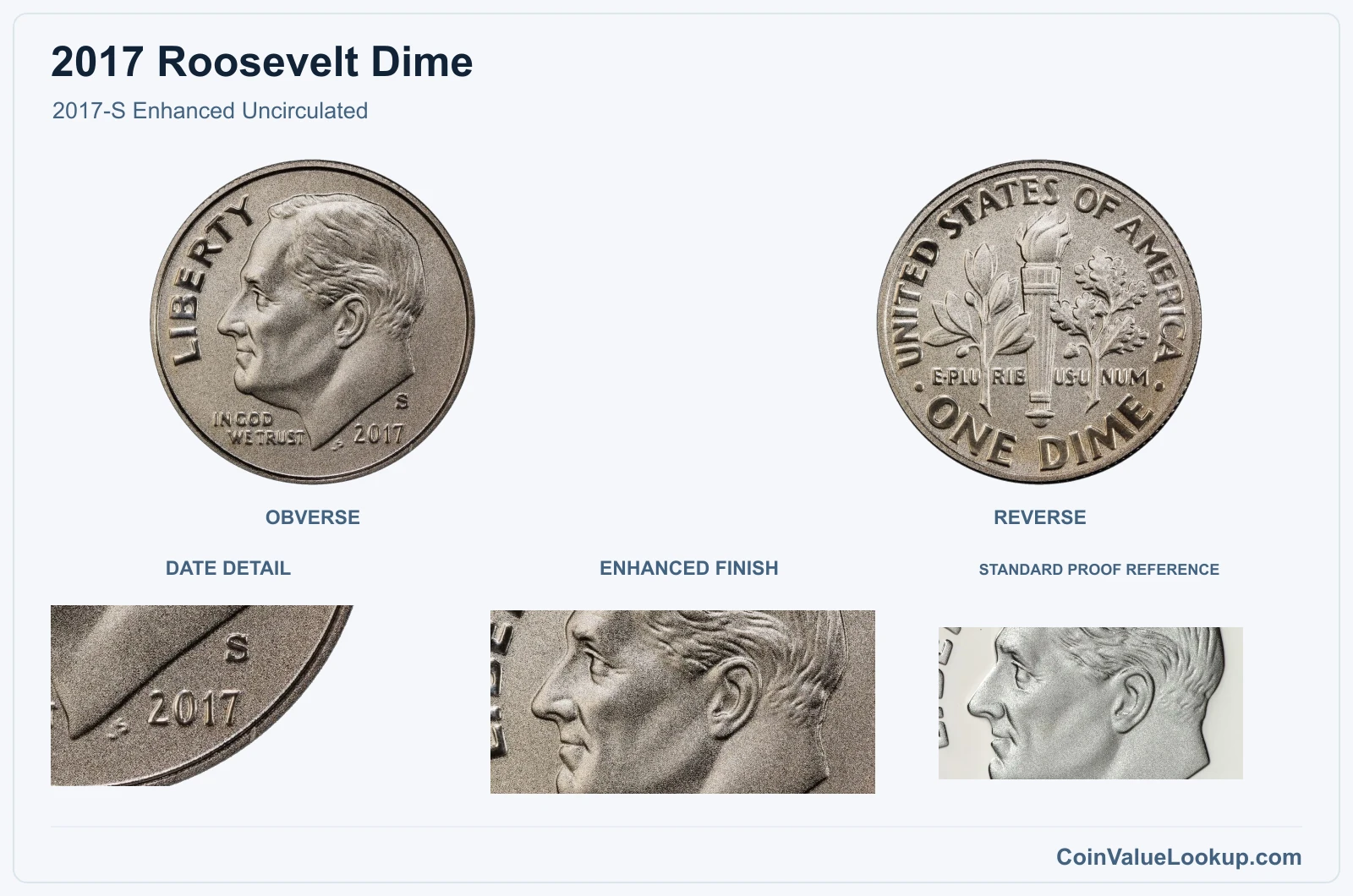
The 2017-S enhanced uncirculated dime is a copper-nickel clad special strike from San Francisco. It is not a proof and it is not an error — it is a distinct manufacturing finish featuring laser-frosted areas paired with unpolished fields, giving it a look that sits somewhere between a business strike and a proof.
No guide price from the supplied sources is available for this version. Value depends on authenticated identity, condition and market demand at the time of sale.
Because the finish is unusual and production was limited to specific U.S. Mint sets, individual assessment by a grading service is the most reliable way to establish what a particular coin is worth.
Designation-specific values: The prices below apply only to coins certified Full Bands (FB). They do not represent prices for coins without that designation.
Range Grade
Price Auction Records Appraisal SP SP 1
—
Coin Identifier
SP 2
—
Coin Identifier
SP 3
—
Coin Identifier
SP 4
—
Coin Identifier
SP 6
—
Coin Identifier
SP 8
—
Coin Identifier
SP 10
—
Coin Identifier
SP 12
—
Coin Identifier
SP 15
—
Coin Identifier
SP 20
—
Coin Identifier
SP 25
—
Coin Identifier
SP 30
—
Coin Identifier
SP 35
—
Coin Identifier
SP 40
—
Coin Identifier
SP 45
—
Coin Identifier
SP 50
—
Coin Identifier
SP 53
—
Coin Identifier
SP 55
—
Coin Identifier
SP 58
—
Coin Identifier
SP 60
—
Coin Identifier
SP 61
—
Coin Identifier
SP 62
—
Coin Identifier
SP 63
—
Coin Identifier
SP 64
—
Coin Identifier
SP 65
—
Coin Identifier
SP 66
—
Coin Identifier
SP 67
—
Coin Identifier
SP 68
—
Coin Identifier
SP 69
—
Coin Identifier
SP 70
—
Coin Identifier
2017 Roosevelt Dime Error List
1. 2017 Roosevelt Dime — Missing Clad Layer
A missing clad layer error occurs when one of the outer copper-nickel layers is absent before or during striking, exposing the copper core underneath. On a 2017 dime, one face will appear distinctly copper-colored instead of the normal silver tone.
Weigh the coin. A normal clad dime is 2.27 grams; a missing-layer example will be lighter.
The edge should also show an abnormal cross-section — one side of the normal sandwich is gone.
Be cautious with lookalikes. Toning, corrosion, chemical damage and deliberate plating removal can all make a surface look copper-colored after the coin left the mint.
If the weight is normal and the edge looks standard, the discoloration is almost certainly post-mint damage. Condition, visibility and the extent of the missing layer all affect value; no standard price applies.
2. 2017 Roosevelt Dime — Clashed Dies
A die clash happens when the obverse and reverse dies strike each other with no planchet between them. The impact transfers ghost-like traces of the opposite design onto each die, and those impressions then appear on subsequent coins.
On a 2017 dime, look for faint outlines of the torch or branches appearing in the field around Roosevelt's portrait, or traces of Roosevelt's profile showing up on the reverse. The transferred images will align with where the opposite die would naturally sit.
Do not confuse random scratches, raised lines or brockage marks with a true clash. Clash impressions are consistent, repeatable across multiple coins from the same die pair, and positioned in predictable locations.
Value depends on the strength and visibility of the clash, as well as overall coin condition.
3. 2017 Roosevelt Dime — Die Crack / Die Chip
Die cracks and die chips result from a deteriorating or fractured die. A die crack shows up as a thin raised line on the coin's surface, following the path of a fracture in the steel die.
A rim cud is a more dramatic version — a chunk of the die has broken away at the rim, leaving a raised, featureless blob connected to the edge.
On a 2017 dime, examine the rim carefully and then scan the fields and lettering for fine raised lines. Interior chips appear as small raised lumps, often inside letters.
Lookalikes include incuse scratches (which are recessed, not raised), corrosion bubbles and foreign material stuck to the surface. A genuine die crack or cud is raised metal that was part of the strike itself.
Size, location and how dramatic the break is all influence collector interest and value.
4. 2017 Roosevelt Dime — Doubled Die Obverse
A doubled die obverse on a 2017 dime means the die itself received a doubled impression during its manufacturing, and every coin struck by that die carries the same doubling. Check the lettering — "LIBERTY," "IN GOD WE TRUST" and the date — for consistent separation, notching or a secondary image slightly offset from the primary one.
The key word is consistent. True hub doubling shows the same directional shift on every affected element.
Machine doubling, by contrast, produces a flat, shelf-like distortion that varies from coin to coin and is worth very little.
Compare your coin to a normal 2017 dime under the same lighting. If the doubling disappears when you tilt the coin, you are likely seeing a reflection, not a doubled die.
Value depends on the strength of the doubling and the coin's overall condition.
5. 2017 Roosevelt Dime — Doubled Die Reverse
A doubled die reverse on a 2017 dime follows the same principle as a DDO, but the doubling appears on the reverse die. Inspect "UNITED STATES OF AMERICA," "ONE DIME" and the torch design for consistent separation or notching that matches across all affected elements.
Genuine doubled dies repeat on every coin struck by that die, so the shift direction and magnitude are uniform. Machine doubling on the reverse tends to look like flat, mushy shelves around lettering — it lacks the crisp, defined secondary image of true hub doubling.
Random damage, reflections and worn-die softness can all mimic doubling at first glance. Use magnification and compare directly against a confirmed normal example.
Value varies with the visibility and extent of the doubling, plus the coin's grade.
6. 2017 Roosevelt Dime — Off-Center Strike
An off-center strike means the planchet was not properly seated in the collar when the dies came together, so part of the design is missing and an unstruck crescent of blank metal is visible. On a 2017 dime, the percentage of off-center shift and whether the date remains visible are the two biggest factors collectors care about.
A coin that is 5% off-center looks like a minor misalignment. At 10–50% with a readable date, collector interest rises significantly.
Do not confuse a clipped planchet — where a piece of the blank was cut away before striking — with an off-center strike. A clip shows a curved missing section but the remaining design is centered.
Post-mint flattening can also distort a coin's shape without the telltale unstruck crescent. Value depends on the degree of displacement, date visibility and overall condition.
7. 2017 Roosevelt Dime — Broadstrike
A broadstrike occurs when a coin is struck outside or without the retaining collar that normally constrains the planchet. The result is a dime that is wider than normal, with the design spreading outward and no reeded edge.
On a 2017 dime, the full design is usually still present — unlike an off-center strike, the planchet was centered, just not confined. The coin will feel thinner and look slightly larger in diameter than a standard 17.9 mm dime.
The edge will be smooth or irregularly shaped rather than reeded.
A coin that was flattened or rolled after leaving the mint can look wider, but it will show distorted design details and surface damage. A genuine broadstrike has clean, fully impressed design elements that simply extend beyond the normal boundary.
Condition and visual impact determine collector value.
8. 2017 Roosevelt Dime — Struck-Through Error
A struck-through error happens when foreign material — grease, a thread, a metal fragment or other debris — sits between the die and the planchet during striking. The result is a localized area of missing or distorted detail on the finished coin.
On a 2017 dime, a grease-filled die typically produces missing or weak letters. "LIBERTY" and "IN GOD WE TRUST" are common spots.
The affected area appears as a smooth, slightly recessed patch where detail should be.
A retained struck-through — where the foreign object is still embedded in the coin — is a different animal and generally more collectible than a simple grease fill. Normal wear, cleaning and surface scratches can all produce areas of weak detail, but those show progressive loss rather than a sharply defined blank zone.
The size, location and type of obstruction all factor into value.