1954 Roosevelt Dime Coin Value: How Much Is It Worth?
The 1954 Roosevelt Dime is a 90% silver coin struck across three mints, and every version carries at least its silver content in value. Guide estimates for ordinary examples range from about $5.81 in Good condition to around $16 for an uncirculated MS65 business strike, depending on mint and grade.
Philadelphia proofs from this year carry an estimated $26 at PR65. These are grade-specific retail reference points from a published guide, not guaranteed buy prices, and silver spot fluctuations move the floor.
A documented proof-only doubled obverse variety exists as well, so there is more to this date than meets the eye.
Fast Way to Identify Your 1954 Roosevelt Dime
Want a quick read on your 1954 dime? Upload clear photos of the front and back, and our identifier can offer a preliminary take on which mint version you have and its approximate condition.
It is not a substitute for professional authentication or certified grading, but it gives you a useful starting point before deciding on next steps.
1954 Roosevelt Dime Value
Upload both sides of your 1954 Roosevelt Dime.
Front Obverse
Upload photo
Back Reverse
Upload photo
Which 1954 Roosevelt Dime Versions Are Worth Money?
- Uncirculated examples (MS65 and above) with strong, fully separated torch bands and original untouched surfaces command the best premiums among business strikes.
- Philadelphia proofs, especially those independently graded with cameo or deep-cameo contrast between frosted devices and mirrored fields, are the standout collectible finish for this date.
- The Proof Doubled Die Obverse, visible mainly in the date's 4 digit, is exclusive to 1954 Philadelphia proofs — confirm proof manufacture before applying any premium.
- A Repunched S Mintmark on 1954-S dimes shows a secondary S impression; one PCGS MS63 example sold for $38 in May 2025.
- Die crack and spike-head varieties on 1954 Philadelphia strikes are documented and attract error collectors.
Step 1: Identify Your 1954 Roosevelt Dime Mint Mark and Version
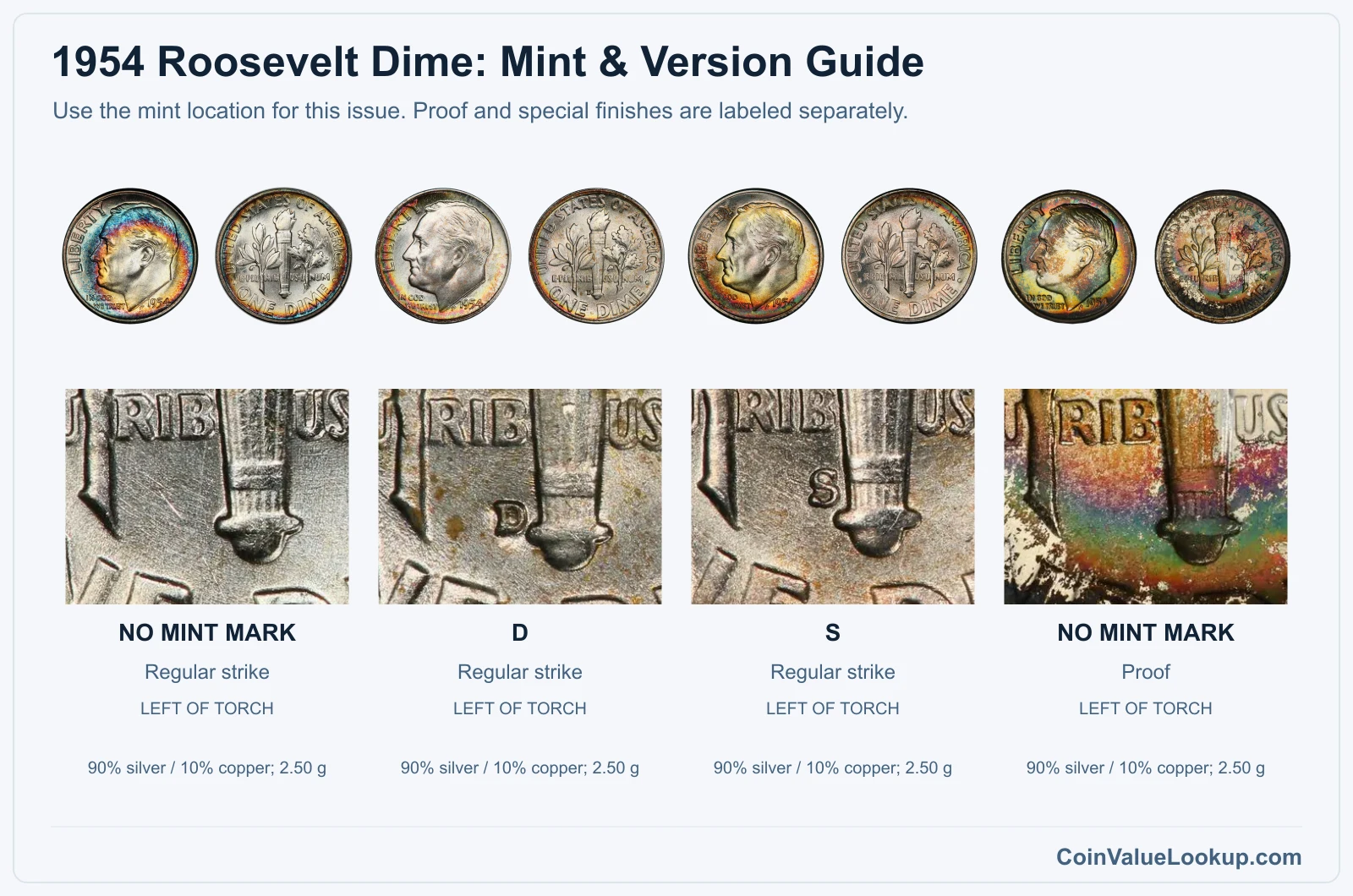
Start by confirming the date reads 1954 and that you see Roosevelt's portrait on the obverse with a torch flanked by olive and oak branches on the reverse. Flip the coin over and look near the base of the torch for a small mintmark letter.
A "D" means Denver. An "S" means San Francisco.
No letter at all means Philadelphia, and that is completely normal for this year — do not assume a blank spot is a missing-mintmark error.
Every regular 1954 dime is struck in 90% silver and 10% copper, weighing about 2.50 grams and measuring roughly 17.9 mm across. There is no clad version of this date.
If your coin is noticeably lighter or looks like a sandwich of layers on the rim, you may have something unusual worth investigating further.
One important caution: a proof-only doubled die obverse variety is documented for 1954 Philadelphia proofs. Do not apply that variety's value to a circulation-strike Philadelphia dime just because it lacks a mintmark.
Step 2: Check Your 1954 Roosevelt Dime Grade
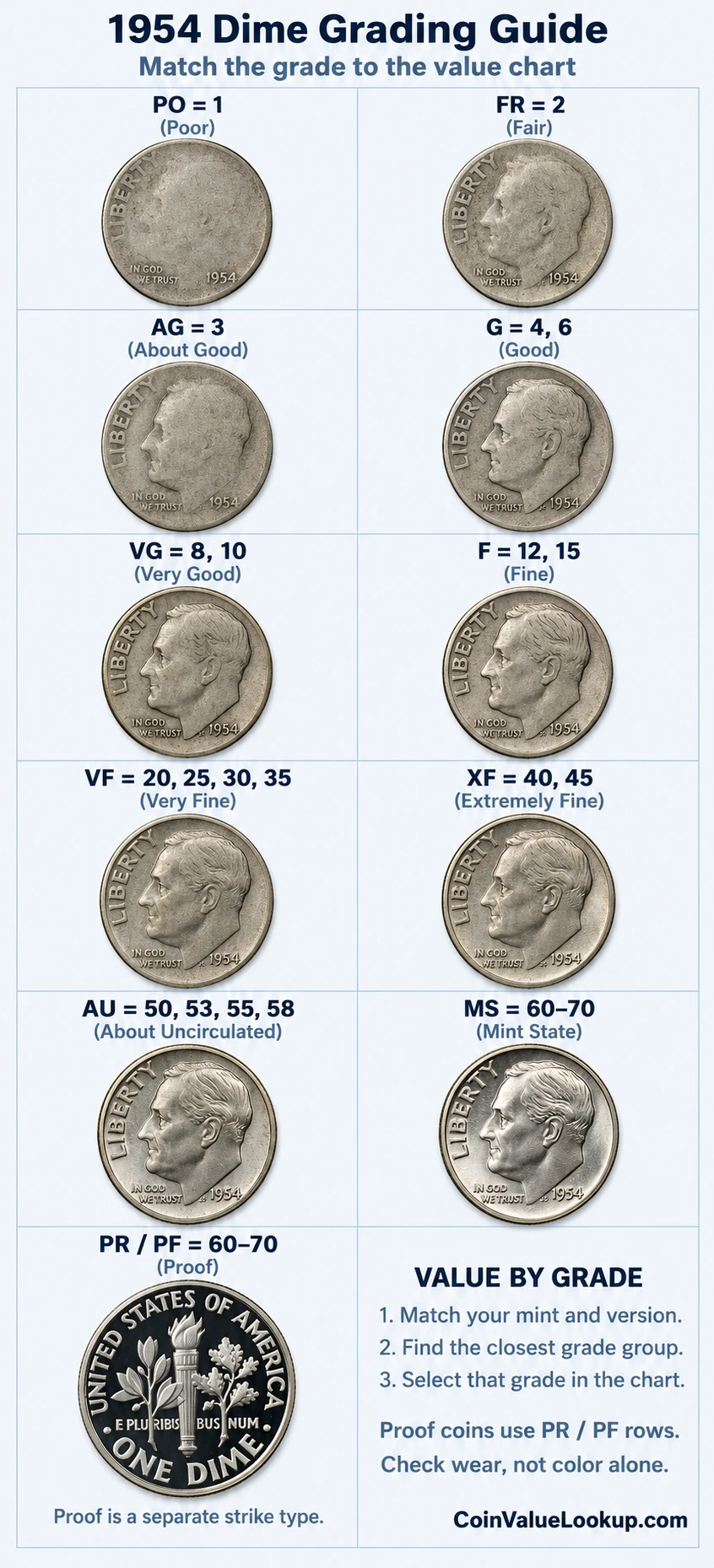
Check Roosevelt's cheekbone first — it is the highest point on the obverse and shows wear earliest. Then examine the hair detail above the ear and along the jawline.
On the reverse, the upper torch and the tips of the olive and oak leaves lose definition quickly with circulation.
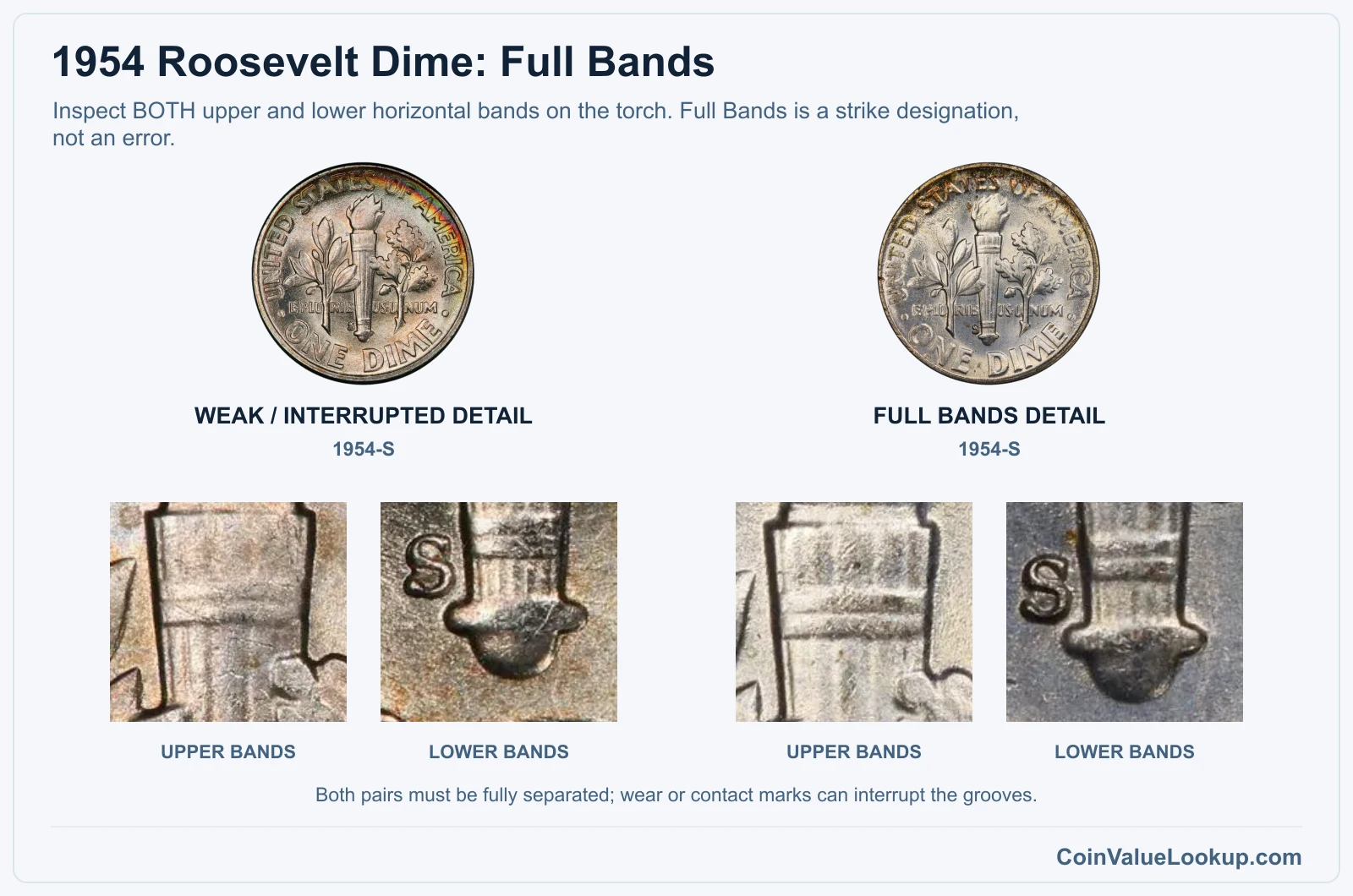
A soft or incomplete set of horizontal torch bands does not automatically mean the coin circulated. Weak bands can result from a less-than-perfect strike at the mint.
The Full Bands designation refers to complete separation of both pairs of horizontal bands on the torch, and it is a strike quality marker, not a grade.
Compare your coin against the reference image and match it to the closest grade within the same mint and strike type. A proof coin should be judged against other proofs, not against business strikes.
Original luster matters more than raw shininess. A harshly cleaned coin that gleams can actually grade lower than a slightly toned one with undisturbed surfaces.
Look for hairline scratches under angled light — they are the telltale sign of past cleaning.
Step 3: Check 1954 Roosevelt Dime Value by Mint and Version
1954 Roosevelt Dime — No Mintmark / Philadelphia
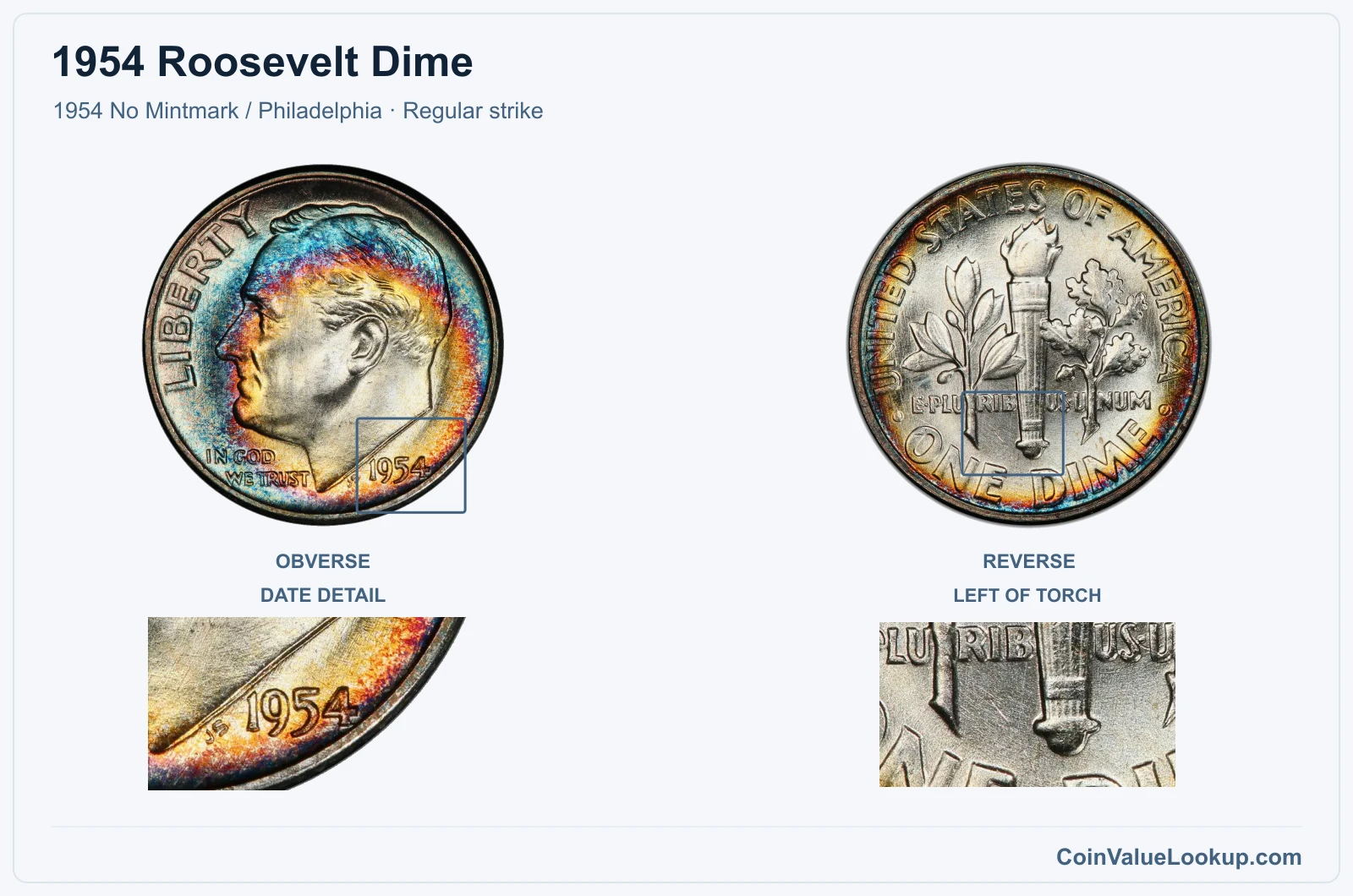
The 1954 Philadelphia dime carries no mintmark, which is standard for that facility in this era. It is a 90% silver business strike weighing 2.50 grams.
Guide estimates place a well-worn Good-4 example around $5.81 and an uncirculated MS65 near $16, per USA Coin Book. Coins with Full Bands — meaning both horizontal torch-band pairs are fully separated — often trade at a premium above those figures within the same numerical grade.
Coin Value Lookup is a handy place to look up guides for other Roosevelt Dime dates and denominations if you are working through a collection.
Preserve original surfaces. A light, even tone is far preferable to a coin scrubbed back to white.
And remember, the proof-only doubled die obverse documented for 1954 does not apply to circulation strikes from Philadelphia.
Range Grade
Price Auction Records Appraisal PO PO 1
—
Coin Identifier FR FR 2
—
Coin Identifier AG AG 3
—
Coin Identifier G G 4
—
Coin Identifier
G 6
—
Coin Identifier VG VG 8
—
Coin Identifier
VG 10
—
Coin Identifier F F 12
—
Coin Identifier
F 15
—
Coin Identifier VF VF 20
—
Coin Identifier
VF 25
—
Coin Identifier
VF 30
—
Coin Identifier
VF 35
—
Coin Identifier XF XF 40
—
Coin Identifier
XF 45
—
Coin Identifier AU AU 50
—
Coin Identifier
AU 53
—
Coin Identifier
AU 55
—
Coin Identifier
AU 58
—
Coin Identifier MS MS 60
—
Coin Identifier
MS 61
—
Coin Identifier
MS 62
—
Coin Identifier
MS 63
—
Coin Identifier
MS 64
—
Coin Identifier
MS 65
Coin Identifier
MS 66
Coin Identifier
MS 67
Coin Identifier
MS 68
Coin Identifier
MS 69
—
—
—
MS 70
—
—
—
1954 Roosevelt Dime — D / Denver
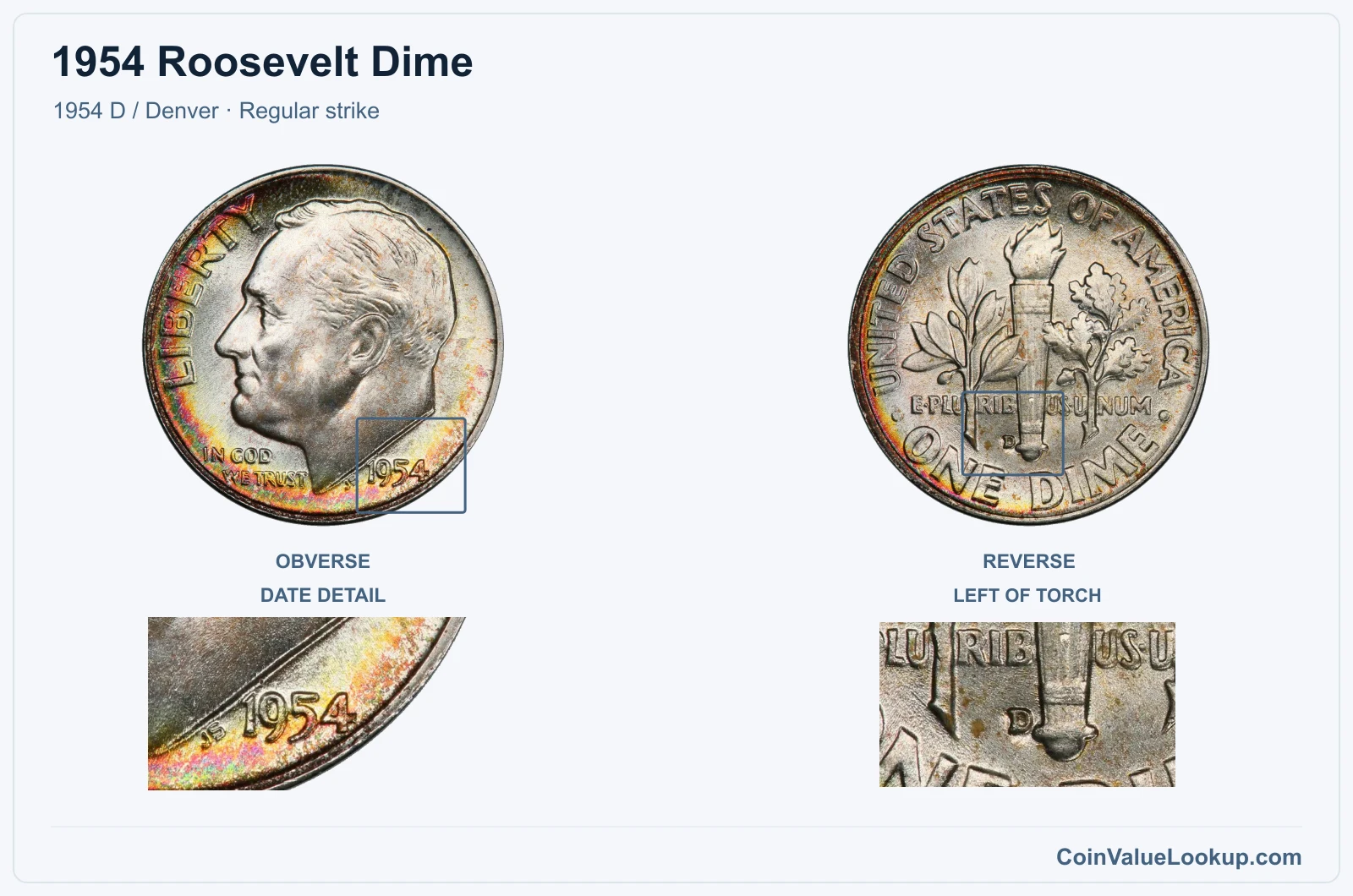
Look for a small "D" mintmark on the reverse near the base of the torch. Denver produced business strikes in 90% silver at 2.50 grams, identical in composition to Philadelphia and San Francisco issues.
A Good-4 Denver dime lists around $5.81 in the USA Coin Book guide, climbing to roughly $16 at MS65. Full Bands examples can exceed those figures, so it is worth checking the torch under magnification.
Denver strikes sometimes show a slightly different luster quality than Philadelphia coins, but the grading standards are the same. Keep your comparisons within the D-mint lane when evaluating strike sharpness.
Range Grade
Price Auction Records Appraisal PO PO 1
—
Coin Identifier FR FR 2
—
Coin Identifier AG AG 3
—
Coin Identifier G G 4
—
Coin Identifier
G 6
—
Coin Identifier VG VG 8
—
Coin Identifier
VG 10
—
Coin Identifier F F 12
—
Coin Identifier
F 15
—
Coin Identifier VF VF 20
—
Coin Identifier
VF 25
—
Coin Identifier
VF 30
—
Coin Identifier
VF 35
—
Coin Identifier XF XF 40
—
Coin Identifier
XF 45
—
Coin Identifier AU AU 50
—
Coin Identifier
AU 53
—
Coin Identifier
AU 55
—
Coin Identifier
AU 58
—
Coin Identifier MS MS 60
—
Coin Identifier
MS 61
—
Coin Identifier
MS 62
—
Coin Identifier
MS 63
—
Coin Identifier
MS 64
—
Coin Identifier
MS 65
Coin Identifier
MS 66
Coin Identifier
MS 67
Coin Identifier
MS 68
—
—
—
MS 69
—
—
—
MS 70
—
—
—
1954 Roosevelt Dime — S / San Francisco
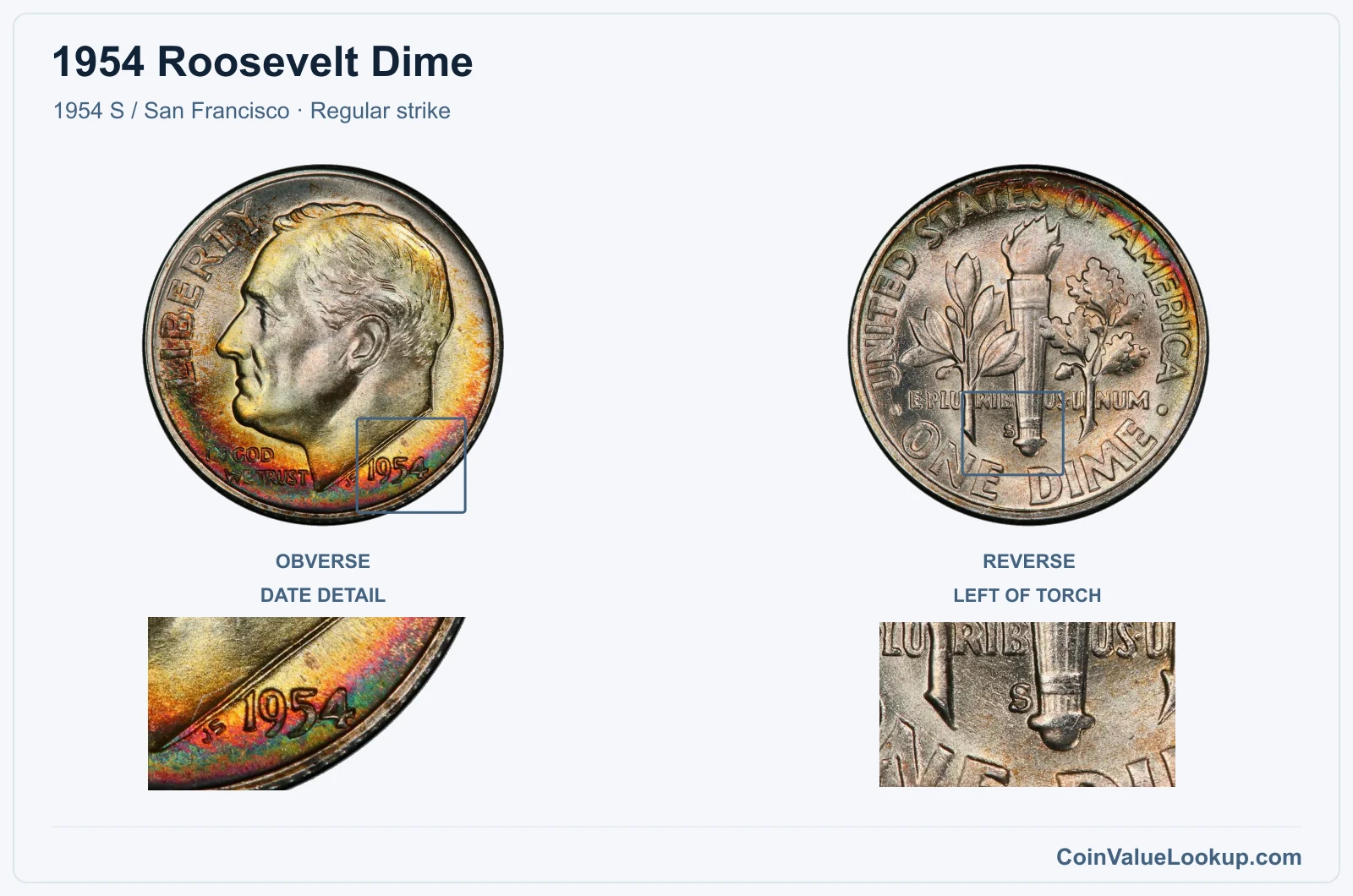
San Francisco's 1954 dime carries an "S" mintmark on the reverse beside the torch base. Same silver composition, same weight — 90% silver, 2.50 grams.
Guide values from USA Coin Book sit at about $5.81 in Good-4 and around $16 for MS65. As with all three mints, Full Bands designation can add a noticeable bump.
The 1954-S is also the host coin for a repunched mintmark variety and a reported missing-initials variety, so give the mintmark area and the designer's initials a close look under magnification before dropping it in a flip and moving on.
Range Grade
Price Auction Records Appraisal PO PO 1
—
Coin Identifier FR FR 2
—
Coin Identifier AG AG 3
—
Coin Identifier G G 4
—
Coin Identifier
G 6
—
Coin Identifier VG VG 8
—
Coin Identifier
VG 10
—
Coin Identifier F F 12
—
Coin Identifier
F 15
—
Coin Identifier VF VF 20
—
Coin Identifier
VF 25
—
Coin Identifier
VF 30
—
Coin Identifier
VF 35
—
Coin Identifier XF XF 40
—
Coin Identifier
XF 45
—
Coin Identifier AU AU 50
—
Coin Identifier
AU 53
—
Coin Identifier
AU 55
—
Coin Identifier
AU 58
—
Coin Identifier MS MS 60
—
Coin Identifier
MS 61
—
Coin Identifier
MS 62
—
Coin Identifier
MS 63
—
Coin Identifier
MS 64
—
Coin Identifier
MS 65
Coin Identifier
MS 66
Coin Identifier
MS 67
Coin Identifier
MS 68
Coin Identifier
MS 69
—
—
—
MS 70
—
—
—
1954 Roosevelt Dime — Philadelphia Proof (No Mintmark)
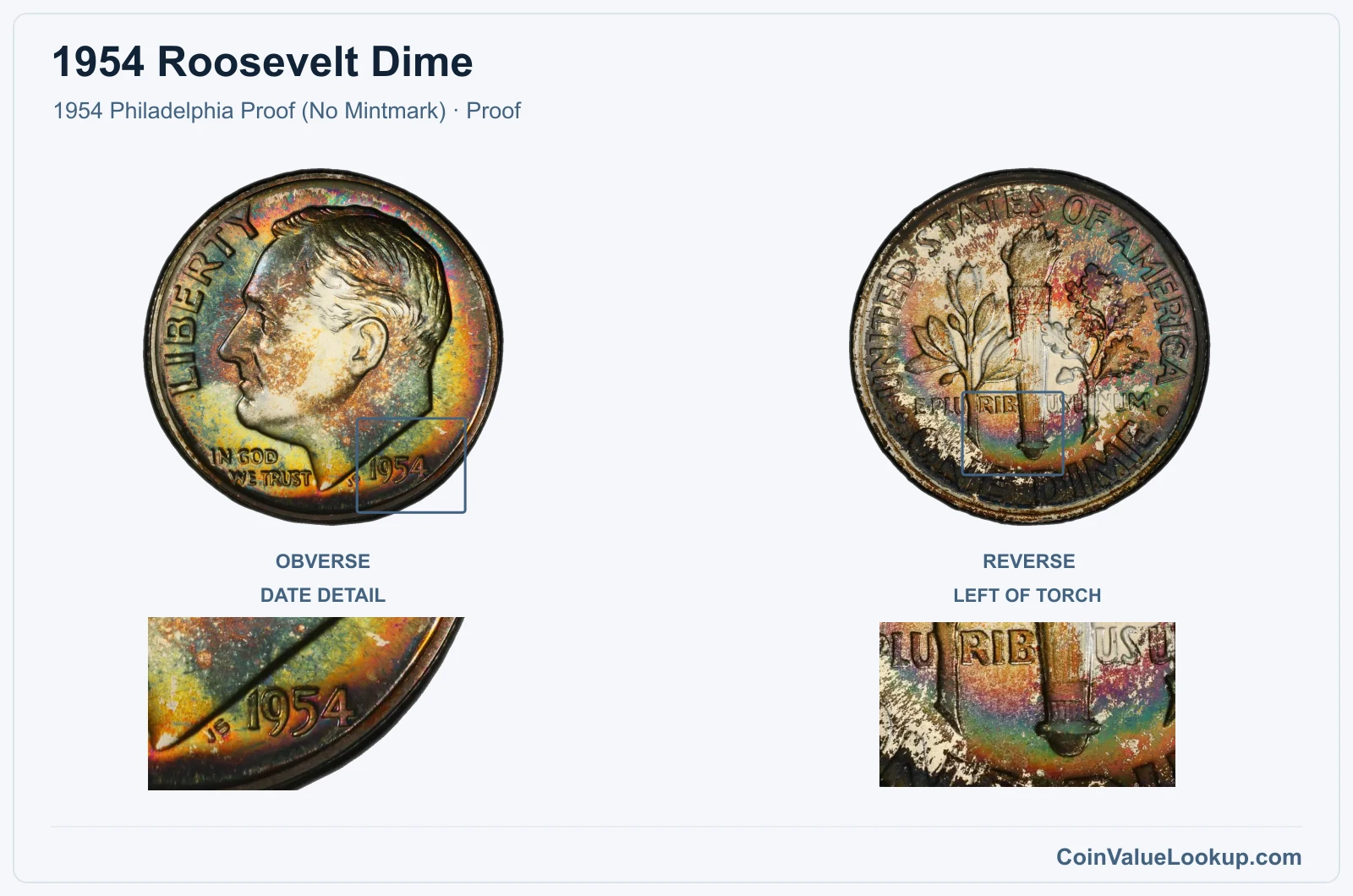
Philadelphia proofs from 1954 feature mirrored fields, squared rims and sharply detailed devices — they were struck intentionally for collectors, not plucked from circulation. All are 90% silver, 2.50 grams, and carry no mintmark.
The USA Coin Book guide places a PR65 example at roughly $26. That figure covers an ordinary proof finish.
Cameo and deep-cameo designations, where frosted devices contrast against mirror fields, are tracked separately and can command considerably more, so do not assume $26 is the ceiling for every proof.
This is also the only version where the documented 1954 Doubled Die Obverse occurs. If you have a circulation-strike dime with no mintmark, it is a Philadelphia business strike, not a proof, and the DDO variety does not apply to it.
Range Grade
Price Auction Records Appraisal PR PR 1
—
Coin Identifier
PR 2
—
Coin Identifier
PR 3
—
Coin Identifier
PR 4
—
Coin Identifier
PR 6
—
Coin Identifier
PR 8
—
Coin Identifier
PR 10
—
Coin Identifier
PR 12
—
Coin Identifier
PR 15
—
Coin Identifier
PR 20
—
Coin Identifier
PR 25
—
Coin Identifier
PR 30
—
Coin Identifier
PR 35
—
Coin Identifier
PR 40
—
Coin Identifier
PR 45
—
Coin Identifier
PR 50
—
Coin Identifier
PR 53
—
Coin Identifier
PR 55
—
Coin Identifier
PR 58
—
Coin Identifier
PR 60
Coin Identifier
PR 61
—
Coin Identifier
PR 62
—
Coin Identifier
PR 63
—
Coin Identifier
PR 64
Coin Identifier
PR 65
Coin Identifier
PR 66
Coin Identifier
PR 67
Coin Identifier
PR 68
Coin Identifier
PR 69
Coin Identifier
PR 70
—
—
—
1954 Roosevelt Dime Error List
1. 1954 Roosevelt Dime — Proof Doubled Die Obverse
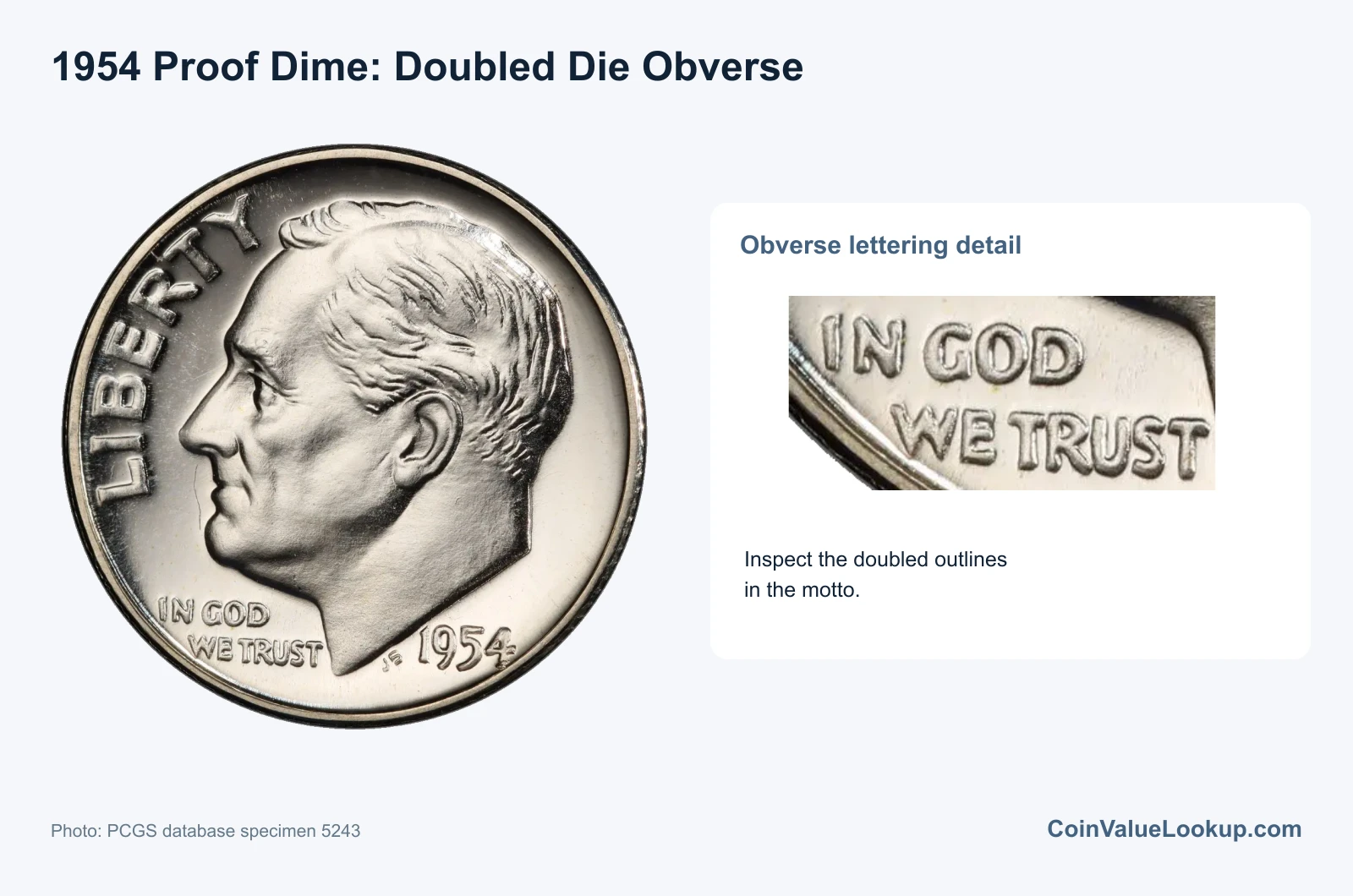
This doubled die obverse is exclusive to 1954 Philadelphia proofs. The strongest diagnostic is a bold extra impression visible below the digit 4 in the date.
The designer's initials and portions of the motto may also show doubling.
Before applying any premium, confirm you actually have a proof: mirrored fields, squared rims and sharp device edges. An ordinary Philadelphia business strike — which also lacks a mintmark — is not a proof and does not qualify for this variety.
Flat, shelf-like doubling that runs in one direction is typically machine doubling from die chatter, not a doubled die. True doubled-die impressions show rounded, separated outlines.
No specific price range is adopted here because value depends on authenticated identity, the coin's overall condition and how strongly the doubling presents. Individual professional assessment is the way to go.
2. 1954 Roosevelt Dime — Repunched S Mintmark
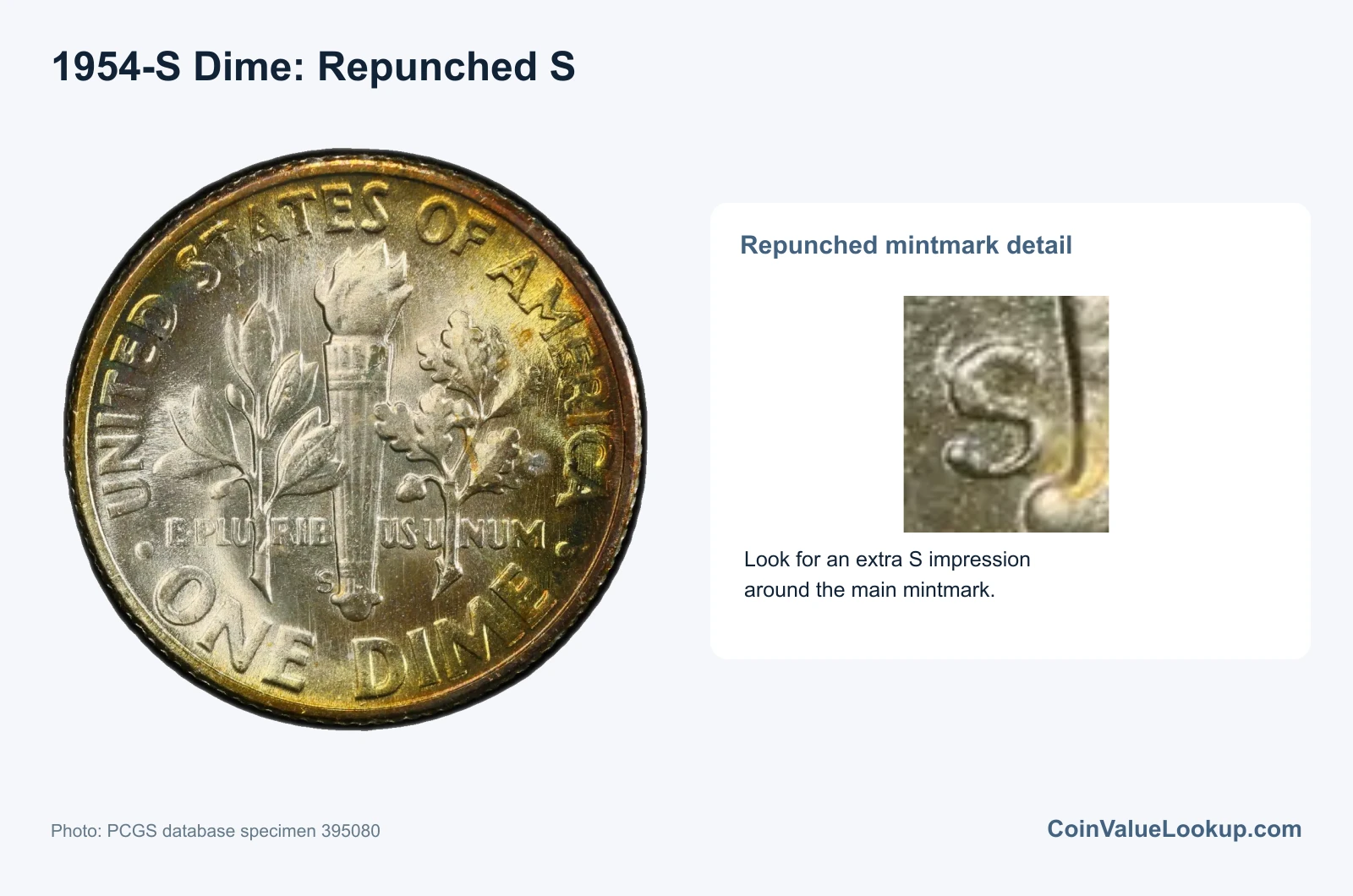
On some 1954-S dimes, a secondary "S" is visible at the upper-left of the final, properly positioned S mintmark. You will need a loupe to spot the raised, curved outline of the earlier punch.
Not every thick or blobby mintmark is a repunched mintmark. Machine doubling can flatten and shelf the letter, and accumulated dirt or minor damage can mimic a second impression.
A genuine RPM shows a distinctly separate, raised outline — look for that curved repeat specifically.
One archived sale provides a reference point: a PCGS MS63 example sold for $38 in May 2025. That is a single transaction, not a universal RPM price.
Condition, the clarity of the repunching and third-party certification all factor into what a given coin might bring.
3. 1954 Roosevelt Dime — Die Cracks / Spike Head
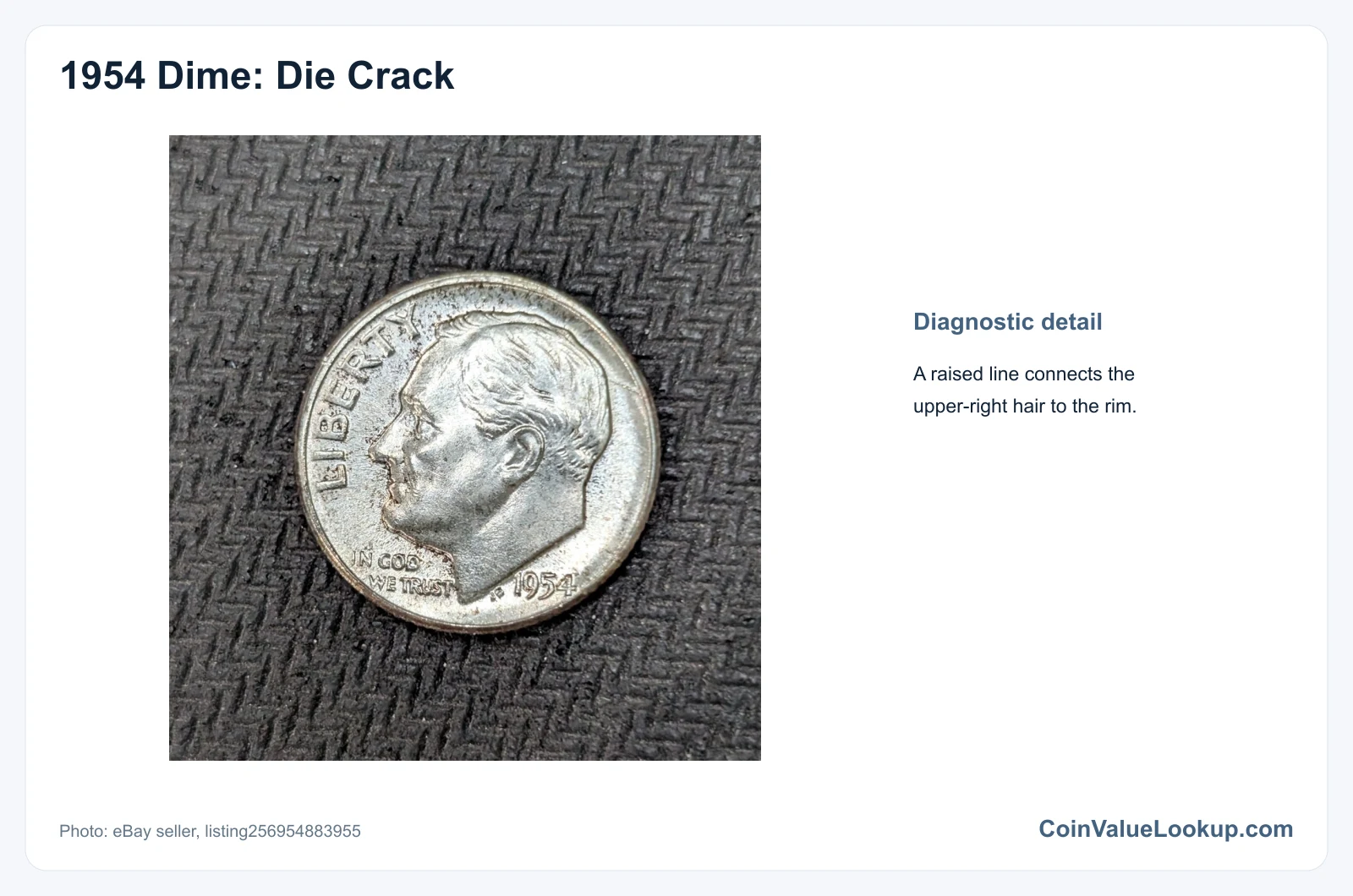
Die cracks on 1954 Philadelphia business strikes sometimes produce a raised line running from the top of Roosevelt's head toward the rim, earning the nickname "spike head." Multiple die states have been documented for this date, showing the crack at various stages of progression.
To confirm, direct a light across the surface at a low angle. A genuine die crack stands above the field as a thin raised ridge.
Incuse scratches and tool marks sit below the surface — the opposite profile. Post-mint contact damage also tends to be irregular and lacks the consistent path that a die crack follows from device to rim.
Do not assume a raised line near the rim is a rim cud unless there is actually missing die metal producing a blob connected to the rim edge. No specific price range is adopted for these; value depends on the prominence of the crack, the coin's grade and authentication.
4. 1954 Roosevelt Dime — Doubled Die Reverse
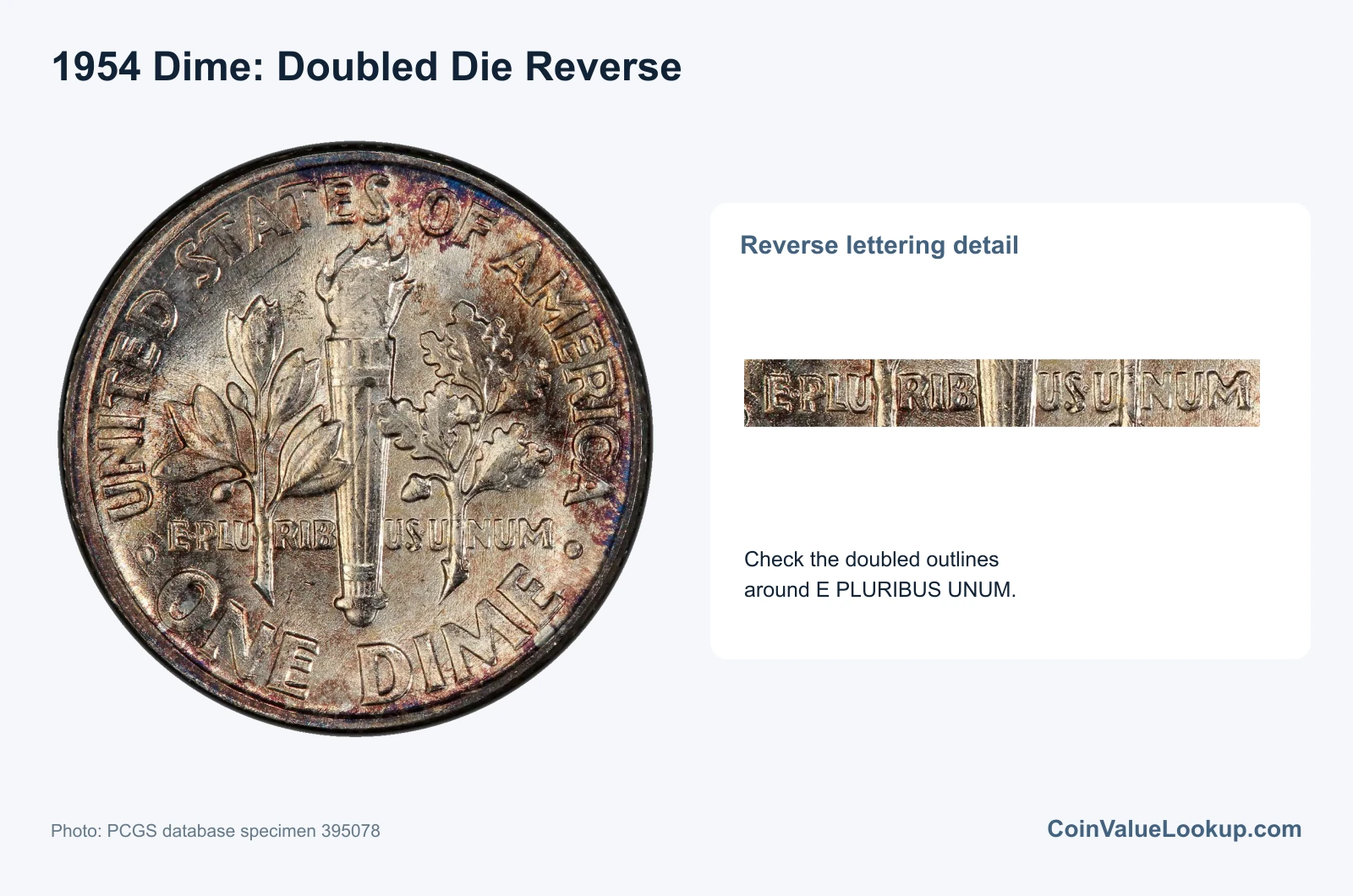
A Doubled Die Reverse has been reported for 1954 dimes. The variety involves doubling visible in the reverse legends or design contours, distinguishable from normal strike characteristics when compared side by side with an unaffected coin.
Use magnification and compare your reverse lettering and torch details against a known normal example. Genuine hub doubling produces separated, rounded secondary impressions.
Machine doubling, by contrast, leaves flat, shelf-like distortions and is far more common — and far less valuable.
Reflections from proof surfaces or random post-strike damage can also mimic doubling at a glance, so a careful comparison is important. No numerical price range is adopted here.
The value of any individual example depends on the visibility of the doubling, the coin's overall condition and professional authentication of the specific variety.
5. 1954 Roosevelt Dime — Missing FG Initials
A reported variety for the 1954-S dime involves missing designer initials (JS) on the reverse. On a normal coin, these small letters appear near the base of the torch on the lower right.
The likely cause cited in source references is die polishing at the mint, which can remove shallow design elements like tiny initials before strikes begin. However, wear from circulation, grease fill during striking and deliberate post-mint removal can all produce the same blank look in that area.
Compare the surrounding reverse details carefully. If the rest of the design shows sharp, full detail while the initials are absent, die polishing is a more plausible explanation than wear.
If the entire lower torch area is mushy, normal wear is the more likely culprit.
No numerical price range is adopted for this variety. Value depends on condition, the clarity of the missing-initials characteristic and whether the coin has been independently authenticated as the recognized variety.