1849 Liberty Seated Dollar Coin Value: How Much Is It Worth?
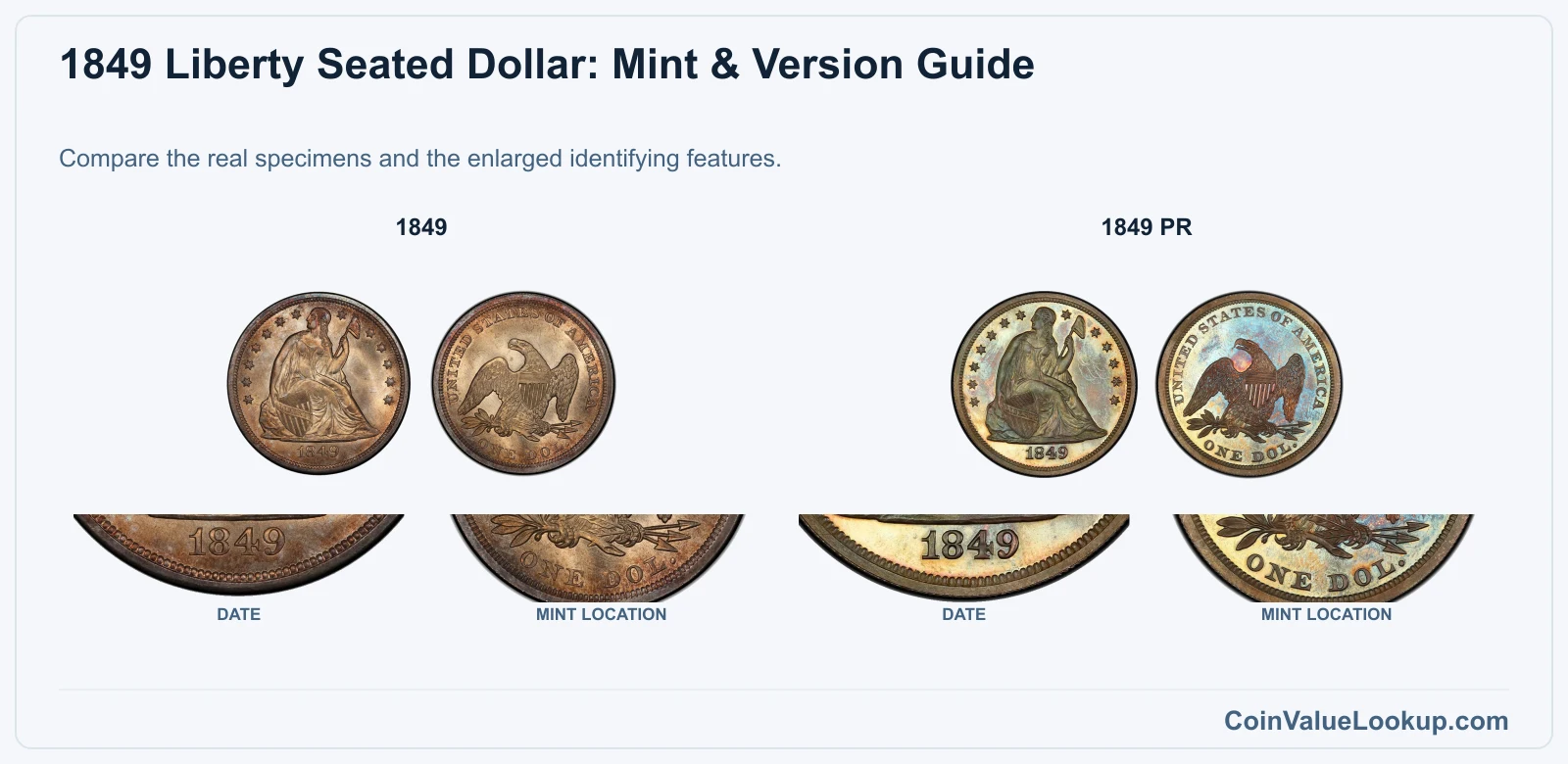
The 1849 Liberty Seated Dollar is a pre-Civil War silver dollar that draws steady collector interest. Guide estimates for business-strike examples range from about $508 in Good-4 to $6,434 in MS63, according to USA Coin Book.
Those figures depend on accurate identification of mint, finish, and design, so confirming what you actually have comes first.
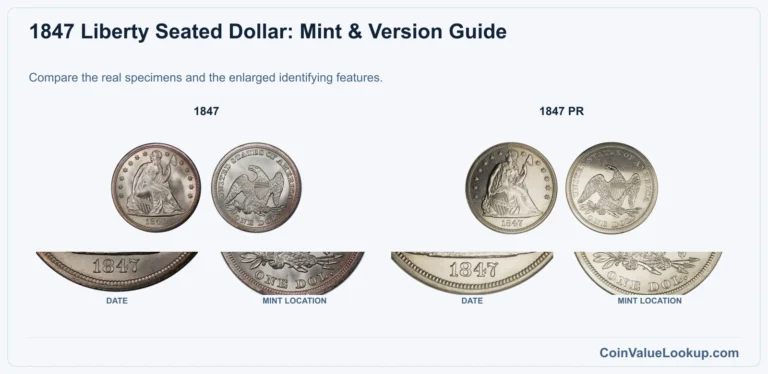
This year produced two distinct collectible branches: a regular Philadelphia business strike and a proof issue. The proof is a separate manufacturing finish, not just a high-grade coin, and requires individual assessment by an authenticated example.
Sorting out which version you hold is the essential first step before any value comparison.
Fast Way to Identify Your 1849 Liberty Seated Dollar
Upload clear photos of both the front and back of your 1849 Liberty Seated Dollar for a preliminary identification. Good lighting at a slight angle helps capture surface details and any wear patterns.
This step can help narrow down whether your coin is a business strike or proof finish, and flag any obvious condition issues before you dig deeper into value.
1849 Liberty Seated Dollar Value
Upload both sides of your 1849 Liberty Seated Dollar.
Front Obverse
Upload photo
Back Reverse
Upload photo
Which 1849 Liberty Seated Dollar Versions Are Worth Money?
- The 1849 proof (PR) is a distinct manufacturing finish requiring individual assessment; it is not simply a high-grade business strike.
- Business strikes range from roughly $508 in Good-4 to $6,434 in MS63 per USA Coin Book guide estimates, with condition and original surfaces being the main value drivers.
Step 1: Identify Your 1849 Liberty Seated Dollar Mint Mark and Version
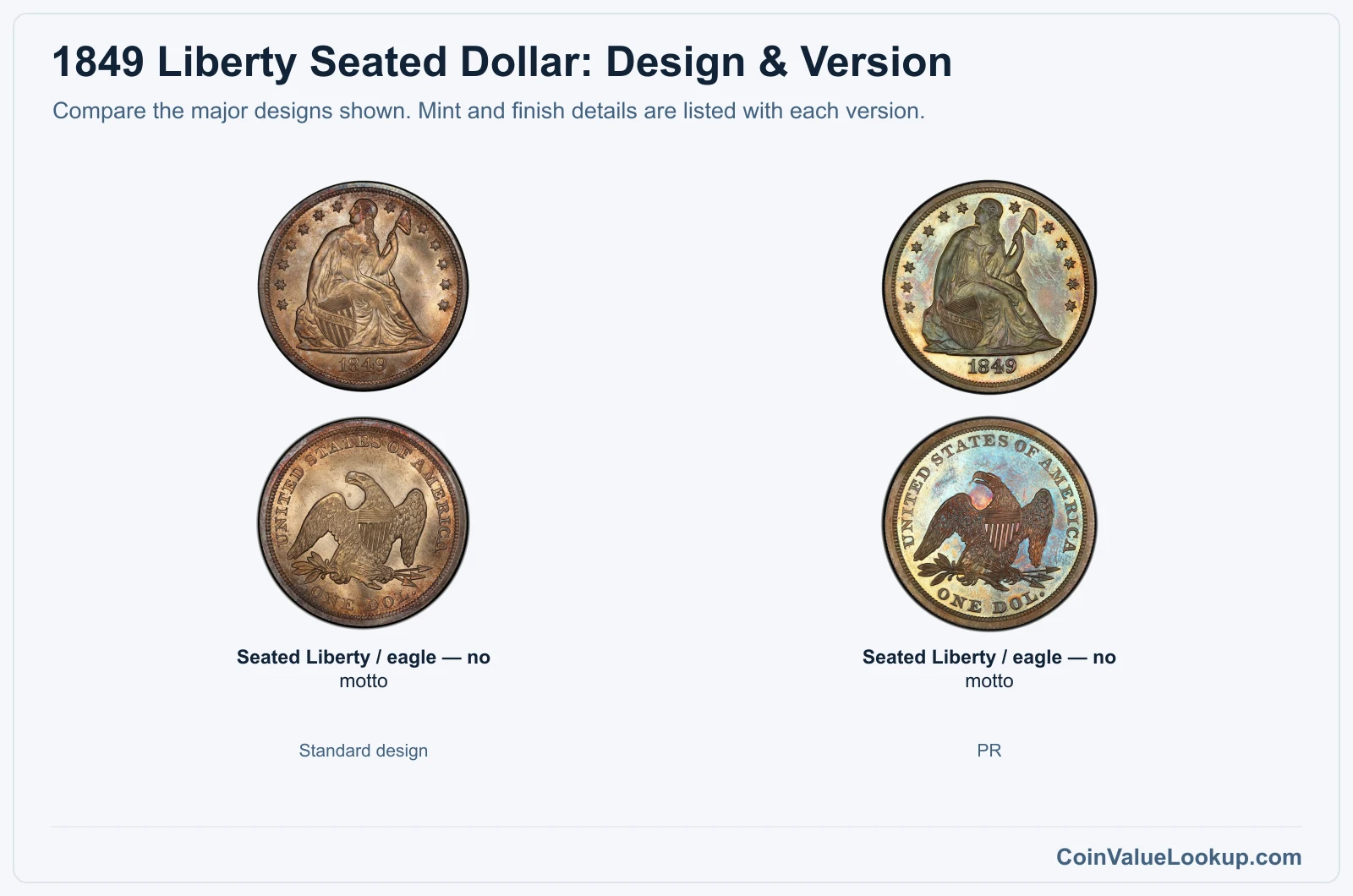
Philadelphia struck these dollars without a mintmark. On branch-mint Seated Dollars of other years, a small letter appears on the reverse below the eagle and above the ONE DOL.
denomination. If your 1849 has no such letter, it is a Philadelphia coin, which is expected since Philadelphia was the only mint producing this denomination in 1849.
The design shows a seated Liberty figure on the obverse holding a liberty pole and cap, with a shield at her side. The reverse features an eagle with outstretched wings.
This is the no-motto type, meaning the ribbon above the eagle does not carry IN GOD WE TRUST, a detail added in later years.
The coin is 90% silver and 10% copper, with a nominal weight of 26.73 grams. If your coin feels noticeably light or does not respond to a magnet test as expected for silver, that warrants closer inspection.
Two versions exist for 1849: the standard business strike (version-1) and a proof finish (version-2). A proof will show squared, mirror-like fields and sharp rims from specially prepared dies and planchets.
A shiny circulated coin or one that has been polished is not a proof.
Step 2: Check Your 1849 Liberty Seated Dollar Grade
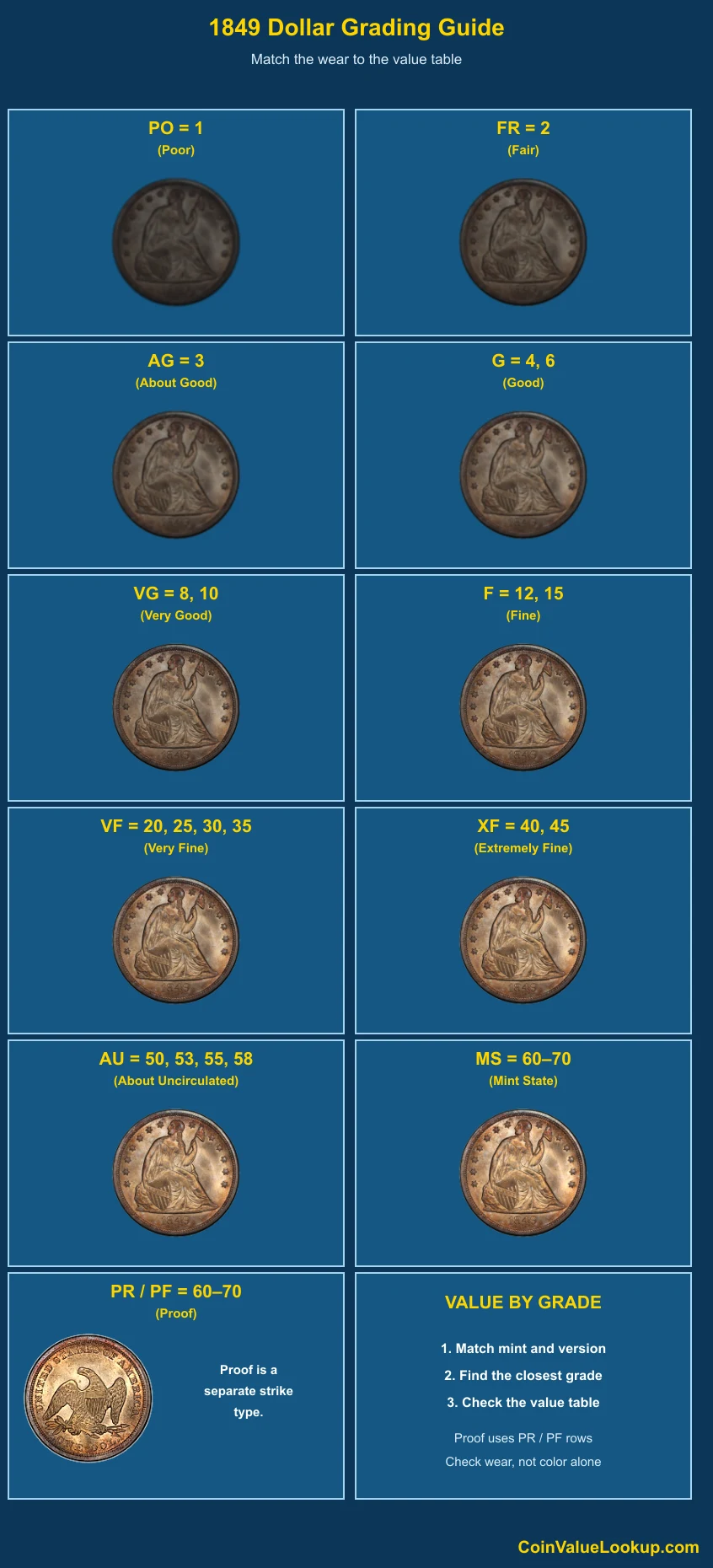
Start with Liberty herself. On a well-worn coin, the head, breast, knee, and shield lose detail progressively.
The knee area and the top of the shield tend to show wear first, followed by Liberty's head and breast. A coin grading Good-4 will have a visible outline of Liberty but most interior detail gone.
Do not grade a weakly struck head as heavily worn. Some Seated Dollars left the press with soft strikes on the head, which is a die issue, not circulation damage.
Compare your coin side by side with a genuine same-type grading image to see the difference between wear and strike weakness.
On the reverse, the eagle's breast feathers and wing tips are the first areas to flatten. In AU grades, you will see just a trace of friction on the highest points with most luster intact.
MS63 examples retain full luster but may show light contact marks.
Proof coins should be evaluated separately from business strikes. Mirror fields, sharp devices, and minimal handling marks define a well-preserved proof.
Cleaning, polishing, or whizzing a business strike does not create a proof surface and actually reduces a coin's collectibility.
Step 3: Check 1849 Liberty Seated Dollar Value by Mint and Version
1849 Liberty Seated Dollar
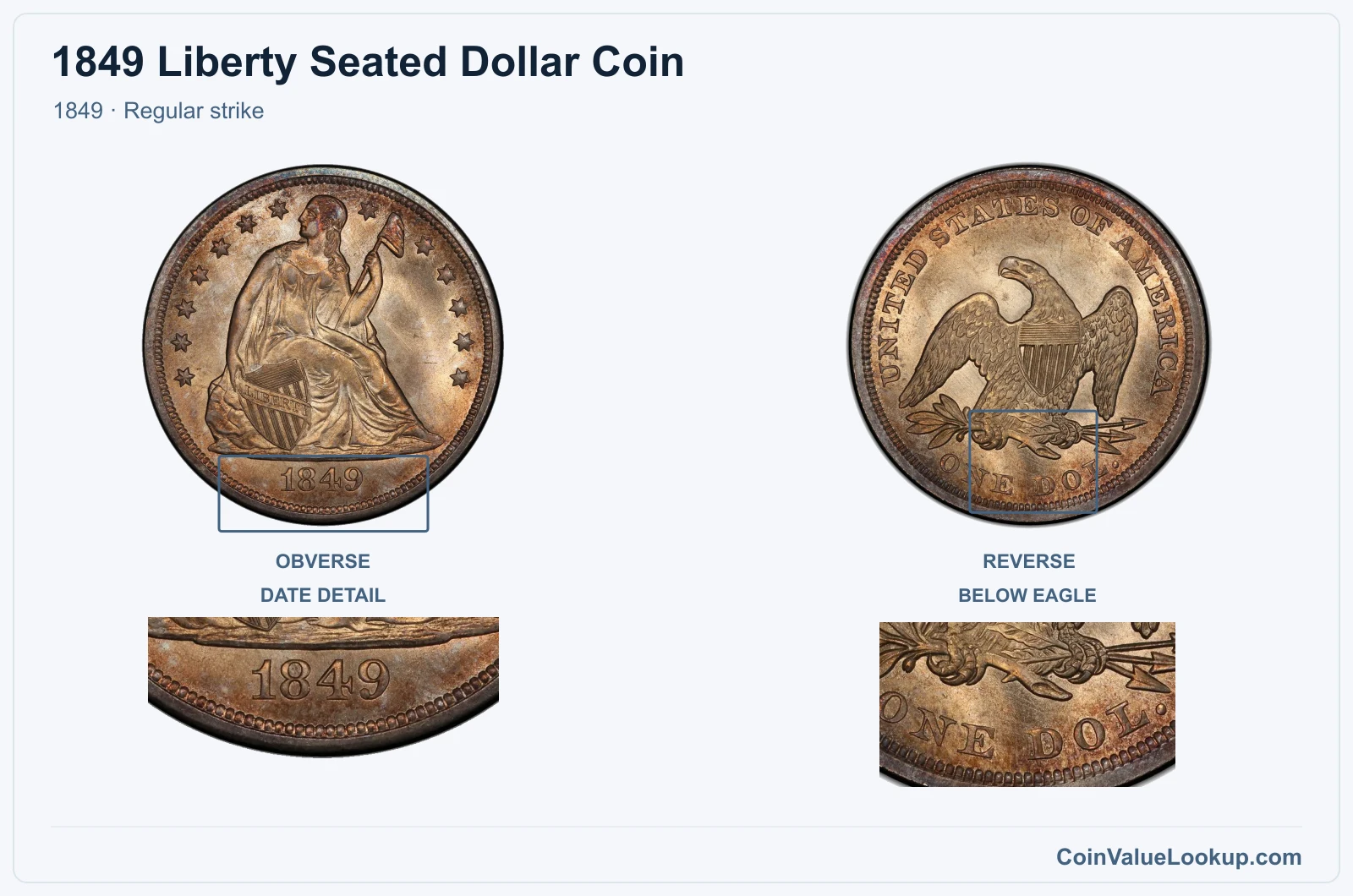
The 1849 business-strike dollar was produced at Philadelphia with no mintmark. It carries the Seated Liberty obverse and no-motto eagle reverse in 90% silver.
USA Coin Book guide estimates place a Good-4 example around $508 and an MS63 near $6,434. Those are reference points, not guaranteed offers.
Original, uncleaned surfaces matter a great deal for this type. A coin that has been polished or dipped may look shiny but loses the natural toning and luster collectors want, which drags down its comparability to graded examples.
Match the exact mint, design, and condition before assuming a value.
Coin Value Lookup is a useful starting point if you want to look up guides for other dates and denominations in the Seated Dollar series or any other U.S. coin type.
Range Grade
Price Auction Records Appraisal PO PO 1
—
Coin Identifier FR FR 2
—
Coin Identifier AG AG 3
Coin Identifier G G 4
—
Coin Identifier
G 6
Coin Identifier VG VG 8
—
Coin Identifier
VG 10
—
Coin Identifier F F 12
Coin Identifier
F 15
—
Coin Identifier VF VF 20
Coin Identifier
VF 25
—
Coin Identifier
VF 30
Coin Identifier
VF 35
Coin Identifier XF XF 40
Coin Identifier
XF 45
Coin Identifier AU AU 50
Coin Identifier
AU 53
Coin Identifier
AU 55
Coin Identifier
AU 58
Coin Identifier MS MS 60
Coin Identifier
MS 61
Coin Identifier
MS 62
Coin Identifier
MS 63
Coin Identifier
MS 64
Coin Identifier
MS 65
Coin Identifier
MS 66
—
Coin Identifier
MS 67
—
Coin Identifier
MS 68
—
—
—
MS 69
—
—
—
MS 70
—
—
—
1849 Liberty Seated Dollar — PR
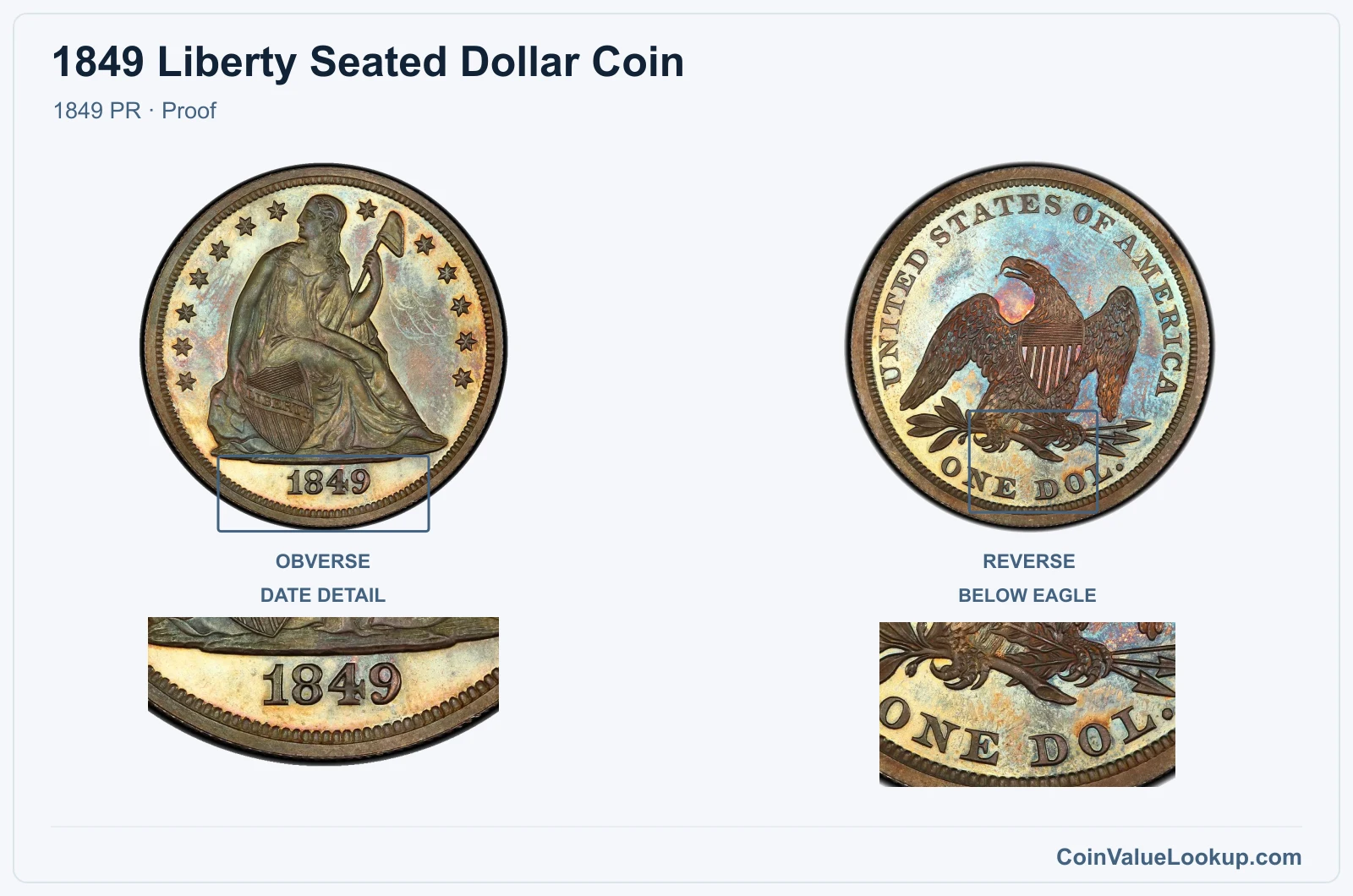
The 1849 proof dollar is a Philadelphia issue struck with specially prepared dies on polished planchets. It shares the same no-motto Seated Liberty design and 90% silver composition as the business strike, but the manufacturing process is completely different.
Proof surfaces show deep, mirror-like fields with sharply defined devices and squared rims.
No supported numeric price range is available for this version. Each proof must be assessed individually based on its authenticated identity and condition.
Third-party certification from a recognized grading service is essentially required before any serious transaction. A shiny, cleaned, or lightly circulated business strike is not a proof, no matter how bright it appears.
If you suspect you have one, professional authentication is the path forward.
Range Grade
Price Auction Records Appraisal PR PR 1
—
Coin Identifier
PR 2
—
Coin Identifier
PR 3
—
Coin Identifier
PR 4
—
Coin Identifier
PR 6
—
Coin Identifier
PR 8
—
Coin Identifier
PR 10
—
Coin Identifier
PR 12
—
Coin Identifier
PR 15
—
Coin Identifier
PR 20
—
Coin Identifier
PR 25
—
Coin Identifier
PR 30
—
Coin Identifier
PR 35
—
Coin Identifier
PR 40
—
Coin Identifier
PR 45
—
Coin Identifier
PR 50
—
Coin Identifier
PR 53
—
Coin Identifier
PR 55
—
Coin Identifier
PR 58
Coin Identifier
PR 60
—
Coin Identifier
PR 61
—
—
—
PR 62
—
—
—
PR 63
Coin Identifier
PR 64
Coin Identifier
PR 65
Coin Identifier
PR 66
Coin Identifier
PR 67
Coin Identifier
PR 68
—
—
—
PR 69
—
—
—
PR 70
—
—
—