1880 Liberty Seated Dime Coin Value: How Much Is It Worth?
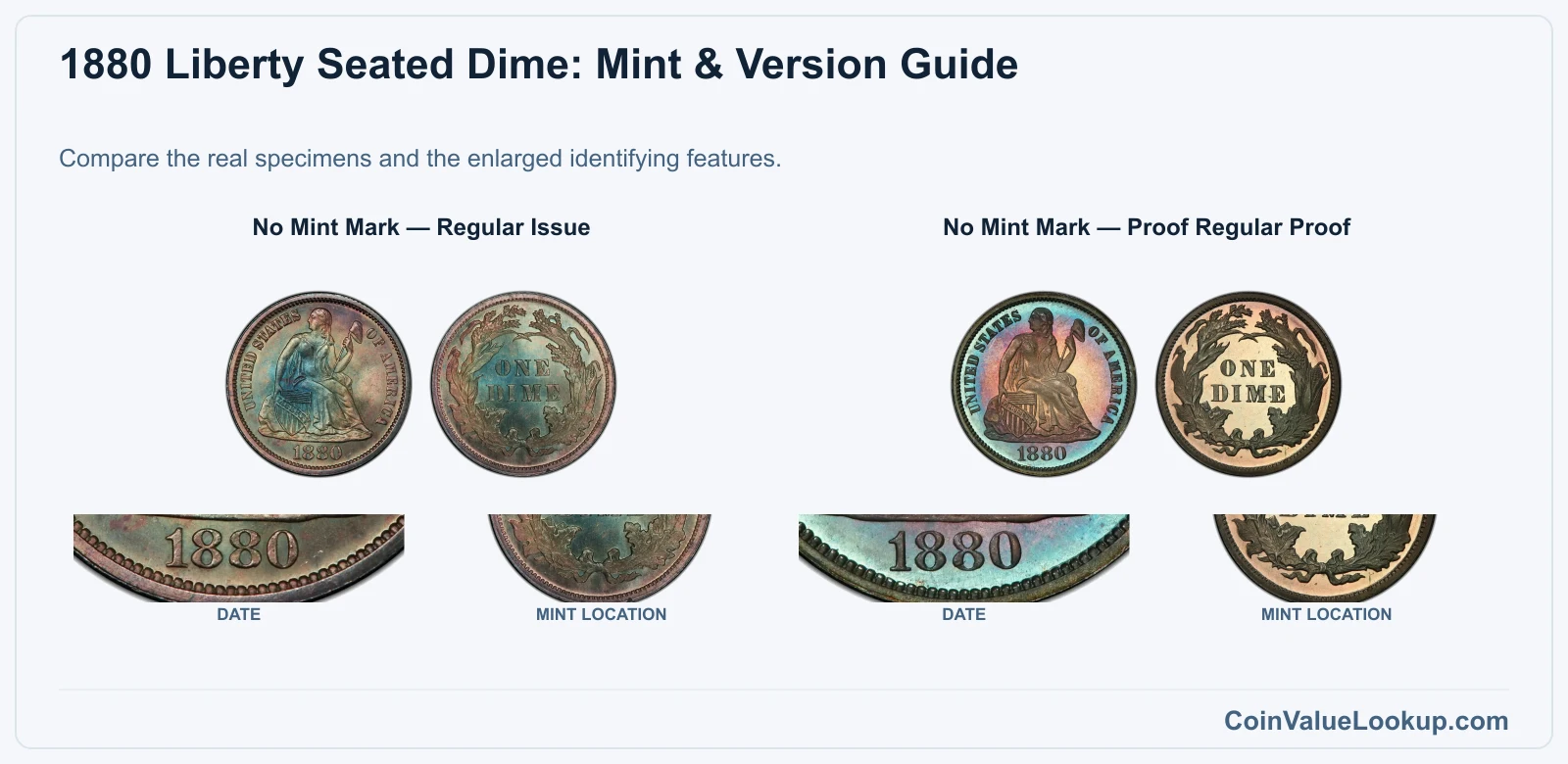
The 1880 Liberty Seated Dime was struck only at Philadelphia, in both business-strike and Proof finishes. Retail guide estimates from USA Coin Book place a circulated example around $189 in G4 condition, climbing to roughly $864 at MS63 for uncirculated pieces.
Proofs carry their own scale. This is a 90% silver coin, so every surviving piece has real metal content behind it — but condition, finish and specific die features drive most of the price difference.
Fast Way to Identify Your 1880 Liberty Seated Dime
Snap clear photos of both sides of your dime under good lighting. Upload the front (obverse) and back (reverse) images and our identifier can offer a preliminary take on what you have — year, mint and general version.
It will not authenticate, certify or grade your coin, but it is a solid first step before investing in professional services.
1880 Liberty Seated Dime Value
Upload both sides of your 1880 Liberty Seated Dime.
Front Obverse
Upload photo
Back Reverse
Upload photo
Which 1880 Liberty Seated Dime Versions Are Worth Money?
- Philadelphia business strikes in solid uncirculated condition (MS63 range) carry a USA Coin Book guide value near $864 — original surfaces and accurate grading are essential.
- Proof examples graded PR63 are listed around $725; confirm mirror fields and deliberate Proof characteristics before assuming this finish.
- Broken date-punch varieties on the 1880 date are documented die features worth examining closely, though no standard guide price is adopted for them.
- A Doubled Die Obverse has been reported for 1880 Philadelphia; visible doubling on specific design elements can affect desirability, so compare your coin to a normal example.
Step 1: Identify Your 1880 Liberty Seated Dime Mint Mark and Version
The 1880 dime shows a seated Liberty figure on the obverse with the legend UNITED STATES OF AMERICA around the rim and the date at the bottom. The reverse displays ONE DIME within an agricultural wreath.
No other mint produced this date, so you should see no mintmark at all — no S, CC or O on the reverse near the wreath bow.
The coin is 90% silver and 10% copper, weighs approximately 2.50 grams and measures 17.9mm across with a reeded edge. Do not confuse it with a half dime, which is noticeably smaller and lighter.
Broken date-punch shapes have been documented for this year. These are die-manufacturing features, not missing-clad errors or evidence of a different alloy.
The coin has no clad layers — it is solid silver throughout.
Step 2: Check Your 1880 Liberty Seated Dime Grade
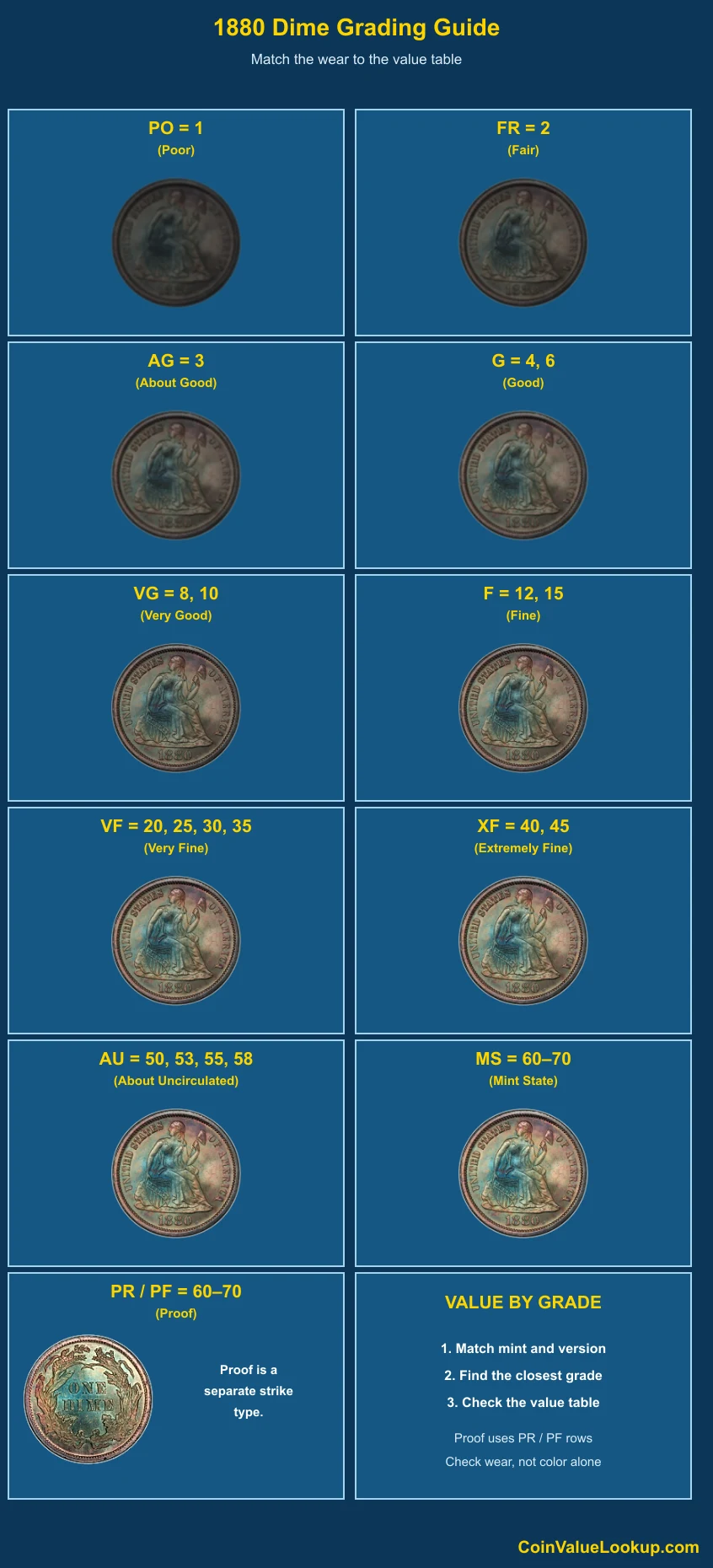
Start with the obverse. Liberty's head, the area around her breast and knee, and the shield on her lap lose detail first as a coin circulates.
On the reverse, check the highest leaves in the wreath for wear. Compare both sides against the reference image to get a realistic sense of where your piece falls.
Luster matters as much as sharpness. A coin can show full design detail yet still grade below MS63 if the original mint luster has been disrupted by cleaning or environmental damage.
Weak strikes and worn dies sometimes soften design elements even on uncirculated coins. That softness is not the same as circulation wear — you will usually see full luster in the affected areas on a weakly struck piece, while a worn coin loses luster where the high points contact other surfaces.
Proof coins are a manufacturing method, not a higher grade than Mint State. A polished business strike is not a Proof.
Genuine Proofs show deliberately prepared mirror fields and sharp rims from the special striking process.
Step 3: Check 1880 Liberty Seated Dime Value by Mint and Version
1880 Liberty Seated Dime — No Mint Mark — Regular Issue
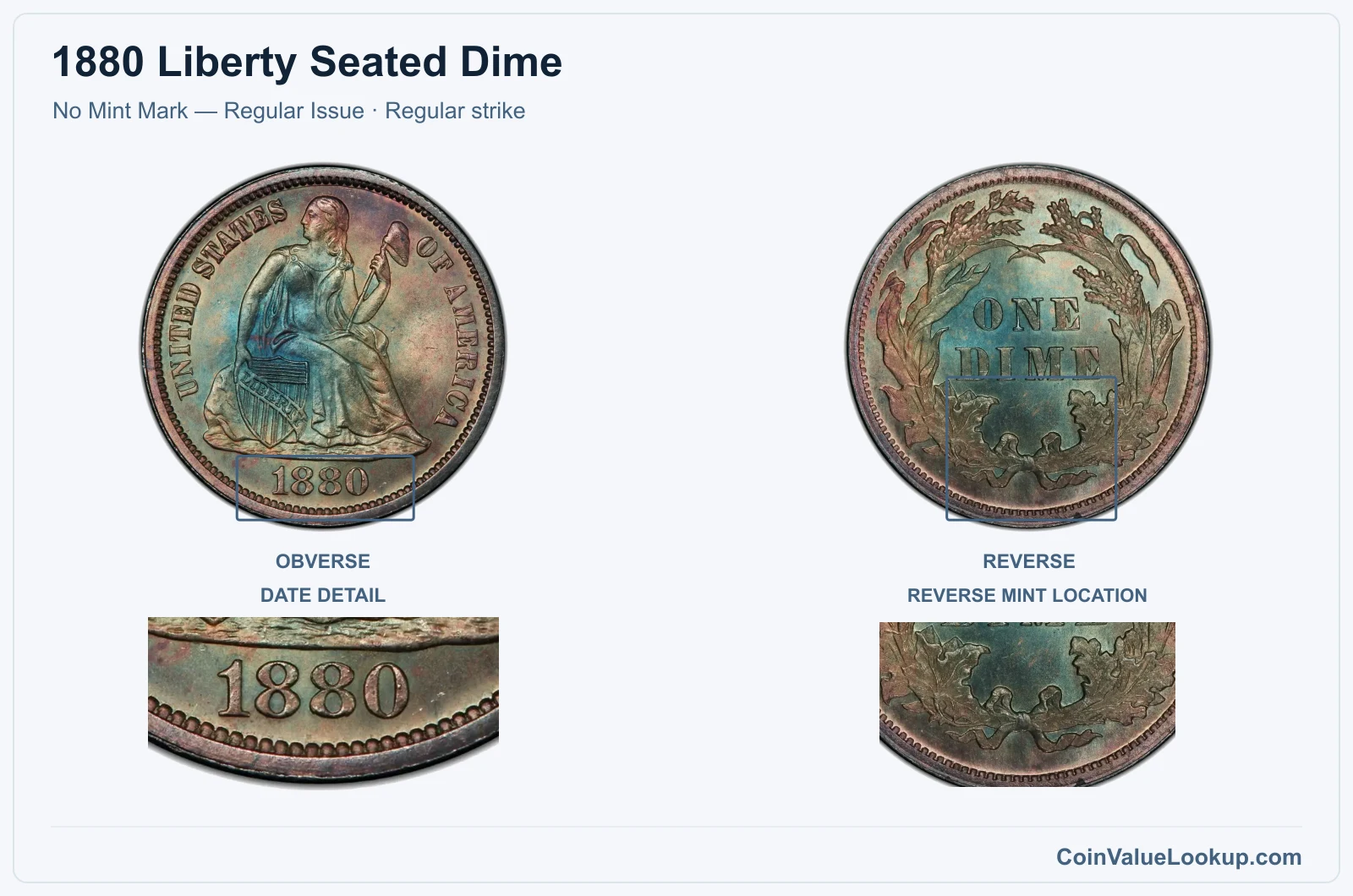
The regular-issue 1880 dime was struck at Philadelphia with no mintmark. It features the Legend Obverse design paired with the agricultural wreath reverse.
Look for the seated Liberty surrounded by the country name in the obverse legend, and ONE DIME centered within the wreath on the back.
USA Coin Book lists a retail guide estimate of about $189 at G4 — a well-worn but identifiable coin — and roughly $864 at MS63, which means full mint luster with only minor contact marks visible under magnification. Original, uncleaned surfaces matter a great deal at every grade level.
If you are exploring other dates and denominations in this series, Coin Value Lookup is a handy starting point for looking up coin guides across many U.S. types.
Range Grade
Price Auction Records Appraisal PO PO 1
—
Coin Identifier FR FR 2
—
Coin Identifier AG AG 3
—
Coin Identifier G G 4
—
Coin Identifier
G 6
—
Coin Identifier VG VG 8
Coin Identifier
VG 10
—
Coin Identifier F F 12
—
Coin Identifier
F 15
Coin Identifier VF VF 20
Coin Identifier
VF 25
Coin Identifier
VF 30
—
Coin Identifier
VF 35
Coin Identifier XF XF 40
Coin Identifier
XF 45
Coin Identifier AU AU 50
Coin Identifier
AU 53
Coin Identifier
AU 55
Coin Identifier
AU 58
Coin Identifier MS MS 60
Coin Identifier
MS 61
Coin Identifier
MS 62
Coin Identifier
MS 63
Coin Identifier
MS 64
Coin Identifier
MS 65
Coin Identifier
MS 66
Coin Identifier
MS 67
Coin Identifier
MS 68
Coin Identifier
MS 69
—
—
—
MS 70
—
—
—
1880 Liberty Seated Dime — No Mint Mark — Proof Regular Proof
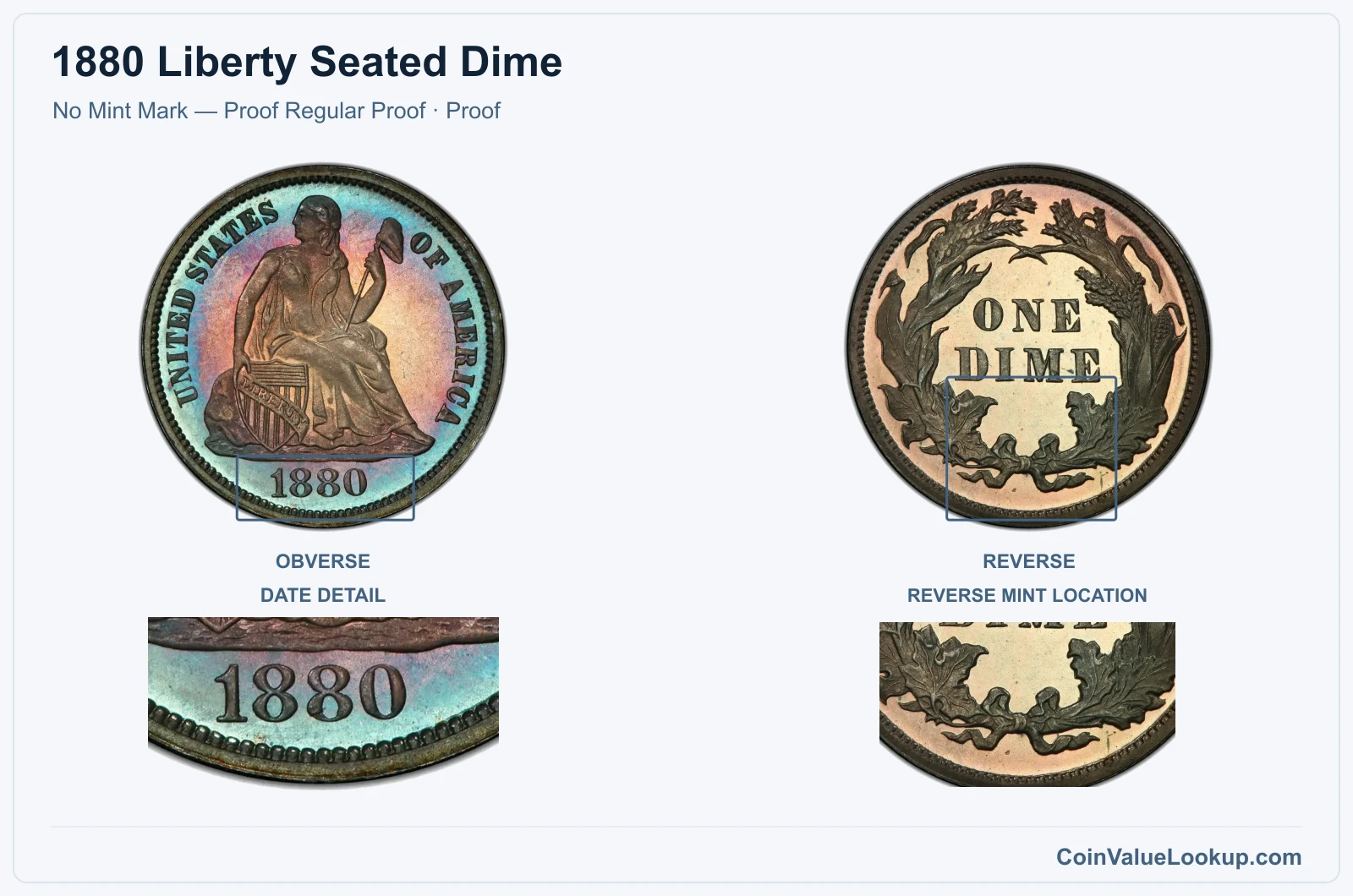
Philadelphia also produced Proof dimes in 1880 for collectors. These were struck on specially prepared planchets using polished dies, resulting in deep mirror fields and sharply defined design elements.
A USA Coin Book guide estimate places the PR63 level around $725.
To identify a genuine Proof, examine the fields — the flat areas between design elements — under angled light. True Proofs show a liquid-mirror reflectivity that business strikes simply do not have.
Hairlines from old cleanings are common on Proofs and will affect the grade, but they do not change the coin's identity as a Proof.
Brilliance alone does not confirm Proof status. Some business strikes can appear bright and reflective, especially when lightly cleaned.
The key is the combination of mirror fields, squared-off rims and evidence of deliberate die preparation.
Range Grade
Price Auction Records Appraisal PR PR 1
—
Coin Identifier
PR 2
—
Coin Identifier
PR 3
—
Coin Identifier
PR 4
—
Coin Identifier
PR 6
—
Coin Identifier
PR 8
—
Coin Identifier
PR 10
—
Coin Identifier
PR 12
—
Coin Identifier
PR 15
—
Coin Identifier
PR 20
—
Coin Identifier
PR 25
—
Coin Identifier
PR 30
—
Coin Identifier
PR 35
—
Coin Identifier
PR 40
—
Coin Identifier
PR 45
—
Coin Identifier
PR 50
Coin Identifier
PR 53
—
Coin Identifier
PR 55
—
Coin Identifier
PR 58
Coin Identifier
PR 60
Coin Identifier
PR 61
Coin Identifier
PR 62
Coin Identifier
PR 63
Coin Identifier
PR 64
Coin Identifier
PR 65
Coin Identifier
PR 66
Coin Identifier
PR 67
Coin Identifier
PR 68
Coin Identifier
PR 69
—
—
—
PR 70
—
—
—
1880 Liberty Seated Dime Error List
1. 1880 Liberty Seated Dime — Broken Date Punch
A broken date punch on the 1880 dime involves an incomplete or fractured portion of one or more digits in the date — specifically the "80" area. This is a die-manufacturing artifact: the steel punch used to impress the date into the working die had a defect, and that defect transferred to every coin struck from that die.
To check, compare the shape of each date digit on your coin against a normal 1880 example. Look for missing serifs, flattened segments or unusual contours in the numerals.
A specialist illustrated reference for this year shows the exact punch shape to watch for.
Do not confuse this with a rim cud, which is a raised blob of metal at the rim caused by a broken die. Also rule out incuse scratches, post-mint damage or ordinary circulation wear that has softened the digits.
No specific price premium has been adopted here — value depends on the visibility of the feature, overall coin condition and collector demand for the specific variety.
2. 1880 Liberty Seated Dime — Doubled Die Obverse
A Doubled Die Obverse has been reported for the 1880 Philadelphia dime. The documented doubling appears on the letters of STATES in the obverse legend.
When examining your coin, look for separated or slightly spread contours on those letters compared to a normal strike.
The critical distinction is between true hub doubling and machine doubling. Genuine doubled dies show design elements with clear, raised secondary impressions that have their own distinct outline.
Machine doubling, by contrast, produces a flat, shelf-like distortion — it looks mushed rather than doubled. Reflections or worn die contours can also mimic doubling under certain lighting angles, so use consistent magnification and a single directed light source.
No standard guide price has been adopted for this variety. The premium, if any, depends on the strength and visibility of the doubling, the coin's overall condition and buyer interest.
Professional attribution from a recognized grading service is the surest way to confirm the variety.