1880 Indian Head Penny Coin Value: How Much Is It Worth?
The 1880 Indian Head penny is a Philadelphia-only issue struck in bronze. Selected guide values for ordinary circulated and uncirculated examples run from about $6.25 at G4 to $154 at MS63, based on USA Coin Book retail estimates.
Those figures cover standard business strikes in comparable condition and are not guaranteed offers. Proofs, major die varieties and mint errors each require their own evaluation.
Fast Way to Identify Your 1880 Indian Head Penny
Want a quick read on your 1880 Indian Head cent? Upload clear photos of both the front and back, and our identifier can offer a preliminary take on what you have.
It won't authenticate, certify or pin down an exact grade, but it can help you figure out which branch of this year's issue you're looking at and where to dig deeper.
1880 Indian Head Penny Value
Upload both sides of your 1880 Indian Head Penny.
Front Obverse
Upload photo
Back Reverse
Upload photo
Which 1880 Indian Head Penny Versions Are Worth Money?
- Business strikes range from roughly $6.25 at G4 to $154 at MS63 per USA Coin Book; original uncirculated surfaces with remaining red color can push values higher.
- Proofs are listed around $313 at PR63; confirm true proof manufacture before applying proof pricing.
- Die errors such as doubled dies, repunched dates or cuds documented for this date can carry individual premiums that depend on authenticated identity and severity.
- Condition and originality drive most of the value difference; a cleaned or damaged coin will fall well below guide figures for the same technical grade.
Step 1: Identify Your 1880 Indian Head Penny Mint Mark and Version
Every regular 1880 Indian Head cent was struck at the Philadelphia Mint, so there is no mintmark to hunt for. The small "L" you may see on the ribbon behind the portrait is the engraver's initial, not a mintmark.
On the obverse you should see a female Liberty wearing a feathered headdress with UNITED STATES OF AMERICA around the border and the date at the bottom. The reverse carries an oak wreath enclosing ONE CENT, topped by a small federal shield.
Make sure you are looking at an Indian Head cent and not a Lincoln wheat cent or a Flying Eagle cent from the late 1850s. Those are completely different series with different value structures.
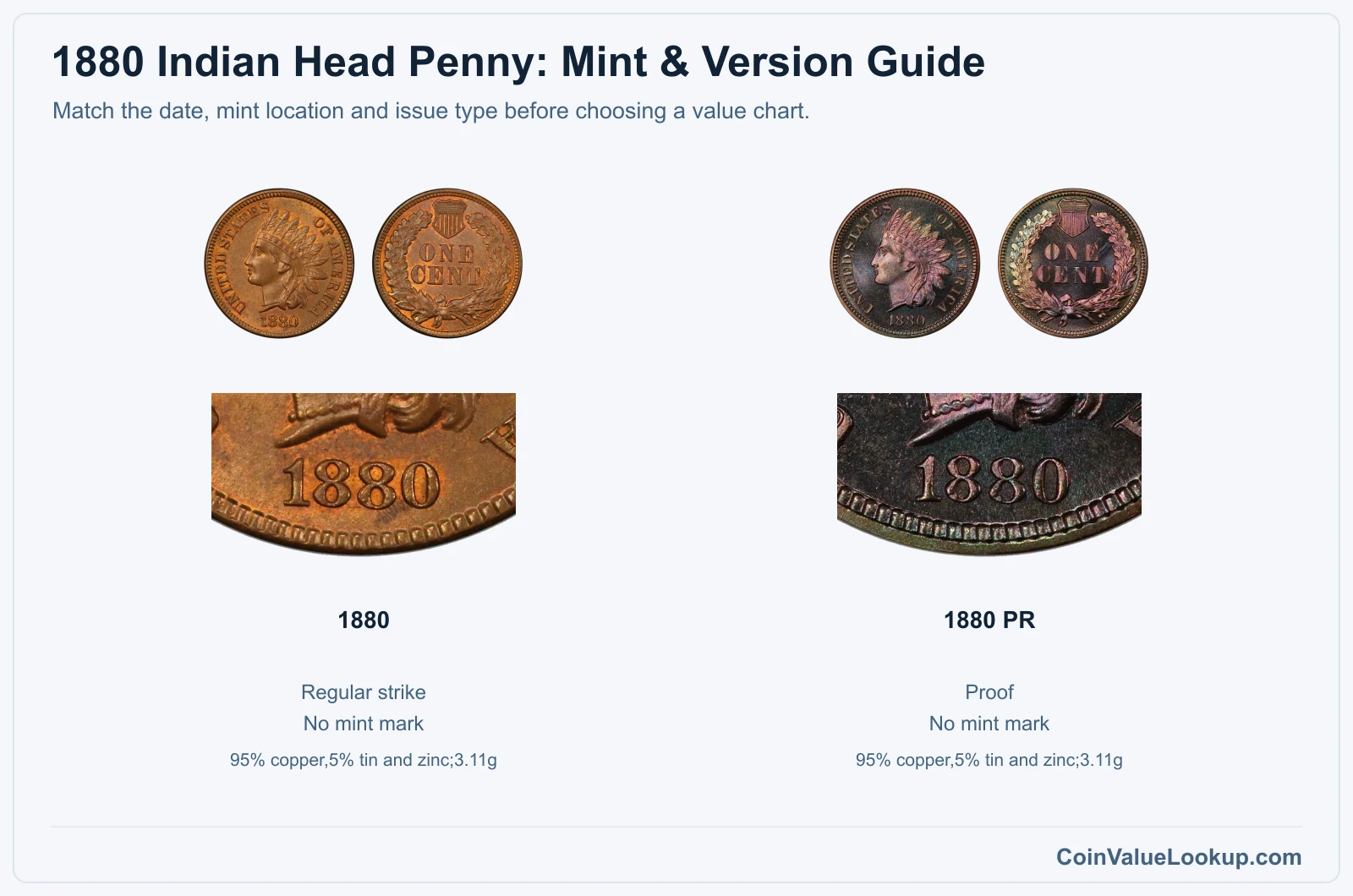
The key split for 1880 is business strike versus proof. Proofs were specially manufactured with polished dies and planchets, producing mirror-like fields and sharp rims.
A business strike that someone has buffed shiny is not a proof. If you are unsure, compare your coin's rim geometry and field quality under magnification with known examples before claiming proof status.
Step 2: Check Your 1880 Indian Head Penny Grade
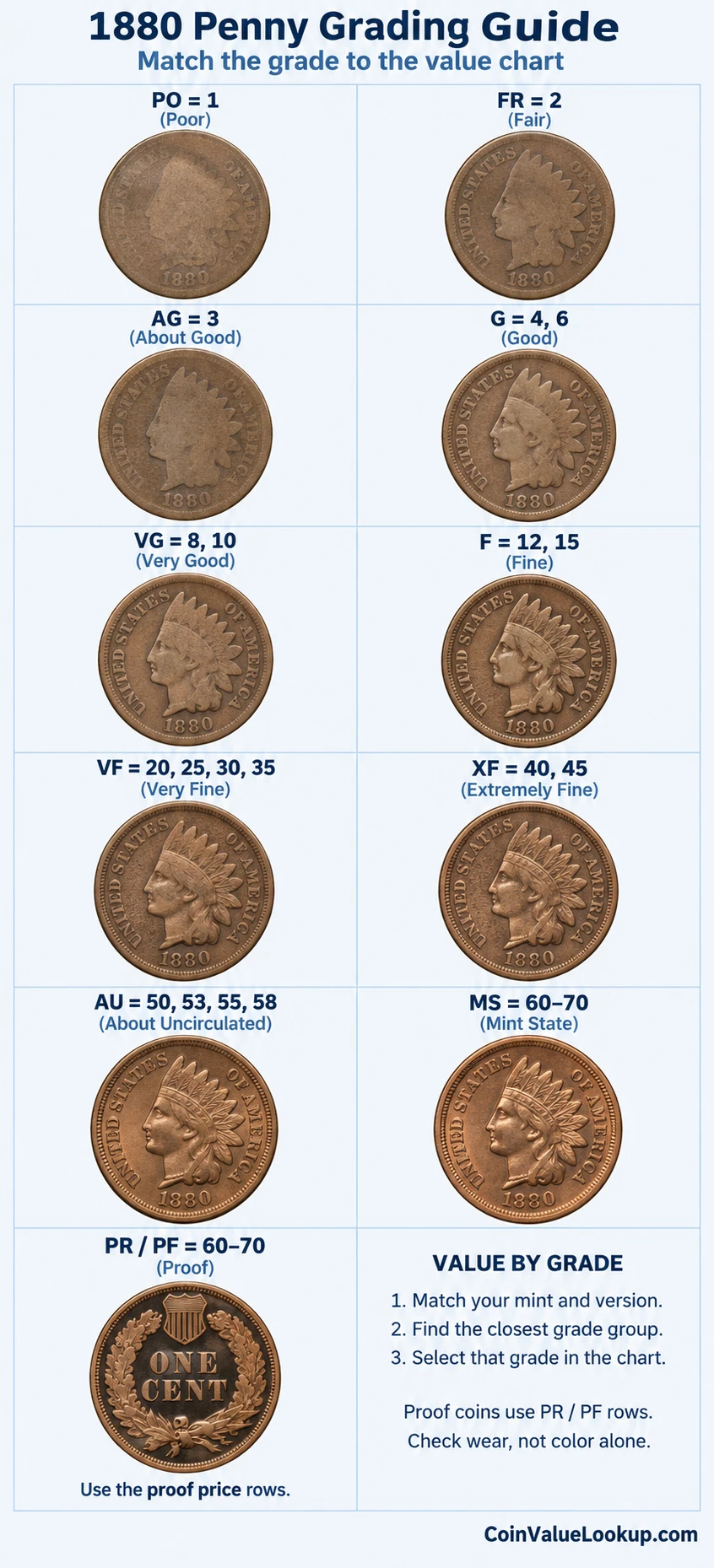
Start by checking the headband. On a well-worn coin the word LIBERTY in the headdress will be partly or fully gone.
At G4, the portrait outline is clear but LIBERTY is mostly smooth. Around VF, most letters should be readable.
Next, look at the feather tips above the headband and the hair curls near the ear. These are the first areas to lose sharpness from circulation wear.
Here is where it gets tricky: some 1880 cents were softly struck from the factory, so weak feathers or hair detail alone do not prove the coin circulated. Compare your coin against the reference image and look for flatness in multiple areas, not just one spot.
On the reverse, check the wreath leaves nearest the shield, then the bow at the bottom. Wear shows as smooth, flat patches rather than the rounded relief you see on a fresh strike.
Luster matters a lot once you get into uncirculated territory. Bronze color designations like BN, RB and RD describe how much original red copper color remains.
These are color descriptions, not separate metals. A coin with full original red surfaces in uncirculated condition will generally bring a premium over a brown example, all else being equal.
Always factor in surface problems. Cleaning, scratches, corrosion and rim damage all reduce a coin's marketability regardless of how much detail remains.
Step 3: Check 1880 Indian Head Penny Value by Mint and Version
1880 Indian Head Penny
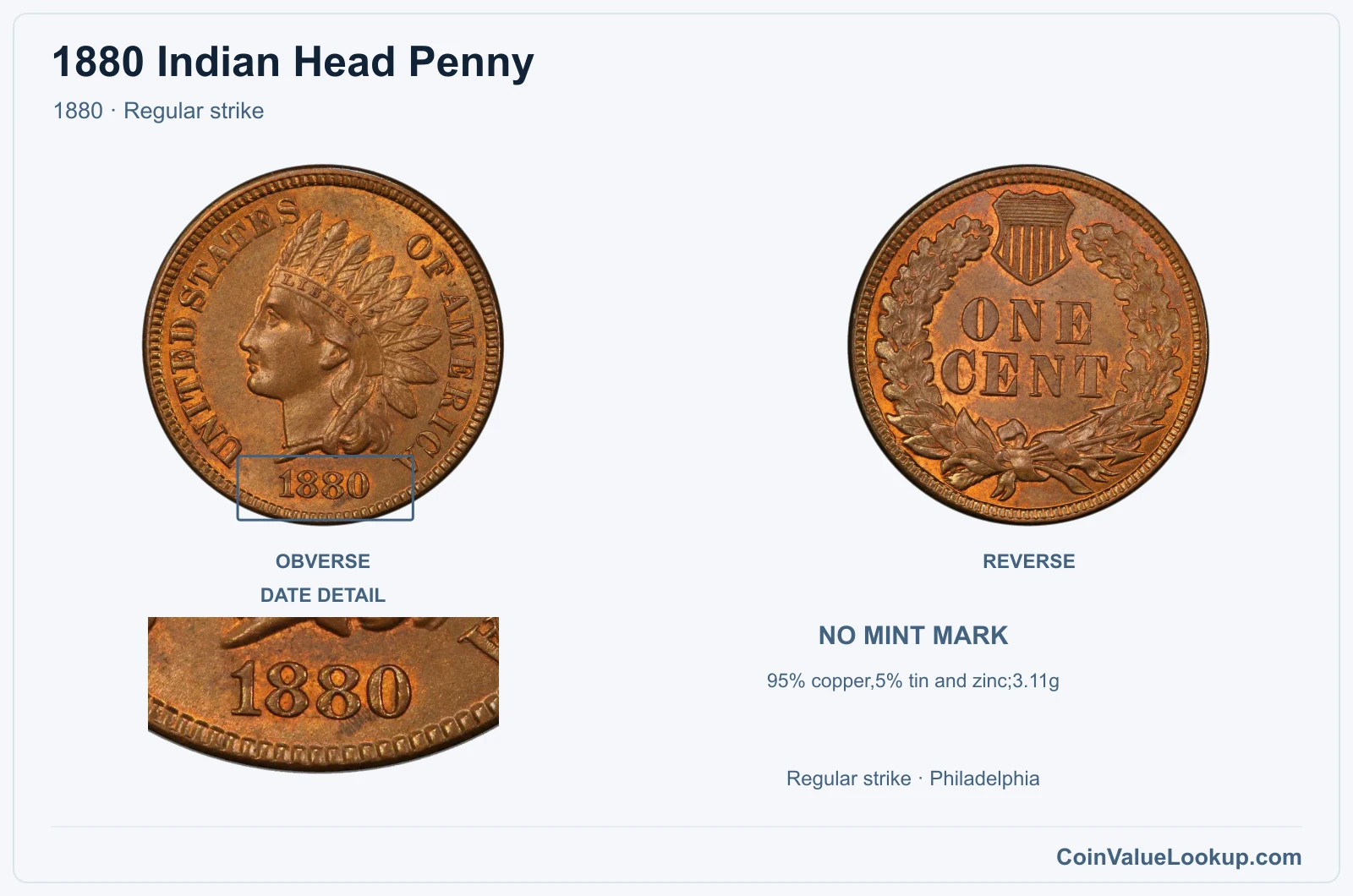
The standard 1880 Indian Head cent is a Philadelphia business strike, composed of 95% copper with 5% tin and zinc, weighing 3.11 grams. No mintmark appears on the coin.
USA Coin Book lists retail estimates of about $6.25 in G4 and $154 in MS63.
That is a wide spread, and it tells you condition is doing all the heavy lifting on this date. A well-worn pocket piece and a lustrous uncirculated example are almost different coins in the market's eyes.
Original surfaces matter here. If your coin has been cleaned or shows corrosion, expect values below these guide figures even if the detail looks decent.
Coin Value Lookup is a handy starting point if you want to compare this date against other Indian Head cents or different series entirely.
| Range | Grade | Price | Auction Records | Appraisal |
|---|---|---|---|---|
| PO | PO 1 | — | Coin Identifier | |
| FR | FR 2 | — | Coin Identifier | |
| AG | AG 3 | — | Coin Identifier | |
| G | G 4 | Coin Identifier | ||
| G 6 | — | Coin Identifier | ||
| VG | VG 8 | Coin Identifier | ||
| VG 10 | Coin Identifier | |||
| F | F 12 | — | Coin Identifier | |
| F 15 | — | Coin Identifier | ||
| VF | VF 20 | — | Coin Identifier | |
| VF 25 | Coin Identifier | |||
| VF 30 | — | Coin Identifier | ||
| VF 35 | — | Coin Identifier | ||
| XF | XF 40 | Coin Identifier | ||
| XF 45 | Coin Identifier | |||
| AU | AU 50 | Coin Identifier | ||
| AU 53 | — | Coin Identifier | ||
| AU 55 | Coin Identifier | |||
| AU 58 | Coin Identifier | |||
| MS | MS 60 | — | Coin Identifier | |
| MS 61 | Coin Identifier | |||
| MS 62 | Coin Identifier | |||
| MS 63 | Coin Identifier | |||
| MS 64 | Coin Identifier | |||
| MS 65 | Coin Identifier | |||
| MS 66 | Coin Identifier | |||
| MS 67 | — | — | — | |
| MS 68 | — | — | — | |
| MS 69 | — | — | — | |
| MS 70 | — | — | — |
1880 Indian Head Penny — PR
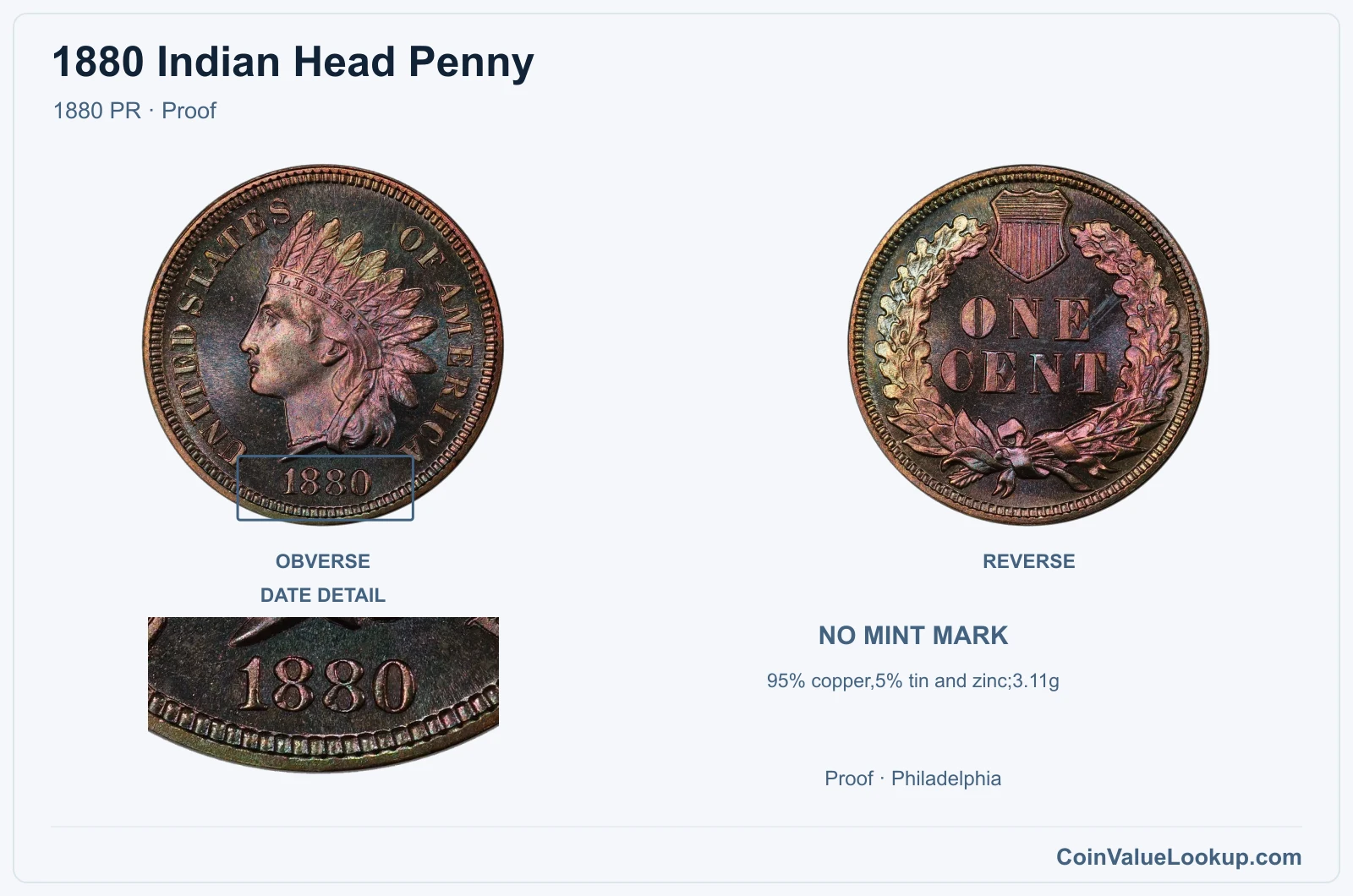
The 1880 proof Indian Head cent was a limited special striking from Philadelphia, using the same bronze composition and weight as the business issue. These were made with polished dies and prepared planchets, giving the fields a mirror-like finish and the devices exceptionally sharp detail.
USA Coin Book places the PR63 value around $313. That is a significant step up from even a nice uncirculated business strike.
Before you get excited, be honest about what you are holding. A polished business strike can look shiny, but it will not have the characteristic squared-off rims, deeply mirrored fields and die-polish lines of a genuine proof.
Compare carefully under magnification. If there is any doubt, professional authentication is worth pursuing before you price your coin as a proof.
| Range | Grade | Price | Auction Records | Appraisal |
|---|---|---|---|---|
| PR | PR 1 | — | Coin Identifier | |
| PR 2 | — | Coin Identifier | ||
| PR 3 | — | Coin Identifier | ||
| PR 4 | — | Coin Identifier | ||
| PR 6 | — | Coin Identifier | ||
| PR 8 | — | Coin Identifier | ||
| PR 10 | — | Coin Identifier | ||
| PR 12 | — | Coin Identifier | ||
| PR 15 | — | Coin Identifier | ||
| PR 20 | — | Coin Identifier | ||
| PR 25 | — | Coin Identifier | ||
| PR 30 | — | Coin Identifier | ||
| PR 35 | — | Coin Identifier | ||
| PR 40 | — | Coin Identifier | ||
| PR 45 | — | Coin Identifier | ||
| PR 50 | — | Coin Identifier | ||
| PR 53 | — | Coin Identifier | ||
| PR 55 | — | Coin Identifier | ||
| PR 58 | — | Coin Identifier | ||
| PR 60 | Coin Identifier | |||
| PR 61 | — | Coin Identifier | ||
| PR 62 | Coin Identifier | |||
| PR 63 | Coin Identifier | |||
| PR 64 | Coin Identifier | |||
| PR 65 | Coin Identifier | |||
| PR 66 | Coin Identifier | |||
| PR 67 | Coin Identifier | |||
| PR 68 | — | — | — | |
| PR 69 | — | — | — | |
| PR 70 | — | — | — |
1880 Indian Head Penny Error List
1. 1880 Indian Head Penny — Misplaced Date
A misplaced date error on the 1880 Indian Head cent shows partial impressions of one or more date digits in an unexpected location, typically embedded in the denticles near the rim or close to the portrait, well away from the final date position. This happened when the date punch struck the die off-target before the correct placement was made.
To check for this, examine the denticles below and around the date area under magnification. You are looking for the distinct curve or serif of a numeral, not just a random bump.
Die chips, scratches and corrosion can mimic partial digit shapes, so compare what you see against the known numeral forms. Value depends on the authenticated identity of the specific die, the clarity of the misplaced digits and overall coin condition.
No standard price range applies across all examples.
2. 1880 Indian Head Penny — Die Crack
Die cracks on the 1880 Indian Head cent appear as thin raised lines running across the coin's surface. They form when the steel die develops a fracture during use, and the crack fills with metal during striking.
You can trace a genuine die crack from one point to another; it follows a continuous path across the field or through design elements. Record where it starts and ends.
Do not confuse die cracks with incuse scratches, which are cut into the surface rather than raised above it. Corrosion lines and displaced-metal scrapes also look different under magnification.
A die crack sits on top of the coin's surface and is part of the strike itself.
Value depends on the crack's size, location and the coin's overall condition. There is no fixed price range for this category on the 1880 date.
3. 1880 Indian Head Penny — Die Break / Cud
A cud on the 1880 Indian Head cent is a raised, featureless blob of metal connected to the rim, caused by a piece of the die breaking away entirely. The missing chunk leaves a void that fills with metal during striking, producing that distinctive raised lump where design detail should be.
Smaller interior die breaks that do not reach the rim also exist but are technically not cuds. Both are collected.
To distinguish a cud from post-mint damage, check whether the surrounding design flows naturally into the raised area. A rim dent or corrosion lump will look different; it will interrupt the struck detail rather than replacing it at the moment of manufacture.
Pricing varies with size, location and coin grade. No standard range is established for this date, so individual assessment by a professional service is the safest route.
4. 1880 Indian Head Penny — Doubled Die Obverse
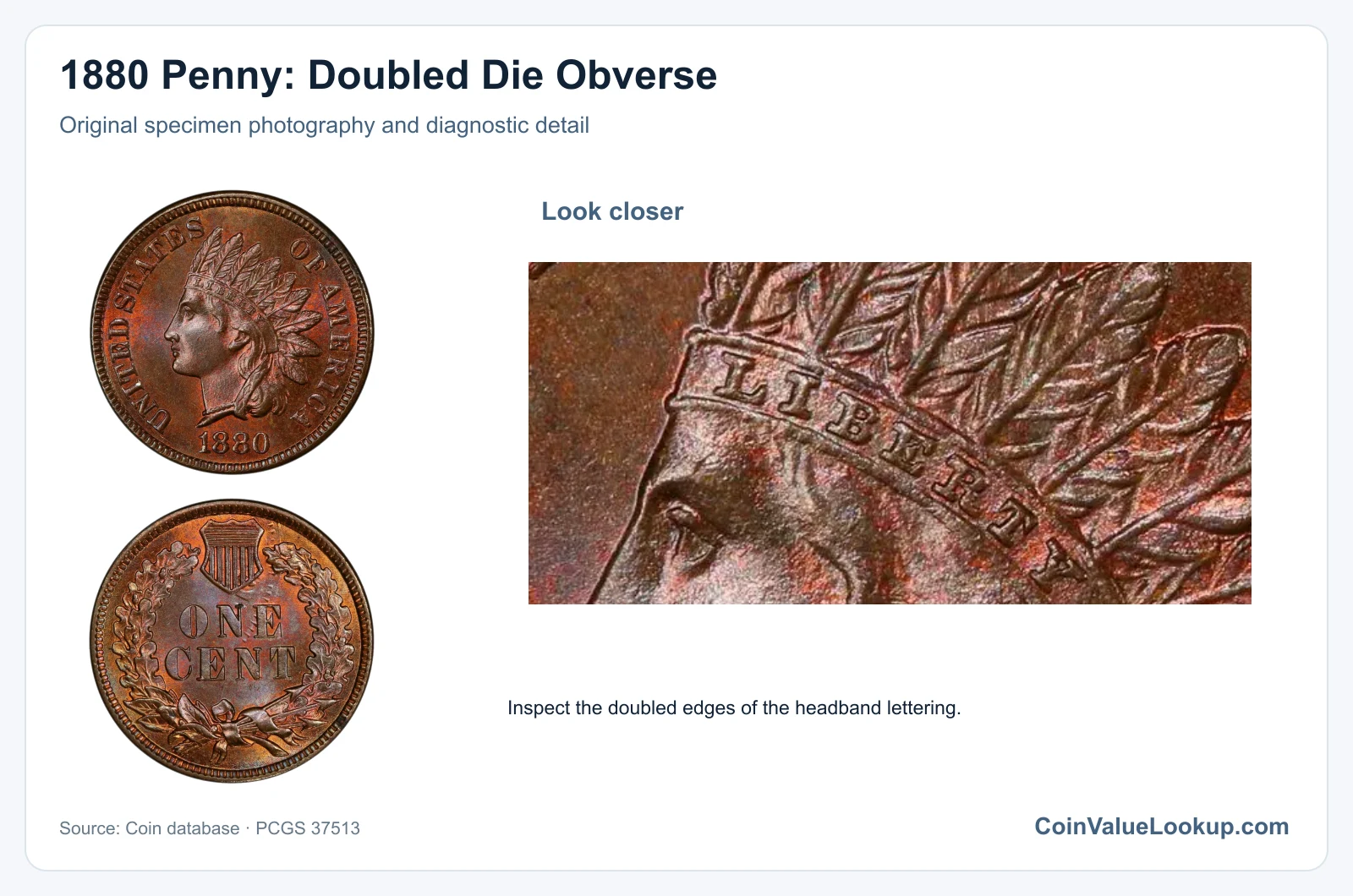
A doubled die obverse on the 1880 Indian Head cent results from a misalignment during die preparation, producing consistent doubling of obverse design elements. You will typically see separation, notching or shelf-like doubling on the letters of UNITED STATES OF AMERICA, the date digits or details of the portrait.
The key word is consistent. Genuine doubled dies repeat the same doubling pattern on every coin struck from that die.
Machine doubling, also called mechanical doubling, is a different animal. It produces flat, shelf-like distortion rather than the distinct, rounded secondary image of a true doubled die.
Worn die contours and reflected light can also trick you.
Compare your coin's letters and date against a known normal example under the same lighting. Value is assessed individually based on the specific die, the strength of doubling and overall condition.
5. 1880 Indian Head Penny — Clashed Dies
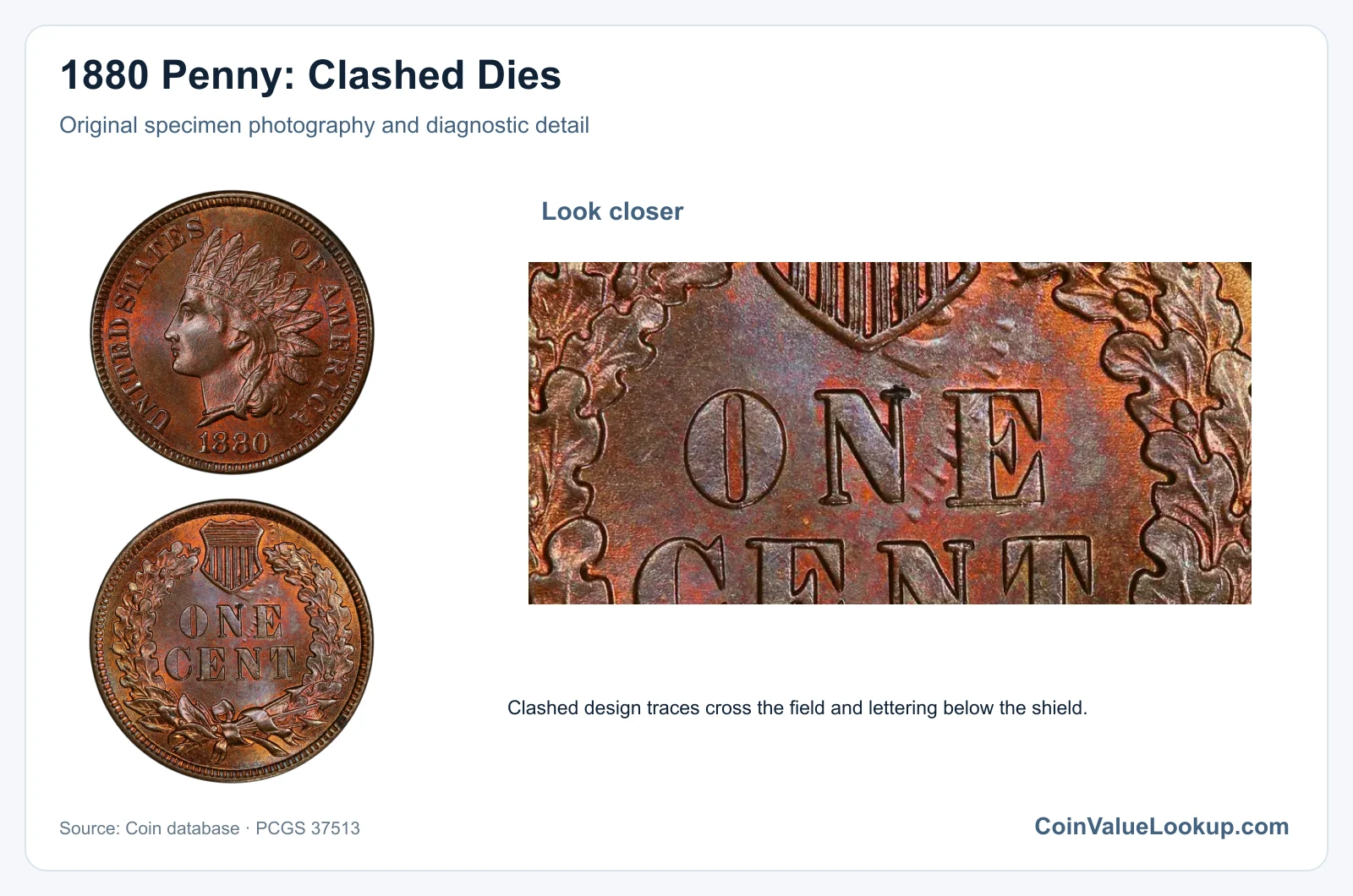
Clashed dies occur when the obverse and reverse dies strike each other without a planchet between them. The result is a faint ghost of the opposite design transferred onto each side of subsequently struck coins.
On the 1880 Indian Head cent, look for traces of the wreath on the obverse field or an outline of the portrait on the reverse, positioned where the opposing design would have contacted the die.
The transferred image should align with the expected orientation of the opposite die. Random scratches, raised lines from die polishing or damage from a brockage will not match that alignment.
Clash marks range from bold and obvious to extremely faint. Value depends on clarity and overall coin condition; no fixed price range is established for clashed die examples of this date.
6. 1880 Indian Head Penny — Repunched Date
A repunched date on the 1880 Indian Head cent shows remnants of an earlier punch position visible beside or beneath the final date numerals. During production, date digits were individually punched into the working die by hand, and sometimes the first hit landed slightly off.
Look for traces of a secondary "1" or "8" or "0" offset from the primary digits. The remnants often appear as partial serifs, curves or shadows near the base or top of the numerals.
This is different from a doubled die, which affects the entire obverse design, not just the date. A damaged or corroded date can also mimic repunching, so compare under magnification against a known normal date.
Value depends on which repunched date variety you have, how visible the repunching is and the coin's overall condition. No blanket price range applies.
7. 1880 Indian Head Penny — Die Chip
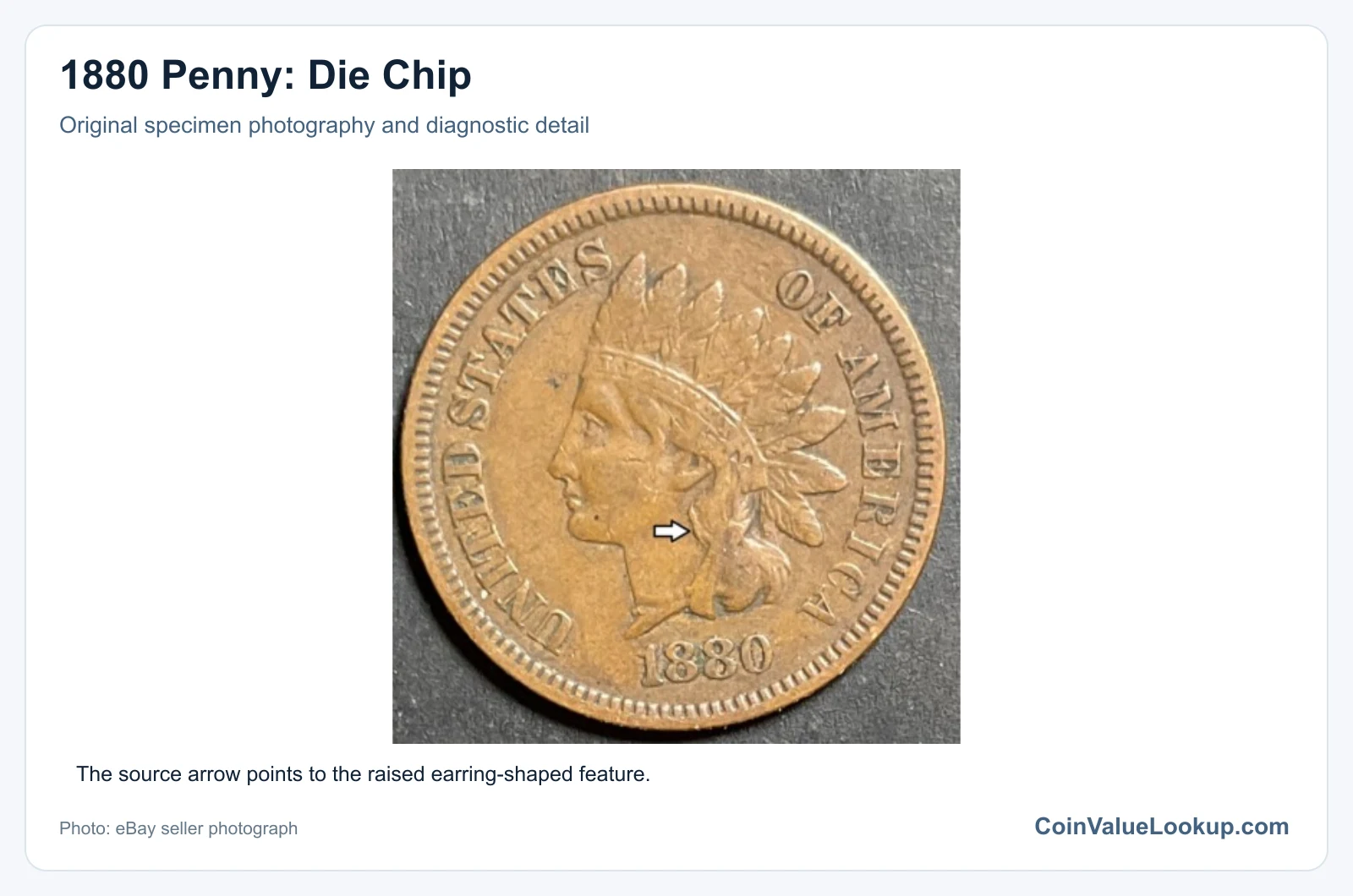
A die chip on the 1880 Indian Head cent shows up as a small, localized raised lump, usually inside or adjacent to a letter, numeral or design element. It forms when a tiny piece of the die surface flakes away, leaving a void that fills with metal during striking.
To confirm a die chip, check whether the surrounding struck detail flows smoothly into the raised area. The lump should look like it belongs to the strike, not like something was glued on or gouged into the surface after the fact.
Post-mint damage such as gouges, adhesive residue or displaced-metal impacts will not integrate with the coin's original struck surface the same way. Under magnification the difference is usually clear.
Die chips are common across Indian Head cents. Value for a specific example depends on size, location and overall coin condition, with no set price range for the 1880 date.