1907 Indian Head Penny Coin Value: How Much Is It Worth?
A 1907 Indian Head penny is one of the final issues in a series that ended in 1909. Guide estimates for regular Philadelphia business strikes range from about $2.50 in Good (G4) condition to around $81 in Mint State (MS63), based on USA Coin Book retail figures.
These are not guaranteed offers, and proofs, major varieties, and mint errors require separate evaluation.
Condition and original surface color matter a lot with these old bronze cents. A coin with full original luster will trade very differently from a cleaned or corroded example, even at the same technical grade.
Fast Way to Identify Your 1907 Indian Head Penny
Want a quick read on what you have? Upload clear photos of both the front and back of your 1907 Indian Head penny.
Our identifier can provide a preliminary identification based on those images, helping you figure out which version you hold and what condition range to explore. It is not a substitute for professional authentication, but it is a solid starting point.
1907 Indian Head Penny Value
Upload both sides of your 1907 Indian Head Penny.
Front Obverse
Upload photo
Back Reverse
Upload photo
Which 1907 Indian Head Penny Versions Are Worth Money?
- A regular 1907 business strike in MS63 lists around $81 in a retail guide; circulated examples in G4 start near $2.50.
- A 1907 proof in PR63 carries a guide value of about $313, reflecting its limited collector-only production.
- Original uncirculated surfaces with remaining red or red-brown color add a premium over brown examples at the same grade.
- Confirmed mint errors such as doubled dies, off-center strikes, or cuds require individual assessment and professional authentication for accurate valuation.
Step 1: Identify Your 1907 Indian Head Penny Mint Mark and Version
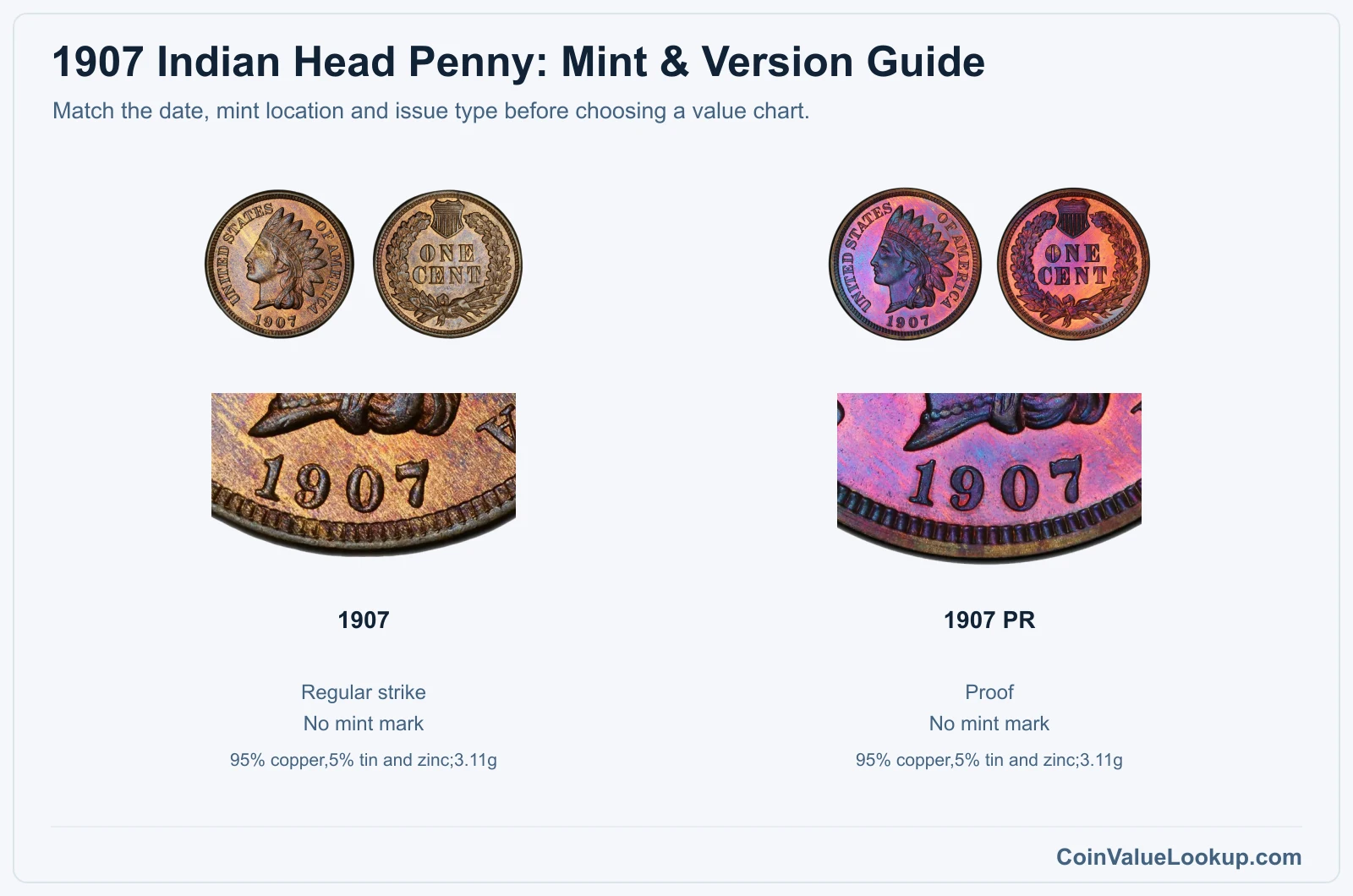
Every regular 1907 Indian Head cent was struck at the Philadelphia Mint. There is no mintmark on this coin, and the small "L" on the ribbon behind the neck is a designer initial, not a mint identifier.
The obverse shows a portrait wearing a feathered headdress, and the reverse features an oak wreath surrounding a shield. Do not confuse this with a Lincoln cent or a Flying Eagle cent from the 1850s; the designs are completely different.
You need to separate standard business strikes from proof issues. Proofs were specially manufactured coins with mirrored surfaces and sharp rims, made for collectors.
A business strike that someone has polished to a shine is not a proof. Look for squared-off rims, fully mirrored fields, and a sharp strike that extends to the smallest details.
The composition is 95% copper with 5% tin and zinc, weighing 3.11 grams. If your coin feels noticeably heavier or lighter, something is off.
Step 2: Check Your 1907 Indian Head Penny Grade
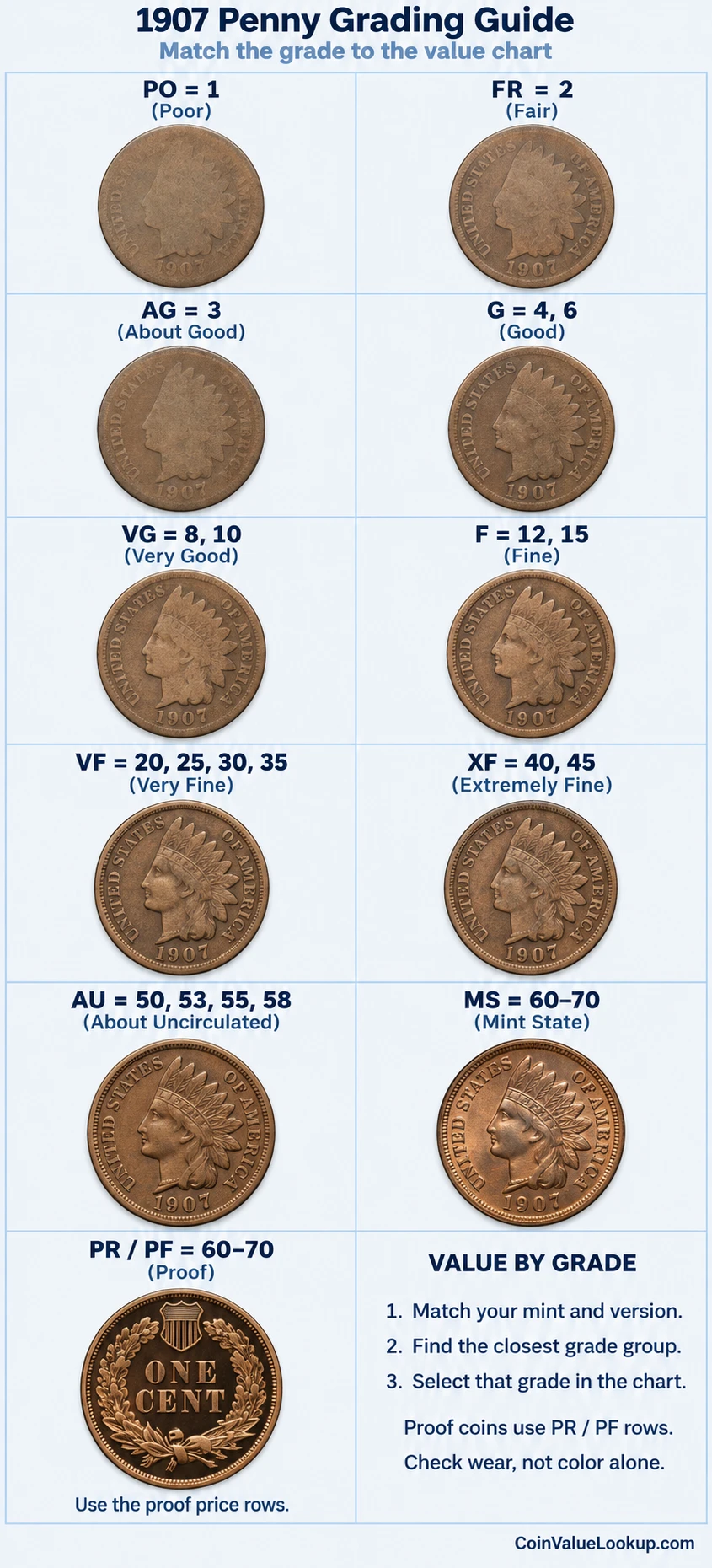
Start with the headband. The word LIBERTY should be fully legible on higher-grade coins and progressively worn on circulated pieces.
On a well-worn coin (G4), you may see only partial letters or none at all.
Next, check the feather tips above the headband, the hair curls near the ear, and the cheek. These are the highest points and the first to show wear.
On the reverse, the wreath leaves and the shield are your wear checkpoints.
Here is the tricky part: some 1907 cents were weakly struck at the mint, which can make feathers or hair look worn even on an uncirculated coin. Do not grade from a single detail.
Look at the overall coin, including luster, surface marks, and whether the high points show actual friction or just a soft impression.
Bronze color designations like BN (brown), RB (red-brown), and RD (red) describe how much original copper color remains. These are not different materials.
A coin with full red surfaces commands a premium over a fully brown example at the same grade. Use the comparison image to match your coin's wear pattern against known grade examples.
Step 3: Check 1907 Indian Head Penny Value by Mint and Version
1907 Indian Head Penny
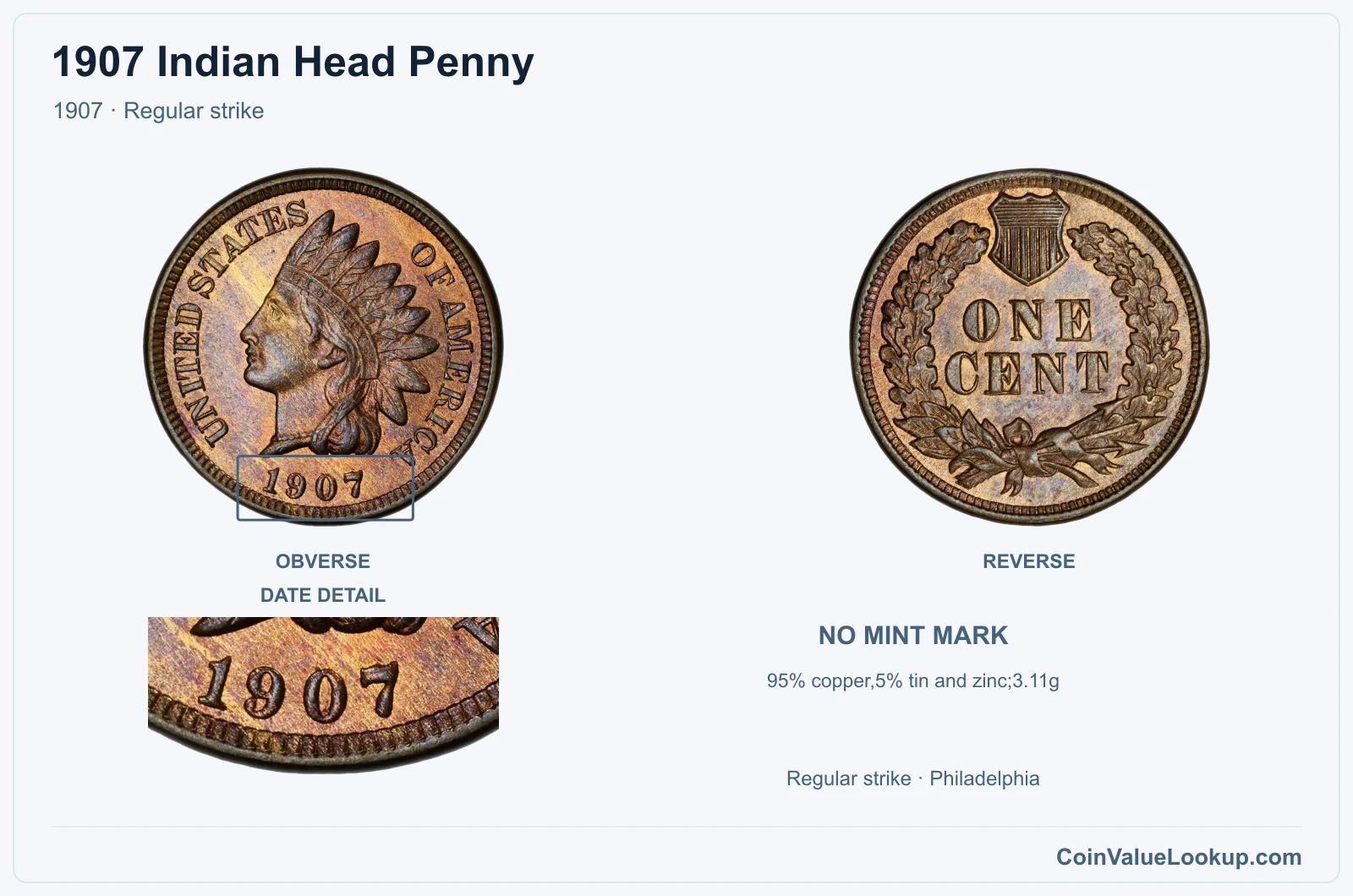
The 1907 Indian Head cent is a standard Philadelphia business strike with no mintmark. It weighs 3.11 grams and is composed of 95% copper with 5% tin and zinc.
USA Coin Book lists retail guide values of approximately $2.50 in G4 and $81 in MS63; bronze color designation is not specified in that source, so do not assume these reflect certified red (RD) pricing.
Condition drives everything here. A well-circulated example is a common, affordable coin.
An uncirculated piece with strong luster and original color is a different animal entirely. Compare your coin's surfaces carefully, looking for cleaning, corrosion, or retoning, all of which reduce marketability regardless of technical grade.
Coin Value Lookup is a good place to start if you want to look up guides for other dates in the Indian Head series or compare values across different coin types.
| Range | Grade | Price | Auction Records | Appraisal |
|---|---|---|---|---|
| PO | PO 1 | — | Coin Identifier | |
| FR | FR 2 | — | Coin Identifier | |
| AG | AG 3 | — | Coin Identifier | |
| G | G 4 | — | Coin Identifier | |
| G 6 | — | Coin Identifier | ||
| VG | VG 8 | — | Coin Identifier | |
| VG 10 | — | Coin Identifier | ||
| F | F 12 | — | Coin Identifier | |
| F 15 | — | Coin Identifier | ||
| VF | VF 20 | Coin Identifier | ||
| VF 25 | — | Coin Identifier | ||
| VF 30 | Coin Identifier | |||
| VF 35 | Coin Identifier | |||
| XF | XF 40 | Coin Identifier | ||
| XF 45 | Coin Identifier | |||
| AU | AU 50 | Coin Identifier | ||
| AU 53 | Coin Identifier | |||
| AU 55 | Coin Identifier | |||
| AU 58 | Coin Identifier | |||
| MS | MS 60 | — | Coin Identifier | |
| MS 61 | Coin Identifier | |||
| MS 62 | Coin Identifier | |||
| MS 63 | Coin Identifier | |||
| MS 64 | Coin Identifier | |||
| MS 65 | Coin Identifier | |||
| MS 66 | — | — | — | |
| MS 67 | — | — | — | |
| MS 68 | — | — | — | |
| MS 69 | — | — | — | |
| MS 70 | — | — | — |
1907 Indian Head Penny — PR
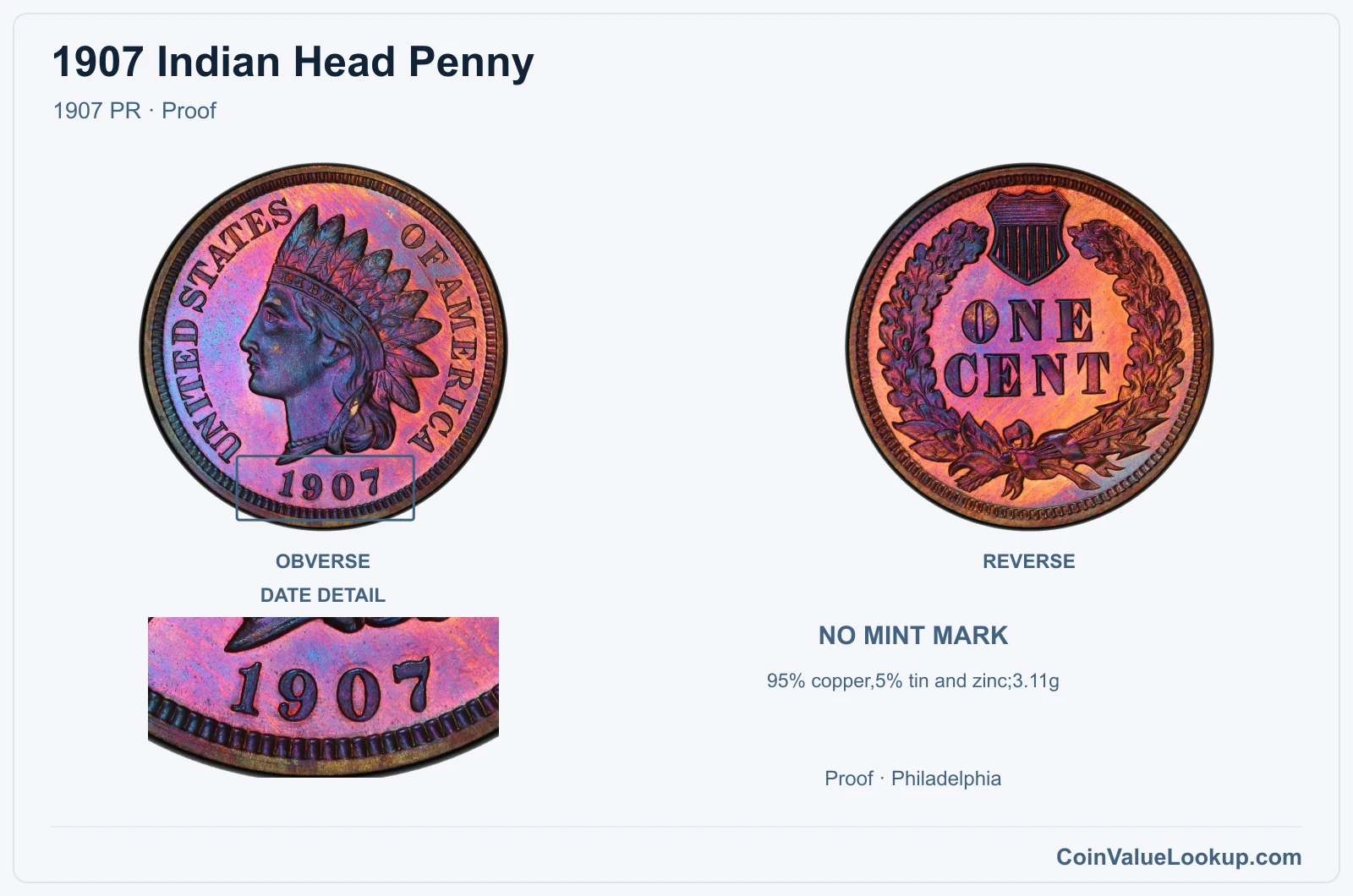
The 1907 proof Indian Head cent was a special collector issue struck at Philadelphia with mirrored fields and sharp detail. USA Coin Book lists a retail guide value of about $313 in PR63.
That is a single guide anchor, not a guaranteed sale price.
Identifying a real proof takes care. Genuine proofs show squared, knife-like rims, deeply mirrored fields, and exceptional detail in the feathers and wreath.
A polished business strike can fool you at first glance, but it will not have the rim geometry or the consistent reflective depth of a true proof. If you suspect you have a proof, professional authentication from a major grading service is the smart move.
The premium over a business strike is large enough that the authentication fee pays for itself if the coin is genuine.
| Range | Grade | Price | Auction Records | Appraisal |
|---|---|---|---|---|
| PR | PR 1 | — | Coin Identifier | |
| PR 2 | — | Coin Identifier | ||
| PR 3 | — | Coin Identifier | ||
| PR 4 | — | Coin Identifier | ||
| PR 6 | — | Coin Identifier | ||
| PR 8 | — | Coin Identifier | ||
| PR 10 | — | Coin Identifier | ||
| PR 12 | — | Coin Identifier | ||
| PR 15 | — | Coin Identifier | ||
| PR 20 | — | Coin Identifier | ||
| PR 25 | — | Coin Identifier | ||
| PR 30 | — | Coin Identifier | ||
| PR 35 | — | Coin Identifier | ||
| PR 40 | — | Coin Identifier | ||
| PR 45 | — | Coin Identifier | ||
| PR 50 | — | Coin Identifier | ||
| PR 53 | — | Coin Identifier | ||
| PR 55 | — | Coin Identifier | ||
| PR 58 | — | Coin Identifier | ||
| PR 60 | — | Coin Identifier | ||
| PR 61 | — | Coin Identifier | ||
| PR 62 | Coin Identifier | |||
| PR 63 | Coin Identifier | |||
| PR 64 | Coin Identifier | |||
| PR 65 | Coin Identifier | |||
| PR 66 | Coin Identifier | |||
| PR 67 | Coin Identifier | |||
| PR 68 | — | — | — | |
| PR 69 | — | — | — | |
| PR 70 | — | — | — |
1907 Indian Head Penny Error List
1. 1907 Indian Head Penny — Die Break / Cud
A cud error on a 1907 Indian Head cent appears as a raised, featureless blob of metal connected to the rim. It forms when a piece of the die breaks away entirely, leaving a void that fills with metal during striking.
The result is a smooth lump that displaces part of the normal design along the rim.
To confirm a cud, check that the raised area connects to the rim and that the opposite side of the coin is not damaged in the same spot. A rim dent, interior die chip, or corrosion deposit can mimic a cud at first glance but will lack the smooth, raised profile and rim connection.
No specific price range is supported for this error on 1907 cents. Value depends on the size, location, and condition of the coin, best assessed on a case-by-case basis by an authenticated example.
2. 1907 Indian Head Penny — Doubled Die Reverse
A doubled die reverse on a 1907 Indian Head cent shows consistent doubling on reverse design elements such as the wreath, shield, or lettering. The key word is consistent: the separation or notching repeats in the same direction across multiple features.
Compare your reverse closely to a known normal example under good lighting. Look at the leaf tips, the ONE CENT lettering, and the shield lines.
True hub doubling produces a clear secondary image with depth, not a flat shelf.
Machine doubling is the most common lookalike. It tends to produce a flat, shelf-like distortion rather than a rounded secondary image, and it typically shows up in a different mechanical pattern.
Random scratches or reflections under a loupe can also trick you. No supported price range exists for this error; each coin needs individual assessment based on the strength and location of the doubling and overall condition.
3. 1907 Indian Head Penny — Misplaced Date
A misplaced date on a 1907 Indian Head cent shows partial impressions of date digits in unexpected locations, typically embedded in the denticles or near the portrait, away from where the final date sits. This happened when the date punch struck the die in the wrong position before being corrected.
Look carefully at the denticles below the date and along the bust truncation. You are searching for the faint outline of a numeral, a partial curve of a "9" or the crossbar of a "7" where no digit belongs.
Die chips, scratches, and random bumps can look like misplaced digits under magnification. The test is whether the shape matches a specific numeral from the date.
No supported price range is available; value depends on the clarity of the misplaced element and the coin's overall condition, best evaluated individually.
4. 1907 Indian Head Penny — Repunched Date
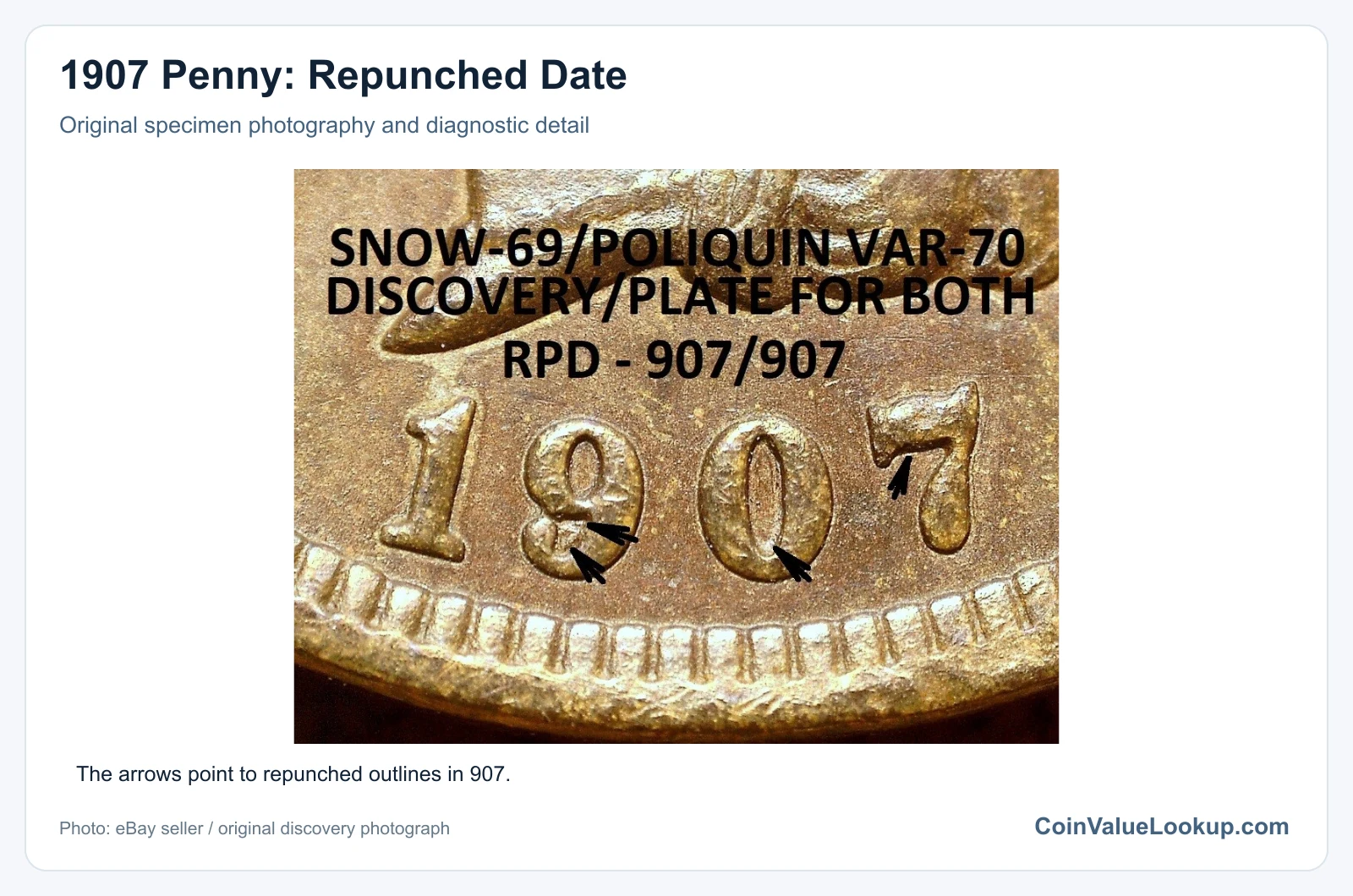
A repunched date on a 1907 Indian Head cent shows remnants of an earlier punch position beside or beneath the final date numerals. Before the adoption of master hubs with integrated dates, individual date digits were hand-punched into working dies, and sometimes the first impression landed slightly off.
You will see traces of a secondary impression, often visible as extra serifs, partial numeral outlines, or a slight offset shadow near one or more digits. This is different from a doubled die, which affects the entire design from the hub, not just the date.
Damaged dates and machine doubling are common lookalikes. A repunched date shows a clean secondary impression that matches the shape of the numeral itself.
No price range is supported for this variety; individual assessment based on authentication, the degree of repunching, and coin condition determines value.
5. 1907 Indian Head Penny — Rusted Die Texture
A rusted die texture on a 1907 Indian Head cent appears as small raised bumps or pimples on the coin's surface. These are the inverse impression of pits that formed on the die face from rust or oxidation between uses.
The key diagnostic is that these bumps are raised, not sunken. They also tend to repeat in the same locations across multiple coins struck from the same die.
Compare your coin to a known example photograph to see if the pattern matches.
Do not confuse die rust texture with corrosion on the coin itself. Corrosion removes metal and creates pits; die rust transfers raised spots.
If you see sunken pitting, that is damage to your coin, not a die error. No specific price range is supported; value depends on the severity, location, and the coin's overall condition.
6. 1907 Indian Head Penny — Die Crack
A die crack on a 1907 Indian Head cent shows up as a thin raised line crossing the coin's field or design. It forms when stress fractures develop in the steel die; the crack fills with metal during each strike and transfers as a raised ridge.
Trace where the line begins and ends. Die cracks often run from the rim inward or connect design elements.
The line should be raised above the surface, which distinguishes it from a scratch or scrape that is incised into the metal.
Incuse scratches, corrosion trails, and displaced-metal scrapes are common lookalikes. Run your fingernail across the line: a die crack is raised, while a scratch catches your nail in the opposite direction.
No supported price range exists for die cracks on this date; value depends on the crack's prominence, location, and the coin's grade, assessed individually.
7. 1907 Indian Head Penny — Off-Center Strike
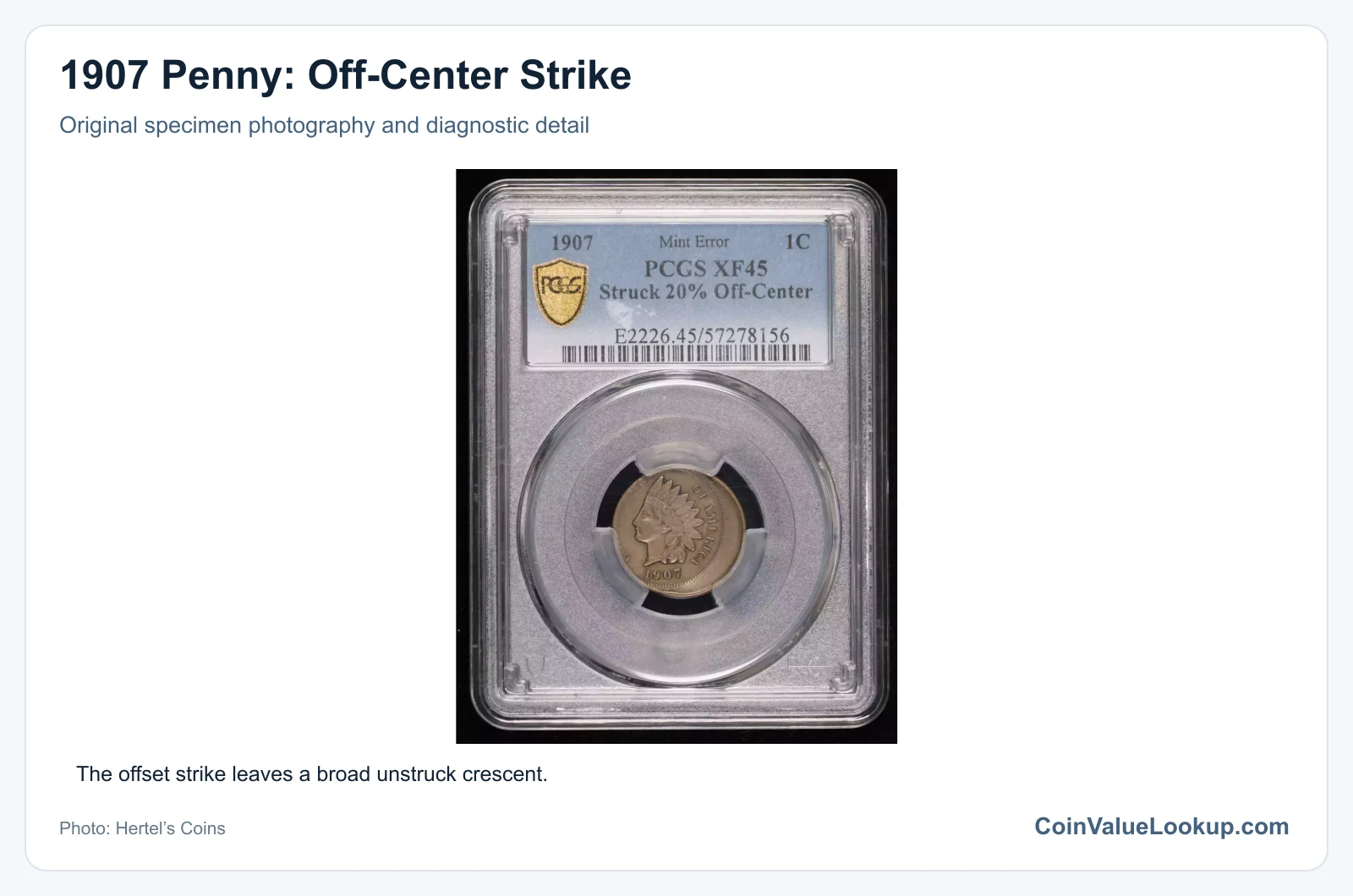
An off-center strike on a 1907 Indian Head cent means the coin blank was not properly centered between the dies when struck. The result is a partial design with a blank crescent on one side where the dies did not reach.
The percentage of off-center displacement and whether the date remains visible are the two biggest factors for value. A coin struck 5% off-center is mildly interesting; one struck 20% or more with a full date is a different story.
Do not confuse an off-center strike with a clipped planchet, which produces a curved bite out of the edge but a fully centered design. Post-mint flattening from damage can also create an irregular shape.
No supported price range is available; each off-center coin is assessed individually based on the degree of displacement, date visibility, and overall condition.
8. 1907 Indian Head Penny — Doubled Die Obverse
A doubled die obverse on a 1907 Indian Head cent shows consistent doubling on obverse elements such as the LIBERTY text, date digits, or feather details. Look for a clear secondary image with rounded edges rather than a flat, shelf-like distortion.
Compare each letter and design element against a normal 1907 cent under the same lighting. Genuine hub doubling produces separation or notching that is uniform in direction across multiple features.
Machine doubling is the usual suspect. It creates a flat mechanical shelf, often most visible on raised lettering, and it does not carry the same collector premium.
Worn die contours and lighting reflections can also create false positives under magnification. No supported price range exists for this category; value depends on the strength of the doubling, its location, and the coin's condition, requiring individual evaluation.
9. 1907 Indian Head Penny — Struck-Through Error
A struck-through error on a 1907 Indian Head cent occurs when foreign material sits between the die and the planchet during striking. The result is a localized depression or incomplete design area where the obstruction blocked the full impression.
These errors vary widely. A grease-filled die produces soft, mushy detail across part of the design.
A retained foreign object, like a thread or metal fragment, leaves a sharper, more defined impression. Keep these subtypes distinct when describing what you see.
Wear, cleaning, and ordinary weak strikes are the most common lookalikes. A struck-through area typically has a sharper boundary than natural wear and may show an impression texture that does not match normal coin surfaces.
No supported price range is available; assessment depends on the type of obstruction, the size and visibility of the affected area, and the coin's overall condition.