1999 Lincoln Penny Coin Value: How Much Is It Worth?
Most 1999 Lincoln pennies are worth face value in circulated condition. A regular Philadelphia or Denver cent in MS65 uncirculated grade carries a guide estimate around $0.36, while a standard 1999-S proof is about $7.29 at PR65.
The real action is in the varieties: a 1999 Philadelphia Wide AM business strike lists at $612 in MS65, and a 1999-S Close AM proof sits near $100 at PR65. These are grade-specific retail estimates from published guides, not guaranteed offers, and special varieties and errors form their own separate markets with no universal ceiling.
Fast Way to Identify Your 1999 Lincoln Penny
Snap a clear photo of the front and back of your 1999 penny and upload both images. Our identifier can give you a preliminary read on mint, variety and general condition.
It will not authenticate or certify a coin, but it is a solid first step before you decide whether professional grading is worthwhile. Two clear, well-lit photos are all you need.
1999 Penny Value
Upload both sides of your 1999 Lincoln Penny.
Front Obverse
Upload photo
Back Reverse
Upload photo
Which 1999 Lincoln Penny Versions Are Worth Money?
- 1999 Philadelphia Wide AM — the A and M in AMERICA are visibly separated on a business strike, the opposite of normal; guide estimate $612 at MS65.
- 1999-S Close AM Proof — the A and M nearly touch on a proof with mirrored fields, the reverse of what proofs normally show; guide estimate $100 at PR65.
- 1999-S standard proof — worth checking for cameo or deep cameo contrast, which can add value above the base PR65 estimate of $7.29.
- Original red, problem-free surfaces on any uncirculated 1999 cent push it well above the worn-coin baseline of one cent.
Step 1: Identify Your 1999 Lincoln Penny Mint Mark and Version
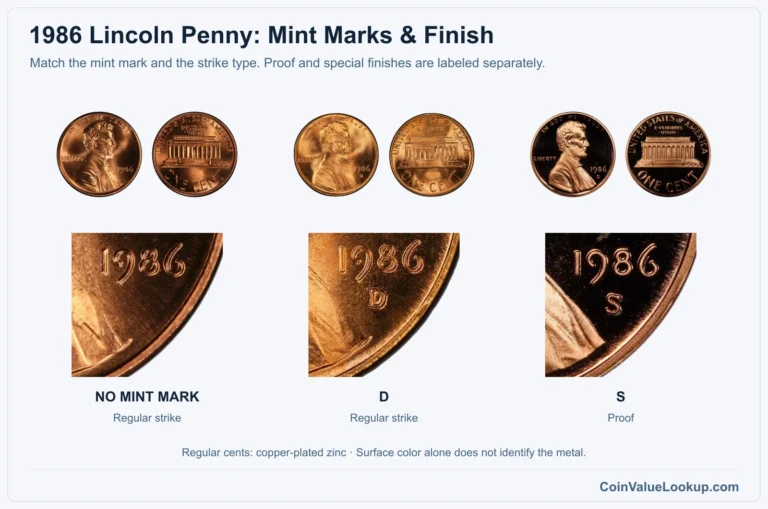
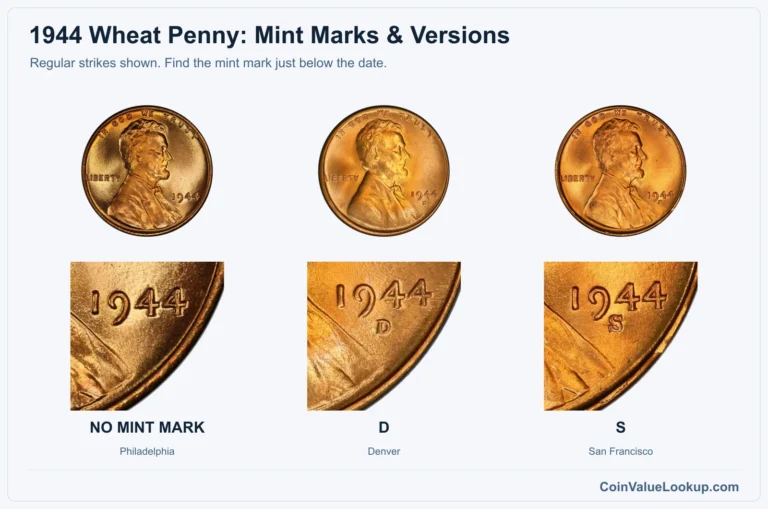
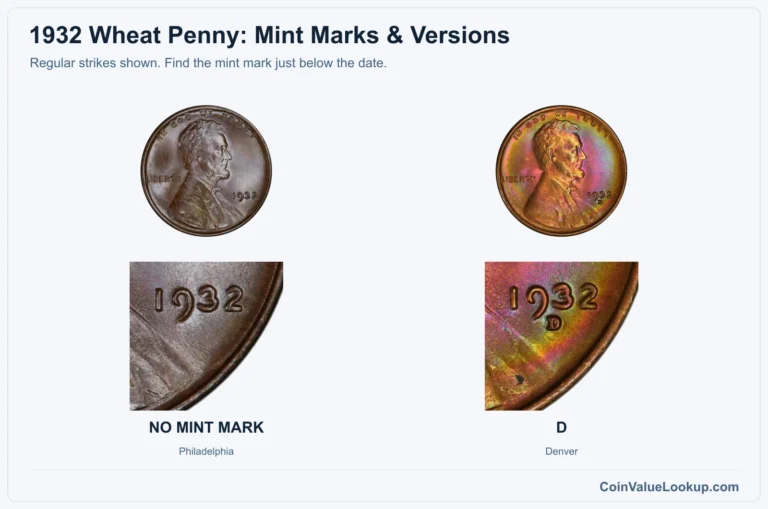
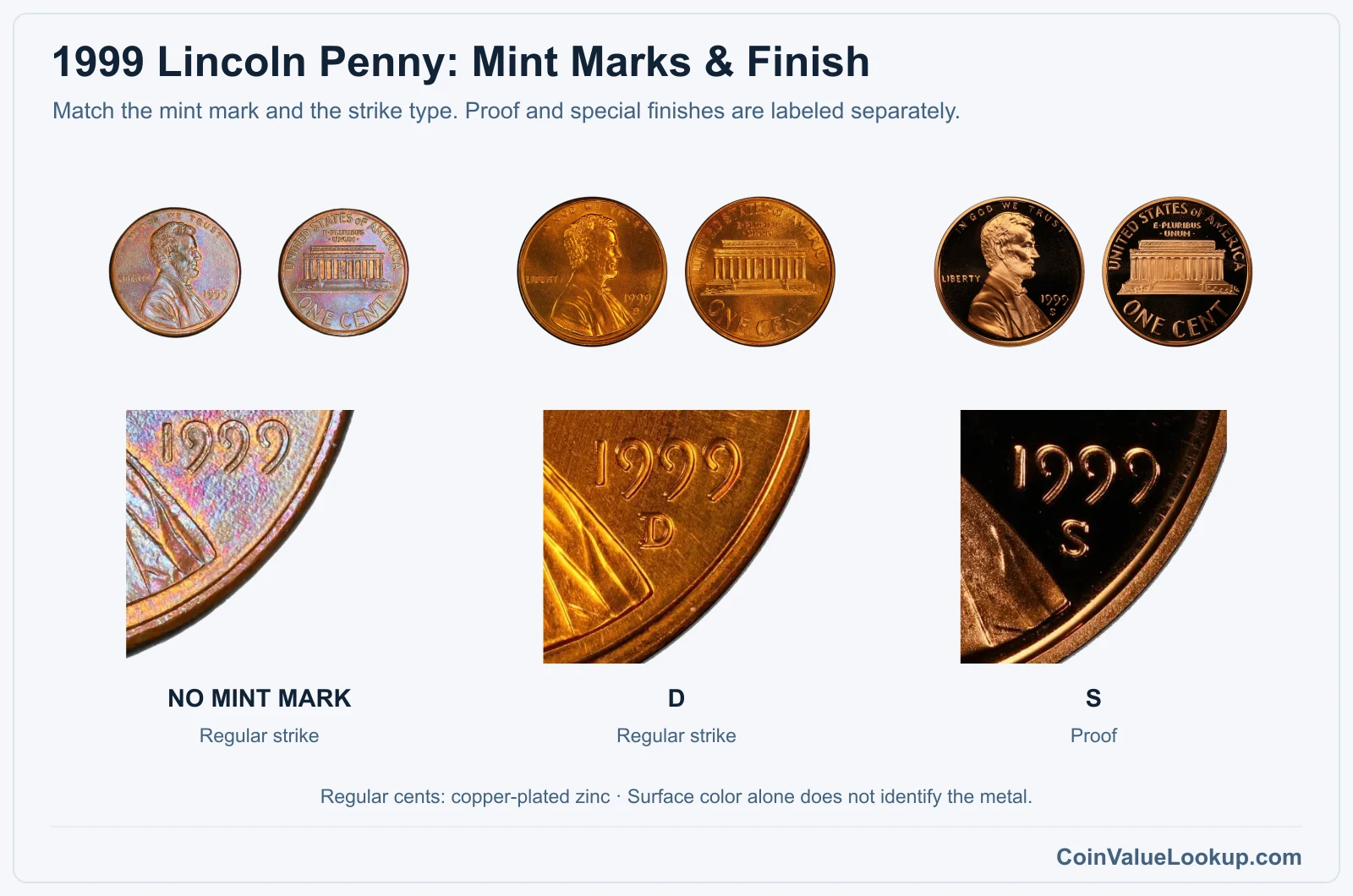
Start by looking just below the date on the obverse. No letter means Philadelphia, a D means Denver, and an S means San Francisco proof.
All 1999 cents are copper-plated zinc with a nominal weight of 2.50 grams and a plain edge. Color alone cannot prove a different alloy.
Next, flip the coin over and look at the word AMERICA above the Lincoln Memorial. On normal 1999 business strikes (Philadelphia and Denver), the A and M nearly touch — that is the Close AM reverse.
On normal 1999-S proofs, the A and M are clearly separated — that is the Wide AM reverse.
The valuable swaps go in the opposite direction. A Philadelphia business strike with a Wide AM gap is the scarce variety.
An S proof with Close AM lettering is the unusual proof variety. Always confirm the mintmark and strike type first, then check the AM spacing.
Comparing your coin side by side with a known normal example under good light is the most reliable method.
Step 2: Check Your 1999 Lincoln Penny Grade
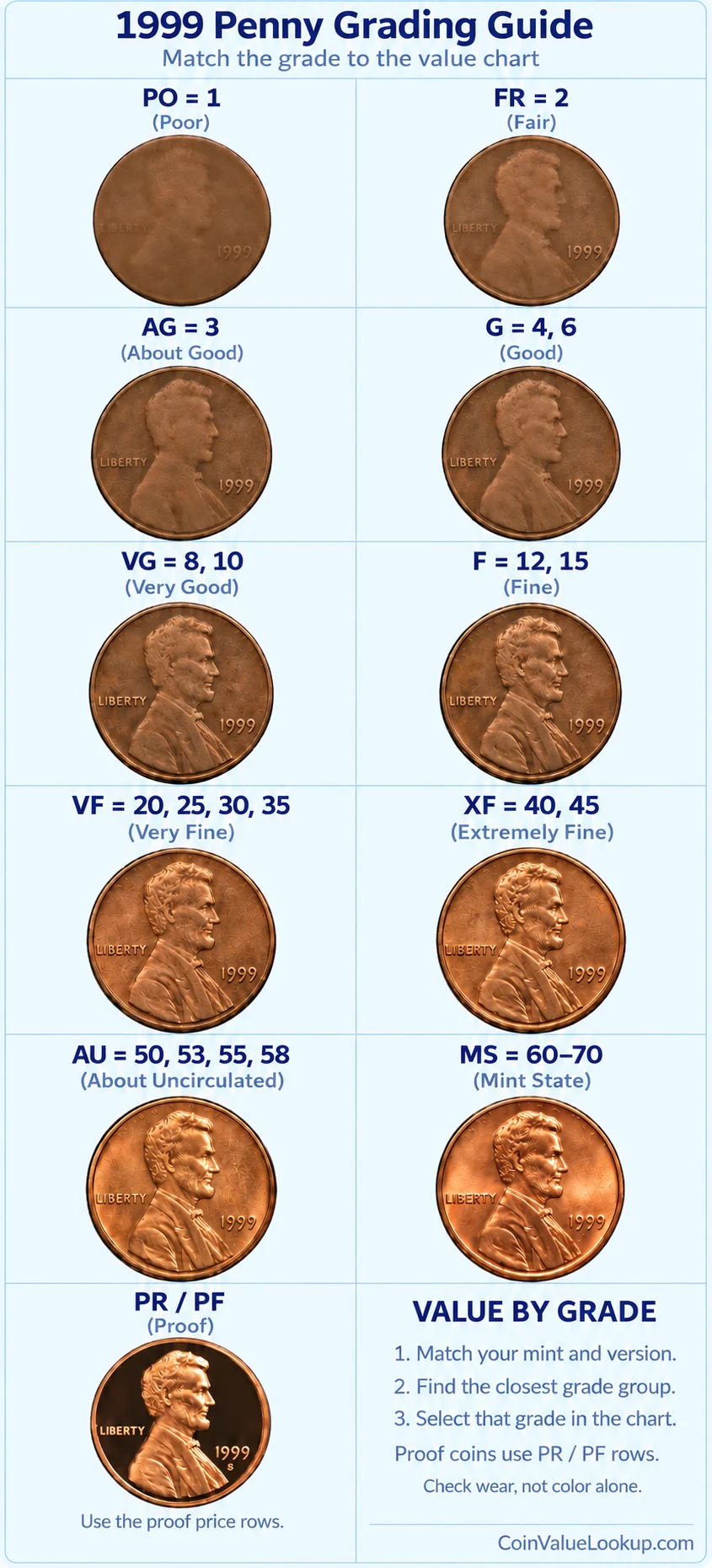
Check Lincoln's cheekbone, jawline and the hair detail above the ear first. On a lightly circulated coin these high points show slight flattening, while a well-worn piece loses nearly all hair separation.
On the reverse, look at the Memorial columns and horizontal lines between them.
Luster matters a lot on zinc cents. An uncirculated coin should have unbroken cartwheel shine across both sides.
Red, red-brown and brown describe how much original copper plating color remains; they are separate from the numerical grade.
The comparison image is your best friend here. Hold your coin next to it and match the wear pattern, not just the color.
Spots, corrosion, cleaning marks and contact dings all drag the grade down regardless of how sharp the design looks. A spotted MS64 coin is not the same market animal as a clean MS65.
Step 3: Check 1999 Lincoln Penny Value by Mint and Version
1999 Lincoln Penny
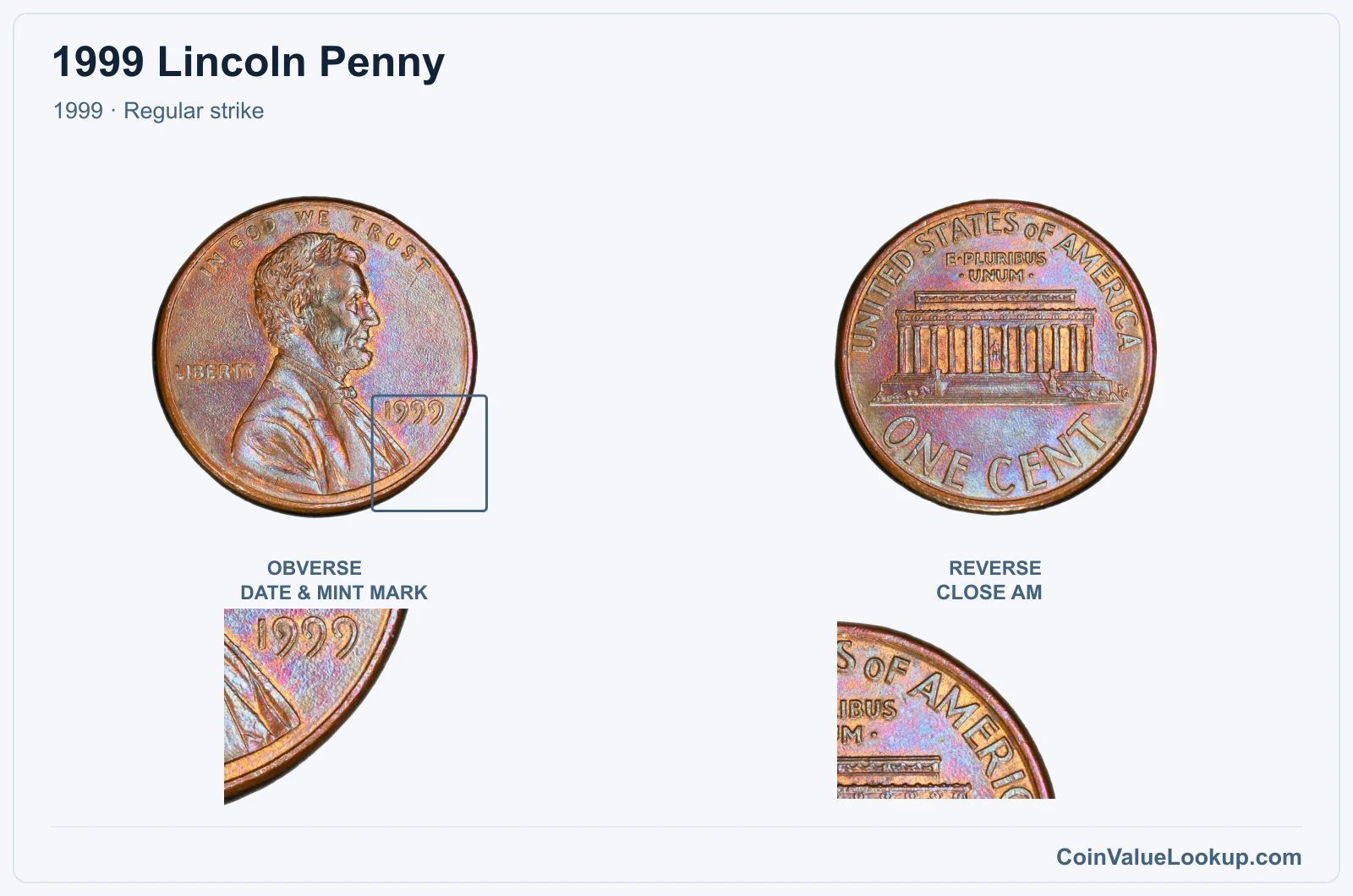
The 1999 Philadelphia cent has no mintmark below the date. It is a copper-plated zinc business strike weighing about 2.50 grams.
The normal reverse for this issue uses Close AM spacing, where the A and M in AMERICA nearly touch.
A guide estimate places this coin at roughly $0.36 in MS65 condition. In circulated grades it is a face-value coin.
Clean, original surfaces with full red color are what separate a common cent from one worth pulling out of a roll.
| Range | Grade | Price | Auction Records | Appraisal |
|---|---|---|---|---|
| PO | PO 1 | — | Coin Identifier | |
| FR | FR 2 | — | Coin Identifier | |
| AG | AG 3 | — | Coin Identifier | |
| G | G 4 | — | Coin Identifier | |
| G 6 | — | Coin Identifier | ||
| VG | VG 8 | — | Coin Identifier | |
| VG 10 | — | Coin Identifier | ||
| F | F 12 | — | Coin Identifier | |
| F 15 | — | Coin Identifier | ||
| VF | VF 20 | — | Coin Identifier | |
| VF 25 | — | Coin Identifier | ||
| VF 30 | — | Coin Identifier | ||
| VF 35 | — | Coin Identifier | ||
| XF | XF 40 | — | Coin Identifier | |
| XF 45 | — | Coin Identifier | ||
| AU | AU 50 | — | Coin Identifier | |
| AU 53 | — | Coin Identifier | ||
| AU 55 | — | Coin Identifier | ||
| AU 58 | — | Coin Identifier | ||
| MS | MS 60 | — | Coin Identifier | |
| MS 61 | — | Coin Identifier | ||
| MS 62 | — | Coin Identifier | ||
| MS 63 | — | Coin Identifier | ||
| MS 64 | — | Coin Identifier | ||
| MS 65 | — | Coin Identifier | ||
| MS 66 | — | Coin Identifier | ||
| MS 67 | — | Coin Identifier | ||
| MS 68 | — | Coin Identifier | ||
| MS 69 | — | — | — | |
| MS 70 | — | — | — |
1999 Lincoln Penny — D
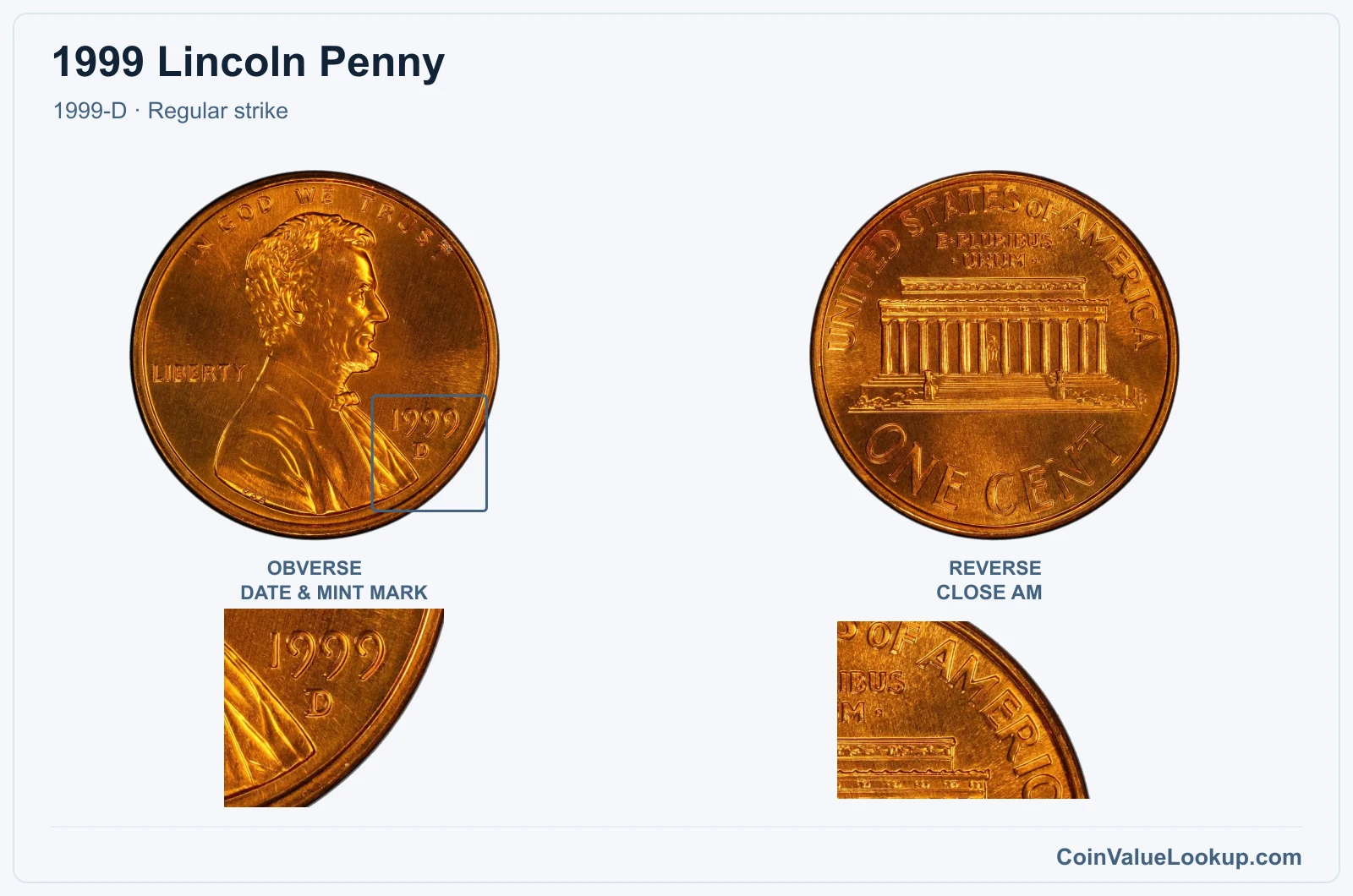
Look for the small D mintmark below the date. The 1999-D is a Denver business strike on the same copper-plated zinc planchet as the Philadelphia issue, and it shares the Close AM reverse as standard.
Guide value sits at about $0.36 in MS65. Circulated examples are worth one cent.
As with the Philadelphia coin, uncirculated pieces with original red luster and no contact marks are the ones worth setting aside.
| Range | Grade | Price | Auction Records | Appraisal |
|---|---|---|---|---|
| PO | PO 1 | — | Coin Identifier | |
| FR | FR 2 | — | Coin Identifier | |
| AG | AG 3 | — | Coin Identifier | |
| G | G 4 | — | Coin Identifier | |
| G 6 | — | Coin Identifier | ||
| VG | VG 8 | — | Coin Identifier | |
| VG 10 | — | Coin Identifier | ||
| F | F 12 | — | Coin Identifier | |
| F 15 | — | Coin Identifier | ||
| VF | VF 20 | — | Coin Identifier | |
| VF 25 | — | Coin Identifier | ||
| VF 30 | — | Coin Identifier | ||
| VF 35 | — | Coin Identifier | ||
| XF | XF 40 | — | Coin Identifier | |
| XF 45 | — | Coin Identifier | ||
| AU | AU 50 | — | Coin Identifier | |
| AU 53 | — | Coin Identifier | ||
| AU 55 | — | Coin Identifier | ||
| AU 58 | — | Coin Identifier | ||
| MS | MS 60 | — | Coin Identifier | |
| MS 61 | — | Coin Identifier | ||
| MS 62 | — | Coin Identifier | ||
| MS 63 | — | Coin Identifier | ||
| MS 64 | — | Coin Identifier | ||
| MS 65 | — | Coin Identifier | ||
| MS 66 | Coin Identifier | |||
| MS 67 | Coin Identifier | |||
| MS 68 | Coin Identifier | |||
| MS 69 | Coin Identifier | |||
| MS 70 | — | — | — |
1999 Lincoln Penny — S PR
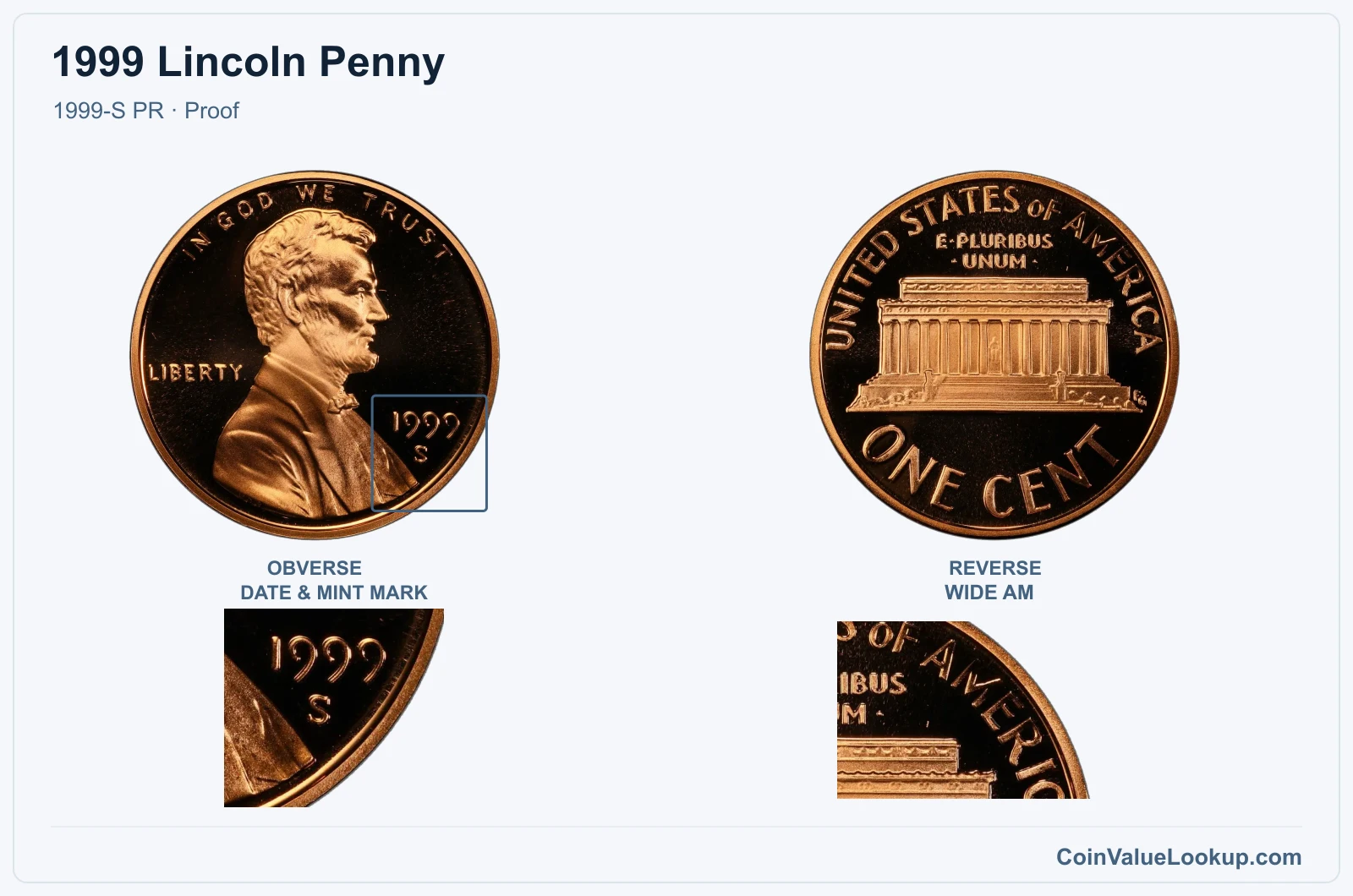
The 1999-S proof was struck at San Francisco for collectors, with mirrored fields and sharply defined devices. Its S mintmark sits below the date.
The standard proof reverse uses Wide AM spacing, where a clear gap separates the A and M in AMERICA.
A PR65 example carries a guide estimate of $7.29. Cameo and deep cameo designations, which describe contrast between frosted design elements and mirror fields, are graded separately and can affect value.
Proof is a manufacturing finish, not a grade above Mint State — a proof can still have hairlines or toning that lowers its numerical grade.
| Range | Grade | Price | Auction Records | Appraisal |
|---|---|---|---|---|
| PR | PR 1 | — | Coin Identifier | |
| PR 2 | — | Coin Identifier | ||
| PR 3 | — | Coin Identifier | ||
| PR 4 | — | Coin Identifier | ||
| PR 6 | — | Coin Identifier | ||
| PR 8 | — | Coin Identifier | ||
| PR 10 | — | Coin Identifier | ||
| PR 12 | — | Coin Identifier | ||
| PR 15 | — | Coin Identifier | ||
| PR 20 | — | Coin Identifier | ||
| PR 25 | — | Coin Identifier | ||
| PR 30 | — | Coin Identifier | ||
| PR 35 | — | Coin Identifier | ||
| PR 40 | — | Coin Identifier | ||
| PR 45 | — | Coin Identifier | ||
| PR 50 | — | Coin Identifier | ||
| PR 53 | — | Coin Identifier | ||
| PR 55 | — | Coin Identifier | ||
| PR 58 | — | Coin Identifier | ||
| PR 60 | Coin Identifier | |||
| PR 61 | — | Coin Identifier | ||
| PR 62 | — | Coin Identifier | ||
| PR 63 | — | Coin Identifier | ||
| PR 64 | — | Coin Identifier | ||
| PR 65 | — | Coin Identifier | ||
| PR 66 | Coin Identifier | |||
| PR 67 | Coin Identifier | |||
| PR 68 | Coin Identifier | |||
| PR 69 | Coin Identifier | |||
| PR 70 | Coin Identifier |
1999 Lincoln Penny — S Close AM PR
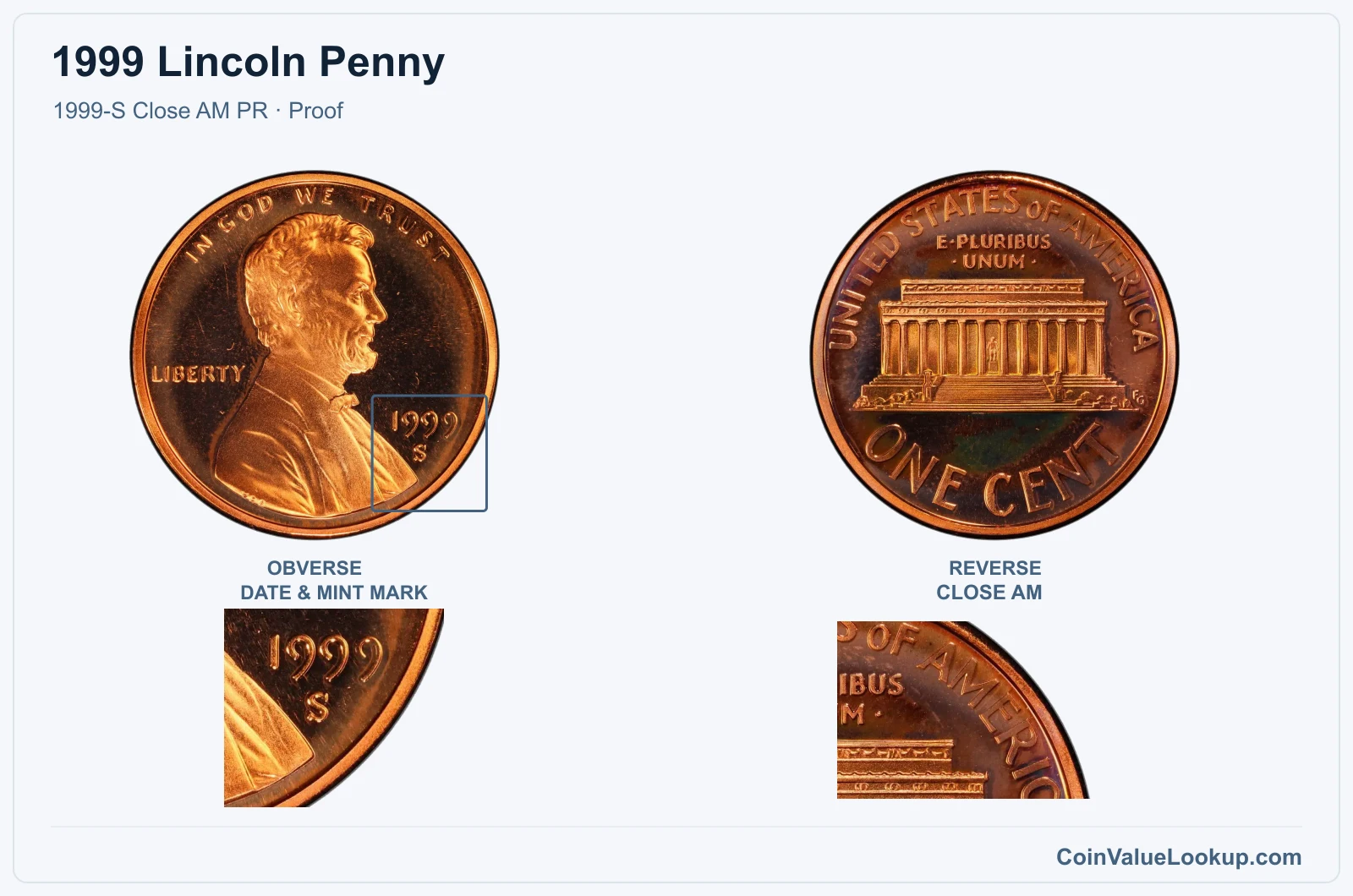
This is the oddball proof. On the 1999-S Close AM proof, the A and M in AMERICA nearly touch — the reverse style normally found on circulation strikes, not proofs.
You still need to confirm proof characteristics: mirrored fields, the S mintmark and sharp device edges.
A guide estimate places this variety at $100 in PR65. That is a significant jump over the standard proof.
When checking, compare both the AM spacing and the overall finish side by side with a normal 1999-S proof. The AM difference is small but consistent, and the rest of the coin should still look like a proof, not a polished business strike.
Coin Value Lookup is a good starting point if you want to compare guide values across different Lincoln cent years and varieties before deciding whether to pursue professional grading.
| Range | Grade | Price | Auction Records | Appraisal |
|---|---|---|---|---|
| PR | PR 1 | — | Coin Identifier | |
| PR 2 | — | Coin Identifier | ||
| PR 3 | — | Coin Identifier | ||
| PR 4 | — | Coin Identifier | ||
| PR 6 | — | Coin Identifier | ||
| PR 8 | — | Coin Identifier | ||
| PR 10 | — | Coin Identifier | ||
| PR 12 | — | Coin Identifier | ||
| PR 15 | — | Coin Identifier | ||
| PR 20 | — | Coin Identifier | ||
| PR 25 | — | Coin Identifier | ||
| PR 30 | — | Coin Identifier | ||
| PR 35 | — | Coin Identifier | ||
| PR 40 | — | Coin Identifier | ||
| PR 45 | — | Coin Identifier | ||
| PR 50 | — | Coin Identifier | ||
| PR 53 | — | Coin Identifier | ||
| PR 55 | — | Coin Identifier | ||
| PR 58 | — | Coin Identifier | ||
| PR 60 | — | Coin Identifier | ||
| PR 61 | — | Coin Identifier | ||
| PR 62 | — | Coin Identifier | ||
| PR 63 | Coin Identifier | |||
| PR 64 | — | Coin Identifier | ||
| PR 65 | — | Coin Identifier | ||
| PR 66 | Coin Identifier | |||
| PR 67 | Coin Identifier | |||
| PR 68 | Coin Identifier | |||
| PR 69 | Coin Identifier | |||
| PR 70 | Coin Identifier |
1999 Lincoln Penny — Philadelphia Wide AM
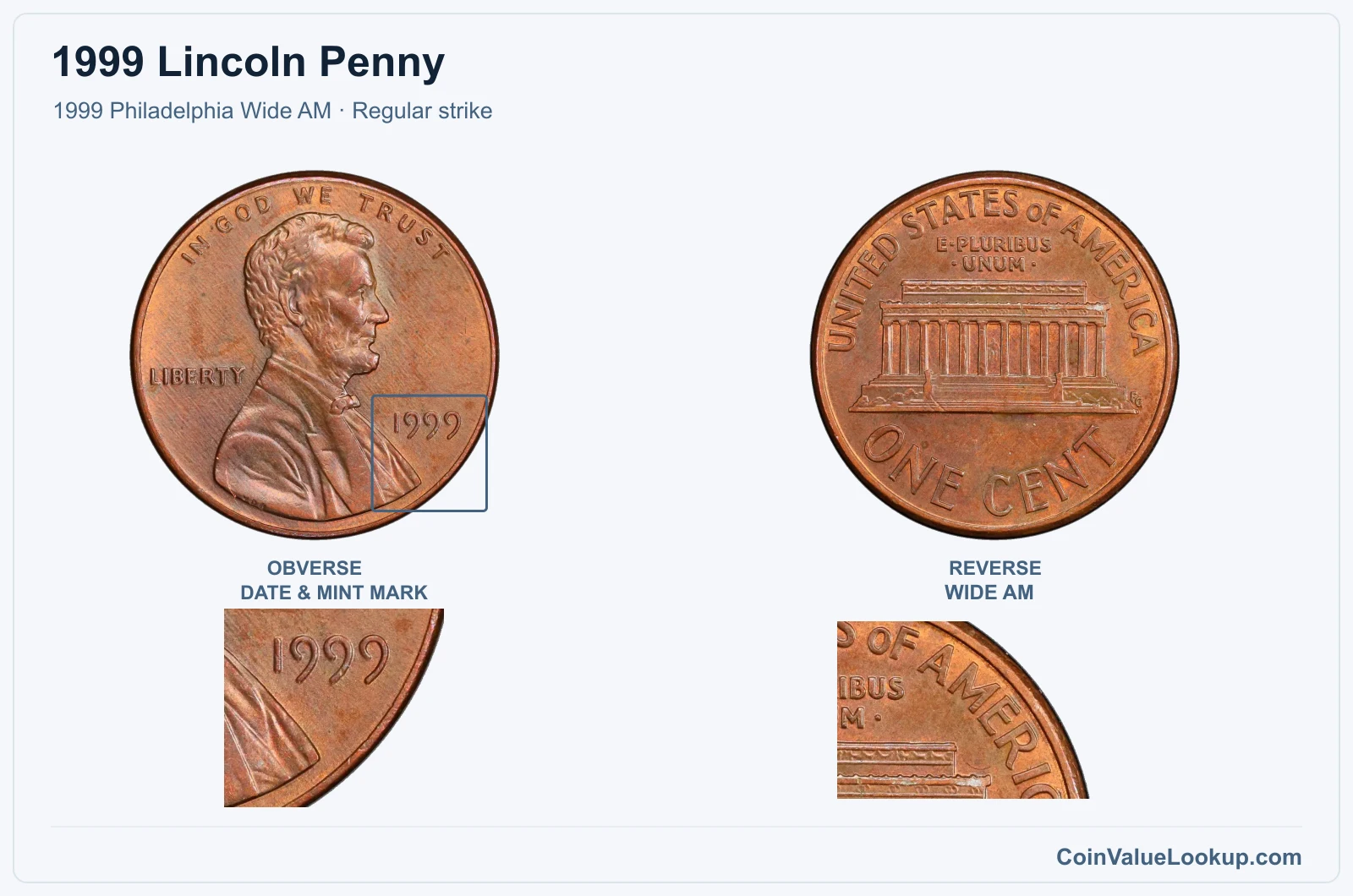
The 1999 Philadelphia Wide AM is the prize of this year. On a normal Philadelphia business strike the A and M in AMERICA almost touch (Close AM).
On this variety they are clearly separated, matching the spacing usually reserved for proof dies.
A guide estimate from USA Coin Book puts this coin at $612 in MS65, making it by far the most valuable circulation-strike branch for the year. PCGS recognizes 1998, 1999 and 2000 as the Wide AM circulation dates, and 1999 is considered the scarcest of the three.
When you check, also compare the position of the FG initials relative to the Memorial building — differences there can help confirm which reverse die was used. Every detail counts on a coin worth this kind of premium over face value.
Range Grade
Price1999 Philadelphia Wide AM (BN) Price1999 Philadelphia Wide AM (RB) Price1999 Philadelphia Wide AM (RD) Auction Records Appraisal PO PO 1
—
Coin Identifier FR FR 2
—
Coin Identifier AG AG 3
—
Coin Identifier G G 4
—
Coin Identifier
G 6
—
Coin Identifier VG VG 8
—
Coin Identifier
VG 10
—
Coin Identifier F F 12
—
Coin Identifier
F 15
—
Coin Identifier VF VF 20
—
Coin Identifier
VF 25
—
Coin Identifier
VF 30
—
Coin Identifier
VF 35
—
Coin Identifier XF XF 40
—
Coin Identifier
XF 45
—
Coin Identifier AU AU 50
—
Coin Identifier
AU 53
—
Coin Identifier
AU 55
—
Coin Identifier
AU 58
—
Coin Identifier MS MS 60
—
Coin Identifier
MS 61
—
Coin Identifier
MS 62
—
Coin Identifier
MS 63
Coin Identifier
MS 64
Coin Identifier
MS 65
—
Coin Identifier
MS 66
—
—
Coin Identifier
MS 67
—
—
Coin Identifier
MS 68
—
—
—
—
—
MS 69
—
—
—
—
—
MS 70
—
—
—
—
—
1999 Lincoln Penny Error List
1. 1999 Lincoln Penny — Doubled Die Obverse
A doubled die obverse on a 1999 Lincoln cent shows consistent doubling in the design — look for separation or notching on obverse letters, the date or Lincoln's profile. The key word is consistent: the doubling repeats in the same direction and width across affected areas.
Under magnification, compare your coin's obverse lettering to a normal 1999 cent in matching light. Machine doubling, which is a different and far more common phenomenon, tends to produce a flat shelf on one side of the letter rather than a full second image.
Reflections or worn die contours can also mimic doubling. Value depends on the specific die, the severity of the doubling and the coin's authenticated condition, so no single price range covers all examples.
2. 1999 Lincoln Penny — Off-Center Strike
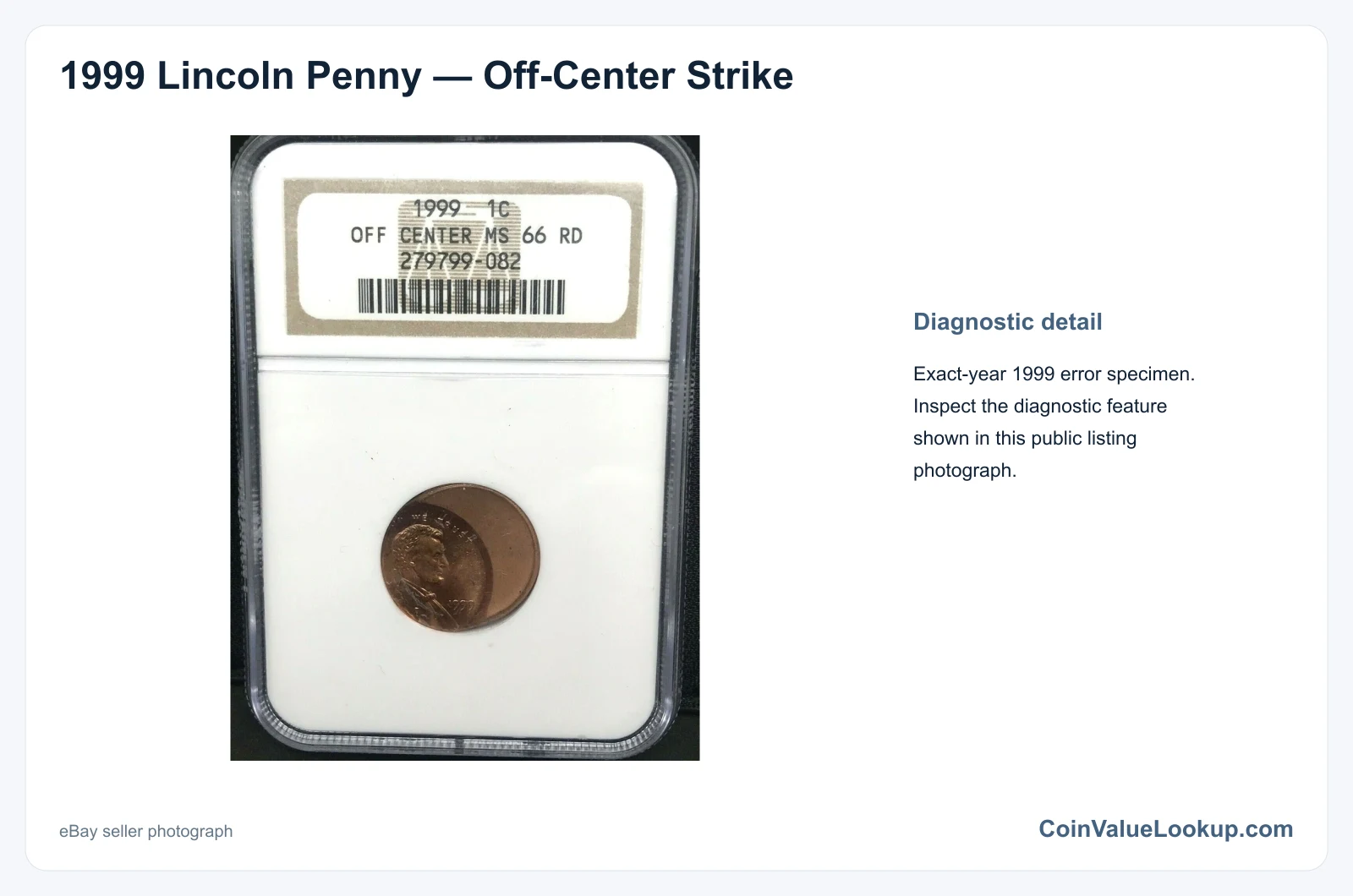
An off-center strike happens when the planchet is not seated properly between the dies. The result is a design that is shifted to one side, leaving an unstruck crescent of blank metal on the opposite edge.
The further off center, the more dramatic the coin looks.
Collectors strongly prefer examples where the date remains fully visible — without a readable date, the coin loses much of its appeal. Compare any candidate to a clipped planchet, which shows a curved bite from the blank rather than a shifted design.
One-sided die misalignment and post-mint flattening from damage can also look similar at first glance. Value depends on the percentage of off-center shift, date visibility, and authenticated condition.
3. 1999 Lincoln Penny — Die Break / Cud
A die break leaves a raised, irregular blob of metal on the coin's surface where a chunk of the die cracked away. When that break connects to the rim, collectors call it a cud — a raised lump that interrupts the normal design at the edge.
Look for a distinct boundary between the cud and the surrounding design. The raised area should feel solid and uniform, not rough or corroded.
Rim dents from post-mint damage can mimic a cud but usually show displaced metal pushed inward, not a smooth raised feature. Interior die chips are smaller and do not reach the rim.
Value depends on the size, location and visual impact of the break, along with the coin's overall condition. Professional authentication is the safest route for any significant example.
4. 1999 Lincoln Penny — Wrong Planchet / Off-Metal Strike
A wrong-planchet or off-metal strike means a 1999 Lincoln cent design was struck on a blank intended for a different denomination or composition. The result is a coin that looks like a penny but does not weigh, measure or feel like one.
To check, weigh your coin on a precision scale and measure its diameter. A normal 1999 cent is copper-plated zinc, about 2.50 grams and 19.05 mm across with a plain edge.
Any significant deviation — especially combined with an unusual edge or incomplete design — is worth investigating. Be cautious: plating loss, acid damage, corrosion and deliberate alterations can all change a coin's appearance and weight.
Authenticated examples command strong collector interest, but value varies entirely by the specific planchet involved and the coin's condition.
5. 1999 Lincoln Penny — Wide AM circulation reverse
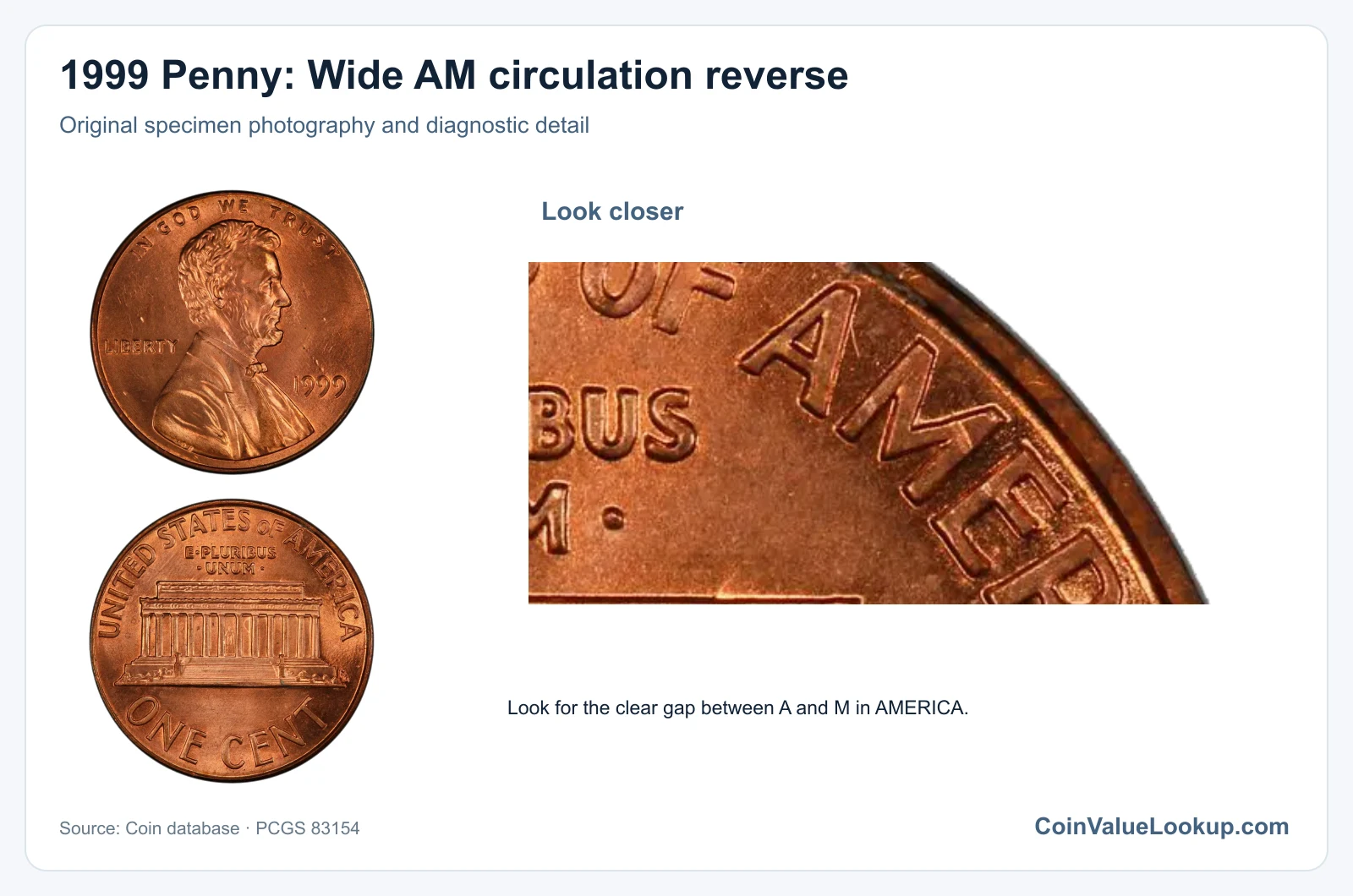
The Wide AM variety on a 1999 Philadelphia circulation cent is also tracked as a recognized die variety. The A and M in AMERICA are visibly separated, whereas normal business strikes of this year show them nearly touching (Close AM).
This spacing matches what you would normally see only on proof coins.
When checking, use magnification and compare both the AM gap and the position of the designer's initials (FG) near the Memorial. A normal Wide AM on a proof coin is not an error — it is standard.
What makes this special is the combination of Wide AM with a business-strike finish and no mintmark. Damage to the lettering or a worn die can occasionally make the spacing ambiguous, so a side-by-side comparison with a confirmed normal 1999 cent is essential.
6. 1999 Lincoln Penny — Close AM proof reverse
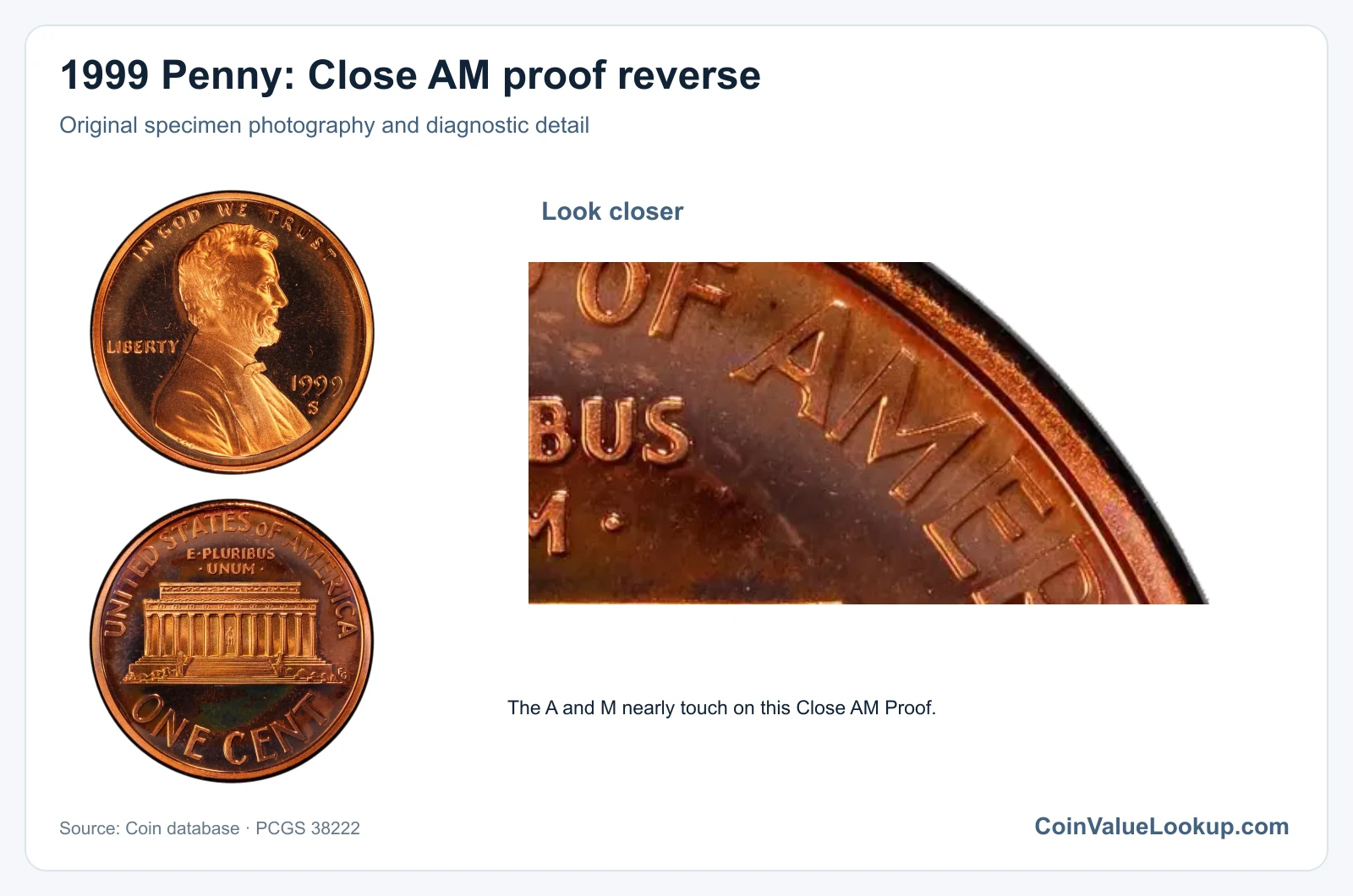
The 1999-S Close AM proof is the mirror image of the Wide AM circulation variety. Here a proof coin — with mirrored fields, an S mintmark and sharp strikes — carries the Close AM reverse normally found only on business strikes.
The A and M in AMERICA nearly touch instead of showing the usual proof-die gap.
Confirm the proof finish first. A polished or cleaned business strike can look reflective, but it will not have the same depth of mirror surface or the precise S mintmark.
Hold the coin at an angle and check for the characteristic liquid-mirror reflection in the fields. Then compare the AM spacing to a known standard 1999-S proof.
Without both proof confirmation and Close AM spacing, you do not have this variety.