1944 Wheat Penny Coin Value: How Much Is It Worth?
A 1944 Wheat Penny in ordinary circulated condition (Fine-12) runs about $0.06, while an uncirculated example at MS63 can reach around $6.25 across the standard Philadelphia, Denver and San Francisco issues. Those are guide estimates for normal shellcase brass strikes.
Steel errors, the D/S over-mintmark variety and other unusual pieces are priced separately based on authentication and condition. Original surfaces, color and wear all affect what a buyer will actually pay.
Fast Way to Identify Your 1944 Wheat Penny
Want a quick read on your 1944 penny? Upload clear photos of the front and back, and the identifier can help with a preliminary identification of your coin's mint and version.
Good lighting and a close-up of the mintmark area below the date make a real difference. This is not a substitute for professional authentication, but it is a solid starting point.
1944 Wheat Penny Value
Upload both sides of your 1944 Wheat Penny.
Front Obverse
Upload photo
Back Reverse
Upload photo
Which 1944 Wheat Penny Versions Are Worth Money?
- The 1944-D/S (D Over S) variety shows remnants of an S mintmark under the D and is valued from about $61 in G4 to $860 in MS63.
- 1944 Steel cents from any mint are transitional wrong-metal errors struck on leftover steel planchets; they require authentication and are individually assessed.
- A normal 1944-S in MS63 guides around $4.96, slightly above the Philadelphia issue at the same grade.
- Original red surfaces on any uncirculated 1944 cent carry stronger appeal than brown or cleaned examples.
Step 1: Identify Your 1944 Wheat Penny Mint Mark and Version
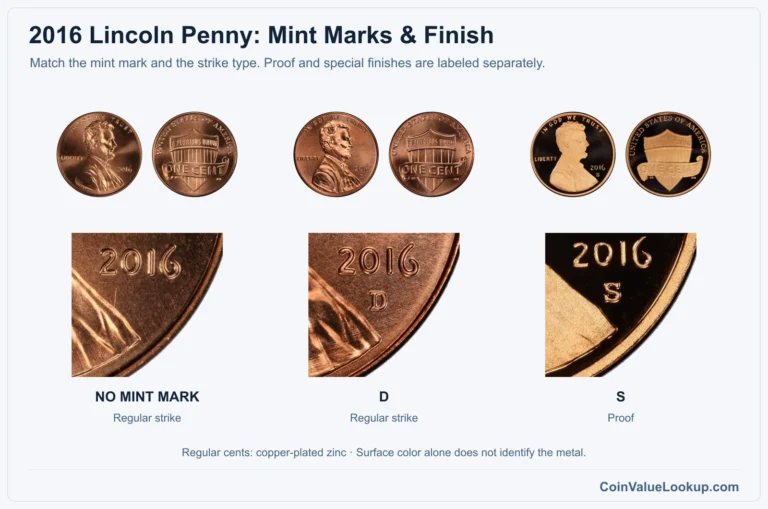
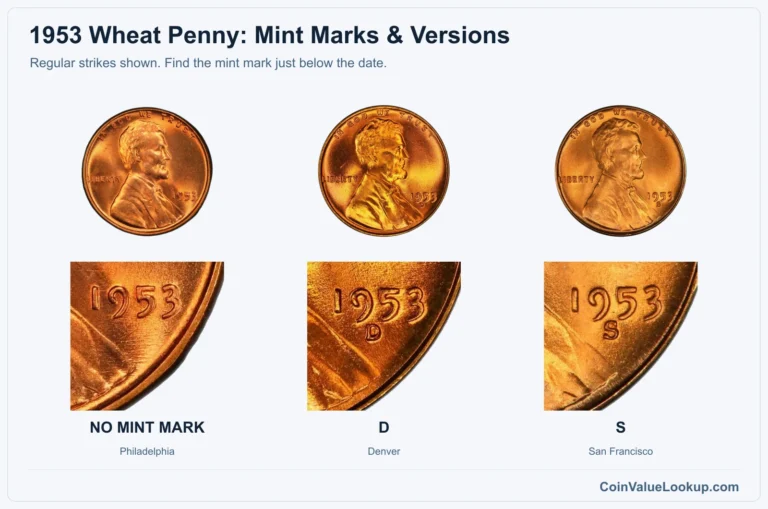
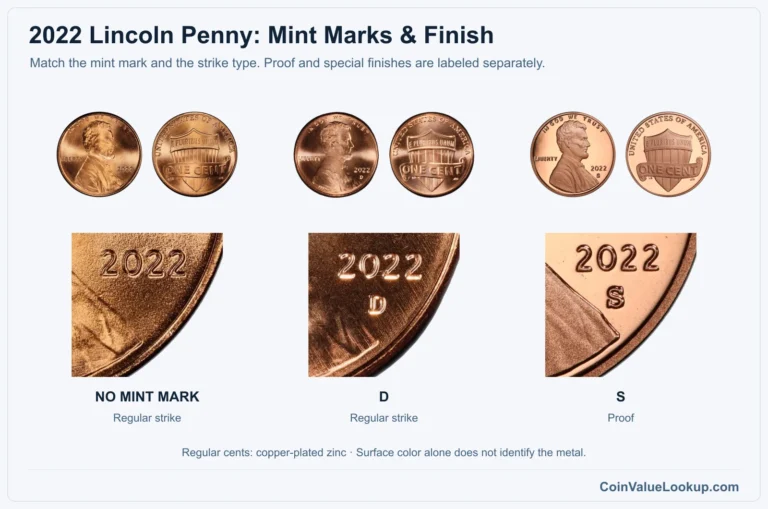
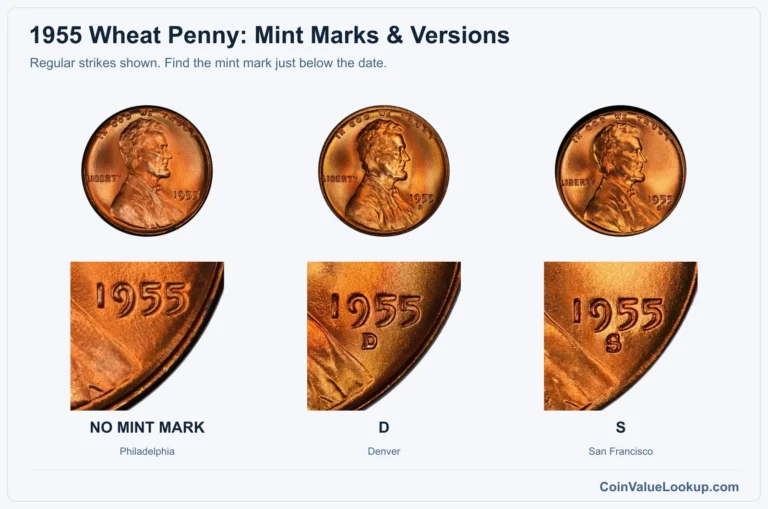
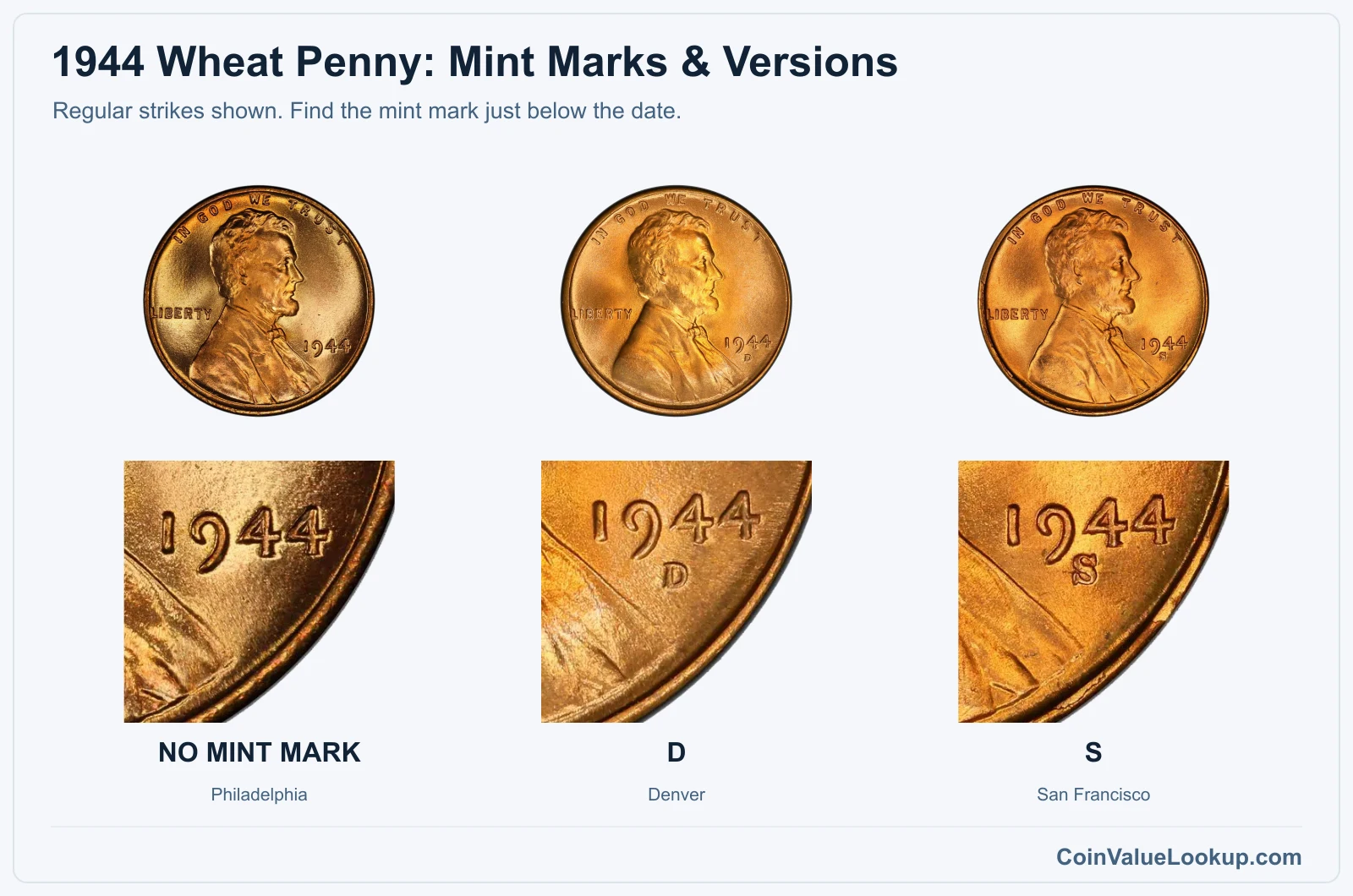
First, flip the coin over to the obverse and look just below the date. No letter means Philadelphia.
A small "D" means Denver. A small "S" means San Francisco.
That is the single biggest sorting step.
All normal 1944 cents are 95% copper and 5% zinc shellcase brass, weighing about 3.11 grams. They are not magnetic.
If your coin sticks to a magnet and weighs around 2.70 grams, you may have a steel error, which is a completely different animal and needs professional authentication.
There is also a 1944-D/S variety where a Denver "D" mintmark was punched over an earlier "S." Under magnification you can see remnants of the S beneath the D. That one commands a serious premium over a plain 1944-D.
No proof cents were produced in 1944, so do not confuse a nice uncirculated coin with a proof. Color descriptions like red, red-brown and brown refer to surface toning, not manufacturing method or grade level.
Step 2: Check Your 1944 Wheat Penny Grade
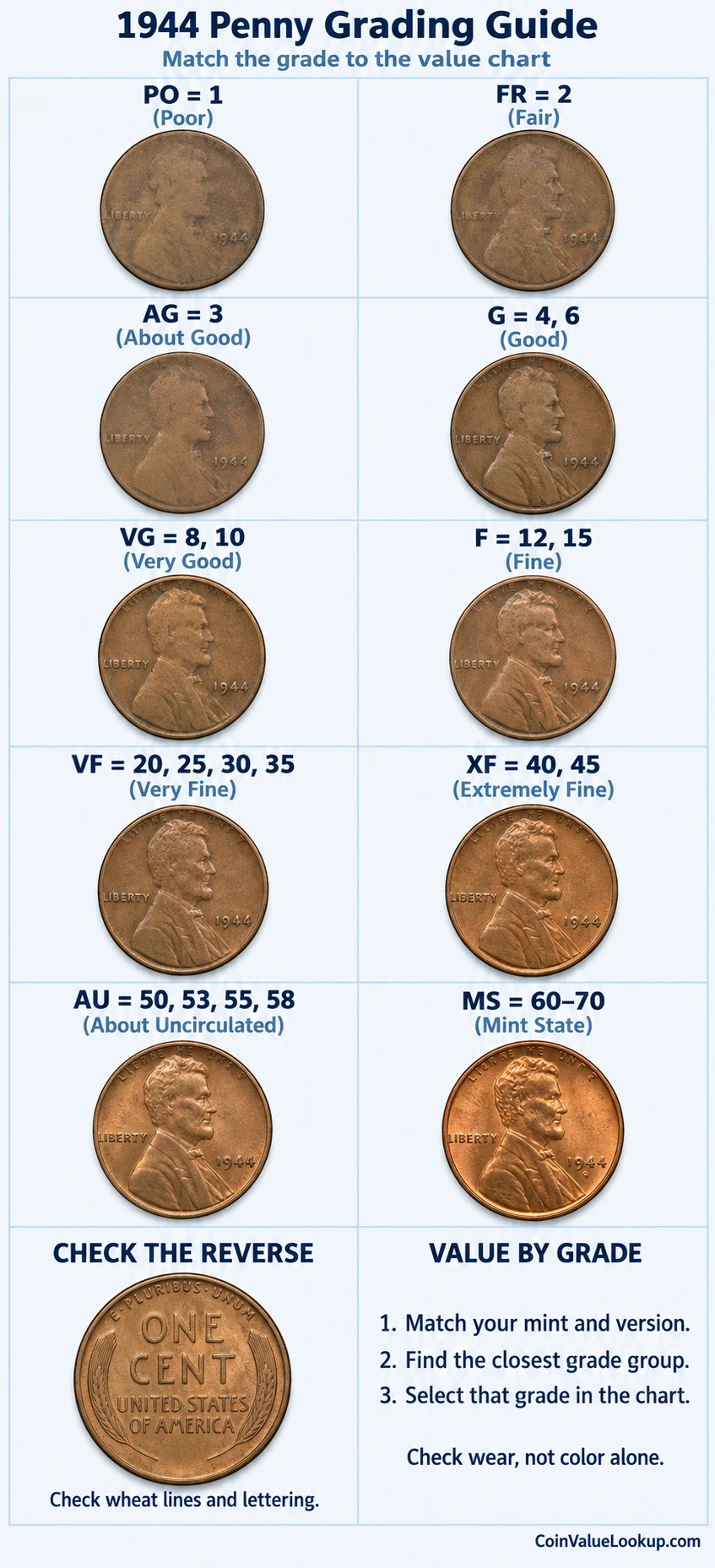
Start with Lincoln's cheekbone and jawline on the obverse. These are the highest points of the design and the first places to lose detail.
In well-worn grades like Good-4 through Fine-12, the jaw blends into the neck and hair detail above the ear is mostly flat.
On the reverse, check the individual wheat grain lines and the parallel horizontal lines between the stalks. A coin grading Very Fine will still show separation in the wheat grains.
By About Uncirculated, only the slightest friction appears on the cheek and jaw.
At MS63, expect full luster with minor bagmarks. Use the comparison image to match your coin's wear pattern against known grade benchmarks.
A weak original strike can mimic wear, so look at the overall luster before concluding the coin is circulated. Cleaning, corrosion and spots are separate condition factors that reduce desirability regardless of technical grade.
Step 3: Check 1944 Wheat Penny Value by Mint and Version
1944 Wheat Penny
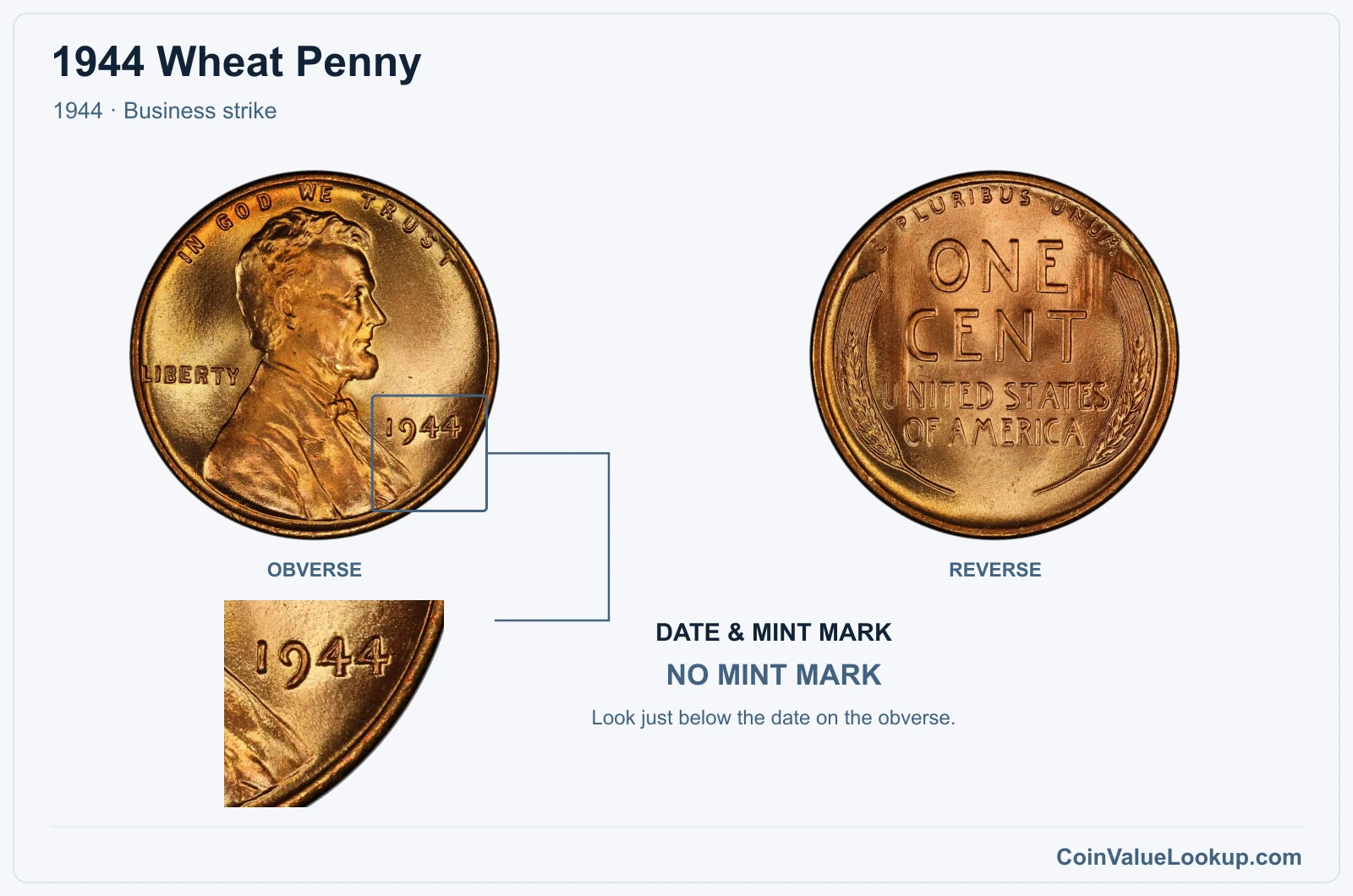
The 1944 Philadelphia cent has no mintmark below the date. It is a business strike on 95% copper, 5% zinc shellcase brass weighing about 3.11 grams.
These were made in enormous quantities, so circulated examples are extremely common. A Fine-12 guides at roughly $0.06, and MS63 comes in around $6.25 per USA Coin Book estimates.
Those figures do not specify color, so a certified red example in the same grade may trade differently. Look for original luster and clean surfaces if you are hoping for uncirculated money.
| Range | Grade | Price | Auction Records | Appraisal |
|---|---|---|---|---|
| PO | PO 1 | — | Coin Identifier | |
| FR | FR 2 | — | Coin Identifier | |
| AG | AG 3 | — | Coin Identifier | |
| G | G 4 | — | Coin Identifier | |
| G 6 | — | Coin Identifier | ||
| VG | VG 8 | — | Coin Identifier | |
| VG 10 | — | Coin Identifier | ||
| F | F 12 | — | Coin Identifier | |
| F 15 | — | Coin Identifier | ||
| VF | VF 20 | — | Coin Identifier | |
| VF 25 | — | Coin Identifier | ||
| VF 30 | — | Coin Identifier | ||
| VF 35 | — | Coin Identifier | ||
| XF | XF 40 | — | Coin Identifier | |
| XF 45 | — | Coin Identifier | ||
| AU | AU 50 | — | Coin Identifier | |
| AU 53 | — | Coin Identifier | ||
| AU 55 | — | Coin Identifier | ||
| AU 58 | — | Coin Identifier | ||
| MS | MS 60 | — | Coin Identifier | |
| MS 61 | — | Coin Identifier | ||
| MS 62 | — | Coin Identifier | ||
| MS 63 | — | Coin Identifier | ||
| MS 64 | Coin Identifier | |||
| MS 65 | Coin Identifier | |||
| MS 66 | Coin Identifier | |||
| MS 67 | Coin Identifier | |||
| MS 68 | Coin Identifier | |||
| MS 69 | — | — | — | |
| MS 70 | — | — | — |
1944 Wheat Penny — Steel
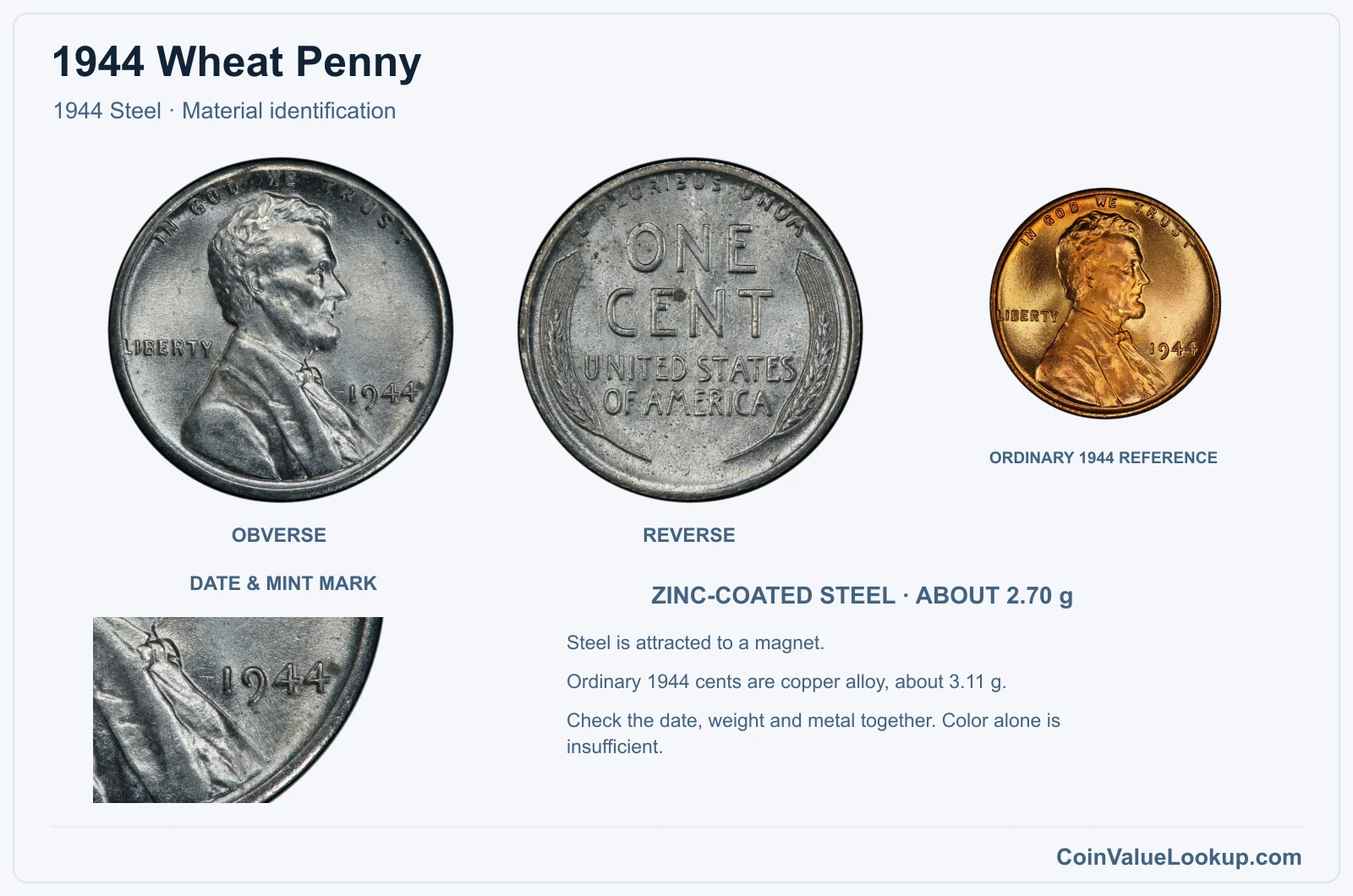
A 1944 Steel cent from Philadelphia is a wrong-metal error. Normal 1944 cents are brass, but a small number were struck on leftover zinc-coated steel planchets from 1943 production.
The quickest screening test is a magnet: steel cents stick, brass cents do not. Weight matters too, about 2.70 grams for steel versus 3.11 grams for brass.
Do not assume a silvery-looking 1944 penny is steel. Plated brass cents and coins with altered dates (a modified 1948, for example) are common lookalikes.
Any suspected 1944 steel cent needs professional third-party authentication before you can rely on its identity. No guide price range is adopted here because each authenticated example is assessed individually based on its condition, surfaces and confirmed authenticity.
| Range | Grade | Price | Auction Records | Appraisal |
|---|---|---|---|---|
| PO | PO 1 | — | Coin Identifier | |
| FR | FR 2 | — | Coin Identifier | |
| AG | AG 3 | — | Coin Identifier | |
| G | G 4 | — | Coin Identifier | |
| G 6 | — | Coin Identifier | ||
| VG | VG 8 | — | Coin Identifier | |
| VG 10 | — | Coin Identifier | ||
| F | F 12 | — | Coin Identifier | |
| F 15 | — | Coin Identifier | ||
| VF | VF 20 | — | Coin Identifier | |
| VF 25 | — | Coin Identifier | ||
| VF 30 | — | Coin Identifier | ||
| VF 35 | — | Coin Identifier | ||
| XF | XF 40 | — | Coin Identifier | |
| XF 45 | — | Coin Identifier | ||
| AU | AU 50 | Coin Identifier | ||
| AU 53 | Coin Identifier | |||
| AU 55 | Coin Identifier | |||
| AU 58 | Coin Identifier | |||
| MS | MS 60 | — | Coin Identifier | |
| MS 61 | Coin Identifier | |||
| MS 62 | Coin Identifier | |||
| MS 63 | Coin Identifier | |||
| MS 64 | Coin Identifier | |||
| MS 65 | — | — | — | |
| MS 66 | — | — | — | |
| MS 67 | — | — | — | |
| MS 68 | — | — | — | |
| MS 69 | — | — | — | |
| MS 70 | — | — | — |
1944 Wheat Penny — D
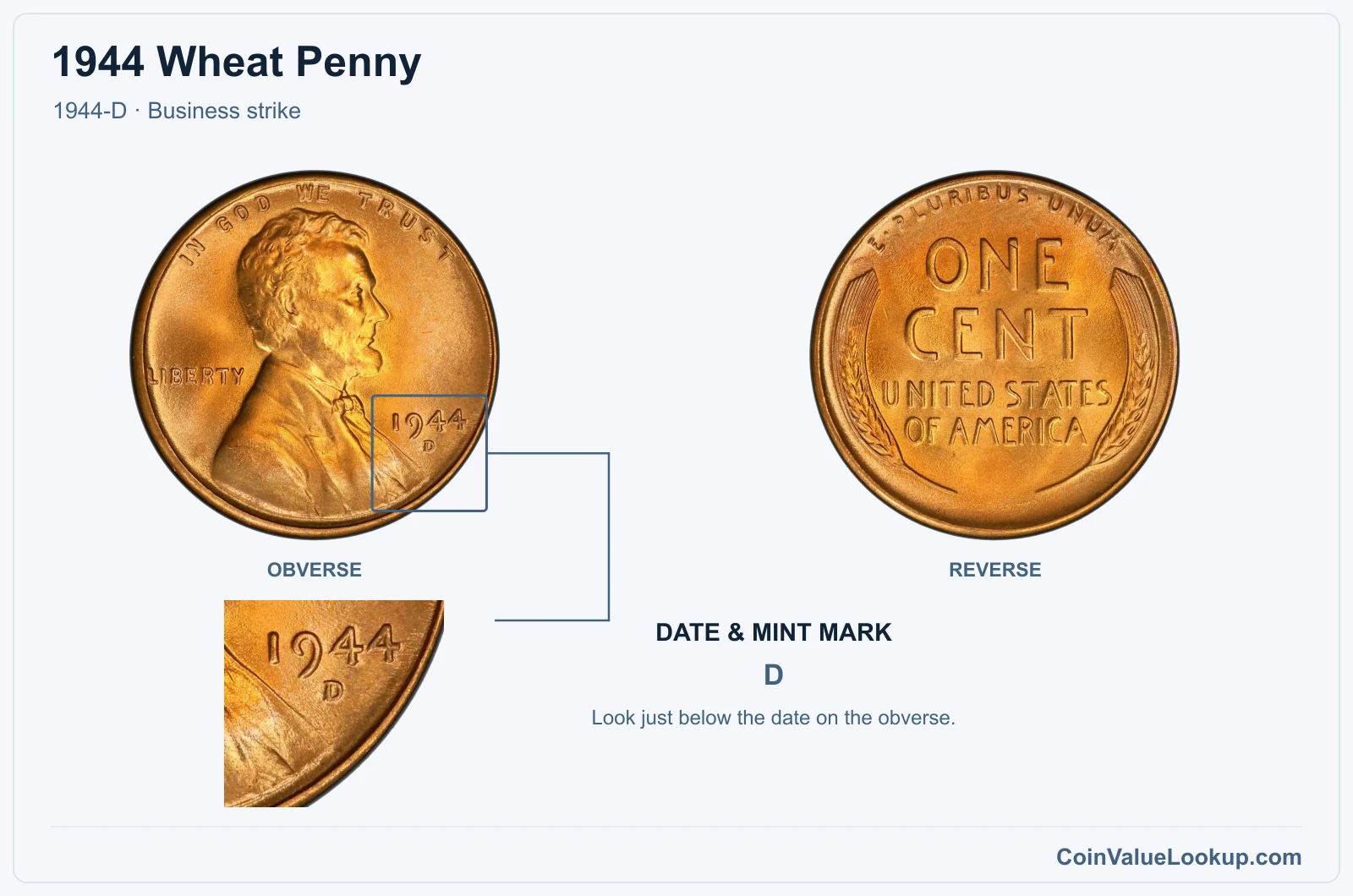
The 1944-D was struck at Denver and carries a small "D" mintmark below the date. Same shellcase brass composition, same 3.11-gram weight as the Philadelphia issue.
Fine-12 examples guide around $0.06, and MS63 reaches about $4.96. Like its Philadelphia sibling, color is not specified in these guide figures, so actual market prices for a certified red coin may differ.
Denver struck a huge run in 1944, so finding one is easy. Finding one with original surfaces and no marks is the real challenge.
Coin Value Lookup is a useful starting point if you want to check values across multiple dates and mints in the Lincoln Wheat cent series. It can save you a lot of flipping through printed guides.
| Range | Grade | Price | Auction Records | Appraisal |
|---|---|---|---|---|
| PO | PO 1 | — | Coin Identifier | |
| FR | FR 2 | — | Coin Identifier | |
| AG | AG 3 | — | Coin Identifier | |
| G | G 4 | — | Coin Identifier | |
| G 6 | — | Coin Identifier | ||
| VG | VG 8 | — | Coin Identifier | |
| VG 10 | — | Coin Identifier | ||
| F | F 12 | — | Coin Identifier | |
| F 15 | — | Coin Identifier | ||
| VF | VF 20 | — | Coin Identifier | |
| VF 25 | — | Coin Identifier | ||
| VF 30 | — | Coin Identifier | ||
| VF 35 | — | Coin Identifier | ||
| XF | XF 40 | — | Coin Identifier | |
| XF 45 | — | Coin Identifier | ||
| AU | AU 50 | — | Coin Identifier | |
| AU 53 | — | Coin Identifier | ||
| AU 55 | — | Coin Identifier | ||
| AU 58 | — | Coin Identifier | ||
| MS | MS 60 | — | Coin Identifier | |
| MS 61 | — | Coin Identifier | ||
| MS 62 | — | Coin Identifier | ||
| MS 63 | — | Coin Identifier | ||
| MS 64 | Coin Identifier | |||
| MS 65 | Coin Identifier | |||
| MS 66 | Coin Identifier | |||
| MS 67 | Coin Identifier | |||
| MS 68 | Coin Identifier | |||
| MS 69 | — | — | — | |
| MS 70 | — | — | — |
1944 Wheat Penny — D Steel
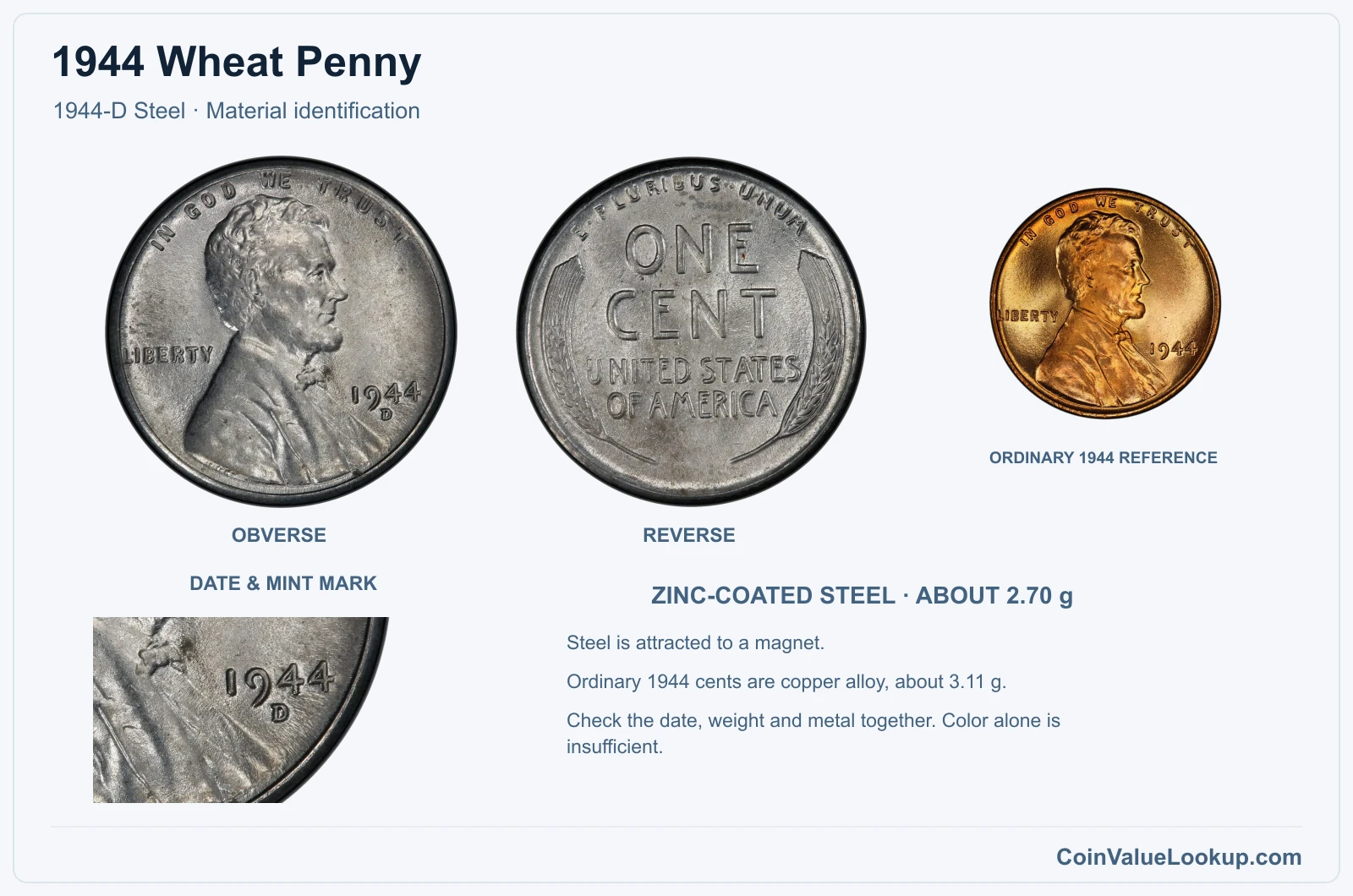
The 1944-D Steel cent is the Denver counterpart of the Philadelphia steel error, struck on a zinc-coated steel planchet instead of brass. It weighs about 2.70 grams and responds to a magnet.
The D mintmark should be clearly present below the date.
Authentication is essential. A plated brass cent or a coin with an altered date can fool the eye, but it will not fool a scale or a magnet together.
Even passing those screening tests does not guarantee authenticity on its own, so professional certification by a major grading service is the standard before any serious value discussion. No guide price range is adopted for this variety because each piece is assessed individually based on authenticated identity, condition and error severity.
| Range | Grade | Price | Auction Records | Appraisal |
|---|---|---|---|---|
| PO | PO 1 | — | Coin Identifier | |
| FR | FR 2 | — | Coin Identifier | |
| AG | AG 3 | — | Coin Identifier | |
| G | G 4 | — | Coin Identifier | |
| G 6 | — | Coin Identifier | ||
| VG | VG 8 | — | Coin Identifier | |
| VG 10 | — | Coin Identifier | ||
| F | F 12 | — | Coin Identifier | |
| F 15 | — | Coin Identifier | ||
| VF | VF 20 | — | Coin Identifier | |
| VF 25 | — | Coin Identifier | ||
| VF 30 | — | Coin Identifier | ||
| VF 35 | — | Coin Identifier | ||
| XF | XF 40 | — | Coin Identifier | |
| XF 45 | — | Coin Identifier | ||
| AU | AU 50 | — | Coin Identifier | |
| AU 53 | Coin Identifier | |||
| AU 55 | Coin Identifier | |||
| AU 58 | — | — | — | |
| MS | MS 60 | — | Coin Identifier | |
| MS 61 | — | Coin Identifier | ||
| MS 62 | Coin Identifier | |||
| MS 63 | Coin Identifier | |||
| MS 64 | — | — | — | |
| MS 65 | — | — | — | |
| MS 66 | — | — | — | |
| MS 67 | — | — | — | |
| MS 68 | — | — | — | |
| MS 69 | — | — | — | |
| MS 70 | — | — | — |
1944 Wheat Penny — D/S
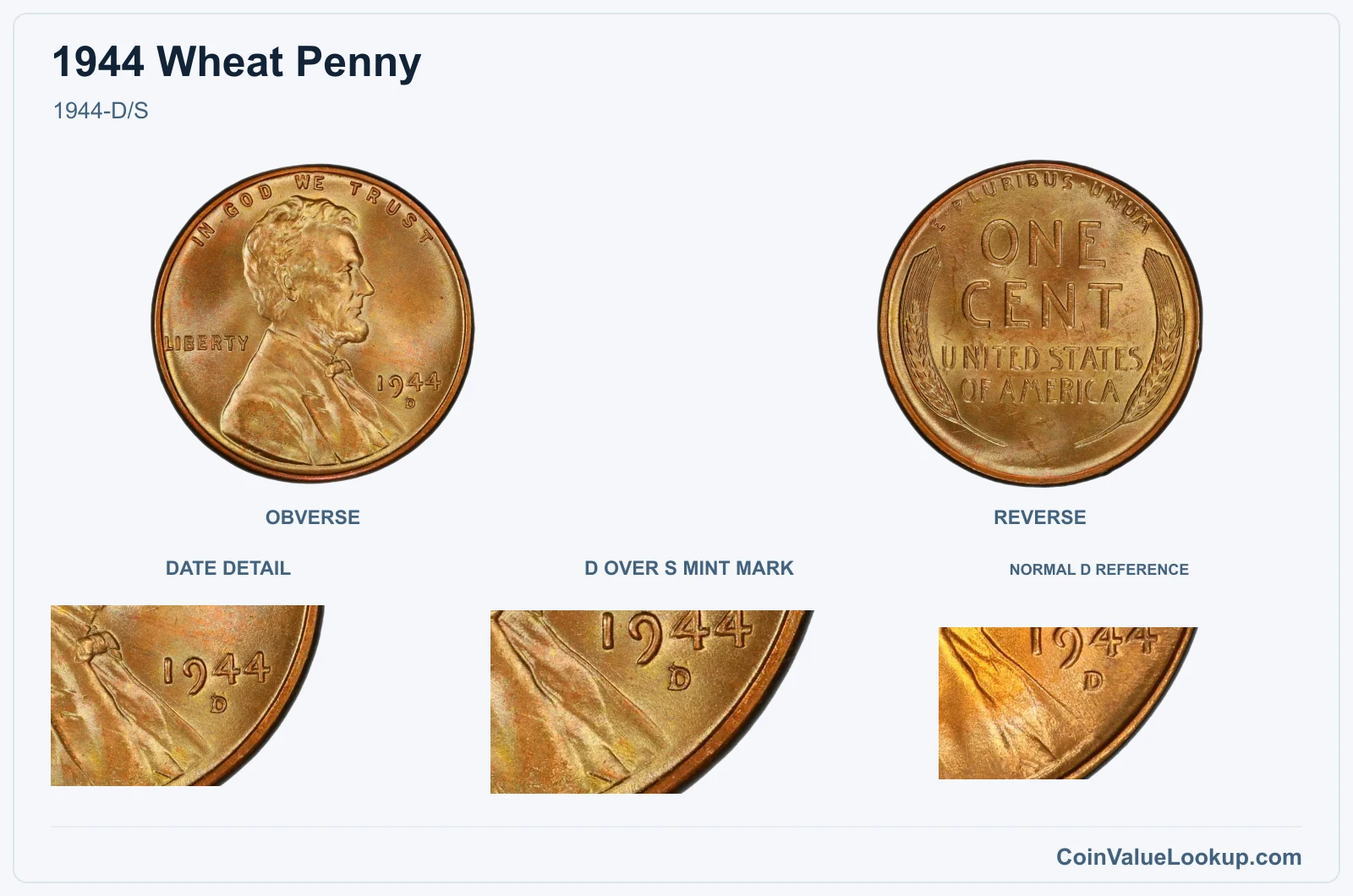
The 1944-D/S is a Denver cent where the mintmark punch shows clear remnants of an underlying "S" beneath the final "D." This happened when a die originally intended for San Francisco was repunched with a Denver mintmark. Under magnification, traces of the curved S are visible around the lower portion of the D.
This is a genuinely scarce variety. Guide estimates run from about $61 in G4 to $860 in MS63 per USA Coin Book.
Even well-worn examples carry a meaningful premium over a normal 1944-D. Do not confuse this with a simple repunched mintmark where a D was punched twice; the diagnostic here is the presence of a different letter entirely.
Careful comparison with known examples or high-resolution reference images is the way to confirm it before seeking professional attribution.
| Range | Grade | Price | Auction Records | Appraisal |
|---|---|---|---|---|
| PO | PO 1 | — | Coin Identifier | |
| FR | FR 2 | — | Coin Identifier | |
| AG | AG 3 | — | Coin Identifier | |
| G | G 4 | — | Coin Identifier | |
| G 6 | — | Coin Identifier | ||
| VG | VG 8 | — | Coin Identifier | |
| VG 10 | — | Coin Identifier | ||
| F | F 12 | — | Coin Identifier | |
| F 15 | — | Coin Identifier | ||
| VF | VF 20 | — | Coin Identifier | |
| VF 25 | — | Coin Identifier | ||
| VF 30 | Coin Identifier | |||
| VF 35 | Coin Identifier | |||
| XF | XF 40 | Coin Identifier | ||
| XF 45 | Coin Identifier | |||
| AU | AU 50 | Coin Identifier | ||
| AU 53 | Coin Identifier | |||
| AU 55 | Coin Identifier | |||
| AU 58 | Coin Identifier | |||
| MS | MS 60 | — | Coin Identifier | |
| MS 61 | Coin Identifier | |||
| MS 62 | Coin Identifier | |||
| MS 63 | Coin Identifier | |||
| MS 64 | Coin Identifier | |||
| MS 65 | Coin Identifier | |||
| MS 66 | — | Coin Identifier | ||
| MS 67 | — | — | — | |
| MS 68 | — | — | — | |
| MS 69 | — | — | — | |
| MS 70 | — | — | — |
1944 Wheat Penny — S
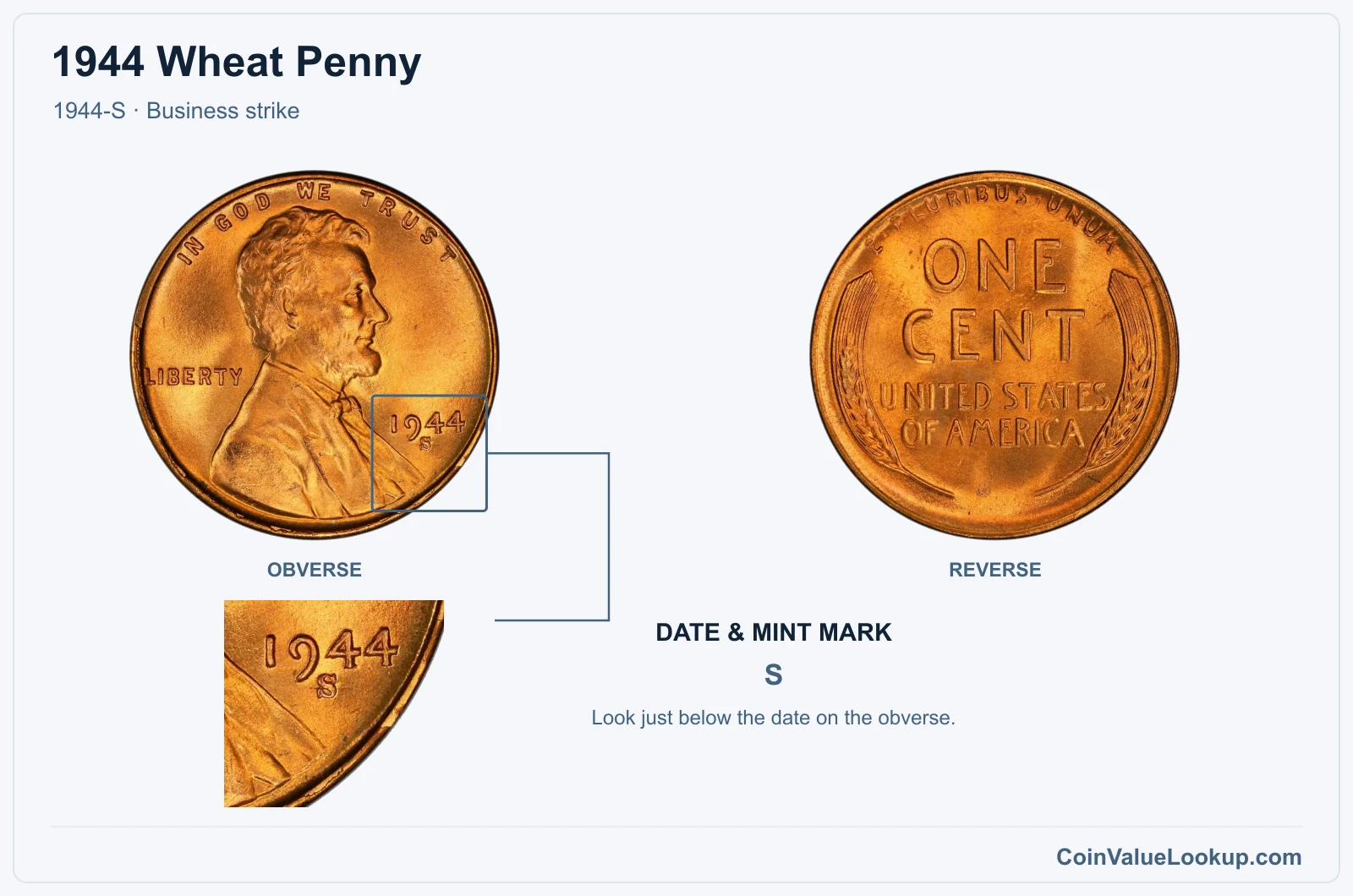
The 1944-S comes from San Francisco with a small "S" mintmark below the date. Same shellcase brass, same 3.11-gram weight.
Fine-12 guides at about $0.12, roughly double the Philadelphia and Denver issues at the same grade. MS63 comes in around $4.96.
San Francisco cents from this era can sometimes show softer strikes, so do not automatically downgrade a coin that looks slightly mushy in the hair detail. Check overall luster first.
Original surfaces with no cleaning or corrosion make the biggest difference once you are past the lower circulated grades.
| Range | Grade | Price | Auction Records | Appraisal |
|---|---|---|---|---|
| PO | PO 1 | — | Coin Identifier | |
| FR | FR 2 | — | Coin Identifier | |
| AG | AG 3 | — | Coin Identifier | |
| G | G 4 | — | Coin Identifier | |
| G 6 | — | Coin Identifier | ||
| VG | VG 8 | — | Coin Identifier | |
| VG 10 | — | Coin Identifier | ||
| F | F 12 | — | Coin Identifier | |
| F 15 | — | Coin Identifier | ||
| VF | VF 20 | — | Coin Identifier | |
| VF 25 | — | Coin Identifier | ||
| VF 30 | — | Coin Identifier | ||
| VF 35 | — | Coin Identifier | ||
| XF | XF 40 | — | Coin Identifier | |
| XF 45 | — | Coin Identifier | ||
| AU | AU 50 | — | Coin Identifier | |
| AU 53 | — | Coin Identifier | ||
| AU 55 | — | Coin Identifier | ||
| AU 58 | — | Coin Identifier | ||
| MS | MS 60 | — | Coin Identifier | |
| MS 61 | — | Coin Identifier | ||
| MS 62 | — | Coin Identifier | ||
| MS 63 | Coin Identifier | |||
| MS 64 | Coin Identifier | |||
| MS 65 | Coin Identifier | |||
| MS 66 | Coin Identifier | |||
| MS 67 | Coin Identifier | |||
| MS 68 | — | — | — | |
| MS 69 | — | — | — | |
| MS 70 | — | — | — |
1944 Wheat Penny — S Steel
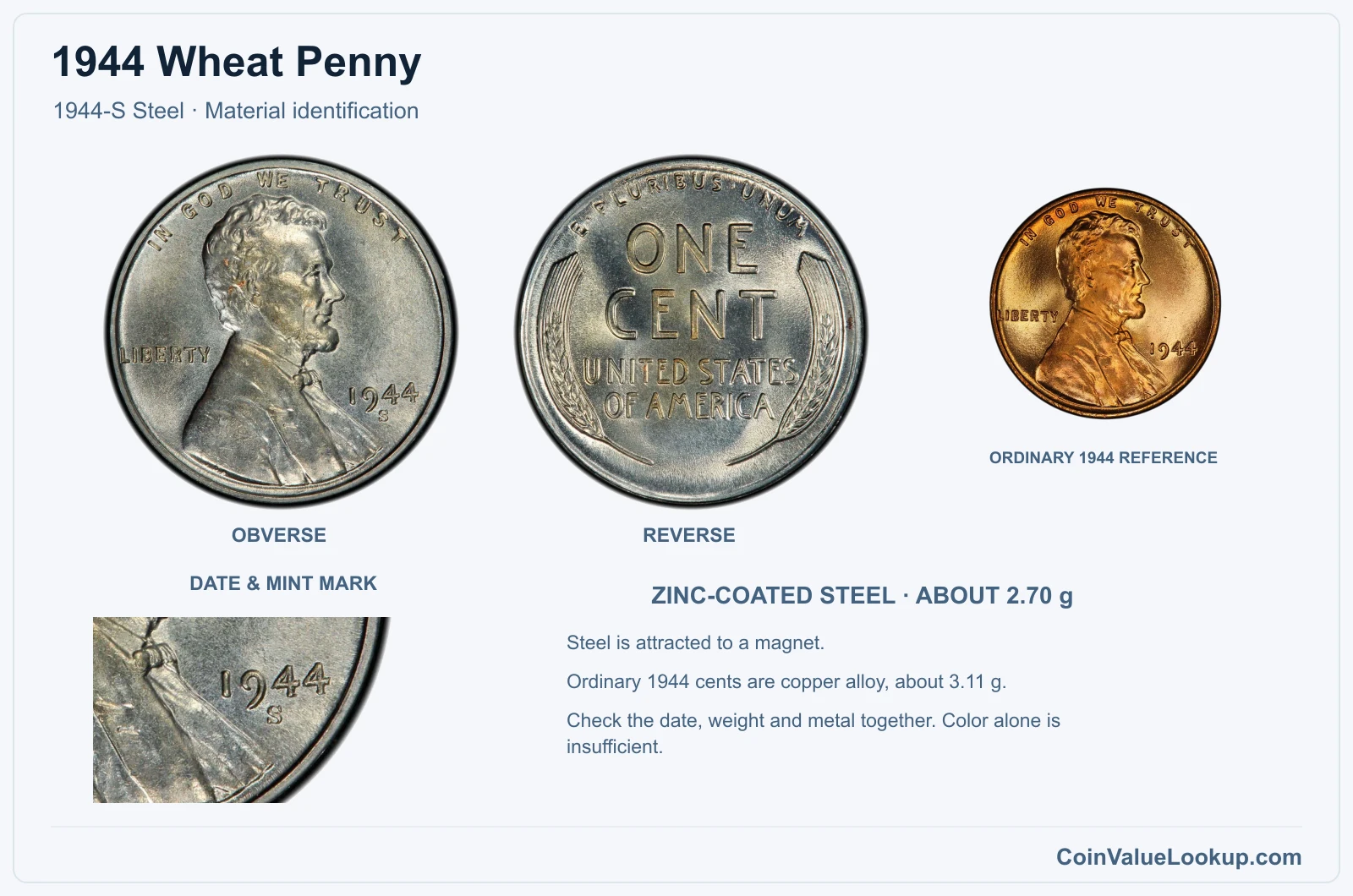
The 1944-S Steel cent is San Francisco's version of the wrong-metal error. Like the Philadelphia and Denver steel cents, it was struck on a zinc-coated steel planchet, weighs about 2.70 grams and is magnetic.
The S mintmark should be visible below the date.
Fakes and lookalikes are common. A brass cent that has been plated to look silvery will still weigh 3.11 grams and will not stick to a magnet.
An altered 1943 steel cent with a modified date is another trap. Both the weight and magnet tests should be your first steps, but passing them is not enough.
Third-party authentication is required before any confident identification. No specific price range is adopted here; each authenticated example is evaluated individually based on condition and confirmed identity.
| Range | Grade | Price | Auction Records | Appraisal |
|---|---|---|---|---|
| PO | PO 1 | — | Coin Identifier | |
| FR | FR 2 | — | Coin Identifier | |
| AG | AG 3 | — | Coin Identifier | |
| G | G 4 | — | Coin Identifier | |
| G 6 | — | Coin Identifier | ||
| VG | VG 8 | — | Coin Identifier | |
| VG 10 | — | Coin Identifier | ||
| F | F 12 | — | Coin Identifier | |
| F 15 | — | Coin Identifier | ||
| VF | VF 20 | — | Coin Identifier | |
| VF 25 | — | Coin Identifier | ||
| VF 30 | — | Coin Identifier | ||
| VF 35 | — | Coin Identifier | ||
| XF | XF 40 | — | Coin Identifier | |
| XF 45 | — | Coin Identifier | ||
| AU | AU 50 | — | Coin Identifier | |
| AU 53 | — | Coin Identifier | ||
| AU 55 | — | Coin Identifier | ||
| AU 58 | — | Coin Identifier | ||
| MS | MS 60 | — | Coin Identifier | |
| MS 61 | — | Coin Identifier | ||
| MS 62 | — | Coin Identifier | ||
| MS 63 | — | Coin Identifier | ||
| MS 64 | — | Coin Identifier | ||
| MS 65 | — | Coin Identifier | ||
| MS 66 | Coin Identifier | |||
| MS 67 | — | — | — | |
| MS 68 | — | — | — | |
| MS 69 | — | — | — | |
| MS 70 | — | — | — |
1944 Wheat Penny Error List
1. 1944 Wheat Penny — Doubled Die Obverse
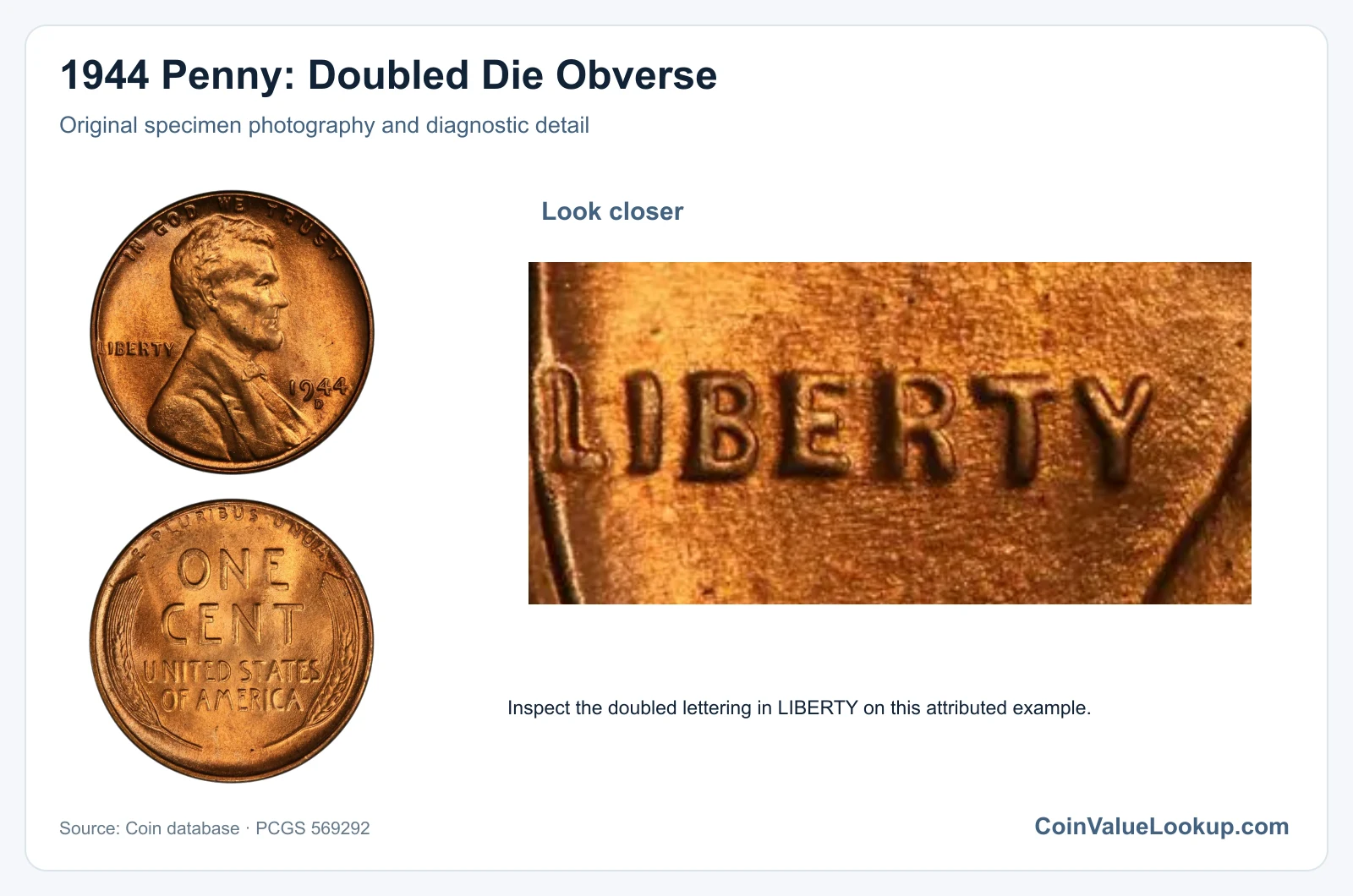
A doubled die obverse on a 1944 Wheat cent shows consistent doubling in the obverse lettering or design elements. The key diagnostic is separation or notching that repeats in the same direction across multiple letters or features.
This is a die-manufacturing error, not something that happened after the coin left the press.
The most common lookalike is machine doubling, which produces a flat, shelf-like distortion rather than the raised, rounded separation of a true doubled die. Worn dies and odd lighting angles can also create illusions.
Compare your coin to a normal 1944 cent under matching magnification and lighting. No specific price range is adopted for this category; each example would need individual assessment based on the strength of the doubling and the coin's authenticated condition.
2. 1944 Wheat Penny — Over-Mintmark
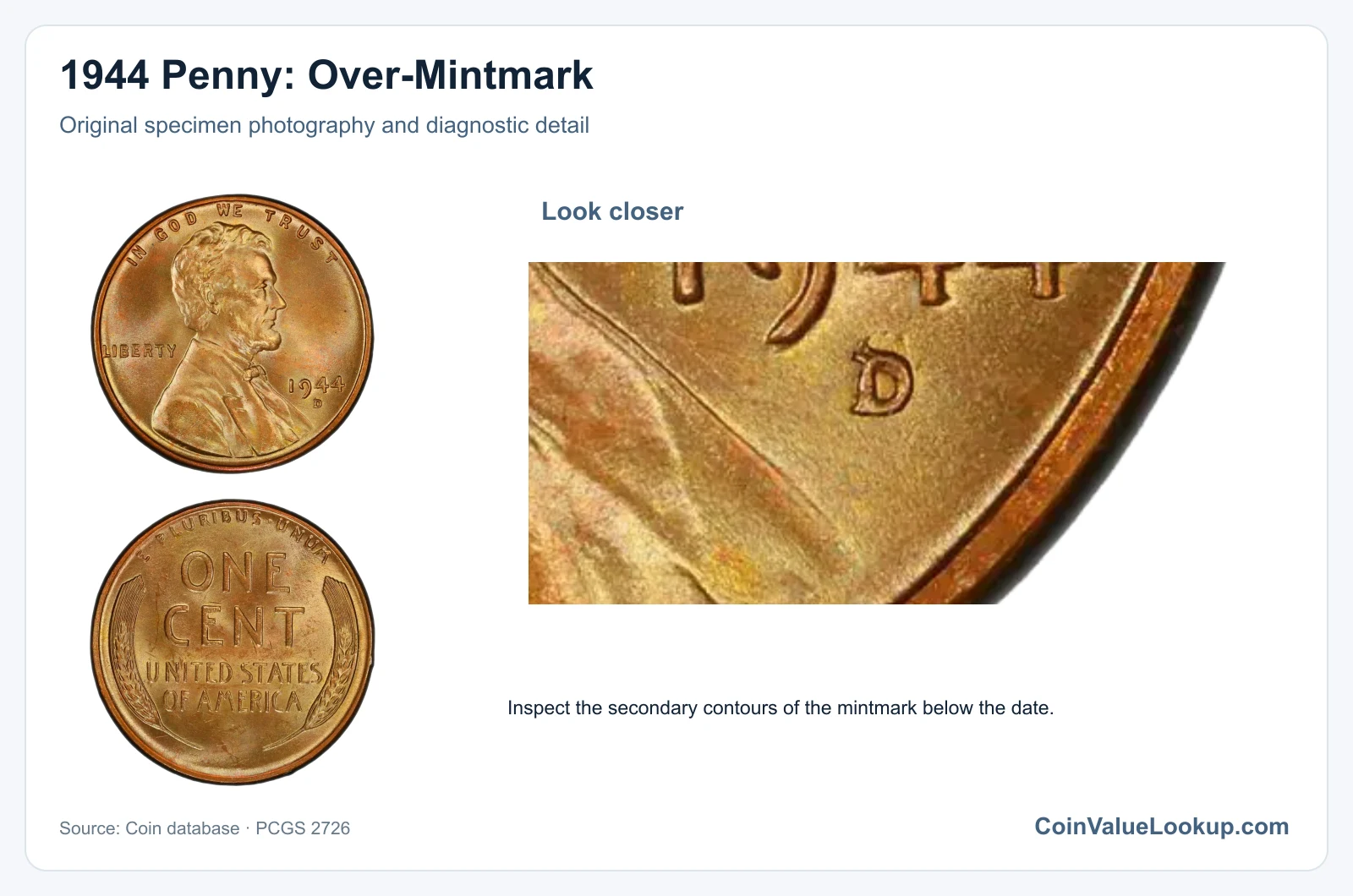
An over-mintmark on a 1944 cent means the final mintmark was punched over a different letter on the working die. The 1944-D/S variety, where a D was punched over an S, is the most recognized example from this year and is listed as a separate version above.
To identify any over-mintmark, look for traces of a different letter beneath or around the edges of the primary mintmark. This requires magnification and a known genuine comparison.
A repunched mintmark, where the same letter was struck twice in slightly different positions, is not the same thing. Die chips and corrosion near the mintmark can also create confusing shapes.
No general price range is adopted for this error category; value depends on which specific over-mintmark it is, its authentication and the coin's condition.
3. 1944 Wheat Penny — Repunched Mintmark
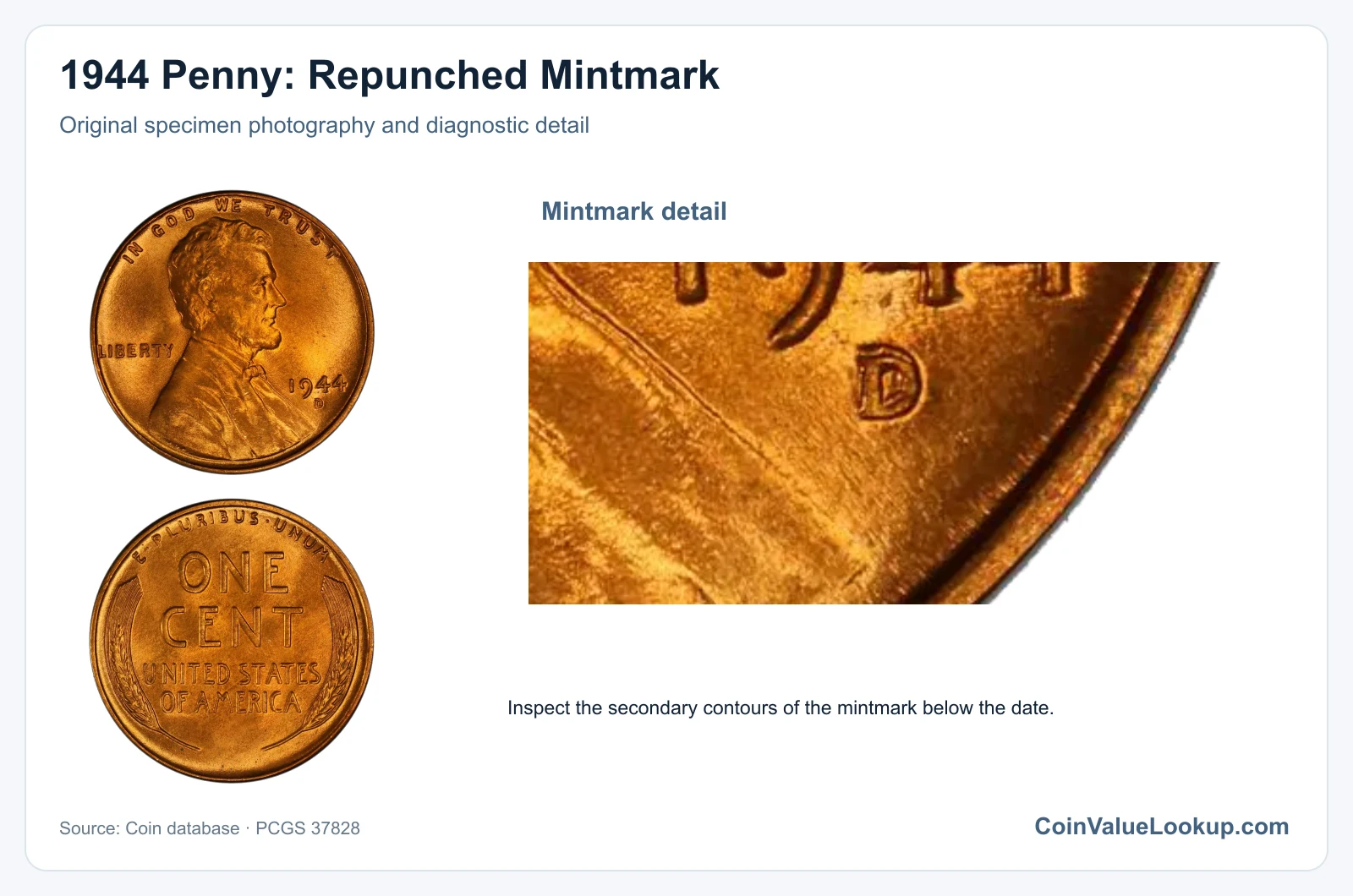
A repunched mintmark on a 1944 cent appears when the same mintmark letter was punched into the die more than once in slightly different positions. This applies only to Denver (D) and San Francisco (S) issues, since Philadelphia coins carry no mintmark.
Look for a ghost image, partial extra serif or slight offset shadow of the same letter near the primary mintmark. Compare at magnification against a normal mintmark from the same mint and year.
Machine doubling creates a flat shelf around the letter and is a different phenomenon. Die chips and corrosion near the mark can also mimic an extra punch.
No specific price range is adopted; each repunched mintmark variety is assessed individually based on the strength of the repunching, authentication and the coin's overall condition.
4. 1944 Wheat Penny — Wrong Planchet / Off-Metal Strike
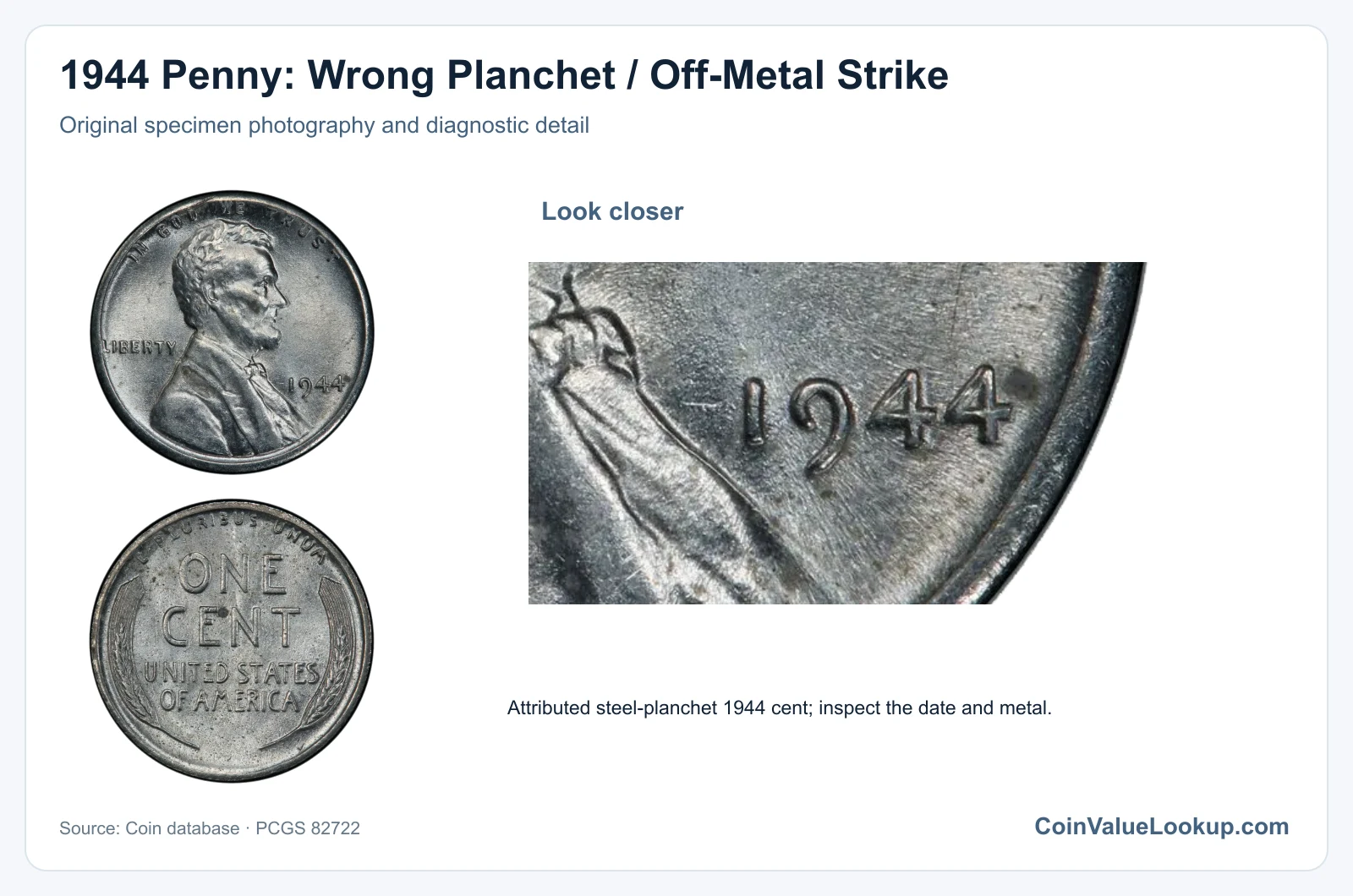
A wrong-planchet 1944 cent was struck on metal not intended for that year's production. The best-known example is the 1944 steel cent, struck on leftover zinc-coated steel planchets from 1943.
These weigh about 2.70 grams and stick to a magnet, while normal 1944 brass cents weigh 3.11 grams and are non-magnetic.
Both tests together are your first screen. A silvery appearance alone means nothing; brass cents can be plated after the fact, and altered dates from 1943 steel cents or 1948 cents are well-documented fakes.
If your coin passes the weight and magnet checks, professional authentication is the next step. No price range is adopted here because each authenticated wrong-planchet coin is assessed individually based on its confirmed identity, mint, condition and the nature of the error.
5. 1944 Wheat Penny — Off-Center Strike
An off-center strike happens when the planchet is not properly seated between the dies. The result is a displaced design with an unstruck crescent of blank metal on one side.
The percentage of off-center displacement and whether the date remains visible are the two biggest factors collectors care about.
A coin that is 10-15% off-center with a full date is generally more collectible than one that is 50% off-center with the date missing. Do not confuse an off-center strike with a clipped planchet or one-sided die misalignment.
Post-mint damage from a vise or hammer can flatten one side but will not produce a clean, unstruck crescent. No specific price range is adopted; each off-center 1944 cent is evaluated individually by the degree of displacement, date visibility, authentication and overall condition.
6. 1944 Wheat Penny — Clipped Planchet
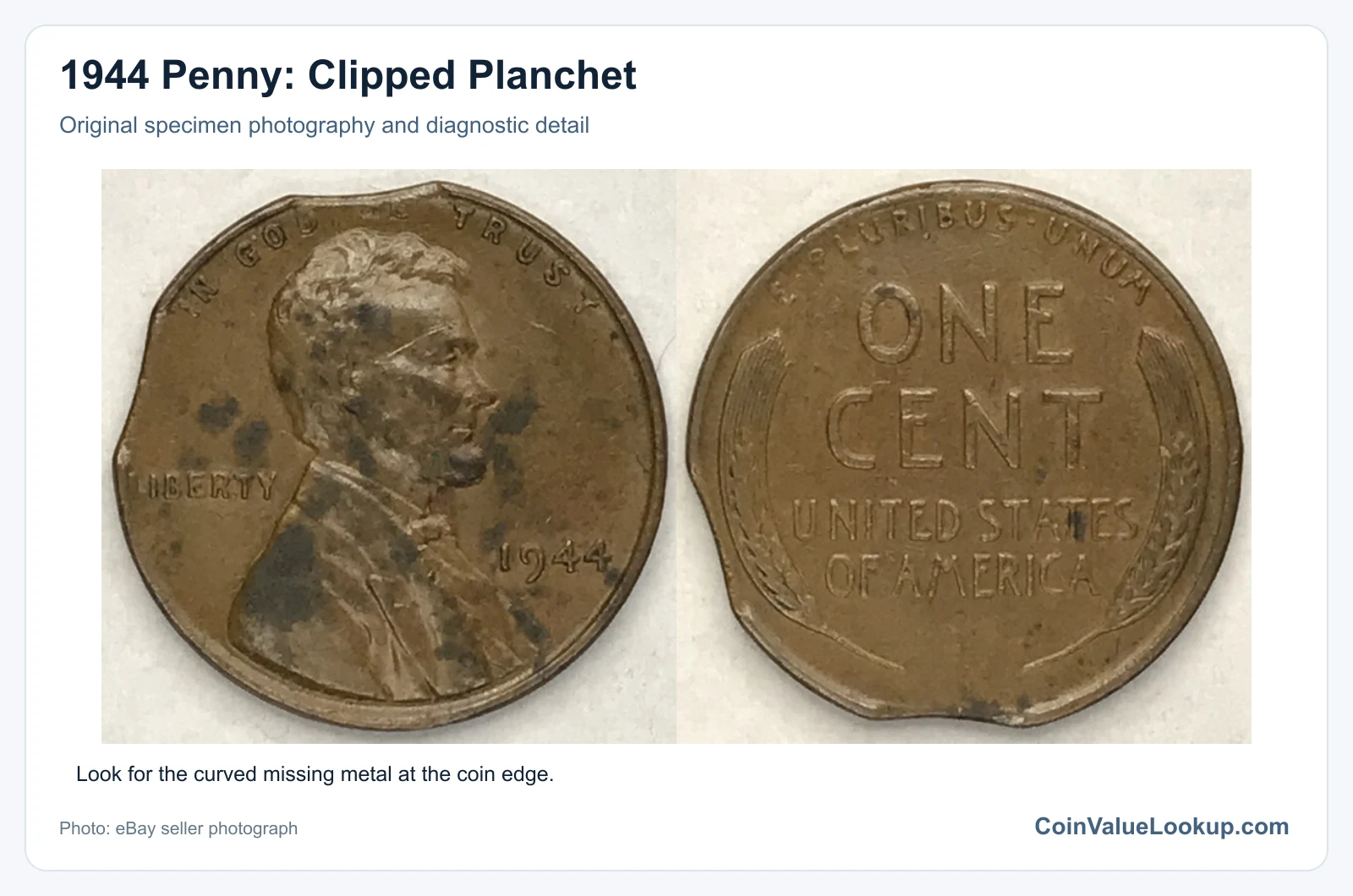
A clipped planchet error occurs when the blank was incompletely punched from the metal strip before striking. The result is a missing curved, straight or irregularly shaped section of the coin's edge.
Genuine clips often produce a corresponding area of design weakness on the opposite side of the coin, because the metal could not flow evenly during the strike.
Check the edge texture carefully. A real clip shows the natural metal flow of the original blank, not a sharp filed edge or corrosion pit.
Post-mint damage from cutting, filing or heavy corrosion can imitate a clip but will lack that characteristic opposite-side weakness. No price range is adopted for this category; value depends on the size and type of clip, whether the date is intact, authentication and the coin's overall condition.
7. 1944 Wheat Penny — Lamination / Split Planchet
A lamination error on a 1944 cent shows as peeling, flaking or separation within the shellcase brass alloy. You might see a retained metal flap, a sunken area where metal has lifted away, or actual splitting of the planchet into layers.
Impurities or gas trapped in the alloy during rolling are the usual culprit.
Photograph the edge and the affected face together when documenting a suspected lamination. This helps distinguish it from post-mint scraping, corrosion or deliberate cutting.
Genuine laminations follow the metal's grain and often have irregular, organic-looking edges rather than straight cuts. No specific price range is adopted for lamination errors on 1944 cents; each piece is individually assessed based on the severity and visual impact of the flaw, authentication and overall condition.