1970 Lincoln Penny Coin Value: How Much Is It Worth?
Most 1970 Lincoln pennies you pull from a jar are worth a modest amount, often close to face value in circulated condition. A USA Coin Book guide estimate places an ordinary 1970 penny at about $1.24 in MS65 grade.
The real action starts with the 1970-S Small Date, which carries guide estimates of $69 in MS65 for business strikes and $50 in PR65 for proofs. Authenticated error coins, particularly the major 1970-S Large Date Doubled Die Obverse, require individual assessment and can command serious money.
Fast Way to Identify Your 1970 Lincoln Penny
Snap a clear photo of both the front and back of your 1970 penny and upload them to our identifier. It can help with preliminary identification of your coin's mint mark, date style and general condition from those two images.
This is not a substitute for professional authentication or grading, but it gives you a solid starting point before deciding whether deeper evaluation is worthwhile.
1970 Penny Value
Upload both sides of your 1970 Lincoln Penny.
Front Obverse
Upload photo
Back Reverse
Upload photo
Which 1970 Lincoln Penny Versions Are Worth Money?
- 1970-S Small Date business strikes carry a USA Coin Book guide estimate of $69 in MS65, far above other 1970 branches at the same grade.
- 1970-S Small Date proofs are estimated at $50 in PR65, versus $1.24 for the Large Date proof.
- The 1970-S Large Date Doubled Die Obverse (business strike) with major motto and LIBERTY doubling requires individual assessment and professional authentication; do not confuse minor doubled-zero varieties with this coin.
- A 1970-D flipover triple saddle strike sold for $1,322.50 in PCGS MS62 Red at a February 2007 Heritage auction, showing that dramatic mint errors on this date can bring strong prices.
Step 1: Identify Your 1970 Lincoln Penny Mint Mark and Version
Every 1970 Lincoln penny shows the Lincoln portrait on the obverse and the Lincoln Memorial on the reverse. The alloy is 95% copper and 5% zinc, weighing a nominal 3.11 grams with a plain edge.
These are not the copper-plated zinc cents that came later.
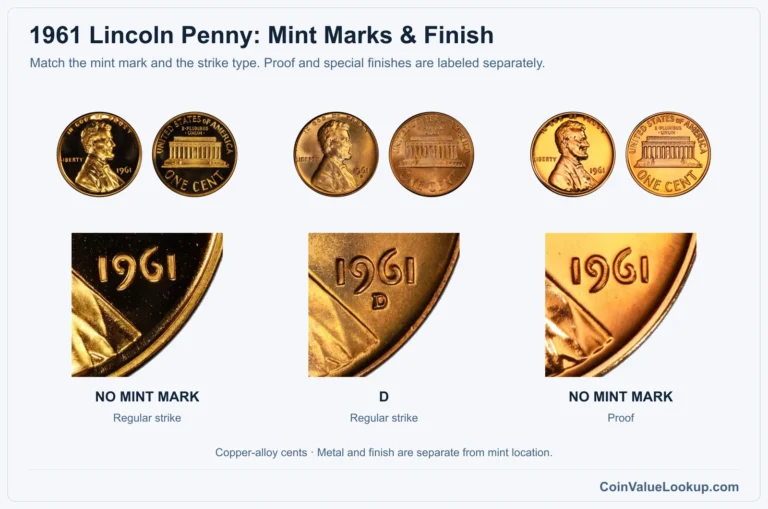
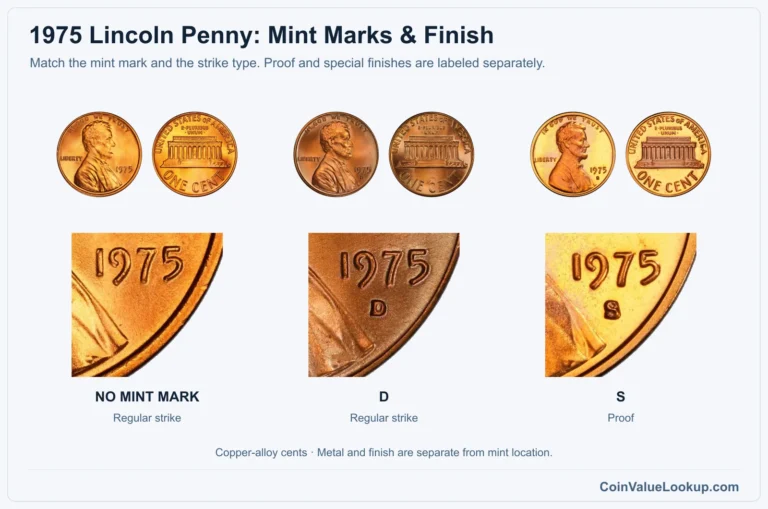
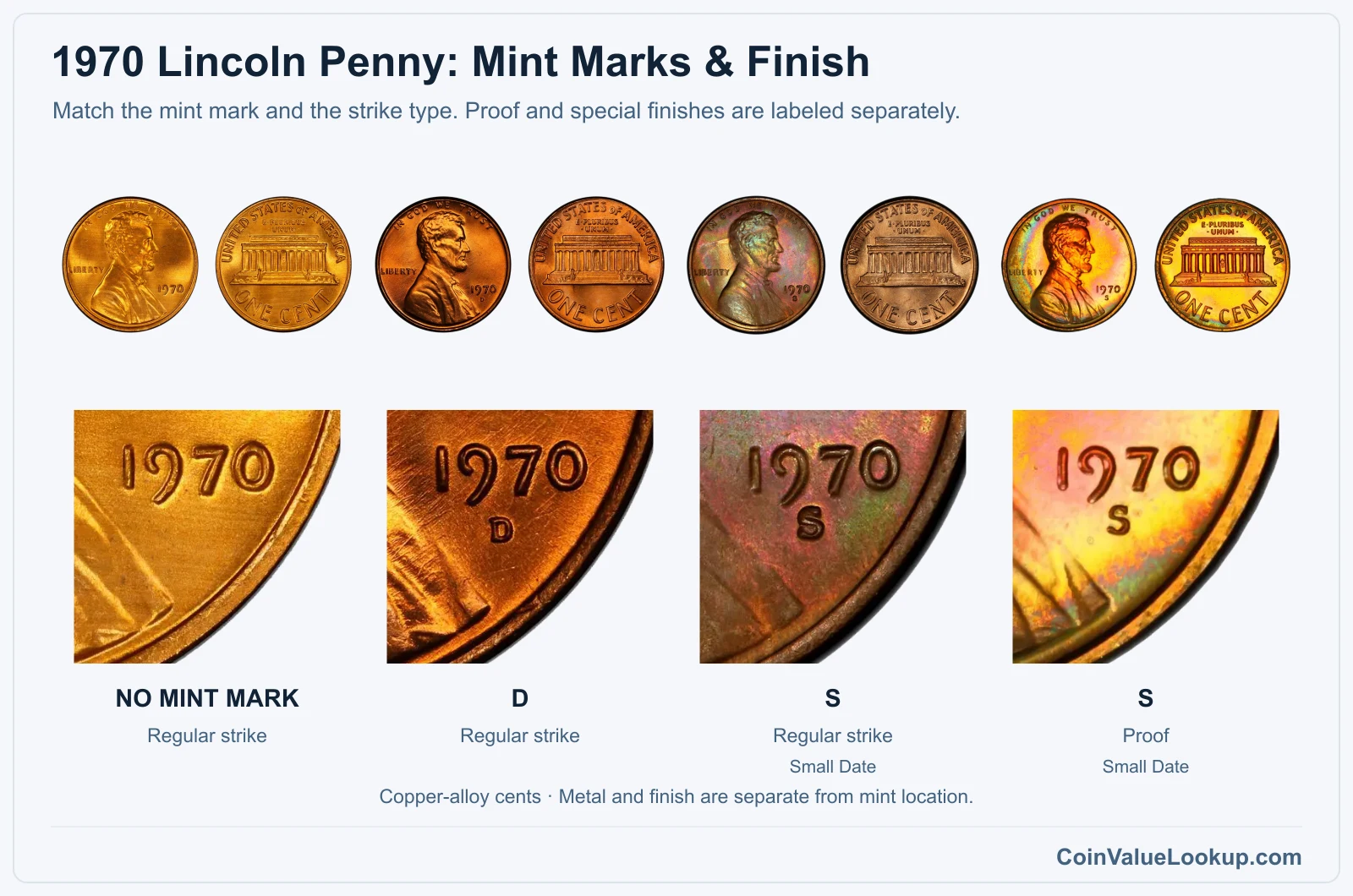
First, check for a mint mark below the date. No letter means the coin is cataloged in the Philadelphia branch.
A "D" is Denver. An "S" is San Francisco, but S coins come in both business strike and proof versions, so you need to check surfaces too.
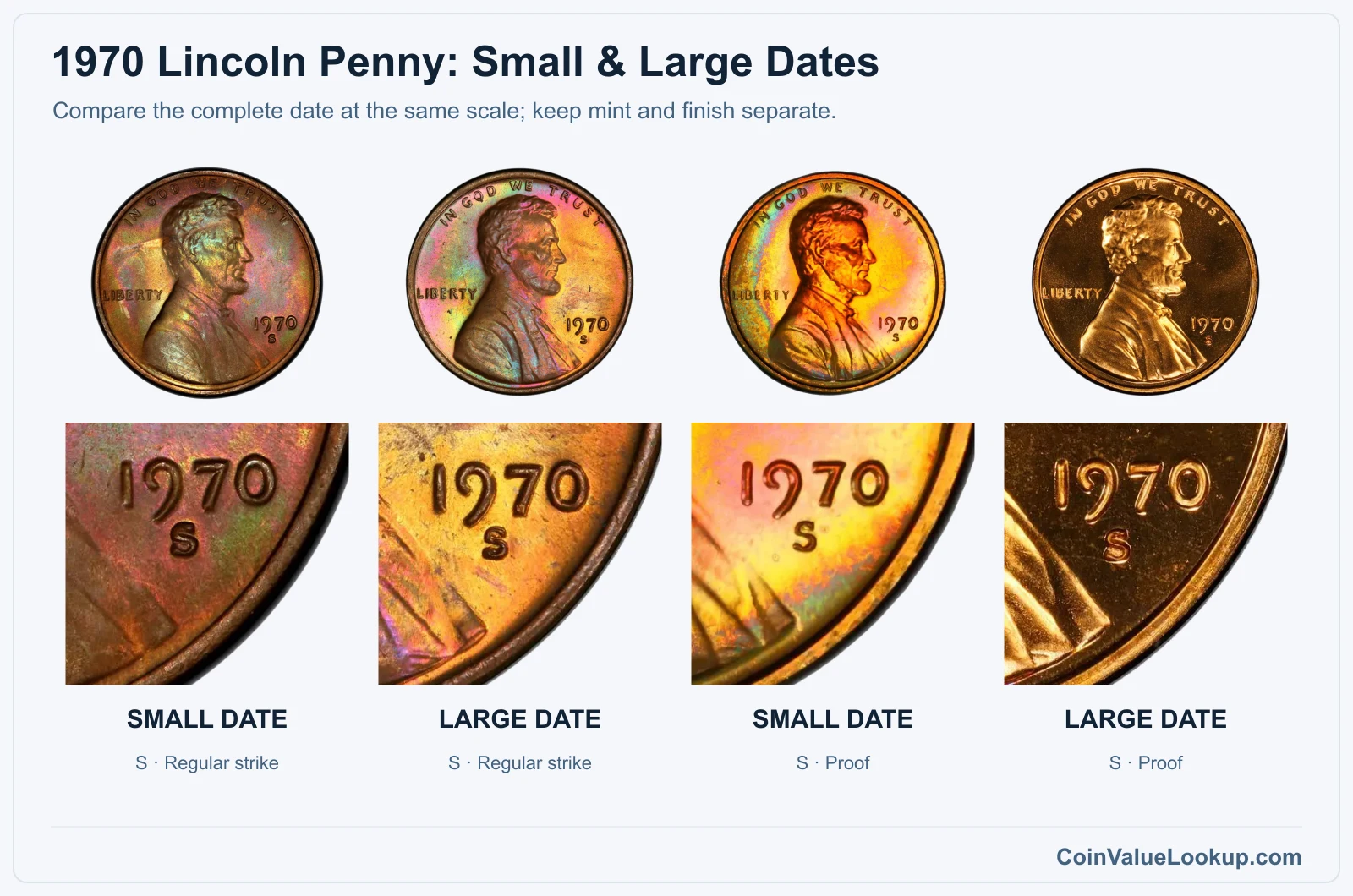
For S-mint coins, the critical question is date style. Small Date has a "7" whose top is roughly level with the neighboring digits, and LIBERTY often shows slight weakness.
Large Date has a noticeably lower "7." Do not rely on LIBERTY weakness alone to decide the date variety.
Both date styles exist as business strikes and proofs. A proof coin has mirror-like fields and sharp detail from the manufacturing process; it is a finish, not a higher grade.
Red, Red-Brown and Brown describe how much original copper color survives. They are preservation categories, not different metals.
Altered, plated or chemically cleaned coins are not errors. Bright copper is not automatically uncirculated; it may be cleaned.
Step 2: Check Your 1970 Lincoln Penny Grade
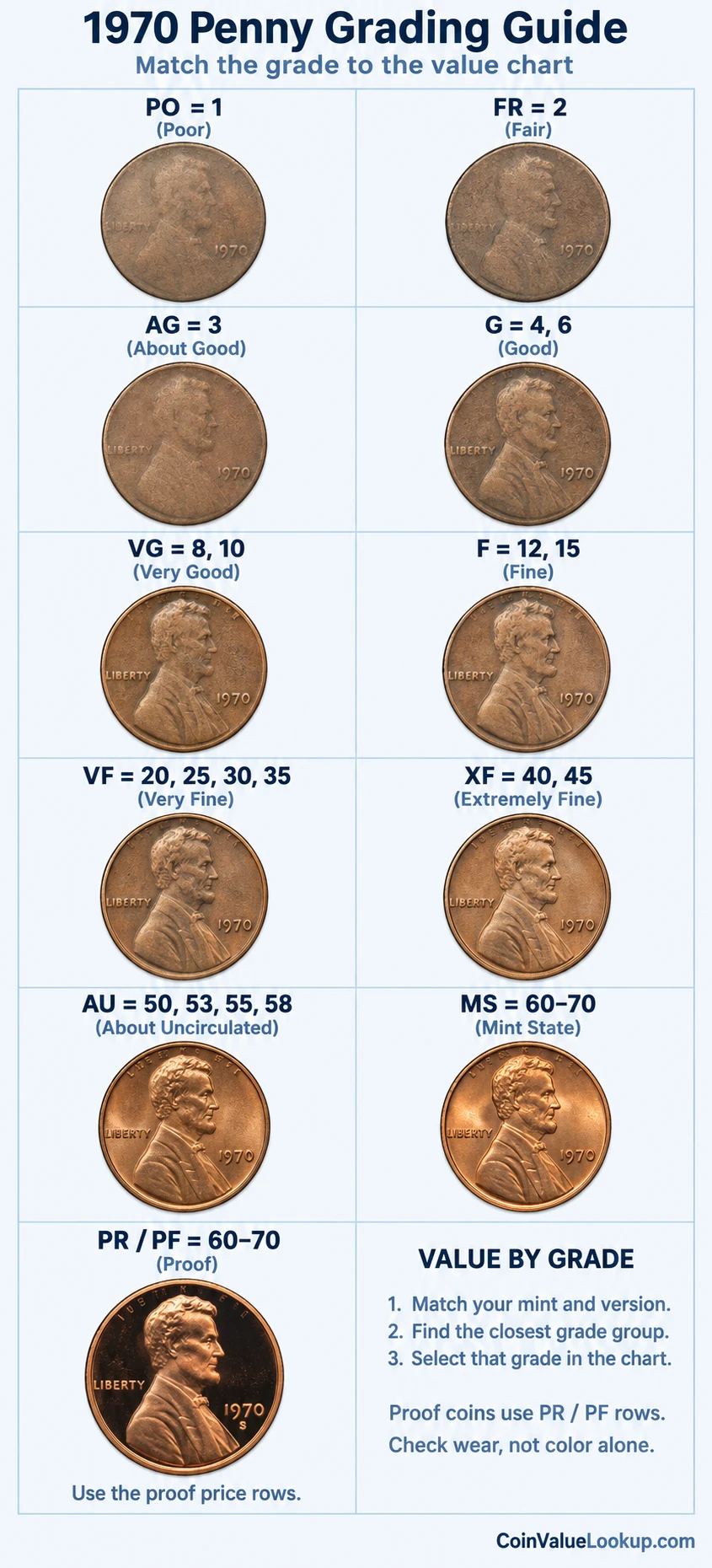
Start on the obverse. Lincoln's cheek, jawline and the hair detail above the ear show wear first.
On the reverse, look at the roof of the Memorial and the column details.
Separate contact marks from actual wear. A coin with full luster and a few bag marks is uncirculated; one with smooth, flat high points has been in circulation regardless of how it looks otherwise.
Dark copper can still be uncirculated. A suspiciously bright coin may have been cleaned, which hurts value.
Use the comparison image to match your coin's wear pattern against known grade examples. Pay attention to whether the copper color is original.
Red designation means most original color survives; Brown means it has toned significantly. Red-Brown sits between them.
Proof coins are graded on a separate scale. Look for hairlines from handling rather than circulation wear, and evaluate fields for haze or spots.
Step 3: Check 1970 Lincoln Penny Value by Mint and Version
1970 Lincoln Penny — No Mint Mark — Business
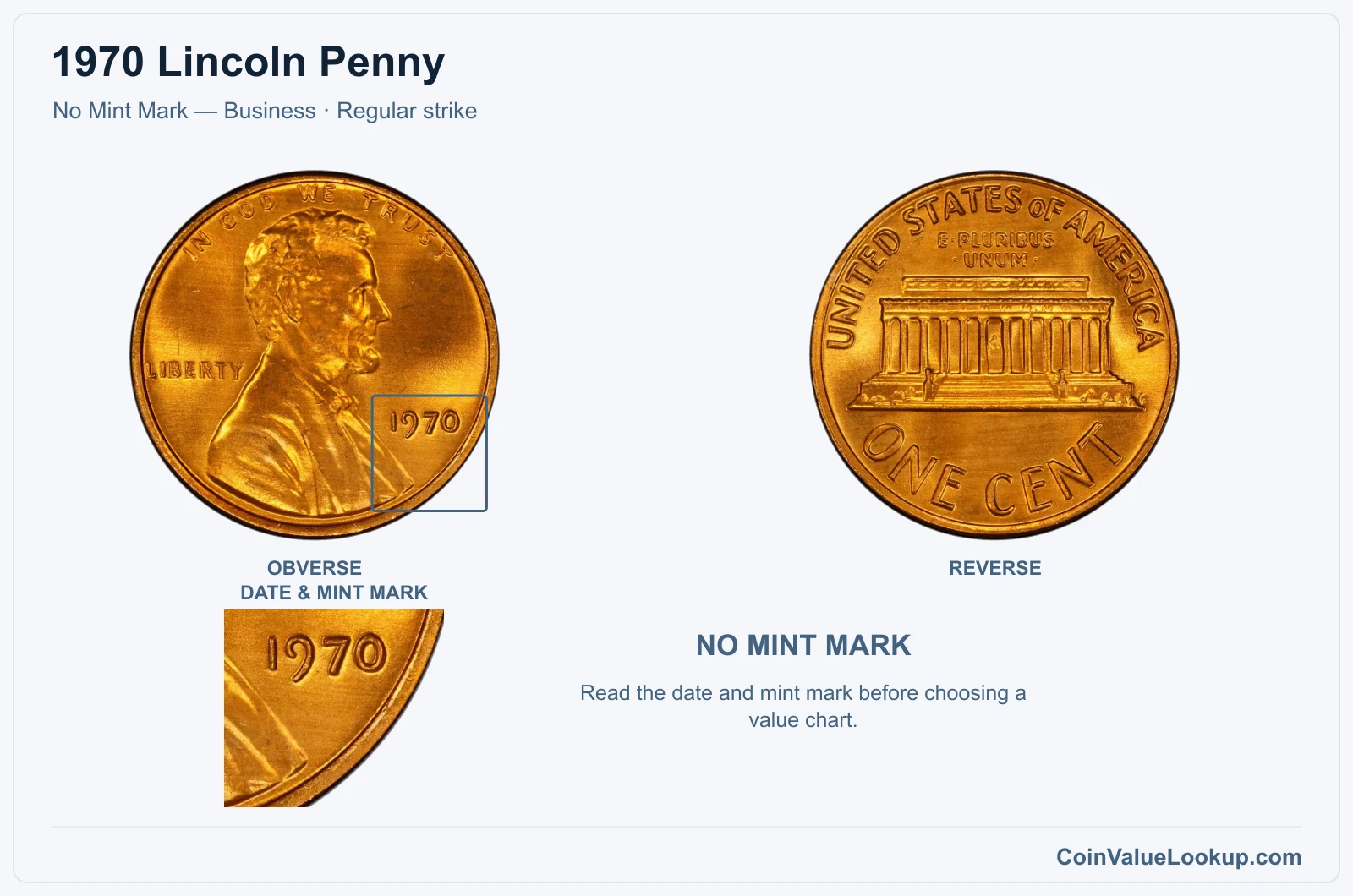
The no-mintmark 1970 penny is a standard Philadelphia-catalog business strike. Look below the date: if there is no letter at all, this is the branch you have.
A USA Coin Book guide estimate puts it at about $1.24 in MS65, which means a circulated example is worth very little above face value. Copper color matters at higher grades.
Full original Red commands more than a Brown-toned coin in the same technical grade, so note the color before comparing prices.
Range Grade
Price1970 No Mint Mark — Business (BN) Price1970 No Mint Mark — Business (RB) Price1970 No Mint Mark — Business (RD) Auction Records Appraisal PO PO 1
—
Coin Identifier FR FR 2
—
Coin Identifier AG AG 3
—
Coin Identifier G G 4
—
Coin Identifier
G 6
—
Coin Identifier VG VG 8
—
Coin Identifier
VG 10
—
Coin Identifier F F 12
—
Coin Identifier
F 15
—
Coin Identifier VF VF 20
—
Coin Identifier
VF 25
—
Coin Identifier
VF 30
—
Coin Identifier
VF 35
—
Coin Identifier XF XF 40
—
Coin Identifier
XF 45
—
Coin Identifier AU AU 50
—
Coin Identifier
AU 53
—
Coin Identifier
AU 55
—
Coin Identifier
AU 58
—
Coin Identifier MS MS 60
—
—
Coin Identifier
MS 61
—
Coin Identifier
MS 62
—
Coin Identifier
MS 63
Coin Identifier
MS 64
Coin Identifier
MS 65
Coin Identifier
MS 66
Coin Identifier
MS 67
—
—
Coin Identifier
MS 68
—
—
—
—
—
MS 69
—
—
—
—
—
MS 70
—
—
—
—
—
1970 Lincoln Penny — D — Business
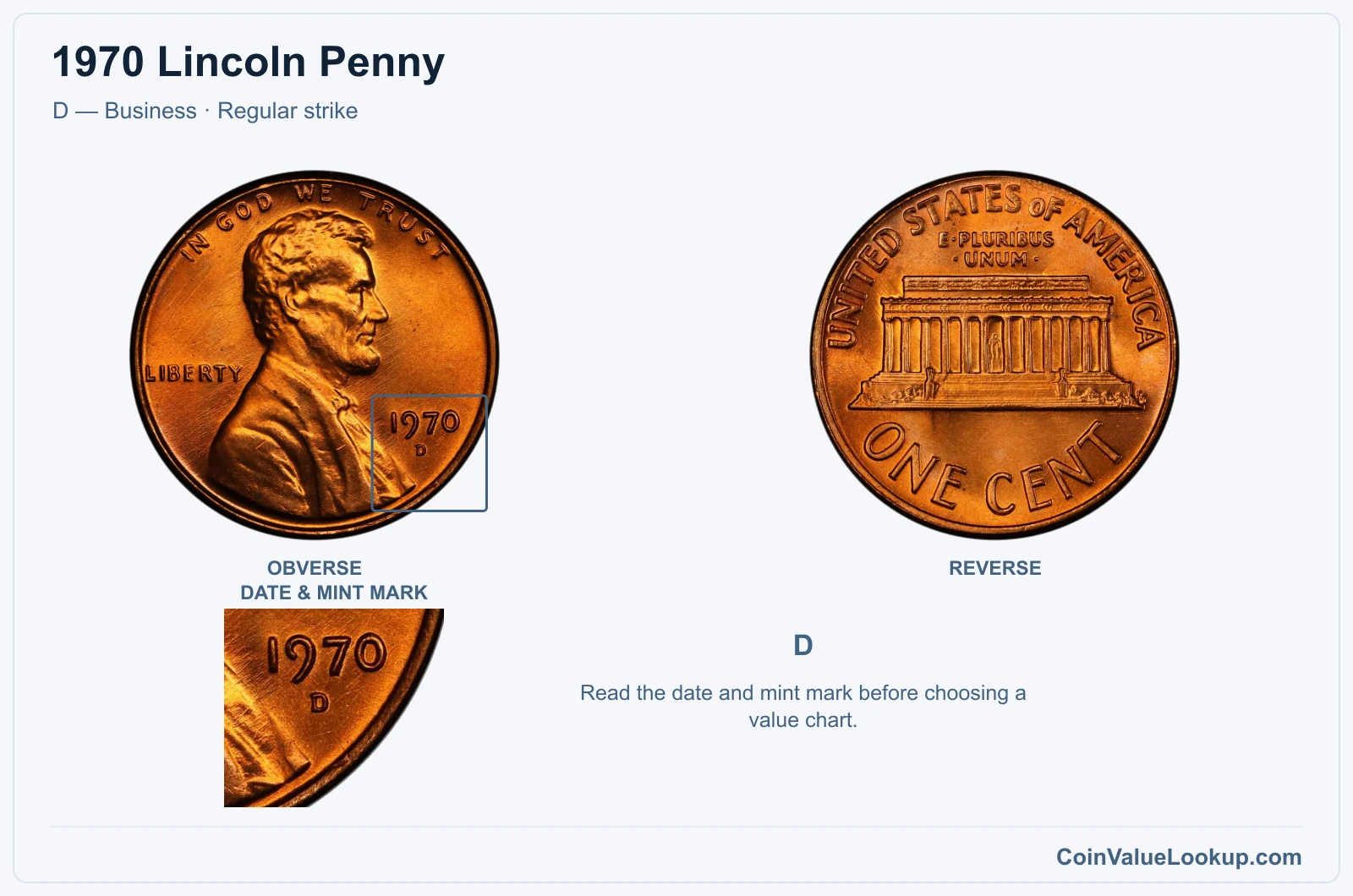
Denver struck 1970-D pennies in large numbers. The small "D" sits below the date on the obverse.
In MS65, the USA Coin Book guide estimate is about $1.24, the same as the no-mintmark issue. Most circulated examples are common.
If yours is uncirculated with strong original Red color, it has mild collector appeal, but this is not a scarce date. Grade and copper preservation are your main value levers here.
Range Grade
Price1970 D — Business (BN) Price1970 D — Business (RB) Price1970 D — Business (RD) Auction Records Appraisal PO PO 1
—
Coin Identifier FR FR 2
—
Coin Identifier AG AG 3
—
Coin Identifier G G 4
—
Coin Identifier
G 6
—
Coin Identifier VG VG 8
—
Coin Identifier
VG 10
—
Coin Identifier F F 12
—
Coin Identifier
F 15
—
Coin Identifier VF VF 20
—
—
Coin Identifier
VF 25
—
Coin Identifier
VF 30
—
Coin Identifier
VF 35
—
Coin Identifier XF XF 40
—
Coin Identifier
XF 45
—
Coin Identifier AU AU 50
—
Coin Identifier
AU 53
—
Coin Identifier
AU 55
—
Coin Identifier
AU 58
—
Coin Identifier MS MS 60
—
—
Coin Identifier
MS 61
—
—
Coin Identifier
MS 62
—
Coin Identifier
MS 63
—
Coin Identifier
MS 64
Coin Identifier
MS 65
Coin Identifier
MS 66
—
Coin Identifier
MS 67
—
—
Coin Identifier
MS 68
—
—
—
—
—
MS 69
—
—
—
—
—
MS 70
—
—
—
—
—
1970 Lincoln Penny — S — Small Date Business
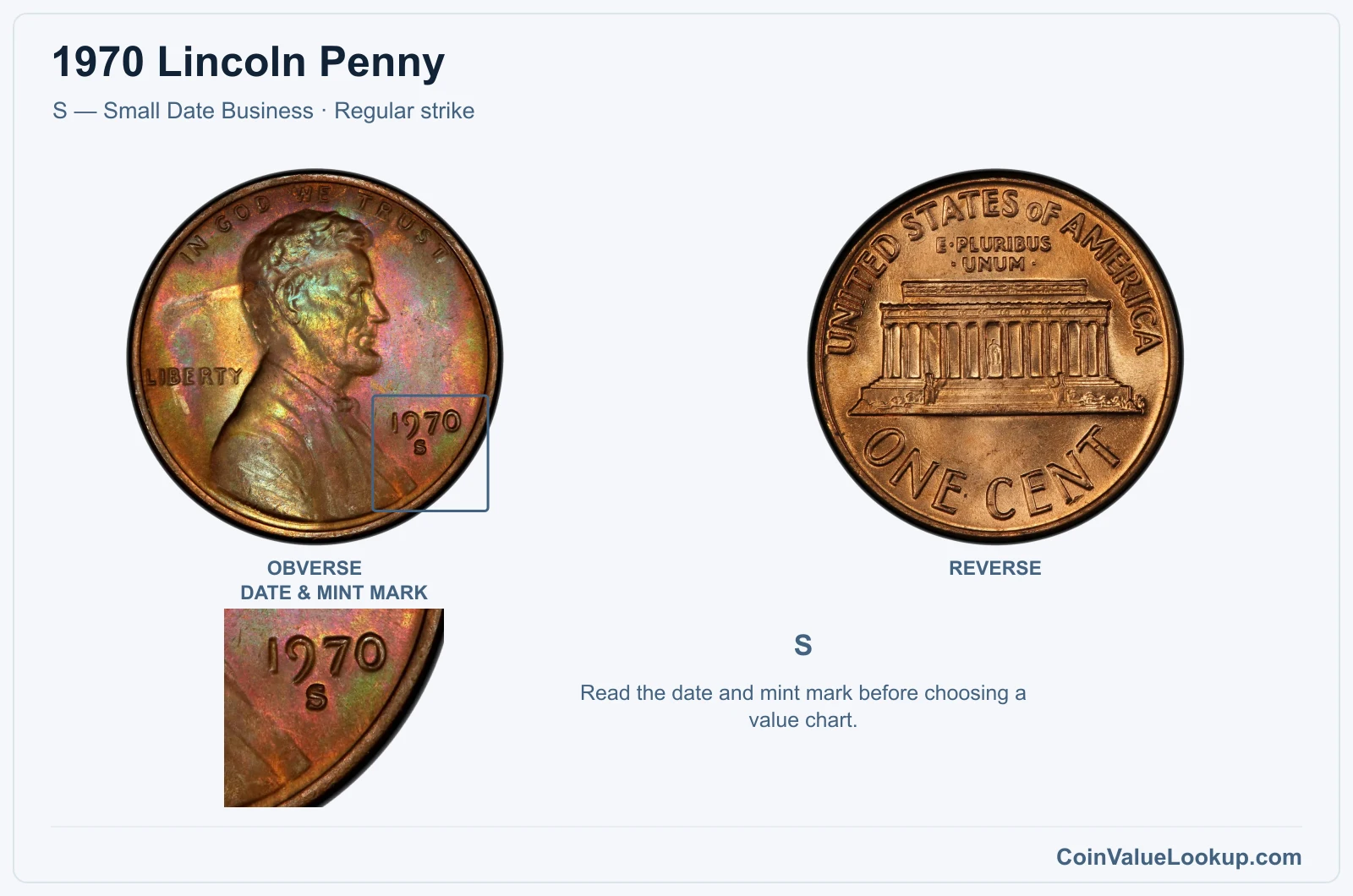
This is the one to look for. The 1970-S Small Date business strike has a level-topped "7" that sits roughly even with the adjacent digits.
LIBERTY may appear slightly weaker than on the Large Date, but use the date itself as your primary diagnostic. A USA Coin Book guide estimate places this coin at $69 in MS65, a dramatic jump from the $1.24 range of ordinary 1970 branches.
Condition and original copper color drive value further. Make sure you are comparing against confirmed Small Date images and not just assuming a worn Large Date is something different.
Authentication through a major grading service is worth the cost on this variety.
Range Grade
Price1970 S — Small Date Business (BN) Price1970 S — Small Date Business (RB) Price1970 S — Small Date Business (RD) Auction Records Appraisal PO PO 1
—
Coin Identifier FR FR 2
—
Coin Identifier AG AG 3
—
Coin Identifier G G 4
—
Coin Identifier
G 6
—
Coin Identifier VG VG 8
—
Coin Identifier
VG 10
—
Coin Identifier F F 12
—
Coin Identifier
F 15
—
Coin Identifier VF VF 20
—
Coin Identifier
VF 25
—
Coin Identifier
VF 30
—
Coin Identifier
VF 35
—
Coin Identifier XF XF 40
—
Coin Identifier
XF 45
—
Coin Identifier AU AU 50
—
Coin Identifier
AU 53
—
Coin Identifier
AU 55
—
Coin Identifier
AU 58
—
Coin Identifier MS MS 60
—
Coin Identifier
MS 61
—
Coin Identifier
MS 62
—
Coin Identifier
MS 63
Coin Identifier
MS 64
Coin Identifier
MS 65
Coin Identifier
MS 66
—
Coin Identifier
MS 67
—
—
Coin Identifier
MS 68
—
—
—
—
—
MS 69
—
—
—
—
—
MS 70
—
—
—
—
—
1970 Lincoln Penny — S — Large Date Business
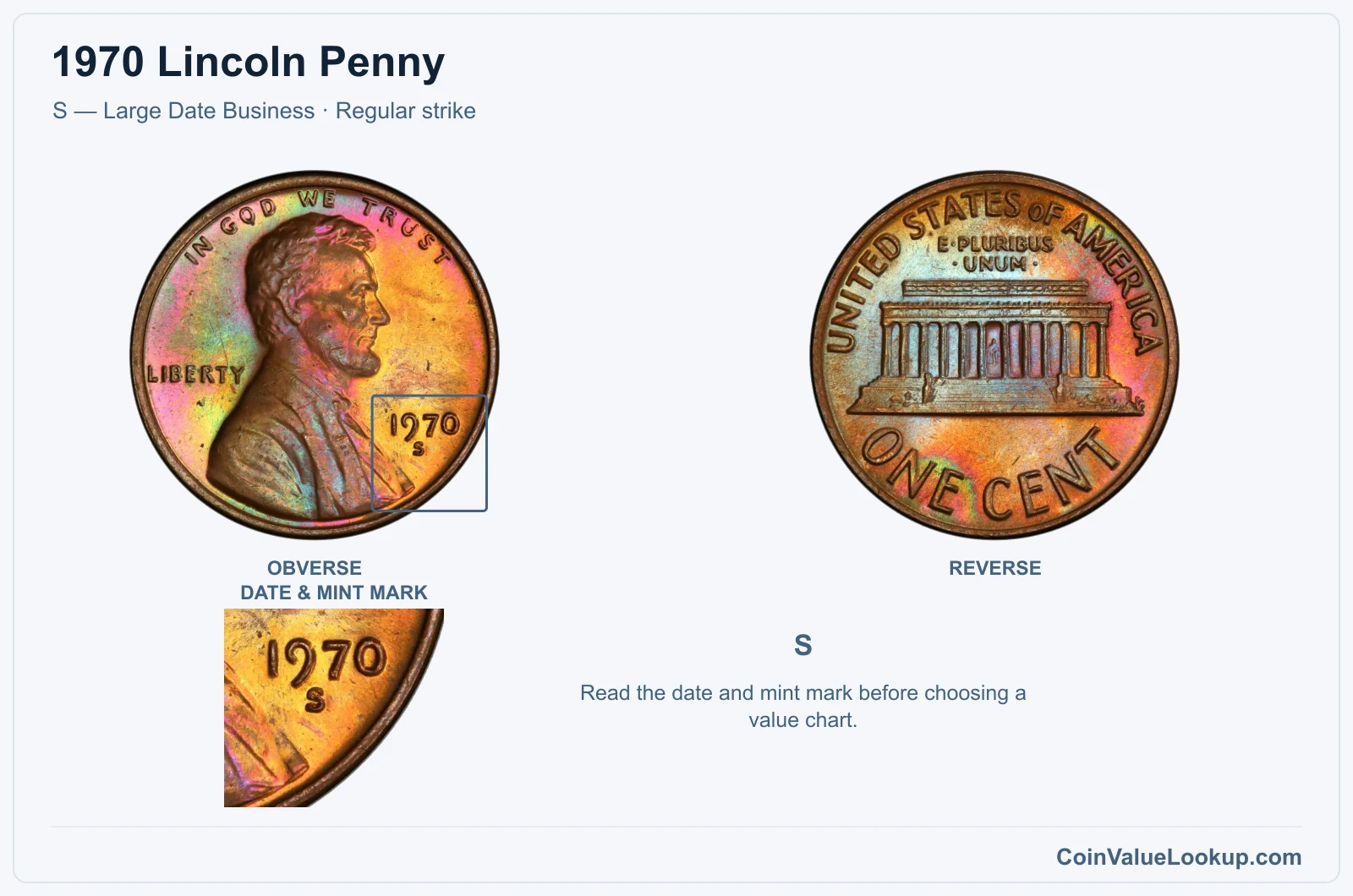
The 1970-S Large Date business strike is the common San Francisco version. Its "7" drops noticeably lower than the surrounding digits.
A USA Coin Book guide estimate is about $1.24 in MS65, on par with the Philadelphia and Denver issues. Do not confuse this coin with the major Doubled Die Obverse, which is also a Large Date S-mint coin but carries its own separate and much higher valuation.
An ordinary Large Date S with no doubling is a regular collectible.
Range Grade
Price1970 S — Large Date Business (BN) Price1970 S — Large Date Business (RB) Price1970 S — Large Date Business (RD) Auction Records Appraisal PO PO 1
—
Coin Identifier FR FR 2
—
Coin Identifier AG AG 3
—
Coin Identifier G G 4
—
Coin Identifier
G 6
—
Coin Identifier VG VG 8
—
Coin Identifier
VG 10
—
Coin Identifier F F 12
—
Coin Identifier
F 15
—
Coin Identifier VF VF 20
—
Coin Identifier
VF 25
—
Coin Identifier
VF 30
—
Coin Identifier
VF 35
—
Coin Identifier XF XF 40
—
Coin Identifier
XF 45
—
Coin Identifier AU AU 50
—
Coin Identifier
AU 53
—
Coin Identifier
AU 55
—
Coin Identifier
AU 58
—
Coin Identifier MS MS 60
—
Coin Identifier
MS 61
—
Coin Identifier
MS 62
—
Coin Identifier
MS 63
Coin Identifier
MS 64
Coin Identifier
MS 65
Coin Identifier
MS 66
Coin Identifier
MS 67
—
Coin Identifier
MS 68
—
—
—
—
—
MS 69
—
—
—
—
—
MS 70
—
—
—
—
—
1970 Lincoln Penny — S — Small Date Proof
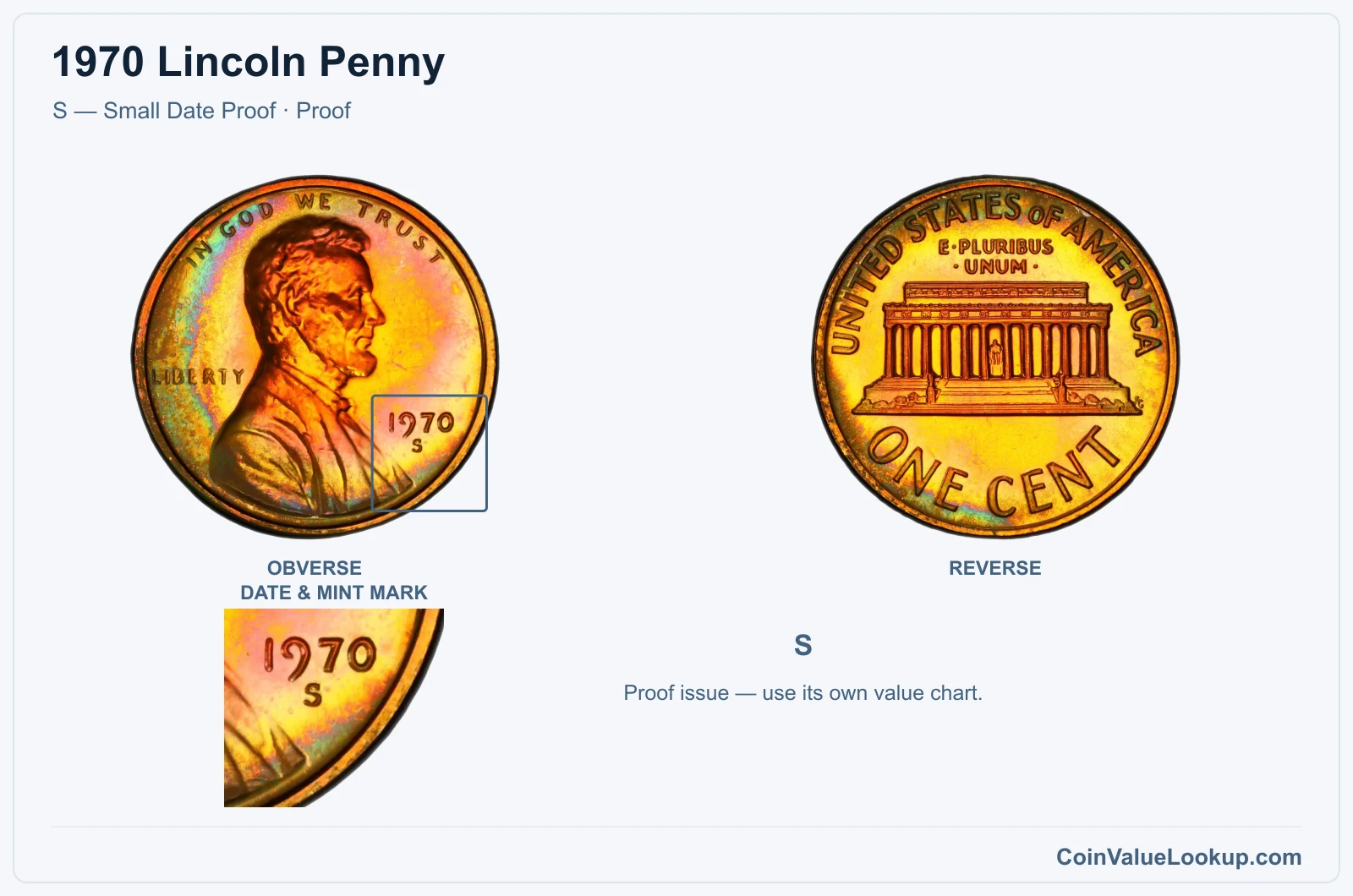
The 1970-S Small Date proof was struck with the same level-topped "7" date style, but on proof planchets with mirror fields. Confirm both the date variety and the proof surface before claiming this identification.
The USA Coin Book guide estimate is $50 in PR65. That is a significant premium over the $1.24 Large Date proof at the same grade.
These came in proof sets, so most survivors are in decent shape. Still, hairlines, haze and toning spots can reduce the grade and the premium.
Coin Value Lookup is a good place to start when you want to compare values across different years and versions of Lincoln pennies.
Range Grade
Price1970 S — Small Date Proof (CAM) Price1970 S — Small Date Proof (DCAM) Auction Records Appraisal PR PR 1
—
Coin Identifier
PR 2
—
Coin Identifier
PR 3
—
Coin Identifier
PR 4
—
Coin Identifier
PR 6
—
Coin Identifier
PR 8
—
Coin Identifier
PR 10
—
Coin Identifier
PR 12
—
Coin Identifier
PR 15
—
Coin Identifier
PR 20
—
Coin Identifier
PR 25
—
Coin Identifier
PR 30
—
Coin Identifier
PR 35
—
Coin Identifier
PR 40
—
Coin Identifier
PR 45
—
Coin Identifier
PR 50
—
Coin Identifier
PR 53
—
Coin Identifier
PR 55
—
Coin Identifier
PR 58
—
Coin Identifier
PR 60
—
Coin Identifier
PR 61
—
Coin Identifier
PR 62
—
Coin Identifier
PR 63
—
Coin Identifier
PR 64
—
Coin Identifier
PR 65
Coin Identifier
PR 66
Coin Identifier
PR 67
Coin Identifier
PR 68
Coin Identifier
PR 69
Coin Identifier
PR 70
—
—
—
—
1970 Lincoln Penny — S — Large Date Proof
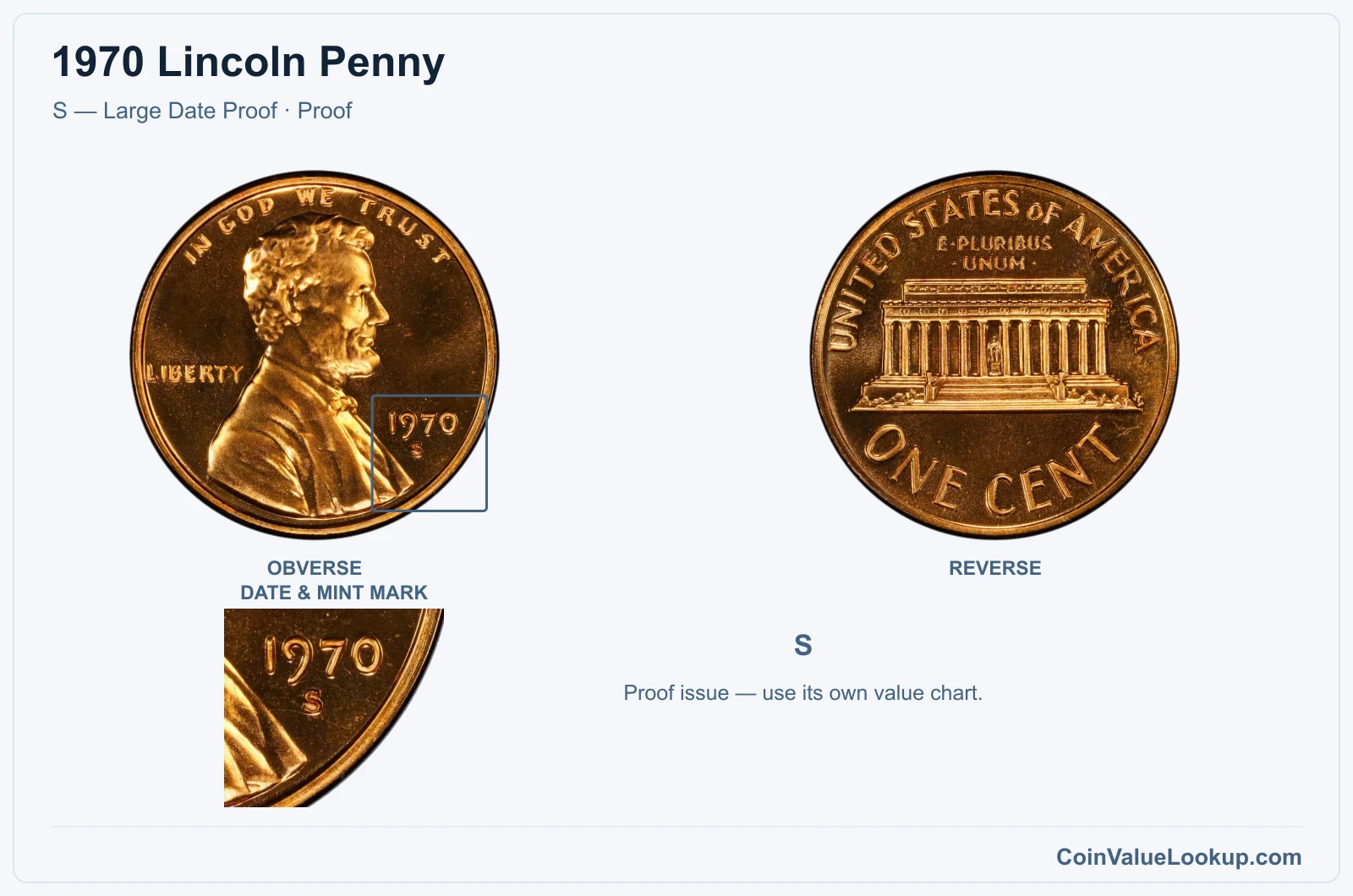
The 1970-S Large Date proof is the ordinary proof issue for this year, with the low "7" date style and standard mirror-field surfaces. A USA Coin Book guide estimate puts it at $1.24 in PR65, the same range as a business strike in MS65.
Most of these came from proof sets and are readily available. Copper toning and handling marks affect the grade and eye appeal.
Range Grade
Price1970 S — Large Date Proof (CAM) Price1970 S — Large Date Proof (DCAM) Auction Records Appraisal PR PR 1
—
Coin Identifier
PR 2
—
Coin Identifier
PR 3
—
Coin Identifier
PR 4
—
Coin Identifier
PR 6
—
Coin Identifier
PR 8
—
Coin Identifier
PR 10
—
Coin Identifier
PR 12
—
Coin Identifier
PR 15
—
Coin Identifier
PR 20
—
Coin Identifier
PR 25
—
Coin Identifier
PR 30
—
Coin Identifier
PR 35
—
Coin Identifier
PR 40
—
Coin Identifier
PR 45
—
Coin Identifier
PR 50
—
Coin Identifier
PR 53
—
Coin Identifier
PR 55
—
Coin Identifier
PR 58
—
Coin Identifier
PR 60
—
Coin Identifier
PR 61
—
Coin Identifier
PR 62
—
Coin Identifier
PR 63
—
Coin Identifier
PR 64
—
Coin Identifier
PR 65
Coin Identifier
PR 66
Coin Identifier
PR 67
Coin Identifier
PR 68
Coin Identifier
PR 69
Coin Identifier
PR 70
—
—
—
—
1970 Lincoln Penny — S — Large Date Doubled Die Obverse
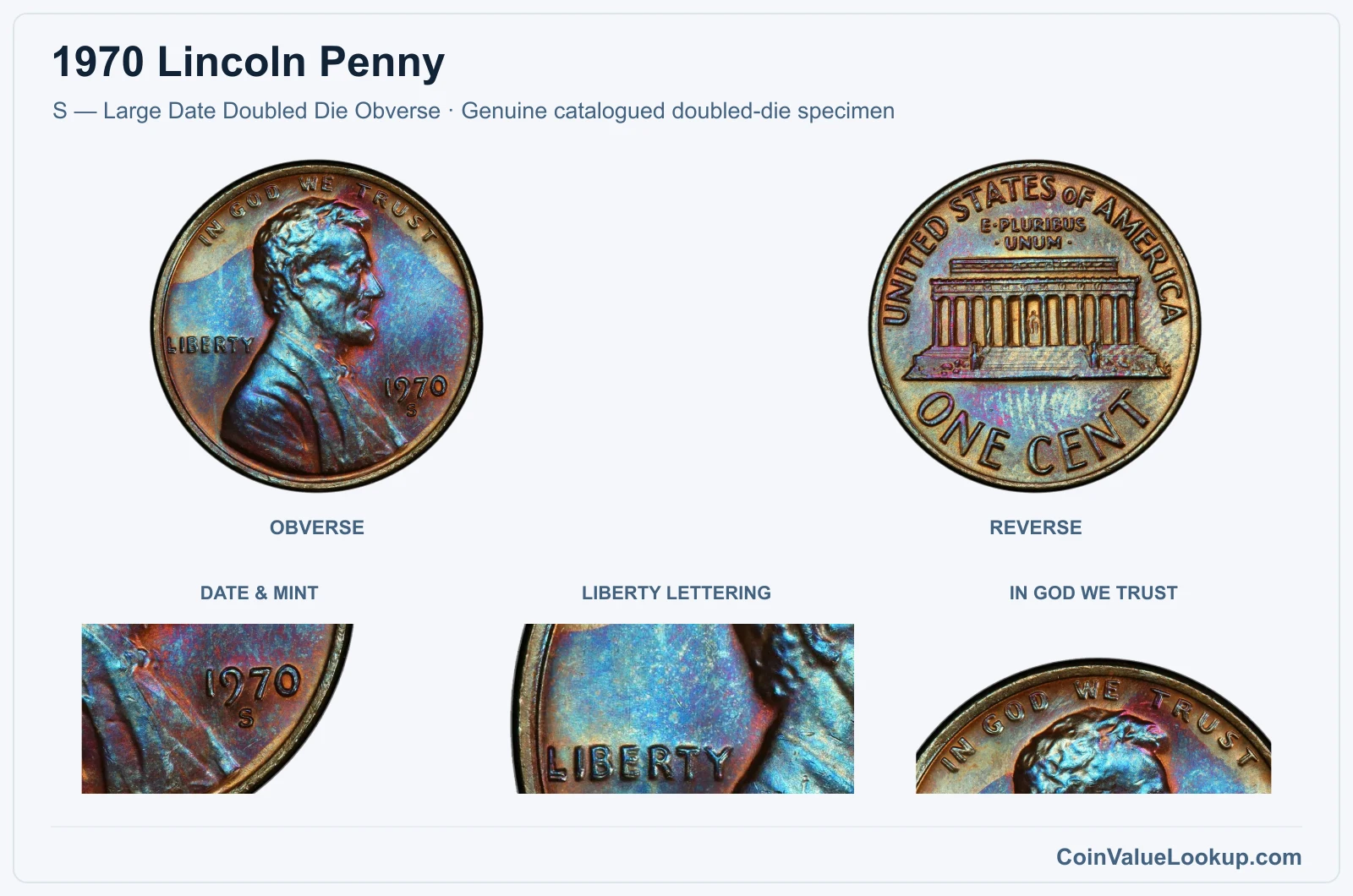
The 1970-S Large Date Doubled Die Obverse is a major variety with pronounced doubling visible in the motto and LIBERTY lettering. Date doubling is present but less dramatic.
This is a Large Date coin with the low "7," struck as a business issue at the San Francisco mint. Do not confuse small doubled-zero varieties or flat machine doubling with this coin; the major doubled die shows clear, separated contours on the affected letters.
No supported numerical price range is adopted here. Value depends entirely on authenticated identity, the severity and completeness of the doubling, and the coin's condition.
Professional authentication is essential before assigning any value to a suspected doubled die. A coin that only shows doubling on the zeros, or shows flat shelf-like displacement, is not this variety.
Range Grade
Price1970 S — Large Date Doubled Die Obverse (BN) Price1970 S — Large Date Doubled Die Obverse (RB) Price1970 S — Large Date Doubled Die Obverse (RD) Auction Records Appraisal PO PO 1
—
Coin Identifier FR FR 2
—
Coin Identifier AG AG 3
—
Coin Identifier G G 4
—
Coin Identifier
G 6
—
Coin Identifier VG VG 8
—
Coin Identifier
VG 10
—
Coin Identifier F F 12
—
Coin Identifier
F 15
—
Coin Identifier VF VF 20
—
Coin Identifier
VF 25
—
Coin Identifier
VF 30
—
Coin Identifier
VF 35
—
Coin Identifier XF XF 40
—
Coin Identifier
XF 45
—
Coin Identifier AU AU 50
—
Coin Identifier
AU 53
—
Coin Identifier
AU 55
—
Coin Identifier
AU 58
Coin Identifier MS MS 60
—
Coin Identifier
MS 61
—
Coin Identifier
MS 62
—
Coin Identifier
MS 63
Coin Identifier
MS 64
Coin Identifier
MS 65
Coin Identifier
MS 66
—
—
Coin Identifier
MS 67
—
—
—
—
—
MS 68
—
—
—
—
—
MS 69
—
—
—
—
—
MS 70
—
—
—
—
—
1970 Lincoln Penny Error List
1. 1970 Lincoln Penny — Doubled Die Obverse
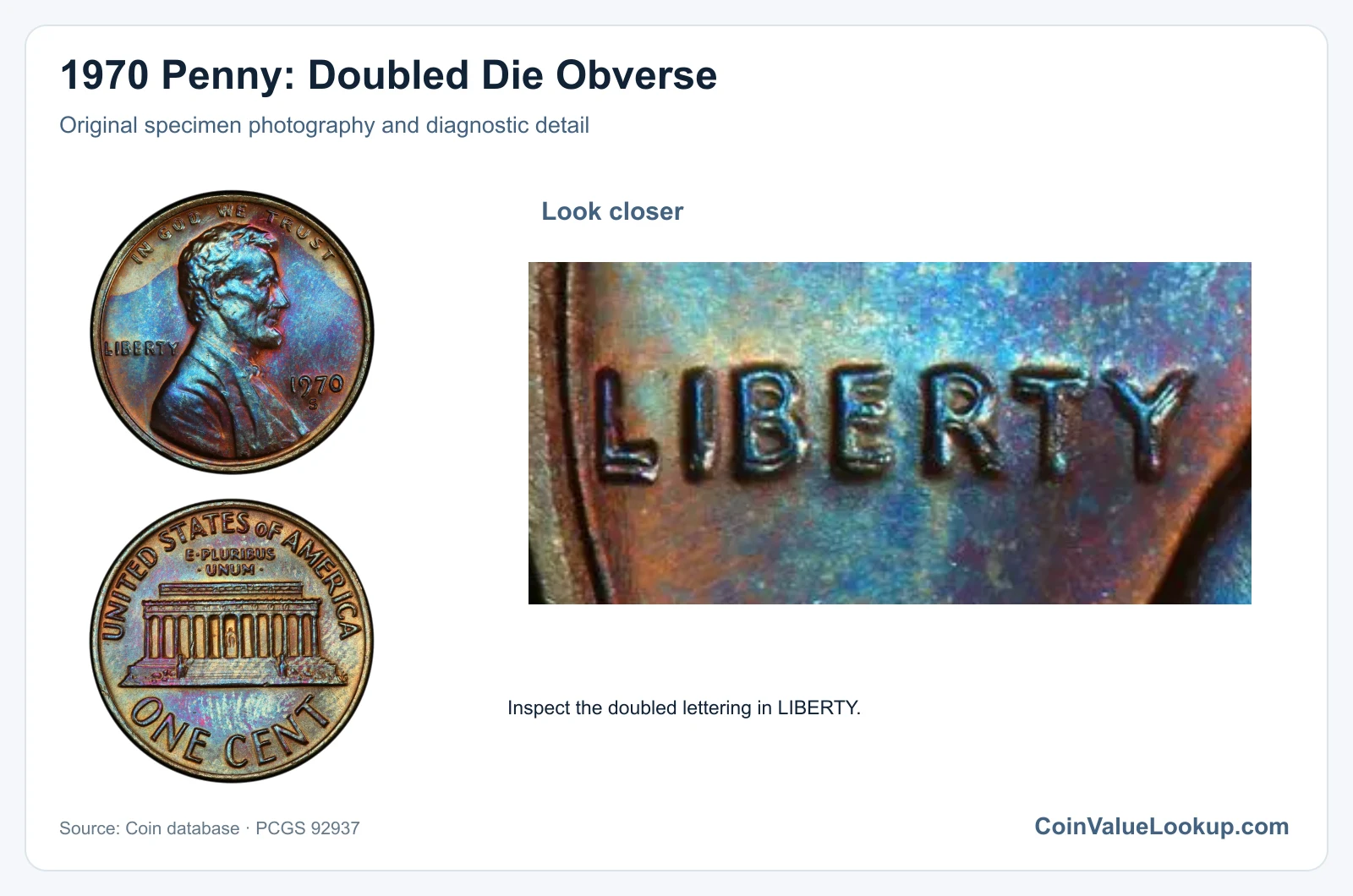
The major 1970-S Doubled Die Obverse is a Large Date business strike showing pronounced repeated contours on IN GOD WE TRUST and LIBERTY. The doubling in the date area is less dramatic.
To confirm, look for clear separation in the motto lettering, not just a slightly fuzzy zero.
Machine doubling produces flat, shelf-like distortion without the raised, separated profiles of a true doubled die. Minor doubled-zero varieties also exist and do not carry the same value as the major variety.
No supported numerical price range is adopted for this error. Each coin's worth depends on its authenticated identity, the completeness and strength of the doubling, and overall condition.
Professional grading service authentication is the path forward if you believe you have this coin.
2. 1970 Lincoln Penny — Flipover Triple Saddle Strike
A flipover triple saddle strike on a 1970-D cent is a dramatic compound error. The coin was struck multiple times with different orientations, leaving overlapping design elements on both faces and a bent or saddle-shaped planchet.
You can identify it by the multiple competing design impressions and the physical distortion of the blank.
Do not confuse this with die doubling, which affects lettering within a single strike, or with vise damage, which can mimic design transfer. A PCGS MS62 Red example of this specific error sold for $1,322.50 at a Heritage auction in February 2007.
That is a single recorded sale, not a market range. If you have a similarly dramatic multi-strike, professional authentication is the necessary first step.
3. 1970 Lincoln Penny — Struck Through on Both Faces
A struck-through error on a 1970-S Large Date cent means some material was trapped between the die and the planchet during striking. The result is smooth or irregular depressions where the die design failed to fully transfer, visible on both the obverse and reverse in this particular example.
Look for areas where detail is missing but the surrounding design remains sharp, which distinguishes a struck-through from wear or corrosion. Scraping and post-mint damage tend to leave different edge profiles and surface textures.
An NGC MS64 Red-Brown example with struck-through errors on both faces sold for $114 at a Heritage auction in April 2023. That sale documents one coin's result, not a general price for all struck-throughs.
4. 1970 Lincoln Penny — Off-Center Strike with Indent
This compound error on a 1970-D cent combines an off-center strike with an obverse indent. The off-center portion displaces the design away from the center of the planchet, while the indent is a separate impression caused by another blank overlapping during striking.
Look for both features: shifted design plus a flattened area that does not match the coin's own design. A simple misaligned die shifts the entire image but does not leave an indent, and a post-mint dent lacks the characteristics of a blank-overlap impression.
An NGC MS65 Red-Brown example sold for $94 at a Heritage auction in November 2020. Condition, the degree of off-center displacement, and the clarity of the indent all affect what any individual coin might bring.
5. 1970 Lincoln Penny — Die Break / Cud
A die break or cud on a 1970 cent appears as a raised, irregular lump of metal where a piece of the die broke away. A true cud connects to the rim and creates a flat or convex blob replacing part of the normal design.
Interior die breaks away from the rim are smaller raised features.
Compare carefully against rim dents, which are depressions rather than raised areas, and corrosion, which has a different texture. A small interior die chip is not the same as a prominent cud.
No supported numerical price range is adopted for this category. Value depends on the size, location and visual impact of the break, plus the coin's overall condition.
6. 1970 Lincoln Penny — Clipped Planchet
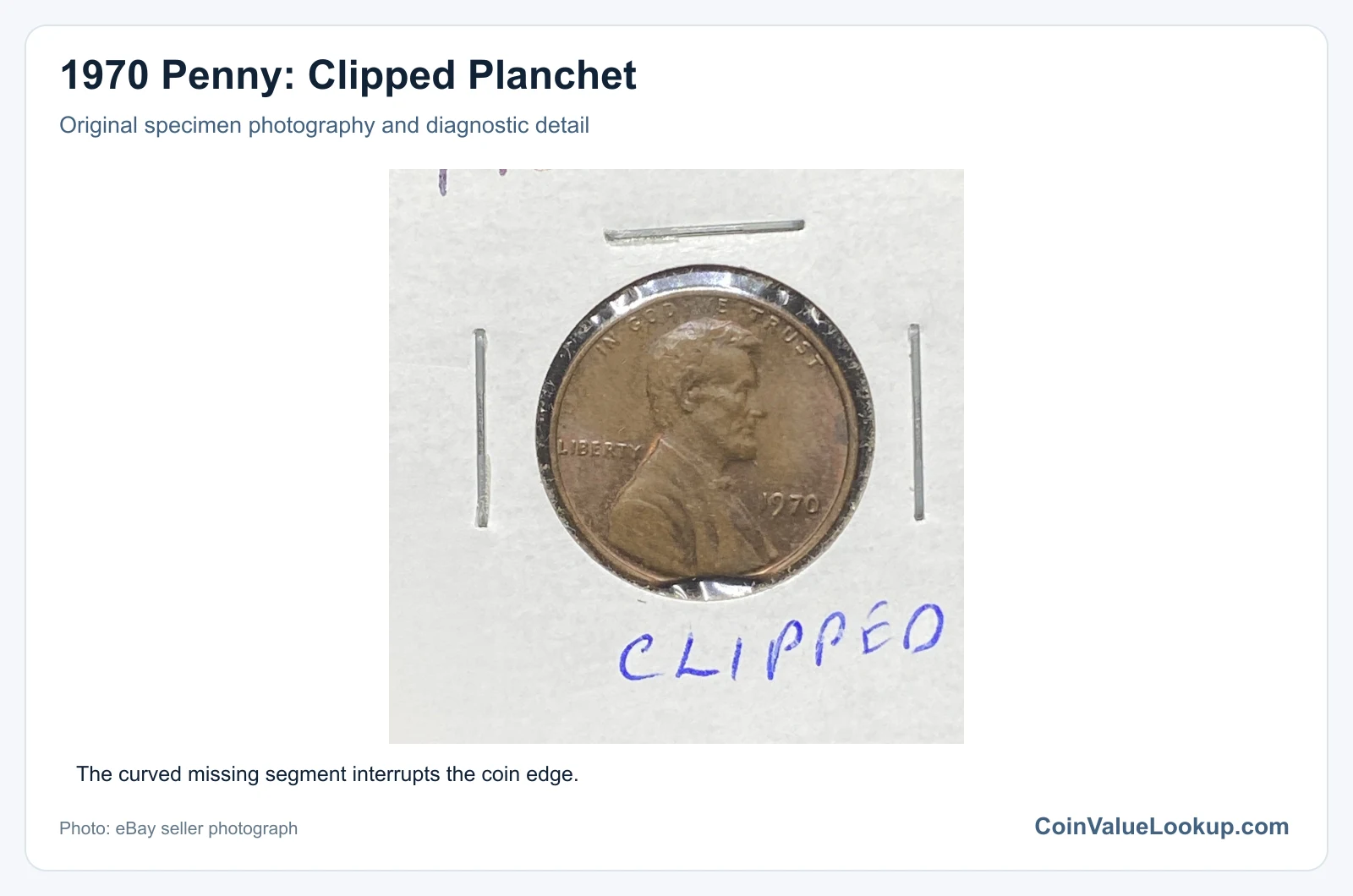
A clipped planchet error on a 1970 cent means the blank was incompletely punched from the metal strip before striking. The missing area can be curved, straight or ragged depending on how the clip occurred.
Look at the edge texture where the clip meets the remaining rim and check for metal-flow weakness on the opposite side of the coin, which often accompanies a genuine clip.
Filed notches, cut edges and corrosion can mimic a clip but lack the characteristic Blakesley effect, which is weakness directly opposite the missing area. No supported numerical price range is adopted.
Value depends on the clip's size, shape, and the coin's grade and eye appeal.
7. 1970 Lincoln Penny — Repunched Mintmark
A repunched mintmark on a 1970 cent shows remnants of a second or shifted mintmark punch near the primary letter. Under magnification you can see traces of a separately positioned impression that does not line up with the final mark.
This is different from machine doubling, which produces flat shelf-like distortion, and from a die chip, which adds material rather than showing a second punch outline. Corrosion around the mintmark can also mimic extra shapes.
Compare your coin's mintmark area at matching magnification against a confirmed normal example. No supported numerical price range is adopted.
The premium, if any, depends on the clarity and rarity of the specific repunched variety and the coin's overall condition.
8. 1970 Lincoln Penny — Floating Roof / Overpolished Reverse
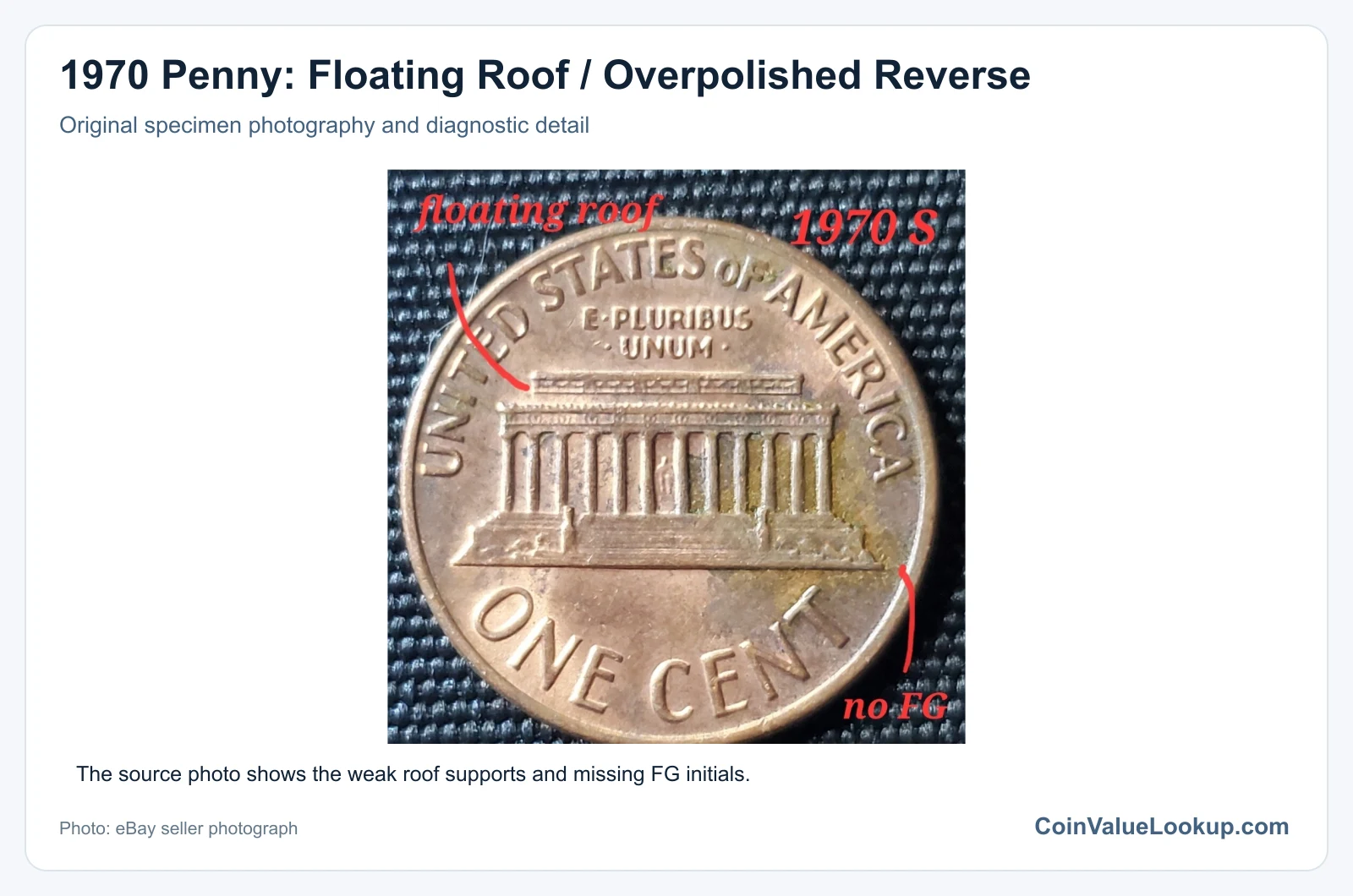
The floating roof or overpolished reverse on a 1970 cent refers to missing detail on the Memorial building's roof supports, caused by excessive die polishing at the mint. The roof appears to hover above the columns because the connecting lines have been partially or fully removed.
Compare your reverse directly against a normal 1970 cent to see whether the supports are genuinely absent rather than worn away through circulation. Weak strikes and intentional alteration can produce similar-looking results.
This is best understood as a die-polishing feature with uncertain collector premium, not a major rare error. No supported numerical price range is adopted.
If the effect is dramatic and the coin is well preserved, it may attract some collector interest.