1970 Kennedy Half Dollar Coin Value: How Much Is It Worth?
A 1970 Kennedy half dollar is a 40% silver coin that can be worth more than its modest face value suggests. Guide estimates for the regular 1970-D range from about $32 at MS60 to $99 at MS65, while silver-market fluctuations affect what a worn example might bring.
The 1970-S proof and its doubled die variety add further interest to this year.
Fast Way to Identify Your 1970 Kennedy Half Dollar
Snap a clear photo of the front and back of your 1970 half dollar and upload both images for a preliminary identification. This can help you figure out which mint version you have and whether any obvious variety markers are present.
Exact grading or authentication requires professional evaluation, but a photo check is a solid first step.
1970 Kennedy Half Dollar Value
Upload both sides of your 1970 Kennedy Half Dollar.
Front Obverse
Upload photo
Back Reverse
Upload photo
Which 1970 Kennedy Half Dollar Versions Are Worth Money?
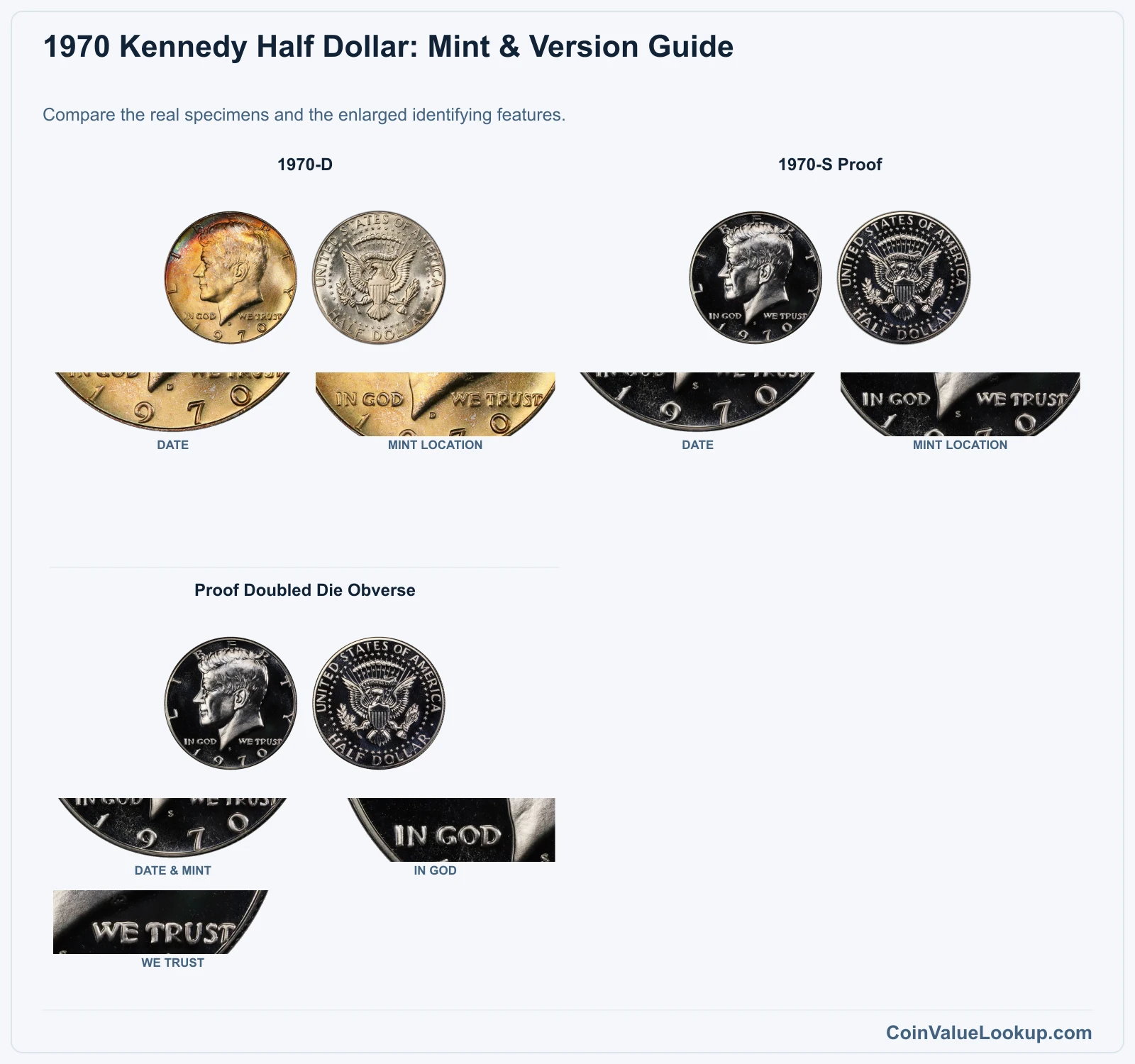
- The 1970-D was only distributed in Mint Sets, making it less common in the wild than a typical circulation half dollar. Guide estimates reach $99 at MS65.
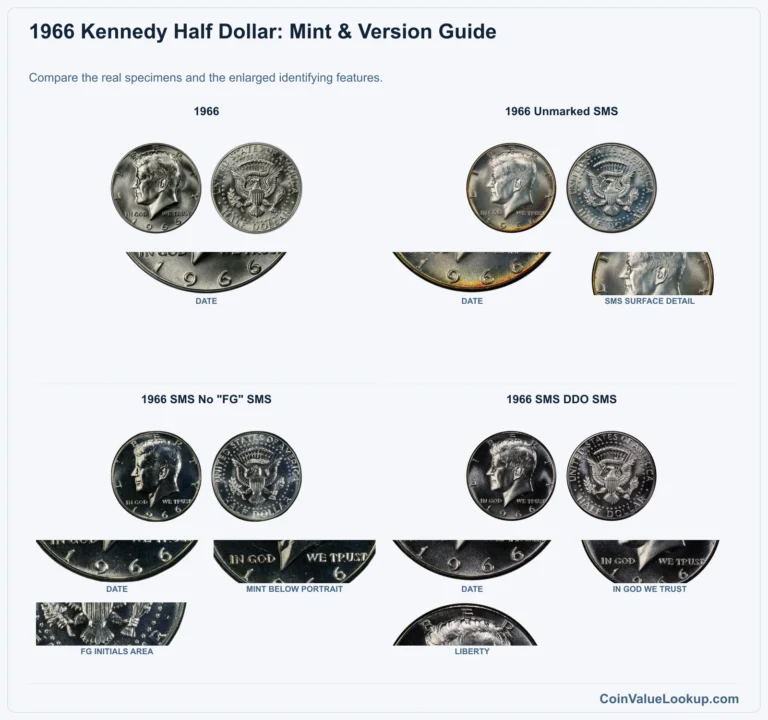
- The 1970-S Proof Doubled Die Obverse shows raised, separated lettering on IN GOD WE TRUST, LIBERTY, and the date. Value depends on authenticated identity and condition, so individual assessment is needed.
- Proof mint errors such as the broadstrike and the strike on a quarter planchet are rare 1970-S anomalies that have sold at auction for four figures.
- All 1970 halves contain 40% silver, giving even a worn coin some intrinsic metal value tied to the silver market.
Step 1: Identify Your 1970 Kennedy Half Dollar Mint Mark and Version
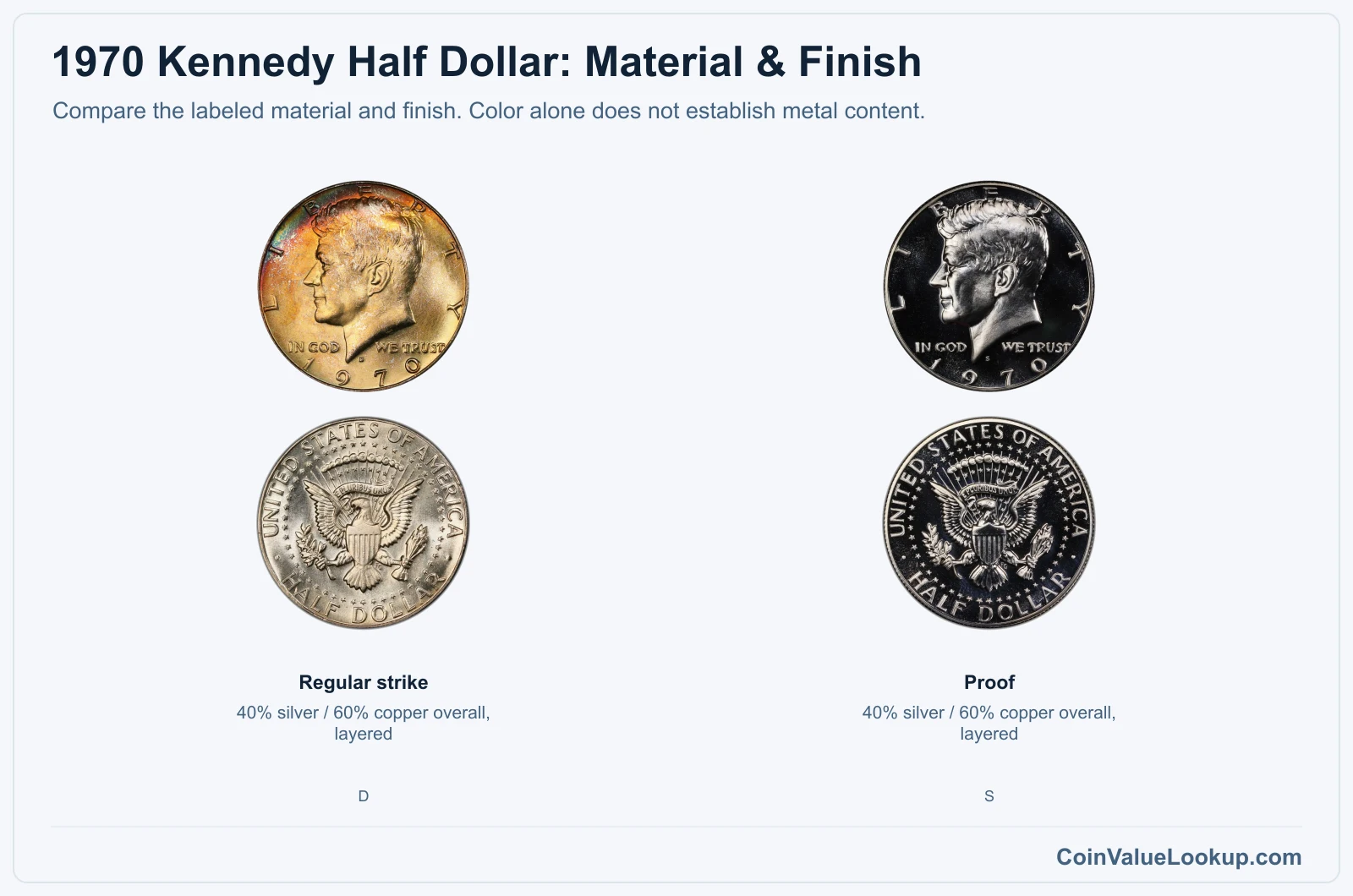
All 1970 Kennedy halves are 40% silver, weighing about 11.50 grams with a diameter of roughly 30.61 mm. The outer layers are 80% silver, and the inner layer is approximately 20.9% silver.
The mintmark sits on the obverse, just below Kennedy's neck truncation. A "D" means Denver; an "S" means San Francisco.
Philadelphia-minted coins of this era carry no mintmark, but no regular Philadelphia issue was struck for 1970.
The 1970-D was produced exclusively for Mint Sets and was not released through normal circulation channels. If you find a worn one, it likely escaped from a broken-up set at some point.
The 1970-S is a proof coin, struck with specially prepared dies at the San Francisco Mint.
Do not confuse this coin with earlier 1966 or 1967 halves that also lack mintmarks. Those years simply did not carry marks at all, and no premium for a "missing mintmark" applies to them.
Step 2: Check Your 1970 Kennedy Half Dollar Grade
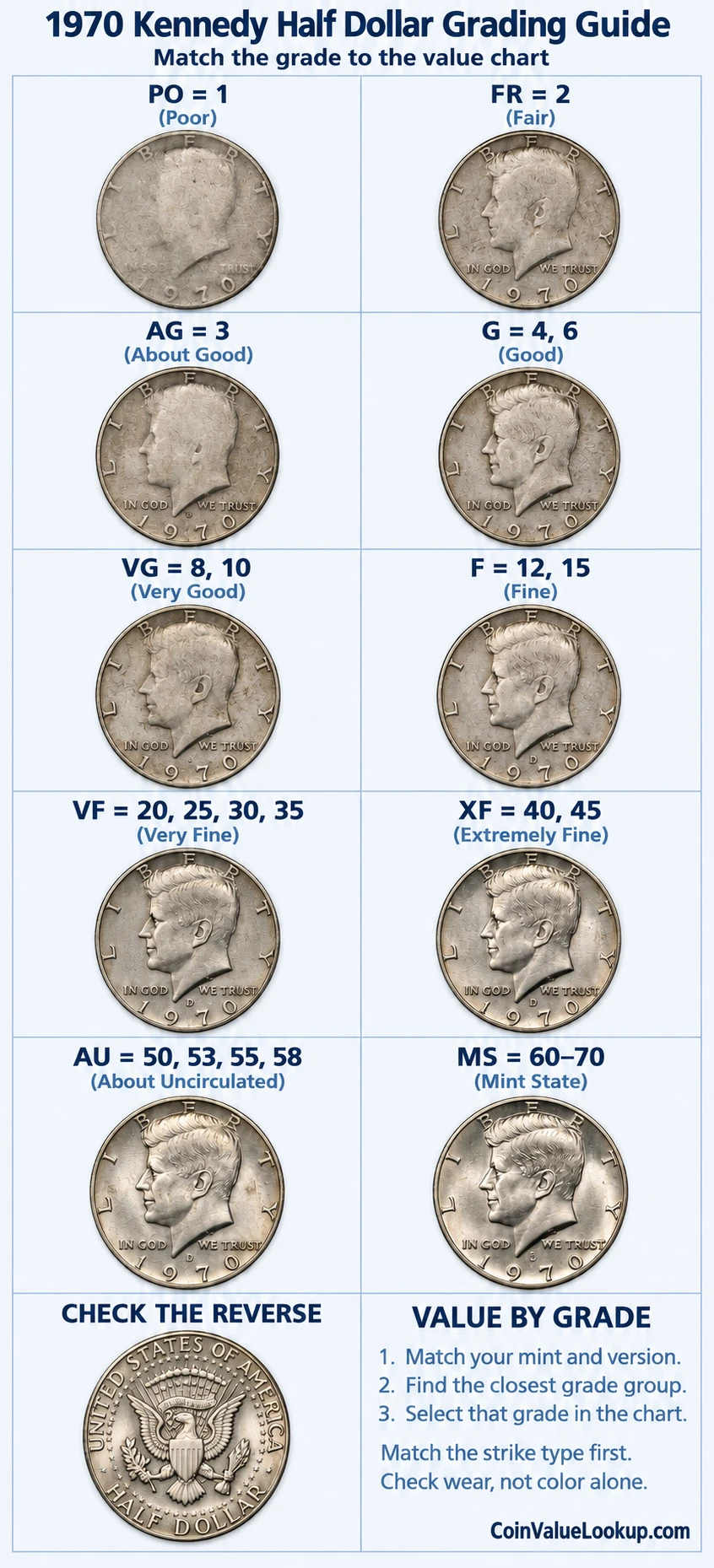
Start with the hair above Kennedy's ear and along the temple. On a well-preserved coin, individual strands are sharp and fully separated.
Rub shows up here first as a flat, dull patch where luster breaks down.
Check the cheek and jawline next. These high points lose detail quickly in circulation, so even light wear is visible if you tilt the coin under a single light source.
Flip to the reverse. The eagle's breast feathers, tail feathers, and the horizontal lines of the shield are your wear indicators.
However, some 1970 halves came with a softer strike from the factory, so faint detail there does not automatically mean wear.
Use the comparison image to match your coin against same-type examples at various grade levels. Look for contact marks and hairlines on the fields, which are separate from circulation wear.
Brightness alone does not establish grade. A proof is a manufacturing finish, not a grade above Mint State, so a proof with scratches can grade lower than an untouched business strike.
Step 3: Check 1970 Kennedy Half Dollar Value by Mint and Version
1970 Kennedy Half Dollar — D
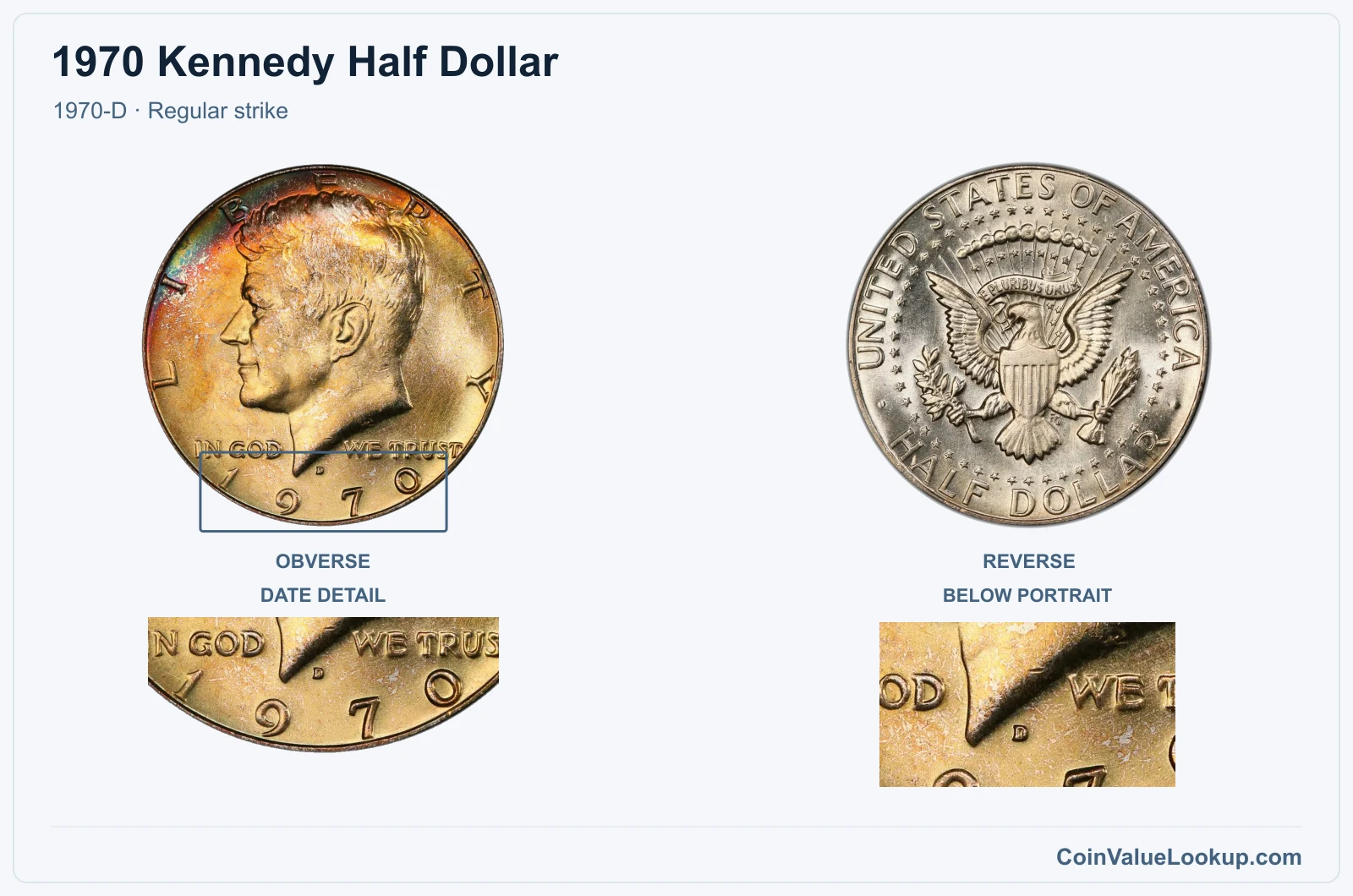
The 1970-D Kennedy half was never released into general circulation. Every example was packaged in that year's U.S. Mint Set, so finding one with obvious wear means it was removed from its original holder and spent or handled.
Guide estimates from USA Coin Book place a 1970-D at about $32 in MS60 condition and around $99 at MS65. Because these are silver-content coins, the lower end of the value range shifts with the silver market.
If you have a 1970-D, look for a small "D" on the obverse below Kennedy's neck. Original Mint Set coins should still show strong luster across both sides.
Any rub on the cheek or hair above the ear drops it out of the Mint State tier.
| Range | Grade | Price | Auction Records | Appraisal |
|---|---|---|---|---|
| PO | PO 1 | — | Coin Identifier | |
| FR | FR 2 | — | Coin Identifier | |
| AG | AG 3 | — | Coin Identifier | |
| G | G 4 | — | Coin Identifier | |
| G 6 | — | Coin Identifier | ||
| VG | VG 8 | — | Coin Identifier | |
| VG 10 | — | Coin Identifier | ||
| F | F 12 | — | Coin Identifier | |
| F 15 | — | Coin Identifier | ||
| VF | VF 20 | — | Coin Identifier | |
| VF 25 | — | Coin Identifier | ||
| VF 30 | — | Coin Identifier | ||
| VF 35 | — | Coin Identifier | ||
| XF | XF 40 | — | Coin Identifier | |
| XF 45 | — | Coin Identifier | ||
| AU | AU 50 | — | Coin Identifier | |
| AU 53 | — | Coin Identifier | ||
| AU 55 | — | Coin Identifier | ||
| AU 58 | — | Coin Identifier | ||
| MS | MS 60 | — | Coin Identifier | |
| MS 61 | — | Coin Identifier | ||
| MS 62 | Coin Identifier | |||
| MS 63 | Coin Identifier | |||
| MS 64 | Coin Identifier | |||
| MS 65 | Coin Identifier | |||
| MS 66 | Coin Identifier | |||
| MS 67 | Coin Identifier | |||
| MS 68 | — | — | — | |
| MS 69 | — | — | — | |
| MS 70 | — | — | — |
1970 Kennedy Half Dollar — S Proof
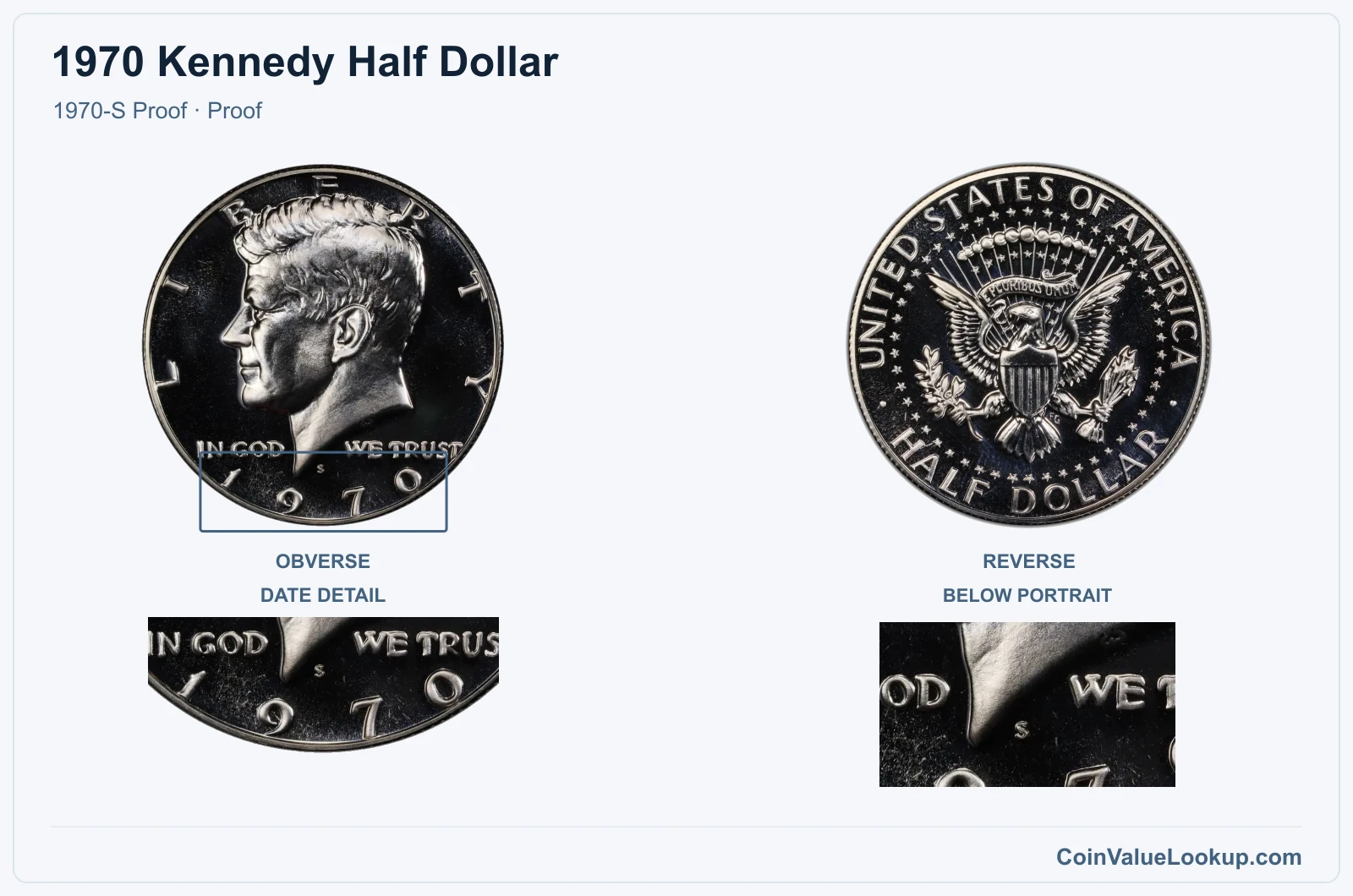
The 1970-S proof was struck at the San Francisco Mint with polished dies on specially prepared planchets, producing mirror-like fields and sharp detail. Look for the "S" mintmark on the obverse below Kennedy's neck.
A USA Coin Book guide estimate puts a PR65 example at about $26. These were sold in proof sets, so most survivors are well preserved.
Hairlines from mishandling or improper storage are the main grade limiters you will encounter.
Coin Value Lookup is a handy place to look up guides for Kennedy halves and other series if you want to compare values across different years and mints.
| Range | Grade | Price | Auction Records | Appraisal |
|---|---|---|---|---|
| PR | PR 1 | — | Coin Identifier | |
| PR 2 | — | Coin Identifier | ||
| PR 3 | — | Coin Identifier | ||
| PR 4 | — | Coin Identifier | ||
| PR 6 | — | Coin Identifier | ||
| PR 8 | — | Coin Identifier | ||
| PR 10 | — | Coin Identifier | ||
| PR 12 | — | Coin Identifier | ||
| PR 15 | — | Coin Identifier | ||
| PR 20 | — | Coin Identifier | ||
| PR 25 | — | Coin Identifier | ||
| PR 30 | — | Coin Identifier | ||
| PR 35 | — | Coin Identifier | ||
| PR 40 | — | Coin Identifier | ||
| PR 45 | — | Coin Identifier | ||
| PR 50 | — | Coin Identifier | ||
| PR 53 | — | Coin Identifier | ||
| PR 55 | — | Coin Identifier | ||
| PR 58 | — | Coin Identifier | ||
| PR 60 | — | Coin Identifier | ||
| PR 61 | — | Coin Identifier | ||
| PR 62 | — | Coin Identifier | ||
| PR 63 | Coin Identifier | |||
| PR 64 | — | Coin Identifier | ||
| PR 65 | Coin Identifier | |||
| PR 66 | Coin Identifier | |||
| PR 67 | Coin Identifier | |||
| PR 68 | Coin Identifier | |||
| PR 69 | Coin Identifier | |||
| PR 70 | — | — | — |
1970 Kennedy Half Dollar — Proof Doubled Die Obverse
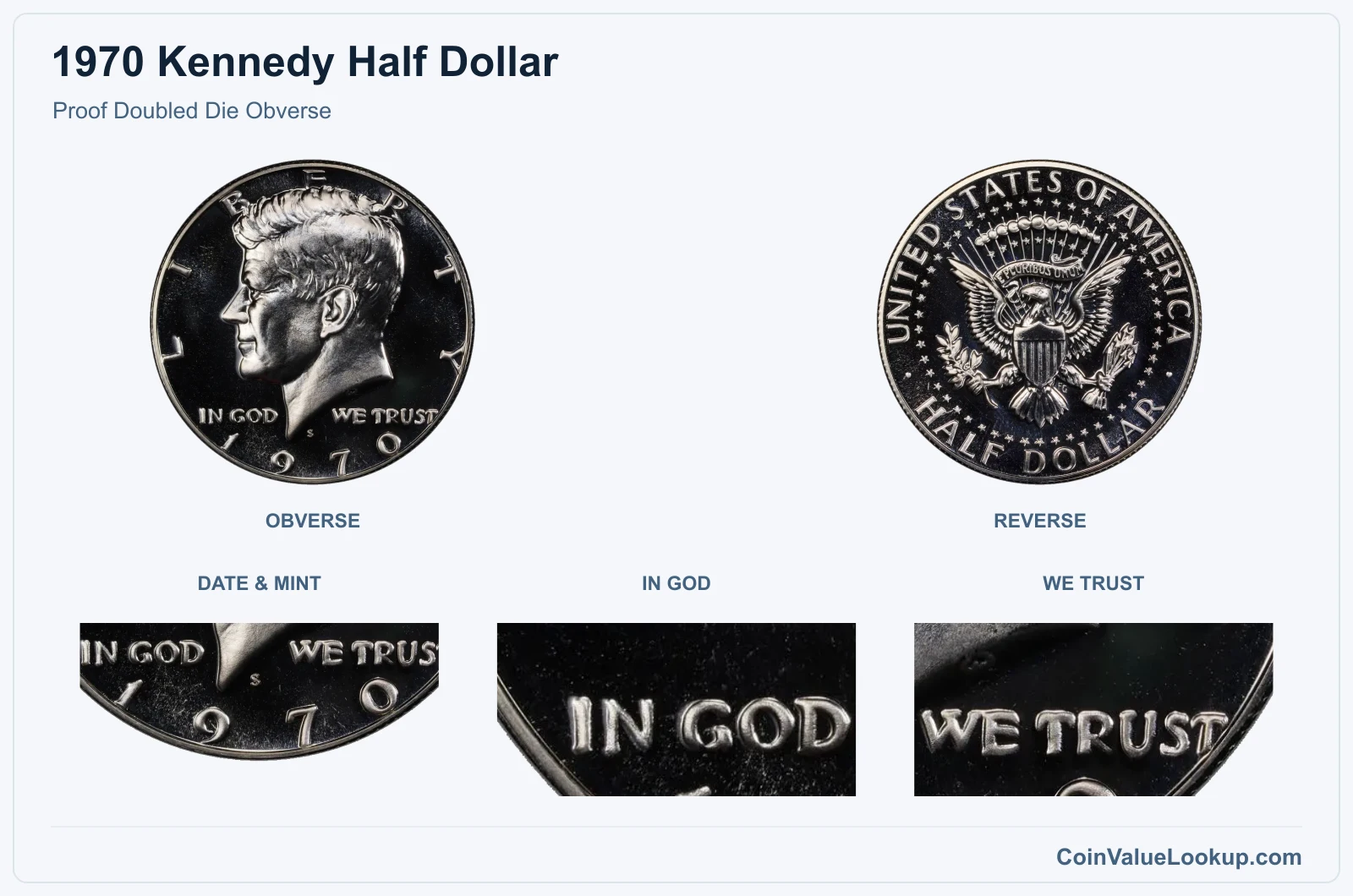
This is the 1970-S proof with a doubled die obverse, a hub-doubling variety that shows raised, separated lettering on IN GOD WE TRUST, LIBERTY, and the date. The doubling is distinct from flat, shelf-like machine doubling, which is a different and far less collectible phenomenon.
Do not confuse this coin with the famous 1970-S Lincoln cent doubled die obverse. That is a completely different denomination.
On the Kennedy half, compare your coin side by side with a normal 1970-S proof to spot the spread on the legend letters.
No supported price range is available for this variety. Value depends on authenticated identity, the severity of the doubling, and the coin's overall condition, so professional evaluation is the way to go.
Ordinary-issue reference: Ordinary-issue reference only: The table below shows prices for the 1970-S Kennedy Half Dollar (proof). It does not represent the value of the specific Proof Doubled Die Obverse variety or its variety premium. Year, mint, metal and strike type are matched; the specific variety is not priced by this table.
Range Grade
Price Auction Records Appraisal PR PR 1
—
Coin Identifier
PR 2
—
Coin Identifier
PR 3
—
Coin Identifier
PR 4
—
Coin Identifier
PR 6
—
Coin Identifier
PR 8
—
Coin Identifier
PR 10
—
Coin Identifier
PR 12
—
Coin Identifier
PR 15
—
Coin Identifier
PR 20
—
Coin Identifier
PR 25
—
Coin Identifier
PR 30
—
Coin Identifier
PR 35
—
Coin Identifier
PR 40
—
Coin Identifier
PR 45
—
Coin Identifier
PR 50
—
Coin Identifier
PR 53
—
Coin Identifier
PR 55
—
Coin Identifier
PR 58
—
Coin Identifier
PR 60
—
Coin Identifier
PR 61
—
Coin Identifier
PR 62
—
Coin Identifier
PR 63
Coin Identifier
PR 64
—
Coin Identifier
PR 65
Coin Identifier
PR 66
Coin Identifier
PR 67
Coin Identifier
PR 68
Coin Identifier
PR 69
Coin Identifier
PR 70
—
—
—
1970 Kennedy Half Dollar Error List
1. 1970 Kennedy Half Dollar — Proof Doubled Die Obverse
The proof doubled die obverse on the 1970-S Kennedy half shows raised, separated lettering on IN GOD WE TRUST, LIBERTY, and the date. This is genuine hub doubling from the die-making process, not a strike anomaly.
To check, hold your coin under magnification and compare the legend letters to a normal 1970-S proof. The doubled version will have a visible spread, almost like a shadow image slightly offset from the primary lettering.
Flat, shelf-like doubling that looks like a smeared echo is machine doubling and is not the same thing. Post-mint damage, glare under certain lighting, and separately double-struck coins can also mimic the look.
No supported price range is adopted for this variety. Each coin's value hinges on authenticated identity, the severity of the doubling, and overall condition.
Professional attribution is recommended before assuming you have the real deal.
2. 1970 Kennedy Half Dollar — Proof Struck on a Quarter Planchet
A 1970-S proof Kennedy half struck on a quarter-sized planchet is a dramatic wrong-planchet error. The coin appears as a small, oval-shaped strike displaced toward roughly the 11 o'clock position, with much of the HALF DOLLAR inscription missing entirely because the blank was too small to receive the full design.
Authenticated proof surfaces, the S mintmark, and the date should all be visible on the struck portion. A PCGS PR66 example sold at Heritage Auctions in January 2007 for $7,475.
Be cautious with lookalikes. Post-mint alterations such as cutting, filing, or plating can make a normal coin look undersized.
An odd outline or unusual color alone is not proof of a wrong-planchet strike. The struck surfaces and remaining design elements must match the authenticated variety.
3. 1970 Kennedy Half Dollar — Proof Broadstrike
A broadstrike happens when the restraining collar fails to contain the planchet during striking, allowing the metal to spread beyond its normal diameter. On the 1970-S proof broadstrike, the coin shows slight off-centering toward the 12 o'clock position, with distortion visible in the E of LIBERTY and in HALF DOLLAR on the reverse.
Mirror-like proof fields should still be present across the expanded surface. An NGC PR65 example brought $2,040 at Heritage Auctions in July 2022.
Do not confuse a broadstrike with post-mint damage. Coins that have been squeezed, filed, or altered after leaving the mint can look spread out, but they will lack the consistent proof surfaces and properly formed design elements of a genuine broadstrike.
Both the date and S mintmark must be confirmed on any suspect coin.