1984 Kennedy Half Dollar Coin Value: How Much Is It Worth?
The 1984 Kennedy half dollar carries a face value of fifty cents, and most circulated clad examples are worth exactly that. Collector guide estimates from USA Coin Book place well-preserved or proof examples between roughly $3.62 and $4.96, depending on mint, finish and grade.
Before you check a price chart, you need to know whether your coin is a Philadelphia business strike, a Denver business strike or a San Francisco proof — and whether it shows any mint-made anomalies.
Fast Way to Identify Your 1984 Kennedy Half Dollar
The quickest way to start is to snap a clear photo of both sides of your coin and upload them here. Our identifier can help with preliminary identification of your mint, finish and general condition based on the images you provide.
It is not a substitute for professional authentication or exact grading, but it gives you a solid starting point.
1984 Kennedy Half Dollar Value
Upload both sides of your 1984 Kennedy Half Dollar.
Front Obverse
Upload photo
Back Reverse
Upload photo
Which 1984 Kennedy Half Dollar Versions Are Worth Money?
- Check your mintmark and finish first — a San Francisco proof is the most collected 1984 Kennedy half dollar branch and carries a higher guide estimate than business strikes at comparable grades.
- Well-preserved Philadelphia and Denver business strikes in original, mark-free condition can exceed face value; a USA Coin Book guide estimate places MS65 examples at about $3.62.
- Mint-made errors such as off-center strikes, doubled dies and broadstrikes have been reported for 1984 Kennedy halves; value depends on the specific error, its visibility and overall coin condition.
Step 1: Identify Your 1984 Kennedy Half Dollar Mint Mark and Version
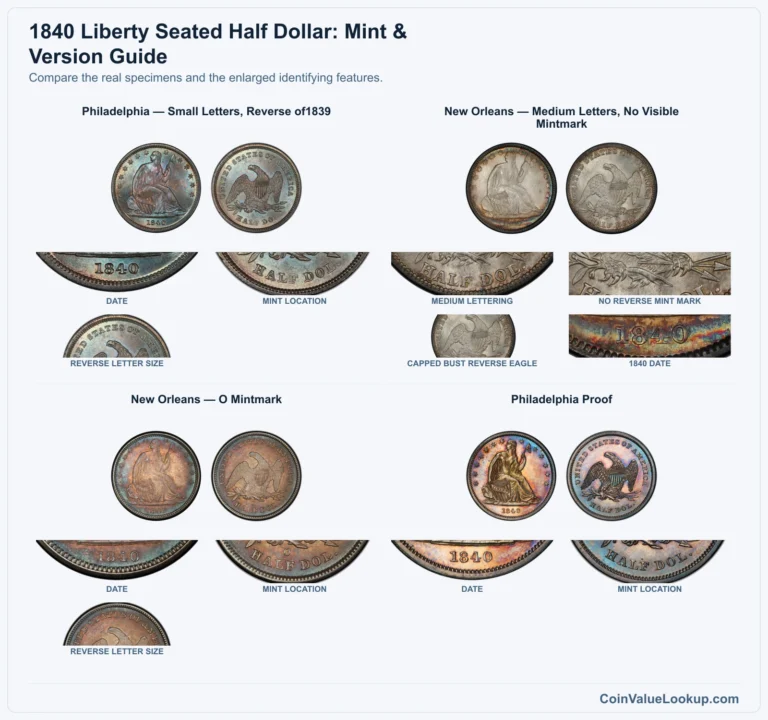
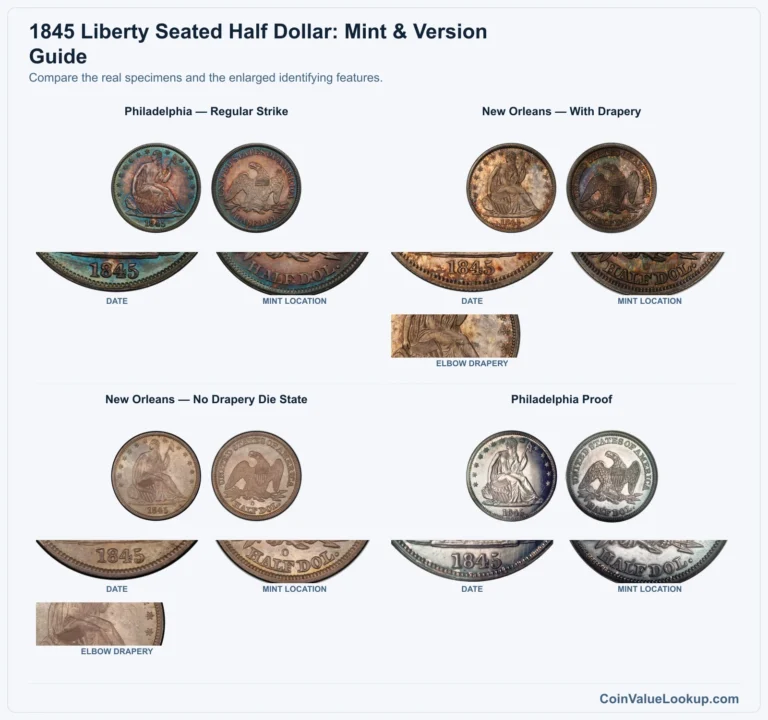
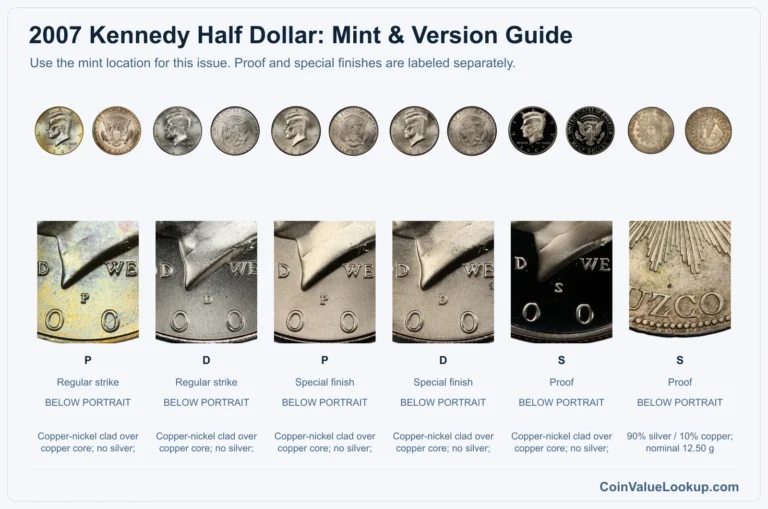
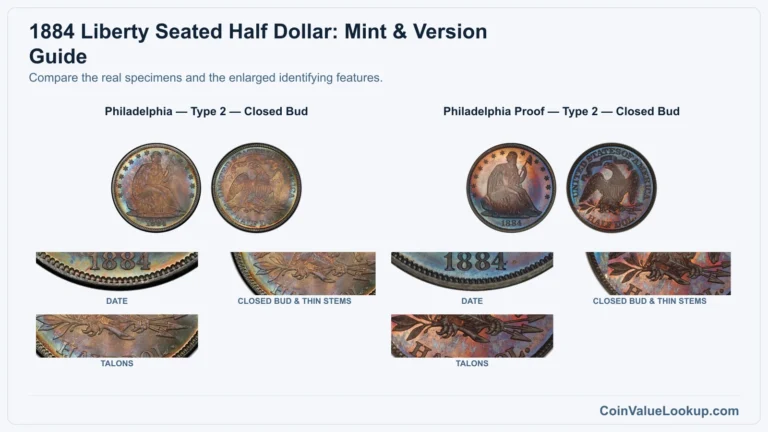
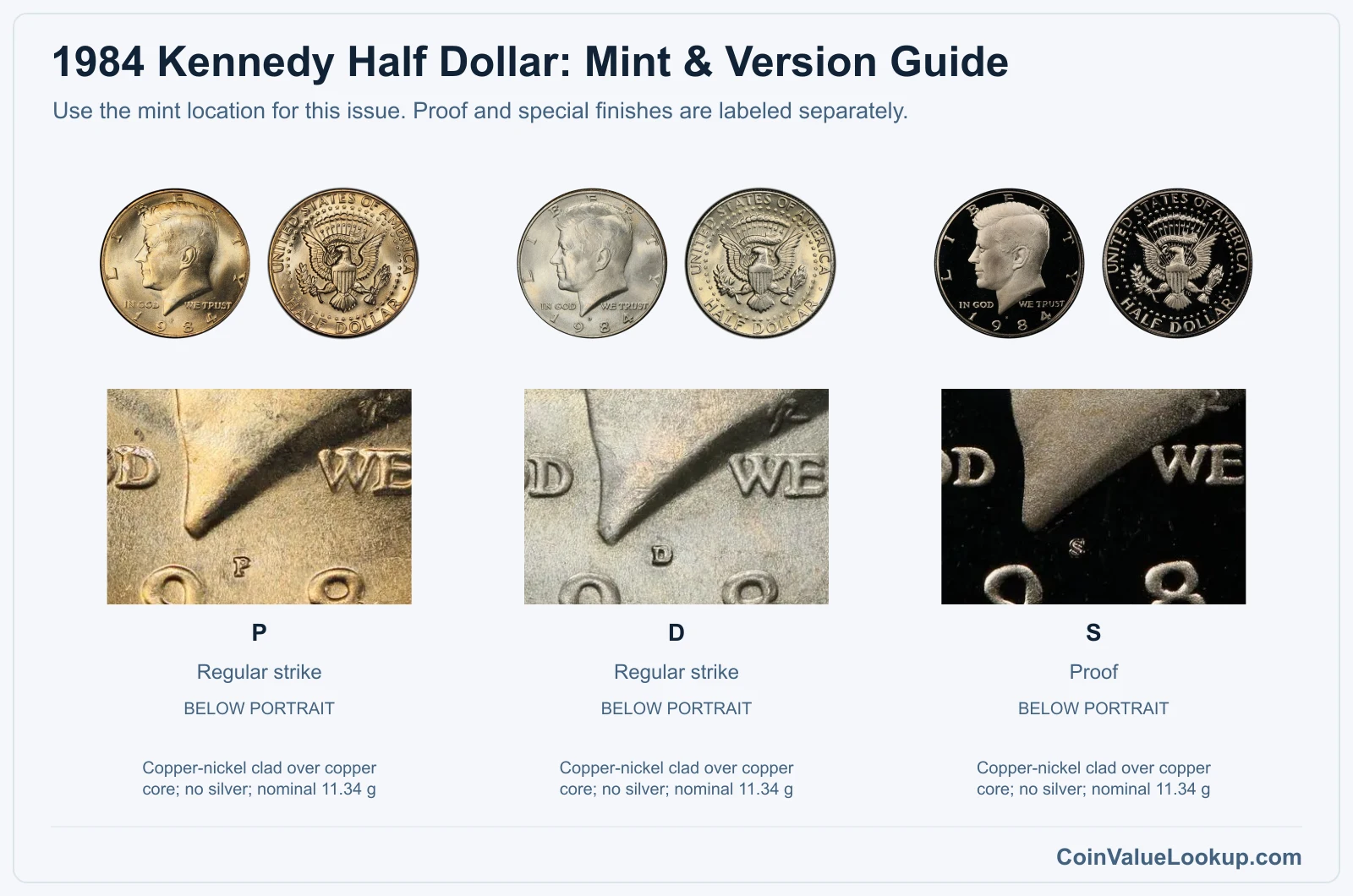
First, find the mintmark. On 1984 Kennedy halves, the mintmark sits on the obverse just beneath Kennedy's portrait, above the date.
A "P" means Philadelphia, a "D" means Denver, and an "S" means San Francisco proof.
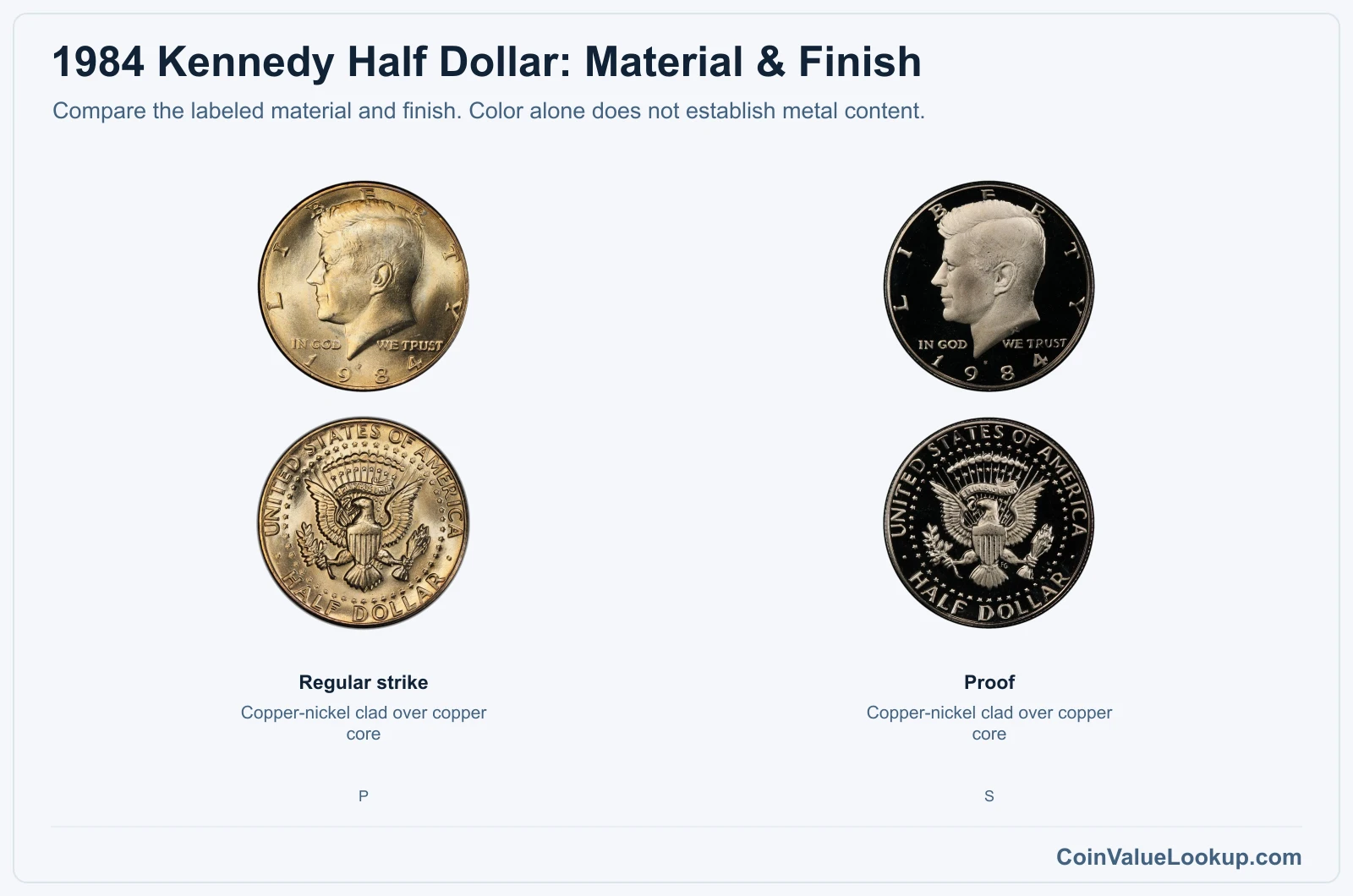
All three 1984 issues are copper-nickel clad — none contain silver. Do not assume a half dollar is silver just because it looks shiny or has unusual toning; lighting, tarnish and even plating can fool you.
To tell a proof from a business strike, look at the fields. Proofs have mirror-like surfaces and frosted raised design elements.
They were sold in sealed sets from the San Francisco mint, not released into circulation.
If you are checking the reverse for designer Frank Gasparro's "FG" initials, note that faint initials caused by normal wear or a minor obstruction are not automatically a recognized variety. Compare your coin carefully to a known normal example before drawing conclusions.
Step 2: Check Your 1984 Kennedy Half Dollar Grade
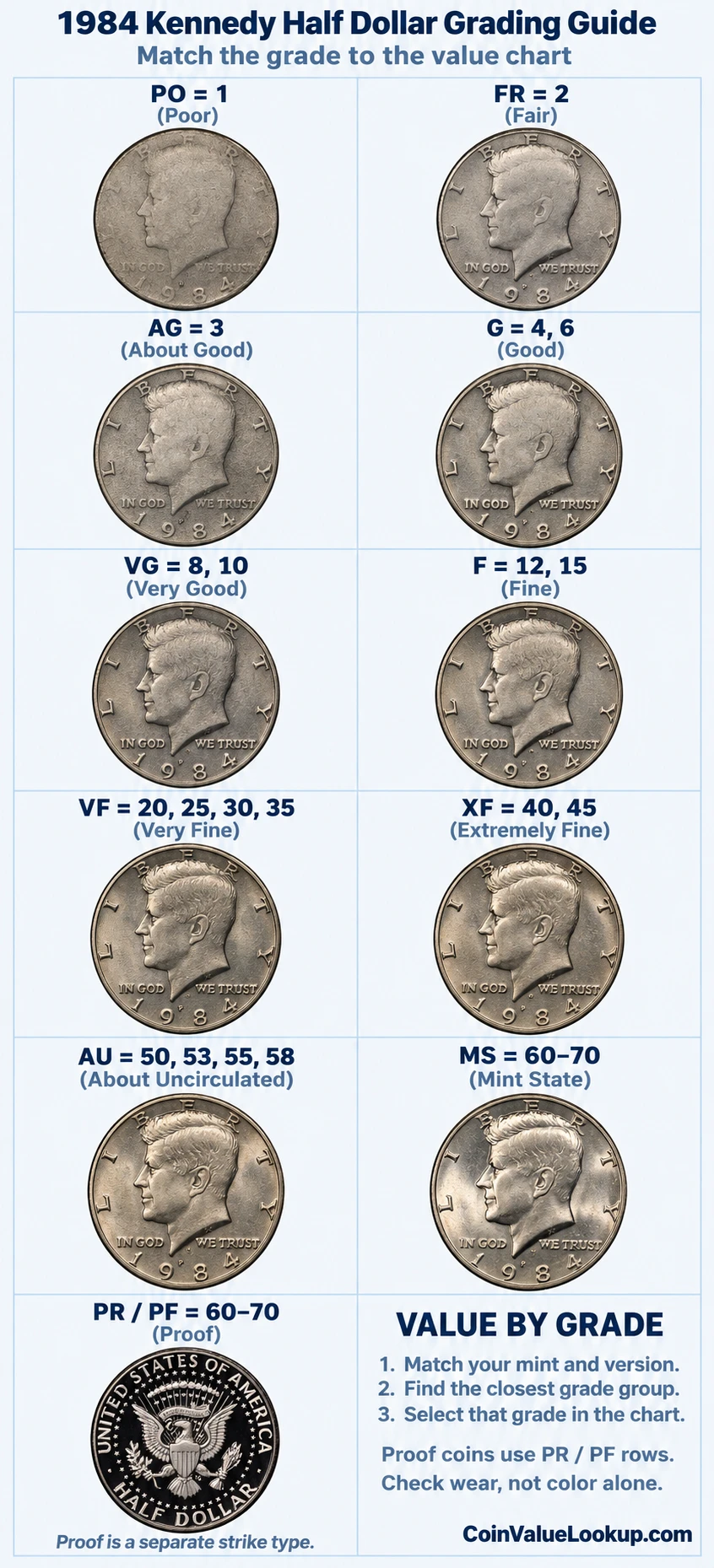
For business strikes, start with Kennedy's cheek and jawline. These are the highest points and the first to show friction.
Then check the hair above the ear — on a truly uncirculated coin, every strand is sharp and unbroken.
Flip to the reverse. The eagle's breast feathers and the tops of the wings lose definition early.
If those areas look smooth but the rest of the coin is sharp, you are likely looking at light wear.
Bag marks are a trap. A coin can be technically uncirculated but covered in small contact marks from bouncing around in mint bags.
These dings lower the grade without being circulation wear. Use the comparison image to calibrate your eye.
Proofs get graded differently. You are looking for hairlines from mishandling, haze from improper storage and contact marks.
A proof in its original government packaging with no visible issues will grade higher than one that has been removed and handled.
Step 3: Check 1984 Kennedy Half Dollar Value by Mint and Version
1984 Kennedy Half Dollar — P — clad business
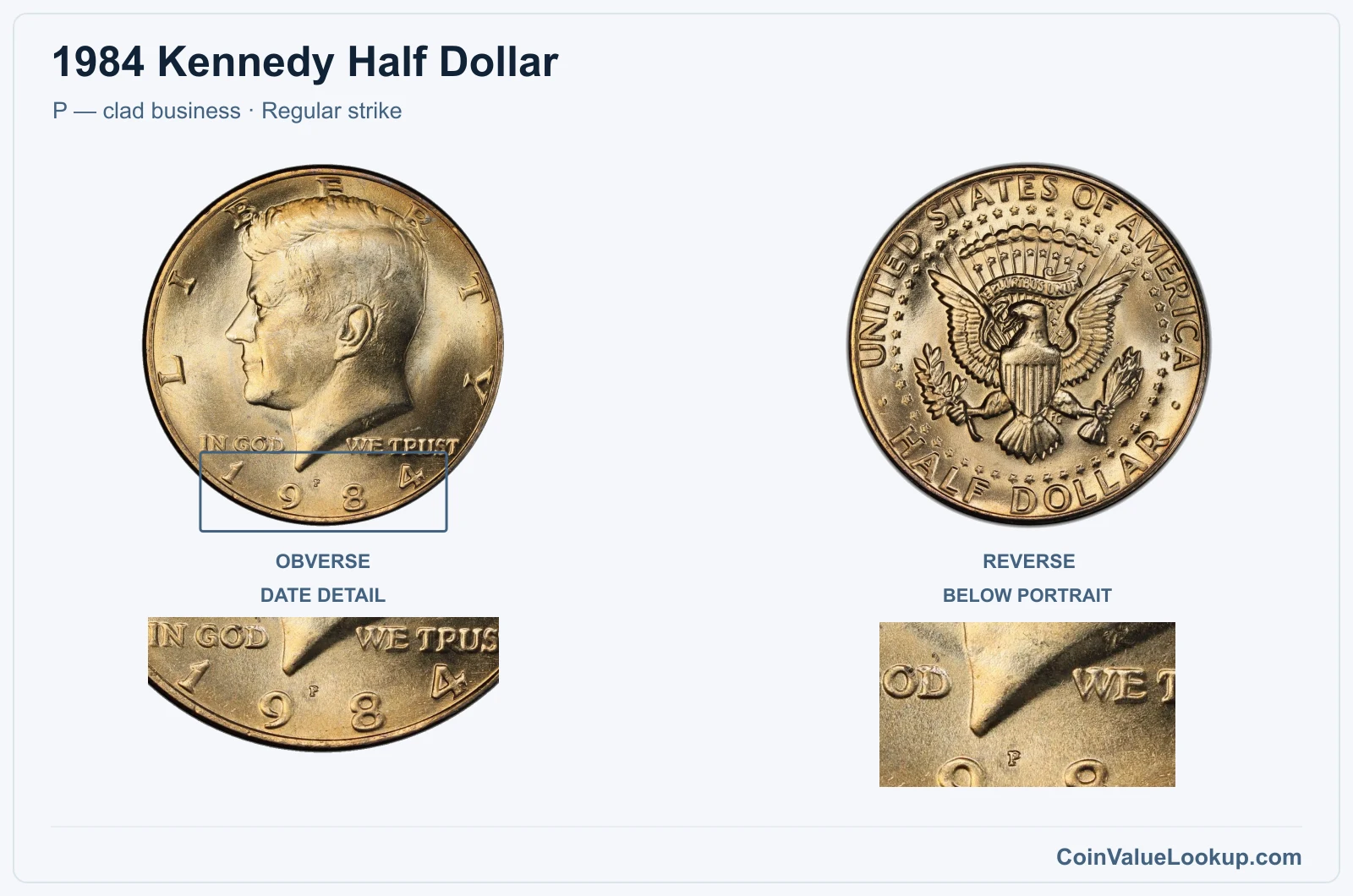
The 1984-P Kennedy half dollar is a copper-nickel clad business strike produced in Philadelphia. Look for the "P" mintmark on the obverse beneath Kennedy's portrait.
From 1980 onward, Philadelphia coins carry that small letter; earlier issues are unmarked.
Most circulated examples trade at face value. A USA Coin Book guide estimate places an MS65 example — a well-struck coin with minimal bag marks and full luster — at about $3.62.
That is not a guaranteed offer, just a reference point. If your coin shows any wear on the cheek or jaw, it almost certainly falls below that threshold.
Range Grade
Price Auction Records Appraisal PO PO 1
—
Coin Identifier FR FR 2
—
Coin Identifier AG AG 3
—
Coin Identifier G G 4
—
Coin Identifier
G 6
—
Coin Identifier VG VG 8
—
Coin Identifier
VG 10
—
Coin Identifier F F 12
—
Coin Identifier
F 15
—
Coin Identifier VF VF 20
—
Coin Identifier
VF 25
—
Coin Identifier
VF 30
—
Coin Identifier
VF 35
—
Coin Identifier XF XF 40
—
Coin Identifier
XF 45
—
Coin Identifier AU AU 50
—
Coin Identifier
AU 53
—
Coin Identifier
AU 55
—
Coin Identifier
AU 58
—
Coin Identifier MS MS 60
—
Coin Identifier
MS 61
—
Coin Identifier
MS 62
—
Coin Identifier
MS 63
Coin Identifier
MS 64
Coin Identifier
MS 65
Coin Identifier
MS 66
Coin Identifier
MS 67
Coin Identifier
MS 68
—
—
—
MS 69
—
—
—
MS 70
—
—
—
1984 Kennedy Half Dollar — D — clad business
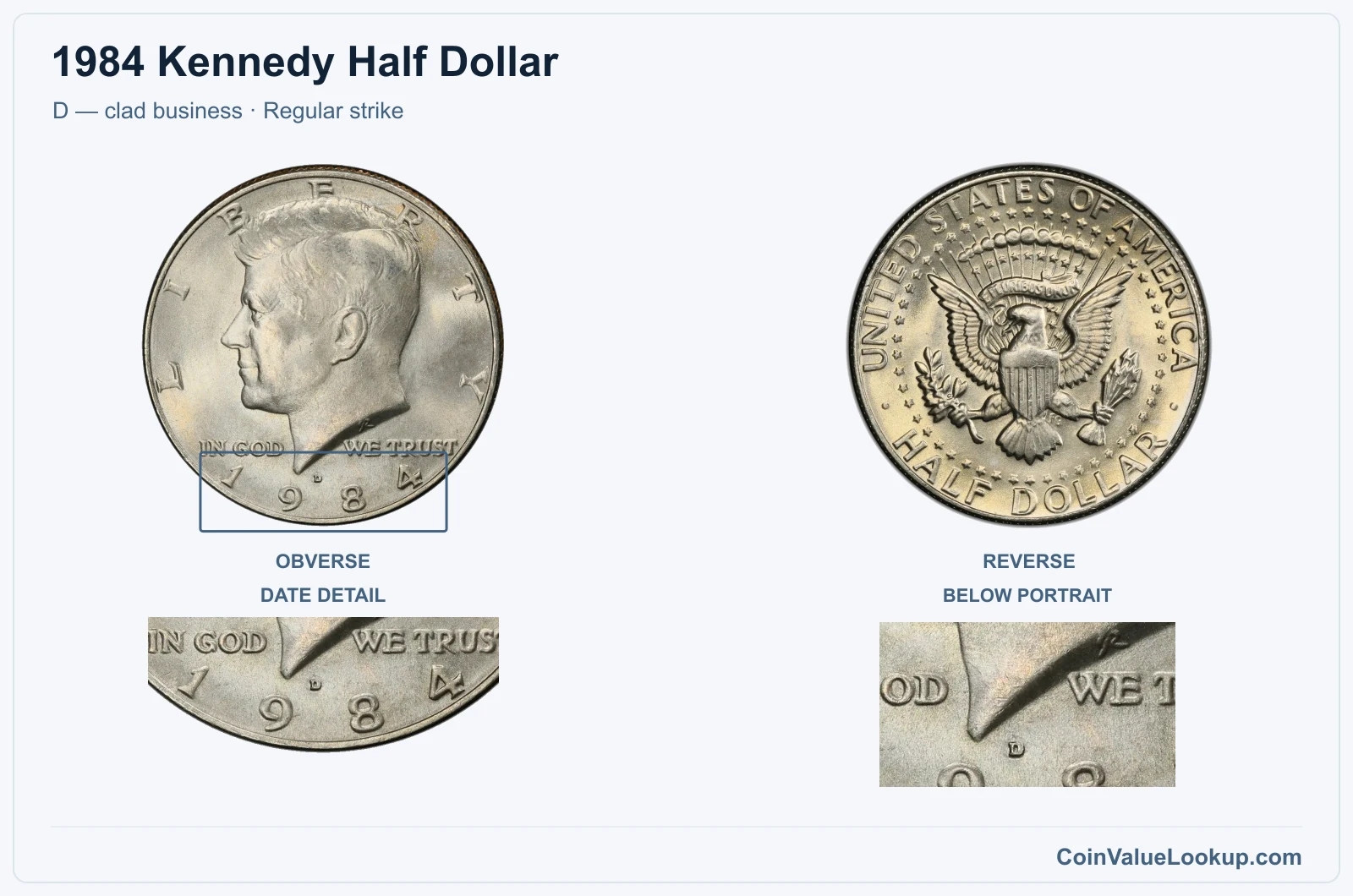
The 1984-D Kennedy half dollar was struck at the Denver Mint. You will see a small "D" beneath Kennedy's portrait on the obverse.
The composition is the same copper-nickel clad as the Philadelphia issue, weighing roughly 11.34 grams.
Circulated pieces are face-value coins. A USA Coin Book guide estimate puts a nice MS65 example at about $3.62.
Finding one that clean outside of an original roll is genuinely difficult, because bag marks accumulate fast on these large coins. Check luster and high points carefully before assuming yours qualifies.
Coin Value Lookup is a good place to look up guides for other Kennedy half dollar dates and mints if you are working through a collection.
Range Grade
Price Auction Records Appraisal PO PO 1
—
Coin Identifier FR FR 2
—
Coin Identifier AG AG 3
—
Coin Identifier G G 4
—
Coin Identifier
G 6
—
Coin Identifier VG VG 8
—
Coin Identifier
VG 10
—
Coin Identifier F F 12
—
Coin Identifier
F 15
—
Coin Identifier VF VF 20
—
Coin Identifier
VF 25
—
Coin Identifier
VF 30
—
Coin Identifier
VF 35
—
Coin Identifier XF XF 40
—
Coin Identifier
XF 45
—
Coin Identifier AU AU 50
—
Coin Identifier
AU 53
—
Coin Identifier
AU 55
—
Coin Identifier
AU 58
—
Coin Identifier MS MS 60
—
Coin Identifier
MS 61
—
Coin Identifier
MS 62
—
Coin Identifier
MS 63
—
Coin Identifier
MS 64
Coin Identifier
MS 65
Coin Identifier
MS 66
Coin Identifier
MS 67
Coin Identifier
MS 68
—
—
—
MS 69
—
—
—
MS 70
—
—
—
1984 Kennedy Half Dollar — S — clad proof
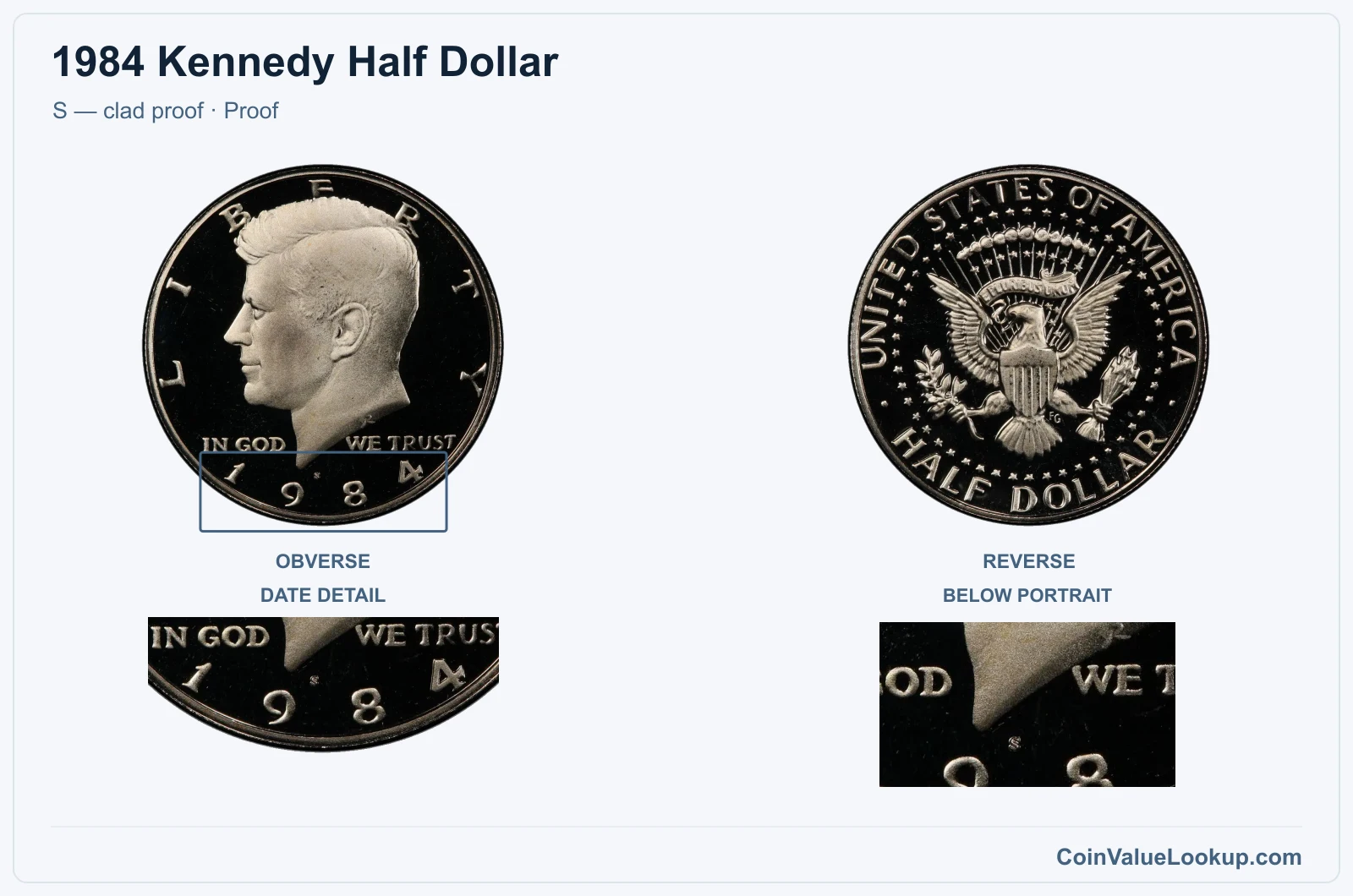
The 1984-S Kennedy half dollar is a clad proof struck at the San Francisco Mint. It carries an "S" mintmark beneath Kennedy's portrait.
Despite the mirror fields and sharp detail, this is not a silver coin — it is the same copper-nickel clad composition as the business strikes.
Proofs were sold in sealed government sets and were never meant for circulation. A USA Coin Book guide estimate places a PR65 example at about $4.96.
Grading proofs centers on hairlines, haze and contact marks rather than the wear patterns you look for on business strikes. Coins still sealed in their original packaging tend to grade best, because handling is the main enemy of a proof surface.
Range Grade
Price Auction Records Appraisal PR PR 1
—
Coin Identifier
PR 2
—
Coin Identifier
PR 3
—
Coin Identifier
PR 4
—
Coin Identifier
PR 6
—
Coin Identifier
PR 8
—
Coin Identifier
PR 10
—
Coin Identifier
PR 12
—
Coin Identifier
PR 15
—
Coin Identifier
PR 20
—
Coin Identifier
PR 25
—
Coin Identifier
PR 30
—
Coin Identifier
PR 35
—
Coin Identifier
PR 40
—
Coin Identifier
PR 45
—
Coin Identifier
PR 50
—
Coin Identifier
PR 53
—
Coin Identifier
PR 55
—
Coin Identifier
PR 58
—
Coin Identifier
PR 60
—
Coin Identifier
PR 61
—
Coin Identifier
PR 62
—
Coin Identifier
PR 63
—
Coin Identifier
PR 64
—
Coin Identifier
PR 65
—
Coin Identifier
PR 66
Coin Identifier
PR 67
Coin Identifier
PR 68
Coin Identifier
PR 69
Coin Identifier
PR 70
Coin Identifier
1984 Kennedy Half Dollar Error List
1. 1984 Kennedy Half Dollar — Off-Center Strike
An off-center strike happens when the coin blank is not properly seated between the dies. The result is a displaced design with an unstruck crescent of blank metal along one edge.
On a 1984 Kennedy half dollar, the most collectible off-center errors keep the full date visible despite the shift.
Do not confuse an off-center strike with a clipped planchet, which removes a section of edge metal in a different shape, or with post-mint damage from being flattened or bent. A genuine off-center error shows a complete, sharp design that simply starts in the wrong place.
No reliable numerical price range is available for this error. Value depends on the degree of off-center shift, whether the date is readable and the coin's overall condition.
2. 1984 Kennedy Half Dollar — Doubled Die Reverse
A doubled die reverse on a 1984 Kennedy half dollar shows consistent doubling on the reverse design elements — letters in the legends, the eagle's features or other raised details. The key word is consistent: every affected area shifts in the same direction by the same amount, because the doubling occurred when the die itself was made.
Compare your reverse closely to a normal coin under good light. Look for separation, notching or thickening on lettering rather than a flat, shelf-like distortion.
That flat shelf appearance usually points to machine doubling, which is mechanical damage from the striking process and carries little collector interest.
No adopted price range is available. The value of any doubled die depends on how visible the doubling is, which die pair produced it and the coin's grade.
3. 1984 Kennedy Half Dollar — Doubled Die Obverse
A doubled die obverse on a 1984 Kennedy half dollar displays consistent separation or notching on obverse design elements such as "LIBERTY," "IN GOD WE TRUST" or details in Kennedy's portrait. The doubling is baked into the die, so it repeats identically on every coin struck from that die.
To check, compare your obverse lettering and design contours to a normal example under the same lighting. Genuine hub doubling shows clean, consistent directional separation.
Machine doubling, by contrast, typically looks like a flat shelf pushed to one side with reduced sharpness — that kind is common and not particularly valuable.
No numerical price range is adopted for this error. Condition, the strength of the doubling and the specific die involved all affect what a collector might pay.
4. 1984 Kennedy Half Dollar — Broadstrike
A broadstruck 1984 Kennedy half dollar was struck without the retaining collar that normally constrains the coin to its proper diameter. The result is a coin that spreads outward, appearing slightly larger than normal with a distorted or absent rim.
The full design is present, unlike an off-center strike where part of the design is missing entirely.
Check the edge carefully. A broadstrike will have a flat or irregular edge profile instead of the normal reeded edge of a half dollar.
Coins flattened after minting by a vise or railroad track will show different damage patterns — usually smeared detail and uneven thickness.
No specific price range is available. Value depends on the severity of the spread, whether the coin is otherwise well-struck, and its overall condition.
5. 1984 Kennedy Half Dollar — Struck-Through Error
A struck-through error occurs when foreign material — grease, a thread, a fragment of metal — sits between the die and the blank during striking. The result is a localized depression, a strange texture or an area of incomplete design where the obstruction blocked the die's impression.
On a 1984 Kennedy half dollar, look for a clearly defined area that differs from normal wear. Grease fill-ins tend to produce smooth, rounded missing detail, while a retained foreign object may leave a distinct outline or texture in the coin's surface.
Do not confuse a struck-through with ordinary wear, cleaning scratches or weak strike from a deteriorating die. Struck-through areas have defined boundaries and sit within otherwise normal surrounding detail.
No adopted price is available; value depends on the size, type and visibility of the obstruction impression.
6. 1984 Kennedy Half Dollar — Rotated Dies
Die rotation errors on 1984 Kennedy half dollars have been reported primarily in the context of proof coins. To test for rotation, hold the obverse upright and flip the coin top-to-bottom along its vertical axis.
On a normally aligned US coin, the reverse should also appear upright. Any deviation from that standard 180-degree alignment is a die rotation.
Small rotations of a few degrees are relatively common and add little premium. Larger rotations — say, 45 degrees or more — attract more collector attention.
Be careful with photographs: a rotated image is not a rotated die. You need to physically flip the coin or verify alignment in hand.
No specific price range is adopted. The degree of rotation and the coin's condition both matter.
7. 1984 Kennedy Half Dollar — Double / Multiple Strike
A double-struck or multiple-struck 1984 Kennedy half dollar shows two or more distinct impressions from repeated strikes. You will typically see overlapping or displaced design elements — not just thickened letters, but clearly separate sets of design details where the coin was struck, shifted and struck again.
This is different from a doubled die, where the doubling is on the die itself and appears as consistent minor separation. A double strike produces a dramatically distorted coin with obviously repeated full or partial impressions.
Look for two distinct outlines of Kennedy's portrait or two sets of reverse legends at different angles. Post-mint damage such as vise marks or counter-stamping can mimic a second strike, but those impressions lack the sharp, die-quality detail of a genuine mint-produced second strike.
No numerical price range is available for this error.
8. 1984 Kennedy Half Dollar — Missing FG Initials
The "FG" initials on the reverse of Kennedy half dollars identify designer Frank Gasparro. On some 1984-P half dollars, collectors have reported coins where these initials appear to be missing.
This has been discussed as a possible result of die polishing at the mint, where aggressive polishing of a working die can remove fine details like small initials.
Before concluding your coin is a genuine missing-FG example, look carefully at the area near the eagle's tail feathers where the initials belong. Normal wear, grease fill during striking and even deliberate post-mint removal can all produce a similar look.
Compare the surrounding reverse detail — if the nearby feathers and design elements are also weak or mushy, wear or a filled die is the more likely explanation.
No adopted price range is available. The value of a missing-FG coin depends on whether the absence is confirmed as a die state rather than damage or wear.