1887 Liberty Seated Quarter Coin Value: How Much Is It Worth?
The 1887 Liberty Seated Quarter is a late-date issue from a long-running series that ended just four years later. Guide estimates from USA Coin Book range from about $321.00 in well-worn Good-4 condition up to $1,399.00 for an uncirculated MS63 business strike, while a proof finish example is listed around $938.00 at PR63.
Those figures depend entirely on whether your coin is a regular strike or a proof, plus its actual condition and surface quality.
Fast Way to Identify Your 1887 Liberty Seated Quarter
The quickest way to start figuring out what you have is to upload clear photos of both sides of your coin. A front and back image lets us provide a preliminary identification of the mint, finish type, and approximate condition.
Snap the photos in even lighting without flash glare, and you will get a much better starting point than guessing from memory.
1887 Liberty Seated Quarter Value
Upload both sides of your 1887 Liberty Seated Quarter.
Front Obverse
Upload photo
Back Reverse
Upload photo
Which 1887 Liberty Seated Quarter Versions Are Worth Money?
- 1887 business strike: USA Coin Book lists the MS63 grade at $1,399.00 and even a worn Good-4 at $321.00, reflecting the coin's silver content and collector demand for this late-date issue.
- 1887 Proof: guide value of $938.00 at PR63; proof examples were produced in limited quantities for collectors and require mirror fields and sharp rims to confirm.
- Check your coin's finish and mint first. Damage, heavy wear, or a bright cleaned surface does not make a coin rare or establish it as a proof.
Step 1: Identify Your 1887 Liberty Seated Quarter Mint Mark and Version
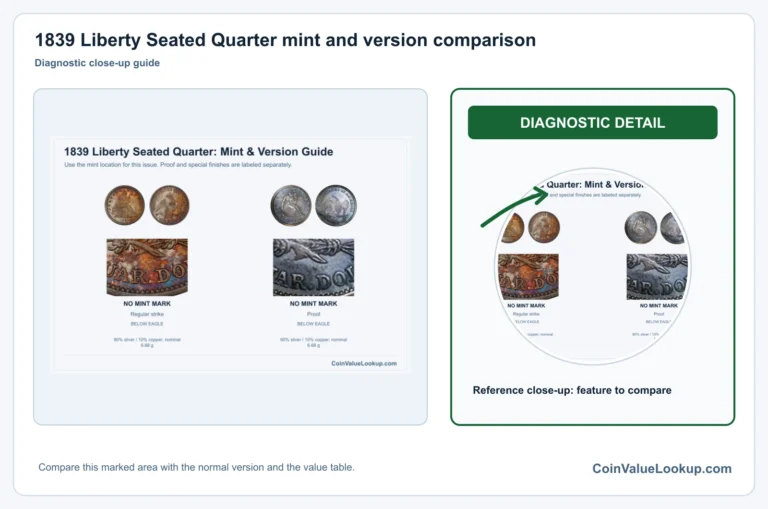
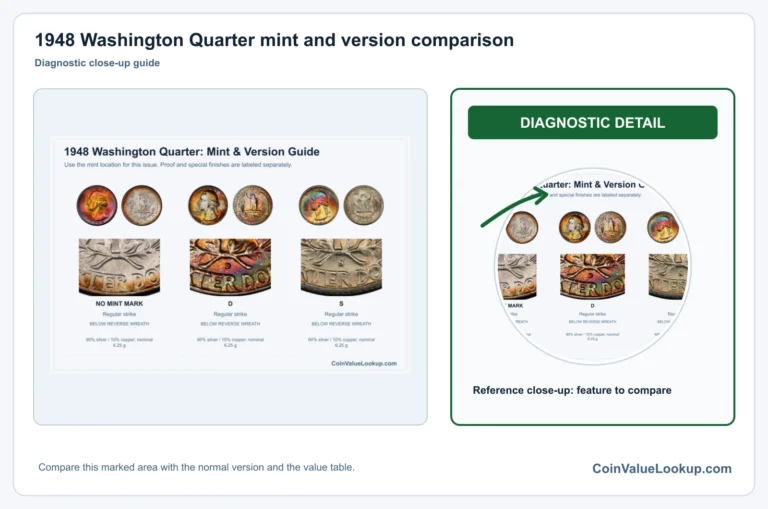
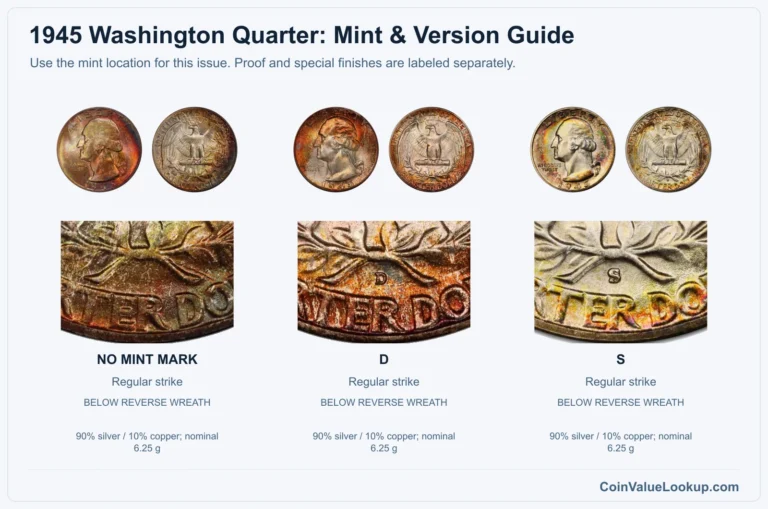
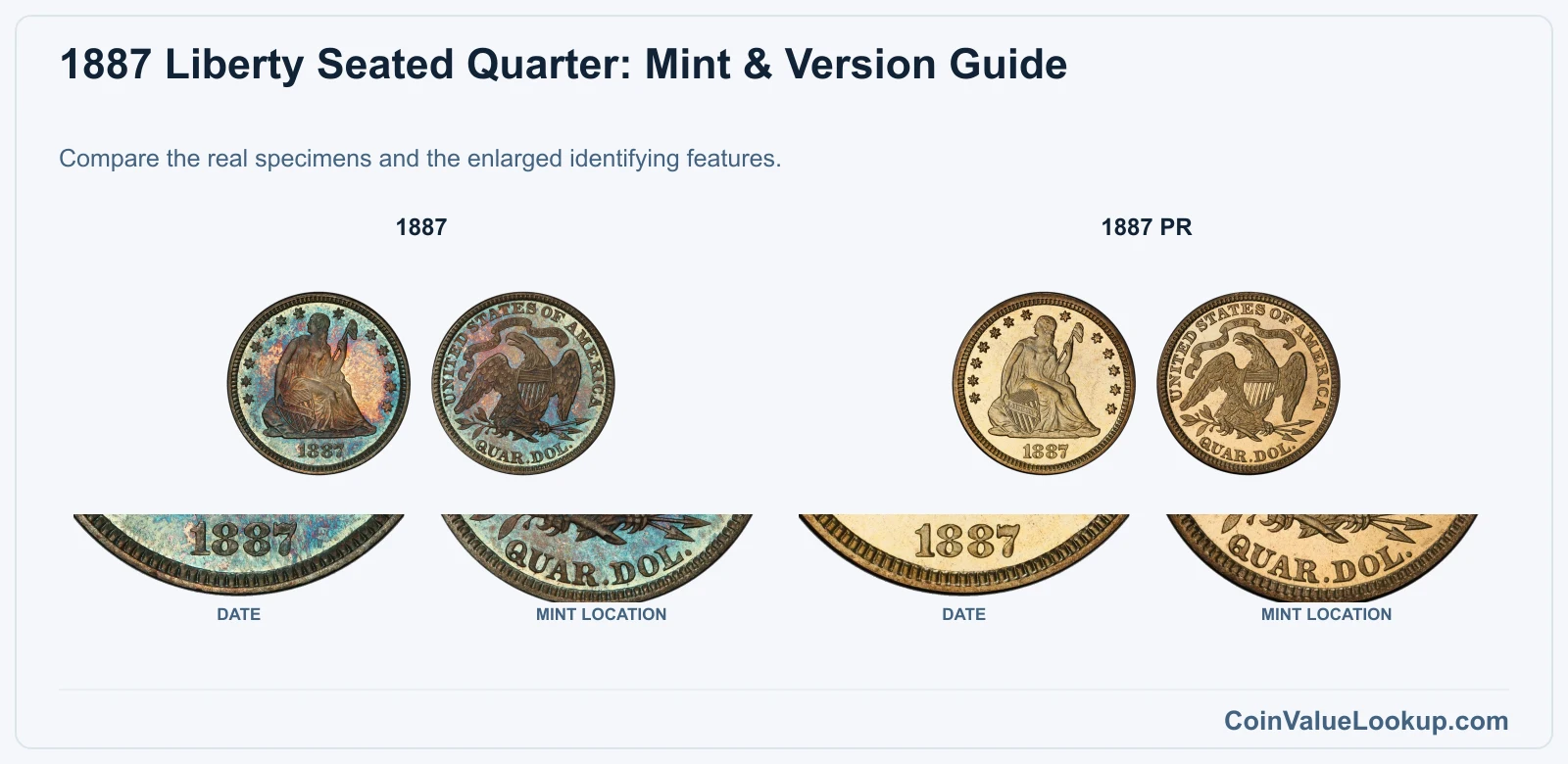
Every 1887 quarter was struck at the Philadelphia Mint, so there is no mintmark on this date. If you see a small letter below the eagle on the reverse, you are looking at a different year or denomination.
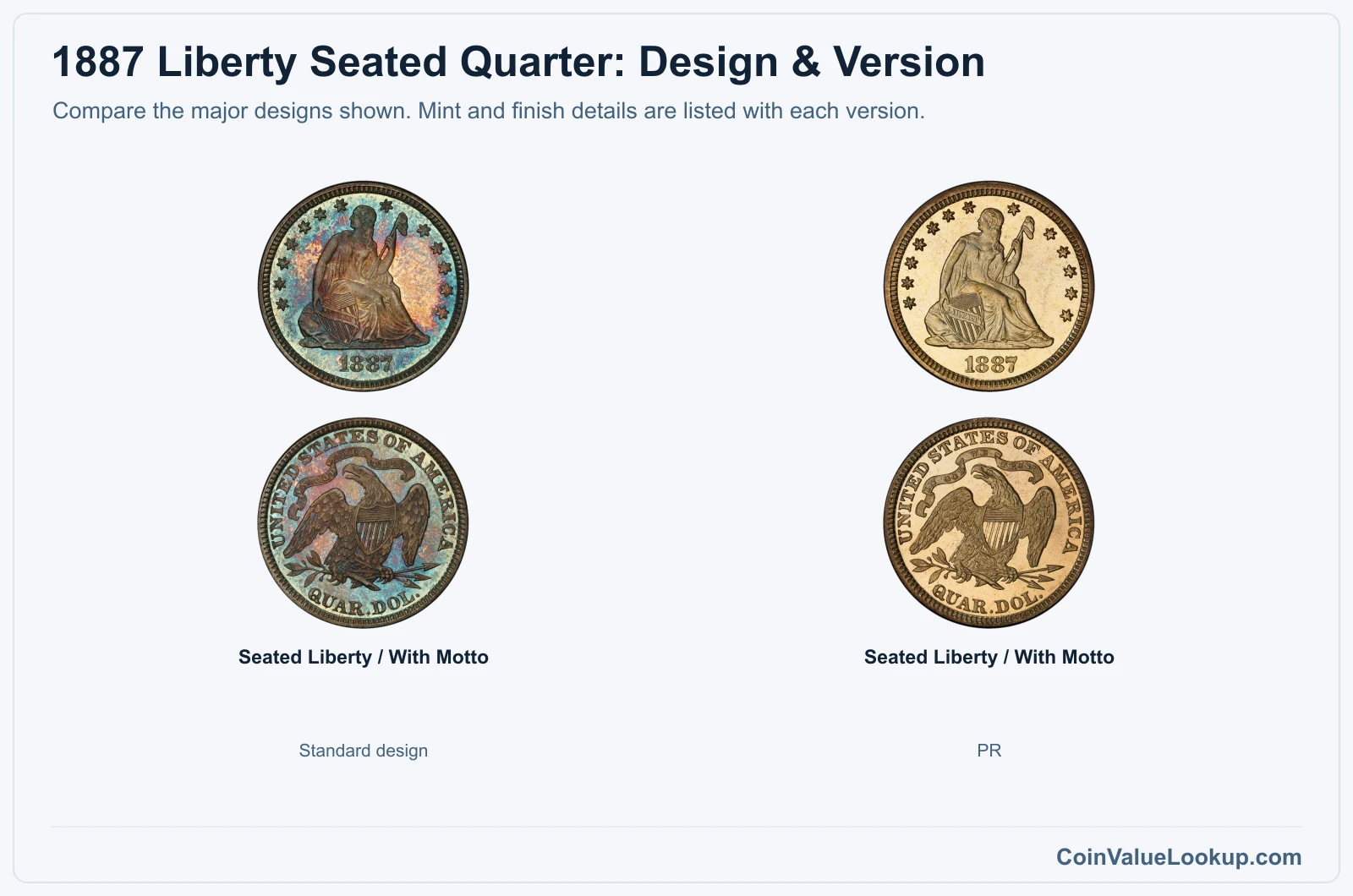
The coin is 90% silver and 10% copper, weighing 6.25 grams. It carries the Seated Liberty obverse with the "In God We Trust" motto banner above the eagle on the reverse, a feature added to the series in 1866.
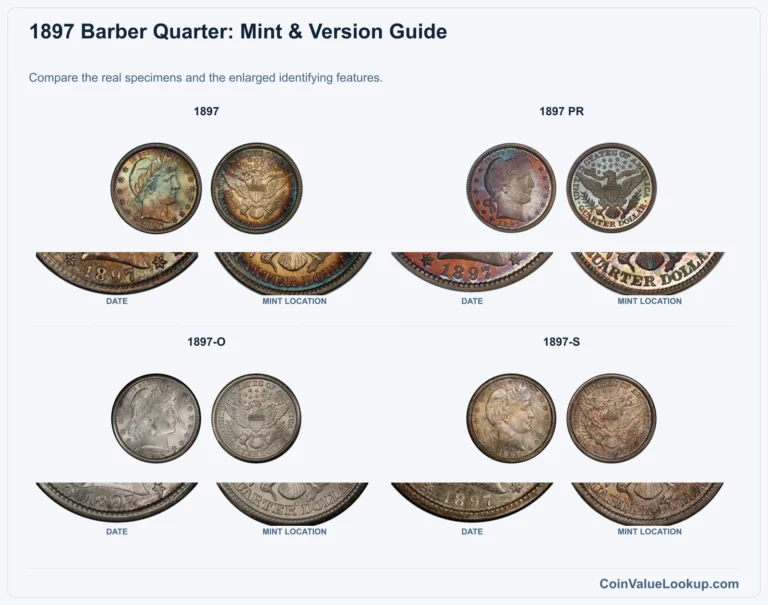
Two versions exist for 1887: the regular business strike and the proof. Business strikes were made for commerce and show varying degrees of luster and contact marks.
Proofs were specially manufactured with polished dies and planchets, producing mirror-like fields. A shiny, cleaned regular strike is not a proof.
Look for squared-off rims and exceptionally sharp detail in the stars and denticles as starting indicators of proof manufacture.
Step 2: Check Your 1887 Liberty Seated Quarter Grade
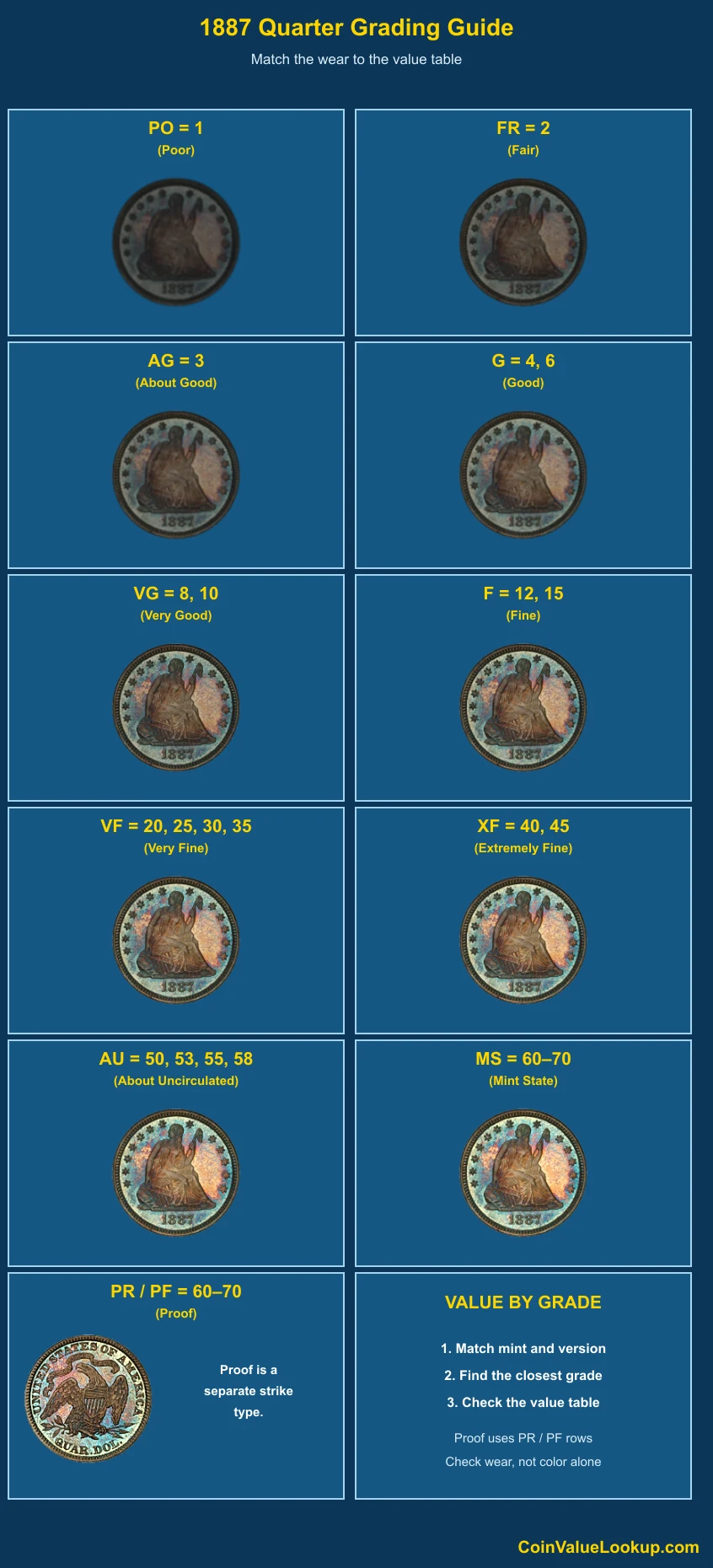
Start with Liberty herself. On a lightly worn coin, the first areas to lose detail are the top of her head, the area across her breast, and the knee of her forward leg.
The shield on her arm also flattens early. A coin grading Good-4 will have a visible outline of Liberty but most interior detail is gone.
On the reverse, check the eagle's breast feathers and the upper edges of the wings. These smooth out before the tail feathers and lower shield.
Use the comparison image to match your coin's wear pattern against known grade examples of the same Liberty Seated type. Luster matters as much as detail.
A coin with full design elements but no original mint luster is not the same as one with cartwheel shine intact.
Watch out for weakly struck centers, which are common on this series. A soft strike can make an otherwise unworn coin look like it has wear on Liberty's head or the eagle's breast.
If the surrounding areas retain sharp detail and full luster, the softness is likely from the strike, not handling.
Step 3: Check 1887 Liberty Seated Quarter Value by Mint and Version
1887 Liberty Seated Quarter
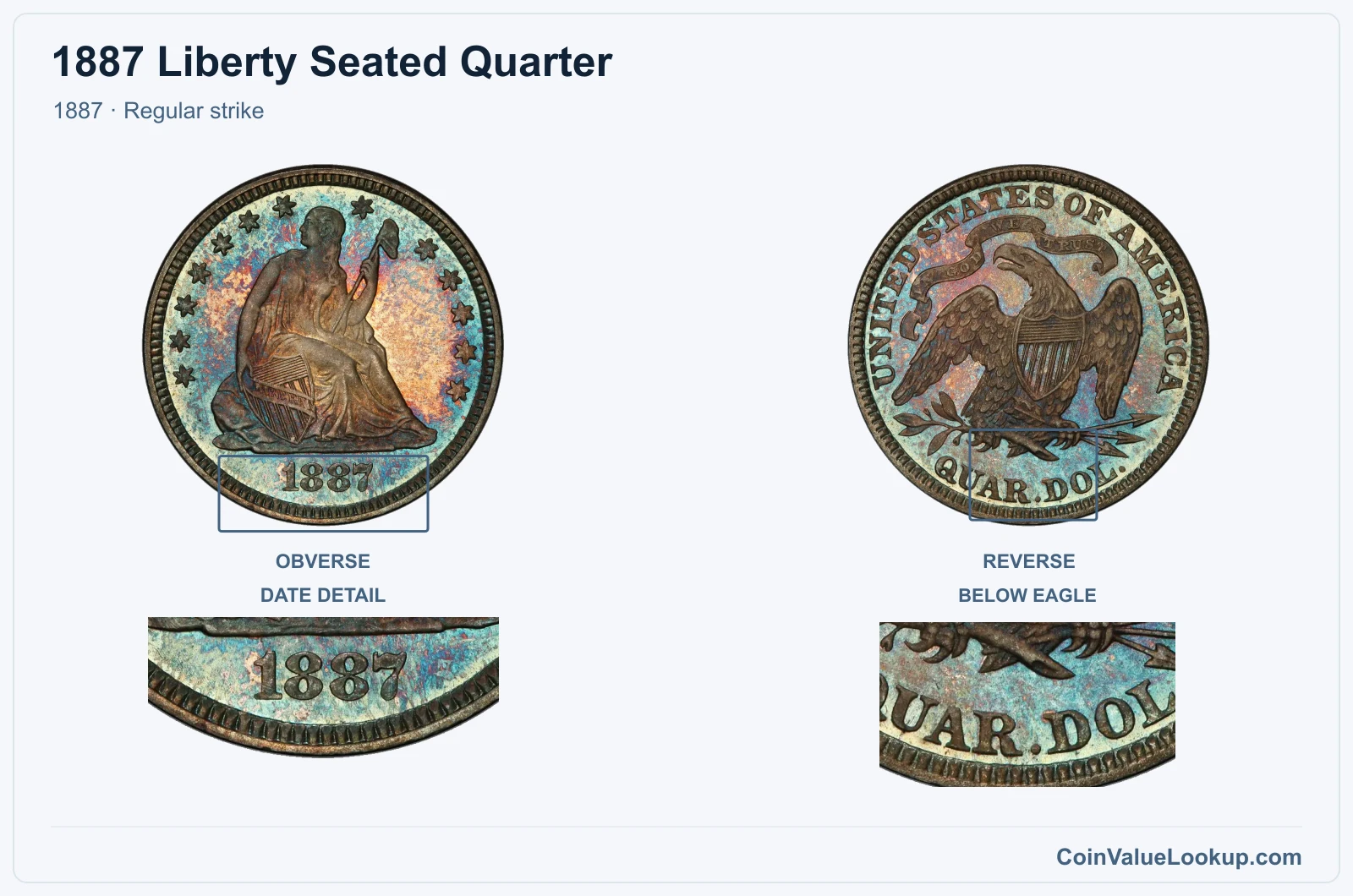
The 1887 business strike was produced at Philadelphia with no mintmark. It is a 90% silver coin weighing 6.25 grams, featuring the Seated Liberty obverse and the eagle-with-motto reverse.
USA Coin Book lists guide estimates of $321.00 at Good-4, $1,072.00 at MS60, and $1,399.00 at MS63. These are retail guide figures, not guaranteed sale prices.
Actual value depends on strike sharpness, surface preservation, and whether the coin has been cleaned or damaged. Original, problem-free surfaces matter a lot with this series.
A coin with harsh cleaning lines or rim dings will trade well below these guides regardless of its technical grade.
If you are exploring other dates and denominations, Coin Value Lookup is a good place to look up coin guides across many U.S. series.
Range Grade
Price Auction Records Appraisal PO PO 1
—
Coin Identifier FR FR 2
Coin Identifier AG AG 3
Coin Identifier G G 4
—
Coin Identifier
G 6
—
Coin Identifier VG VG 8
Coin Identifier
VG 10
Coin Identifier F F 12
Coin Identifier
F 15
—
Coin Identifier VF VF 20
Coin Identifier
VF 25
Coin Identifier
VF 30
Coin Identifier
VF 35
Coin Identifier XF XF 40
Coin Identifier
XF 45
Coin Identifier AU AU 50
Coin Identifier
AU 53
—
Coin Identifier
AU 55
—
Coin Identifier
AU 58
Coin Identifier MS MS 60
—
Coin Identifier
MS 61
Coin Identifier
MS 62
Coin Identifier
MS 63
Coin Identifier
MS 64
Coin Identifier
MS 65
Coin Identifier
MS 66
Coin Identifier
MS 67
Coin Identifier
MS 68
Coin Identifier
MS 69
—
—
—
MS 70
—
—
—
1887 Liberty Seated Quarter — PR
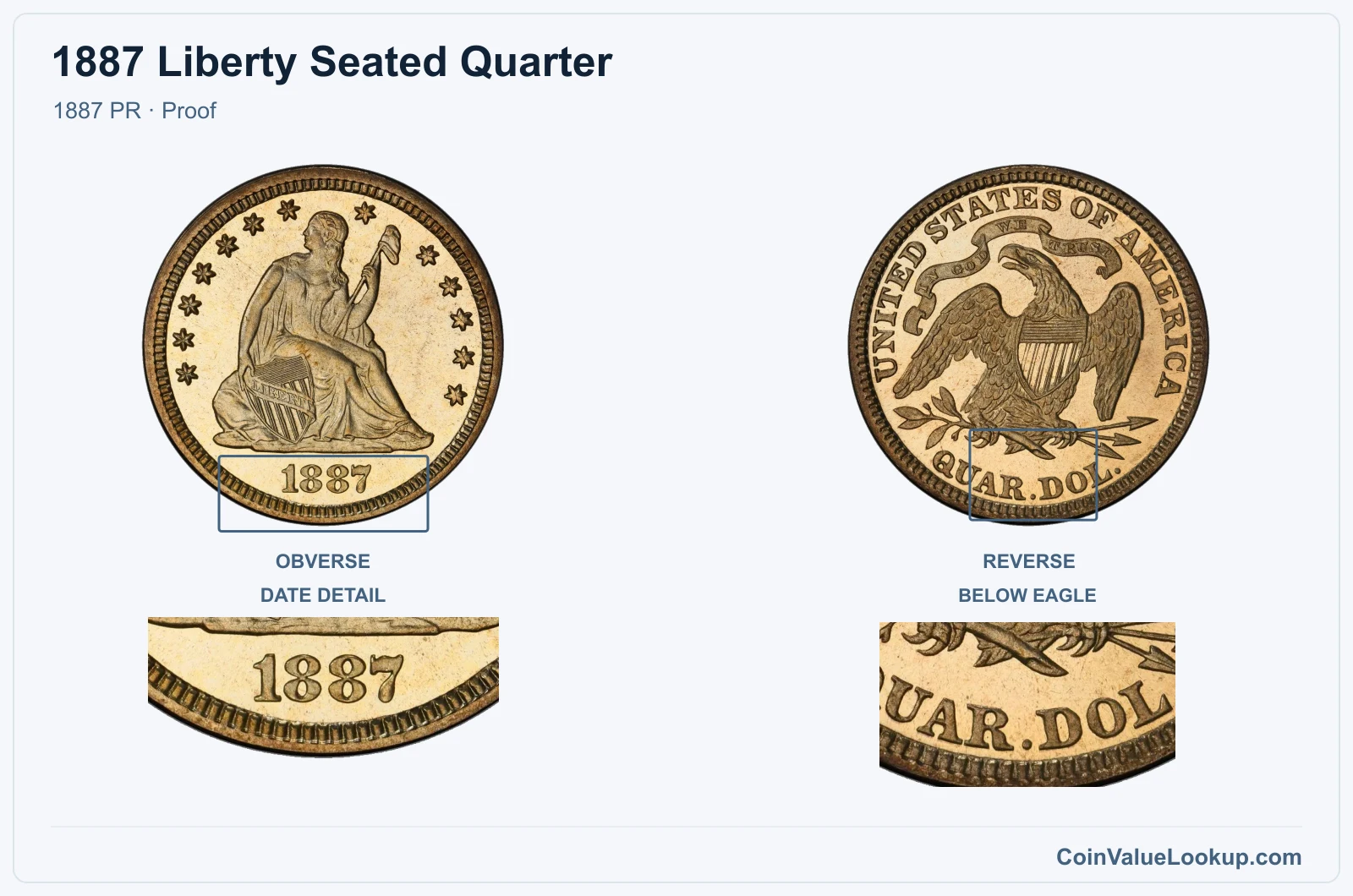
The 1887 Proof quarter was a collector-only issue struck at Philadelphia with specially prepared dies and planchets. Like the business strike, it carries no mintmark and is composed of 90% silver and 10% copper at 6.25 grams.
USA Coin Book places the PR63 guide estimate at $938.00. That figure assumes original proof surfaces free of significant problems.
Proof manufacture produces deeply reflective mirror fields and exceptionally crisp design elements, including sharp denticles and squared rims. Do not confuse a polished or lightly cleaned business strike with a proof; the manufacturing differences go well beyond surface shine.
Hairlines from improper handling or storage are the most common issue on proof Seated quarters. Even light wiping leaves fine lines visible under magnification, and these pull the grade and value down quickly.
Surface haze from decades in old holders is another factor to evaluate before comparing to guide prices.
Range Grade
Price Auction Records Appraisal PR PR 1
—
Coin Identifier
PR 2
—
Coin Identifier
PR 3
—
Coin Identifier
PR 4
—
Coin Identifier
PR 6
—
Coin Identifier
PR 8
—
Coin Identifier
PR 10
—
Coin Identifier
PR 12
—
Coin Identifier
PR 15
—
Coin Identifier
PR 20
—
Coin Identifier
PR 25
—
Coin Identifier
PR 30
—
Coin Identifier
PR 35
—
Coin Identifier
PR 40
—
Coin Identifier
PR 45
—
Coin Identifier
PR 50
—
Coin Identifier
PR 53
—
Coin Identifier
PR 55
—
Coin Identifier
PR 58
—
Coin Identifier
PR 60
Coin Identifier
PR 61
Coin Identifier
PR 62
Coin Identifier
PR 63
Coin Identifier
PR 64
Coin Identifier
PR 65
Coin Identifier
PR 66
Coin Identifier
PR 67
Coin Identifier
PR 68
Coin Identifier
PR 69
—
—
—
PR 70
—
—
—