1809 Capped Bust Dime Coin Value: How Much Is It Worth?
The 1809 Capped Bust Dime is one of the earliest silver dimes produced at the Philadelphia Mint, and it remains a genuinely scarce coin more than two centuries later. USA Coin Book guide estimates place this date between roughly $1,001 in well-worn Good-4 condition and $15,247 for an uncirculated MS63 example.
These are guide anchors for specific grades, not guaranteed offers, and your coin's actual value depends on its surfaces, wear and overall condition.
Fast Way to Identify Your 1809 Capped Bust Dime
Snap clear photos of both the front and back of your 1809 dime and upload them here for a preliminary identification. Good lighting and a steady hand help.
This step can confirm the correct denomination, design type and approximate condition so you know which guide values might apply to your specific coin.
1809 Capped Bust Dime Value
Upload both sides of your 1809 Capped Bust Dime.
Front Obverse
Upload photo
Back Reverse
Upload photo
Which 1809 Capped Bust Dime Versions Are Worth Money?
- The 1809 date is the key identifier; confirm it before applying any value reference.
- Original, problem-free surfaces (no cleaning, scratches or corrosion) preserve full grade-appropriate value.
- Well-preserved examples approaching MS63 can reach the $15,247 guide level according to USA Coin Book, making condition the single biggest value driver.
- Even heavily worn Good-4 examples carry a guide estimate around $1,001, reflecting the overall scarcity of this early date.
Step 1: Identify Your 1809 Capped Bust Dime Mint Mark and Version
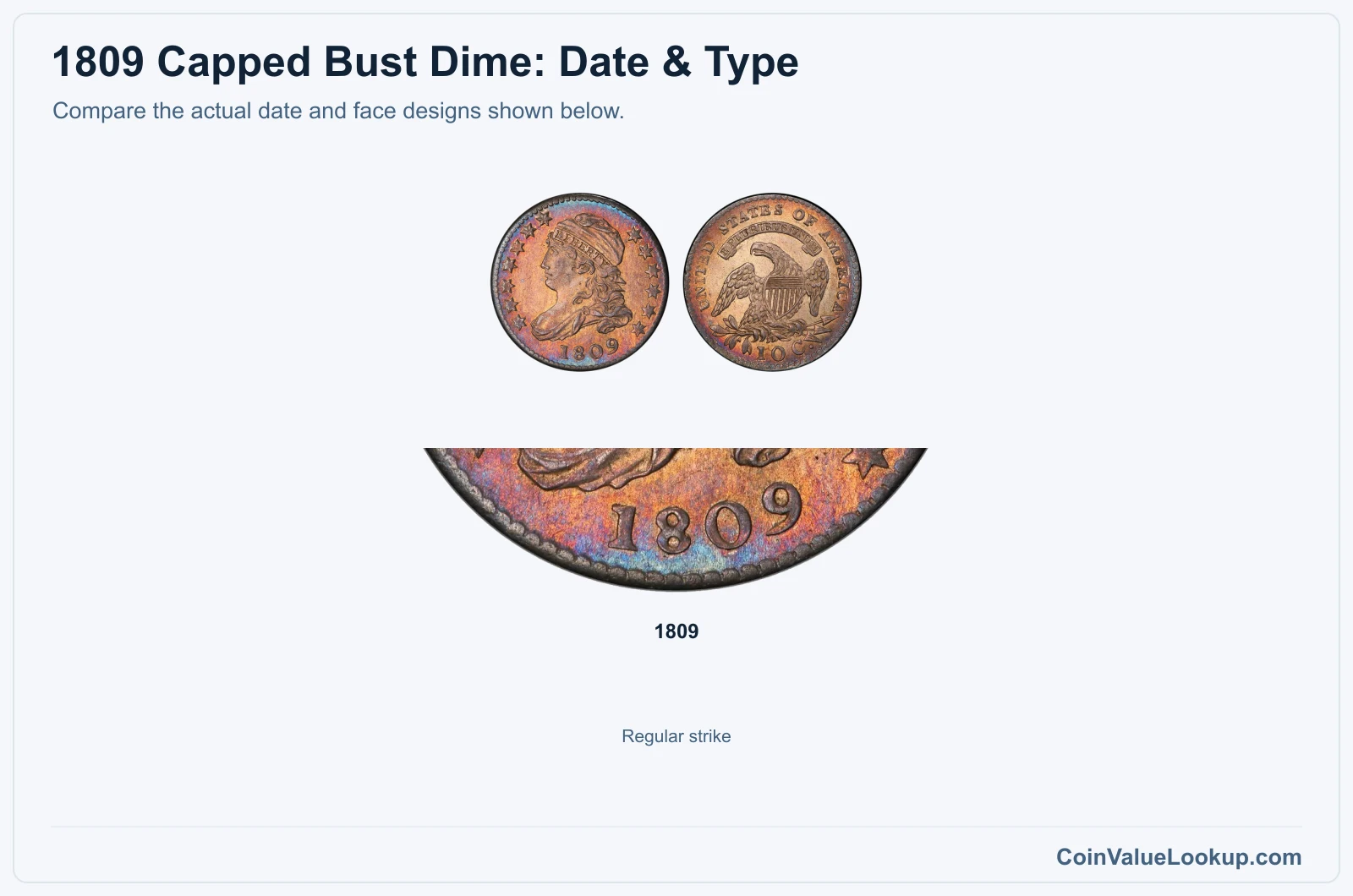
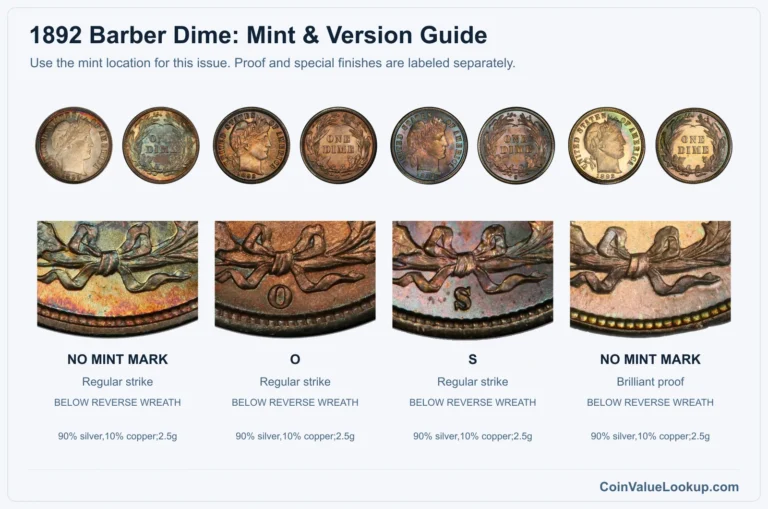
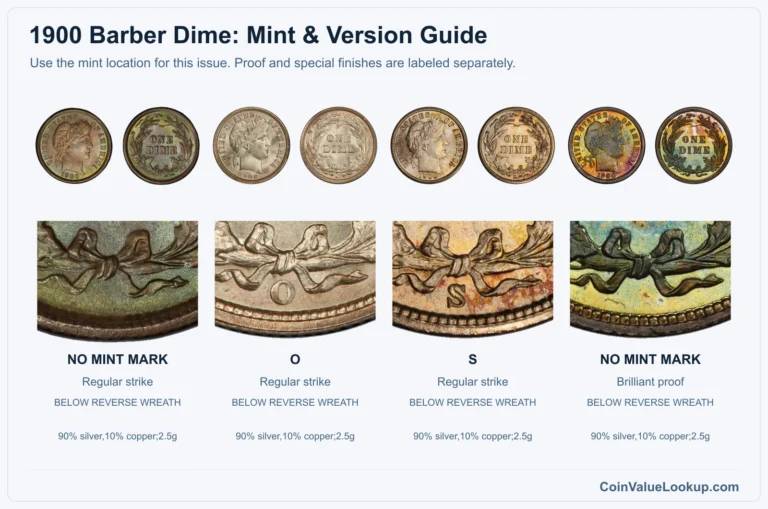
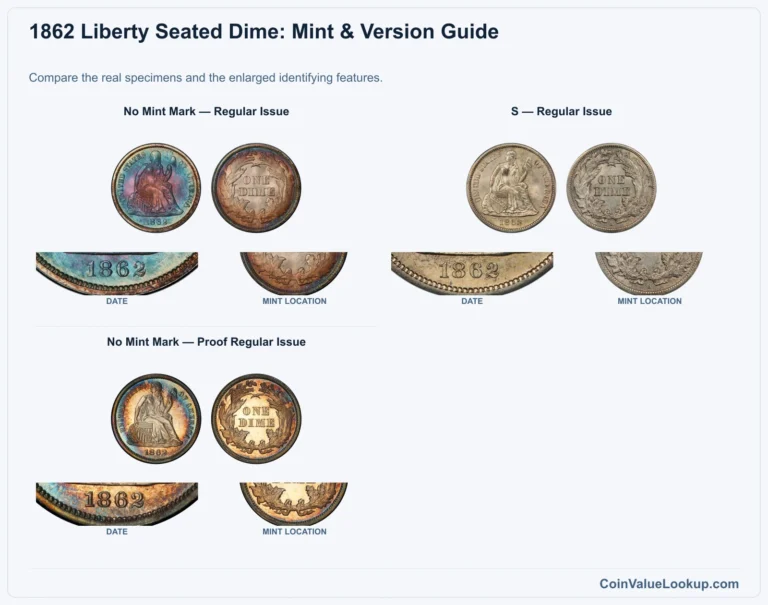
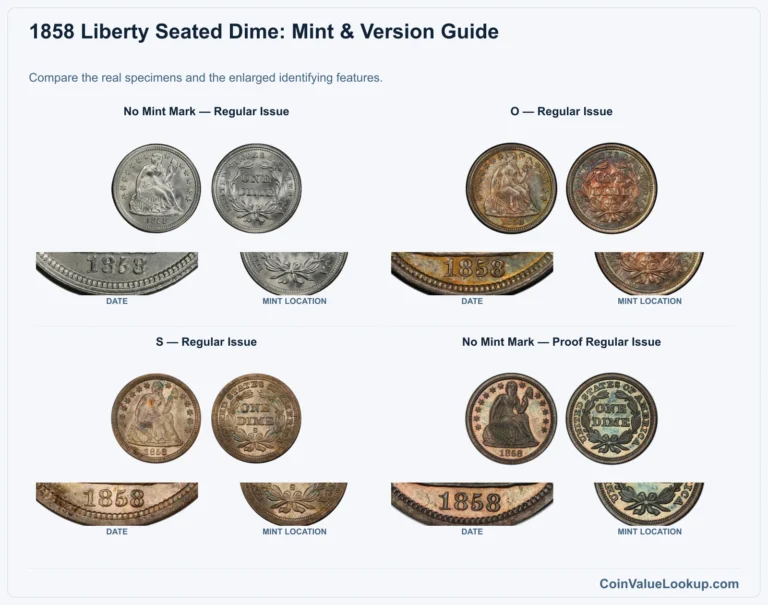
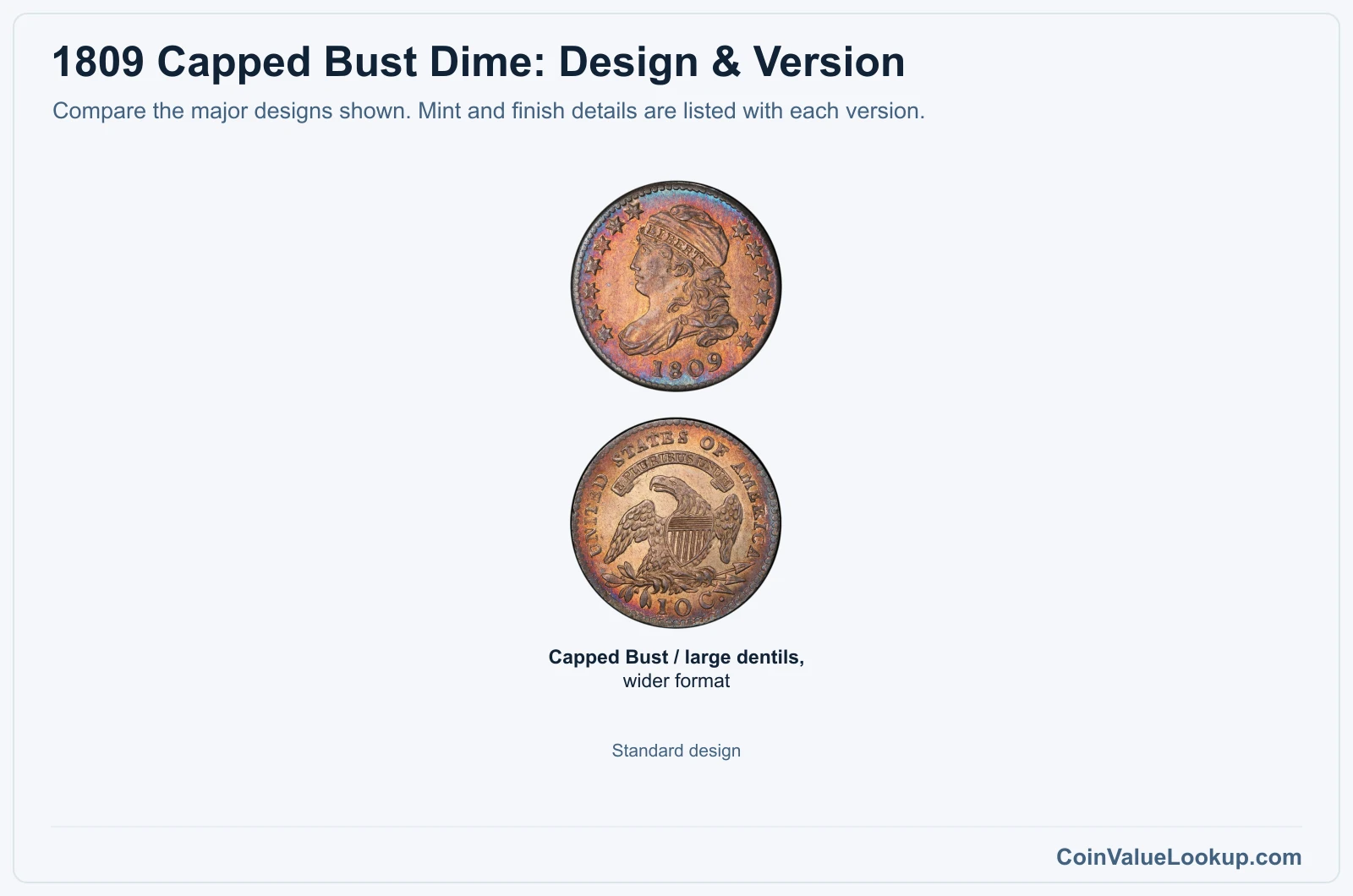
Every 1809 dime was struck at Philadelphia, so there is no mintmark to look for. The design is the Capped Bust type with large dentils (the tooth-like border elements) and a wider planchet format than later dimes.
On the obverse, Liberty faces left wearing a cloth cap with a ribbon, surrounded by stars and the date 1809 at the bottom. The reverse shows a heraldic eagle with a shield on its breast, olive branch and arrows in its talons, and the inscription UNITED STATES OF AMERICA around the rim.
The coin is struck in a silver-copper alloy of approximately 89.24% silver. Do not confuse it with a half dime, which is a noticeably smaller coin of a different denomination.
Confirm the date reads 1809 clearly. Match the wide-format Capped Bust design before comparing any price references.
Original, untampered surfaces are far more important than how shiny the coin looks.
Step 2: Check Your 1809 Capped Bust Dime Grade
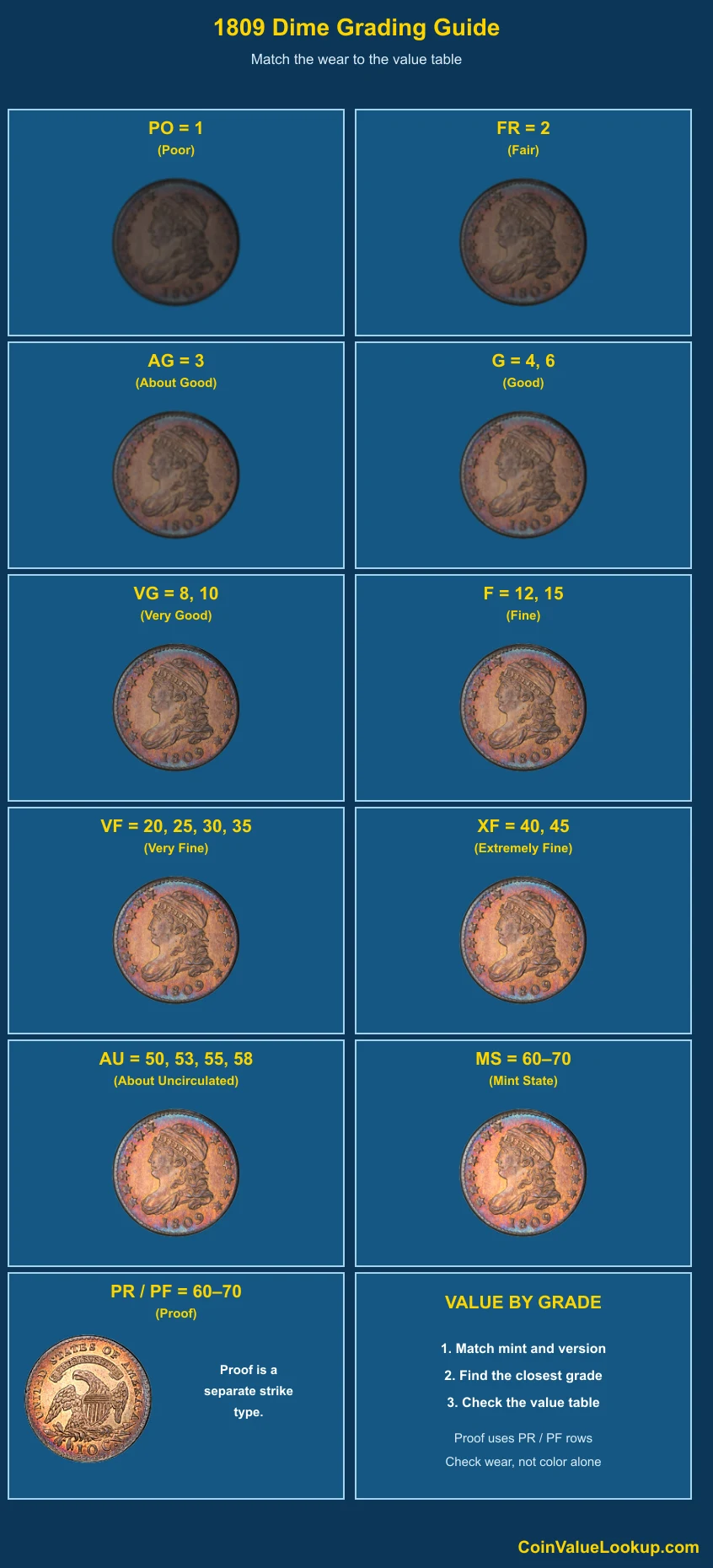
Start with Liberty's hair curls above the forehead and ear. On a well-worn coin these blend into flat, undefined patches.
A lightly circulated piece retains individual curl definition, and an unworn example shows full, sharp strands with original mint luster in the protected areas.
Check Liberty's cheek next. It is a high point that picks up wear early.
Smoothness there without luster suggests circulation.
On the reverse, the eagle's breast feathers and wing tips wear first. Compare yours to the reference image to see how much detail remains versus a known grade.
Here is the tricky part with early dimes: these were struck on hand-operated presses. Uneven strike pressure can leave soft spots on a coin that never circulated a day in its life.
Look at overall luster and contact marks together, not just sharpness in one area. A coin with uniform luster and only minor bag marks but a slightly weak eagle breast may still grade higher than one with sharp details but heavy scratches.
Never clean or polish the coin. Cleaning destroys original toning and surfaces, and it sharply reduces both grade and value.
Step 3: Check 1809 Capped Bust Dime Value by Mint and Version
1809 Capped Bust Dime
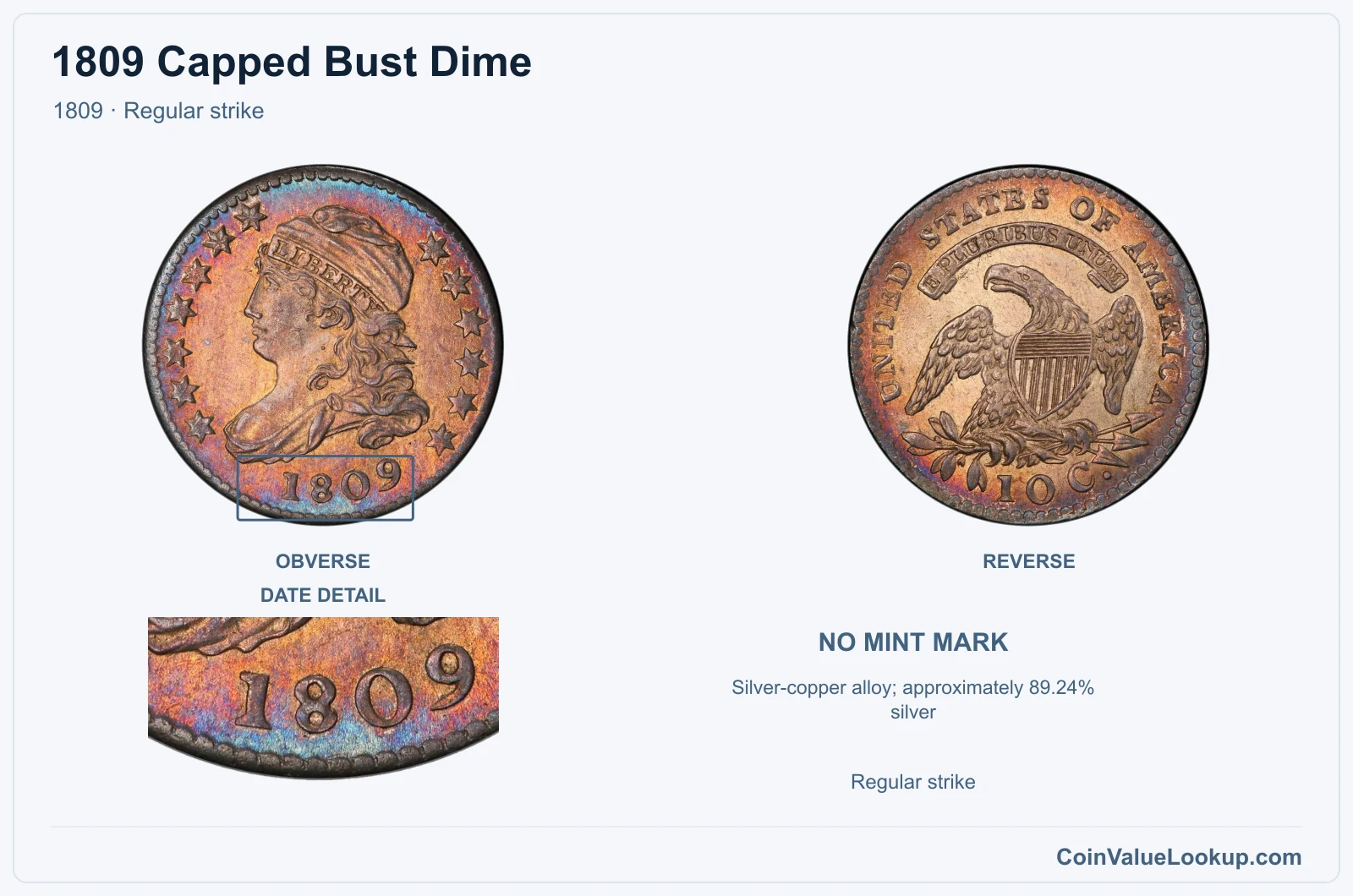
The 1809 Capped Bust Dime was struck only at Philadelphia in a silver-copper alloy of about 89.24% silver. There is no mintmark on this coin.
USA Coin Book guide estimates place a Good-4 example at approximately $1,001 and an MS63 at roughly $15,247. These are reference anchors for those specific grades, not guaranteed purchase prices.
Before comparing your coin to any guide figure, confirm the 1809 date, the wide-format Capped Bust design, and the large dentils around the rim. Original surfaces matter far more than brightness.
A coin that has been cleaned or has visible corrosion will not compare well to these grade-based estimates regardless of remaining detail.
Coin Value Lookup is a good starting point if you want to look up guides for other early dimes or different denominations in your collection.
Range Grade
Price Auction Records Appraisal PO PO 1
—
Coin Identifier FR FR 2
Coin Identifier AG AG 3
Coin Identifier G G 4
Coin Identifier
G 6
Coin Identifier VG VG 8
Coin Identifier
VG 10
Coin Identifier F F 12
Coin Identifier
F 15
Coin Identifier VF VF 20
Coin Identifier
VF 25
Coin Identifier
VF 30
Coin Identifier
VF 35
Coin Identifier XF XF 40
Coin Identifier
XF 45
Coin Identifier AU AU 50
Coin Identifier
AU 53
Coin Identifier
AU 55
Coin Identifier
AU 58
Coin Identifier MS MS 60
—
Coin Identifier
MS 61
Coin Identifier
MS 62
Coin Identifier
MS 63
Coin Identifier
MS 64
Coin Identifier
MS 65
Coin Identifier
MS 66
Coin Identifier
MS 67
—
—
—
MS 68
—
—
—
MS 69
—
—
—
MS 70
—
—
—