1948 Franklin Half Dollar Coin Value: How Much Is It Worth?
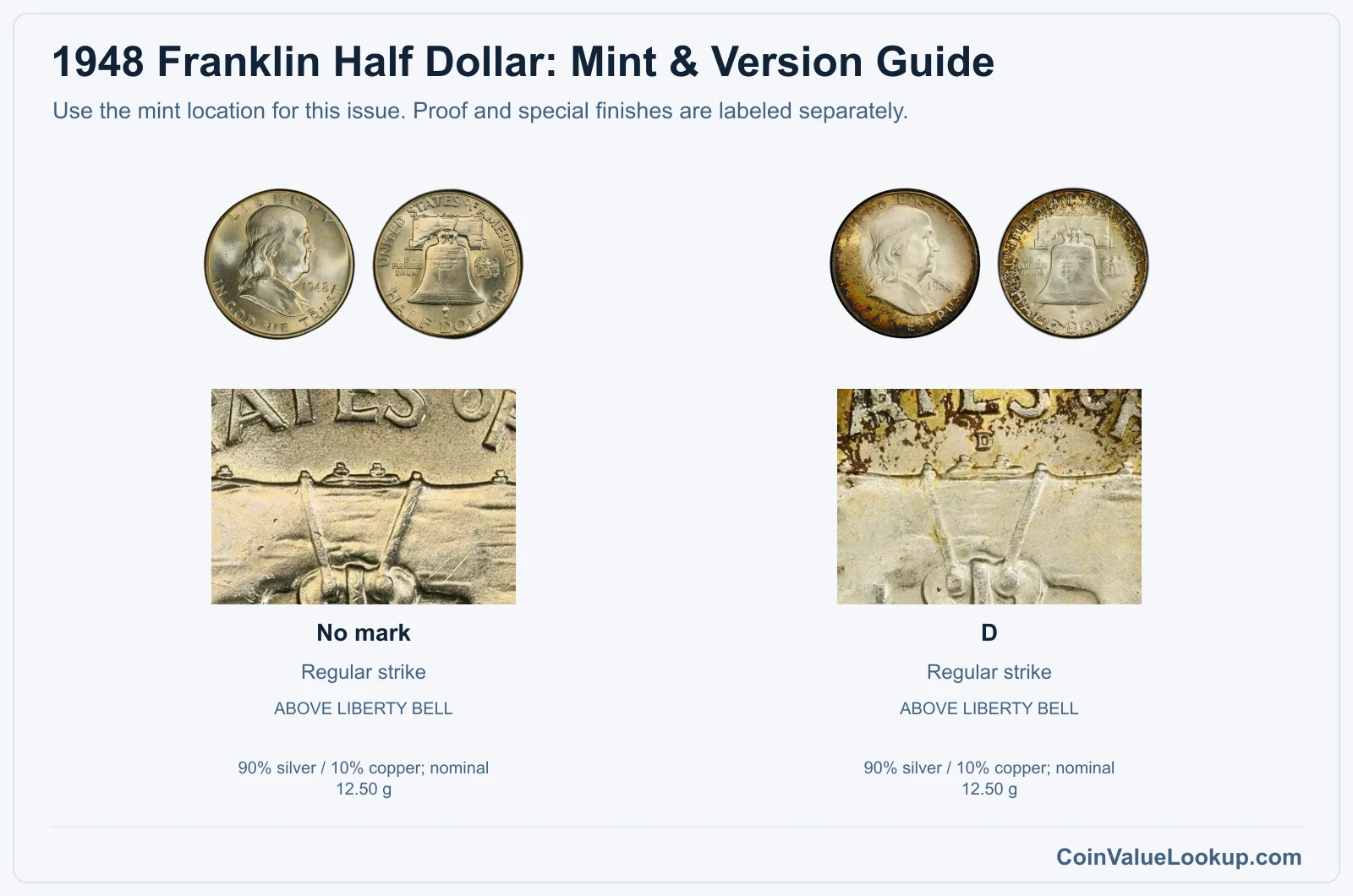
The 1948 Franklin Half Dollar is a 90% silver coin that launched the series' very first year of production. Guide estimates from USA Coin Book place these across a range of roughly $32.00 to $172.00, depending on which mint struck your coin and what condition it is in.
Those figures are guide anchors, not guaranteed selling prices or current silver-melt quotes. Mint, condition, and certain special strike details like Full Bell Lines all play a role in where a particular piece falls within that spread.
Fast Way to Identify Your 1948 Franklin Half Dollar
The quickest way to start figuring out what you have is to upload clear photos of both the front and back of your coin. Our identifier can give you a preliminary read on the mint, design type, and general branch.
It works from photos alone, so grab decent lighting, avoid glare, and shoot both sides flat. This is not a substitute for professional authentication or exact grading, but it is a solid first step.
1948 Franklin Half Dollar Value
Upload both sides of your 1948 Franklin Half Dollar.
Front Obverse
Upload photo
Back Reverse
Upload photo
Which 1948 Franklin Half Dollar Versions Are Worth Money?
- The 1948-D in MS65 condition carries a USA Coin Book guide estimate of $172.00, the highest listed anchor for this year — check for that "D" mintmark above the bell.
- The 1948 Philadelphia (no mintmark) lists at $105.00 in MS65 grade, still a meaningful step above its circulated value of $32.00 at G4.
- Full Bell Lines designation can increase premiums on either mint, but requires fully intact lower bell lines — not just a generally sharp coin.
- A Doubled Die Reverse has been reported for 1948 Franklins; compare your reverse lettering closely to a normal example.
- The "Bugs Bunny" Die Clash error, showing raised tooth-like marks near Franklin's mouth, has also been reported for this date.
Step 1: Identify Your 1948 Franklin Half Dollar Mint Mark and Version
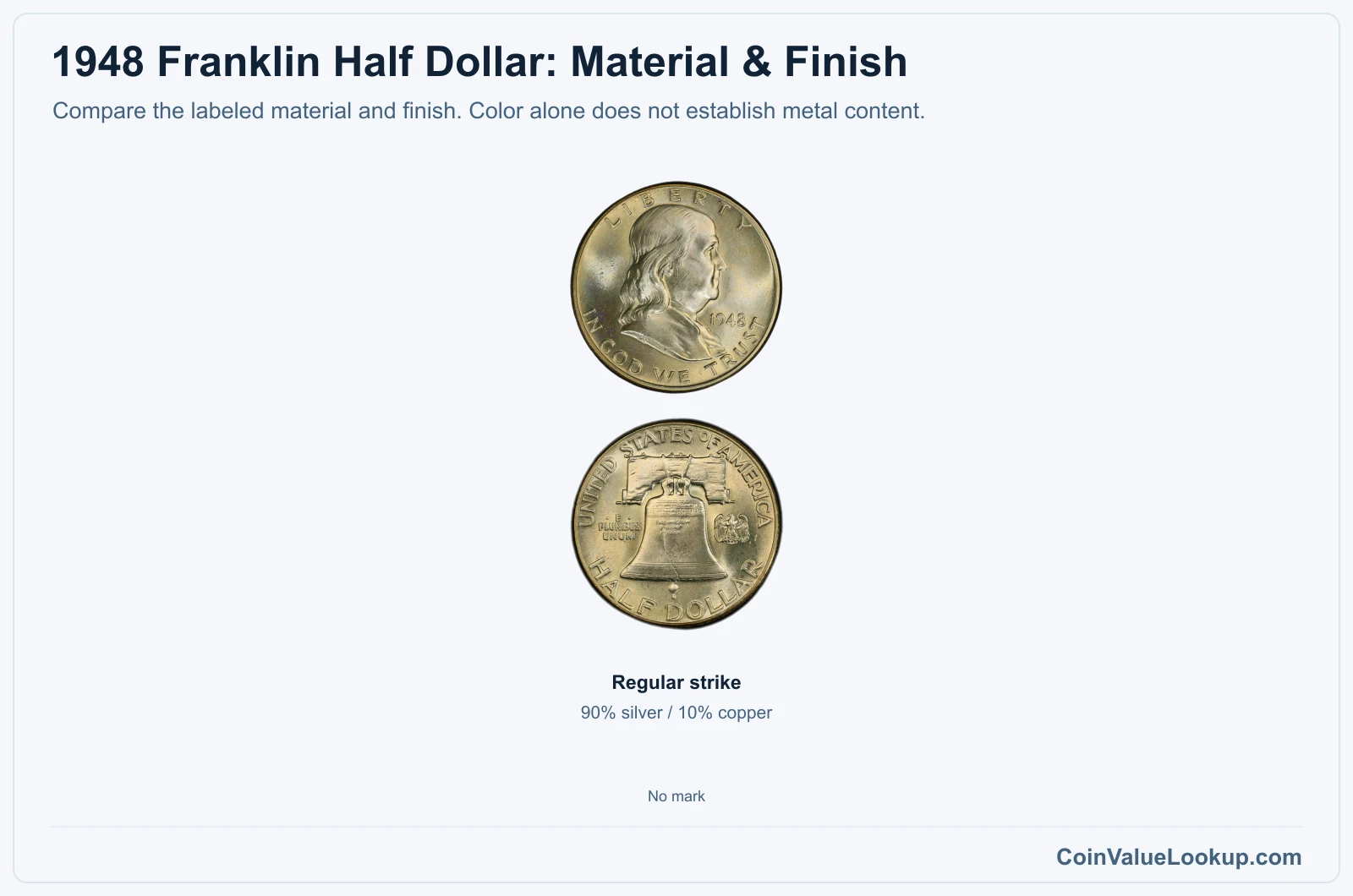
The 1948 Franklin Half Dollar was struck at two mints: Philadelphia and Denver. Philadelphia coins carry no mintmark.
Denver coins show a small "D" on the reverse, located above the Liberty Bell and just below the words E PLURIBUS UNUM. Flip the coin over and look there first — that single letter is the fastest way to sort your piece.
The coin is 90% silver and 10% copper, weighing a nominal 12.50 g. Toning — those rainbow or dark patches — does not change the alloy; it is a surface reaction.
Do not assume a dark coin is a different metal.
There were no San Francisco issues this year, and no proof strikes were produced for 1948. If someone tells you they have a 1948-S Franklin, double-check that mintmark carefully.
Full Bell Lines (FBL) is a strike-quality designation, not a separate mint or metal variety. It means the horizontal lines at the bottom of the Liberty Bell are fully intact and unbroken.
Coins with that detail intact can command higher premiums, but the designation requires meeting a specific grading standard — it is not just "looks sharp."
Step 2: Check Your 1948 Franklin Half Dollar Grade
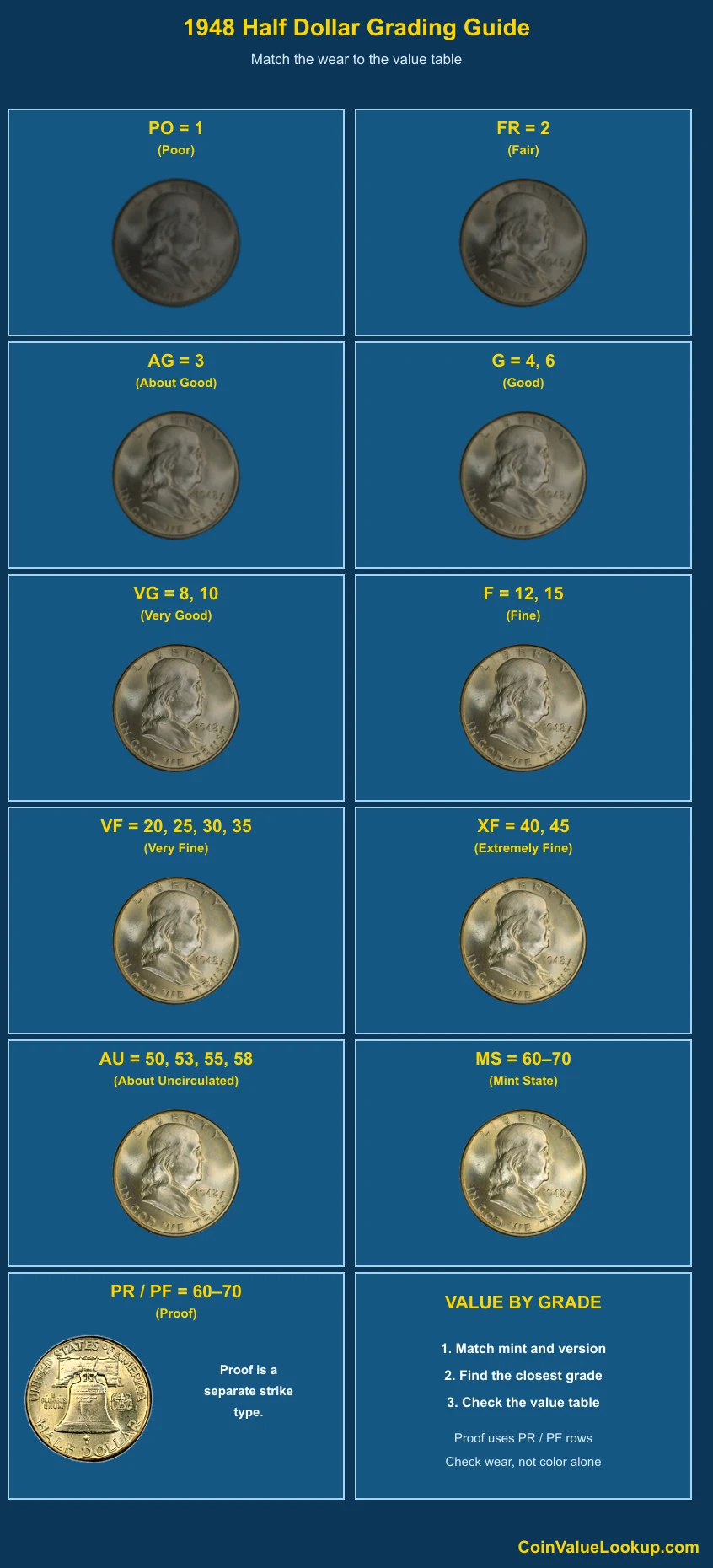
Start on the obverse. Franklin's cheek is the highest point and the first place to show wear.
Look closely at the hair behind his ear and down to his shoulder — smoothing there tells you the coin has seen circulation. A coin that still shows crisp hair strands and a sharp cheekbone is in much better shape than one with flat, slick areas.
Now flip to the reverse. The Liberty Bell's lettering and the lower bell lines are key.
If those horizontal lines at the bell's bottom are mushy or gone, that is either wear or a weak strike. Compare your coin against the reference image to see the difference.
Contact marks are different from wear. Bag marks are small dings from coins banging together in mint bags — they show up even on uncirculated pieces.
Wear, by contrast, is a flattening of the metal from actual use. A coin covered in bag marks but with no flat spots is still technically uncirculated.
Cleaned or damaged coins do not grade the same as problem-free examples, even if the underlying detail looks decent. Original surfaces matter.
Step 3: Check 1948 Franklin Half Dollar Value by Mint and Version
1948 Franklin Half Dollar
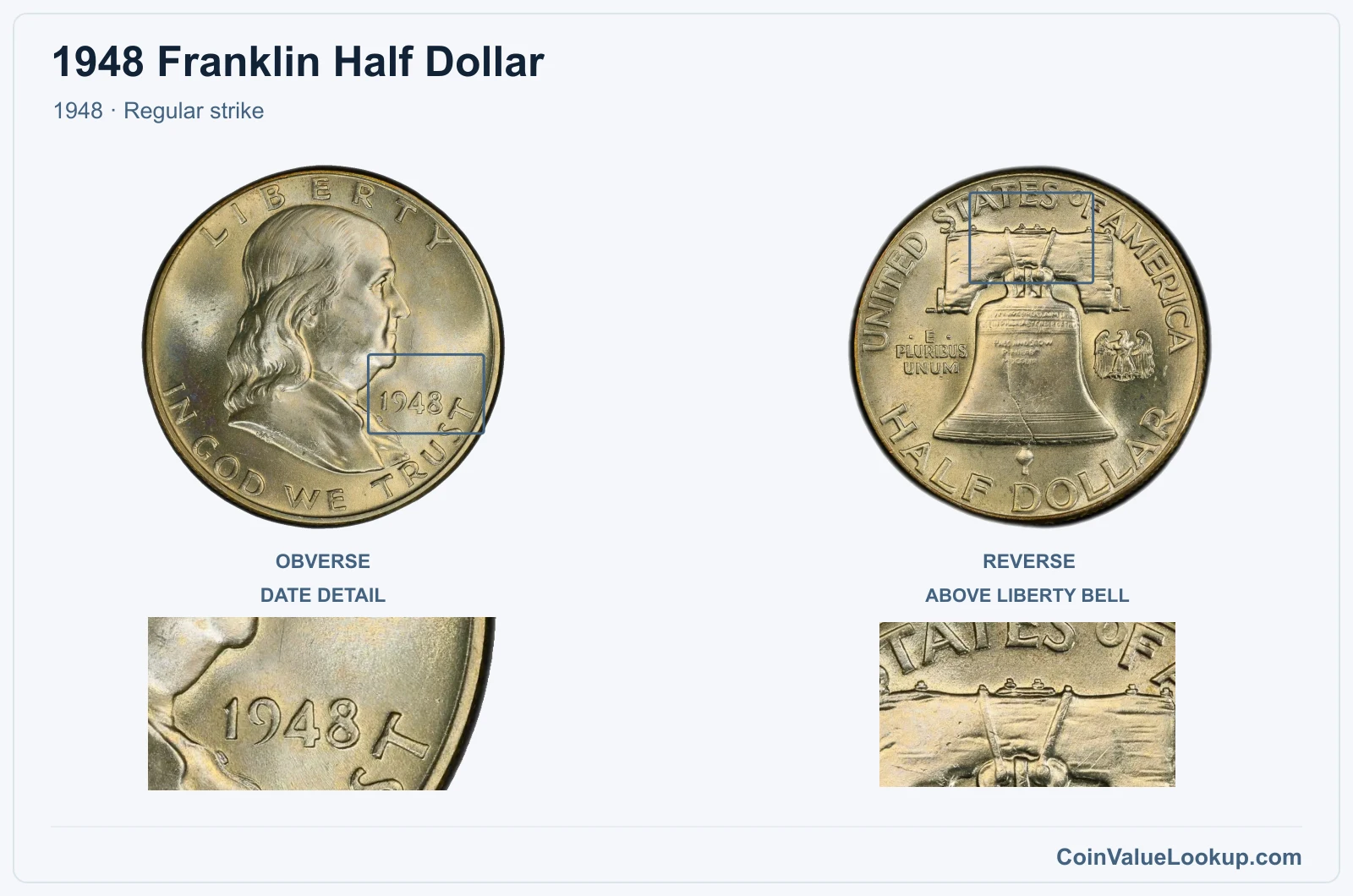
The 1948 Philadelphia Franklin Half Dollar has no mintmark — look above the Liberty Bell on the reverse and you should see blank space below E PLURIBUS UNUM. This was the debut year for John R.
Sinnock's design, with Franklin's portrait on the obverse and the Liberty Bell flanked by a small eagle on the reverse.
USA Coin Book guide estimates place this coin at about $32.00 in G4 (a well-worn but readable condition) and $105.00 in MS65 (a gem uncirculated piece with minimal marks). These are guide figures, not guaranteed sale prices.
Cleaned or damaged examples will fall below those anchors regardless of how much detail remains.
If you are exploring values for other Franklin dates or denominations, Coin Value Lookup is a good starting point for looking up coin guides organized by year and series.
Range Grade
Price Auction Records Appraisal PO PO 1
—
Coin Identifier FR FR 2
—
Coin Identifier AG AG 3
—
Coin Identifier G G 4
—
Coin Identifier
G 6
—
Coin Identifier VG VG 8
—
Coin Identifier
VG 10
—
Coin Identifier F F 12
—
Coin Identifier
F 15
—
Coin Identifier VF VF 20
—
Coin Identifier
VF 25
—
Coin Identifier
VF 30
—
Coin Identifier
VF 35
—
Coin Identifier XF XF 40
—
Coin Identifier
XF 45
—
Coin Identifier AU AU 50
—
Coin Identifier
AU 53
Coin Identifier
AU 55
Coin Identifier
AU 58
Coin Identifier MS MS 60
Coin Identifier
MS 61
Coin Identifier
MS 62
Coin Identifier
MS 63
Coin Identifier
MS 64
Coin Identifier
MS 65
Coin Identifier
MS 66
Coin Identifier
MS 67
—
—
—
MS 68
—
—
—
MS 69
—
—
—
MS 70
—
—
—
1948 Franklin Half Dollar — D
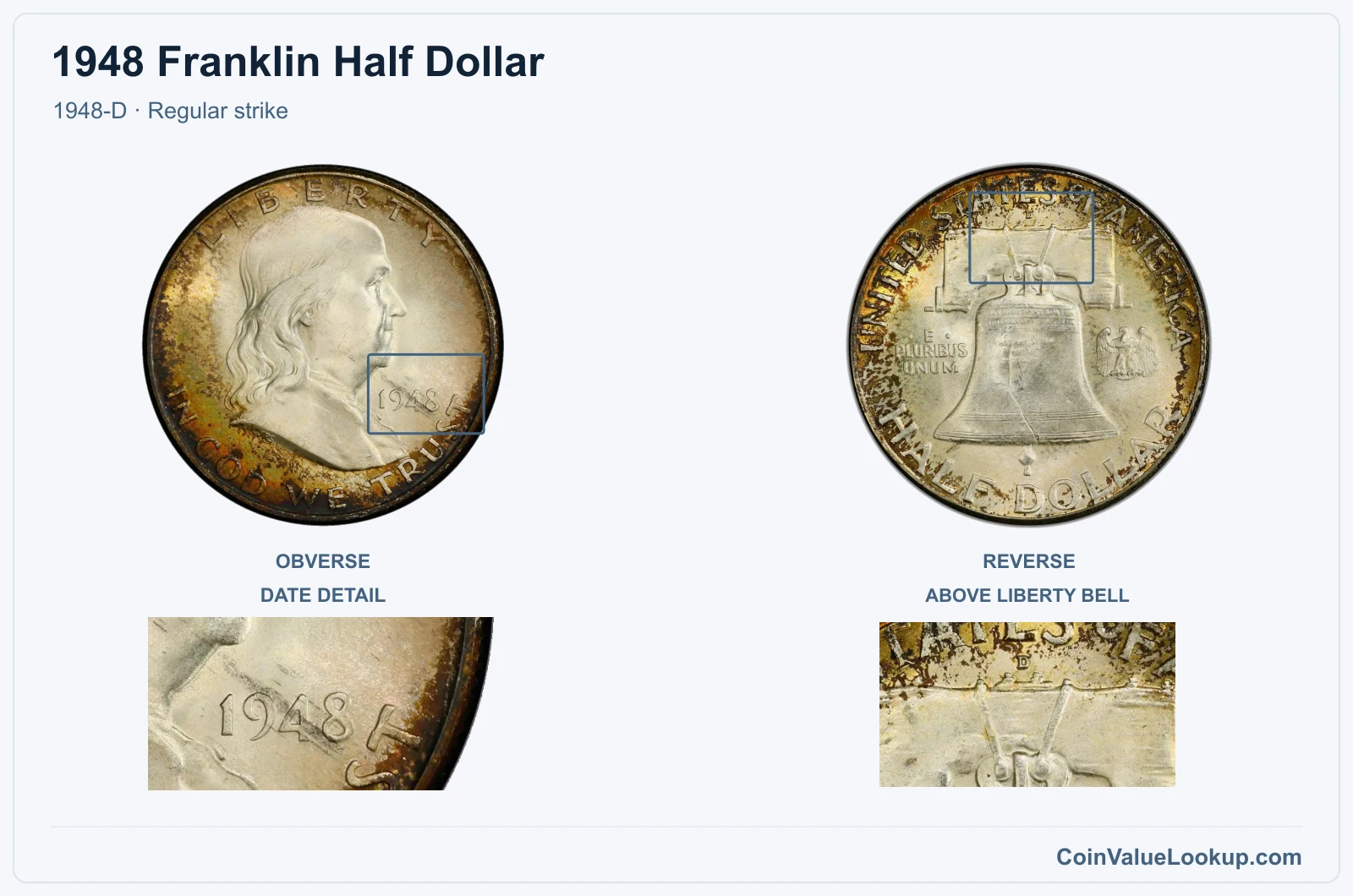
The 1948-D was struck in Denver and carries a small "D" mintmark on the reverse, positioned above the Liberty Bell and below E PLURIBUS UNUM. Same 90% silver composition, same 12.50 g nominal weight, same Franklin portrait and Liberty Bell design.
Guide estimates from USA Coin Book put this branch at $32.00 in G4 and $172.00 in MS65. That MS65 figure is noticeably higher than the Philadelphia issue at the same grade, which suggests gem-quality Denver pieces command a stronger premium.
Again, these are guide anchors — actual sale prices depend on the individual coin's surfaces, eye appeal, and whether it qualifies for Full Bell Lines.
Before checking value, confirm the mintmark is genuinely a "D" and not damage or a shadow. Match the coin's actual wear level to the correct grade column; an optimistic self-grade will lead to disappointment.
Range Grade
Price Auction Records Appraisal PO PO 1
—
Coin Identifier FR FR 2
—
Coin Identifier AG AG 3
—
Coin Identifier G G 4
—
Coin Identifier
G 6
—
Coin Identifier VG VG 8
—
Coin Identifier
VG 10
—
Coin Identifier F F 12
—
Coin Identifier
F 15
—
Coin Identifier VF VF 20
—
Coin Identifier
VF 25
—
Coin Identifier
VF 30
—
Coin Identifier
VF 35
—
Coin Identifier XF XF 40
—
Coin Identifier
XF 45
—
Coin Identifier AU AU 50
—
Coin Identifier
AU 53
Coin Identifier
AU 55
Coin Identifier
AU 58
Coin Identifier MS MS 60
—
Coin Identifier
MS 61
Coin Identifier
MS 62
Coin Identifier
MS 63
Coin Identifier
MS 64
Coin Identifier
MS 65
Coin Identifier
MS 66
Coin Identifier
MS 67
—
—
—
MS 68
—
—
—
MS 69
—
—
—
MS 70
—
—
—
1948 Franklin Half Dollar Error List
1. 1948 Franklin Half Dollar — Doubled Die Reverse
A Doubled Die Reverse (DDR) has been reported for the 1948 Franklin Half Dollar. On an affected coin, portions of the reverse lettering or design contours will appear doubled — slightly offset outlines or thickened letters that you can see under magnification.
Compare your reverse closely against a known normal example, paying attention to legends like E PLURIBUS UNUM and UNITED STATES OF AMERICA.
Not every bit of odd-looking doubling is a DDR. Machine doubling produces flat, shelf-like outlines and is far more common; it is a manufacturing byproduct, not a collectible die variety.
Random scratches and reflections can also mimic doubling to the untrained eye.
No specific price range is available for this variety. Value depends on the strength and visibility of the doubling, the coin's overall condition, and market demand at the time of sale.
Professional attribution from a grading service is the standard way to confirm a genuine doubled die.
2. 1948 Franklin Half Dollar — Bugs Bunny Die Clash
The so-called "Bugs Bunny" Die Clash has been reported on 1948 Franklin Half Dollars. The name comes from raised, tooth-like lines that appear near Franklin's mouth on the obverse, giving him a buck-toothed look.
These marks are the result of clashed dies — the obverse and reverse dies struck each other without a planchet between them, transferring part of the Liberty Bell's design onto the obverse die.
To check for it, use magnification and study the area around Franklin's lips. On a normal coin, the lip and chin area should be smooth.
On a Bugs Bunny clash, you will see small raised ridges that do not belong there.
Do not confuse random scratches, raised lines from a damaged die, or a brockage with a genuine die clash. The marks on a true Bugs Bunny will follow a consistent pattern matching the bell's design.
No specific price range is adopted for this error; value depends on visibility, condition, and buyer demand.