1973 Roosevelt Dime Coin Value: How Much Is It Worth?
Most 1973 Roosevelt dimes in circulated condition are worth their 10-cent face value. In higher uncirculated grades, USA Coin Book lists the no-mintmark and Denver issues at about $2.79 each in MS 65, while a normal San Francisco proof sits around $2.50 in PR 65.
The real action comes from authenticated mint errors and strong-strike designations, which can push values well beyond those guide figures.
Fast Way to Identify Your 1973 Roosevelt Dime
The quickest way to start figuring out what your 1973 dime might be worth is to upload clear photos of both the front and back. Our identifier can give you a preliminary read on the mint, version, and general condition.
It is not a substitute for professional authentication, but it points you in the right direction fast.
1973 Roosevelt Dime Value
Upload both sides of your 1973 Roosevelt Dime.
Front Obverse
Upload photo
Back Reverse
Upload photo
Which 1973 Roosevelt Dime Versions Are Worth Money?
- Uncirculated no-mintmark or Denver coins with strong, fully separated torch bands can carry a premium over typical examples of the same grade.
- San Francisco proofs with clean, undisturbed mirrored fields and genuine cameo contrast between the devices and background are worth checking carefully.
- Off-center strikes — authenticated examples with visible blank crescent and displaced design on both sides have sold at auction.
- Obverse die caps from the Denver mint — one authenticated MS 66 example sold for $546.25 in August 2009.
- Proof struck on a foreign copper planchet — a 1973-S proof on a Liberia 1-cent blank realized $1,560 in November 2020.
Step 1: Identify Your 1973 Roosevelt Dime Mint Mark and Version
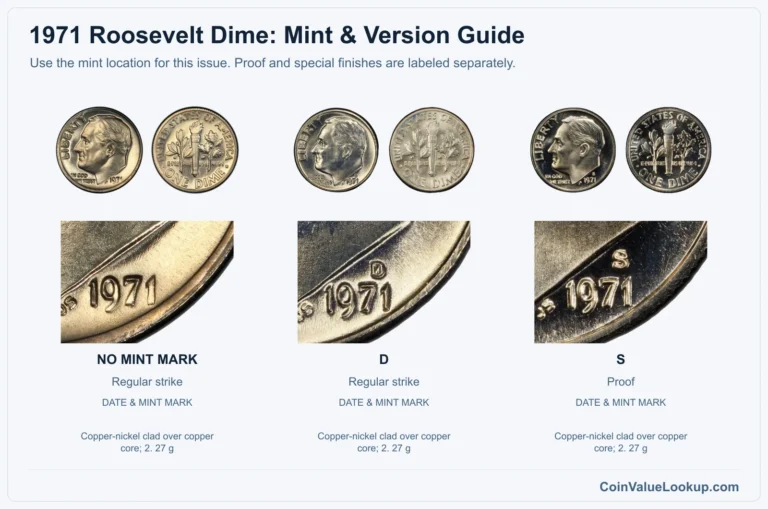
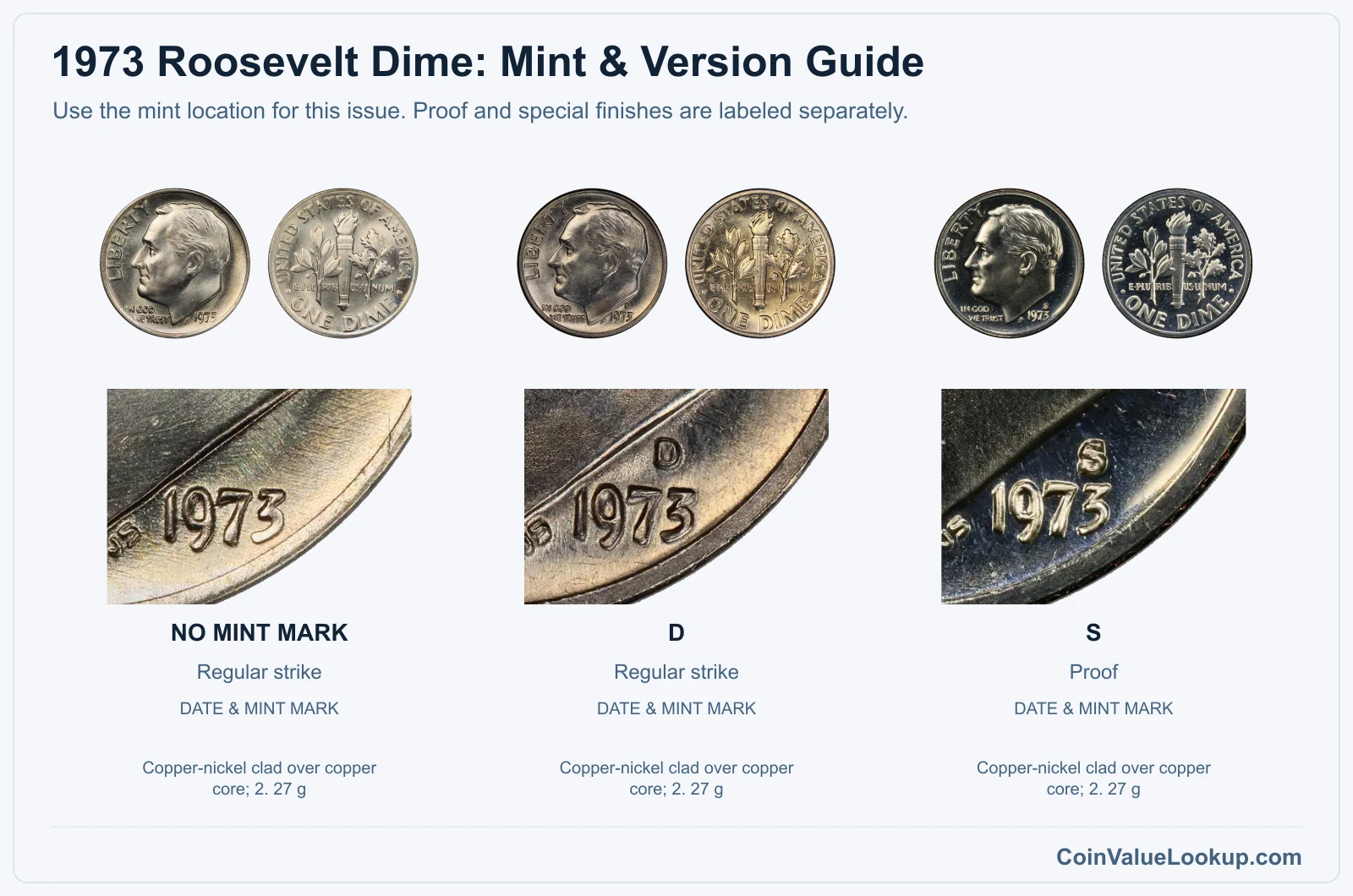
First, confirm you have a 1973 date with the familiar Roosevelt portrait on the obverse and the torch flanked by olive and oak branches on the reverse. The coin is copper-nickel clad over a copper core, weighing about 2.27 grams and measuring roughly 17.9 mm across.
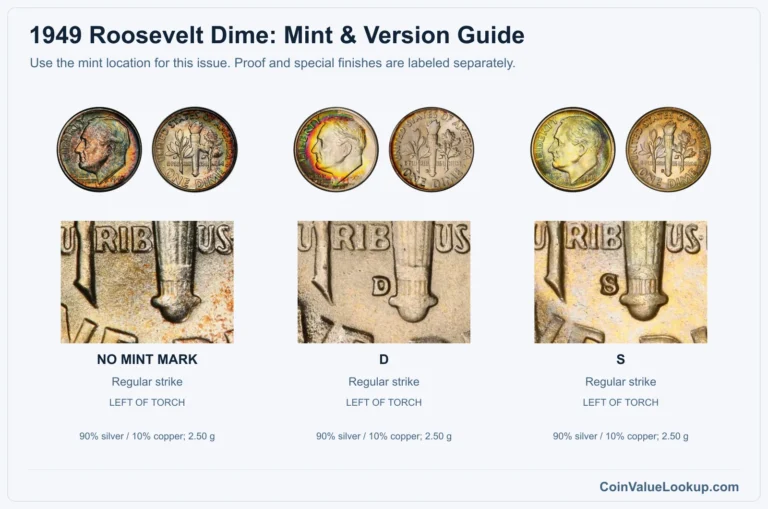
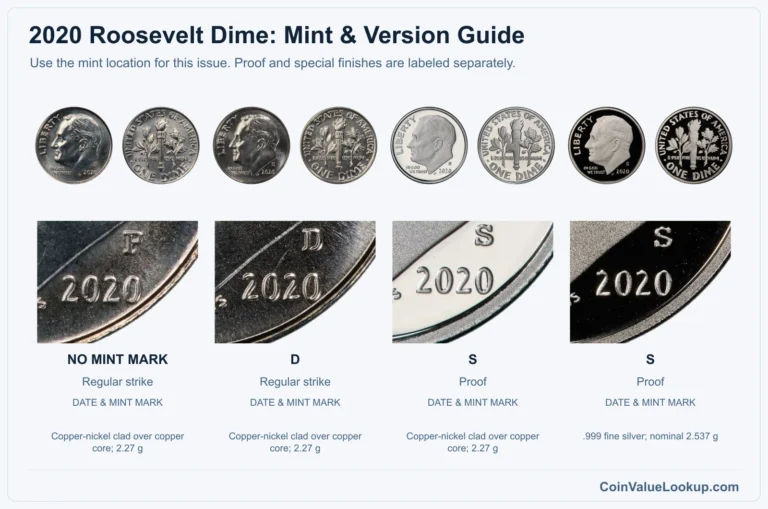
Next, look for the mintmark. On a 1973 dime, the mintmark sits on the obverse near the date.
No mintmark means Philadelphia, a "D" means Denver, and an "S" means San Francisco proof. There is no normal silver proof branch for this date.
Do not confuse a missing mintmark with a rare variety. Philadelphia dimes of this era simply did not carry one.
If your coin has an "S" mintmark but looks like a normal business strike, give the surfaces a closer look under good light — proof coins have distinctly mirrored fields.
Step 2: Check Your 1973 Roosevelt Dime Grade
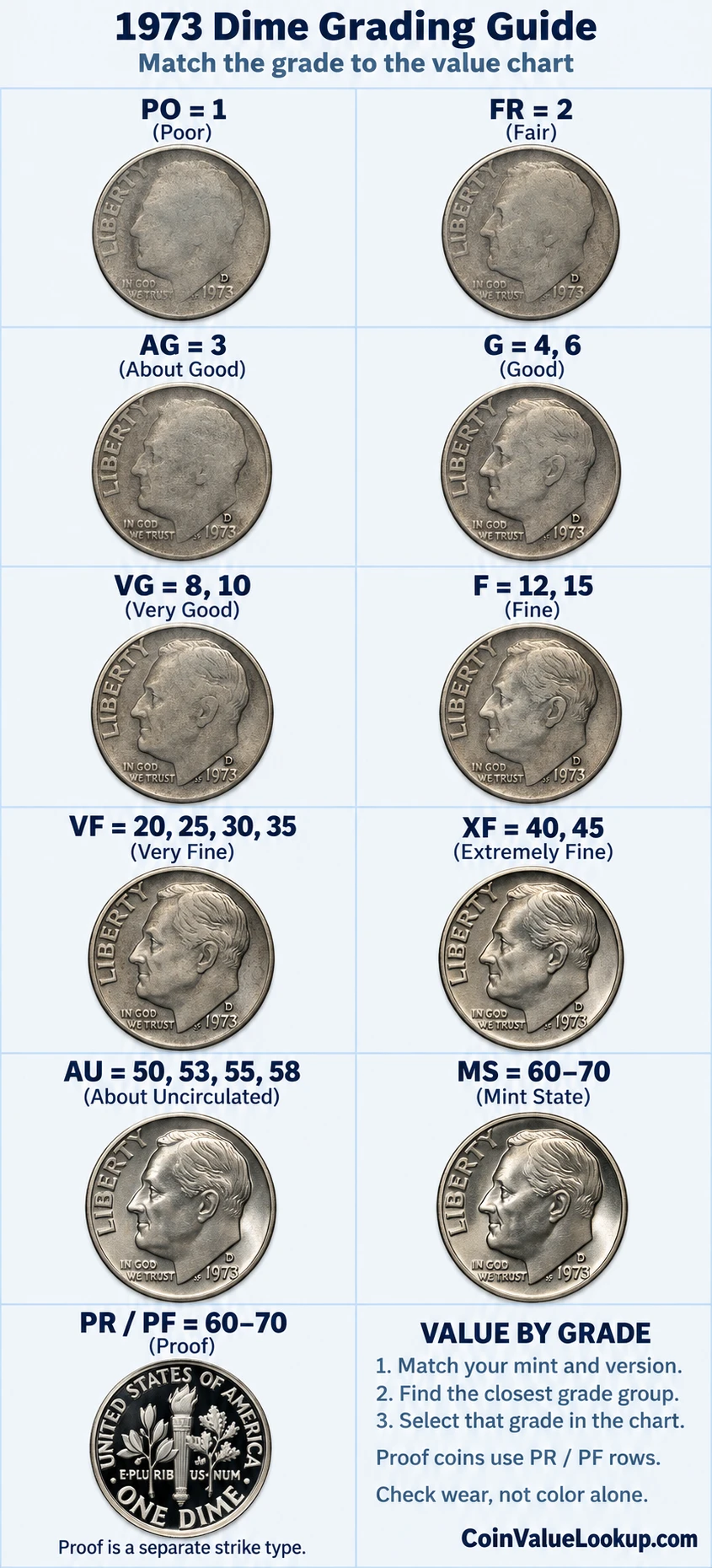
Start at Roosevelt's cheek and jawline — these are the first areas to show friction on a dime. Then check the hair detail directly above the ear.
On the reverse, examine the horizontal bands of the torch and the leaf veins for signs of smoothing.
Do not confuse a weakly struck coin with a worn one. A weak strike will show soft detail but the original luster remains intact, while wear replaces luster with a dull, flat surface.
Scratches, cleaning marks, and corrosion all reduce a coin's grade and desirability.
Proof coins get their own grading scale. A proof is a manufacturing method — polished dies, specially prepared planchets — not a grade above Mint State.
Assess proof surfaces for haze, hairlines, and contact marks separately. Use the comparison image to benchmark your coin's wear level against known grade examples.
Step 3: Check 1973 Roosevelt Dime Value by Mint and Version
1973 Roosevelt Dime — No Mintmark Business Strike
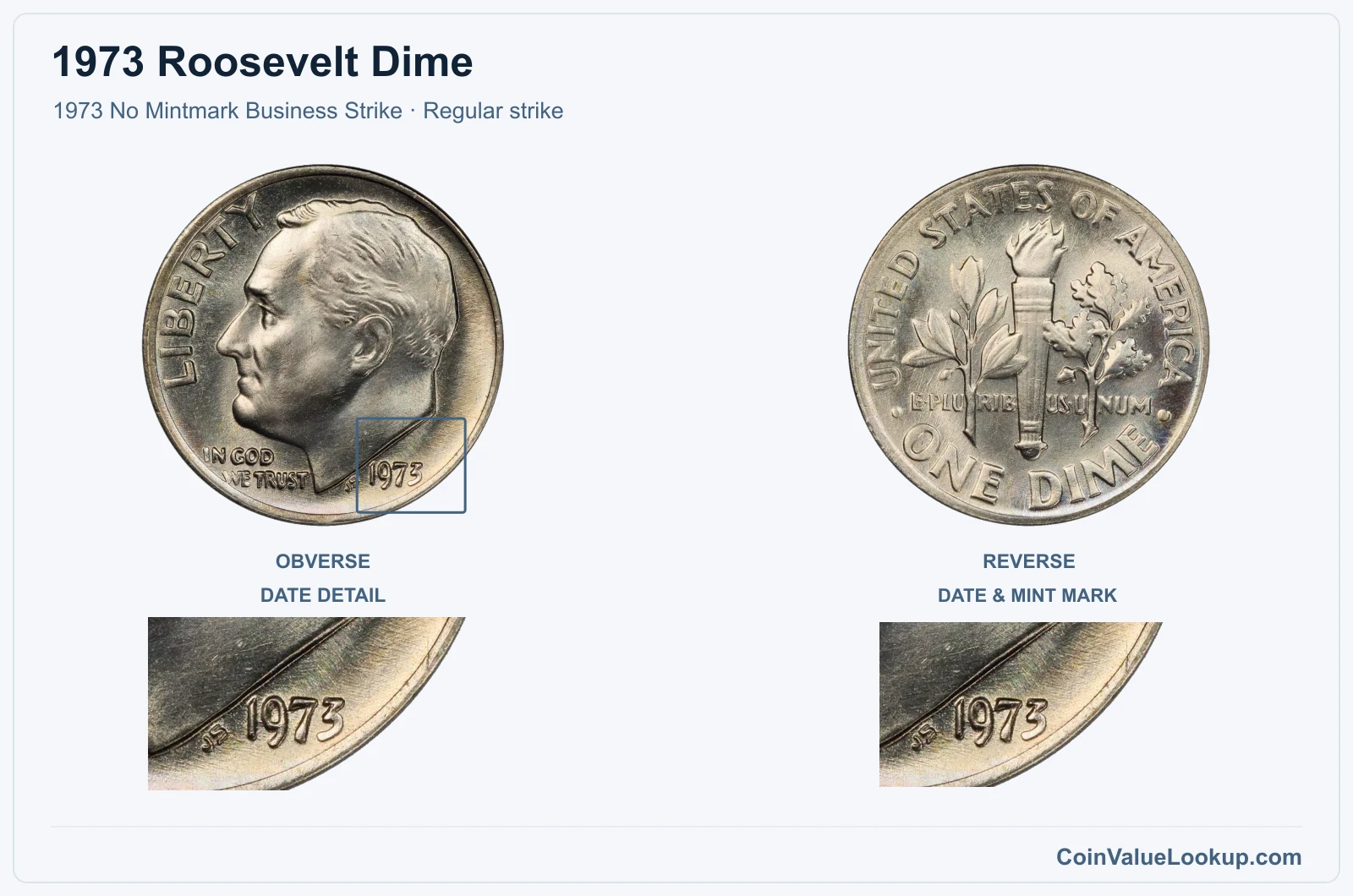
The 1973 no-mintmark dime was struck at Philadelphia and carries no mintmark on the obverse. It is a copper-nickel clad coin weighing about 2.27 grams.
In circulated grades, expect face value. USA Coin Book lists about $2.79 at the MS 65 level.
Coins with fully separated horizontal torch bands — the Full Bands designation — can command a premium, but that designation requires confirmation under magnification. Compare your coin to others of the same finish and condition before drawing conclusions.
Range Grade
Price Auction Records Appraisal PO PO 1
—
Coin Identifier FR FR 2
—
Coin Identifier AG AG 3
—
Coin Identifier G G 4
—
Coin Identifier
G 6
—
Coin Identifier VG VG 8
—
Coin Identifier
VG 10
—
Coin Identifier F F 12
—
Coin Identifier
F 15
—
Coin Identifier VF VF 20
—
Coin Identifier
VF 25
—
Coin Identifier
VF 30
—
Coin Identifier
VF 35
—
Coin Identifier XF XF 40
—
Coin Identifier
XF 45
—
Coin Identifier AU AU 50
—
Coin Identifier
AU 53
—
Coin Identifier
AU 55
—
Coin Identifier
AU 58
—
Coin Identifier MS MS 60
—
Coin Identifier
MS 61
—
Coin Identifier
MS 62
Coin Identifier
MS 63
—
Coin Identifier
MS 64
Coin Identifier
MS 65
—
Coin Identifier
MS 66
Coin Identifier
MS 67
Coin Identifier
MS 68
—
—
—
MS 69
—
—
—
MS 70
—
—
—
1973 Roosevelt Dime — D Business Strike
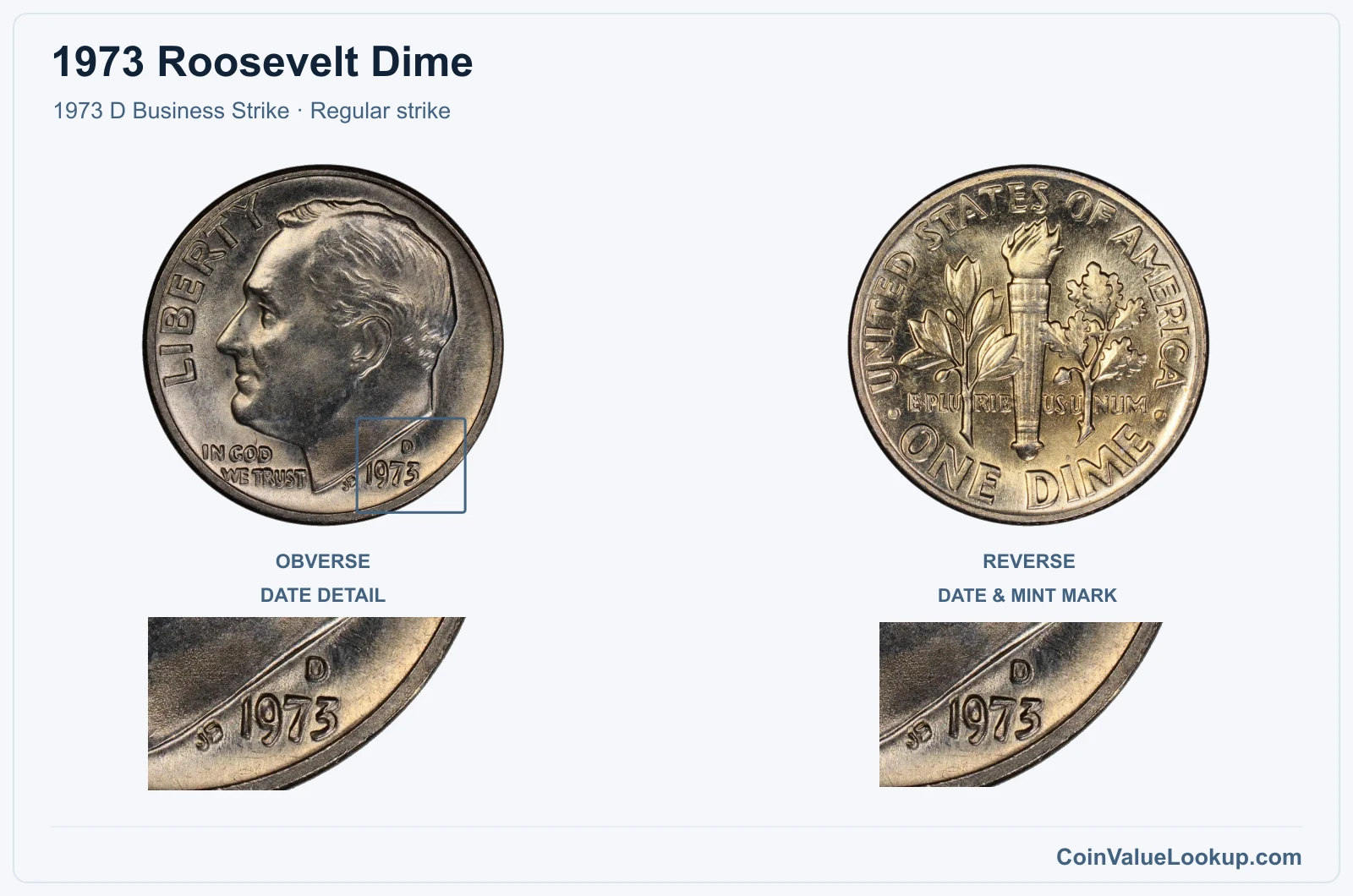
Denver's 1973-D dime is identified by the small "D" mintmark on the obverse near the date. Same clad composition and weight as its Philadelphia sibling.
A guide estimate of $2.79 at MS 65 puts it on par with the no-mintmark issue. Full Bands examples trade at a premium when the designation is confirmed.
Worn pieces are worth 10 cents.
Coin Value Lookup is a handy starting point if you want to compare this dime's value with other Roosevelt dates or denominations. You can browse guides organized by year, mint, and series.
Range Grade
Price Auction Records Appraisal PO PO 1
—
Coin Identifier FR FR 2
—
Coin Identifier AG AG 3
—
Coin Identifier G G 4
—
Coin Identifier
G 6
—
Coin Identifier VG VG 8
—
Coin Identifier
VG 10
—
Coin Identifier F F 12
—
Coin Identifier
F 15
—
Coin Identifier VF VF 20
—
Coin Identifier
VF 25
—
Coin Identifier
VF 30
—
Coin Identifier
VF 35
—
Coin Identifier XF XF 40
—
Coin Identifier
XF 45
—
Coin Identifier AU AU 50
—
Coin Identifier
AU 53
—
Coin Identifier
AU 55
—
Coin Identifier
AU 58
Coin Identifier MS MS 60
—
Coin Identifier
MS 61
—
Coin Identifier
MS 62
—
Coin Identifier
MS 63
—
Coin Identifier
MS 64
—
Coin Identifier
MS 65
Coin Identifier
MS 66
Coin Identifier
MS 67
Coin Identifier
MS 68
—
—
—
MS 69
—
—
—
MS 70
—
—
—
1973 Roosevelt Dime — S Proof
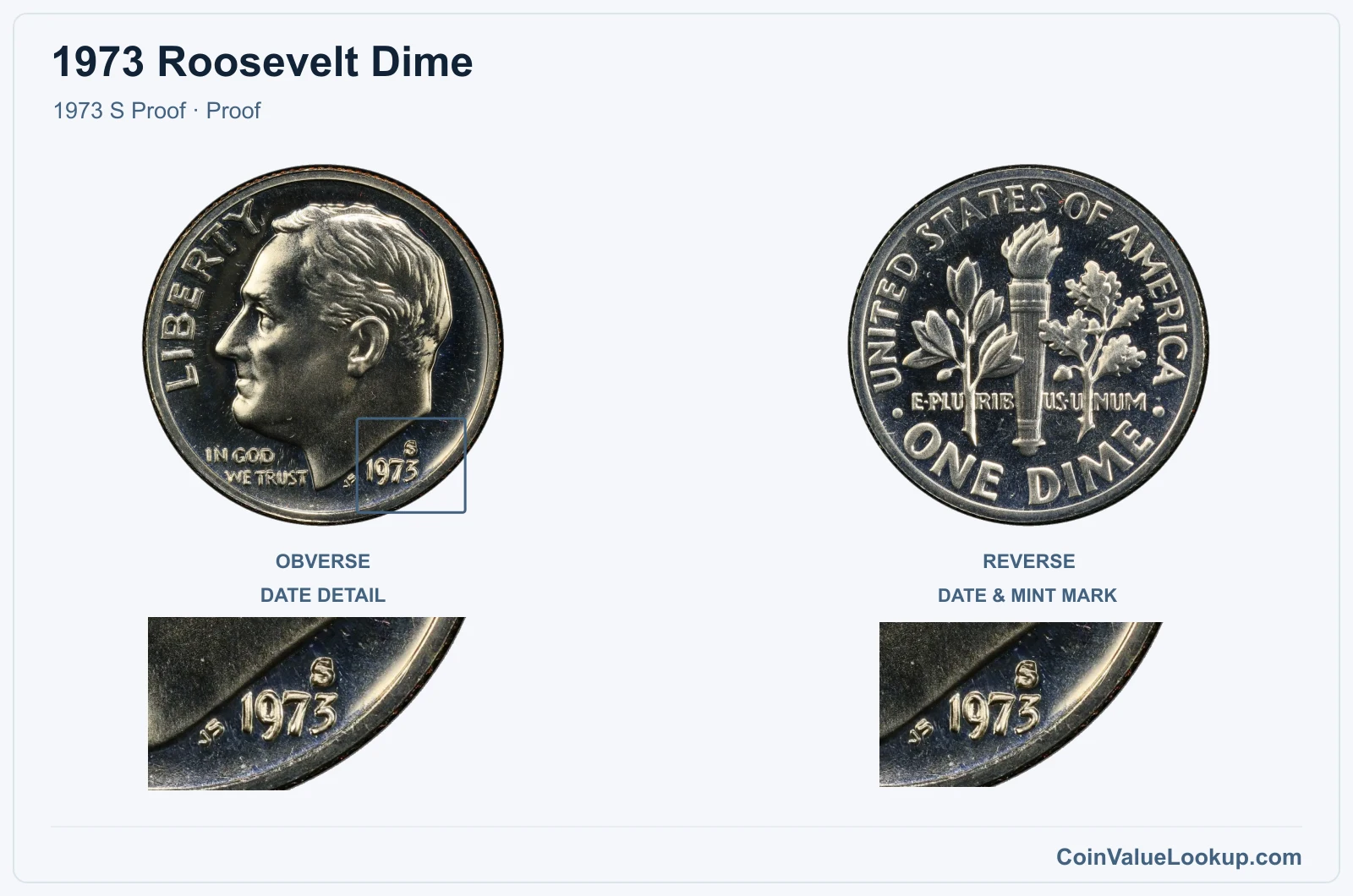
The 1973-S proof dime was produced at San Francisco and features the "S" mintmark. These were sold in official proof sets, not released into circulation.
The copper-nickel clad composition is the same as the business strikes — there is no silver proof branch for 1973. USA Coin Book places a normal PR 65 at about $2.50.
Proofs with strong cameo contrast between frosted devices and mirror fields are a separate tier; matched evidence of genuine contrast is needed before assuming a cameo premium. Watch for hairlines from mishandling, which are common on proof surfaces.
Range Grade
Price Auction Records Appraisal PR PR 1
—
Coin Identifier
PR 2
—
Coin Identifier
PR 3
—
Coin Identifier
PR 4
—
Coin Identifier
PR 6
—
Coin Identifier
PR 8
—
Coin Identifier
PR 10
—
Coin Identifier
PR 12
—
Coin Identifier
PR 15
—
Coin Identifier
PR 20
—
Coin Identifier
PR 25
—
Coin Identifier
PR 30
—
Coin Identifier
PR 35
—
Coin Identifier
PR 40
—
Coin Identifier
PR 45
—
Coin Identifier
PR 50
—
Coin Identifier
PR 53
—
Coin Identifier
PR 55
—
Coin Identifier
PR 58
—
Coin Identifier
PR 60
—
Coin Identifier
PR 61
—
Coin Identifier
PR 62
—
Coin Identifier
PR 63
—
Coin Identifier
PR 64
—
Coin Identifier
PR 65
—
Coin Identifier
PR 66
Coin Identifier
PR 67
Coin Identifier
PR 68
Coin Identifier
PR 69
Coin Identifier
PR 70
—
—
—
1973 Roosevelt Dime Error List
1. 1973 Roosevelt Dime — Off-Center Strike
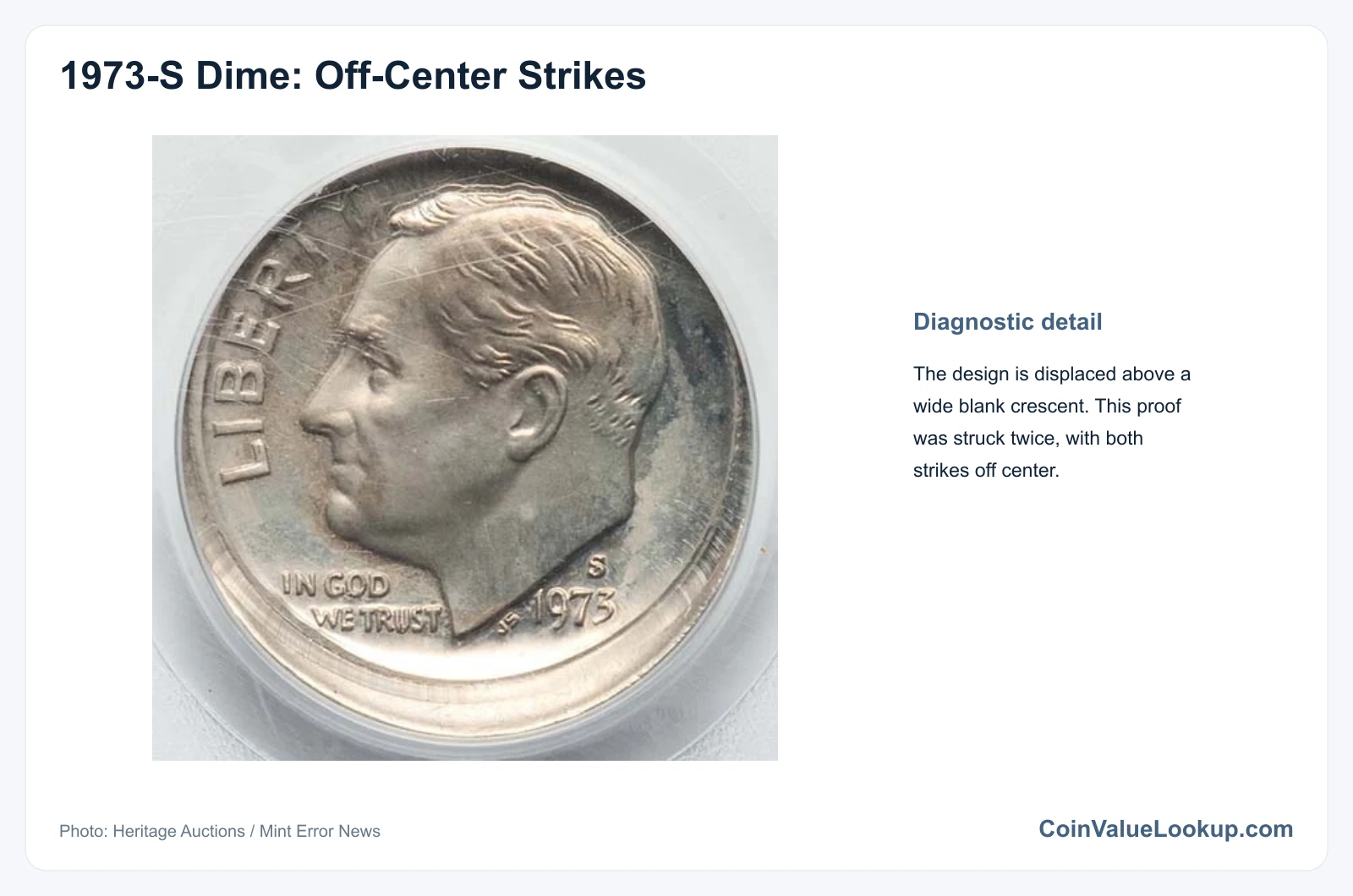
An off-center 1973 no-mintmark dime shows a blank crescent on one side where the planchet was not fully covered by the dies, with the design shifted correspondingly on both faces. One documented example was struck roughly 10 percent off center toward the 11-o'clock position and graded ANACS MS 60.
Value depends on the degree of the shift, whether the date remains visible, and the coin's overall condition.
Do not confuse this with a misaligned die strike, which shifts design on only one side, or a centered broadstrike that spreads the design evenly. Authentication is important because a genuine off-center strike affects both obverse and reverse in a consistent way.
2. 1973 Roosevelt Dime — Obverse Die Cap
A die cap happens when a struck coin sticks to the upper die and keeps striking subsequent blanks. The result is a raised, cup-shaped flange around the coin's rim — especially visible near the 1-o'clock position on the documented 1973-D example.
The reverse progressively loses its normal design and may show a faint incuse mirror of the obverse portrait.
One NGC MS 66 die cap from the Denver mint sold for $546.25 at a Heritage auction in August 2009. That is an individual sale, not a guaranteed market price.
A coin simply bent into a bowl shape after leaving the mint will lack the progressive design loss and metal-flow characteristics of a genuine cap. Professional authentication is essential.
3. 1973 Roosevelt Dime — Proof Struck on Foreign Copper Planchet
This error is a 1973-S proof struck on a planchet intended for a Liberia 1-cent coin. The blank is copper rather than the usual copper-nickel clad, and it weighs approximately 2.5 grams.
You should see proof-quality surfaces — mirrored fields, frosted devices — on distinctly copper-red metal with the "S" mintmark present.
One example, graded NGC PR 64 Red Cameo, sold for $1,560 in November 2020 at auction. That is a single historical sale, not a standing offer.
A normal proof that has toned to a reddish hue, or a coin that has been plated or chemically altered, can mimic this look. Weight comparison and alloy testing by a professional service are necessary to confirm the wrong-planchet attribution.
4. 1973 Roosevelt Dime — Clipped Planchet
A clipped planchet error on a 1973 dime means a portion of the blank was missing before the coin was struck. You will see a curved, straight, or irregular section of missing metal along the edge, and there is often a corresponding area of design weakness on the opposite side where metal could not flow fully into the die.
The edge at the clip should show a natural break consistent with the original blank, not a clean cut or filed notch. Corrosion can eat away an edge and mimic a clip, so compare the texture carefully.
Value depends on the size and visibility of the clip and the coin's overall condition. No specific price is adopted here — each piece needs individual evaluation by an authentication service.
5. 1973 Roosevelt Dime — Struck-Through Error
A struck-through error occurs when debris — grease, a metal fragment, cloth fiber, or other material — sits between the die and planchet during striking. The result is a localized depression or an impression of the foreign object in the coin's surface, sometimes with incomplete design in that area.
Grease-filled dies create smooth, featureless patches, while a retained foreign object may leave a distinct shape or texture. Do not confuse normal wear, post-mint scratches, or cleaning damage with a struck-through error.
The key distinction is that the anomaly sits within the struck surface rather than on top of it. Value varies with the size, clarity, and nature of the obstruction, so individual assessment is the right approach.
6. 1973 Roosevelt Dime — Doubled Die Obverse
A doubled die obverse on a 1973 dime would show consistent doubling in the lettering, date, or design elements on the front of the coin. True hub doubling produces separation or notching that is uniform across the affected area and repeatable from coin to coin struck by the same die.
The most common lookalike is machine doubling, which produces a flat, shelf-like displacement rather than rounded, separated profiles. Reflections under certain lighting can also mimic doubling.
Compare your coin side by side with a normal example under the same light source. No specific price is adopted for this category — value depends on the extent of the doubling, its visibility, and the coin's condition.
7. 1973 Roosevelt Dime — Doubled Die Reverse
A doubled die reverse on a 1973 dime involves doubling visible in the reverse legends, torch, or branch details. Like its obverse counterpart, genuine hub doubling shows consistent separation or notching, not the flat shelf of machine doubling.
Compare your reverse lettering and design contours against a normal coin under matching light. Random damage, die deterioration, and reflections can all trick the eye.
If you spot what looks like doubling, check whether it appears in the same position on other devices — true doubled dies tend to affect a region of the coin, not a single letter. No specific price is adopted; each coin's value depends on the severity and the coin's overall grade.
8. 1973 Roosevelt Dime — Improper Annealing
Improper annealing errors result from problems in the heat-treatment step that prepares blank planchets before striking. On a 1973 dime, this can appear as unusual surface discoloration or an abnormal texture — sometimes a dark, streaky or woodgrain-like pattern across part or all of the coin.
The tricky part is separating this from environmental toning, corrosion, or heat damage applied after the coin left the mint. Compare the suspect surface with the coin's edge and a normal example.
Appearance alone is a screening clue, not proof. Value depends on how dramatic the effect is and the coin's condition, so individual assessment by a professional service is recommended.
No specific price is adopted for this category.
9. 1973 Roosevelt Dime — Missing Clad Layer
A missing clad layer error means one of the outer copper-nickel faces was absent from the planchet before striking. On a 1973 dime, the exposed side will typically show a copper-colored surface, and the coin will weigh noticeably less than the standard 2.27 grams.
Check the edge as well — a normal clad dime shows a visible sandwich of layers, while a missing-clad piece will show an asymmetric or single-layer edge. Do not confuse this with toning, aftermarket plating, corrosion, or someone who filed a surface off.
Weighing the coin is one of the simplest first checks. Value depends on which side is affected, visibility, and overall condition; no specific price is adopted here.