1973 Jefferson Nickel Coin Value: How Much Is It Worth?
Most 1973 Jefferson nickels pulled from circulation are worth face value. The coins that stand out are well-preserved uncirculated examples and authenticated error strikes.
USA Coin Book guide estimates for business strikes range from about $0.30 at MS60 to $3.62 at MS65, so grade matters quite a bit even within uncirculated territory. Proofs and error coins occupy their own separate markets.
Fast Way to Identify Your 1973 Jefferson Nickel
Want a quick read on your 1973 nickel? Upload clear photos of the front and back, and our identifier can offer a preliminary look at which version you have.
It checks the mintmark location, general condition, and finish type. This is not a substitute for professional authentication or certified grading, but it gives you a solid starting point.
1973 Jefferson Nickel Value
Upload both sides of your 1973 Jefferson Nickel.
Front Obverse
Upload photo
Back Reverse
Upload photo
Which 1973 Jefferson Nickel Versions Are Worth Money?
- High-grade Philadelphia or Denver business strikes with certified Full Steps can carry a premium well above the base uncirculated guide price.
- The 1973-S proof operates in its own finish-specific market; cameo and deep cameo designations are graded separately from base proof values.
- Several authenticated wrong-planchet errors exist for this date, including strikes on foreign blanks and dime blanks, with individual auction results in the hundreds to over a thousand dollars.
- Check for doubled die obverse, die cracks, clipped planchets, and other die errors listed for this year, as condition and visibility drive their individual value.
Step 1: Identify Your 1973 Jefferson Nickel Mint Mark and Version
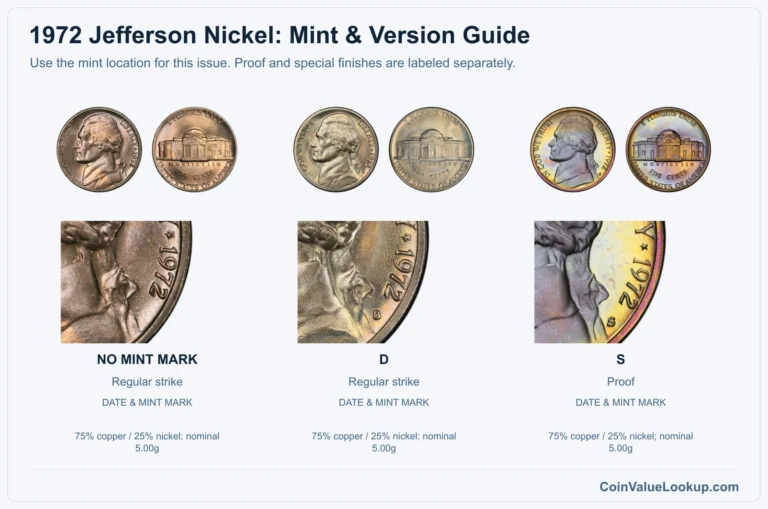
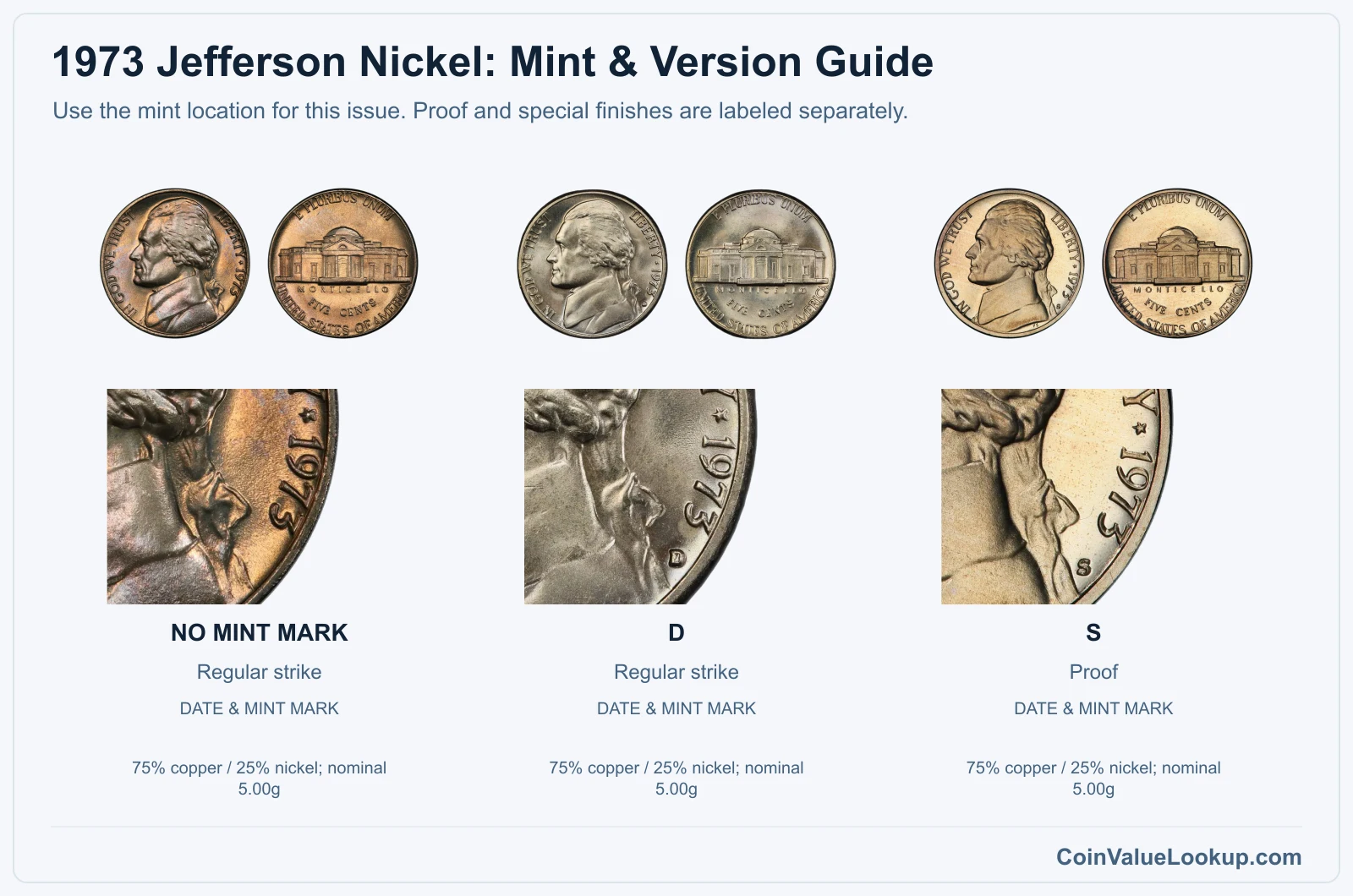
Three versions of the 1973 Jefferson nickel exist, and telling them apart is straightforward. Flip the coin to the obverse and look just below the date for a small letter.
No letter means Philadelphia. A "D" means Denver.
An "S" means San Francisco, and those were struck as proofs only.
All three share the same composition: 75% copper, 25% nickel, with a nominal weight of 5.00 grams and a diameter of 21.2 mm. The edge is plain.
This alloy is solid copper-nickel, not a clad sandwich, so do not mistake normal wear or discoloration for a missing layer.
Proof coins have mirror-like fields and sharp detail from specially prepared dies. That mirror finish is a manufacturing method, not a grade above Mint State.
When examining your coin, record both faces, the date, the mintmark, the finish, and anything unusual about the size or weight.
Step 2: Check Your 1973 Jefferson Nickel Grade
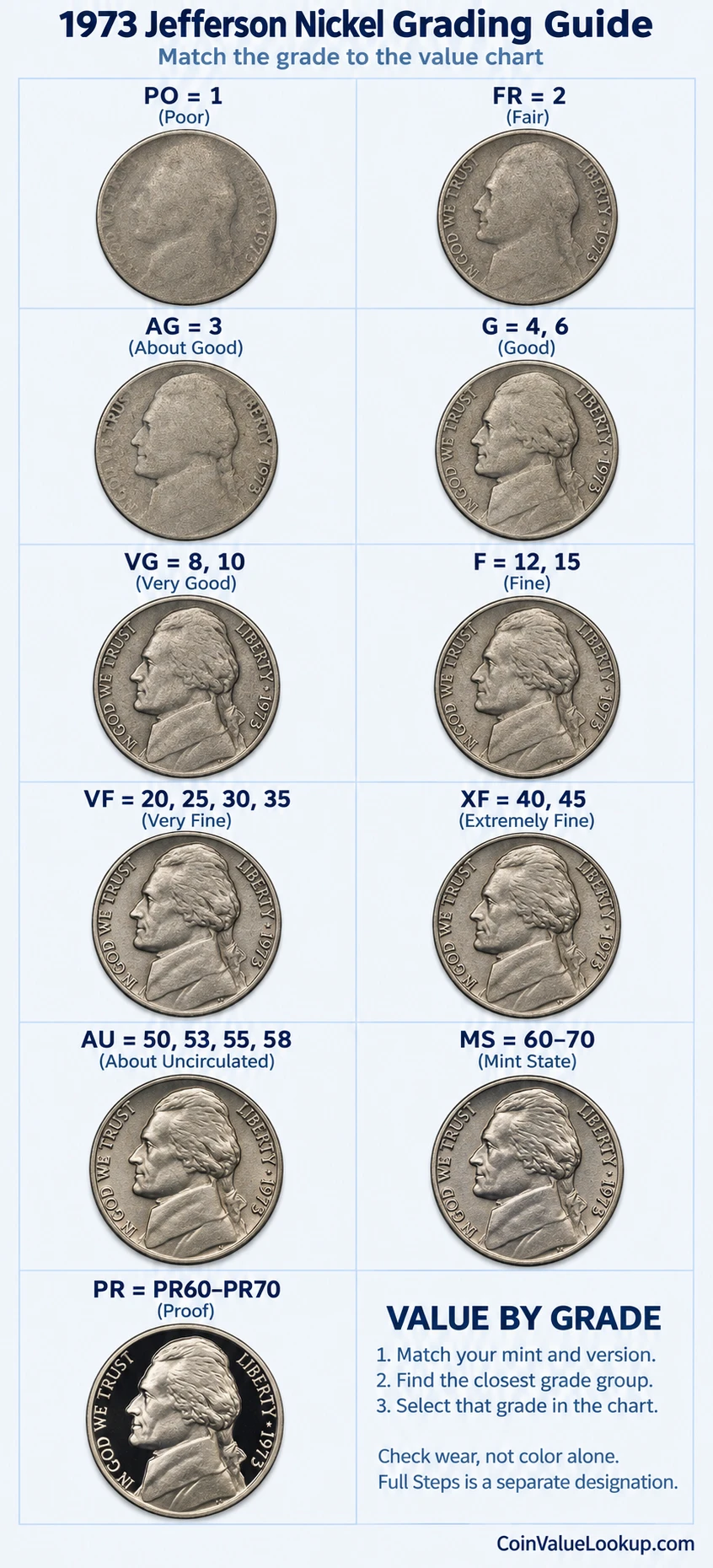
Start with Jefferson's cheek and hair on the obverse. These are the highest points and show friction first.
A coin with full original luster and no rub on the cheek is a candidate for Mint State grades. On the reverse, check the columns and steps of Monticello.
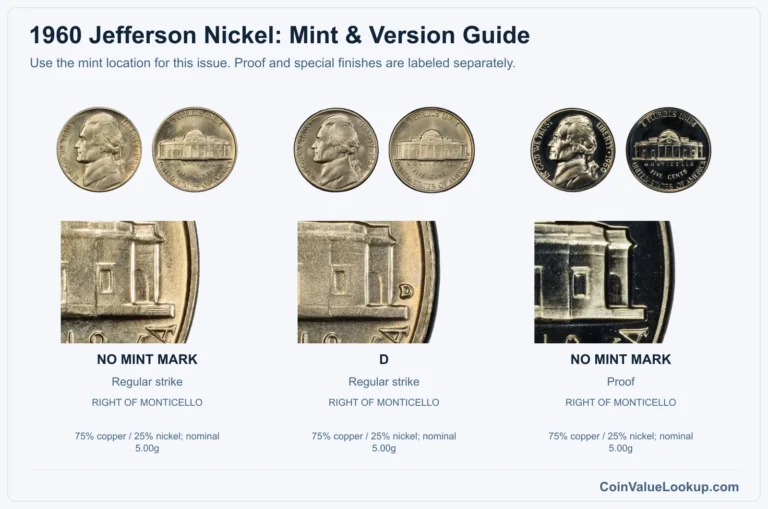
Full Steps is a separate attributed designation for strike quality, not just preservation. It requires uninterrupted step lines on Monticello's base, which is different from steps that are simply worn down.
A weakly struck coin can look lustrous but still lack Full Steps.
Use the comparison image to gauge contact marks, surface preservation, and remaining luster on your own coin. Bag marks from storage and handling affect the grade even on coins that never entered circulation.
Step 3: Check 1973 Jefferson Nickel Value by Mint and Version
1973 Jefferson Nickel — No mintmark (Philadelphia) Business strike
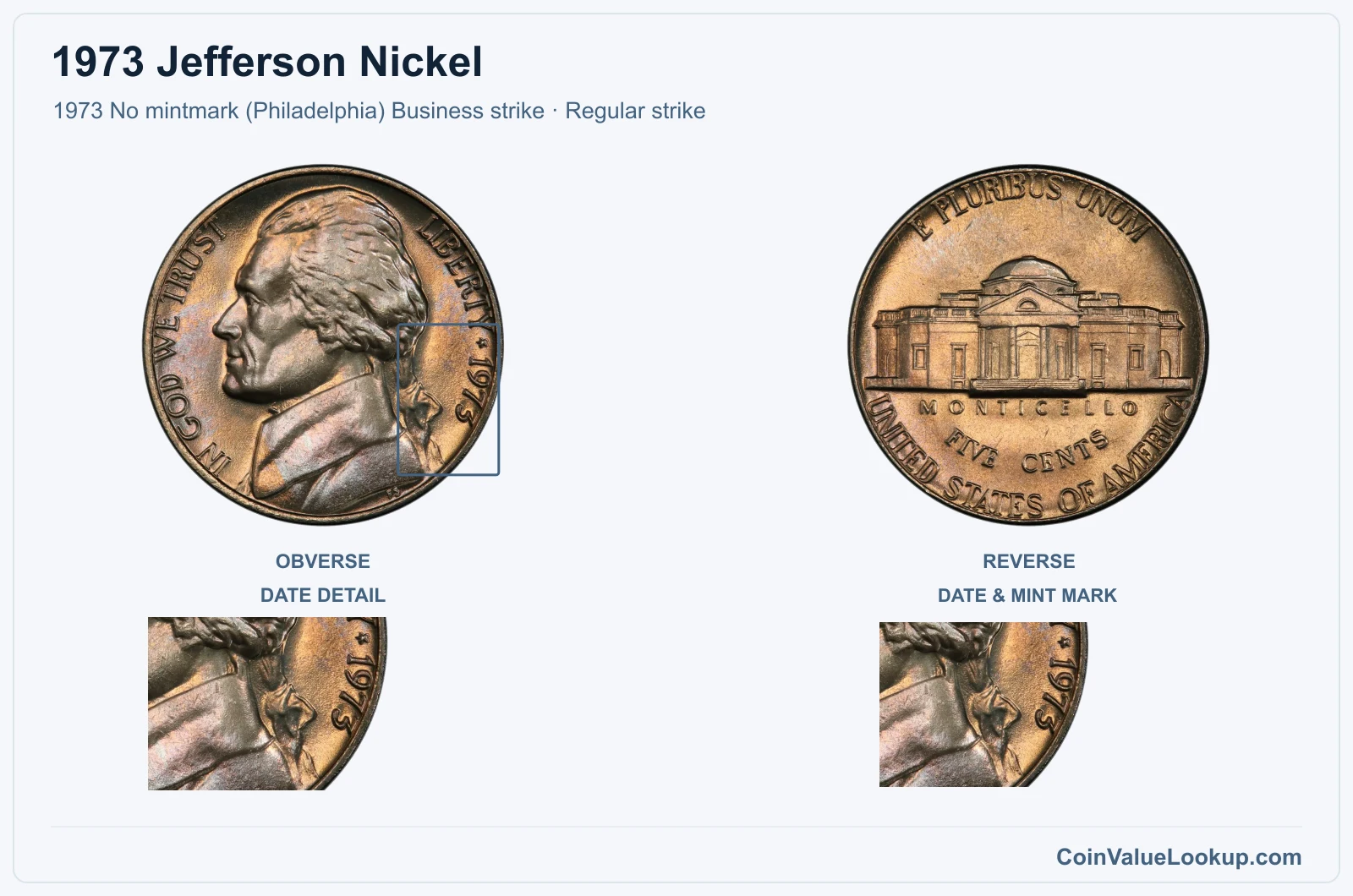
The 1973 Philadelphia nickel has no mintmark on the obverse below the date. That blank space is the identifier.
These were struck for general circulation and are the most commonly encountered version.
In typical worn condition, expect face value. Uncirculated examples carry USA Coin Book guide estimates of about $0.30 at MS60 and $3.62 at MS65.
Coins with certified Full Steps can merit a premium above those baseline figures, though a single bright surface alone does not guarantee that designation.
| Range | Grade | Price | Auction Records | Appraisal |
|---|---|---|---|---|
| PO | PO 1 | — | Coin Identifier | |
| FR | FR 2 | — | Coin Identifier | |
| AG | AG 3 | — | Coin Identifier | |
| G | G 4 | — | Coin Identifier | |
| G 6 | — | Coin Identifier | ||
| VG | VG 8 | — | Coin Identifier | |
| VG 10 | — | Coin Identifier | ||
| F | F 12 | — | Coin Identifier | |
| F 15 | — | Coin Identifier | ||
| VF | VF 20 | — | Coin Identifier | |
| VF 25 | — | Coin Identifier | ||
| VF 30 | — | Coin Identifier | ||
| VF 35 | — | Coin Identifier | ||
| XF | XF 40 | — | Coin Identifier | |
| XF 45 | — | Coin Identifier | ||
| AU | AU 50 | — | Coin Identifier | |
| AU 53 | — | Coin Identifier | ||
| AU 55 | — | Coin Identifier | ||
| AU 58 | — | Coin Identifier | ||
| MS | MS 60 | — | Coin Identifier | |
| MS 61 | — | Coin Identifier | ||
| MS 62 | — | Coin Identifier | ||
| MS 63 | — | Coin Identifier | ||
| MS 64 | — | Coin Identifier | ||
| MS 65 | — | Coin Identifier | ||
| MS 66 | Coin Identifier | |||
| MS 67 | Coin Identifier | |||
| MS 68 | — | — | — | |
| MS 69 | — | — | — | |
| MS 70 | — | — | — |
1973 Jefferson Nickel — D Business strike
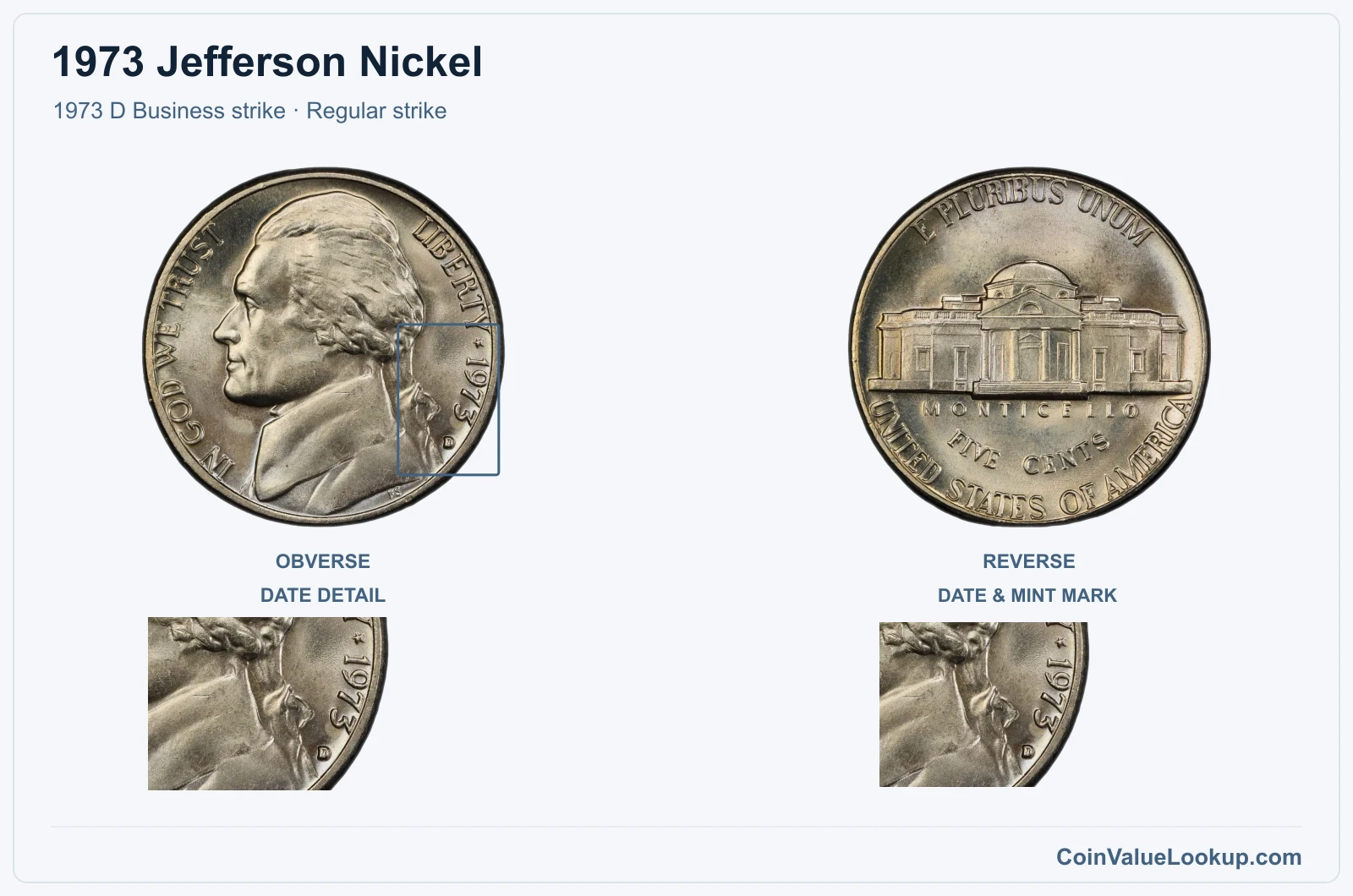
Look for the small "D" mintmark on the obverse just below the date. Denver struck these for everyday commerce, and they turn up regularly in pocket change and rolls.
Coin Value Lookup is a handy place to look up guides for Jefferson nickels and other series when you want to compare values across years and mints.
USA Coin Book guide estimates match the Philadelphia issue: roughly $0.30 at MS60 and $3.62 at MS65. As with the no-mintmark version, circulated pieces are generally worth five cents.
Full Steps attribution can push the value higher for qualifying uncirculated coins.
| Range | Grade | Price | Auction Records | Appraisal |
|---|---|---|---|---|
| PO | PO 1 | — | Coin Identifier | |
| FR | FR 2 | — | Coin Identifier | |
| AG | AG 3 | — | Coin Identifier | |
| G | G 4 | — | Coin Identifier | |
| G 6 | — | Coin Identifier | ||
| VG | VG 8 | — | Coin Identifier | |
| VG 10 | — | Coin Identifier | ||
| F | F 12 | — | Coin Identifier | |
| F 15 | — | Coin Identifier | ||
| VF | VF 20 | — | Coin Identifier | |
| VF 25 | — | Coin Identifier | ||
| VF 30 | — | Coin Identifier | ||
| VF 35 | — | Coin Identifier | ||
| XF | XF 40 | — | Coin Identifier | |
| XF 45 | — | Coin Identifier | ||
| AU | AU 50 | — | Coin Identifier | |
| AU 53 | — | Coin Identifier | ||
| AU 55 | — | Coin Identifier | ||
| AU 58 | — | Coin Identifier | ||
| MS | MS 60 | — | Coin Identifier | |
| MS 61 | — | Coin Identifier | ||
| MS 62 | — | Coin Identifier | ||
| MS 63 | Coin Identifier | |||
| MS 64 | — | Coin Identifier | ||
| MS 65 | — | Coin Identifier | ||
| MS 66 | Coin Identifier | |||
| MS 67 | — | Coin Identifier | ||
| MS 68 | — | — | — | |
| MS 69 | — | — | — | |
| MS 70 | — | — | — |
1973 Jefferson Nickel — S Proof
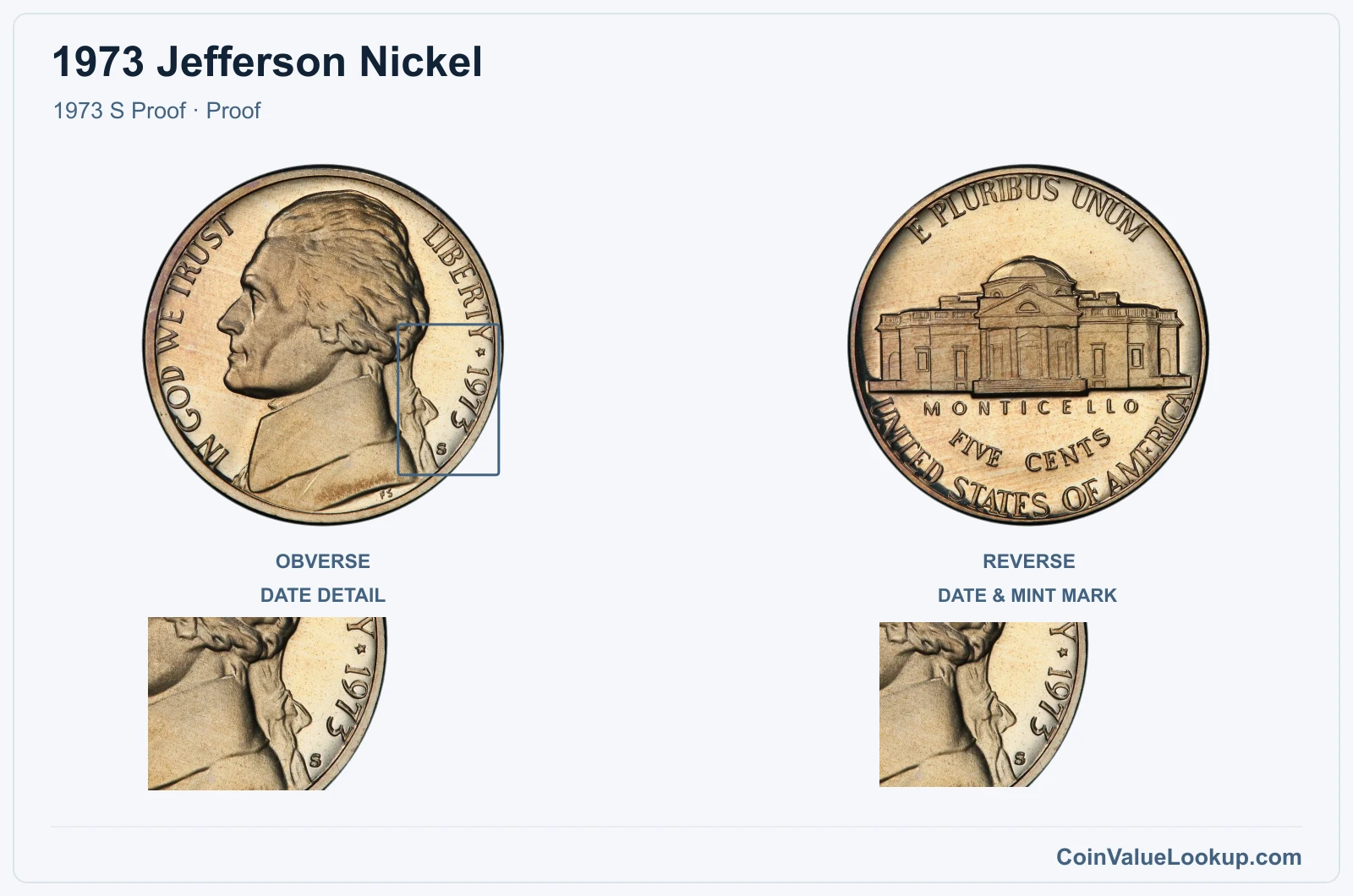
The 1973-S proof was produced at San Francisco exclusively for collectors, sold in proof sets. It carries an "S" mintmark below the date on the obverse and displays the sharp detail and reflective fields characteristic of the proof manufacturing process.
USA Coin Book estimates the base proof at about $2.50 in PR65. Cameo and deep cameo designations are separate categories with their own market, and the base proof guide figure does not apply to those enhanced-contrast coins.
If your proof has frosted devices against mirrored fields, it may qualify for one of those designations upon professional grading.
| Range | Grade | Price | Auction Records | Appraisal |
|---|---|---|---|---|
| PR | PR 1 | — | Coin Identifier | |
| PR 2 | — | Coin Identifier | ||
| PR 3 | — | Coin Identifier | ||
| PR 4 | — | Coin Identifier | ||
| PR 6 | — | Coin Identifier | ||
| PR 8 | — | Coin Identifier | ||
| PR 10 | — | Coin Identifier | ||
| PR 12 | — | Coin Identifier | ||
| PR 15 | — | Coin Identifier | ||
| PR 20 | — | Coin Identifier | ||
| PR 25 | — | Coin Identifier | ||
| PR 30 | — | Coin Identifier | ||
| PR 35 | — | Coin Identifier | ||
| PR 40 | — | Coin Identifier | ||
| PR 45 | — | Coin Identifier | ||
| PR 50 | — | Coin Identifier | ||
| PR 53 | — | Coin Identifier | ||
| PR 55 | — | Coin Identifier | ||
| PR 58 | — | Coin Identifier | ||
| PR 60 | — | Coin Identifier | ||
| PR 61 | — | Coin Identifier | ||
| PR 62 | — | Coin Identifier | ||
| PR 63 | — | Coin Identifier | ||
| PR 64 | — | Coin Identifier | ||
| PR 65 | — | Coin Identifier | ||
| PR 66 | — | Coin Identifier | ||
| PR 67 | Coin Identifier | |||
| PR 68 | Coin Identifier | |||
| PR 69 | Coin Identifier | |||
| PR 70 | Coin Identifier |
1973 Jefferson Nickel Error List
1. 1973 Jefferson Nickel — Proof struck on Liberia5cents blank
A 1973-S proof nickel struck on a Liberia 5-cent blank is a documented wrong-planchet error. The key diagnostic is the weight: the attributed specimen weighs 4.15 grams instead of the standard 5.00 grams.
The full Jefferson proof design appears, but on a foreign blank that is slightly lighter than normal.
Do not rely on color or surface tone alone to identify this error. A regular proof with a weak strike or an altered edge can mimic the appearance.
Authenticated weight and third-party attribution are essential. One example graded NGC PR67 Ultra Cameo sold through Heritage Auctions in January 2011 for $1,207.50.
That is a single auction result for that specific specimen, not a general market range.
2. 1973 Jefferson Nickel — Struck on clad dime blank
A 1973 Philadelphia nickel struck on a clad dime blank is noticeably smaller than a standard nickel. The design is cropped around the perimeter because the dime planchet is narrower than the nickel die cavity.
Edge examination is important: a dime blank has a reeded-stock edge profile distinct from a nickel's plain edge.
The lookalike to watch out for is a nickel that has been trimmed or filed down after minting. Genuine off-metal strikes show uniform design loss at the rim and consistent metal flow.
A PCGS MS64 example sold through Heritage Auctions in December 2024 for $384. That is one documented sale, not a price applicable to every example.
3. 1973 Jefferson Nickel — Off-center with chain strike
A 1973-D nickel struck roughly 60% off center is a dramatic error. The coin shows a large blank crescent where the die missed the planchet, with the opposite portion of the design entirely absent.
The source also identifies a chain strike and counting-wheel damage on this piece, so multiple forms of production interference occurred.
To confirm a genuine off-center strike, both faces should show consistent displacement, and ideally the date remains visible, which increases collector interest. Simple rim damage or a post-mint bend will not produce matching obverse and reverse misalignment.
No general price range is supported for this error; value depends on the authenticated identity, the severity of the displacement, overall condition, and any additional damage present.
4. 1973 Jefferson Nickel — Struck on Philippines5c blank
A 1973-D business strike nickel on a Philippines 5-centavo blank weighs only about 2.5 grams, roughly half the normal 5.00 grams. The Jefferson design appears on a visibly smaller planchet, with the perimeter sharply cropped.
This is a different error from the Liberia proof blank; the weight, mint, finish, and foreign blank origin are all distinct. Do not confuse a small damaged nickel with this variety.
Authentic wrong-planchet strikes show uniform design truncation and correct metal flow for the smaller blank. An NGC MS64 example sold at Heritage Auctions in October 2022 for $780.
That figure reflects one individual auction result for that particular certified coin.
5. 1973 Jefferson Nickel — Clipped Planchet
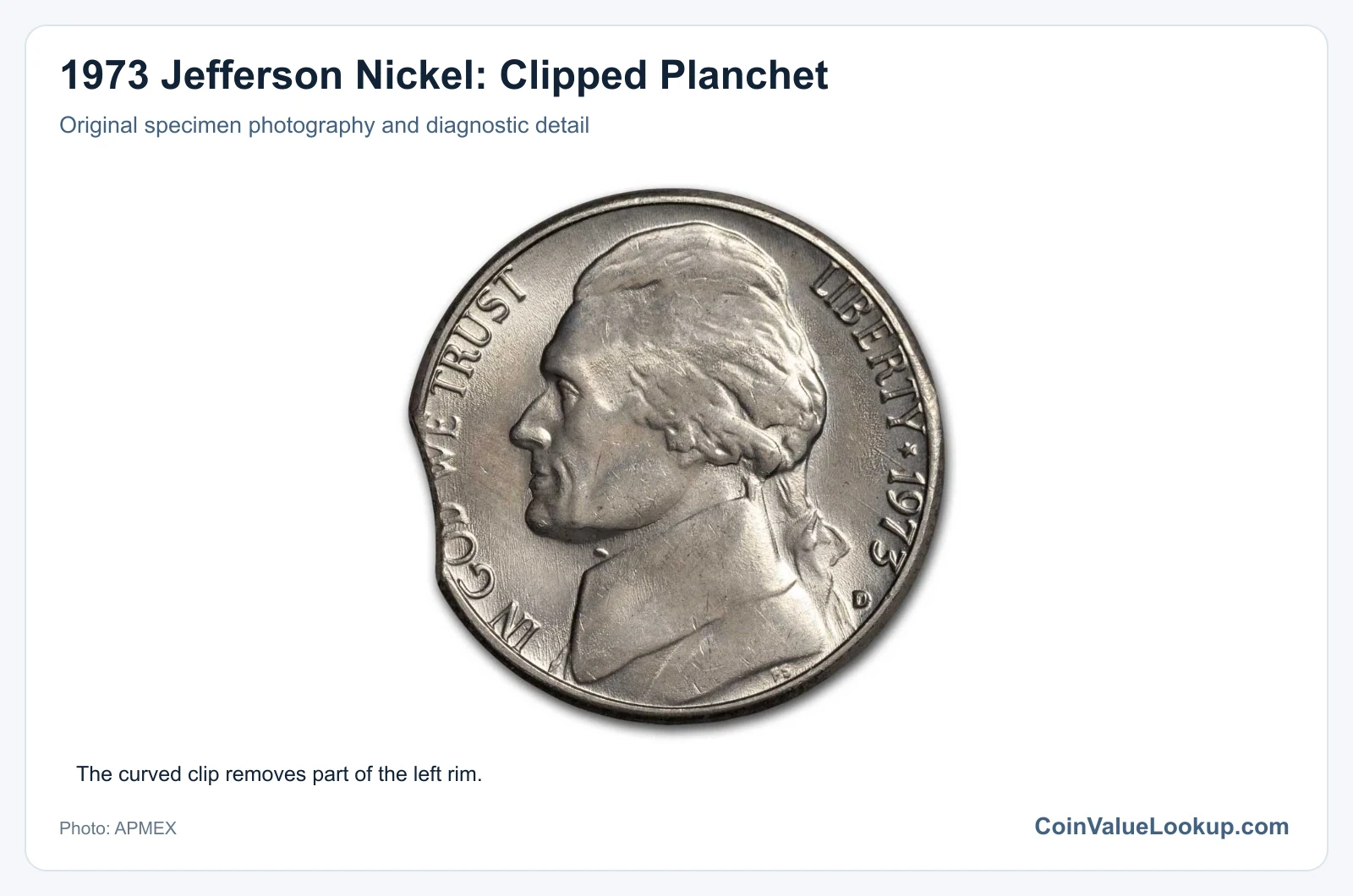
A clipped planchet error on a 1973 nickel means a portion of the original blank was missing before the coin was struck. The clip can be curved, straight, or ragged depending on where the blank-cutting punch went wrong.
On the struck coin, look for a corresponding area of weakness on the opposite side of the missing section, which results from uneven metal flow during striking.
The main lookalike is post-mint damage: an edge that has been cut, filed, or corroded after the coin left the press. Genuine clips typically show a smooth, unstruck edge at the clipped area rather than tool marks.
No specific price range is supported for this category; the value of any individual piece depends on the size and type of clip, the coin's condition, and professional attribution.
6. 1973 Jefferson Nickel — Misplaced Mintmark
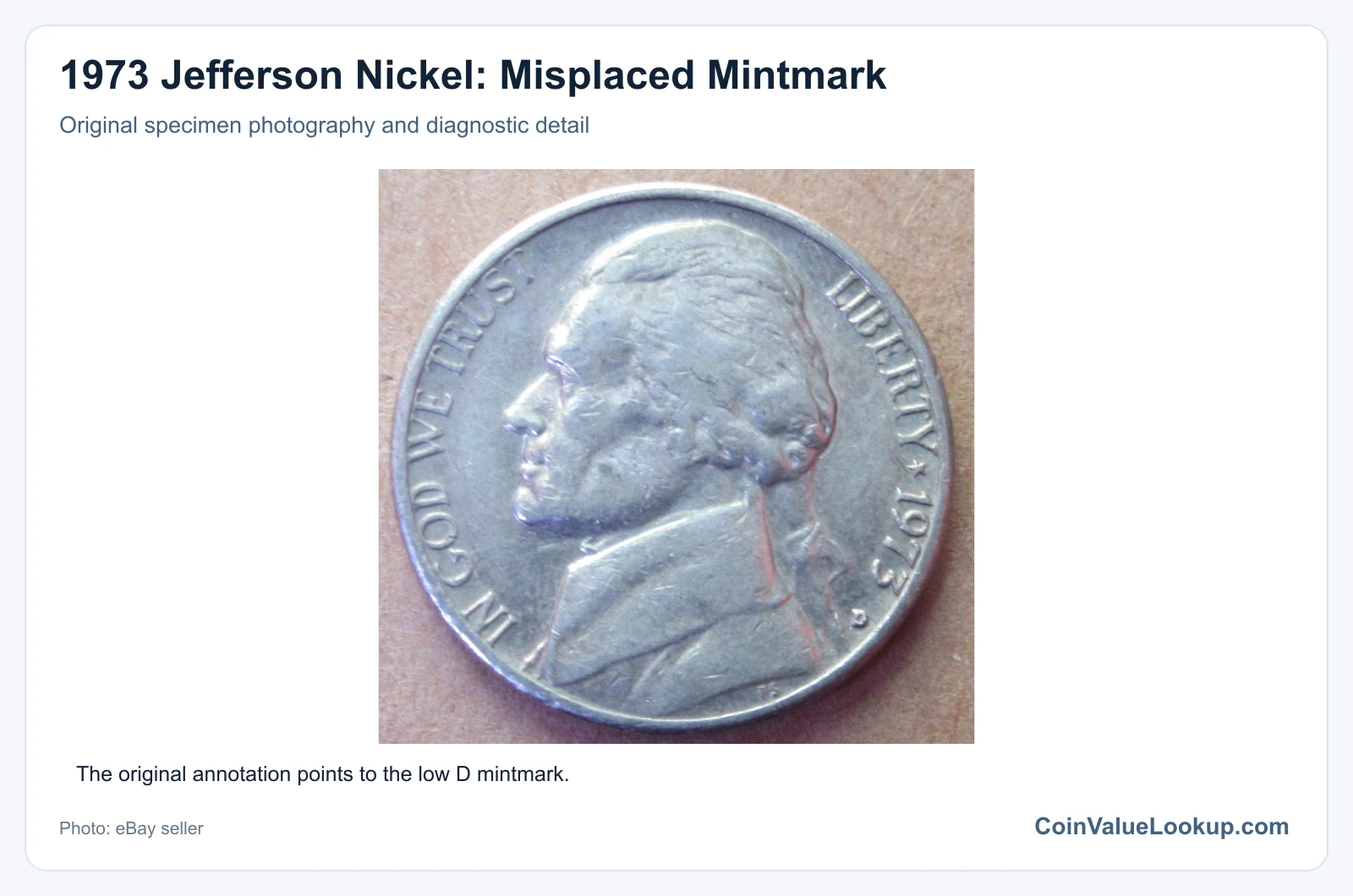
A misplaced mintmark on a 1973 nickel means the mintmark punch landed in an unexpected location relative to its normal position below the date. This could appear as a faint letter impression partially embedded in a nearby design element or shifted well away from the standard spot.
To check, compare your coin's mintmark placement against a known normal example from the same year and mint. The surrounding design details help frame whether the position is genuinely off.
Do not confuse surface marks, scratches, or minor die polish lines for a misplaced letter. Value depends on how visible and dramatic the displacement is, the coin's overall condition, and whether it has been professionally attributed.
7. 1973 Jefferson Nickel — Clashed Dies
A die clash on a 1973 nickel shows traces of the opposite die's design transferred onto the wrong side of the coin. This happens when the obverse and reverse dies strike each other without a planchet between them, leaving ghostly impressions that then appear on subsequently struck coins.
Look for faint outlines of Monticello on the obverse or Jefferson's portrait details on the reverse, aligned with where the opposing die would have contacted. These marks are raised, not incuse.
Do not confuse random scratches, surface lines, or a brockage with a true die clash. Condition, the clarity of the clash impression, and professional attribution all factor into individual value; no specific price range is supported here.
8. 1973 Jefferson Nickel — Doubled Die Obverse
A doubled die obverse on a 1973 nickel shows consistent doubling on obverse design elements such as lettering, the date, or parts of Jefferson's portrait. The key word is consistent: genuine hub doubling produces uniform separation or notching across affected areas, visible under moderate magnification.
The most common lookalike is machine doubling, which creates a flat, shelf-like distortion rather than the rounded, separated profiles of a true doubled die. Reflections under certain lighting angles can also trick the eye.
Compare your coin to a normal 1973 nickel under the same light. Value depends on the strength and visibility of the doubling, the coin's grade, and authenticated attribution.
9. 1973 Jefferson Nickel — Die Crack / Die Chip
Die cracks and die chips on a 1973 nickel appear as raised lines or small raised blobs on the coin's surface. They originate from physical damage to the steel die itself: a crack transfers as a raised line, and a broken-away chip fills with metal to create a small raised lump.
An interior die chip differs from a rim-connected break, sometimes called a cud, which produces a larger featureless raised area at the edge. The diagnostic is that these features are raised, not cut into the surface.
Incuse scratches, corrosion spots, or foreign material stuck to a coin can look similar at first glance but lack the consistent raised profile of a die break. Condition, size, and location of the break all influence individual value; no general price range is adopted for this category.