1863 Indian Head Penny Coin Value: How Much Is It Worth?
The 1863 Indian Head cent is a copper-nickel issue from the Civil War era, struck only at the Philadelphia Mint. Guide estimates for regular business strikes range from about $15 at G4 (a well-worn but readable coin) to around $330 at MS63 (a choice uncirculated example).
Proofs, major varieties, and mint errors require separate evaluation and can carry very different prices.
Fast Way to Identify Your 1863 Indian Head Penny
Want a quick read on your 1863 Indian Head penny? Upload clear photos of both the front and back of your coin.
Our identifier can offer a preliminary identification based on those images, helping you figure out the version and general category you are working with. It is not a substitute for professional authentication, but it is a solid starting point.
1863 Indian Head Penny Value
Upload both sides of your 1863 Indian Head Penny.
Front Obverse
Upload photo
Back Reverse
Upload photo
Which 1863 Indian Head Penny Versions Are Worth Money?
- The 1863 business strike in MS63 carries a guide estimate around $330; most circulated examples are far more affordable at roughly $15 in G4.
- The 1863 proof has a guide estimate near $1,243 at PR63, reflecting its limited original production for collectors.
- Copper-nickel composition and original untouched surfaces add appeal; cleaned or corroded coins trade for less regardless of grade.
- Several die varieties and mint errors have been reported for this date, each valued individually based on authenticated identity and severity.
Step 1: Identify Your 1863 Indian Head Penny Mint Mark and Version
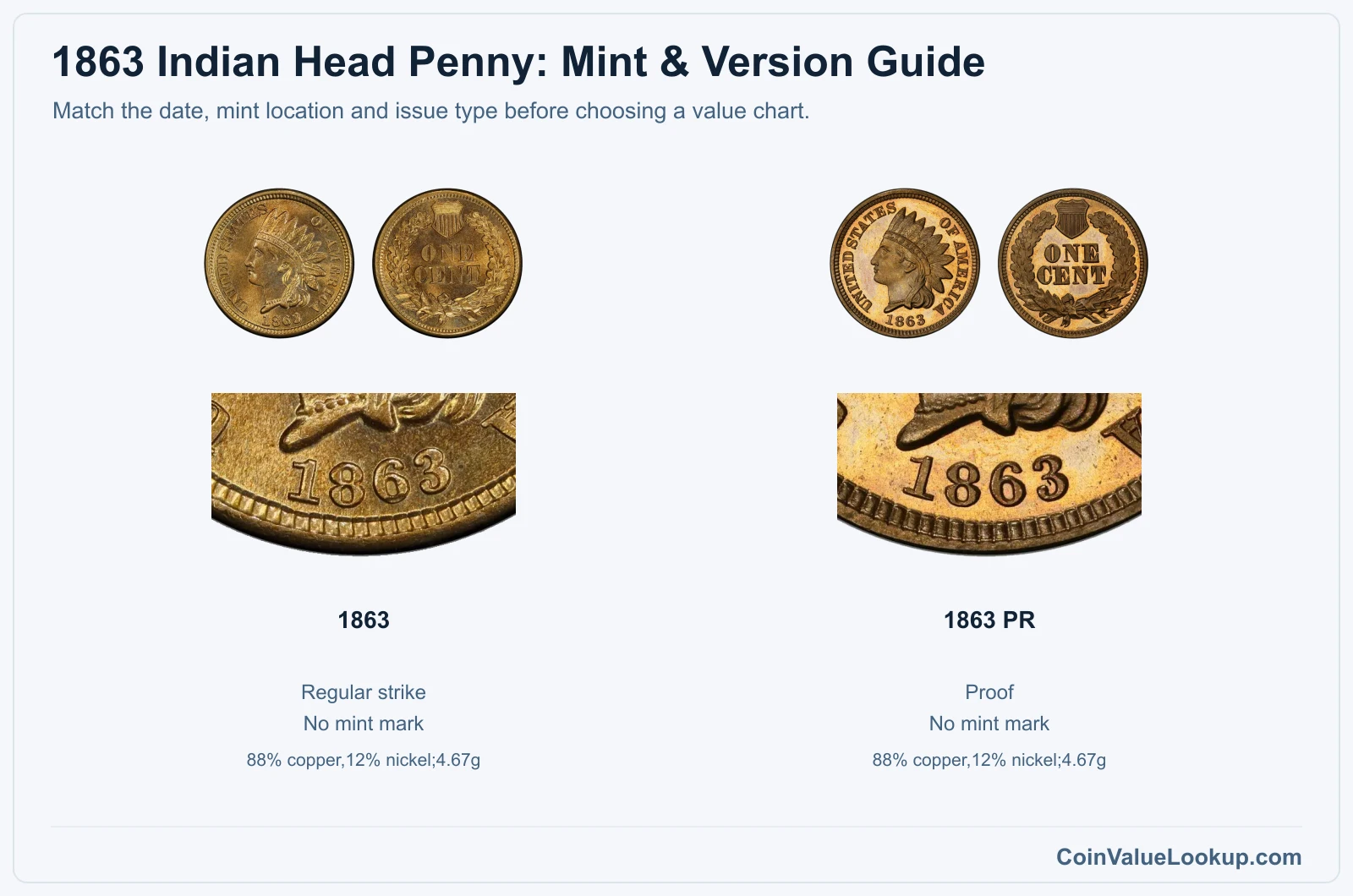
Every regular 1863 Indian Head cent was struck at the Philadelphia Mint. There is no mintmark on this coin, and the small "L" sometimes found on later dates is a designer's initial, not a mint indicator.
The obverse shows the familiar Indian portrait wearing a feathered headdress, with UNITED STATES OF AMERICA around the border. The reverse features an oak wreath with a small shield at the top, framing the denomination ONE CENT.
Do not confuse this coin with the earlier Flying Eagle cents (1856–1858) or the later Lincoln cents, which have completely different portraits. The 1863 issue is copper-nickel, not bronze.
Bronze Indian Head cents did not begin until partway through 1864, so an 1863 should feel slightly heavier (4.67 grams) and have a lighter, more silvery color than later issues.
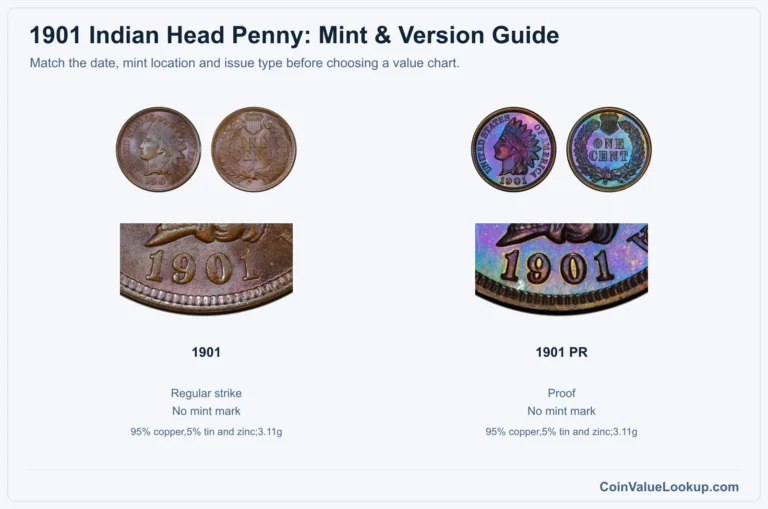
The two main branches for this date are the standard business strike and the proof. Proof coins were specially manufactured with polished dies and planchets, producing mirror-like surfaces.
A shiny coin is not automatically a proof; mirrored fields, squared rims, and a general sharpness of strike all factor in. If you are unsure, professional authentication is the safest route.
Step 2: Check Your 1863 Indian Head Penny Grade
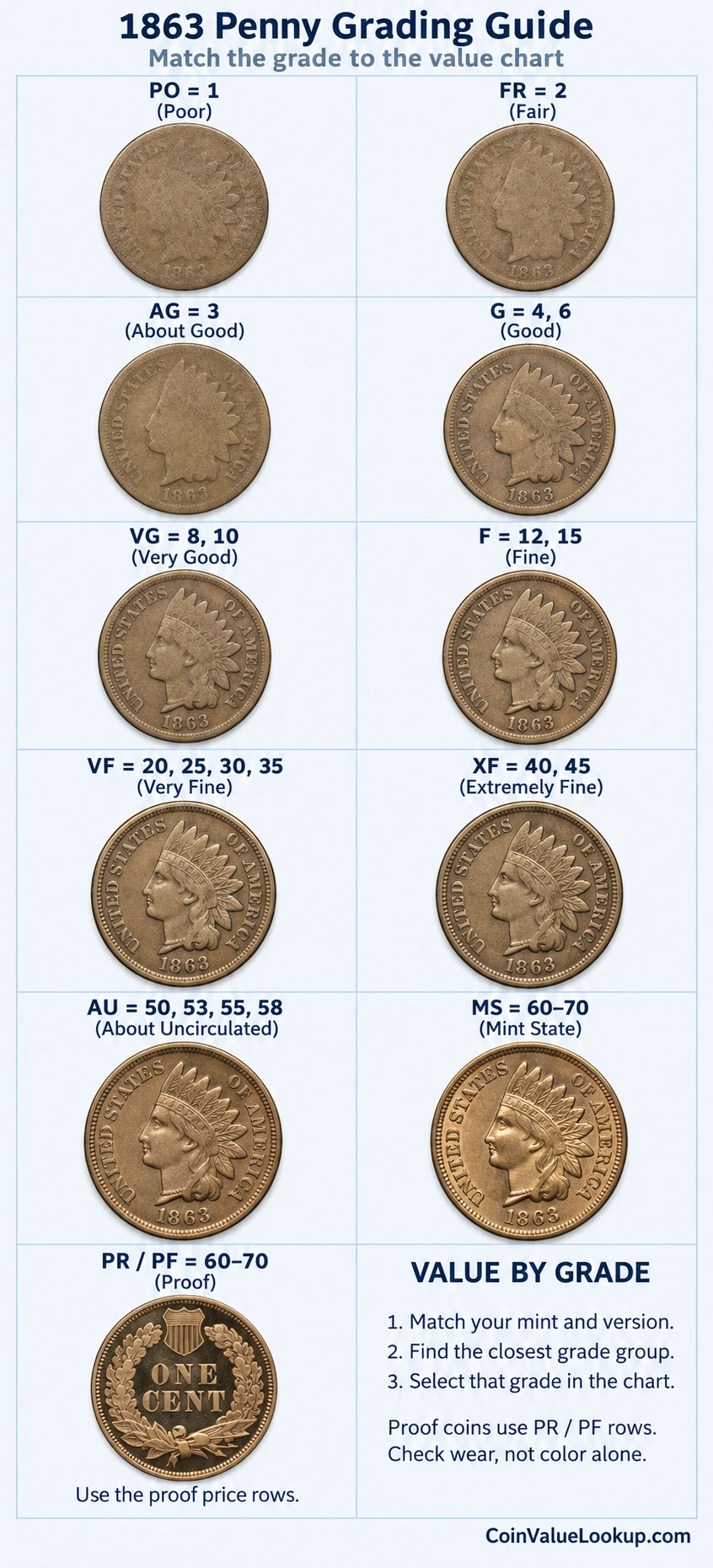
Start with the headband. The word LIBERTY is incused across it, and on a well-worn coin the letters disappear from the center outward.
At G4, at least a couple of letters should still be partially visible, while at higher grades all six letters read clearly.
Next, check the feather tips and hair curls near the ear. These are high points and show wear first.
A soft original strike can leave feathers mushy even on an uncirculated coin, so do not grade from feather detail alone.
On the reverse, examine the wreath leaves and the shield. Flattened leaf veins and a smooth shield indicate circulation wear.
Luster matters a lot at the uncirculated level. An MS63 coin should have original cartwheel luster with only minor contact marks.
Because this is a copper-nickel alloy, the color discussion (BN, RB, RD) that applies to bronze Indian cents does not apply the same way here.
Use the comparison image to match your coin's overall wear pattern. Look for scratches, rim dings, and signs of cleaning, all of which reduce marketability regardless of how much design detail remains.
Step 3: Check 1863 Indian Head Penny Value by Mint and Version
1863 Indian Head Penny
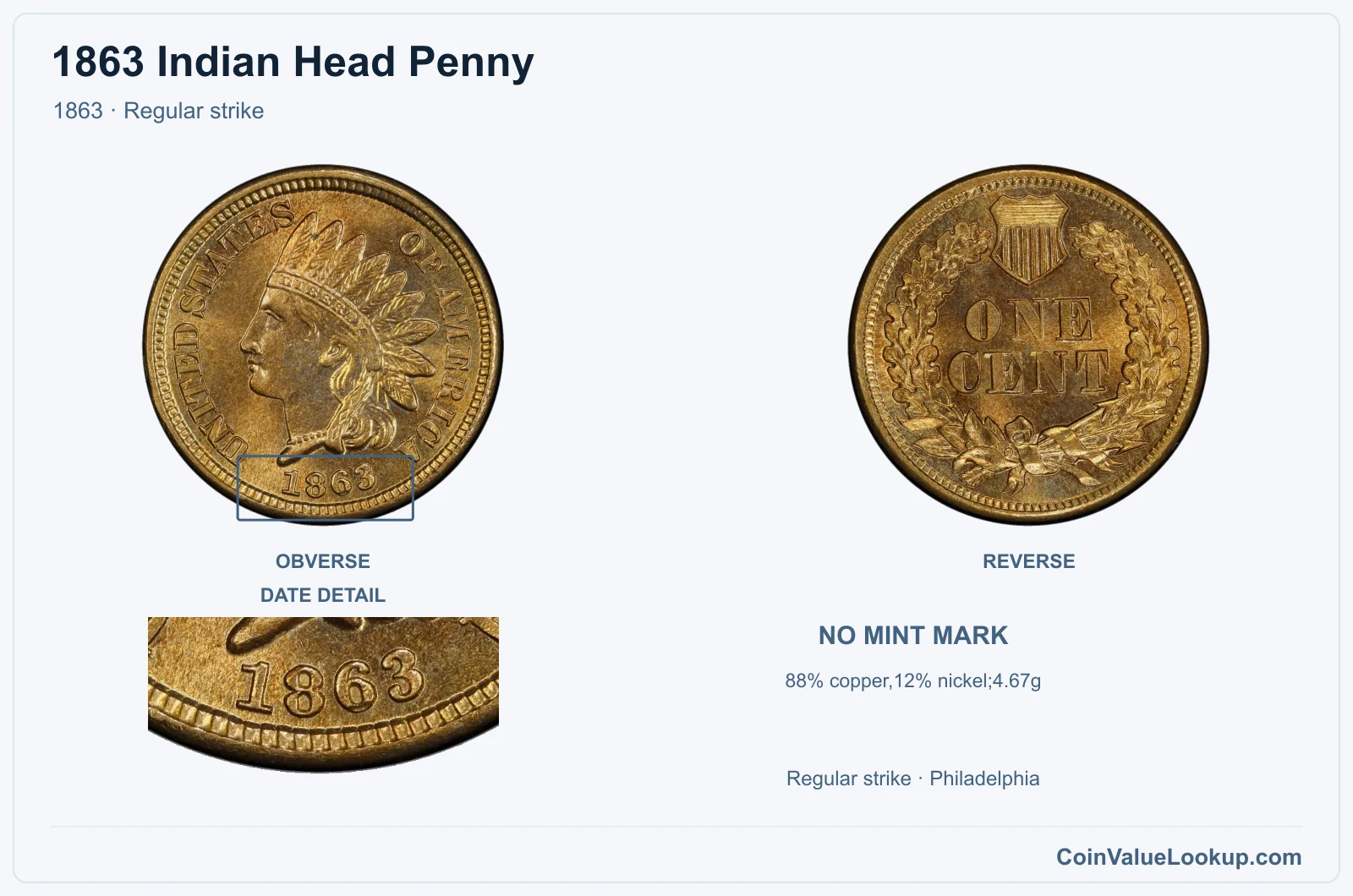
The regular 1863 Indian Head cent is a Philadelphia business strike in copper-nickel (88% copper, 12% nickel) weighing 4.67 grams. It has no mintmark.
Guide estimates place this coin at about $15 in G4 and around $330 in MS63. The wide gap between those two numbers tells you that condition is everything with this date.
Circulated survivors are common enough to be affordable, but a truly choice uncirculated piece with original surfaces is a different animal. Always compare coins of like grade and similar surface quality before assuming a value.
| Range | Grade | Price | Auction Records | Appraisal |
|---|---|---|---|---|
| PO | PO 1 | — | Coin Identifier | |
| FR | FR 2 | — | Coin Identifier | |
| AG | AG 3 | — | Coin Identifier | |
| G | G 4 | — | Coin Identifier | |
| G 6 | — | Coin Identifier | ||
| VG | VG 8 | — | Coin Identifier | |
| VG 10 | — | Coin Identifier | ||
| F | F 12 | — | Coin Identifier | |
| F 15 | Coin Identifier | |||
| VF | VF 20 | Coin Identifier | ||
| VF 25 | — | Coin Identifier | ||
| VF 30 | — | Coin Identifier | ||
| VF 35 | — | Coin Identifier | ||
| XF | XF 40 | Coin Identifier | ||
| XF 45 | Coin Identifier | |||
| AU | AU 50 | Coin Identifier | ||
| AU 53 | Coin Identifier | |||
| AU 55 | Coin Identifier | |||
| AU 58 | Coin Identifier | |||
| MS | MS 60 | Coin Identifier | ||
| MS 61 | Coin Identifier | |||
| MS 62 | Coin Identifier | |||
| MS 63 | Coin Identifier | |||
| MS 64 | Coin Identifier | |||
| MS 65 | Coin Identifier | |||
| MS 66 | Coin Identifier | |||
| MS 67 | Coin Identifier | |||
| MS 68 | — | — | — | |
| MS 69 | — | — | — | |
| MS 70 | — | — | — |
1863 Indian Head Penny — PR
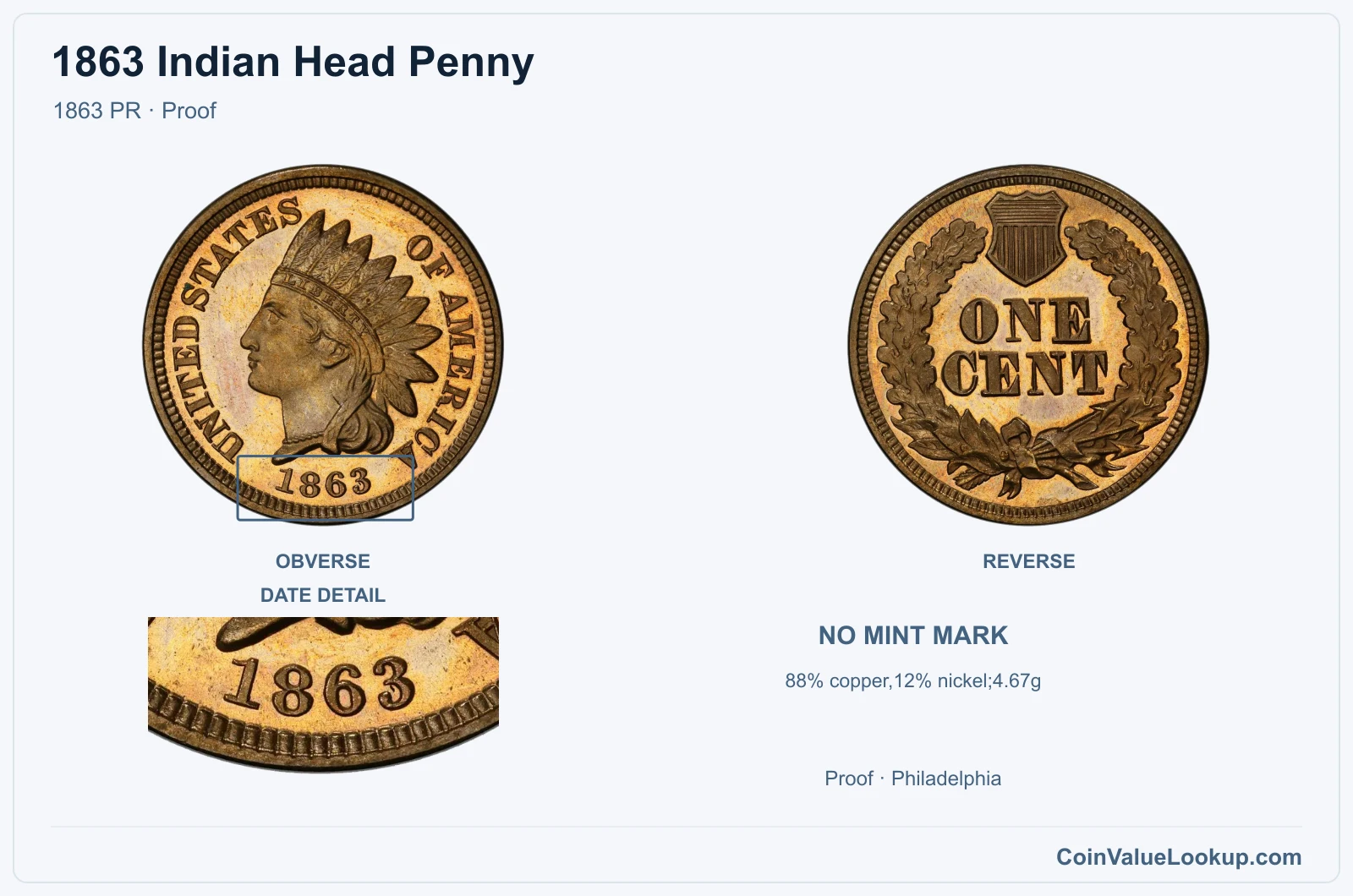
The 1863 proof Indian Head cent was a special striking intended for collectors of the era, produced in small quantities at Philadelphia. At PR63, the guide estimate sits near $1,243.
Proof identification requires more than a shiny surface. Genuine proofs exhibit deeply mirrored fields, sharply squared rim edges, and full design detail from the specially prepared dies.
A business strike that someone polished at home will fool you briefly but falls apart under magnification, where the original die finish is absent and hairline scratches from the polishing are visible.
Coin Value Lookup is a handy place to compare guide values across different Indian Head cent dates and finishes before you decide whether your coin warrants professional grading.
| Range | Grade | Price | Auction Records | Appraisal |
|---|---|---|---|---|
| PR | PR 1 | — | Coin Identifier | |
| PR 2 | — | Coin Identifier | ||
| PR 3 | — | Coin Identifier | ||
| PR 4 | — | Coin Identifier | ||
| PR 6 | — | Coin Identifier | ||
| PR 8 | — | Coin Identifier | ||
| PR 10 | — | Coin Identifier | ||
| PR 12 | — | Coin Identifier | ||
| PR 15 | — | Coin Identifier | ||
| PR 20 | — | Coin Identifier | ||
| PR 25 | — | Coin Identifier | ||
| PR 30 | — | Coin Identifier | ||
| PR 35 | — | Coin Identifier | ||
| PR 40 | — | Coin Identifier | ||
| PR 45 | — | Coin Identifier | ||
| PR 50 | — | Coin Identifier | ||
| PR 53 | — | Coin Identifier | ||
| PR 55 | — | Coin Identifier | ||
| PR 58 | — | Coin Identifier | ||
| PR 60 | — | Coin Identifier | ||
| PR 61 | Coin Identifier | |||
| PR 62 | Coin Identifier | |||
| PR 63 | Coin Identifier | |||
| PR 64 | Coin Identifier | |||
| PR 65 | Coin Identifier | |||
| PR 66 | Coin Identifier | |||
| PR 67 | Coin Identifier | |||
| PR 68 | — | — | — | |
| PR 69 | — | — | — | |
| PR 70 | — | — | — |
1863 Indian Head Penny Error List
1. 1863 Indian Head Penny — Die Crack
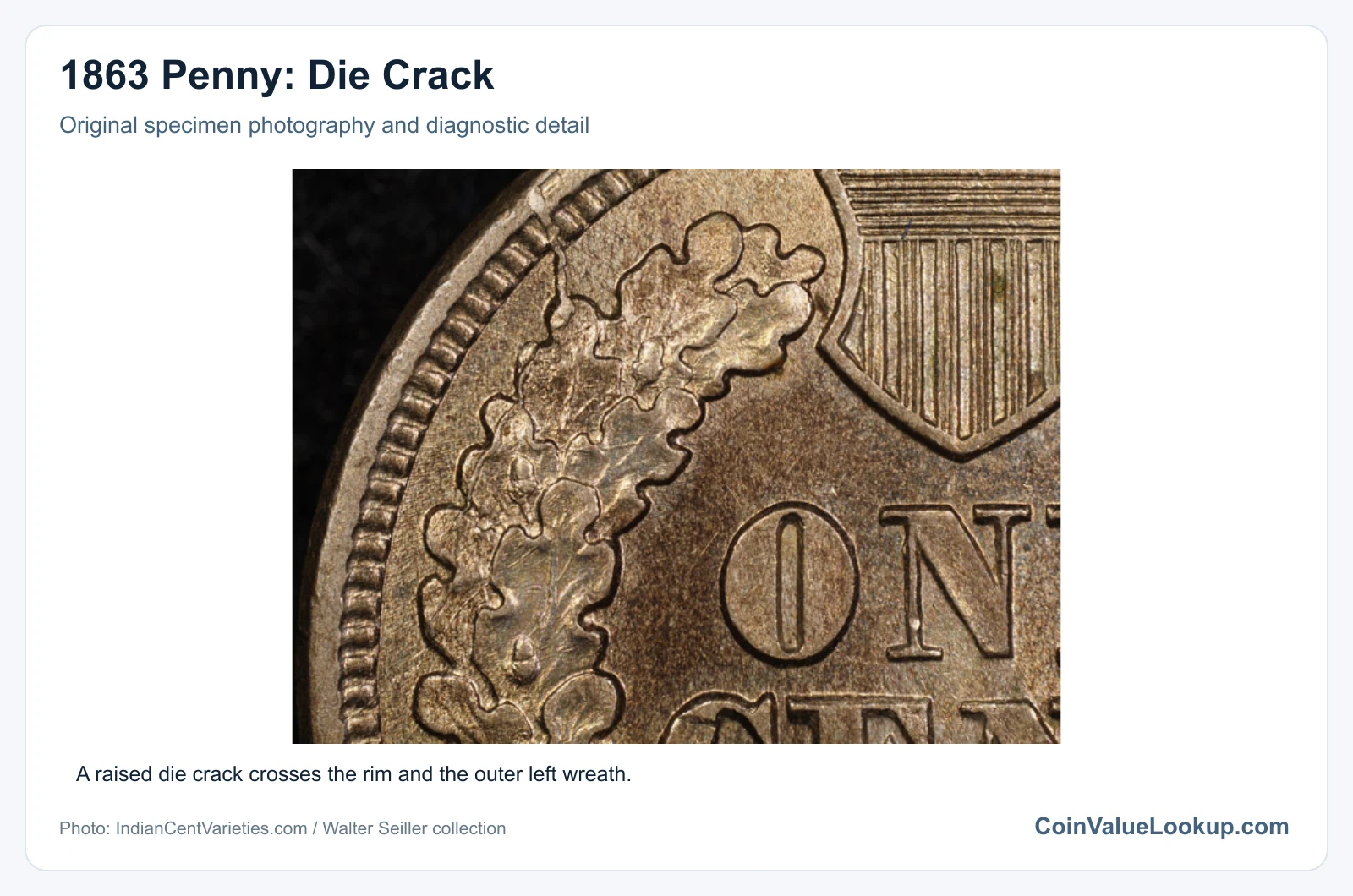
A die crack shows up as a thin raised line running across the coin's surface, sometimes crossing letters, the portrait, or open field areas. On an 1863 Indian Head cent, look carefully for a line that follows a consistent path and stands above the surrounding surface.
Note exactly where it starts and where it ends.
Do not confuse a die crack with an incuse scratch or corrosion line. A scratch cuts into the metal and feels recessed.
A die crack is raised because the recessed crack in the die transferred metal outward. Value depends on the crack's length, location, and how it affects the overall look, so each coin needs individual assessment by an authenticated example and its condition.
2. 1863 Indian Head Penny — Die Break / Cud
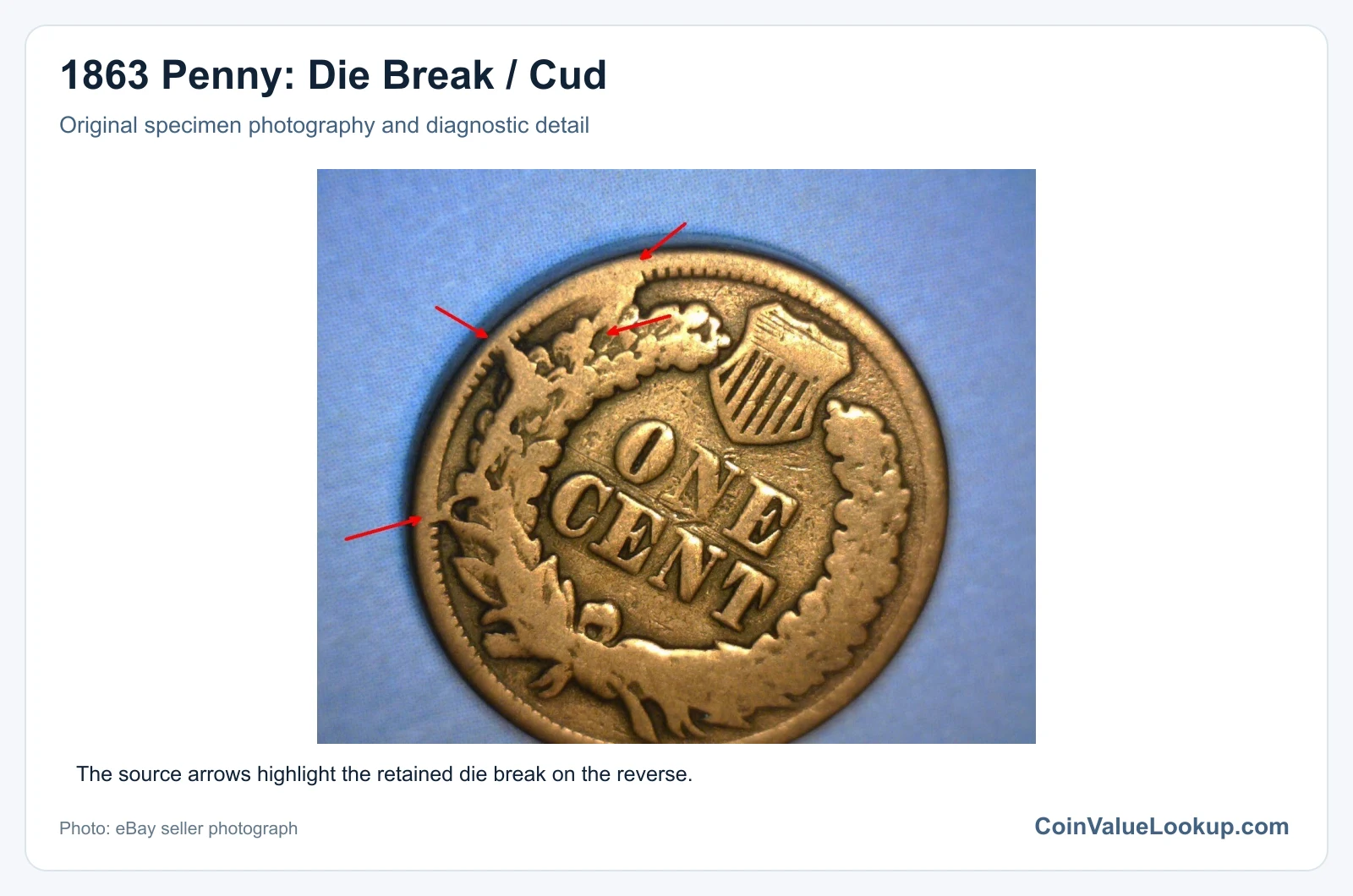
A cud is a specific type of die break that connects to the rim, leaving a raised blob of featureless metal where part of the design should be. On an 1863 Indian cent, you might spot a lump along the edge that replaces a section of lettering or denticles.
Smaller interior die breaks can produce raised lumps too but do not reach the rim, so they are technically die breaks rather than cuds. A rim dent is the opposite: it pushes metal inward rather than leaving a raised area.
Corrosion can also mimic a cud at first glance but will show pitting rather than smooth displaced metal. Pricing depends on size, location, and the coin's overall grade, assessed individually.
3. 1863 Indian Head Penny — Repunched Date
A repunched date on an 1863 Indian cent means that during die preparation, one or more date digits were punched into the die more than once, leaving remnants of the earlier position visible beside the final numbers. Look for traces of extra serifs, partial outlines, or offset shadows near the 1, 8, 6, or 3.
This is different from doubling of the entire design (a doubled die). It is also different from machine doubling, which produces flat, shelf-like distortion rather than the rounded secondary image of a repunched date.
Damaged numerals from post-mint hits can look similar, so compare carefully to known examples. Each repunched date variety is valued individually based on its distinctiveness and the coin's condition.
4. 1863 Indian Head Penny — Rusted Die Texture
When a die develops rust between uses, tiny pits form on its working surface. Those pits transfer to struck coins as small raised bumps or a rough, pimply texture, often in clusters across the field or within design elements.
On an 1863 Indian cent, look for a pattern of raised dots that repeats in the same area, which indicates a die-level origin rather than random damage. The key distinction: die rust adds metal to the coin's surface, while corrosion on the coin itself removes metal, leaving pits.
If your coin has rough patches that are recessed, that is probably environmental damage to the coin. Value for a rusted-die example depends on severity and overall coin condition, assessed individually.
5. 1863 Indian Head Penny — Clashed Dies
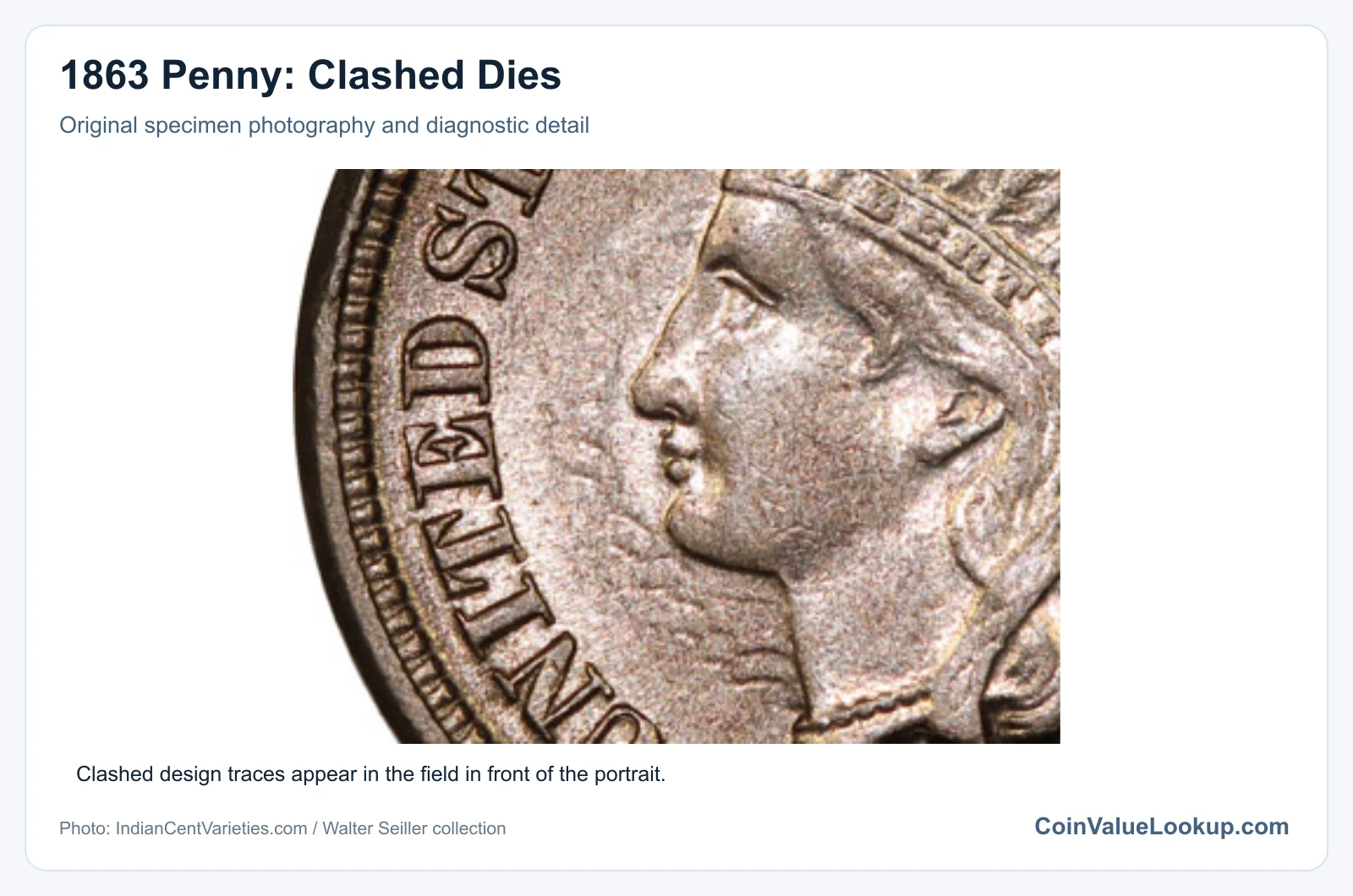
Clashed dies occur when the obverse and reverse dies strike each other without a planchet between them. The impact transfers faint traces of each die's design onto the opposing die, and those ghost images then appear on subsequent coins.
On an 1863 Indian cent, look for portions of the wreath faintly visible in the obverse field, or hints of the portrait appearing on the reverse. The transferred design should align with where the opposite die would have contacted.
Random raised lines, scratches, or brockage impressions can mimic a clash, so orientation and design match are your best confirmation tools. Each clashed-die coin is valued individually based on the clarity of the transferred design and the coin's overall condition.
6. 1863 Indian Head Penny — Rotated Dies
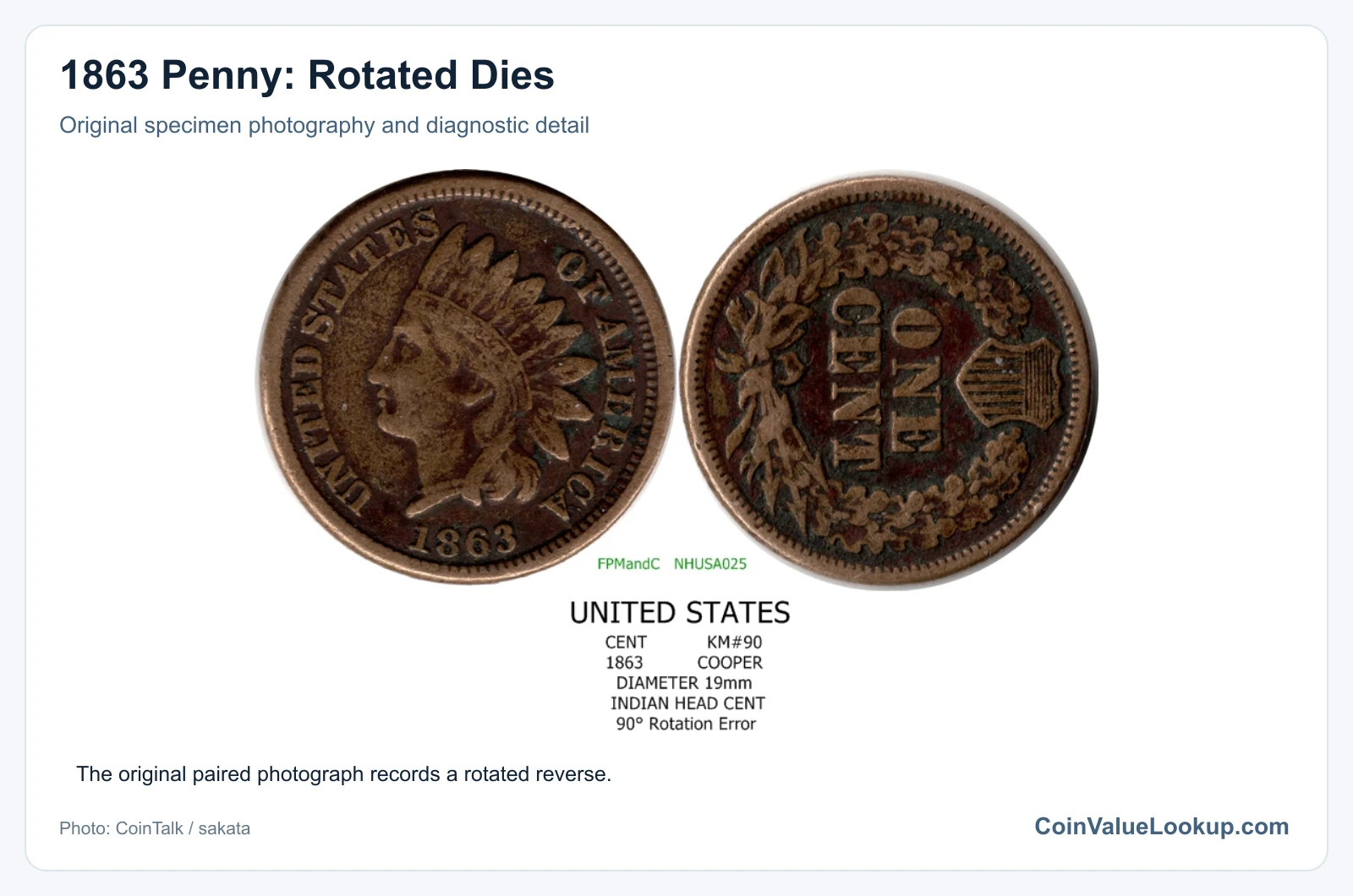
Normal U.S. coins use medal-turn alignment: hold the obverse upright, flip the coin top to bottom, and the reverse should also appear upright. A rotated die error means the reverse is turned from that expected position by some measurable degree.
To check your 1863 Indian cent, hold the obverse facing you with the portrait upright, then flip the coin along its vertical axis. If the reverse wreath and shield are noticeably tilted, you may have a rotation error.
Be careful with photographs, which can be rotated independently of the actual coin. Also rule out coins that were simply placed sideways in a holder.
Severity and degree of rotation determine collector interest, so individual assessment is necessary.
7. 1863 Indian Head Penny — Die Chip
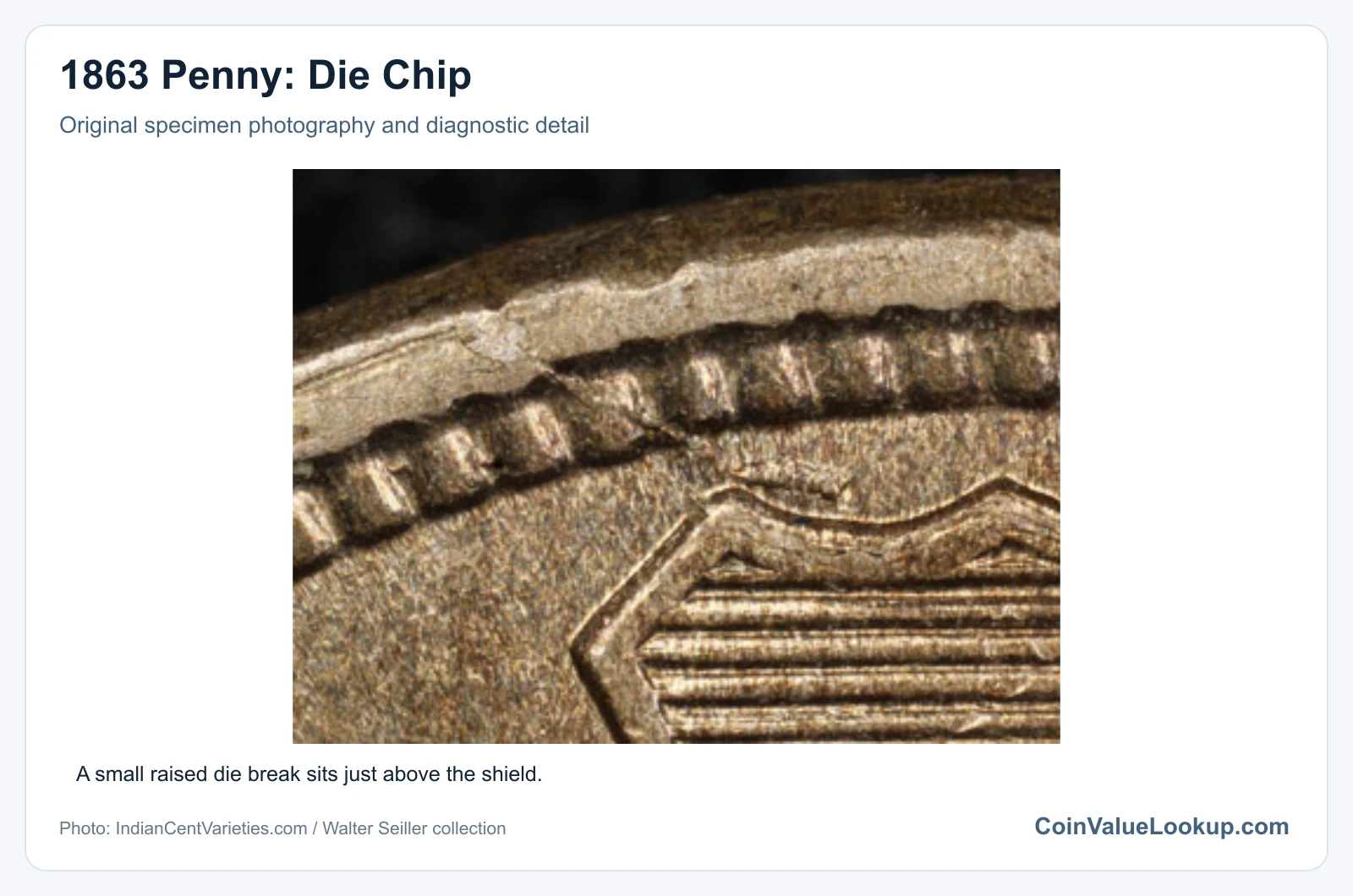
A die chip is a small piece of the die face that breaks away, leaving a void in the die that fills with metal during striking. The result is a localized raised lump on the coin, often found inside a letter, numeral, or nearby field.
On an 1863 Indian cent, check inside the loops of letters like the O in ONE or the E in CENT. A die chip will blend into the surrounding struck design rather than sitting on top like glued debris.
Distinguish it from a gouge mark or displaced-metal impact, which will show different surface flow. Value depends on the chip's size, location, and the coin's condition, each evaluated individually.
8. 1863 Indian Head Penny — Die Gouge / Named Raised-Line Variety
A die gouge appears as a raised line or extra-metal feature on the coin, caused by damage to the die's working face during manufacturing or handling. On an 1863 Indian cent, you might find a short raised streak crossing a letter, the portrait, or the wreath area.
The raised nature is key. An incuse scratch removes metal and sits below the surface; a die gouge adds metal and stands above it.
Die gouges can also resemble die cracks, but a crack typically runs in a longer, more continuous path, while a gouge tends to be shorter and more localized. Some die gouges have been cataloged as named varieties.
Each is valued individually based on the feature's prominence and the coin's overall grade.
9. 1863 Indian Head Penny — Misplaced Date
A misplaced date variety shows partial date digits appearing outside their intended location, typically embedded in denticles near the rim or overlapping the lower edge of the portrait. On an 1863 Indian cent, look for the outline of a numeral, like part of an 8 or 3, peeking out from an area where no date digit belongs.
The shape should match part of an actual numeral from the date. Random die chips, scratches, or bumps near the denticles can look suspicious but will not form a recognizable digit outline.
Compare your coin carefully with published reference images of the reported variety. Value depends on clarity and coin condition, assessed individually.
10. 1863 Indian Head Penny — Doubled Die Reverse
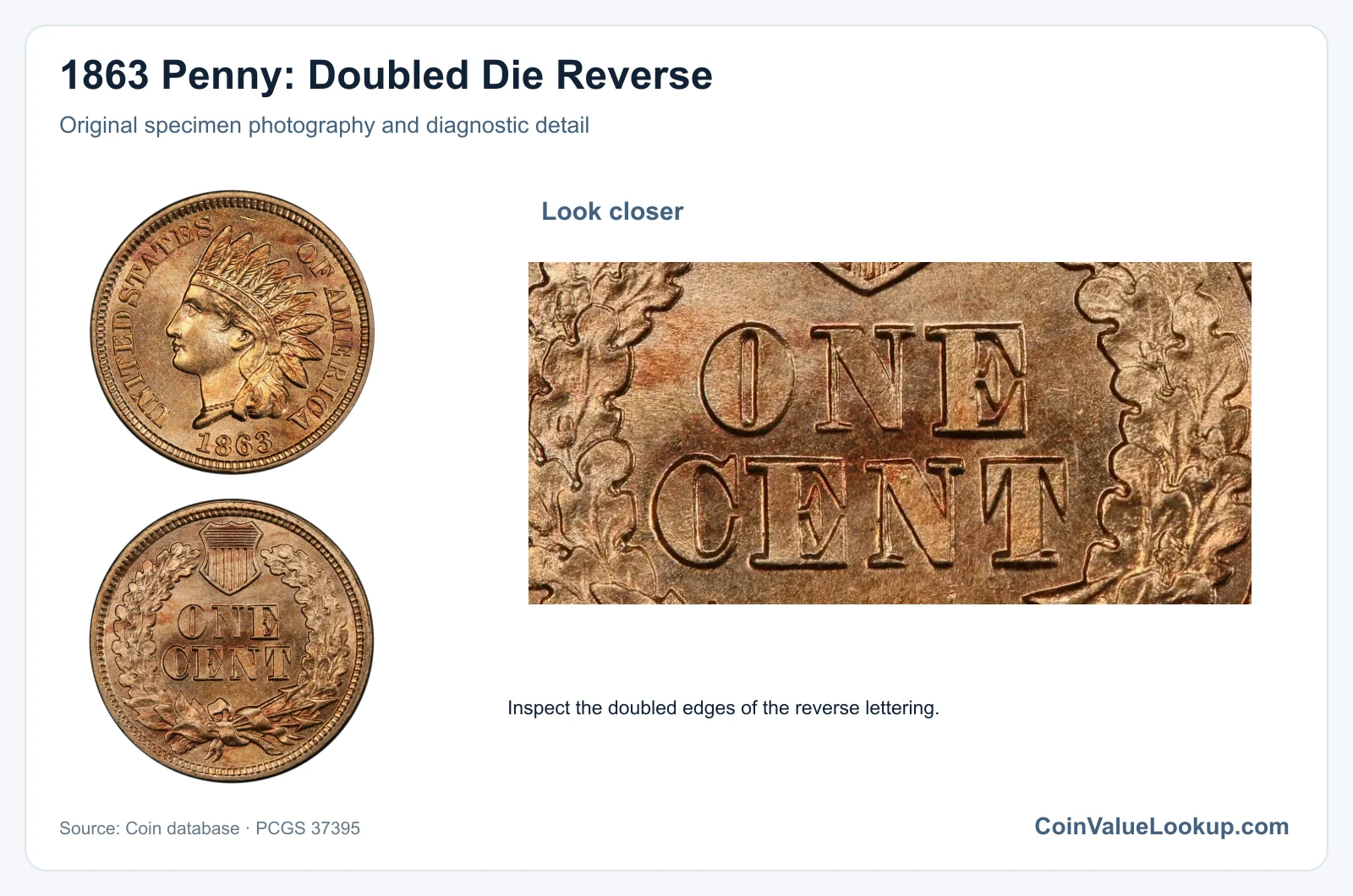
A doubled die reverse on an 1863 Indian cent shows doubling on the reverse design elements: letters in ONE CENT, wreath details, or the shield. This doubling comes from a misalignment during the die-making process, producing a second, slightly offset impression of the design.
Compare the reverse lettering and wreath contours with a normal coin. Genuine hub doubling produces rounded, separated secondary images.
Machine doubling, by contrast, creates flat, shelf-like distortion that lacks the depth of a true doubled die. Reflections or photographic artifacts can also mislead.
Each doubled die reverse variety is valued based on the doubling's visibility and the coin's overall condition, so individual assessment is needed.
11. 1863 Indian Head Penny — Die Cap / Capped-Die Strike
A die cap error happens when a struck coin sticks to one of the dies and continues to be struck against subsequent planchets. The adhered coin gradually cups around the die, forming a cap shape.
Coins struck through that cap show a softened, spread-out impression of the capped side's design.
On an 1863 Indian cent, the capped coin itself will appear deeply cupped with distorted features, while coins struck beneath it will show a mushy, expanded mirror image. Do not confuse a die cap with a coin that was simply bent or squeezed in a vise after leaving the mint.
Post-mint damage lacks the progressive die-contact wear patterns of a genuine cap. These are scarce errors; individual assessment by a professional service is strongly recommended.
12. 1863 Indian Head Penny — Off-Center Strike
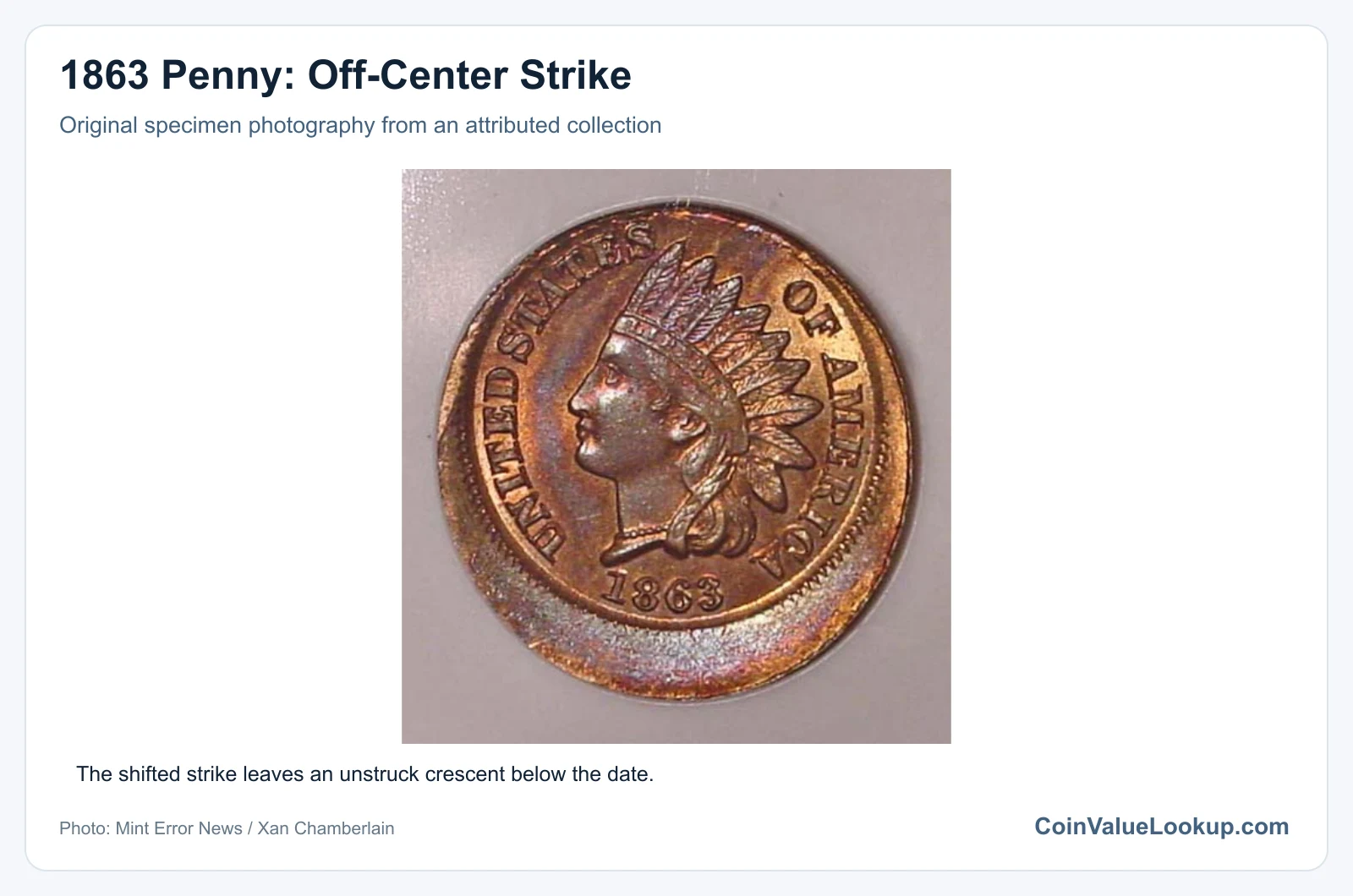
An off-center strike occurs when the planchet is not properly seated between the dies, resulting in a design that is shifted to one side with a blank crescent of unstruck metal on the opposite edge. On an 1863 Indian cent, the percentage of off-center displacement and whether the date remains visible are the two biggest factors in collectibility.
A coin with 10–20% off-center displacement and a full, readable date tends to attract the most collector interest. Do not confuse an off-center strike with a clipped planchet, which removes a curved section but still shows a centered design.
One-sided die misalignment or post-mint flattening can also look off at first glance. Each off-center coin is valued individually based on the displacement percentage, date visibility, and overall condition.