2000 Roosevelt Dime Coin Value: How Much Is It Worth?
Most 2000 Roosevelt dimes pulled from circulation are worth face value — ten cents. In mint-state condition, a USA Coin Book guide estimate places an MS65 example at around $2.50 for both the P and D issues.
The S clad proof sits near $3.08 in PR65, while the S silver proof reaches about $9.65 at the same grade. Authenticated mint errors can push values well beyond those figures, so the version, finish and condition of your specific coin matter.
Fast Way to Identify Your 2000 Roosevelt Dime
The quickest way to start figuring out what you have is to upload clear photos of both sides of your 2000 dime. A front and back image lets the identifier give you a preliminary read on which version you're holding — Philadelphia, Denver or San Francisco — and flag anything that looks unusual.
Sharp, well-lit photos help the most.
2000 Roosevelt Dime Value
Upload both sides of your 2000 Roosevelt Dime.
Front Obverse
Upload photo
Back Reverse
Upload photo
Which 2000 Roosevelt Dime Versions Are Worth Money?
- Mint-state 2000-P and 2000-D dimes with sharp, fully separated torch bands — the Full Bands strike designation can add a premium over a normal MS65.
- The 2000-S silver proof, confirmed by weight and edge color, carries a higher guide estimate than the clad proof at comparable grades.
- A 2000-D Missing Reverse Clad Layer error sold for $132 in November 2020 — confirm the copper core shows only on the reverse and the coin weighs noticeably less than 2.27 grams.
- A 2000-D Reverse Mirror Brockage brought $1,080 at auction in June 2018 — look for a full incuse mirror image on the reverse paired with a normal dated obverse.
- A 2000-P Triple Curved Clip authenticated by ANACS has sold at auction; three curved blank omissions from the blanking process are the key diagnostic.
Step 1: Identify Your 2000 Roosevelt Dime Mint Mark and Version
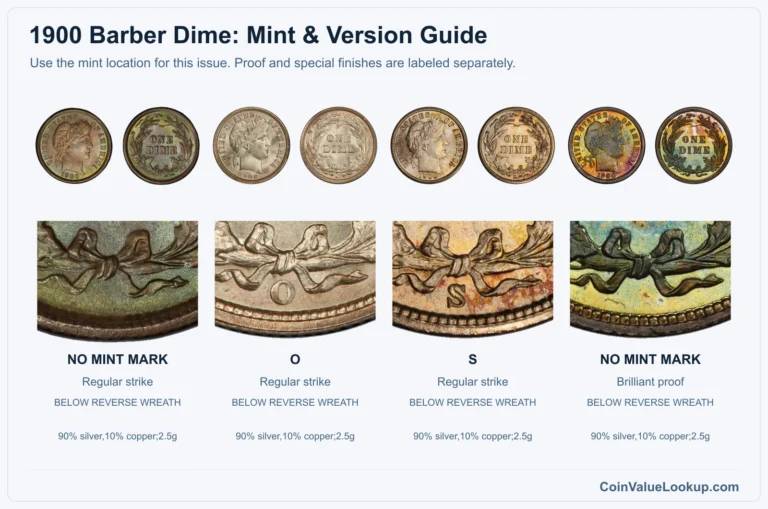
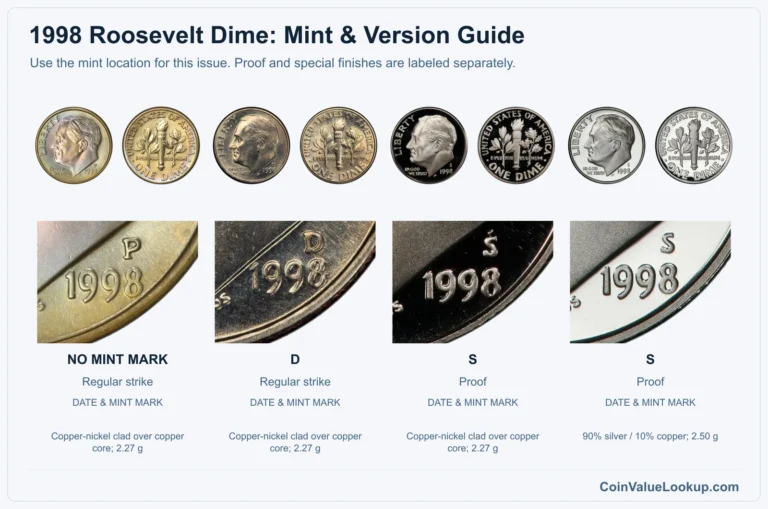
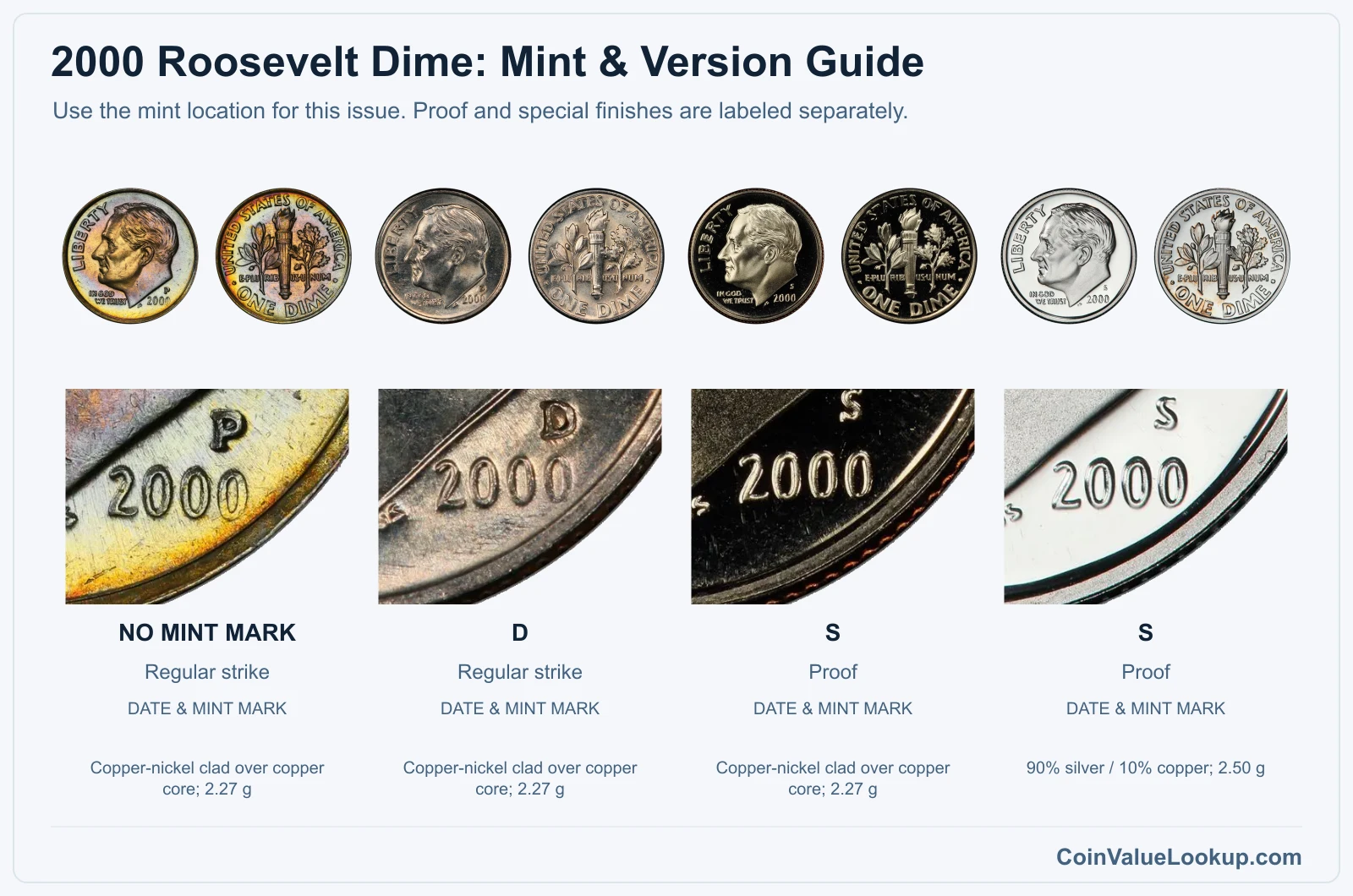
First, confirm the date reads 2000 and the design shows Roosevelt's portrait on the obverse with a torch flanked by branches on the reverse. Then find the mintmark just above the date on the obverse: P for Philadelphia, D for Denver, or S for San Francisco.
P and D strikes are copper-nickel clad and weigh about 2.27 grams. Both S-mint versions — clad proof and silver proof — carry the same mintmark and the same design, so you cannot tell them apart by sight alone.
To separate the two S-mint coins, check the edge. A clad proof shows a visible copper-colored stripe along the edge, while a silver proof has a uniform gray edge.
Weight is your next tool: the silver proof comes in at roughly 2.50 grams versus 2.27 grams for clad. Original mint packaging, if you still have it, confirms the answer immediately.
Color alone is unreliable. Toning, cleaning and environmental exposure can all change a coin's surface appearance without changing its metal content.
Step 2: Check Your 2000 Roosevelt Dime Grade
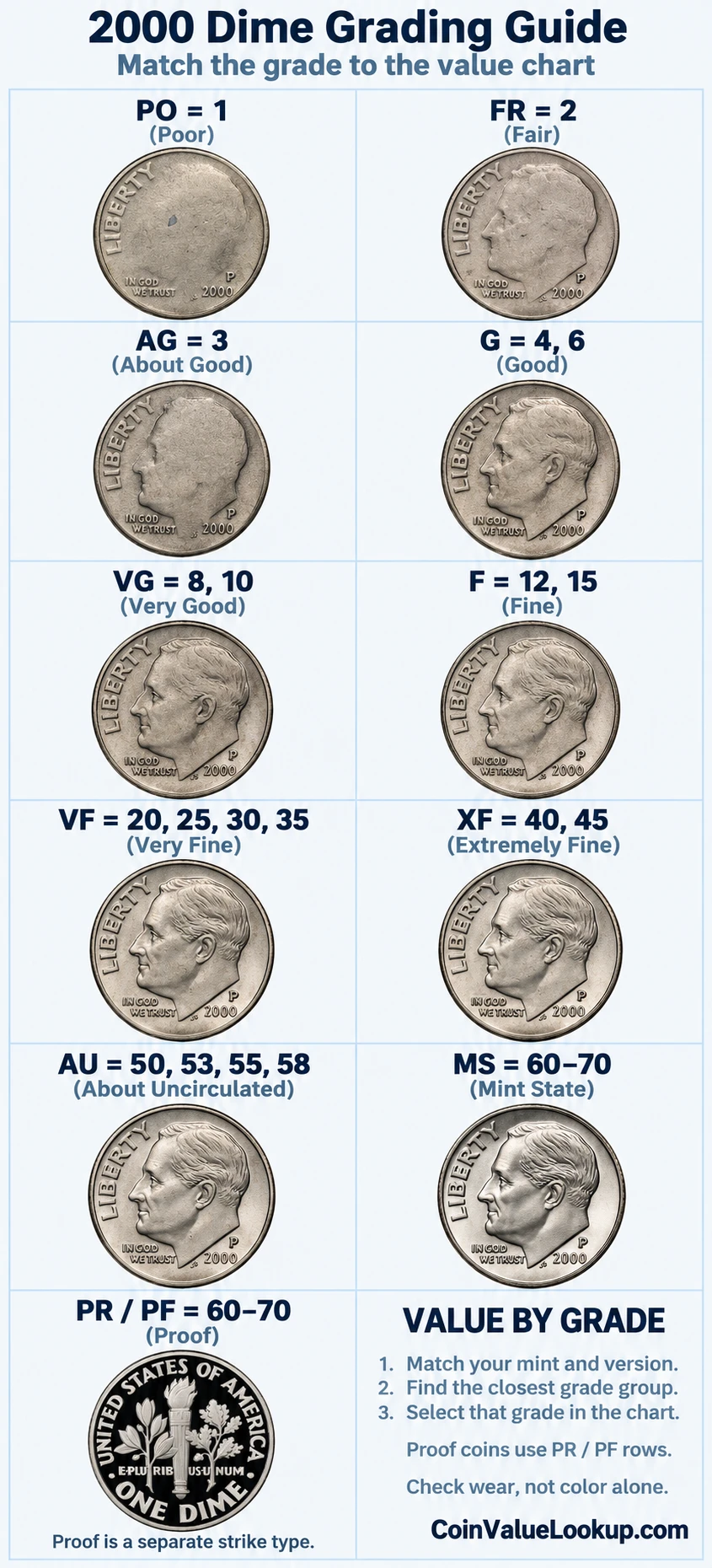
Start at the high points: Roosevelt's cheekbone, jawline and the hair above his ear. These are the first areas to lose detail from wear.
On the reverse, check the horizontal bands on the torch and the leaf tips.
Original luster matters more than raw shininess. A cleaned coin can look bright but will show hairlines under magnification, and that hurts the grade.
Compare your coin to the grading image to see where it falls on the wear spectrum.
Don't confuse a weak strike with actual wear. If the torch bands aren't fully separated but the surrounding surfaces still have full luster and no friction, that's a strike issue, not a grade problem.
Full Bands is a strike designation tracked by services like PCGS — it means both horizontal band pairs on the torch show complete separation.
Proof coins grade on a separate scale. Look for hairlines, haze and any contact marks on the mirrored fields.
A cleaned or damaged coin of any type needs a details qualifier, which limits its market appeal.
Step 3: Check 2000 Roosevelt Dime Value by Mint and Version
2000 Roosevelt Dime — P Business Strike
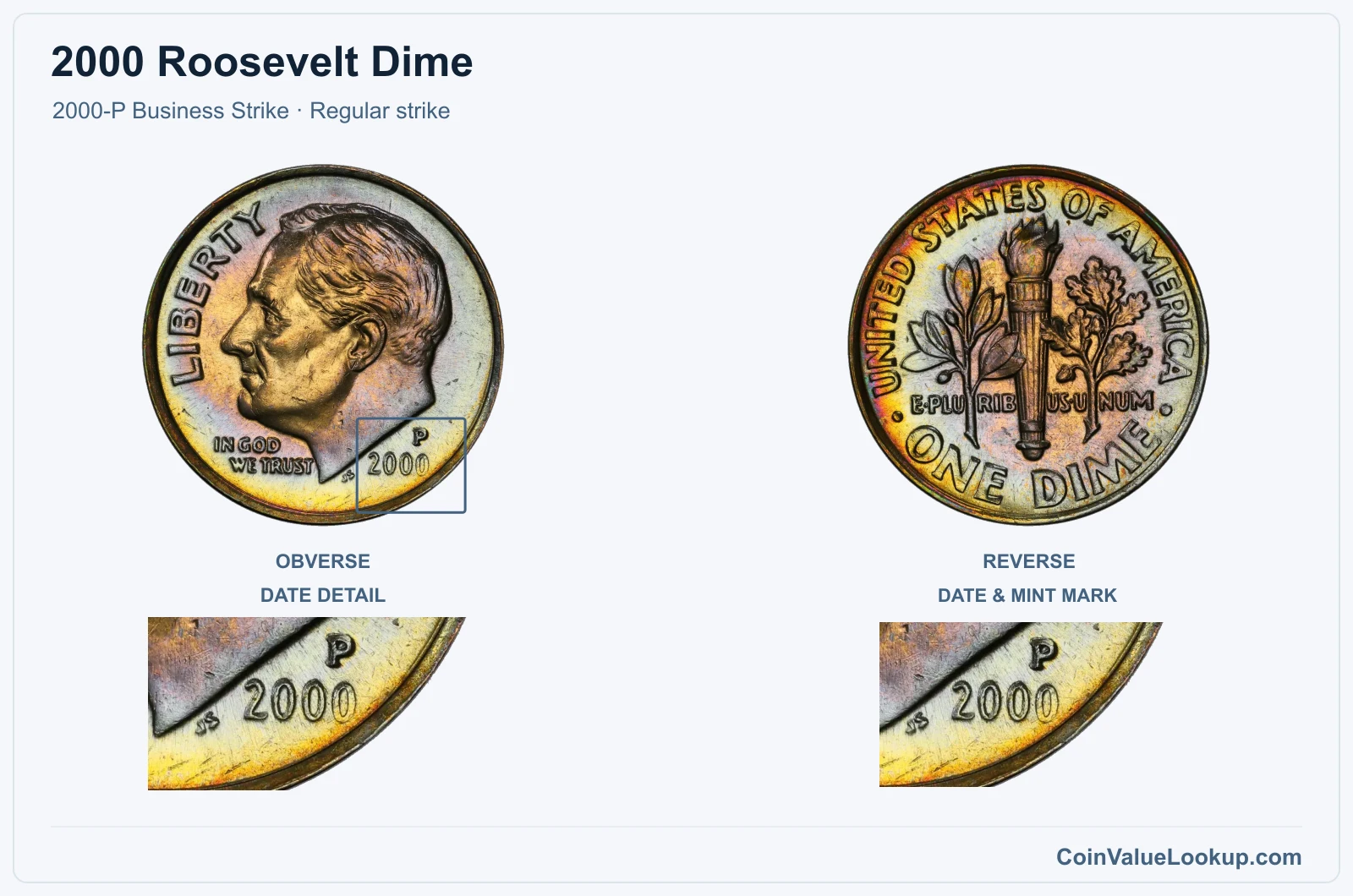
The 2000-P dime is a copper-nickel clad business strike from Philadelphia, weighing 2.27 grams. It carries a small P mintmark on the obverse above the date.
In typical circulated condition these are worth face value.
At MS65, the USA Coin Book guide lists approximately $2.50. Coins with fully separated horizontal torch bands — the Full Bands designation — can trade at a premium above that baseline.
Check your coin's price and sale history in the version-specific comparison widget on this page.
Range Grade
Price Auction Records Appraisal PO PO 1
—
Coin Identifier FR FR 2
—
Coin Identifier AG AG 3
—
Coin Identifier G G 4
—
Coin Identifier
G 6
—
Coin Identifier VG VG 8
—
Coin Identifier
VG 10
—
Coin Identifier F F 12
—
Coin Identifier
F 15
—
Coin Identifier VF VF 20
—
Coin Identifier
VF 25
—
Coin Identifier
VF 30
—
Coin Identifier
VF 35
—
Coin Identifier XF XF 40
—
Coin Identifier
XF 45
—
Coin Identifier AU AU 50
—
Coin Identifier
AU 53
—
Coin Identifier
AU 55
—
Coin Identifier
AU 58
—
Coin Identifier MS MS 60
—
Coin Identifier
MS 61
—
Coin Identifier
MS 62
—
Coin Identifier
MS 63
—
Coin Identifier
MS 64
—
Coin Identifier
MS 65
—
Coin Identifier
MS 66
—
Coin Identifier
MS 67
—
Coin Identifier
MS 68
Coin Identifier
MS 69
—
—
—
MS 70
—
—
—
2000 Roosevelt Dime — D Business Strike
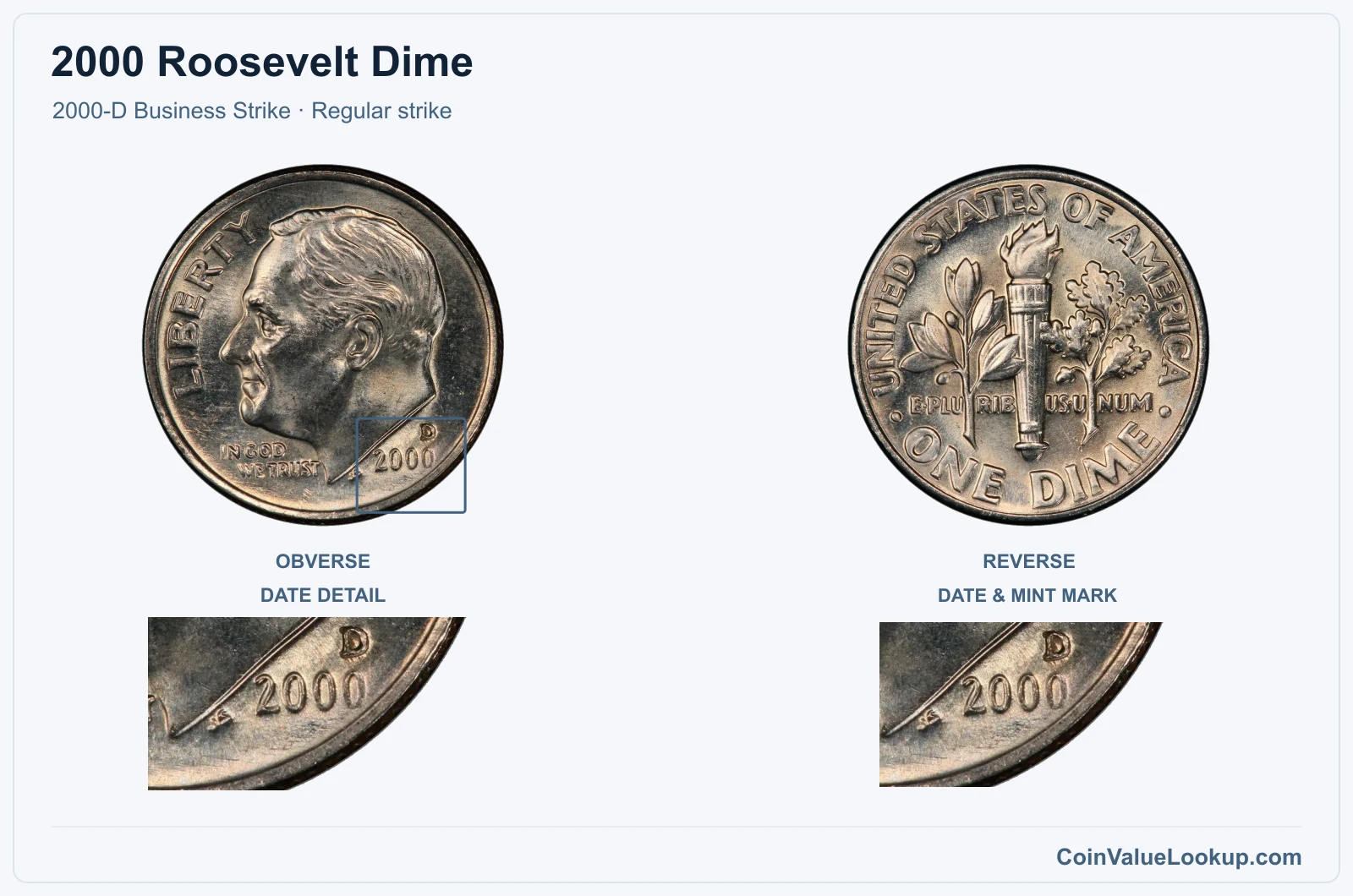
Denver's 2000-D dime is identical in composition and weight to the Philadelphia issue — copper-nickel clad at 2.27 grams — but carries a D mintmark. Circulated examples are face-value coins.
The MS65 guide point is also around $2.50 per USA Coin Book. As with the P-mint, a sharp Full Bands strike can be worth more.
The D-mint is also the version associated with several documented error types, including the missing clad layer and mirror brockage described below.
Coin Value Lookup is a good starting point if you want to compare values across other Roosevelt dime dates or denominations before deciding whether to submit a coin for grading.
Range Grade
Price Auction Records Appraisal PO PO 1
—
Coin Identifier FR FR 2
—
Coin Identifier AG AG 3
—
Coin Identifier G G 4
—
Coin Identifier
G 6
—
Coin Identifier VG VG 8
—
Coin Identifier
VG 10
—
Coin Identifier F F 12
—
Coin Identifier
F 15
—
Coin Identifier VF VF 20
—
Coin Identifier
VF 25
—
Coin Identifier
VF 30
—
Coin Identifier
VF 35
—
Coin Identifier XF XF 40
—
Coin Identifier
XF 45
—
Coin Identifier AU AU 50
—
Coin Identifier
AU 53
—
Coin Identifier
AU 55
—
Coin Identifier
AU 58
—
Coin Identifier MS MS 60
—
Coin Identifier
MS 61
—
Coin Identifier
MS 62
Coin Identifier
MS 63
—
Coin Identifier
MS 64
Coin Identifier
MS 65
—
Coin Identifier
MS 66
—
Coin Identifier
MS 67
Coin Identifier
MS 68
Coin Identifier
MS 69
—
—
—
MS 70
—
—
—
2000 Roosevelt Dime — S Clad Proof
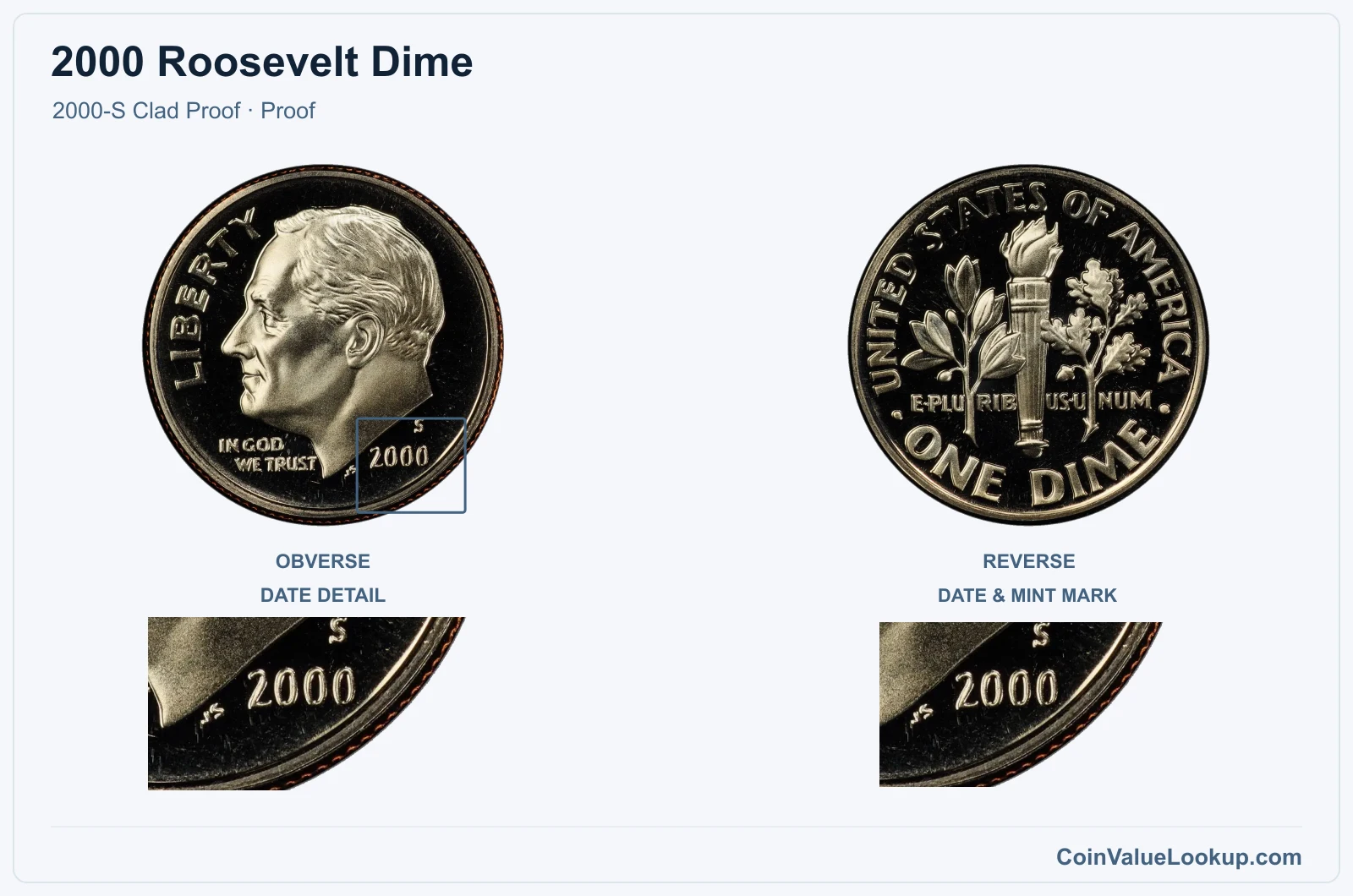
The 2000-S clad proof was struck at San Francisco on a standard copper-nickel clad planchet, the same 2.27-gram weight as circulation issues. It has mirrored fields and frosted devices, and it carries an S mintmark.
USA Coin Book lists approximately $3.08 at PR65. Because both S-mint proofs share the same mintmark and design, you need to check the edge for a copper stripe and, ideally, weigh the coin.
If you see a copper line, it's clad.
Range Grade
Price Auction Records Appraisal PR PR 1
—
Coin Identifier
PR 2
—
Coin Identifier
PR 3
—
Coin Identifier
PR 4
—
Coin Identifier
PR 6
—
Coin Identifier
PR 8
—
Coin Identifier
PR 10
—
Coin Identifier
PR 12
—
Coin Identifier
PR 15
—
Coin Identifier
PR 20
—
Coin Identifier
PR 25
—
Coin Identifier
PR 30
—
Coin Identifier
PR 35
—
Coin Identifier
PR 40
—
Coin Identifier
PR 45
—
Coin Identifier
PR 50
—
Coin Identifier
PR 53
—
Coin Identifier
PR 55
—
Coin Identifier
PR 58
—
Coin Identifier
PR 60
—
Coin Identifier
PR 61
—
Coin Identifier
PR 62
—
Coin Identifier
PR 63
—
Coin Identifier
PR 64
—
Coin Identifier
PR 65
—
Coin Identifier
PR 66
—
Coin Identifier
PR 67
—
Coin Identifier
PR 68
—
Coin Identifier
PR 69
Coin Identifier
PR 70
Coin Identifier
2000 Roosevelt Dime — S Silver Proof
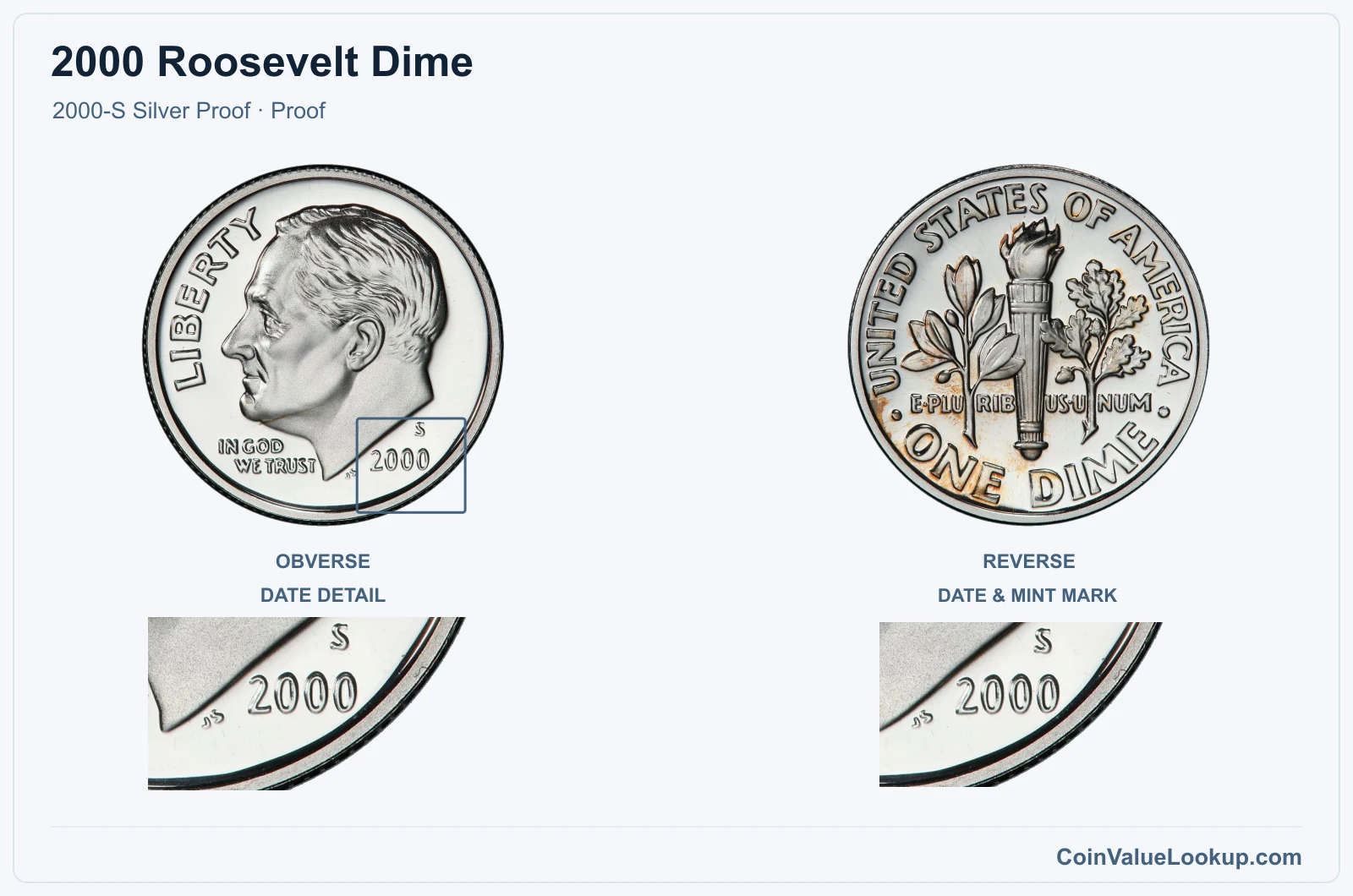
The 2000-S silver proof is struck on a 90% silver, 10% copper planchet weighing about 2.50 grams. The edge appears uniformly gray with no copper stripe — that is the fastest visual separator from the clad proof.
At PR65, USA Coin Book estimates around $9.65, making it the highest-valued standard version of the 2000 dime at that grade level. Silver proofs were sold in dedicated silver proof sets from the U.S. Mint.
Original government packaging is the most reliable confirmation of composition, followed by accurate weight measurement.
Range Grade
Price Auction Records Appraisal PR PR 1
—
Coin Identifier
PR 2
—
Coin Identifier
PR 3
—
Coin Identifier
PR 4
—
Coin Identifier
PR 6
—
Coin Identifier
PR 8
—
Coin Identifier
PR 10
—
Coin Identifier
PR 12
—
Coin Identifier
PR 15
—
Coin Identifier
PR 20
—
Coin Identifier
PR 25
—
Coin Identifier
PR 30
—
Coin Identifier
PR 35
—
Coin Identifier
PR 40
—
Coin Identifier
PR 45
—
Coin Identifier
PR 50
—
Coin Identifier
PR 53
—
Coin Identifier
PR 55
—
Coin Identifier
PR 58
—
Coin Identifier
PR 60
—
Coin Identifier
PR 61
—
Coin Identifier
PR 62
—
Coin Identifier
PR 63
—
Coin Identifier
PR 64
—
Coin Identifier
PR 65
—
Coin Identifier
PR 66
—
Coin Identifier
PR 67
—
Coin Identifier
PR 68
—
Coin Identifier
PR 69
Coin Identifier
PR 70
Coin Identifier
2000 Roosevelt Dime Error List
1. 2000 Roosevelt Dime — Missing Reverse Clad Layer
On a Missing Reverse Clad Layer error, the copper core is exposed on the reverse side while the obverse retains its normal clad surface. The documented example is a 2000-D business strike graded NGC MS63, weighing only 1.9 grams — well below the standard 2.27 grams.
That coin sold for $132 in November 2020 at Heritage Auctions. The weight difference is a critical diagnostic; a normal dime that simply looks copper-colored may have been exposed to acid or environmental damage.
When photographing a suspected missing clad layer, show the edge clearly along with both faces so the clad structure — or lack of it — is visible.
2. 2000 Roosevelt Dime — Reverse Mirror Brockage
A Reverse Mirror Brockage happens when a previously struck coin stays on a die and impresses an incuse, mirror-image copy of its design into the next coin's reverse. The result is a normal dated obverse paired with a sunken, backward image on the reverse.
The documented specimen is a 2000-D business strike, graded NGC Uncirculated Details with noted obverse damage. It sold for $1,080 in June 2018 at Heritage Auctions.
This is a dramatic error and easy to confuse with a vise job — someone sandwiching two coins together after they left the mint. Die clash marks are another lookalike but produce faint, partial impressions rather than a complete mirror image.
Authentication by a grading service is important for this category.
3. 2000 Roosevelt Dime — Triple Curved Clip
A Triple Curved Clip means the planchet was punched from strip metal that overlapped areas where blanks had already been cut, resulting in three curved missing sections. The documented example is a 2000-P business strike graded ANACS MS63.
When examining a suspected clip, look for the curved edge where metal is absent and check that the coin's design trails off naturally into the missing area. Genuine clips often show a Blakesley kick — a weak area on the rim opposite the clip.
Three deliberate cuts made after minting will leave straight or irregular edges and lack the hallmarks of a blanking-stage error. No specific price was adopted for this coin, so value depends on the authenticated severity and overall condition of the individual piece.
4. 2000 Roosevelt Dime — Improper Annealing
Improper annealing occurs when the blank is heated incorrectly before striking, leaving the surface with unusual discoloration or a rough, grainy texture. This has been reported as a category for the 2000 dime.
The appearance can range from dark, streaky toning to a dull, woodgrain-like surface. It is easy to confuse with environmental toning, corrosion, or heat damage applied after the coin left the mint.
Surface appearance alone is a screening clue, not proof of a mint-caused annealing problem. No specific price range is adopted here; value depends on the individual coin's condition, the visibility of the error and whether it has been authenticated by a recognized grading service.
5. 2000 Roosevelt Dime — Die-Adjustment / Low-Pressure Strike
A die-adjustment strike — sometimes called a low-pressure or setup strike — results from test impressions made while press operators calibrate striking force. The coin shows an overall weak impression on both sides, yet the surfaces may appear unworn and lack the friction marks you see on a circulated coin.
This category has been reported for the 2000 dime. The tricky part is distinguishing it from ordinary weak strikes, grease-filled dies or simple circulation wear.
A genuinely weak impression across the entire coin, with no localized soft spots and no wear, is the strongest indicator. No numerical price range is adopted; value hinges on how clearly the error presents and whether a grading service attributes it as a die-adjustment strike rather than just a weakly struck coin.
6. 2000 Roosevelt Dime — Wrong Planchet / Off-Metal Strike
A wrong-planchet or off-metal strike occurs when a dime die strikes a blank intended for a different denomination or even a different country's coin. This has been reported as a category for the 2000 dime.
Diagnostics start with weight and diameter. Compare the suspect coin to a normal 2000 dime — 2.27 grams and roughly 17.9 mm.
If both measurements are off, and the design appears complete or appropriately incomplete for a mismatched blank, you may have a genuine off-metal error. Lookalikes include plated coins, acid-treated coins and deliberate alterations.
No specific price range is adopted for this category; authentication and the identity of the wrong planchet drive value for each individual coin.