2010 Roosevelt Dime Coin Value: How Much Is It Worth?
Most circulated 2010 Roosevelt dimes are worth face value — ten cents. In uncirculated condition at MS65, a USA Coin Book guide estimate places the P or D business strike at about $2.50.
The S clad proof at PR65 is estimated around $3.08, while the S silver proof at PR65 comes in near $10.69. Sorting your coin by mint, metal and finish is the essential first step before applying any price.
Fast Way to Identify Your 2010 Roosevelt Dime
The quickest way to start figuring out what you have is to upload clear photos of both the front and back of your 2010 dime. Our identifier can offer a preliminary identification of the mint, finish and version based on those images.
It is not a substitute for professional authentication or grading, but it gives you a useful starting point.
2010 Roosevelt Dime Value
Upload both sides of your 2010 Roosevelt Dime.
Front Obverse
Upload photo
Back Reverse
Upload photo
Which 2010 Roosevelt Dime Versions Are Worth Money?
- Well-preserved P or D business strikes with full, separated torch bands can exceed their basic MS65 guide value.
- S silver proofs weigh 2.50 grams and carry a higher guide estimate than clad versions — about $10.69 at PR65.
- Satin Finish dimes from P and D are separate Mint Set issues graded on the SP scale, not ordinary MS prices.
- A Missing Obverse Clad Layer error on a 2010-P dime sold at auction for $131.38 in June 2019 — authenticate before applying any premium.
Step 1: Identify Your 2010 Roosevelt Dime Mint Mark and Version
Start with the basics. Confirm you see the 2010 date, Roosevelt's portrait on the obverse, and the torch flanked by branches on the reverse.
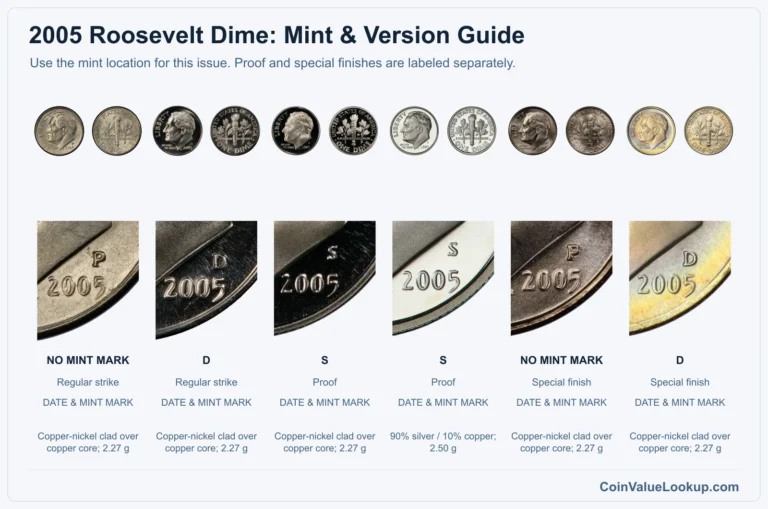
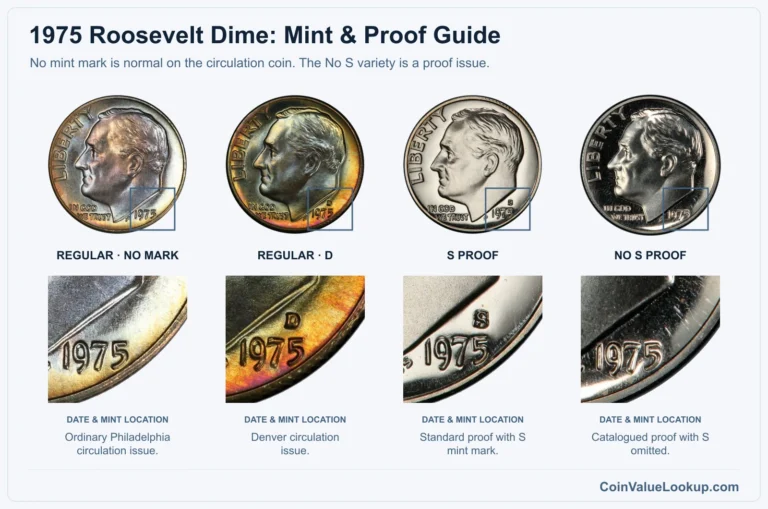
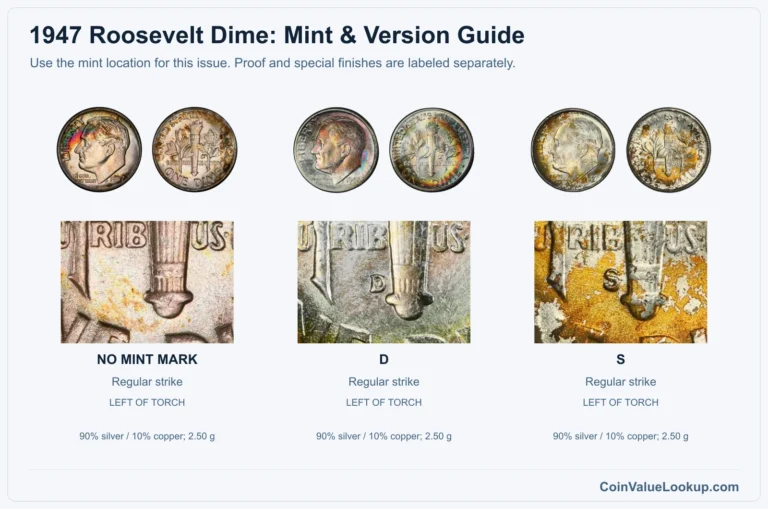
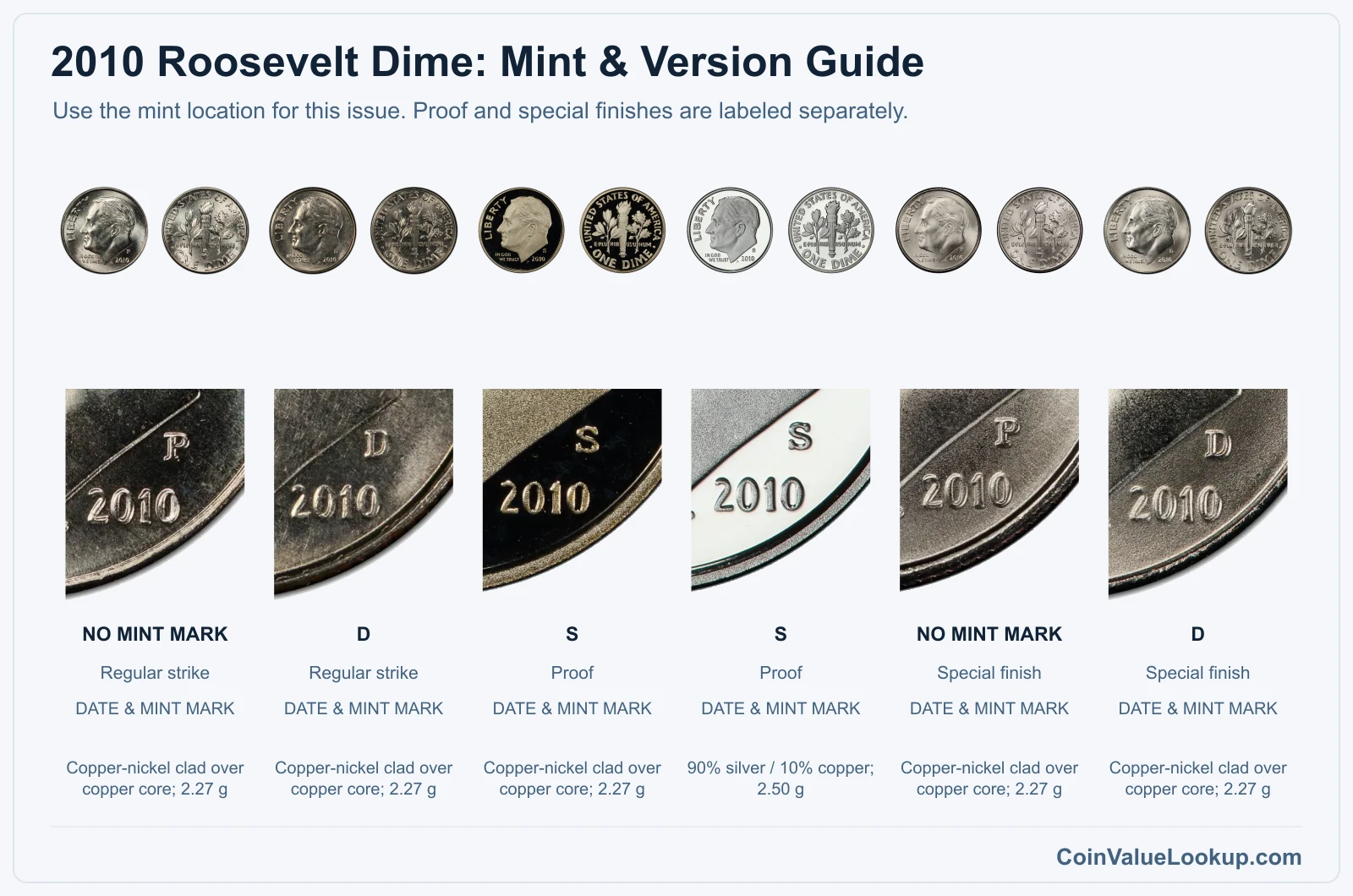
Look below Roosevelt's neck truncation for the mintmark: P for Philadelphia, D for Denver, or S for San Francisco. All three mints produced 2010 dimes, but S-mint coins were made exclusively as proofs.
Clad dimes — business strikes, satin finish and clad proofs — weigh 2.27 grams and measure roughly 17.9 mm across. The silver proof also measures about 17.9 mm but weighs 2.50 grams.
A simple kitchen scale can separate these two.
Check the edge. A clad dime shows a visible layered edge, while a silver proof's edge appears uniform.
Use weight, edge appearance and original packaging together for the most reliable identification.
One common mistake: confusing a Satin Finish dime from the 2010 Mint Set with an ordinary business strike. Satin Finish coins have a distinctive soft, even luster without the cartwheel sheen of a business strike or the mirrored fields of a proof.
These are graded on the SP scale, not MS, so mixing them up leads to wrong price comparisons.
Step 2: Check Your 2010 Roosevelt Dime Grade
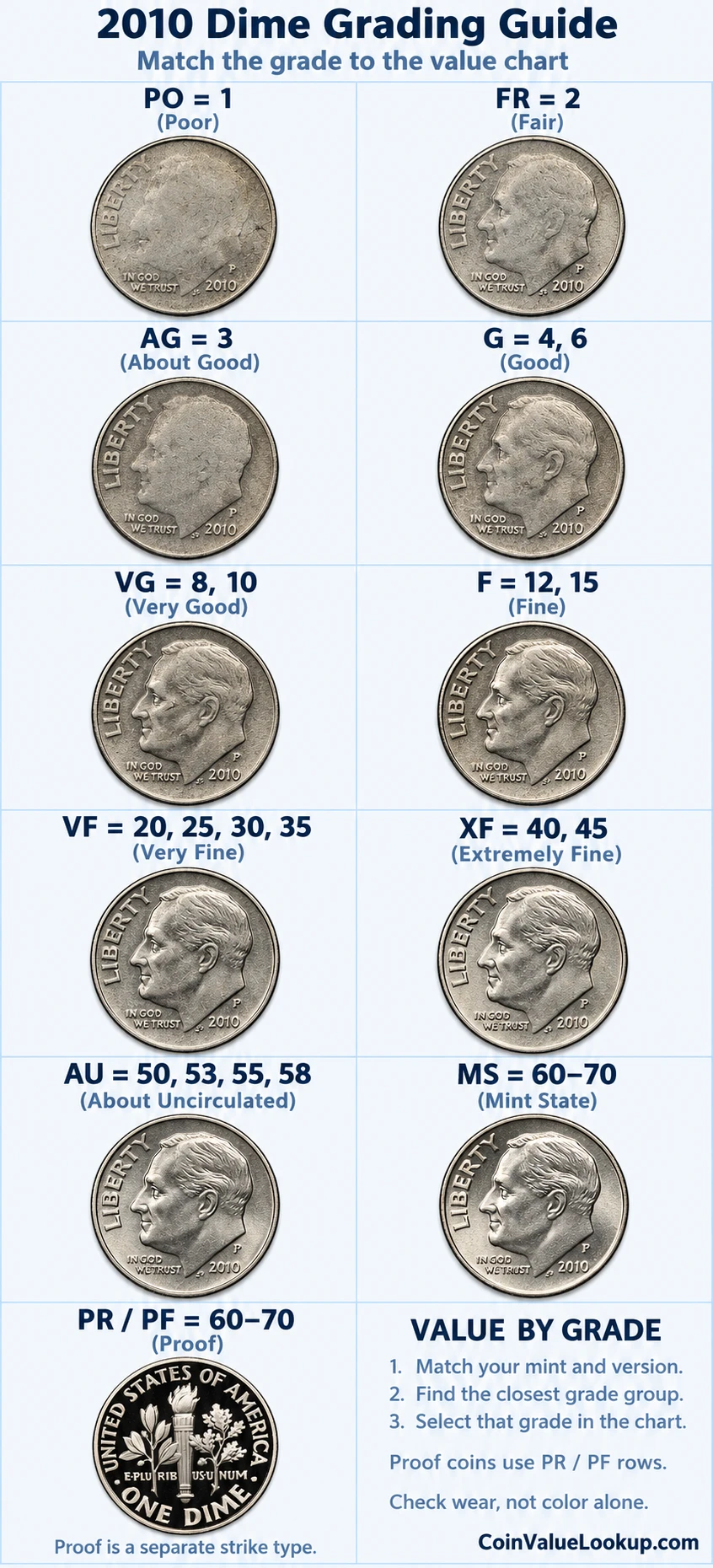
Focus your eye on Roosevelt's cheekbone, jaw line, and the hair detail above and behind the ear — these are the first areas to show friction. On the reverse, check the torch bands and the leaf detail on both branches.
Original mint luster has a flowing, cartwheel-like quality when you tilt the coin. A cleaned coin can look bright but feels slick and shows tiny hairlines under magnification.
That difference matters for grade.
Full Bands (often abbreviated FB or FT) is a strike designation, not a grade. Both horizontal torch-band pairs must show clean separation.
A weakly struck coin can still be uncirculated — it just will not qualify for that designation. Compare your coin's bands against the reference image using examples from the same finish type.
For proofs, look at the fields for hairlines and contact marks. Proof contrast is an intentional manufacturing feature, not a sign of higher grade.
Compare your proof to other proofs, not to business strikes.
Satin Finish coins should be compared to other satin specimens. Their softer luster can fool you into thinking the coin has wear when it does not.
Step 3: Check 2010 Roosevelt Dime Value by Mint and Version
2010 Roosevelt Dime — P Business Strike
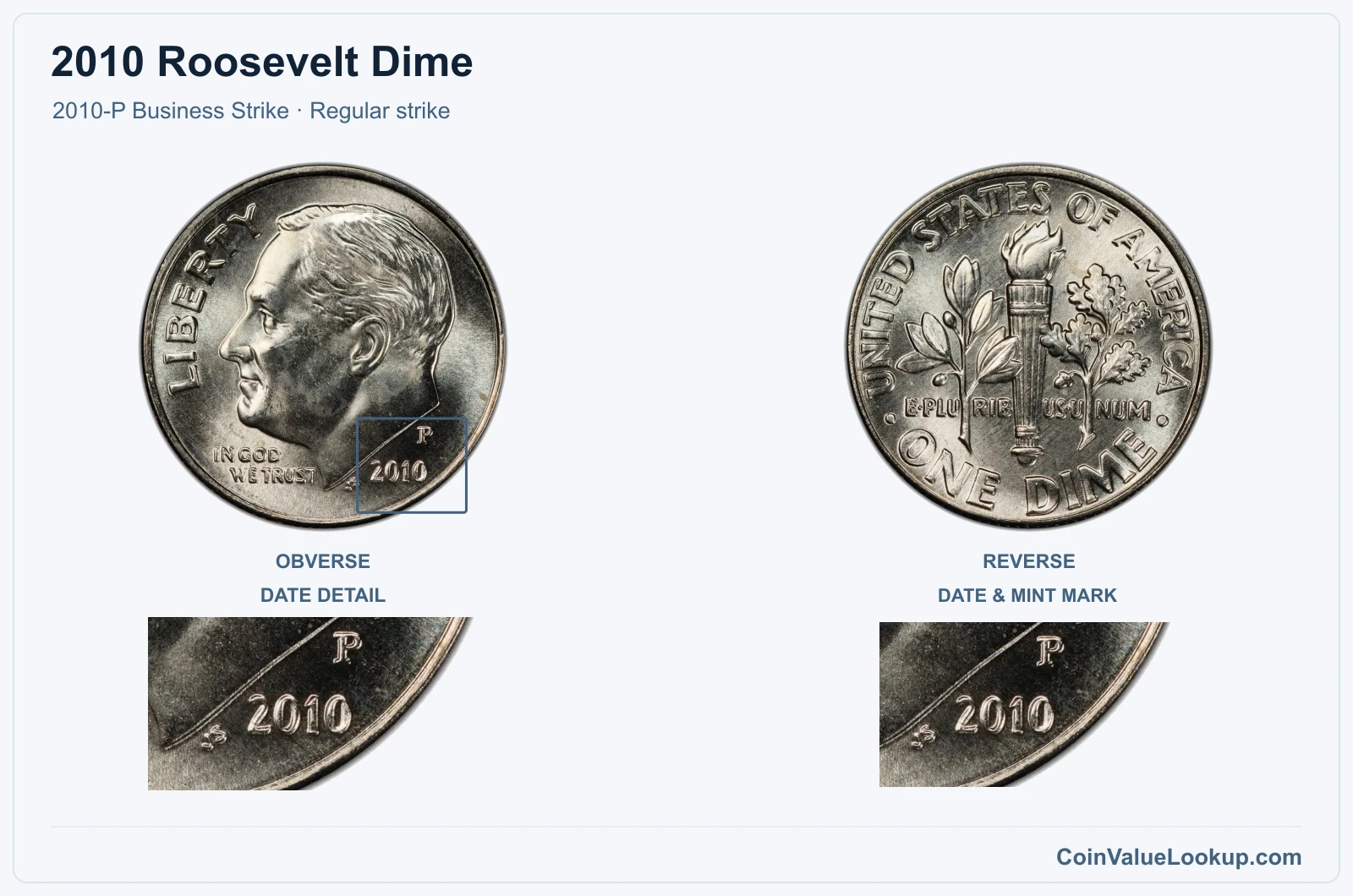
The 2010-P business strike is the standard Philadelphia issue, struck on a copper-nickel clad planchet weighing 2.27 grams. You will find a P mintmark below the neck truncation.
A USA Coin Book guide estimate places MS65 examples around $2.50.
Coins with well-separated Full Bands on the torch can command more attention from specialists. Circulated pieces are worth face value.
Do not confuse this with the P Satin Finish version from the 2010 Mint Set — they look different and are graded on separate scales.
Range Grade
Price Auction Records Appraisal PO PO 1
—
Coin Identifier FR FR 2
—
Coin Identifier AG AG 3
—
Coin Identifier G G 4
—
Coin Identifier
G 6
—
Coin Identifier VG VG 8
—
Coin Identifier
VG 10
—
Coin Identifier F F 12
—
Coin Identifier
F 15
—
Coin Identifier VF VF 20
—
Coin Identifier
VF 25
—
Coin Identifier
VF 30
—
Coin Identifier
VF 35
—
Coin Identifier XF XF 40
—
Coin Identifier
XF 45
—
Coin Identifier AU AU 50
—
Coin Identifier
AU 53
—
Coin Identifier
AU 55
—
Coin Identifier
AU 58
—
Coin Identifier MS MS 60
—
Coin Identifier
MS 61
—
Coin Identifier
MS 62
—
Coin Identifier
MS 63
—
Coin Identifier
MS 64
—
Coin Identifier
MS 65
—
Coin Identifier
MS 66
—
Coin Identifier
MS 67
—
Coin Identifier
MS 68
—
Coin Identifier
MS 69
—
—
—
MS 70
—
—
—
2010 Roosevelt Dime — D Business Strike
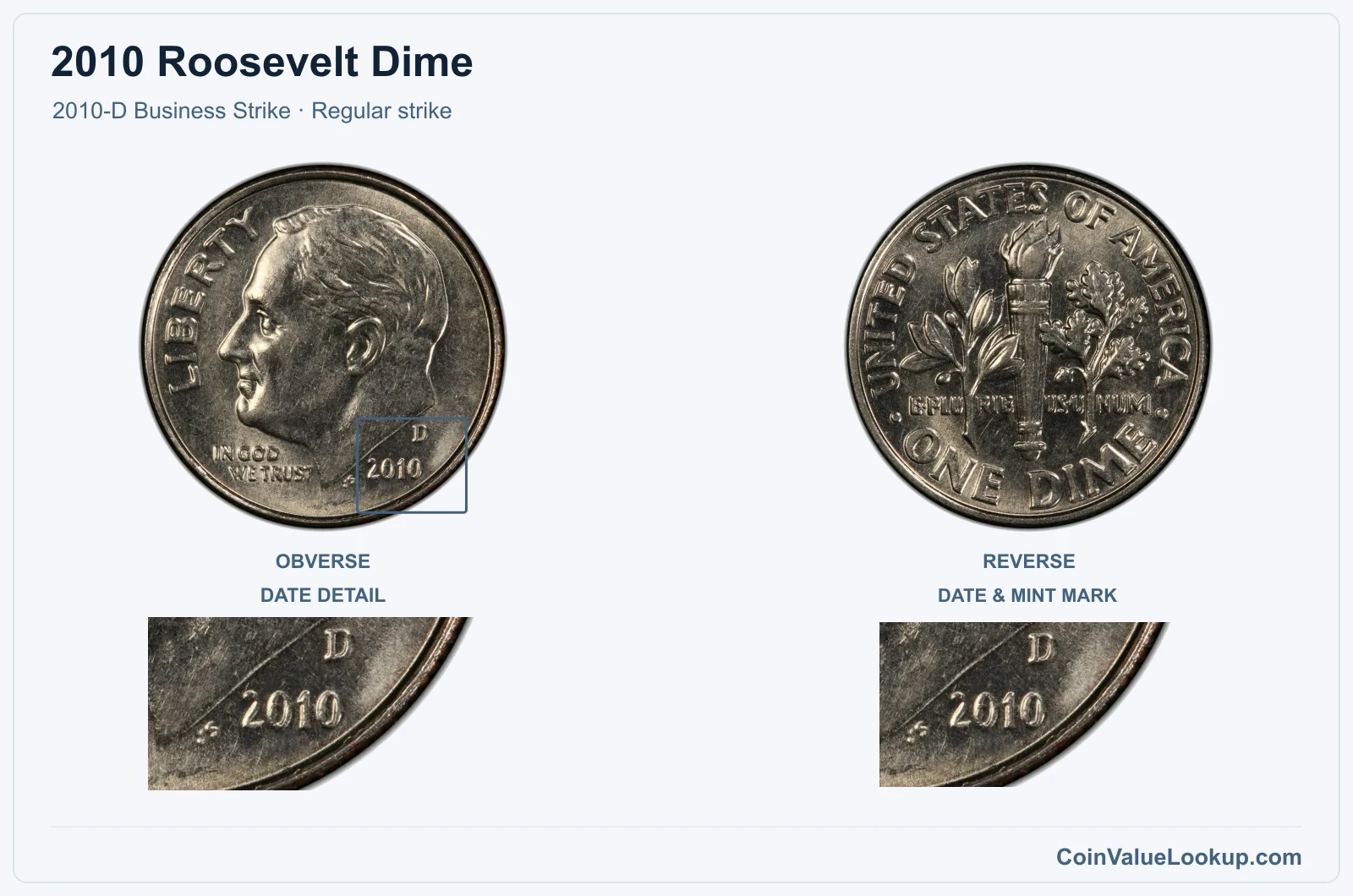
Denver's 2010-D dime is the same copper-nickel clad composition and weight as the Philadelphia issue. Look for the D mintmark below Roosevelt's neck.
The USA Coin Book guide estimate at MS65 is also $2.50.
As with the P mint version, Full Bands separation on the torch is a strike quality that collectors track. Circulated examples remain at face value.
Keep the D business strike separate from the D Satin Finish when checking values.
Range Grade
Price Auction Records Appraisal PO PO 1
—
Coin Identifier FR FR 2
—
Coin Identifier AG AG 3
—
Coin Identifier G G 4
—
Coin Identifier
G 6
—
Coin Identifier VG VG 8
—
Coin Identifier
VG 10
—
Coin Identifier F F 12
—
Coin Identifier
F 15
—
Coin Identifier VF VF 20
—
Coin Identifier
VF 25
—
Coin Identifier
VF 30
—
Coin Identifier
VF 35
—
Coin Identifier XF XF 40
—
Coin Identifier
XF 45
—
Coin Identifier AU AU 50
—
Coin Identifier
AU 53
—
Coin Identifier
AU 55
—
Coin Identifier
AU 58
—
Coin Identifier MS MS 60
—
Coin Identifier
MS 61
—
Coin Identifier
MS 62
—
Coin Identifier
MS 63
—
Coin Identifier
MS 64
—
Coin Identifier
MS 65
—
Coin Identifier
MS 66
—
Coin Identifier
MS 67
—
Coin Identifier
MS 68
—
—
—
MS 69
—
—
—
MS 70
—
—
—
2010 Roosevelt Dime — S Clad Proof
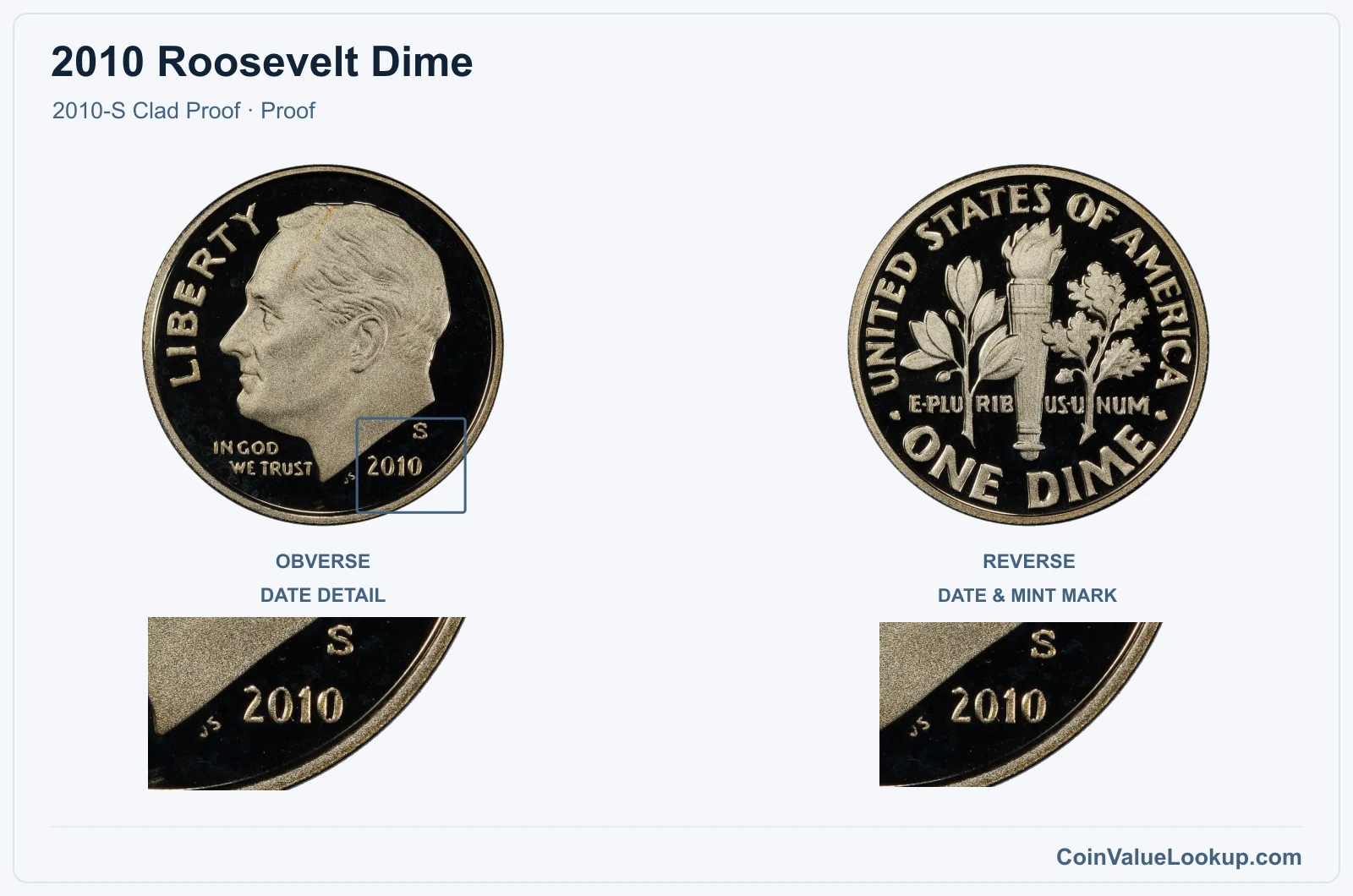
The 2010-S clad proof was struck at San Francisco on a copper-nickel clad planchet weighing 2.27 grams. It shows the S mintmark and has mirrored fields with frosted design elements — hallmarks of the proof manufacturing process.
A USA Coin Book guide estimate puts PR65 at about $3.08. These were sold in proof sets, so most survivors are in high grades.
Judge quality by hairlines, haze and contact marks in the fields rather than wear on high points.
Coin Value Lookup is a handy place to look up guides for Roosevelt dimes and other U.S. coins when you want to compare across years and mints.
Range Grade
Price Auction Records Appraisal PR PR 1
—
Coin Identifier
PR 2
—
Coin Identifier
PR 3
—
Coin Identifier
PR 4
—
Coin Identifier
PR 6
—
Coin Identifier
PR 8
—
Coin Identifier
PR 10
—
Coin Identifier
PR 12
—
Coin Identifier
PR 15
—
Coin Identifier
PR 20
—
Coin Identifier
PR 25
—
Coin Identifier
PR 30
—
Coin Identifier
PR 35
—
Coin Identifier
PR 40
—
Coin Identifier
PR 45
—
Coin Identifier
PR 50
—
Coin Identifier
PR 53
—
Coin Identifier
PR 55
—
Coin Identifier
PR 58
—
Coin Identifier
PR 60
—
Coin Identifier
PR 61
—
Coin Identifier
PR 62
—
Coin Identifier
PR 63
—
Coin Identifier
PR 64
—
Coin Identifier
PR 65
—
Coin Identifier
PR 66
—
Coin Identifier
PR 67
—
Coin Identifier
PR 68
—
Coin Identifier
PR 69
Coin Identifier
PR 70
Coin Identifier
2010 Roosevelt Dime — S Silver Proof
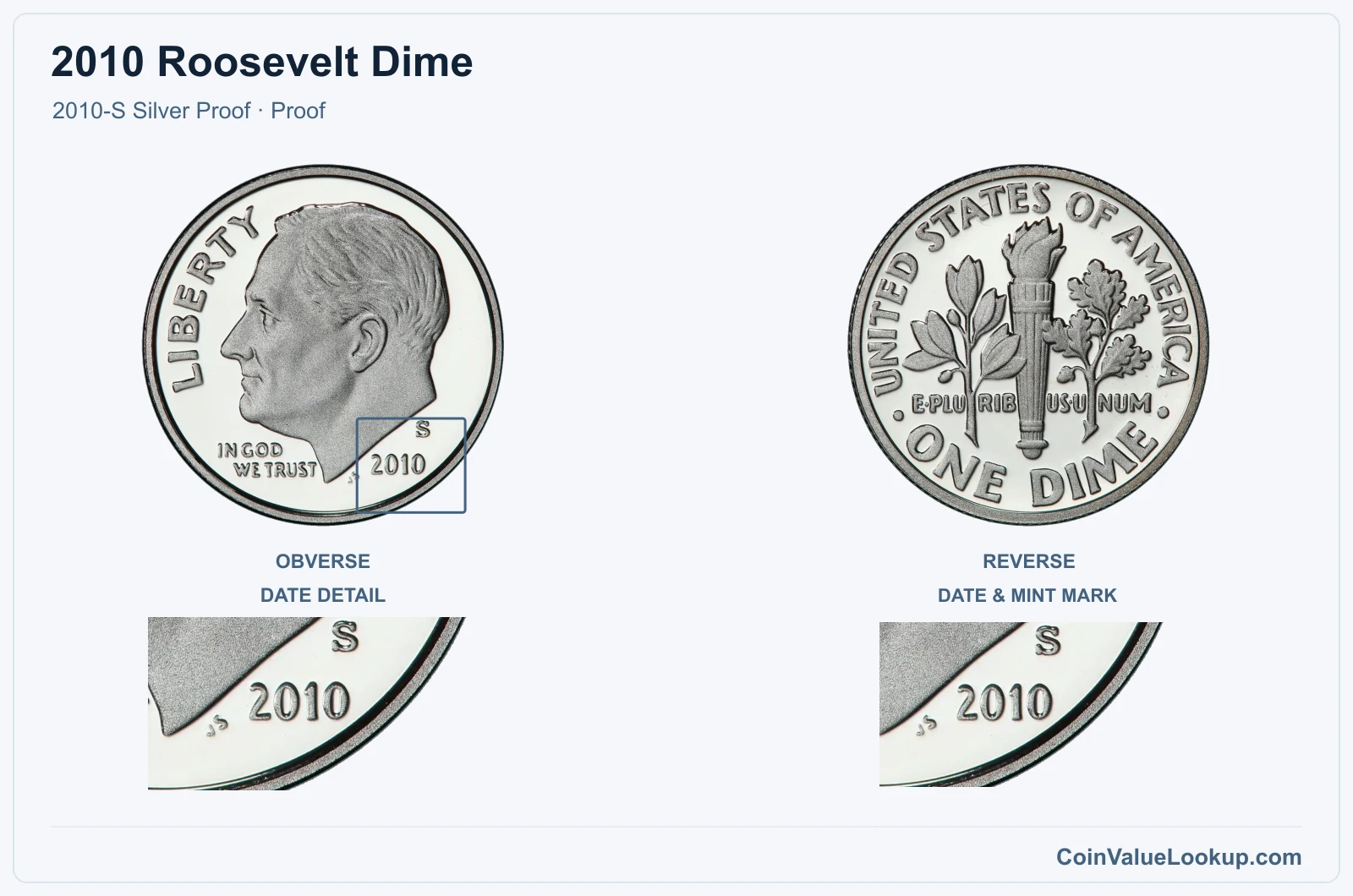
This is the 90% silver version of the 2010-S proof, weighing 2.50 grams compared to the 2.27-gram clad proof. The S mintmark alone does not tell you which one you have — you need to weigh the coin or check the original packaging.
The edge on a silver proof appears uniform rather than showing visible clad layers. At PR65, the USA Coin Book guide estimate is approximately $10.69, reflecting both the precious-metal content and collector demand.
These came in separate silver proof sets from San Francisco.
Range Grade
Price Auction Records Appraisal PR PR 1
—
Coin Identifier
PR 2
—
Coin Identifier
PR 3
—
Coin Identifier
PR 4
—
Coin Identifier
PR 6
—
Coin Identifier
PR 8
—
Coin Identifier
PR 10
—
Coin Identifier
PR 12
—
Coin Identifier
PR 15
—
Coin Identifier
PR 20
—
Coin Identifier
PR 25
—
Coin Identifier
PR 30
—
Coin Identifier
PR 35
—
Coin Identifier
PR 40
—
Coin Identifier
PR 45
—
Coin Identifier
PR 50
—
Coin Identifier
PR 53
—
Coin Identifier
PR 55
—
Coin Identifier
PR 58
—
Coin Identifier
PR 60
—
Coin Identifier
PR 61
—
Coin Identifier
PR 62
—
Coin Identifier
PR 63
—
Coin Identifier
PR 64
—
Coin Identifier
PR 65
—
Coin Identifier
PR 66
—
Coin Identifier
PR 67
—
Coin Identifier
PR 68
—
Coin Identifier
PR 69
Coin Identifier
PR 70
Coin Identifier
2010 Roosevelt Dime — P Satin Finish
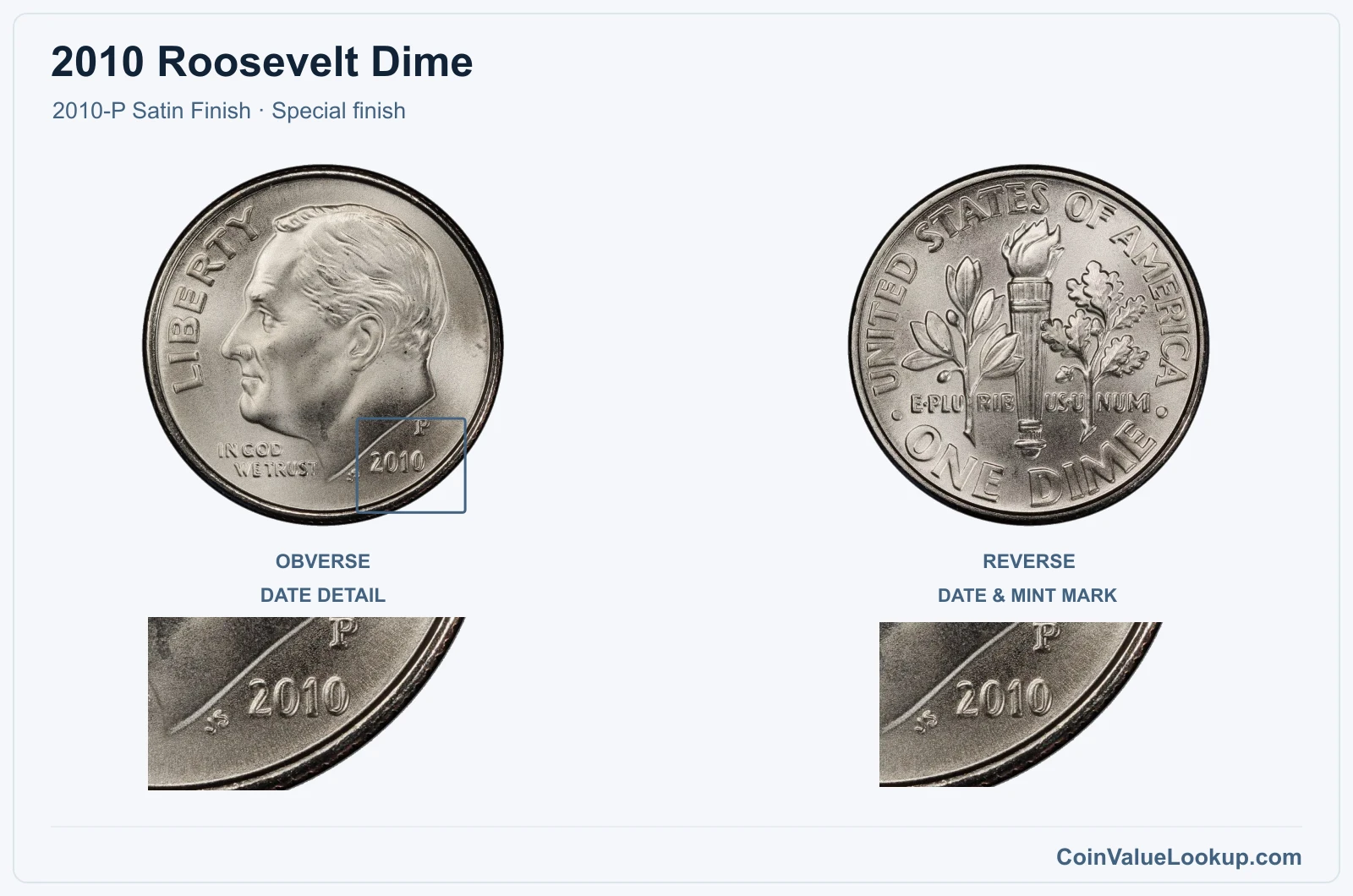
The 2010-P Satin Finish dime was included in the annual Mint Set and is a distinct version from the regular business strike. It has a soft, even luster across the surfaces — no cartwheel flash and no mirrored proof fields.
Think of it as a matte smoothness.
These coins are graded on the SP (Specimen) scale. Mixing SP grades with ordinary MS prices will give you a wrong answer.
No specific guide price is available here, so value depends on the individual coin's authenticated identity, condition and any error present. Third-party grading helps establish exactly what you have.
Range Grade
Price Auction Records Appraisal SP SP 1
—
Coin Identifier
SP 2
—
Coin Identifier
SP 3
—
Coin Identifier
SP 4
—
Coin Identifier
SP 6
—
Coin Identifier
SP 8
—
Coin Identifier
SP 10
—
Coin Identifier
SP 12
—
Coin Identifier
SP 15
—
Coin Identifier
SP 20
—
Coin Identifier
SP 25
—
Coin Identifier
SP 30
—
Coin Identifier
SP 35
—
Coin Identifier
SP 40
—
Coin Identifier
SP 45
—
Coin Identifier
SP 50
—
Coin Identifier
SP 53
—
Coin Identifier
SP 55
—
Coin Identifier
SP 58
—
Coin Identifier
SP 60
—
Coin Identifier
SP 61
—
Coin Identifier
SP 62
—
Coin Identifier
SP 63
—
Coin Identifier
SP 64
—
Coin Identifier
SP 65
—
Coin Identifier
SP 66
—
Coin Identifier
SP 67
—
Coin Identifier
SP 68
Coin Identifier
SP 69
Coin Identifier
SP 70
—
—
—
2010 Roosevelt Dime — D Satin Finish
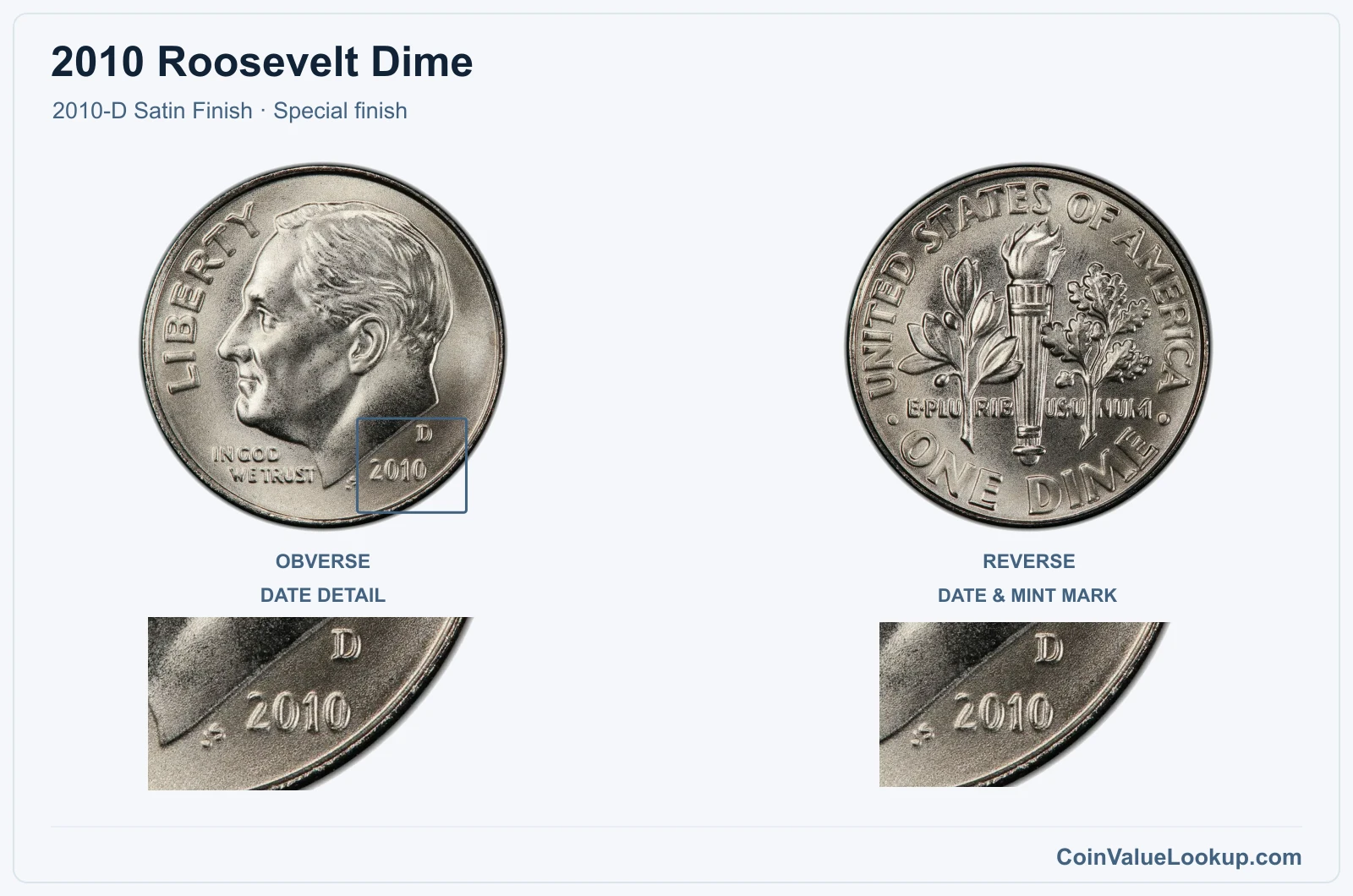
Denver also contributed a Satin Finish dime to the 2010 Mint Set. Like the P satin, it weighs 2.27 grams and is copper-nickel clad, but its surface texture is visibly different from a standard D business strike.
Grade these on the SP scale, not MS. The satin surface can mask or mimic light wear to an untrained eye, so comparing against known satin examples is important.
No specific guide price is available for this version; each coin's value depends on its authenticated condition and any errors it may carry.
Range Grade
Price Auction Records Appraisal SP SP 1
—
Coin Identifier
SP 2
—
Coin Identifier
SP 3
—
Coin Identifier
SP 4
—
Coin Identifier
SP 6
—
Coin Identifier
SP 8
—
Coin Identifier
SP 10
—
Coin Identifier
SP 12
—
Coin Identifier
SP 15
—
Coin Identifier
SP 20
—
Coin Identifier
SP 25
—
Coin Identifier
SP 30
—
Coin Identifier
SP 35
—
Coin Identifier
SP 40
—
Coin Identifier
SP 45
—
Coin Identifier
SP 50
—
Coin Identifier
SP 53
—
Coin Identifier
SP 55
—
Coin Identifier
SP 58
—
Coin Identifier
SP 60
—
Coin Identifier
SP 61
—
Coin Identifier
SP 62
—
Coin Identifier
SP 63
—
Coin Identifier
SP 64
—
Coin Identifier
SP 65
—
Coin Identifier
SP 66
—
Coin Identifier
SP 67
—
Coin Identifier
SP 68
—
Coin Identifier
SP 69
—
Coin Identifier
SP 70
—
—
—
2010 Roosevelt Dime Error List
1. 2010 Roosevelt Dime — Missing Obverse Clad Layer
A Missing Obverse Clad Layer error means one of the outer copper-nickel layers was absent from the planchet before striking. On a 2010-P dime, this shows up as an exposed copper-colored obverse while the reverse retains its normal silver-toned clad surface.
Look at the color contrast between the two sides. The edge can also reveal the missing layer.
One NGC-certified 2010-P example sold on eBay in June 2019 for $131.38; the listing described it as MS65 FT, though the record contains conflicting grade information, so treat that figure as a single historical data point rather than a reliable market benchmark.
Beware of lookalikes: toning, chemical stripping, and copper plating can all create a misleading copper appearance on one side. Professional authentication is strongly recommended before assigning any premium.
2. 2010 Roosevelt Dime — Die Crack / Die Chip
Die cracks and die chips appear as raised lines or small raised lumps on the coin's surface, caused by fractures in the steel die during production. On a 2010 dime, look for a thin raised line connecting design elements or the rim, or a small raised blob — often called a die chip — sitting within a letter or device.
A crack running from the rim inward is sometimes called a cud when it reaches a significant size. Interior chips inside letters like the O in ONE are more common.
The condition of the coin, the prominence of the crack and its location all affect desirability.
Do not confuse die cracks with incuse scratches, surface corrosion or debris stuck to the coin. A die crack is always raised, not recessed.
3. 2010 Roosevelt Dime — Broadstrike
A broadstrike happens when the coin is struck without the retaining collar that normally constrains the planchet's edge. The result is a dime that spreads outward, appearing slightly larger than normal with a smooth or malformed rim.
The full design is still present and centered, which distinguishes a broadstrike from an off-center strike. Check the edge profile: it will lack the normal reeded edge of a properly collared dime.
Condition, visibility and the degree of spread affect what these are worth. Be cautious about coins that were simply flattened or damaged after leaving the mint — post-mint damage does not create the same uniform metal spread and will not show proper strike characteristics.
4. 2010 Roosevelt Dime — Off-Center Strike
An off-center strike occurs when the planchet is not properly seated between the dies. Part of the design is missing, and you will see a blank crescent where the die never touched the metal.
Collectors generally prefer off-center errors that still show the full date and mintmark, because that confirms the coin's identity. The percentage of offset matters: a 5% shift is minor, while 50% or more with a visible date is considerably scarcer.
Do not mistake a clipped planchet, one-sided die misalignment, or post-mint flattening for a genuine off-center strike. A true off-center coin has a blank, unstruck area with a natural edge — not a cut or filed surface.
5. 2010 Roosevelt Dime — Clashed Dies
Clashed dies result from the obverse and reverse dies striking each other without a planchet between them. The impact transfers faint traces of one die's design onto the other.
On a 2010 dime, look for ghostly outlines of the torch or branches visible in Roosevelt's fields, or traces of Roosevelt's profile appearing in the reverse fields. These transferred impressions align with where the opposite die's features would be.
The strength of the clash and the coin's overall condition determine desirability. Faint clashes are fairly common and modest in value; strong, clearly visible clashes attract more attention.
Do not confuse die clashes with random scratches, raised lines from a damaged die, or a brockage — which involves a previously struck coin acting as a die.
6. 2010 Roosevelt Dime — Struck-Through Error
A struck-through error happens when foreign material — grease, cloth, wire, or a fragment of another planchet — gets caught between the die and the planchet during striking. The result is a localized depression or an impression of the object in the coin's surface.
Grease-filled dies produce soft, mushy detail in a specific area, while a retained foreign object leaves a more distinct impression. Look for a depression that has a defined boundary, not the gradual loss of detail you see from normal wear.
Condition, the size of the affected area and the type of obstruction all factor into how collectors evaluate these. Ordinary weak detail from a tired die, surface scratches or cleaning residue can mimic struck-through errors, so close inspection under magnification is worthwhile.
7. 2010 Roosevelt Dime — Improper Annealing
Improper annealing refers to a problem during the heat-treatment stage of planchet preparation. If the temperature or timing was wrong, the planchet can end up with unusual surface discoloration, a rough or granular texture, or inconsistent luster.
On a 2010 dime, this can show up as dark streaks, blotchy tone or a surface that just looks "off" compared to a normal example. Check the edge alongside the surface — if both show the same abnormal appearance, that is more consistent with a planchet-stage issue.
However, surface appearance alone is a screening clue, not proof of the cause. Environmental toning, corrosion and post-mint heat exposure can produce similar looks.
Professional authentication is the only reliable way to confirm this error.
8. 2010 Roosevelt Dime — Doubled Die
A doubled die shows consistent doubling of design elements caused during the die-making process. On a 2010 dime, compare lettering, the date, and Roosevelt's profile against a normal coin.
Look for separation, notching or a shelf-like effect on the edges of letters or design features.
The key word is "consistent." True die doubling appears the same way on every coin struck by that die, and the doubling direction is uniform across affected elements. This is different from machine doubling, which produces flat, shelf-like distortion and is far less collectible.
Reflections, lighting tricks and post-mint impressions can also mimic doubling. Use magnification and compare carefully to a known normal specimen before drawing conclusions.
Condition and the strength of the doubling determine collector interest.
9. 2010 Roosevelt Dime — Clipped Planchet
A clipped planchet error occurs when the blank is punched from strip metal that overlaps a previously punched hole or the strip's edge. The resulting planchet is missing a curved, straight or irregular section.
On a 2010 dime, look for a missing portion with a natural, unstruck edge. Metal flow during striking often creates a weak area on the opposite side of the clip — this is called the Blakesley effect and is a good authentication clue.
The size and type of clip matter. A small curved clip is relatively common; a large straight clip or multiple clips are scarcer.
Do not confuse a clipped planchet with a coin that has been cut, filed or corroded after minting. Post-mint damage leaves tool marks or rough edges that differ from the smooth, natural boundary of a genuine clip.