1950 Washington Quarter Coin Value: How Much Is It Worth?
A 1950 Washington Quarter starts around $16.43 in well-worn grades and can reach roughly $51 in select uncirculated condition, according to USA Coin Book retail estimates. Those figures shift dramatically once you factor in mint, grade, finish, and whether the coin carries an overmintmark variety.
This is a 90% silver coin, so even a beat-up example holds meaningful metal value, but the real premiums live in specific die varieties and pristine survivors.
Fast Way to Identify Your 1950 Washington Quarter
Upload clear photos of both sides of your coin and we can help with a preliminary identification. A straight-on front shot shows the date and overall wear, while a back photo reveals the mintmark below the wreath.
Good lighting and a steady hand beat any expensive camera setup. This step helps sort your coin into the right branch before you start comparing prices.
1950 Washington Quarter Value
Upload both sides of your 1950 Washington Quarter.
Front Obverse
Upload photo
Back Reverse
Upload photo
Which 1950 Washington Quarter Versions Are Worth Money?
- The 1950-D/S overmintmark (D over S) carries guide estimates from about $51 in G4 up to $4,257 at MS65 — far above a regular Denver quarter at the same grades.
- The 1950-S/D overmintmark (S over D) lists around $82 in G4 and roughly $1,399 at MS65, making it the second-strongest premium variety this year.
- A 1950 Proof in PR65 condition lists near $89; coins with cameo or deep cameo contrast are evaluated separately and can command more.
- A 1950 quarter struck on a silver dime planchet is a dramatic off-metal error that requires professional authentication to confirm.
- Even common-date 1950 quarters in MS65 condition bring roughly $48–$51, well above their silver content, because clean uncirculated survivors are not as common as you might guess.
Step 1: Identify Your 1950 Washington Quarter Mint Mark and Version
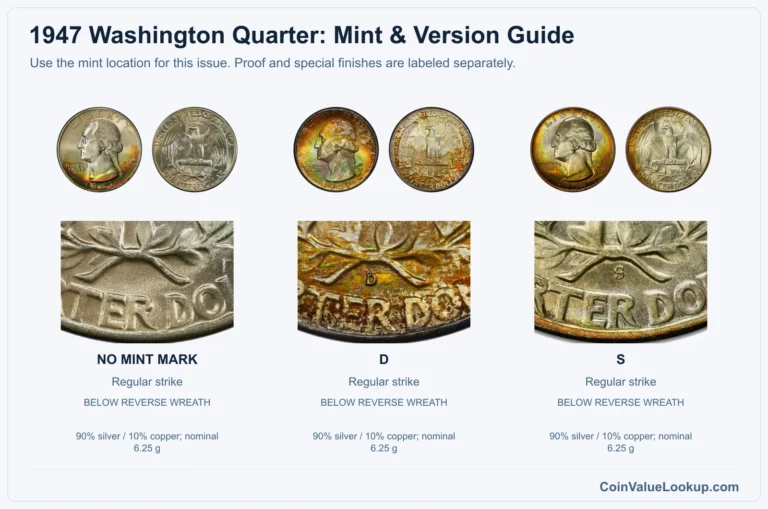
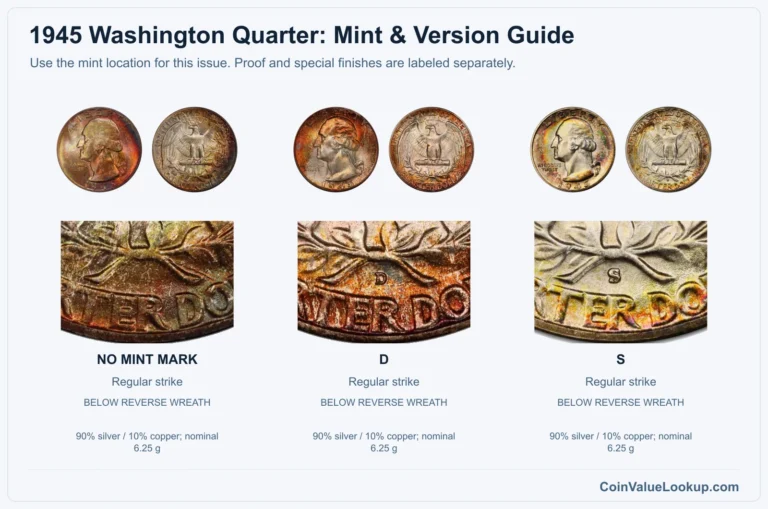
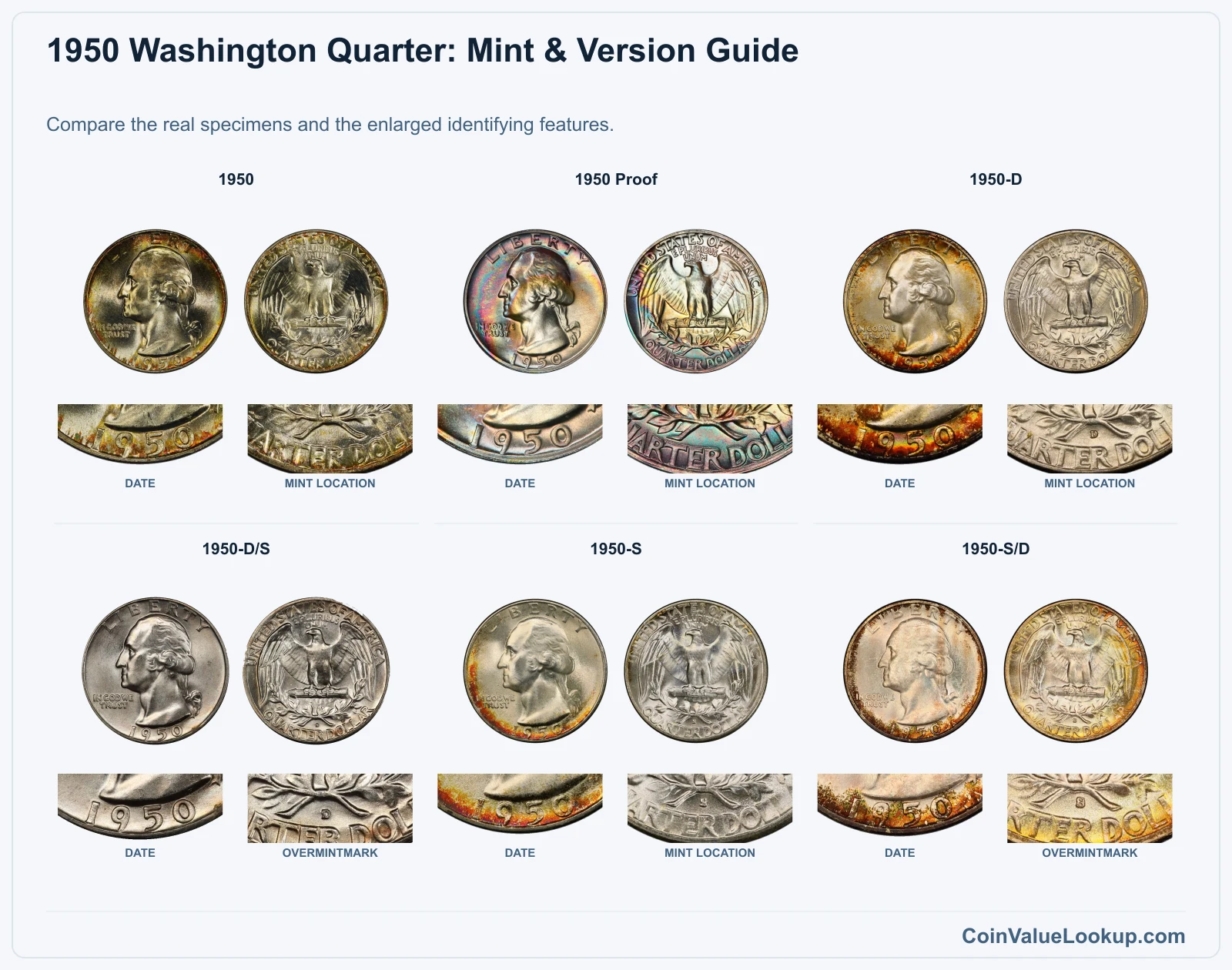
Start with the date on the obverse — you need 1950. Flip the coin over and look directly below the wreath on the reverse for a small letter.
A D means Denver, an S means San Francisco, and a blank space means Philadelphia. Do not assume a missing mintmark is damage; Philadelphia quarters of this era simply have no letter.
All standard 1950 quarters are struck in 90% silver and 10% copper, weigh about 6.25 grams, and measure roughly 24.3 mm across. That composition applies to every mint and every finish this year.
Once you know the mint, determine the finish. Business strikes have a satiny or slightly frosty look from normal production.
Proof coins, struck only at Philadelphia, show deeply reflective mirror-like fields and crisp detail that no amount of polishing a circulation coin can replicate. A shiny, cleaned quarter is not a proof.
Finally, check for overmintmark varieties. Denver coins may show traces of an S under the D, and San Francisco coins may show traces of a D under the S.
These are die features created when one mintmark punch was applied over another at the mint — the coin itself was not shipped between facilities.
Step 2: Check Your 1950 Washington Quarter Grade
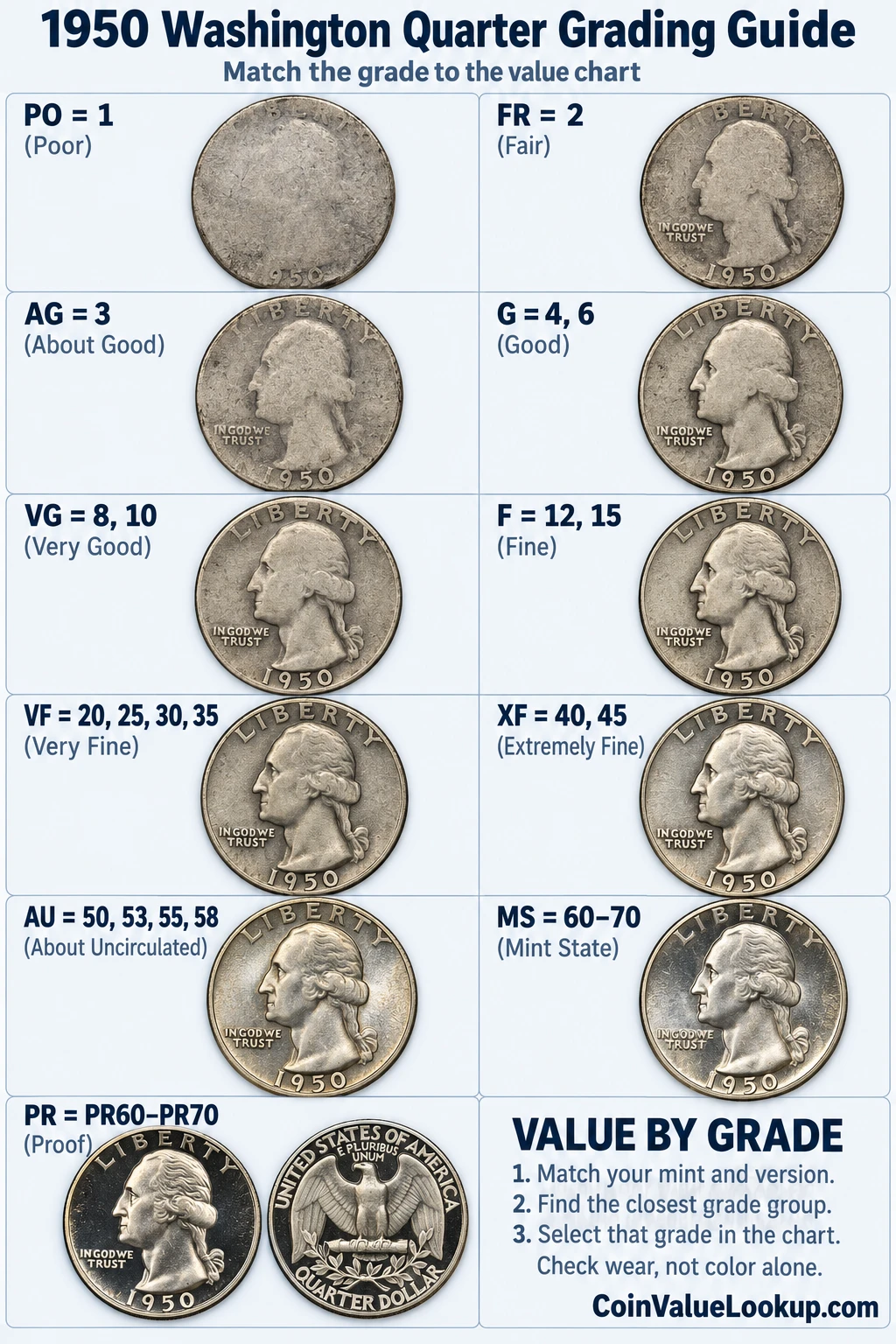
Focus on Washington's hair just above the ear first. On a lightly worn coin, that area loses its fine strands while the surrounding fields still show some original luster.
A coin graded around Good-4 will be flat across the hair, cheek, and jawline, with the major design elements visible but little texture remaining.
Move to the reverse and check the eagle's breast feathers. Early wear shows up there as smooth patches, and heavy wear flattens the breast into a broad, featureless area.
Compare your coin to the reference image to gauge where it falls.
Luster matters more than most beginners expect. A coin with full, unbroken mint luster and only light contact marks can grade MS60 or above, even if it looks "less pretty" than a cleaned coin that lost its original surface.
Cleaning lines — fine parallel scratches from wiping — permanently reduce a coin's grade and desirability.
For proofs, hairlines from mishandling are the main enemy. Cameo contrast, where frosted devices sit against mirror fields, is evaluated separately from the proof grade itself.
Step 3: Check 1950 Washington Quarter Value by Mint and Version
1950 Washington Quarter
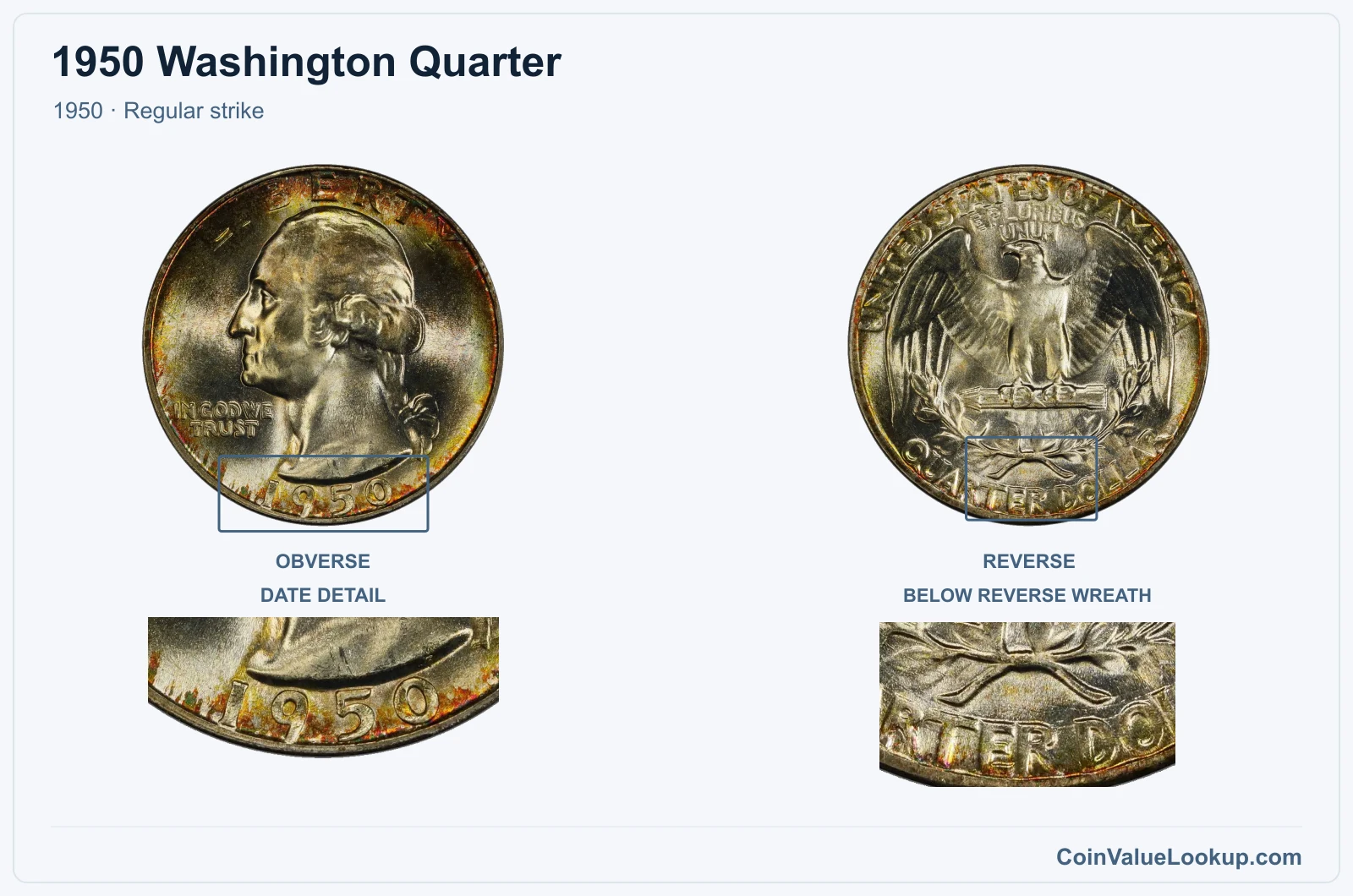
The 1950 Philadelphia quarter has no mintmark — the area below the reverse wreath is blank, which is normal. In well-circulated condition around G4, USA Coin Book lists it at approximately $16.43.
An MS60 example rises to about $21, and a choice MS65 reaches around $48.
Look for original, undisturbed surfaces. A coin that has been cleaned or polished will trade below these guide figures even if it appears shiny.
The Philadelphia mint struck both business-strike and proof versions this year, so confirming your coin's finish is an important first step before pricing.
| Range | Grade | Price | Auction Records | Appraisal |
|---|---|---|---|---|
| PO | PO 1 | — | Coin Identifier | |
| FR | FR 2 | — | Coin Identifier | |
| AG | AG 3 | — | Coin Identifier | |
| G | G 4 | — | Coin Identifier | |
| G 6 | — | Coin Identifier | ||
| VG | VG 8 | — | Coin Identifier | |
| VG 10 | — | Coin Identifier | ||
| F | F 12 | — | Coin Identifier | |
| F 15 | — | Coin Identifier | ||
| VF | VF 20 | — | Coin Identifier | |
| VF 25 | — | Coin Identifier | ||
| VF 30 | — | Coin Identifier | ||
| VF 35 | — | Coin Identifier | ||
| XF | XF 40 | — | Coin Identifier | |
| XF 45 | — | Coin Identifier | ||
| AU | AU 50 | — | Coin Identifier | |
| AU 53 | — | Coin Identifier | ||
| AU 55 | — | Coin Identifier | ||
| AU 58 | Coin Identifier | |||
| MS | MS 60 | — | Coin Identifier | |
| MS 61 | — | Coin Identifier | ||
| MS 62 | Coin Identifier | |||
| MS 63 | Coin Identifier | |||
| MS 64 | Coin Identifier | |||
| MS 65 | Coin Identifier | |||
| MS 66 | Coin Identifier | |||
| MS 67 | Coin Identifier | |||
| MS 68 | Coin Identifier | |||
| MS 69 | — | — | — | |
| MS 70 | — | — | — |
1950 Washington Quarter — Proof
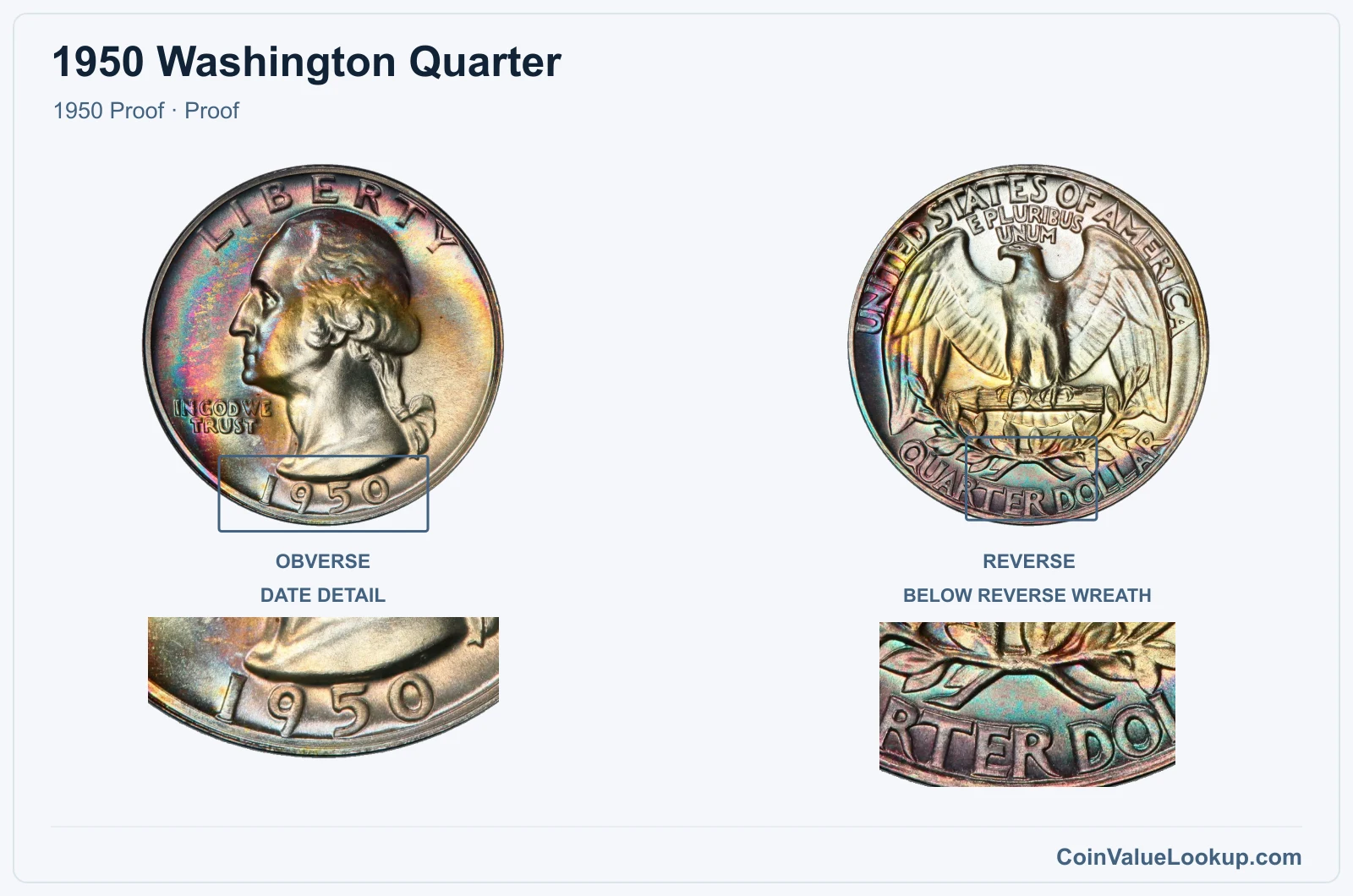
The 1950 Proof was struck at Philadelphia with no mintmark, resuming a tradition suspended during the war years. These coins have mirror-like fields and exceptionally sharp design detail that business strikes simply cannot match.
A PR65 example lists at about $89 per USA Coin Book estimates. Cameo and deep cameo designations, where the raised design carries white frost against mirror fields, are graded separately and typically command higher premiums.
Do not confuse a polished circulation quarter with a proof. Real proofs have a specific die-made reflectivity and sharp squared-off rims.
If you have to wonder whether yours is a proof, it probably is not. Professional grading services can confirm finish when the distinction is unclear.
Coin Value Lookup is a good starting point if you want to compare this proof against other Washington Quarter years or explore different denominations entirely.
| Range | Grade | Price | Auction Records | Appraisal |
|---|---|---|---|---|
| PR | PR 1 | — | Coin Identifier | |
| PR 2 | — | Coin Identifier | ||
| PR 3 | — | Coin Identifier | ||
| PR 4 | — | Coin Identifier | ||
| PR 6 | — | Coin Identifier | ||
| PR 8 | — | Coin Identifier | ||
| PR 10 | — | Coin Identifier | ||
| PR 12 | — | Coin Identifier | ||
| PR 15 | — | Coin Identifier | ||
| PR 20 | — | Coin Identifier | ||
| PR 25 | — | Coin Identifier | ||
| PR 30 | — | Coin Identifier | ||
| PR 35 | — | Coin Identifier | ||
| PR 40 | — | Coin Identifier | ||
| PR 45 | — | Coin Identifier | ||
| PR 50 | — | Coin Identifier | ||
| PR 53 | — | Coin Identifier | ||
| PR 55 | — | Coin Identifier | ||
| PR 58 | — | Coin Identifier | ||
| PR 60 | — | Coin Identifier | ||
| PR 61 | — | Coin Identifier | ||
| PR 62 | Coin Identifier | |||
| PR 63 | Coin Identifier | |||
| PR 64 | Coin Identifier | |||
| PR 65 | Coin Identifier | |||
| PR 66 | Coin Identifier | |||
| PR 67 | Coin Identifier | |||
| PR 68 | Coin Identifier | |||
| PR 69 | Coin Identifier | |||
| PR 70 | — | — | — |
1950 Washington Quarter — D
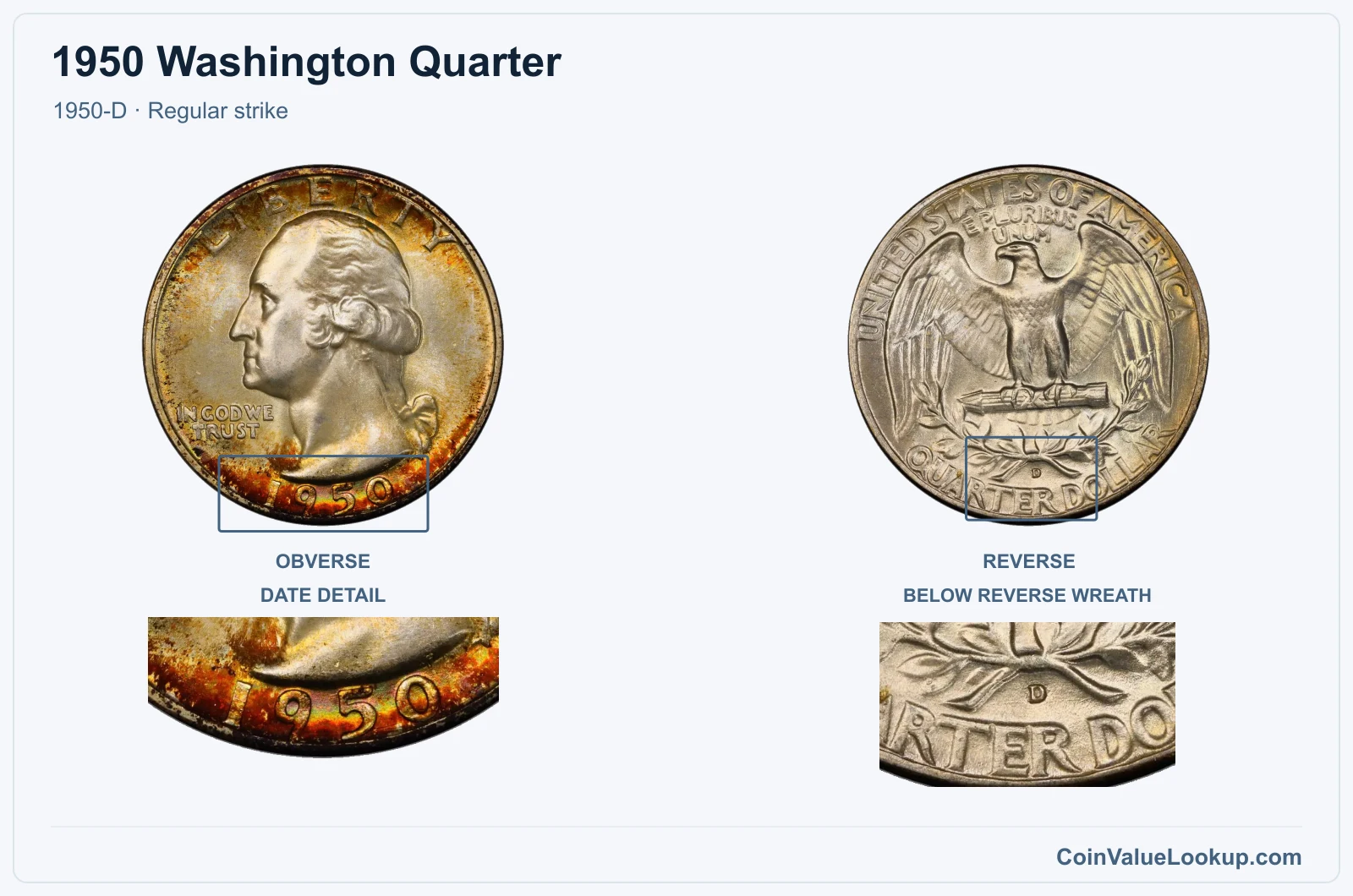
The 1950-D quarter carries a D mintmark below the wreath on the reverse. In G4 condition, USA Coin Book estimates about $16.43, essentially the same as the Philadelphia issue.
An MS60 brings roughly $20, and an MS65 reaches around $50.
Before you file this one away as ordinary, inspect that mintmark carefully under magnification. Some 1950-D quarters are actually D/S overmintmark varieties worth substantially more.
If the D looks clean and singular with no underlying letter traces, you have the standard Denver issue described here.
| Range | Grade | Price | Auction Records | Appraisal |
|---|---|---|---|---|
| PO | PO 1 | — | Coin Identifier | |
| FR | FR 2 | — | Coin Identifier | |
| AG | AG 3 | — | Coin Identifier | |
| G | G 4 | — | Coin Identifier | |
| G 6 | Coin Identifier | |||
| VG | VG 8 | — | Coin Identifier | |
| VG 10 | — | Coin Identifier | ||
| F | F 12 | — | Coin Identifier | |
| F 15 | — | Coin Identifier | ||
| VF | VF 20 | — | Coin Identifier | |
| VF 25 | — | Coin Identifier | ||
| VF 30 | — | Coin Identifier | ||
| VF 35 | — | Coin Identifier | ||
| XF | XF 40 | — | Coin Identifier | |
| XF 45 | — | Coin Identifier | ||
| AU | AU 50 | — | Coin Identifier | |
| AU 53 | — | Coin Identifier | ||
| AU 55 | — | Coin Identifier | ||
| AU 58 | Coin Identifier | |||
| MS | MS 60 | — | Coin Identifier | |
| MS 61 | — | Coin Identifier | ||
| MS 62 | Coin Identifier | |||
| MS 63 | Coin Identifier | |||
| MS 64 | Coin Identifier | |||
| MS 65 | Coin Identifier | |||
| MS 66 | Coin Identifier | |||
| MS 67 | Coin Identifier | |||
| MS 68 | Coin Identifier | |||
| MS 69 | — | — | — | |
| MS 70 | — | — | — |
1950 Washington Quarter — D/S
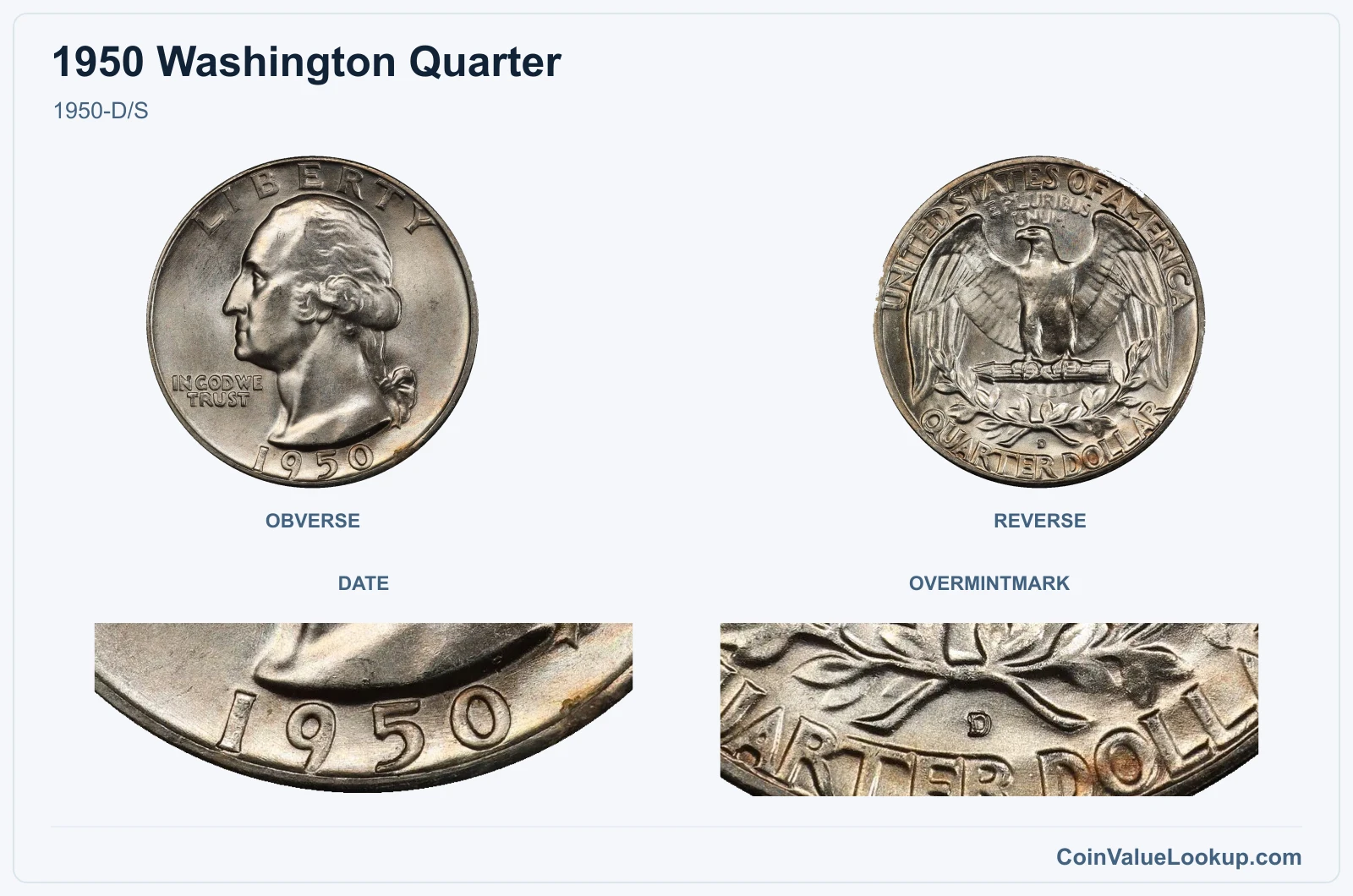
This is the big one for 1950 quarter collectors. The 1950-D/S shows a D mintmark punched over a previously applied S on the reverse die.
Look for remnants of the S, particularly near the upper-left area of the D. The documented die also shows overlapping D punches, so the mintmark area can look busy under magnification.
USA Coin Book guide estimates place this variety at roughly $51 in G4, about $384 at MS60, and approximately $4,257 at MS65. Those are retail guide figures, not guaranteed sale prices, but they show the massive premium this variety commands over a regular 1950-D.
Confirming the overmintmark requires careful comparison with known authenticated examples. Machine doubling, which creates flat, shelf-like distortions, is not the same thing.
If you think you have one, professional attribution is the smart move before selling or insuring.
| Range | Grade | Price | Auction Records | Appraisal |
|---|---|---|---|---|
| PO | PO 1 | — | Coin Identifier | |
| FR | FR 2 | — | Coin Identifier | |
| AG | AG 3 | — | Coin Identifier | |
| G | G 4 | — | Coin Identifier | |
| G 6 | — | Coin Identifier | ||
| VG | VG 8 | Coin Identifier | ||
| VG 10 | — | Coin Identifier | ||
| F | F 12 | Coin Identifier | ||
| F 15 | Coin Identifier | |||
| VF | VF 20 | — | Coin Identifier | |
| VF 25 | Coin Identifier | |||
| VF 30 | — | Coin Identifier | ||
| VF 35 | Coin Identifier | |||
| XF | XF 40 | Coin Identifier | ||
| XF 45 | Coin Identifier | |||
| AU | AU 50 | Coin Identifier | ||
| AU 53 | Coin Identifier | |||
| AU 55 | Coin Identifier | |||
| AU 58 | Coin Identifier | |||
| MS | MS 60 | — | Coin Identifier | |
| MS 61 | Coin Identifier | |||
| MS 62 | Coin Identifier | |||
| MS 63 | Coin Identifier | |||
| MS 64 | Coin Identifier | |||
| MS 65 | Coin Identifier | |||
| MS 66 | Coin Identifier | |||
| MS 67 | Coin Identifier | |||
| MS 68 | — | — | — | |
| MS 69 | — | — | — | |
| MS 70 | — | — | — |
1950 Washington Quarter — S
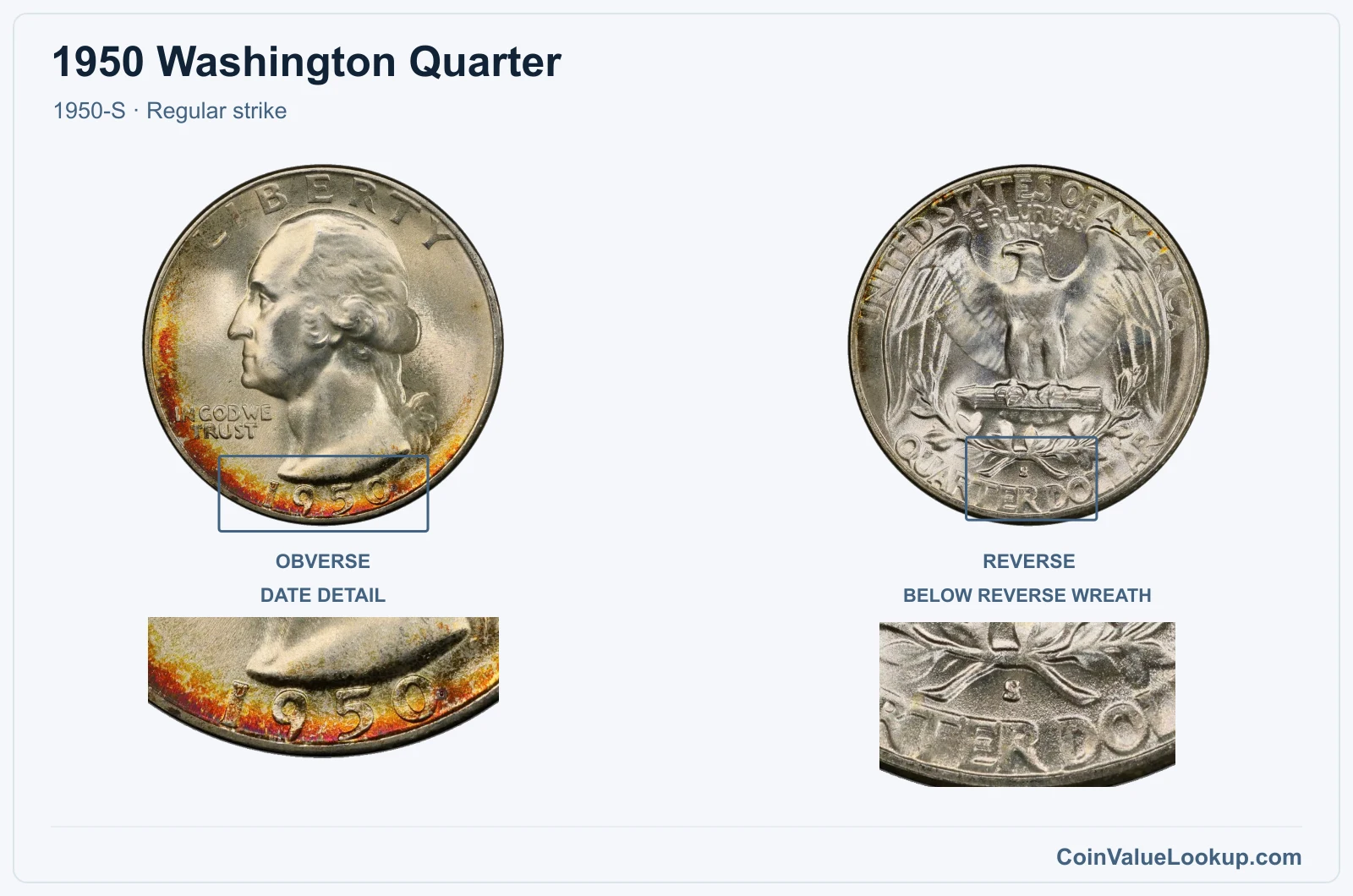
The 1950-S quarter was struck in San Francisco and carries an S mintmark below the reverse wreath. Guide estimates from USA Coin Book put it at about $16.43 in G4, around $23 at MS60, and roughly $51 at MS65 — a hair above the Philadelphia and Denver prices in top uncirculated grades.
As with the Denver issue, take a close look at the mintmark. Some 1950-S quarters are actually S/D overmintmark varieties with traces of a D beneath the final S.
A plain, clean S with no underlying letter means you have the standard San Francisco coin.
| Range | Grade | Price | Auction Records | Appraisal |
|---|---|---|---|---|
| PO | PO 1 | — | Coin Identifier | |
| FR | FR 2 | — | Coin Identifier | |
| AG | AG 3 | — | Coin Identifier | |
| G | G 4 | — | Coin Identifier | |
| G 6 | — | Coin Identifier | ||
| VG | VG 8 | — | Coin Identifier | |
| VG 10 | Coin Identifier | |||
| F | F 12 | — | Coin Identifier | |
| F 15 | Coin Identifier | |||
| VF | VF 20 | — | Coin Identifier | |
| VF 25 | Coin Identifier | |||
| VF 30 | — | Coin Identifier | ||
| VF 35 | — | Coin Identifier | ||
| XF | XF 40 | Coin Identifier | ||
| XF 45 | — | Coin Identifier | ||
| AU | AU 50 | Coin Identifier | ||
| AU 53 | — | Coin Identifier | ||
| AU 55 | — | Coin Identifier | ||
| AU 58 | Coin Identifier | |||
| MS | MS 60 | — | Coin Identifier | |
| MS 61 | — | Coin Identifier | ||
| MS 62 | Coin Identifier | |||
| MS 63 | Coin Identifier | |||
| MS 64 | Coin Identifier | |||
| MS 65 | Coin Identifier | |||
| MS 66 | Coin Identifier | |||
| MS 67 | Coin Identifier | |||
| MS 68 | Coin Identifier | |||
| MS 69 | — | — | — | |
| MS 70 | — | — | — |
1950 Washington Quarter — S/D
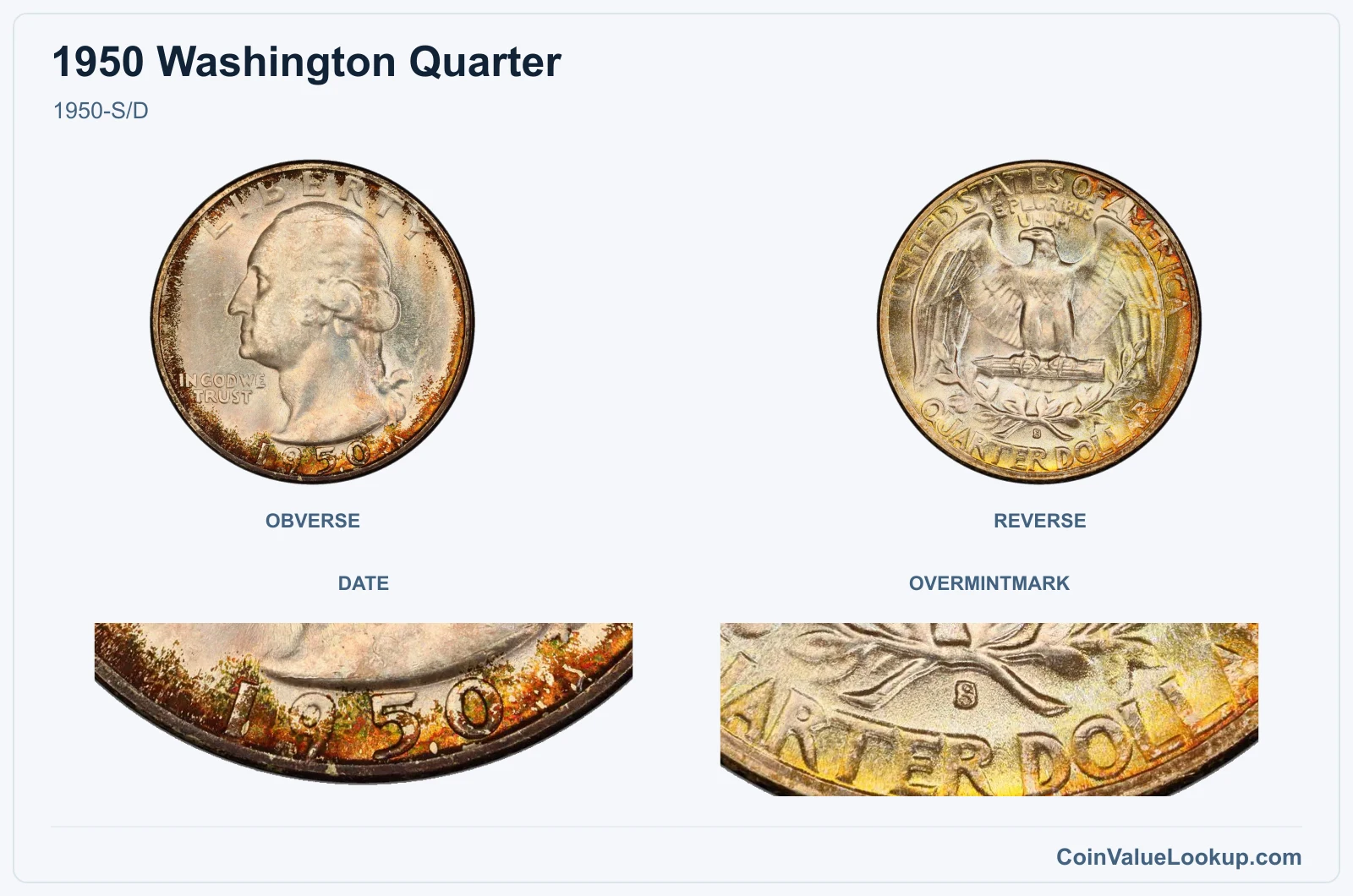
The 1950-S/D is the San Francisco counterpart to the Denver overmintmark. Here the final visible letter is S, but underneath you can detect the contours of a D that was punched first.
The S determines this coin's mint identity — it is a San Francisco variety, not a Denver one.
USA Coin Book estimates roughly $82 in G4, about $446 at MS60, and approximately $1,399 at MS65. While not as stratospheric as the D/S, these premiums are still enormous compared to a standard 1950-S quarter.
Attribution requires careful magnification and comparison with certified reference images. Wear, scratches, and corrosion around the mintmark area can mimic or obscure the underlying letter, so professional confirmation is strongly recommended before assigning the variety premium.
| Range | Grade | Price | Auction Records | Appraisal |
|---|---|---|---|---|
| PO | PO 1 | — | Coin Identifier | |
| FR | FR 2 | — | Coin Identifier | |
| AG | AG 3 | — | Coin Identifier | |
| G | G 4 | — | Coin Identifier | |
| G 6 | — | Coin Identifier | ||
| VG | VG 8 | — | Coin Identifier | |
| VG 10 | — | Coin Identifier | ||
| F | F 12 | — | Coin Identifier | |
| F 15 | — | Coin Identifier | ||
| VF | VF 20 | — | Coin Identifier | |
| VF 25 | — | Coin Identifier | ||
| VF 30 | Coin Identifier | |||
| VF 35 | Coin Identifier | |||
| XF | XF 40 | — | Coin Identifier | |
| XF 45 | Coin Identifier | |||
| AU | AU 50 | Coin Identifier | ||
| AU 53 | Coin Identifier | |||
| AU 55 | Coin Identifier | |||
| AU 58 | Coin Identifier | |||
| MS | MS 60 | — | Coin Identifier | |
| MS 61 | — | Coin Identifier | ||
| MS 62 | Coin Identifier | |||
| MS 63 | — | Coin Identifier | ||
| MS 64 | Coin Identifier | |||
| MS 65 | Coin Identifier | |||
| MS 66 | Coin Identifier | |||
| MS 67 | Coin Identifier | |||
| MS 68 | — | — | — | |
| MS 69 | — | — | — | |
| MS 70 | — | — | — |
1950 Washington Quarter Error List
1. 1950 Washington Quarter — D over S Mintmark
The D over S mintmark on a 1950-D quarter is a die variety created when the San Francisco S punch was applied to the working die before the Denver D was punched over it. To spot it, examine the mintmark area below the reverse wreath under at least 5x magnification.
Look for the top and left remnants of an S peeking out near the upper-left portion of the final D. The documented die also carries overlapping D punches, so the entire mintmark zone can appear complex.
Machine doubling is the most common lookalike. It produces flattened, shelf-like relief rather than the rounded, die-made contours of a genuine overmintmark.
Wear, scratches, and added metal from post-mint contact do not match a repeated die-made pattern either.
No single numeric price range applies here. Value depends on authenticated identity, the coin's condition, and how clearly the underlying S is visible.
Professional grading and attribution services are the safest path to confirming this variety.
2. 1950 Washington Quarter — S over D Mintmark
The S over D mintmark on a 1950-S quarter is the opposite variety from the D/S. Here, the final visible letter is S, struck over an underlying D.
Inspect the reverse S below the wreath for contours of the earlier D punch, ideally using a certified enlarged mintmark reference for comparison. The S being on top is what makes this a San Francisco coin — do not confuse it with the Denver D/S version.
The usual impostor is machine doubling, which leaves flat, shelf-like distortion instead of the rounded letter shapes a genuine overmintmark displays. Wear, environmental damage, and scratches around the mintmark area can also create misleading shadows.
Value depends on authenticated identity, overall condition, and the clarity of the underlying D. No fixed numeric range applies to every example.
Professional attribution is worth pursuing if you suspect you have one, because the premium over a regular 1950-S quarter is substantial.
3. 1950 Washington Quarter — Struck on a Silver Dime Planchet
A 1950 Philadelphia quarter struck on a silver dime planchet is a dramatic wrong-planchet error. The dime blank weighs approximately 2.5 grams versus the quarter's normal 6.25 grams, so the resulting coin is noticeably undersized with the quarter's design spreading only partway across the smaller surface.
Peripheral lettering and design elements are lost off the edge.
Both the dime and quarter blanks are the same 90% silver alloy, so color alone cannot distinguish them. The key diagnostics are weight, diameter, and the characteristic incomplete design coverage that only a genuine small-blank strike produces.
Lookalikes include quarters that have been filed, ground, or squeezed down after leaving the mint. Those show tool marks, uneven edges, and disturbed surfaces that differ from the clean, strike-made features of a real off-metal error.
Professional authentication is essential. Value depends on condition, the specific error's visual impact, and confirmed identity — no single price range covers all examples.
4. 1950 Washington Quarter — Doubled Die Reverse
A doubled die reverse has been reported for the 1950 Philadelphia quarter. This variety shows doubling on reverse design elements — legends and design contours — created during the die-making process.
Compare your coin's reverse lettering and eagle details against a normal 1950 quarter side by side, preferably under magnification.
Do not confuse die doubling with machine doubling, which is a much more common and far less valuable phenomenon. Machine doubling typically produces flat, shelf-like distortions without the rounded, separated quality of true hub doubling.
Random damage and light reflections can also mimic doubling to the untrained eye.
No specific price range is adopted for this variety. Value depends on the coin's overall condition, how visible the doubling is, and confirmed attribution.
If you suspect your quarter shows this kind of reverse doubling, professional evaluation is the logical next step.
5. 1950 Washington Quarter — Repunched Mintmark
A repunched mintmark has been reported for the 1950-S quarter, where the S was punched into the die more than once in slightly different positions. The result is a visible remnant of a separately positioned S near or overlapping the final mintmark.
You will need magnification and good lighting to see it clearly.
This is distinct from the S/D overmintmark variety. Here both punches are the same letter, just offset.
Compare your mintmark at matching magnification against a normal 1950-S to see if extra letter traces are present.
Common lookalikes include machine doubling around the mintmark, die chips that add extra metal, and corrosion or environmental damage that distorts the letter's outline. None of these match the crisp, die-made contours of a genuine repunched mintmark.
No fixed price range applies — value depends on condition, visibility of the repunch, and confirmed attribution by a professional service.