1920 Mercury Dime Coin Value: How Much Is It Worth?
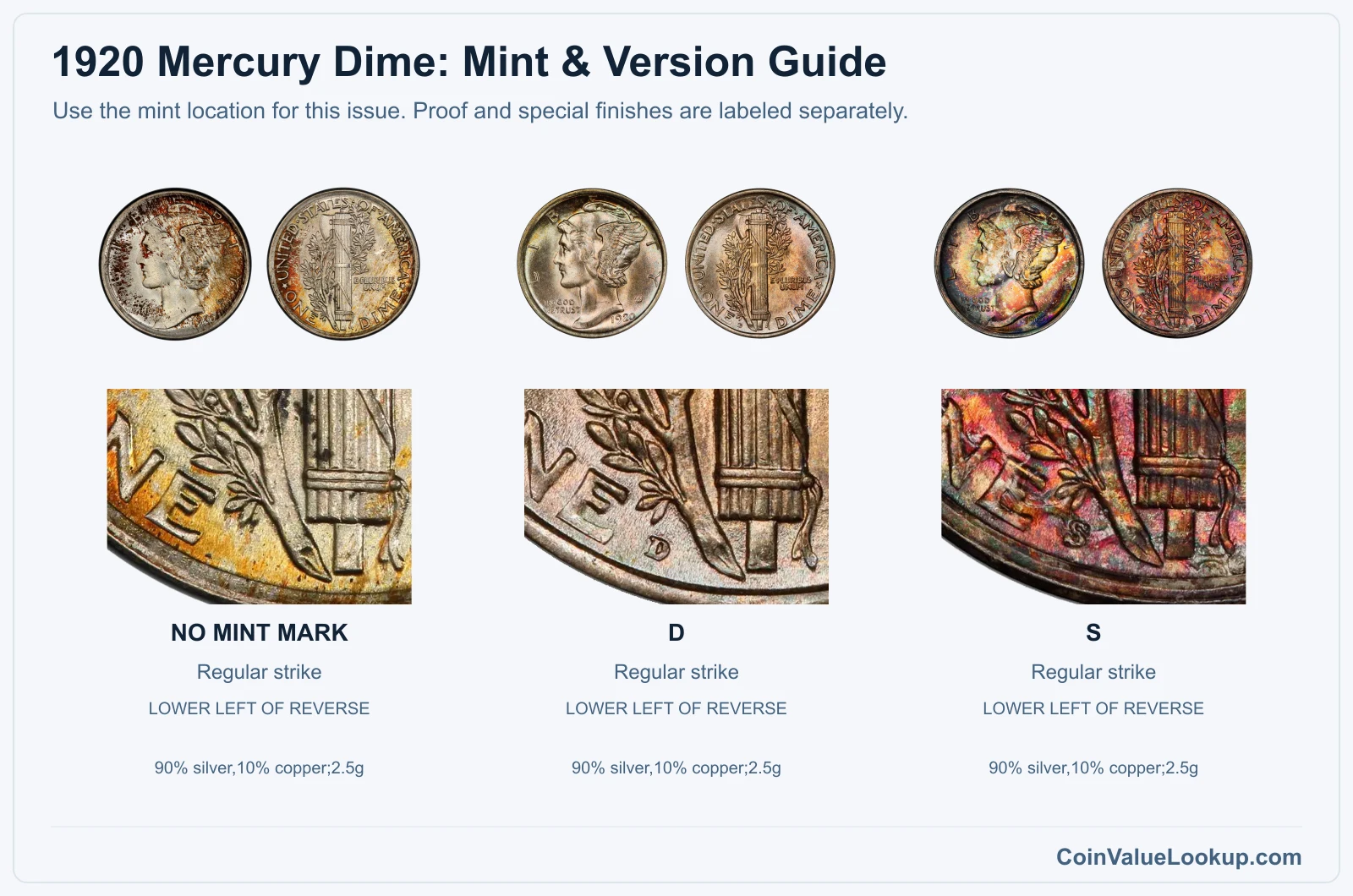
The 1920 Mercury Dime was struck at three mints, and guide estimates for ordinary business strikes range from about $7.16 in Good-4 up to $1,603 in MS-65, depending on the mint. Coins with fully separated fasces bands on the reverse can command additional premiums beyond standard Mint State values.
Branch-mint strikes from this year are sometimes weakly struck, so careful inspection matters.
Fast Way to Identify Your 1920 Mercury Dime
Want a quick read on your 1920 Mercury Dime? Upload clear photos of both the front and back, and our identifier can give you a preliminary take on which mint produced it and its general version.
This is not a substitute for professional authentication or grading, but it is a solid first step toward understanding what you have.
1920 Mercury Dime Value
Upload both sides of your 1920 Mercury Dime.
Front Obverse
Upload photo
Back Reverse
Upload photo
Which 1920 Mercury Dime Versions Are Worth Money?
- Three mints were used in 1920 — Philadelphia (no mintmark), Denver (D), and San Francisco (S) — and values differ significantly by mint, especially in higher grades.
- Original Mint State surfaces with fully separated fasces bands (Full Bands) can bring premiums well above standard guide prices for the same grade.
- Reported error types such as clipped planchets, off-center strikes, and broadstrikes have been documented for this date and may carry additional value depending on condition and visibility.
Step 1: Identify Your 1920 Mercury Dime Mint Mark and Version
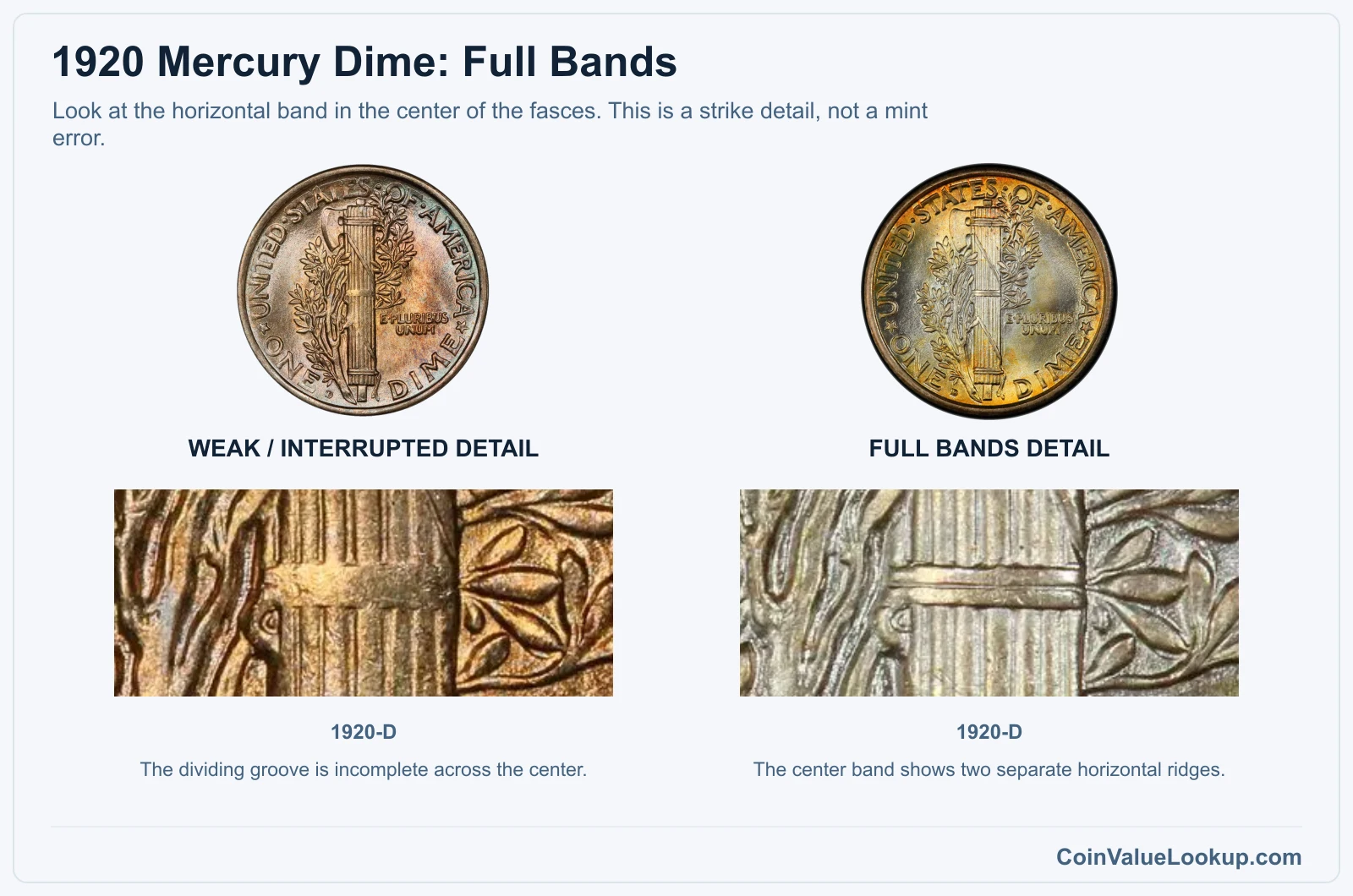
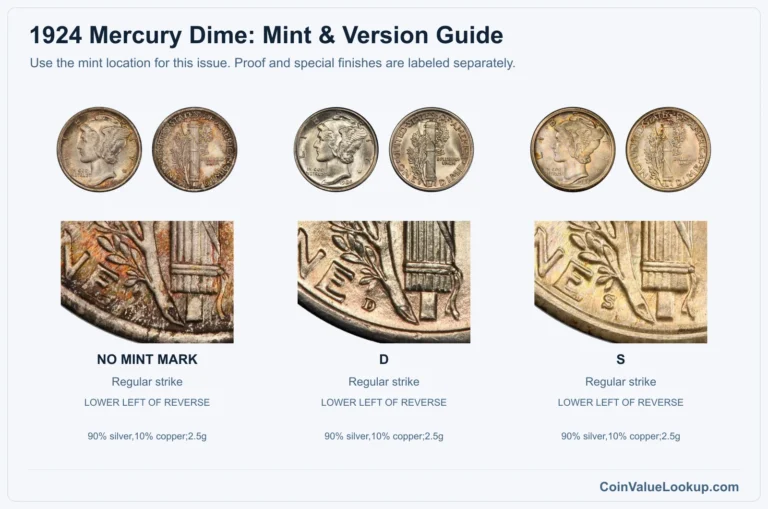
The 1920 Mercury Dime was produced at Philadelphia, Denver, and San Francisco. Philadelphia coins carry no mintmark.
Denver pieces show a small "D" and San Francisco pieces show an "S," both located on the lower-left reverse near the word ONE.
Do not confuse the designer's monogram "AW" on the obverse with a mintmark. That stands for Adolph Weinman, not West Point.
All three versions are struck in 90% silver and 10% copper, weigh approximately 2.5 grams, and measure 17.9 mm with a reeded edge. The alloy is identical across all mints for this date.
Full Bands (FB) refers to completely separated horizontal bands on the reverse fasces. It is a strike designation, not a minting error or a different variety.
Branch-mint coins from 1920 can be weakly struck, so poorly defined bands do not necessarily mean the coin circulated heavily.
Step 2: Check Your 1920 Mercury Dime Grade
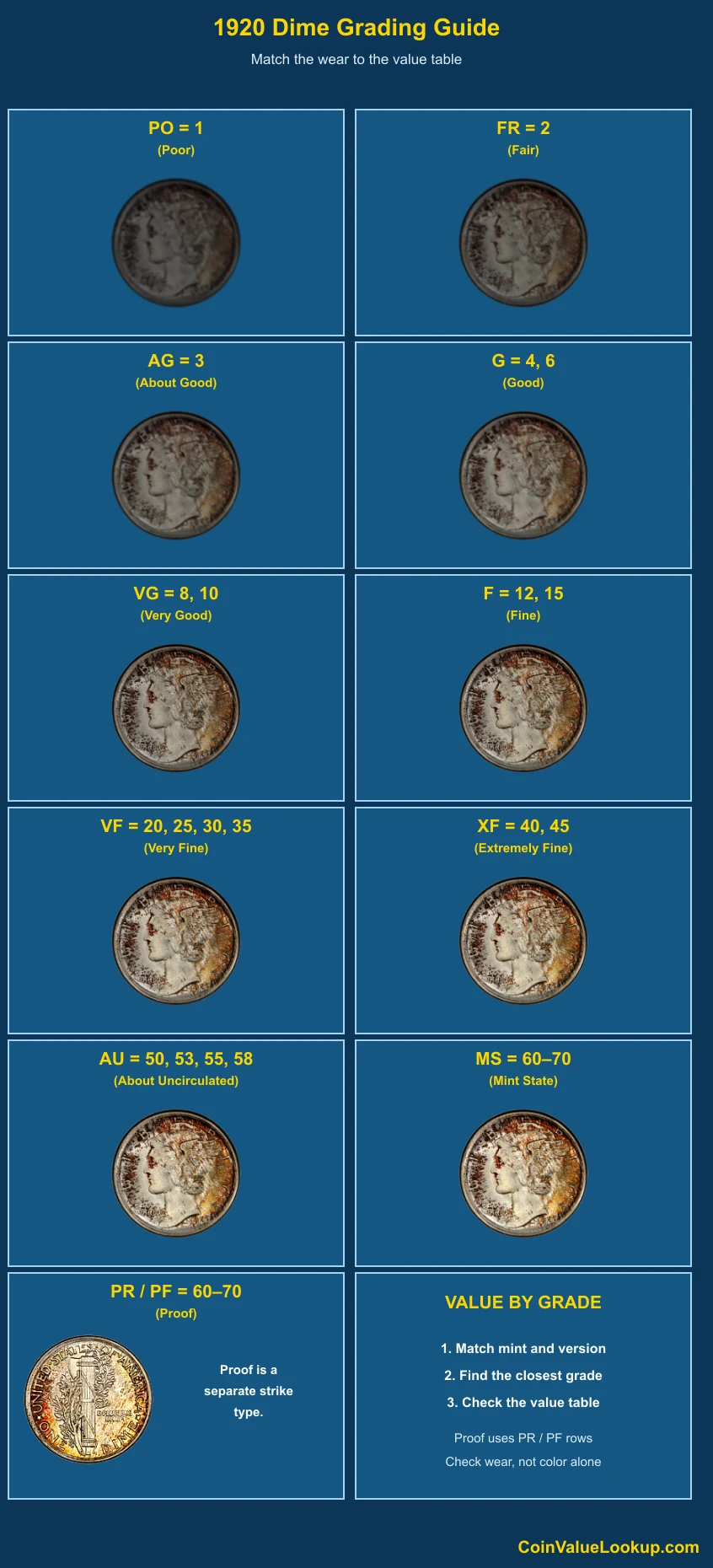
Start by checking Liberty's hair detail above and in front of the ear on the obverse. A well-worn coin loses definition there first, followed by the wing and cap.
On the reverse, look at the fasces and the surrounding details. Weak peripheral legends or soft bands do not automatically indicate circulation wear; branch-mint 1920 dimes were sometimes poorly struck from the press.
Examine overall luster and surface quality. Contact marks, cleaning, and environmental damage all affect grade and desirability.
Use the comparison image to judge your coin's condition against known grade benchmarks. Full Bands evaluation is a separate step from overall grade.
NGC, for example, checks both central and outer band separation, and different grading services may apply their own criteria. A coin can grade MS-65 without earning an FB designation if the bands are incomplete.
Step 3: Check 1920 Mercury Dime Value by Mint and Version
1920 Mercury Dime — No Mint Mark — Silver Circulation
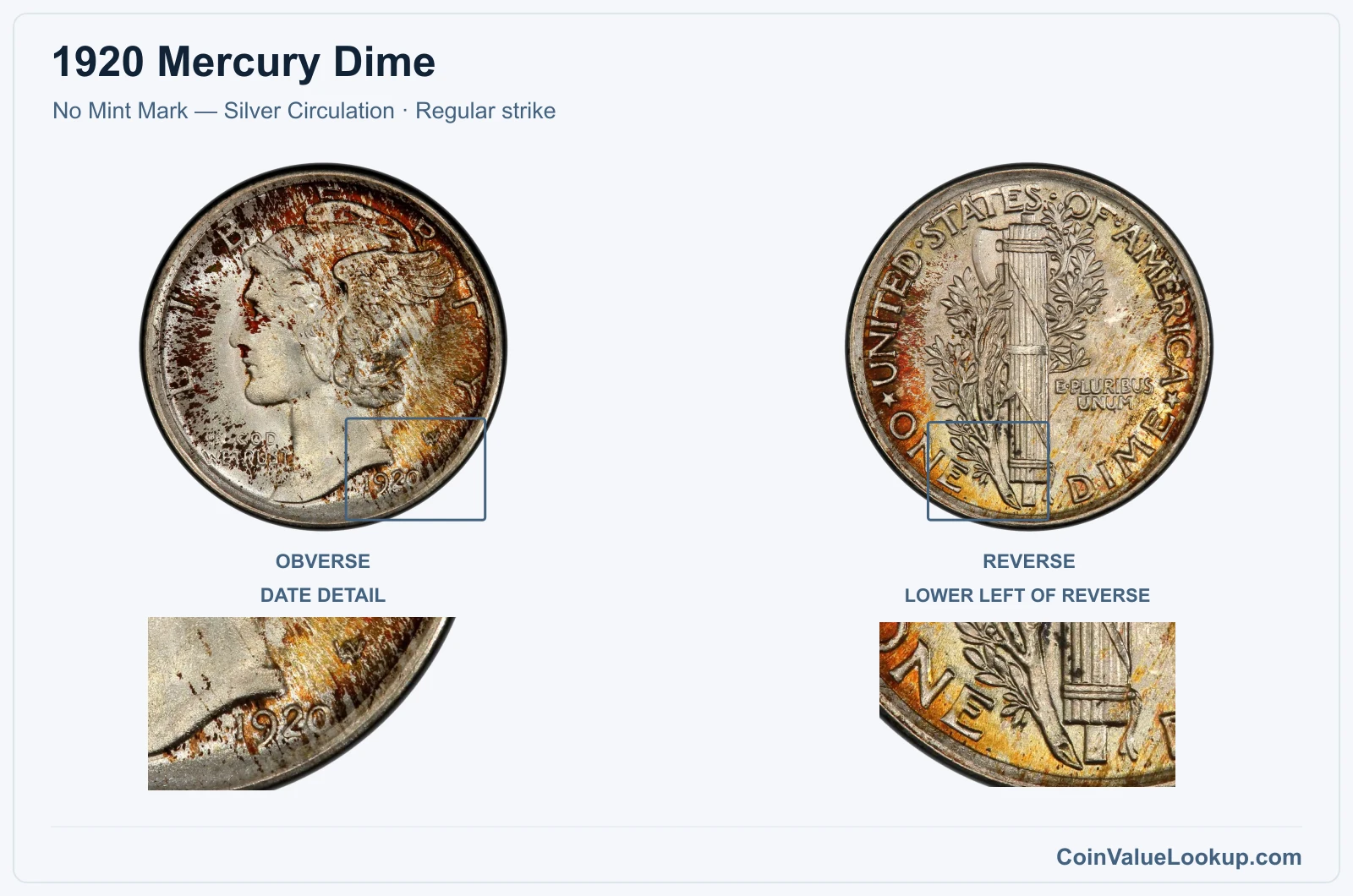
The 1920 Philadelphia dime has no mintmark. Look at the lower-left reverse near ONE and confirm the field is blank.
Guide estimates place this coin at roughly $7.16 in Good-4 and around $316 in MS-65, per USA Coin Book. Most surviving examples are well-circulated, so a coin with original luster stands out.
Full Bands specimens are evaluated separately; a standard MS-65 price does not reflect an FB premium. If your coin's bands are fully separated, it deserves its own targeted comparison.
Coin Value Lookup is a good starting point if you want to look up guides for other Mercury Dime dates or denominations in your collection.
Range Grade
Price Auction Records Appraisal PO PO 1
—
Coin Identifier FR FR 2
—
Coin Identifier AG AG 3
—
Coin Identifier G G 4
—
Coin Identifier
G 6
—
Coin Identifier VG VG 8
—
Coin Identifier
VG 10
—
Coin Identifier F F 12
—
Coin Identifier
F 15
—
Coin Identifier VF VF 20
—
Coin Identifier
VF 25
—
Coin Identifier
VF 30
—
Coin Identifier
VF 35
—
Coin Identifier XF XF 40
—
Coin Identifier
XF 45
—
Coin Identifier AU AU 50
—
Coin Identifier
AU 53
—
Coin Identifier
AU 55
—
Coin Identifier
AU 58
Coin Identifier MS MS 60
—
Coin Identifier
MS 61
—
Coin Identifier
MS 62
Coin Identifier
MS 63
Coin Identifier
MS 64
Coin Identifier
MS 65
Coin Identifier
MS 66
Coin Identifier
MS 67
Coin Identifier
MS 68
Coin Identifier
MS 69
—
—
—
MS 70
—
—
—
1920 Mercury Dime — D — Silver Circulation
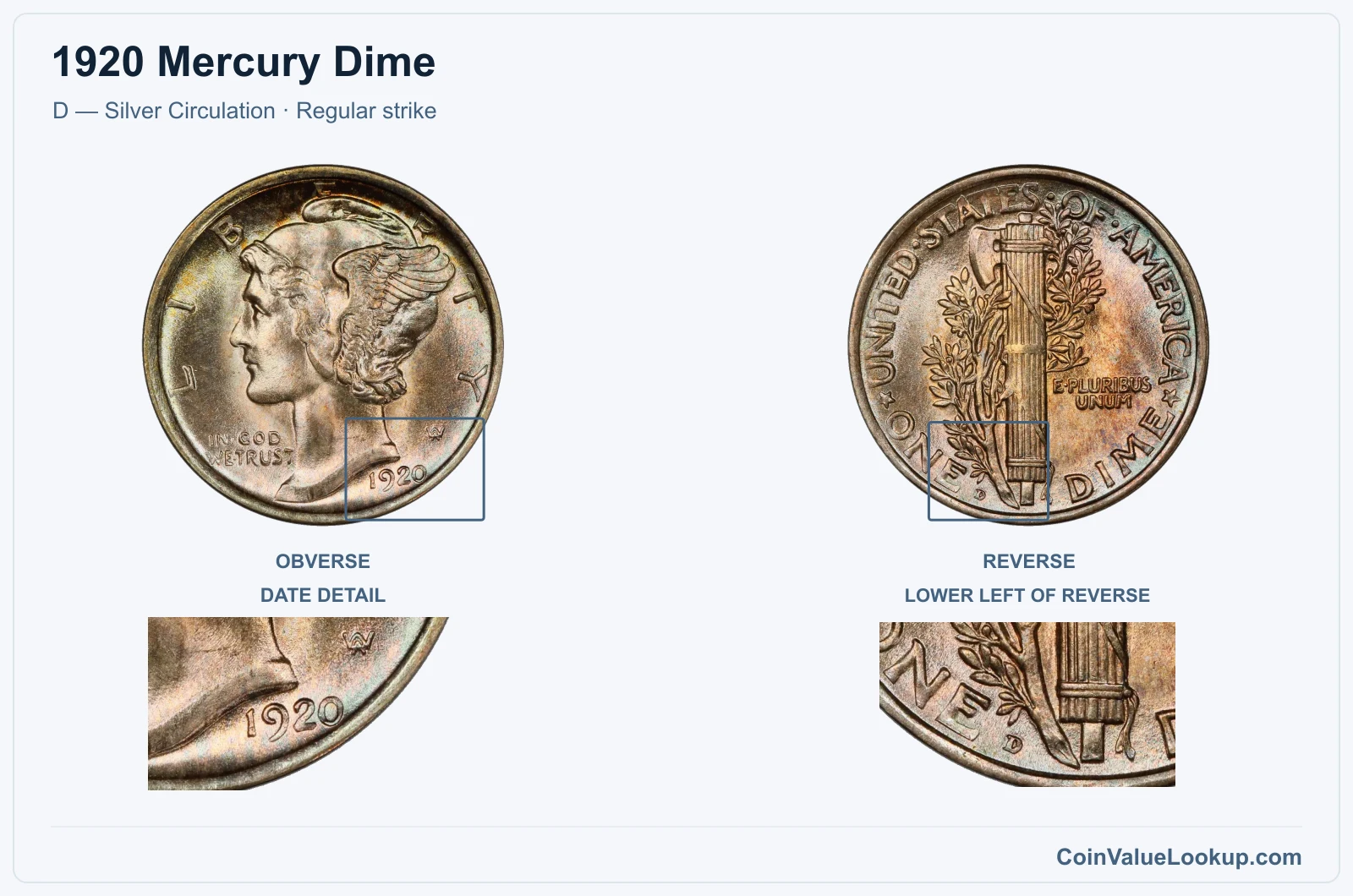
Denver struck 1920 dimes carry a small "D" mintmark on the lower-left reverse. Branch-mint strikes from Denver can show weakness on the fasces bands even on otherwise high-grade coins, so do not mistake a soft strike for wear.
Guide estimates from USA Coin Book run about $7.16 in Good-4 and roughly $759 in MS-65. That jump tells you something: nice original examples in upper grades are scarce enough to matter.
As with Philadelphia, Full Bands coins are a separate category. The MS-65 figure here is for a standard strike without the FB designation.
Range Grade
Price Auction Records Appraisal PO PO 1
—
Coin Identifier FR FR 2
—
Coin Identifier AG AG 3
—
Coin Identifier G G 4
—
Coin Identifier
G 6
Coin Identifier VG VG 8
—
Coin Identifier
VG 10
—
Coin Identifier F F 12
Coin Identifier
F 15
—
Coin Identifier VF VF 20
—
Coin Identifier
VF 25
—
Coin Identifier
VF 30
—
Coin Identifier
VF 35
—
Coin Identifier XF XF 40
—
Coin Identifier
XF 45
Coin Identifier AU AU 50
Coin Identifier
AU 53
Coin Identifier
AU 55
—
Coin Identifier
AU 58
Coin Identifier MS MS 60
—
Coin Identifier
MS 61
Coin Identifier
MS 62
Coin Identifier
MS 63
Coin Identifier
MS 64
Coin Identifier
MS 65
Coin Identifier
MS 66
Coin Identifier
MS 67
Coin Identifier
MS 68
—
—
—
MS 69
—
—
—
MS 70
—
—
—
1920 Mercury Dime — S — Silver Circulation
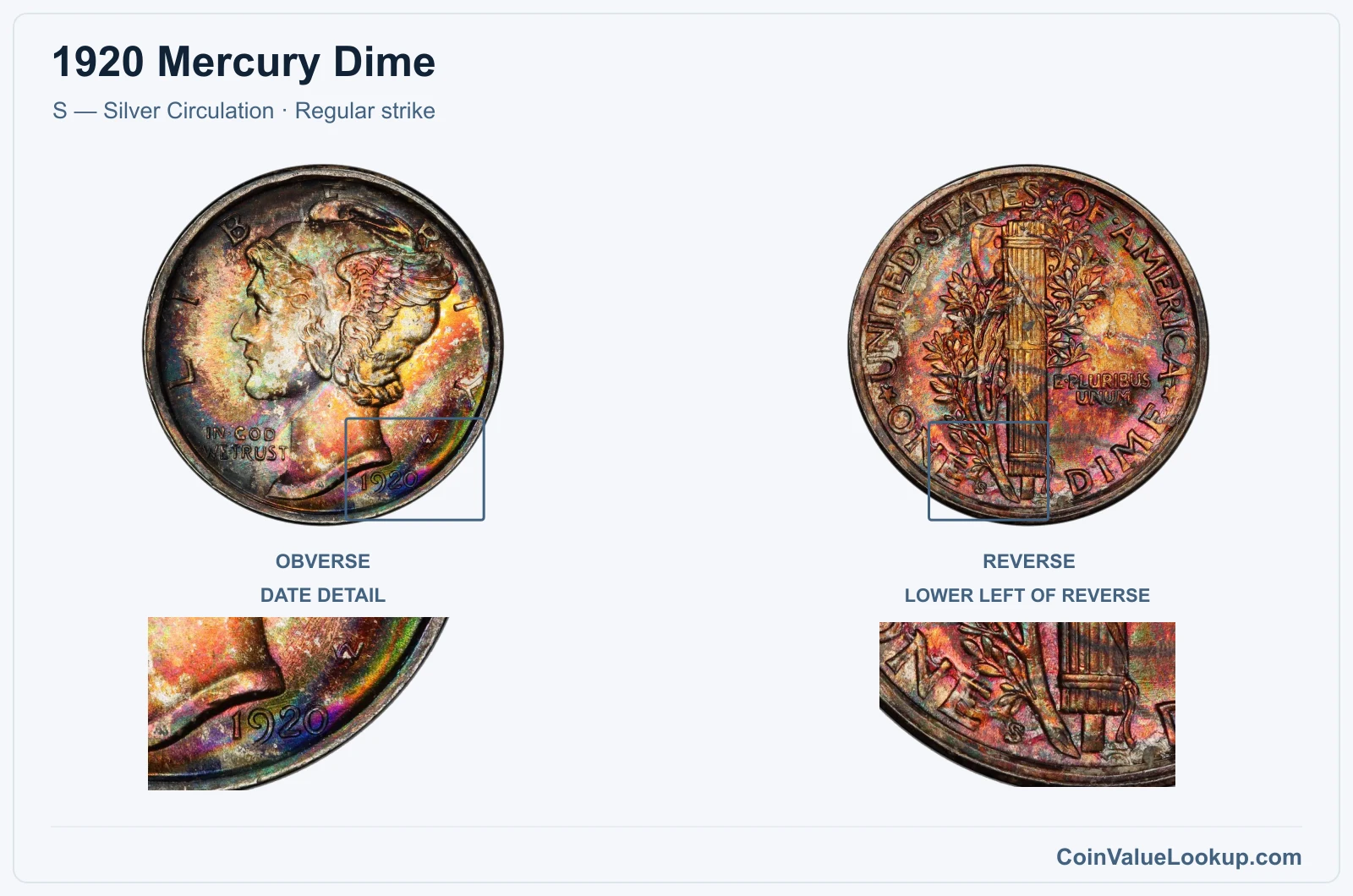
San Francisco pieces carry an "S" mintmark in the same lower-left reverse position. This is the highest-valued regular business strike of the three 1920 mints in upper grades, with USA Coin Book guide estimates of about $7.46 in Good-4 and approximately $1,603 in MS-65.
That MS-65 figure reflects the difficulty of finding well-struck, well-preserved San Francisco dimes from this date. Branch-mint weakness is common here, and coins that survived without heavy bag marks or cleaning are genuinely hard to locate.
Full Bands examples, again, are evaluated on their own terms and are not included in the standard MS-65 estimate.
Range Grade
Price Auction Records Appraisal PO PO 1
—
Coin Identifier FR FR 2
—
Coin Identifier AG AG 3
—
Coin Identifier G G 4
—
Coin Identifier
G 6
—
Coin Identifier VG VG 8
Coin Identifier
VG 10
—
Coin Identifier F F 12
—
Coin Identifier
F 15
—
Coin Identifier VF VF 20
—
Coin Identifier
VF 25
—
Coin Identifier
VF 30
—
Coin Identifier
VF 35
—
Coin Identifier XF XF 40
—
Coin Identifier
XF 45
—
Coin Identifier AU AU 50
—
Coin Identifier
AU 53
—
Coin Identifier
AU 55
Coin Identifier
AU 58
Coin Identifier MS MS 60
Coin Identifier
MS 61
Coin Identifier
MS 62
Coin Identifier
MS 63
Coin Identifier
MS 64
Coin Identifier
MS 65
Coin Identifier
MS 66
Coin Identifier
MS 67
—
—
—
MS 68
—
—
—
MS 69
—
—
—
MS 70
—
—
—
1920 Mercury Dime Error List
1. 1920 Mercury Dime — Clipped Planchet
A clipped planchet error occurs when a portion of the coin blank is missing before striking. On a 1920 dime, look for a curved, straight, or ragged section of missing metal along the rim.
The clip is part of the original blank, not something done after the coin left the mint.
One helpful diagnostic: check the area directly opposite the clip. Genuine clips often produce slight design weakness on the far side because the metal had less material to flow into during striking.
Watch out for lookalikes. A filed edge, deliberate notch, or corrosion-eaten rim will lack that opposite-side weakness and typically shows tool marks or uneven surface texture.
No specific price data is available for this error on the 1920 dime, as value depends on the size and visibility of the clip, the coin's overall condition, and buyer demand.
2. 1920 Mercury Dime — Off-Center Strike
An off-center strike happens when the coin blank is not properly seated between the dies. The result is a displaced design with an unstruck crescent of blank metal on one side.
On a 1920 dime, the key question collectors ask is whether the date remains visible — dateless off-center coins are far less desirable.
The percentage of off-center displacement and the coin's condition both affect value. A 5% shift is mild; a 50% shift with a readable date is dramatic and scarce.
Do not confuse an off-center strike with a clipped planchet or post-mint damage such as a coin that was flattened or bent after leaving the press. The unstruck crescent on a genuine off-center strike will be smooth, uniform blank metal.
No specific price is adopted for this error on the 1920 dime; individual assessment based on displacement, date visibility, and surface quality is needed.
3. 1920 Mercury Dime — Broadstrike
A broadstrike occurs when the coin is struck without the normal collar die that constrains the blank's edge. The result is a coin with outward metal spread — it looks slightly larger than normal and the rim profile is abnormal or absent, yet the full design is generally present.
On a 1920 dime, check the edge carefully. A broadstruck coin will have a flattened or expanded edge rather than the usual reeded edge, and the design may appear slightly spread out toward the periphery.
The main lookalike is post-mint flattening, where someone squished a coin after it was already struck. A genuinely broadstruck coin retains the correct overall design proportions and metal flow consistent with a single press strike.
No adopted price range is available for this error; value depends on the degree of spread, overall condition, and whether the coin is clearly identifiable as a 1920 dime.