1974 Roosevelt Dime Coin Value: How Much Is It Worth?
Most 1974 Roosevelt dimes you pull from pocket change are worth exactly ten cents. Worn circulated examples of either the Philadelphia or Denver issue trade at face value.
In uncirculated MS 65 condition, a guide estimate from USA Coin Book places both the no-mintmark and D versions around $2.79, while a normal PR 65 proof sits near $2.50. The real money shows up with authenticated mint errors and strong-strike designations, so knowing what to look for matters.
Fast Way to Identify Your 1974 Roosevelt Dime
Snap a clear photo of the front and back of your 1974 dime and upload both images here. The identifier can give you a preliminary read on which mint version you have and whether anything looks unusual.
It is not a substitute for professional authentication, but it is a solid first step before you spend money on grading fees.
1974 Roosevelt Dime Value
Upload both sides of your 1974 Roosevelt Dime.
Front Obverse
Upload photo
Back Reverse
Upload photo
Which 1974 Roosevelt Dime Versions Are Worth Money?
- No-mintmark and D coins in MS 65 or better with fully separated torch bands can exceed typical guide values for the grade.
- S proofs with clean, undisturbed mirror fields and genuine cameo contrast between devices and fields are worth closer inspection.
- Off-center strikes, particularly those retaining the date and mintmark, have sold at auction and carry confirmed premiums.
- Straight clipped planchets and partial brockages are documented for this date and are valued individually by severity and condition.
- Doubled die obverse varieties have been reported for 1974 dimes and should be compared carefully against normal examples.
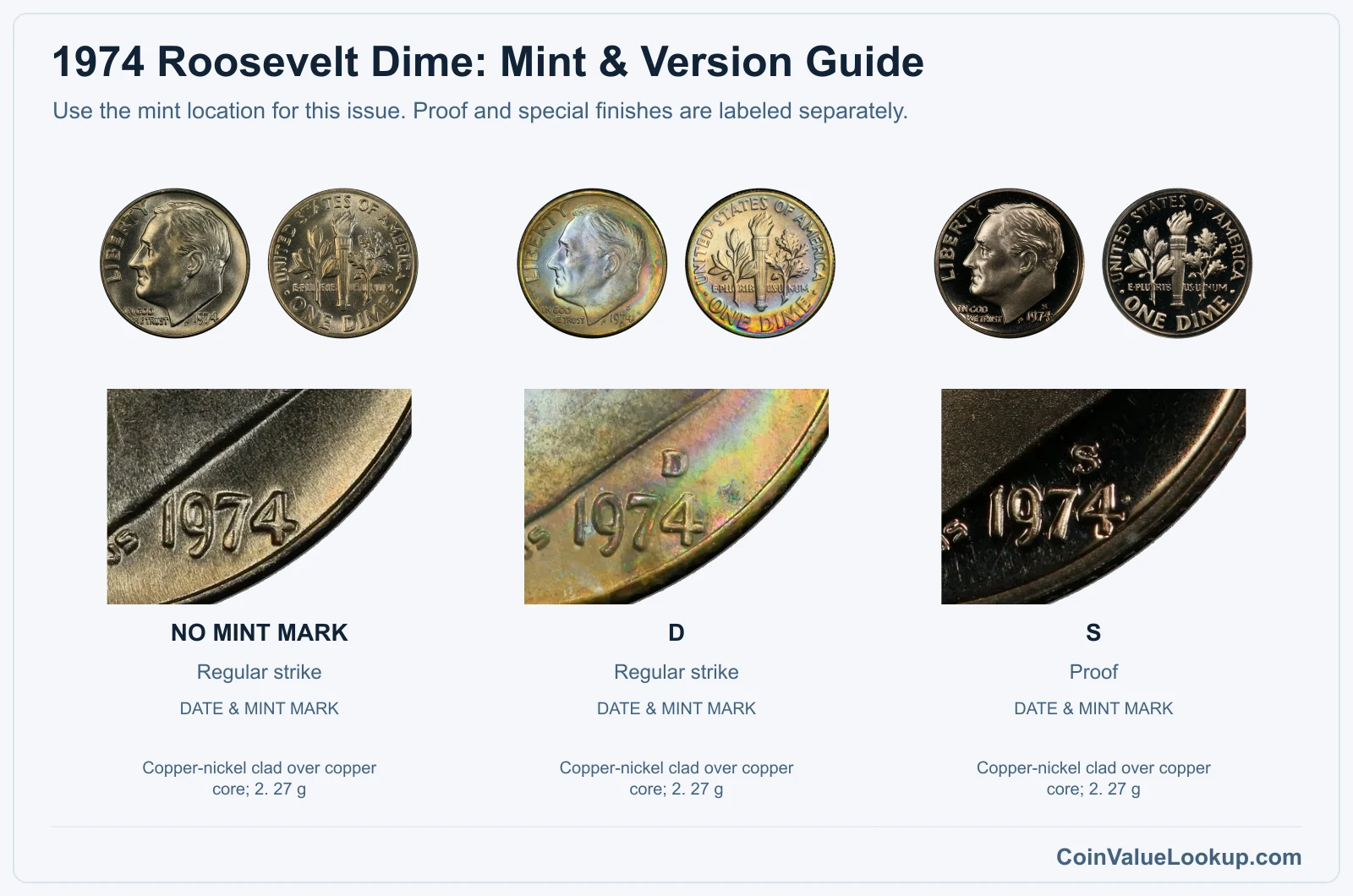
Step 1: Identify Your 1974 Roosevelt Dime Mint Mark and Version
Start with the date. You need to see "1974" below Roosevelt's chin on the obverse, with a torch flanked by branches on the reverse.
That confirms you have the right coin.
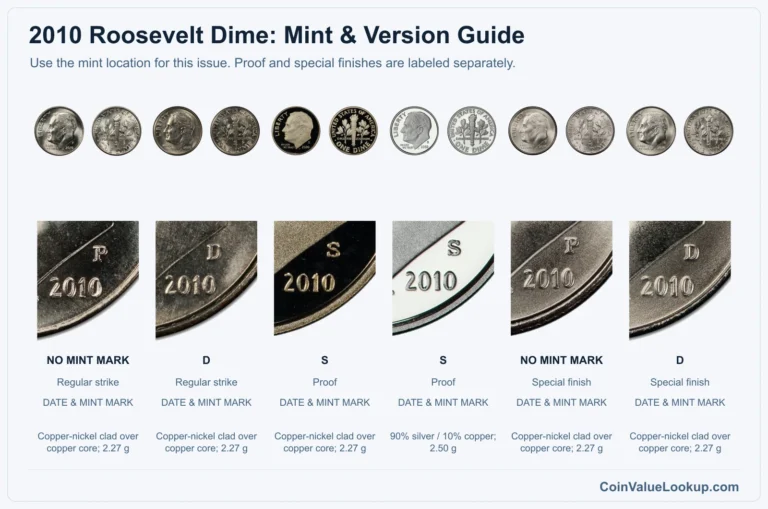
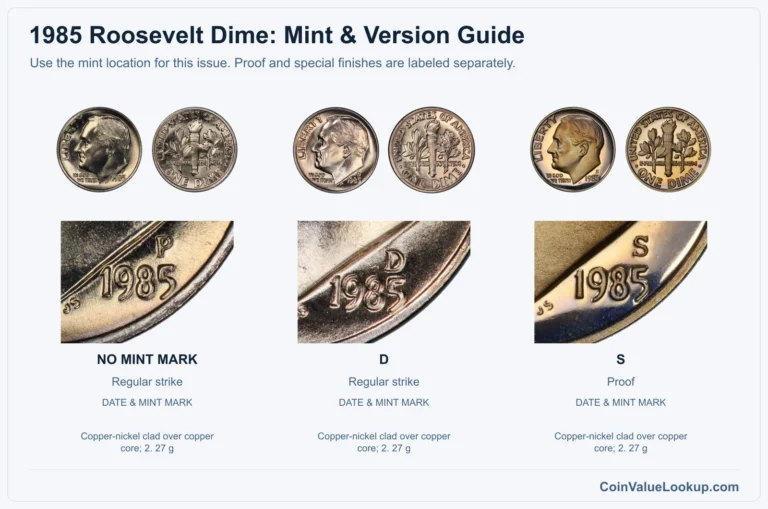
Next, check the mintmark. Look just above the date on the obverse.
No letter means Philadelphia. A small "D" means Denver.
An "S" means San Francisco, and for 1974 that means a proof coin.
All 1974 dimes are copper-nickel clad, weighing about 2.27 grams with a diameter near 17.9 mm. There is no silver version for this year.
If your coin feels lighter or heavier than that, or if the edge looks odd, you may have something worth investigating further.
There is no recognized No-S proof variety for 1974. If someone claims otherwise, be skeptical.
Step 2: Check Your 1974 Roosevelt Dime Grade
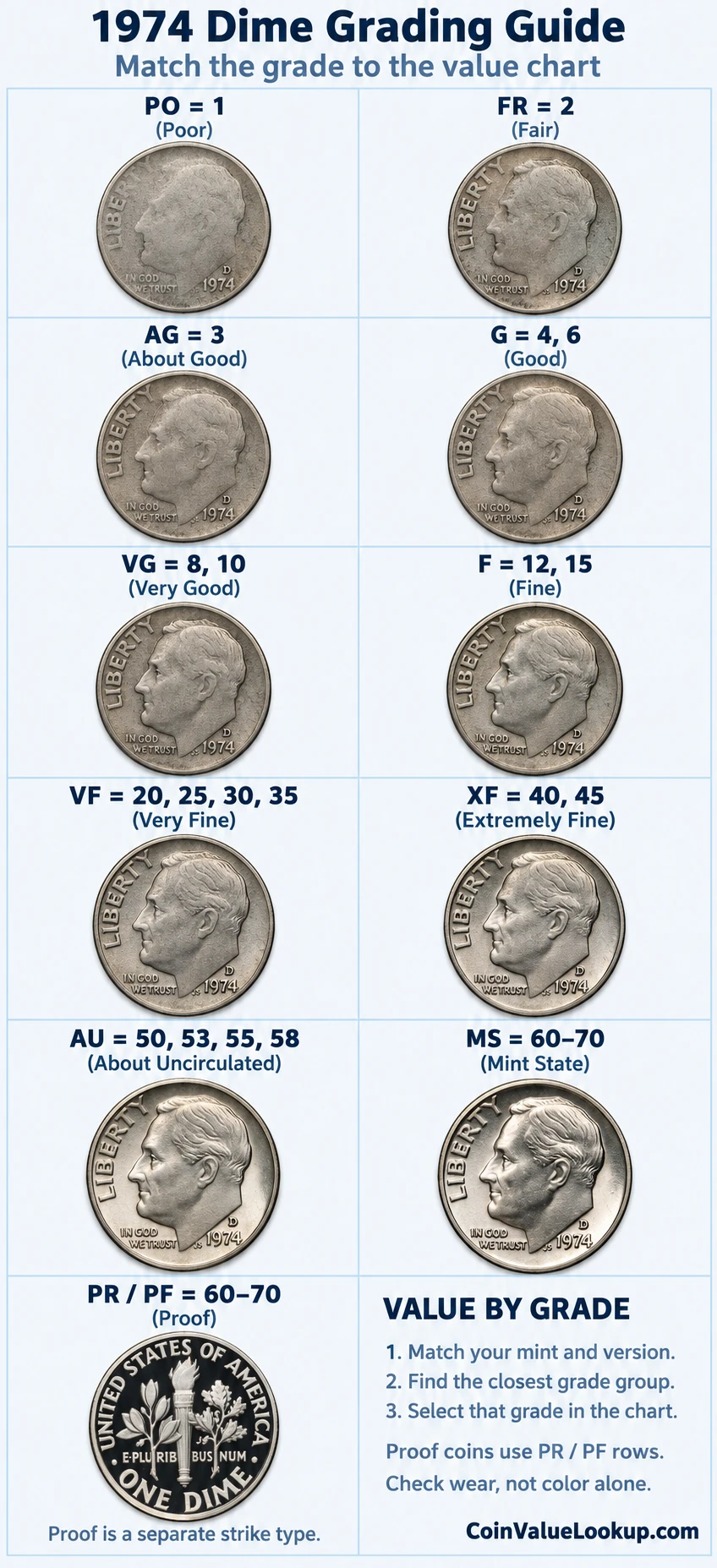
Focus on Roosevelt's cheek and jawline first. These are the highest relief points and show friction before anything else.
Then check the hair detail above the ear; on a well-preserved coin, individual strands remain sharp.
Flip it over and examine the torch. The horizontal bands across the torch are the key to the Full Bands designation.
According to PCGS, both horizontal band pairs must show clear separation. That is a strike characteristic, not an error, and coins with it can carry a premium over ordinary strikes in the same grade.
Look at overall luster. A coin can have sharp details but still grade lower because of cleaning, scratches or corrosion.
Dull, hazy surfaces or unnatural brightness are red flags. Compare your coin to the grading image to get a sense of where it falls.
Remember that "proof" describes how the coin was made, not a grade above Mint State. Proof coins get their own grading scale starting at PR, assessed on surface quality, reflectivity and any contact marks.
Step 3: Check 1974 Roosevelt Dime Value by Mint and Version
1974 Roosevelt Dime — No Mintmark Business Strike
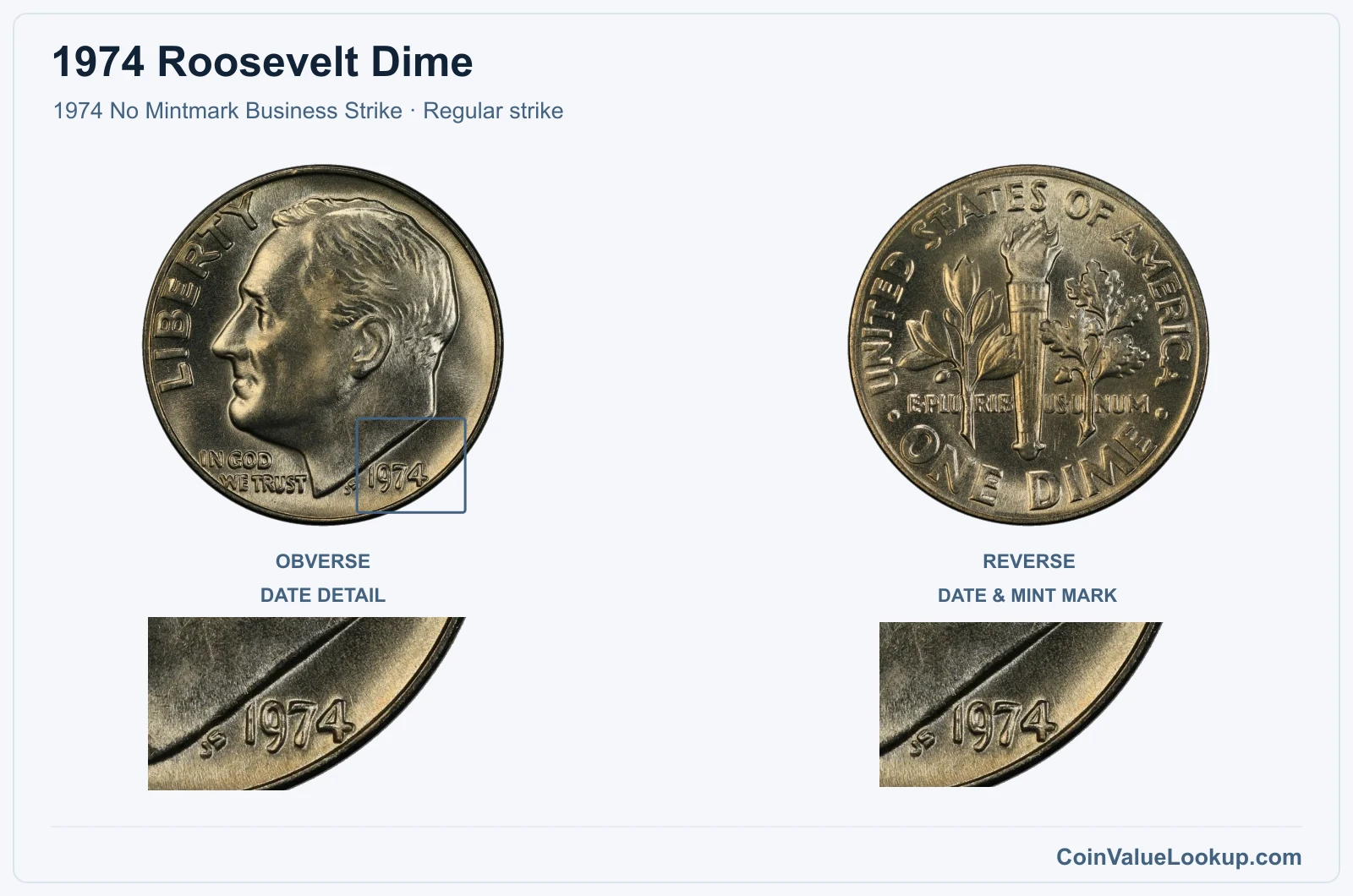
The 1974 no-mintmark dime was struck at Philadelphia. It is copper-nickel clad over a copper core, weighs about 2.27 grams, and carries Roosevelt's portrait on the front with the torch and olive-oak branches on the back.
In typical circulated grades, it is worth face value. A USA Coin Book guide estimate puts an MS 65 example at roughly $2.79.
Coins displaying full separation of the horizontal torch bands may command more, but that designation requires professional confirmation.
Coin Value Lookup is a handy starting point if you want to compare this dime against other Roosevelt dates and mints. You can look up guides across the full series without digging through dozens of separate sources.
Range Grade
Price Auction Records Appraisal PO PO 1
—
Coin Identifier FR FR 2
—
Coin Identifier AG AG 3
—
Coin Identifier G G 4
—
Coin Identifier
G 6
—
Coin Identifier VG VG 8
—
Coin Identifier
VG 10
—
Coin Identifier F F 12
—
Coin Identifier
F 15
—
Coin Identifier VF VF 20
—
Coin Identifier
VF 25
—
Coin Identifier
VF 30
—
Coin Identifier
VF 35
—
Coin Identifier XF XF 40
—
Coin Identifier
XF 45
—
Coin Identifier AU AU 50
—
Coin Identifier
AU 53
—
Coin Identifier
AU 55
—
Coin Identifier
AU 58
—
Coin Identifier MS MS 60
—
Coin Identifier
MS 61
—
Coin Identifier
MS 62
—
Coin Identifier
MS 63
—
Coin Identifier
MS 64
—
Coin Identifier
MS 65
—
Coin Identifier
MS 66
Coin Identifier
MS 67
Coin Identifier
MS 68
—
—
—
MS 69
—
—
—
MS 70
—
—
—
1974 Roosevelt Dime — D Business Strike
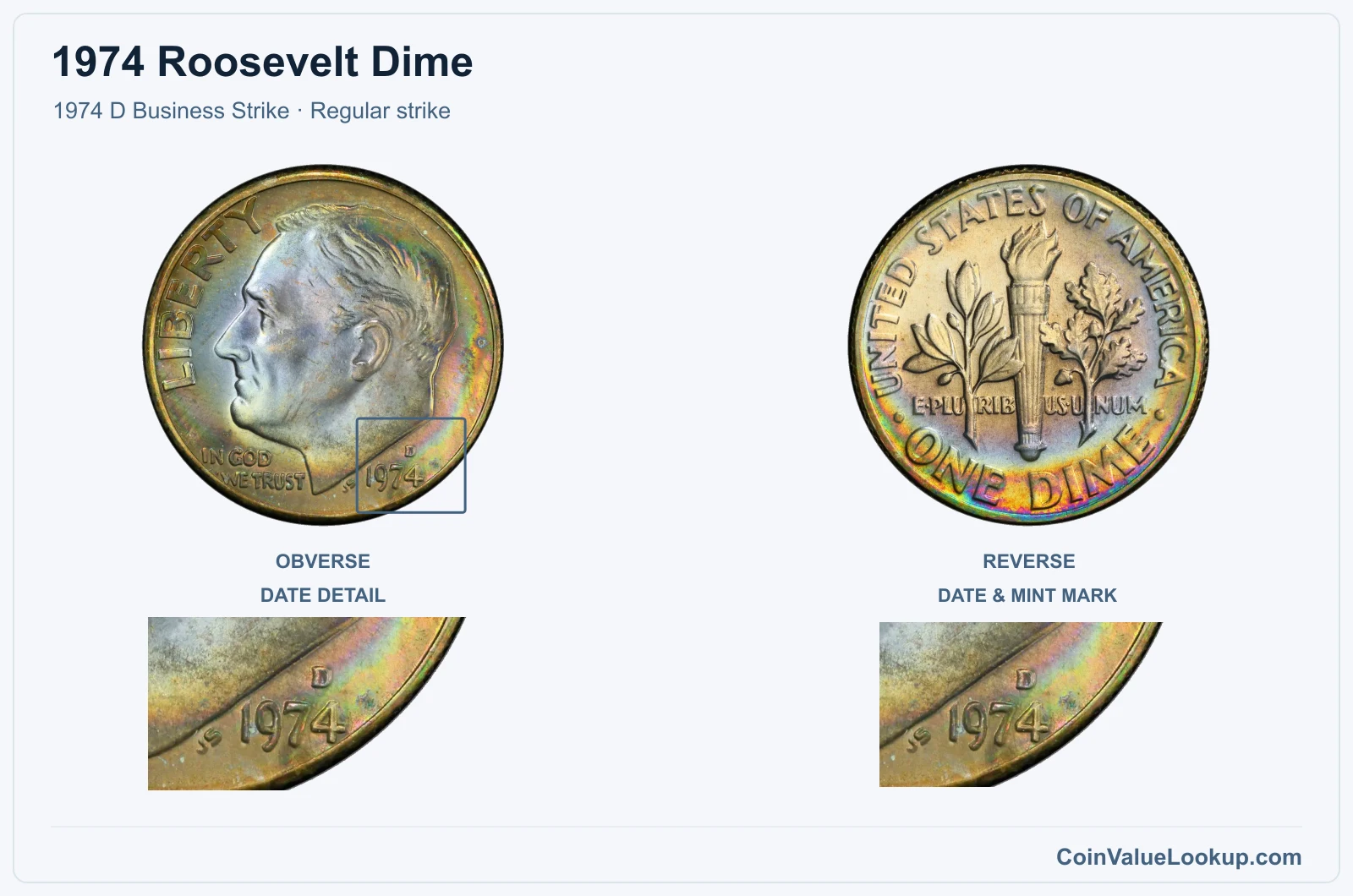
Denver's 1974-D is identified by the small "D" mintmark sitting on the obverse just above the date. Same clad composition, same weight, same design as the Philadelphia issue.
Circulated pieces are face-value coins. At MS 65, the USA Coin Book guide estimate is $2.79, identical to the no-mintmark version.
The interesting specimens are those with Full Bands designation or notable toning, but always compare coins of matching grade and finish before assuming a premium.
Range Grade
Price Auction Records Appraisal PO PO 1
—
Coin Identifier FR FR 2
—
Coin Identifier AG AG 3
—
Coin Identifier G G 4
—
Coin Identifier
G 6
—
Coin Identifier VG VG 8
—
Coin Identifier
VG 10
—
Coin Identifier F F 12
—
Coin Identifier
F 15
—
Coin Identifier VF VF 20
—
Coin Identifier
VF 25
—
Coin Identifier
VF 30
—
Coin Identifier
VF 35
—
Coin Identifier XF XF 40
—
Coin Identifier
XF 45
—
Coin Identifier AU AU 50
—
Coin Identifier
AU 53
—
Coin Identifier
AU 55
—
Coin Identifier
AU 58
Coin Identifier MS MS 60
—
Coin Identifier
MS 61
—
Coin Identifier
MS 62
—
Coin Identifier
MS 63
—
Coin Identifier
MS 64
Coin Identifier
MS 65
—
Coin Identifier
MS 66
Coin Identifier
MS 67
Coin Identifier
MS 68
—
Coin Identifier
MS 69
—
—
—
MS 70
—
—
—
1974 Roosevelt Dime — S Proof
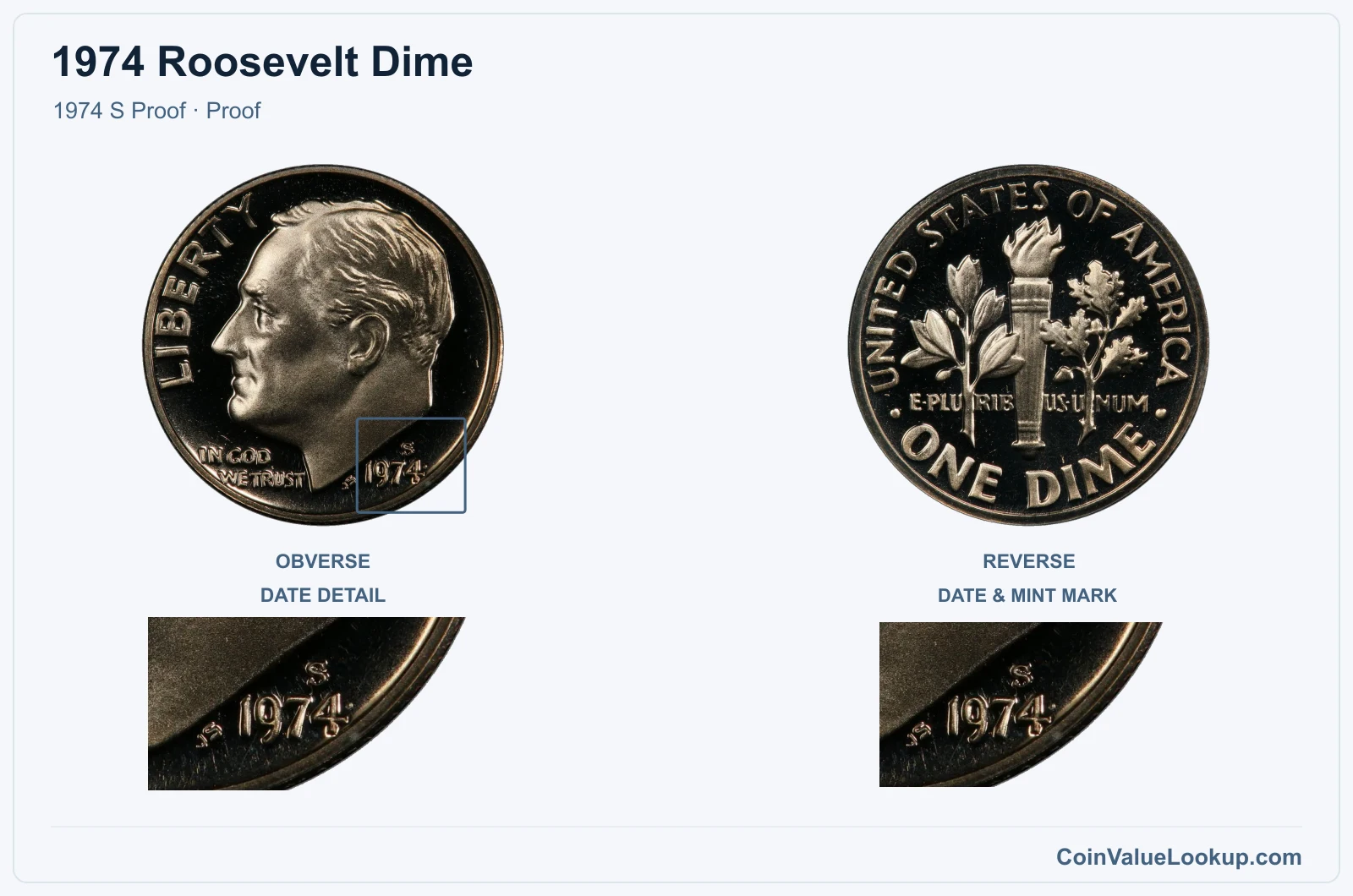
The 1974-S proof was produced at San Francisco exclusively for collector sets. It carries the "S" mintmark on the obverse above the date.
Like the business strikes, it is copper-nickel clad, not silver. There was no silver proof dime issued between 1969 and 1978.
A normal PR 65 is estimated around $2.50 according to USA Coin Book. Proofs with strong cameo contrast, where frosted devices stand against deeply mirrored fields, can be more desirable, but that contrast needs to be genuine and undisturbed.
Cleaned or hazed proof surfaces lose much of their appeal. Assess proof coins on their own scale rather than mixing them up with business-strike grades.
Range Grade
Price Auction Records Appraisal PR PR 1
—
Coin Identifier
PR 2
—
Coin Identifier
PR 3
—
Coin Identifier
PR 4
—
Coin Identifier
PR 6
—
Coin Identifier
PR 8
—
Coin Identifier
PR 10
—
Coin Identifier
PR 12
—
Coin Identifier
PR 15
—
Coin Identifier
PR 20
—
Coin Identifier
PR 25
—
Coin Identifier
PR 30
—
Coin Identifier
PR 35
—
Coin Identifier
PR 40
—
Coin Identifier
PR 45
—
Coin Identifier
PR 50
—
Coin Identifier
PR 53
—
Coin Identifier
PR 55
—
Coin Identifier
PR 58
—
Coin Identifier
PR 60
—
Coin Identifier
PR 61
—
Coin Identifier
PR 62
—
Coin Identifier
PR 63
—
Coin Identifier
PR 64
—
Coin Identifier
PR 65
—
Coin Identifier
PR 66
—
Coin Identifier
PR 67
—
Coin Identifier
PR 68
Coin Identifier
PR 69
Coin Identifier
PR 70
Coin Identifier
1974 Roosevelt Dime Error List
1. 1974 Roosevelt Dime — Off-Center Strike
A 1974-D off-center strike has been documented and sold through Heritage Auctions. The recorded specimen was graded ANACS MS 60 and brought $45 in January 2022.
It showed roughly 45 percent of the design shifted toward the 10 o'clock position, leaving a large blank crescent, while the date and D mintmark remained visible.
That last part is important. Off-center dimes that lose the date or mintmark are much harder to attribute and therefore less collectible.
Look for the telltale blank area with no design at all, not just a slightly uneven rim.
Do not confuse this with a misaligned die, which shifts the entire design slightly but still fills the planchet. Intentional post-mint cutting or filing can also fake the look.
Professional authentication is the safest path before assigning any premium.
2. 1974 Roosevelt Dime — Straight Clipped Planchet
A 1974 no-mintmark dime with a straight clipped planchet has been documented by NGC, graded MS 66. A straight clip happens when the blanking press cuts through an area of the metal strip that was already trimmed, producing a flat edge rather than a curved one.
On a genuine clip, you should see both endpoints of the straight edge and the Blakesley effect, a weak area of the rim roughly opposite the clip. The remaining design and date should be intact.
What to watch out for: post-mint saw cuts or someone grinding an edge flat on a bench grinder. Those leave tool marks and lack the characteristic flow disruption a genuine blanking error creates.
There is no adopted price range for this variety, so value depends on individual assessment of the error's severity, the coin's condition, and professional authentication.
3. 1974 Roosevelt Dime — Partial Brockage
Heritage Auctions has cataloged a 1974-D partial brockage, graded ANACS MS 60 Details with noted damage. A brockage occurs when a previously struck coin sticks in the die and impresses its design into the next blank.
The result is an incuse, mirror-image imprint overlapping part of the normal design.
Look for a raised-then-sunken duplicate image that reads backward compared to the surrounding design. The transition between normal strike and brockage impression should be organic, not sharp-edged.
Fakes exist. A vise job, where someone presses two coins together outside the mint, can mimic the look, but vise jobs typically show less metal flow and more surface damage.
Ordinary strike weakness is another lookalike that lacks the reversed detail. No specific price range is adopted here; each brockage is valued by its coverage, clarity and authenticated condition.
4. 1974 Roosevelt Dime — Doubled Die Obverse
A doubled die obverse variety has been reported for the 1974 dime. On a genuine DDO, you will see consistent doubling on obverse lettering or design elements, showing as separation, notching, or a secondary image that repeats in the same direction across multiple letters or features.
Grab a loupe and compare your coin's obverse inscriptions to a known normal 1974 dime under the same lighting. True hub doubling is uniform and directional.
Machine doubling, by contrast, tends to produce flat, shelf-like distortions without the rounded secondary image.
Reflections under certain lighting can also trick the eye. No numerical price is adopted for this variety.
Value depends on the specific doubled die, how visible the doubling is, and the coin's overall condition, all confirmed through professional authentication.
5. 1974 Roosevelt Dime — Double / Multiple Strike
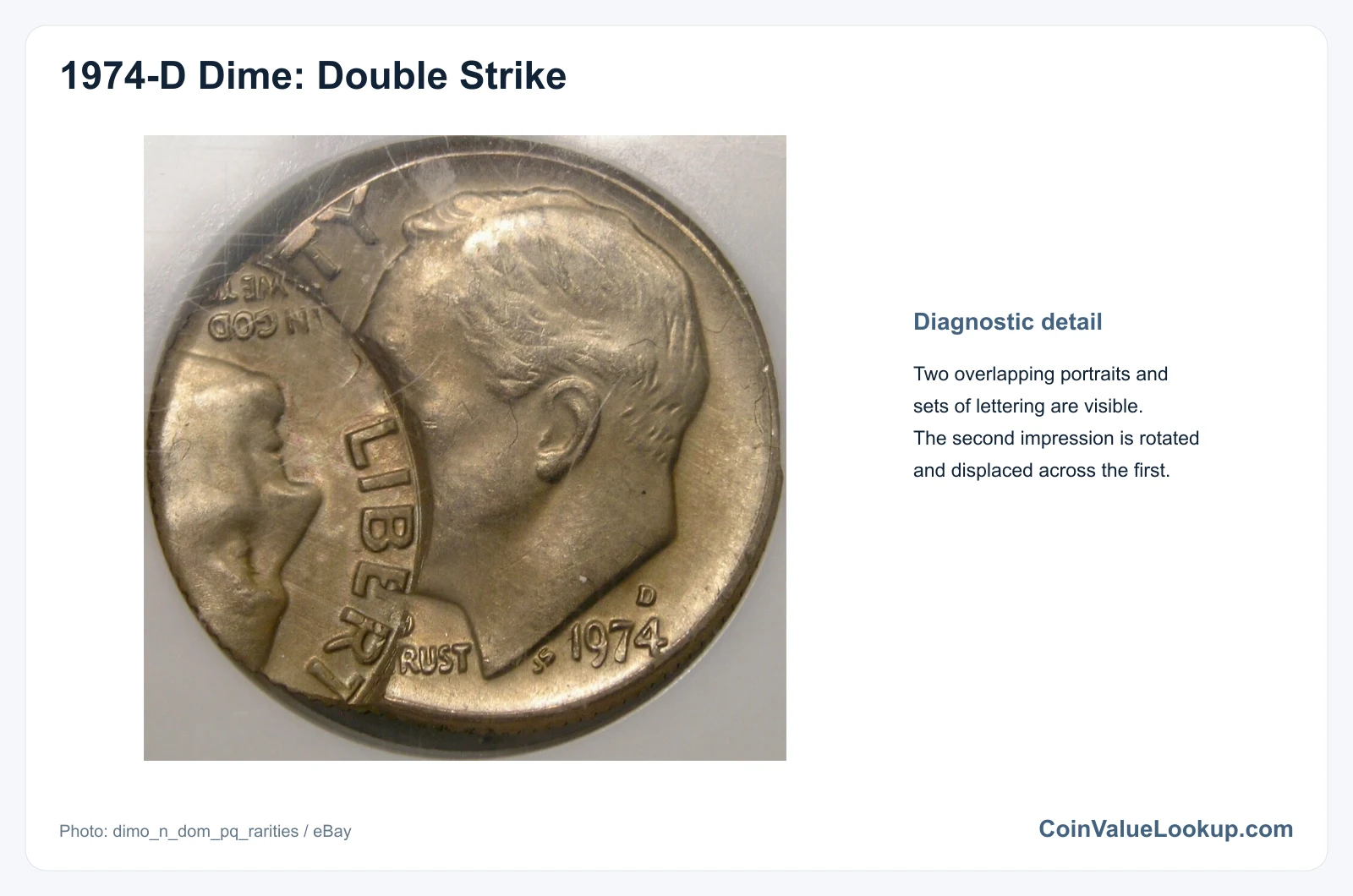
A multiple-strike error has been reported for the 1974 dime. This means the coin received more than one impression from the dies, producing overlapping or displaced design images.
On a genuine example, you will see two or more distinct impressions of the design that may be rotated or shifted relative to each other.
The key diagnostic is separate, recognizable design impressions occupying different positions on the planchet. This is different from a doubled die, which shows doubling within a single impression caused by the hub.
Post-mint damage or vise impressions can create misleading overlapping designs, but they lack the metal flow and strike characteristics of an in-mint multiple strike. No numerical price range is adopted for this category.
Value depends on the number of strikes, their displacement, and authenticated condition.
6. 1974 Roosevelt Dime — Wrong Planchet / Off-Metal Strike
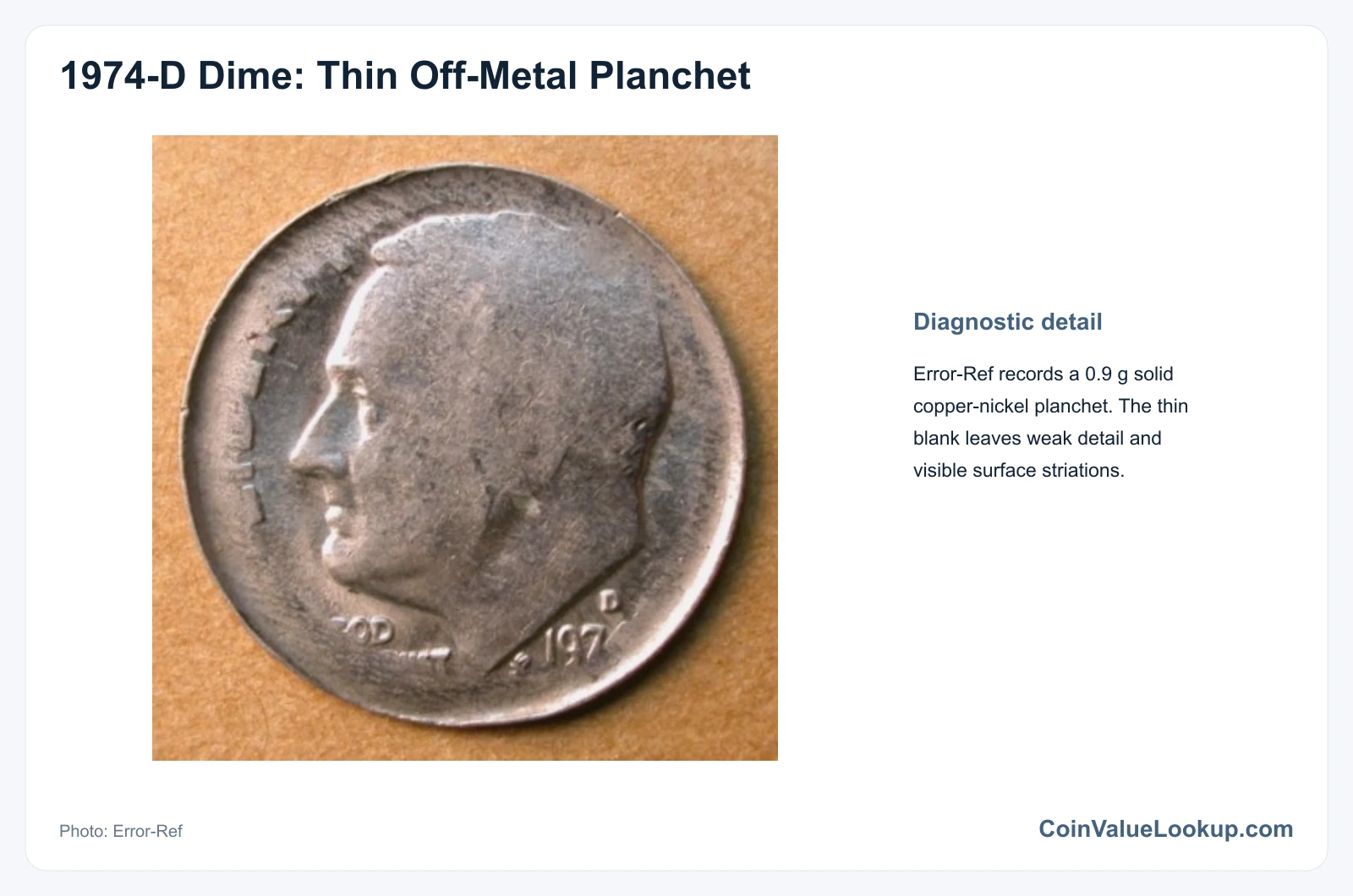
A wrong planchet error has been reported for the 1974 dime, meaning a dime die struck a blank intended for a different denomination or composition. The result is a coin that looks like a dime but feels wrong in hand.
To check, weigh your coin carefully and measure its diameter. A normal 1974 dime should be about 2.27 grams and roughly 17.9 mm across.
If your numbers differ significantly, examine the edge. A wrong-planchet strike may show an incomplete design because the blank was the wrong size for the die.
Lookalikes include coins that have been plated, corroded, acid-treated or deliberately altered to appear unusual. Environmental damage can change a coin's color and apparent weight.
No numerical price is adopted for this category, so value depends entirely on professional authentication confirming the blank's identity, plus the coin's condition and completeness of the design.