1904 Barber Dime Coin Value: How Much Is It Worth?
The 1904 Barber Dime was struck at two mints — Philadelphia and San Francisco — with no New Orleans or Denver issues this year. Guide estimates for ordinary business strikes range from about $12.26 at G4 up to $1,939 at MS63, depending on the mint.
Proofs were produced at Philadelphia only. Silver content alone gives every genuine piece a baseline, but condition and mint drive most of the premium.
Fast Way to Identify Your 1904 Barber Dime
The quickest way to start figuring out what your 1904 Barber Dime might be worth is to upload clear photos of the front and back. Our identifier can offer a preliminary read on the mint, version, and general condition from those images.
Grab a well-lit shot of each side and let the tool do the first pass for you.
1904 Barber Dime Value
Upload both sides of your 1904 Barber Dime.
Front Obverse
Upload photo
Back Reverse
Upload photo
Which 1904 Barber Dime Versions Are Worth Money?
- The 1904-S (San Francisco) in higher grades commands the strongest ordinary premium, with a guide estimate around $1,939 at MS63 versus $253 for a Philadelphia MS63.
- Philadelphia proof strikes carry their own collector market, with a guide estimate near $616 at PR63.
- A well-preserved no-mintmark Philadelphia piece in Mint State still holds solid value compared to the typical circulated survivor.
- Check for the recognized error categories below — clashed dies, repunched dates, and struck-through errors have been reported for this date and can add a premium depending on visibility and condition.
Step 1: Identify Your 1904 Barber Dime Mint Mark and Version
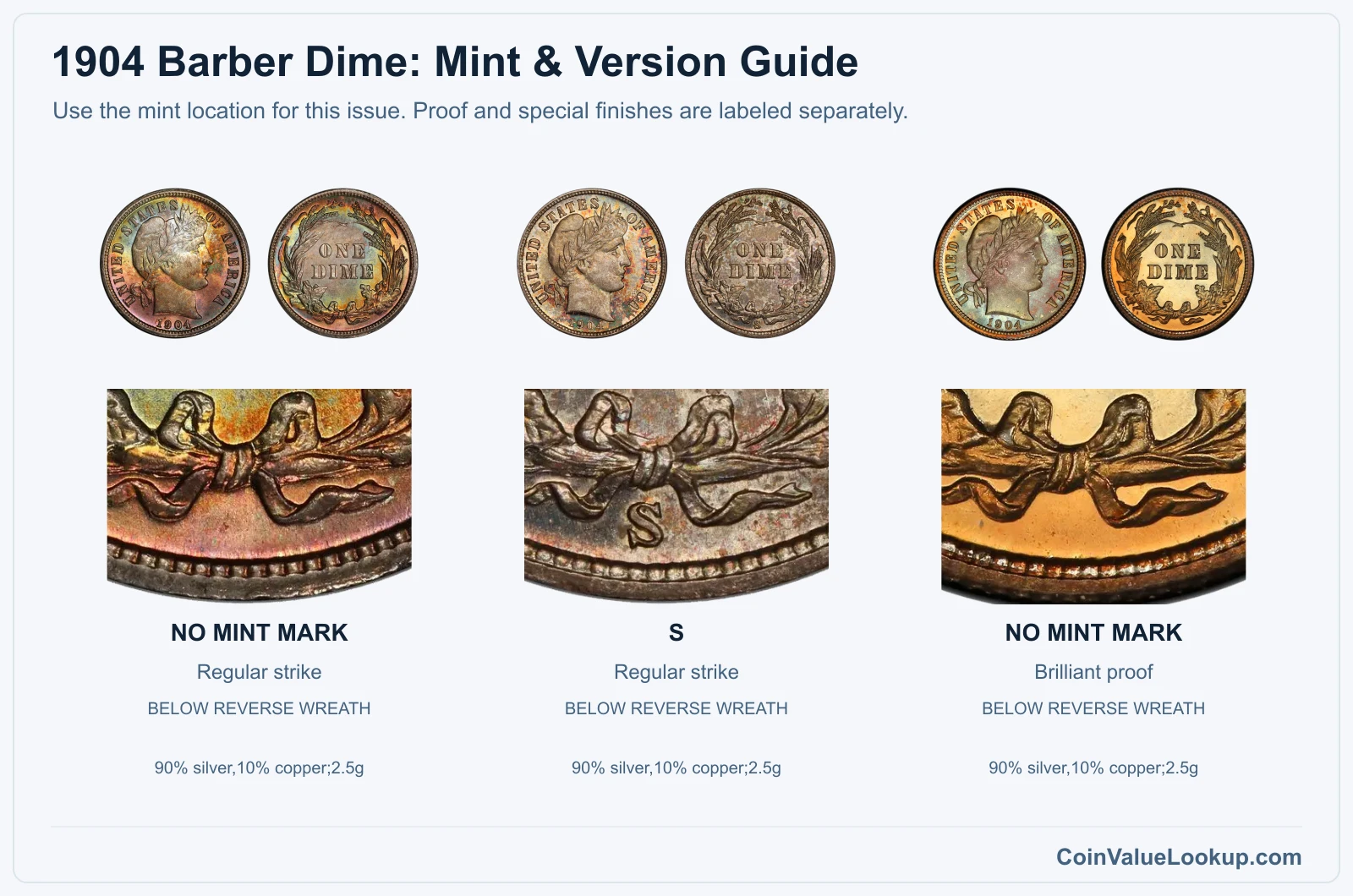
The 1904 Barber Dime shows Liberty facing right on the obverse, wearing a cap and laurel wreath. The reverse reads ONE DIME inside a cereal wreath tied with a ribbon bow at the bottom.
Only two mints produced dimes this year: Philadelphia and San Francisco. There is no New Orleans or Denver issue for 1904, so if someone offers you one, walk away.
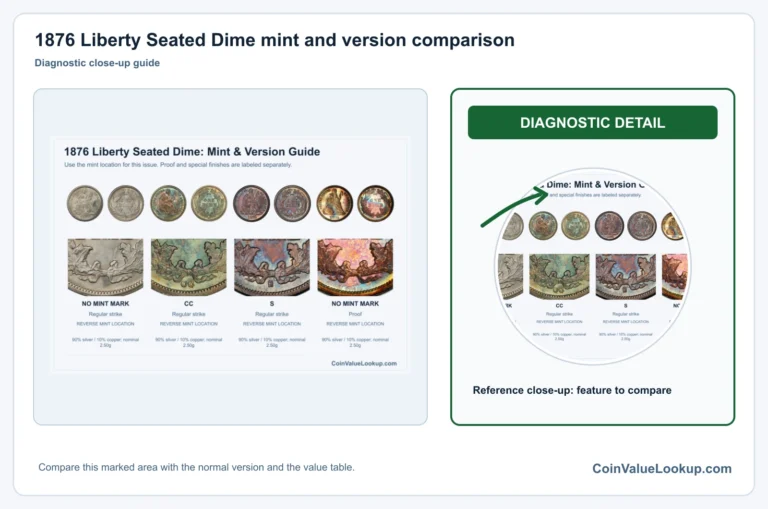
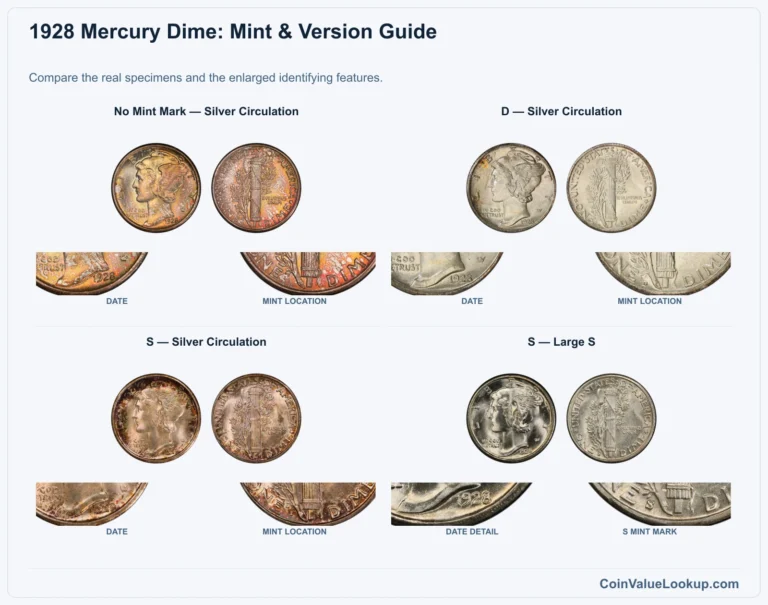
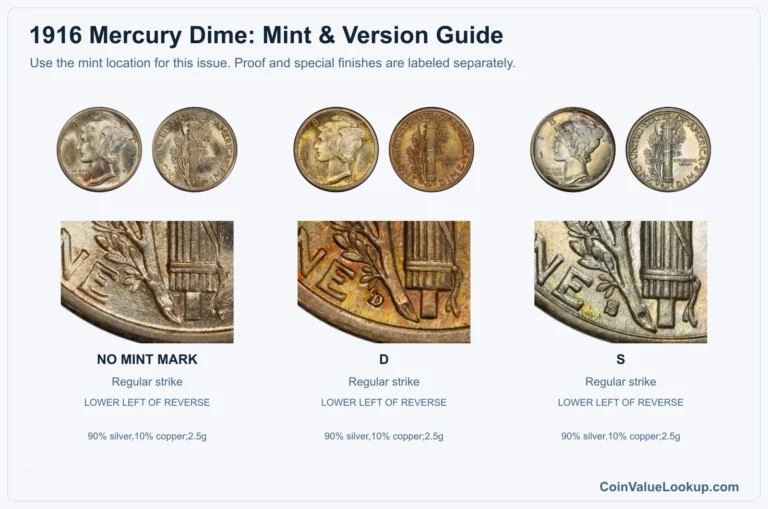
The mintmark — a small "S" for San Francisco — sits on the reverse, just below the wreath bow. No mintmark means Philadelphia.
You may need magnification; a century of wear can make that tiny letter hard to spot.
All standard 1904 Barber Dimes are 90% silver and 10% copper, weigh 2.5 grams, measure 17.9 mm across, and have a reeded edge. A weak strike from worn dies is not automatically a valuable error — it is just a tired die doing its job.
Step 2: Check Your 1904 Barber Dime Grade
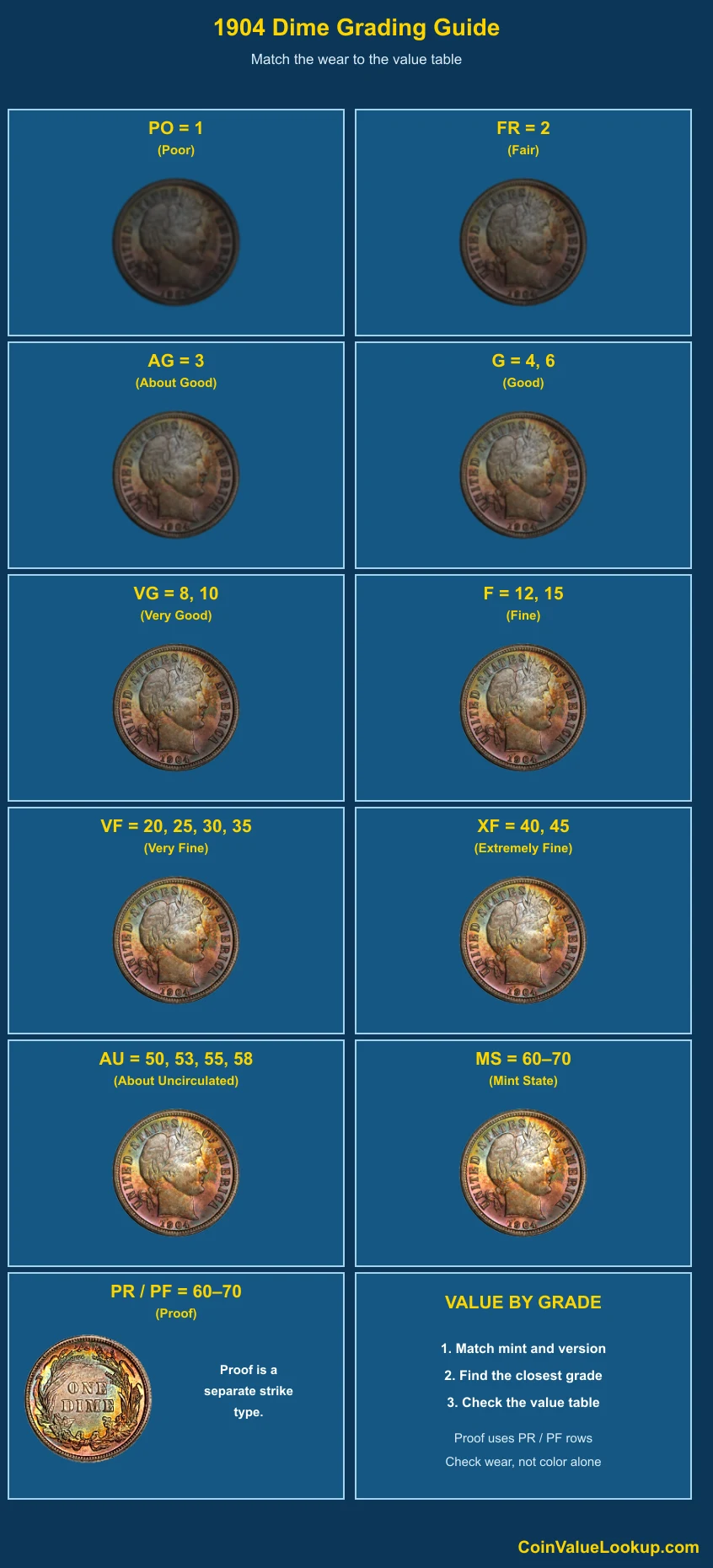
When grading your 1904 Barber Dime, look at the LIBERTY inscription on the headband first. On a well-worn coin (around Good-4), most or all letters will be gone; at Very Fine you should see a full, sharp LIBERTY.
Don't stop at the headband, though. Check the hair detail above Liberty's ear, the smoothness of her cheek, and the sharpness of the wreath leaves on the reverse.
Use all of these together to judge actual wear rather than fixating on a single feature.
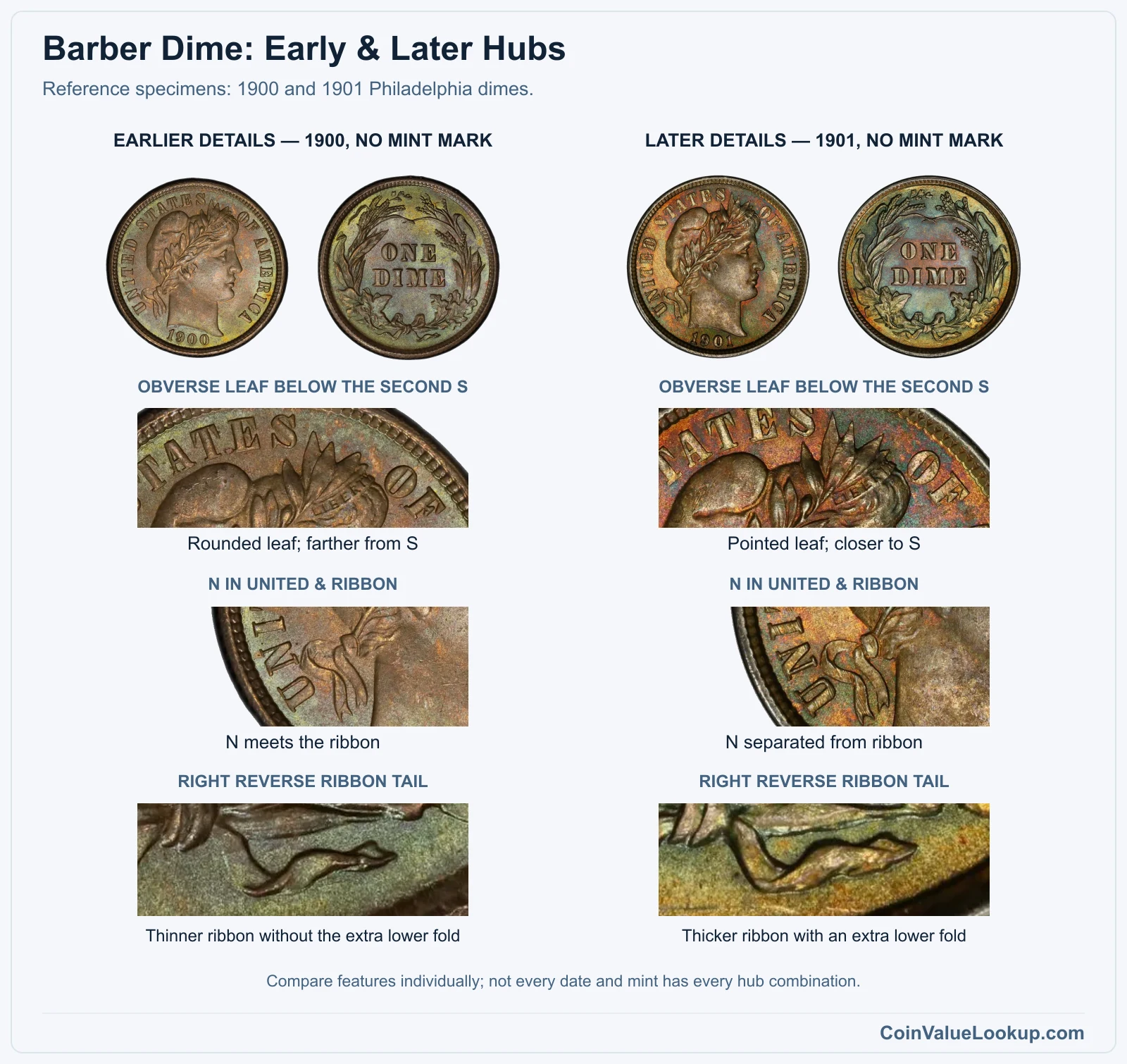
The comparison image can help you match your coin's wear pattern to a known grade. Look at the highest points of the design — they lose detail first.
Mint State requires unbroken, original luster across the entire surface. Hairlines from cleaning or cabinet friction will drop the grade even if the design looks sharp.
A proof is a special manufacturing finish with mirrored fields, not simply a grade above Mint State.
Step 3: Check 1904 Barber Dime Value by Mint and Version
1904 Barber Dime — No Mint Mark — Silver Circulation
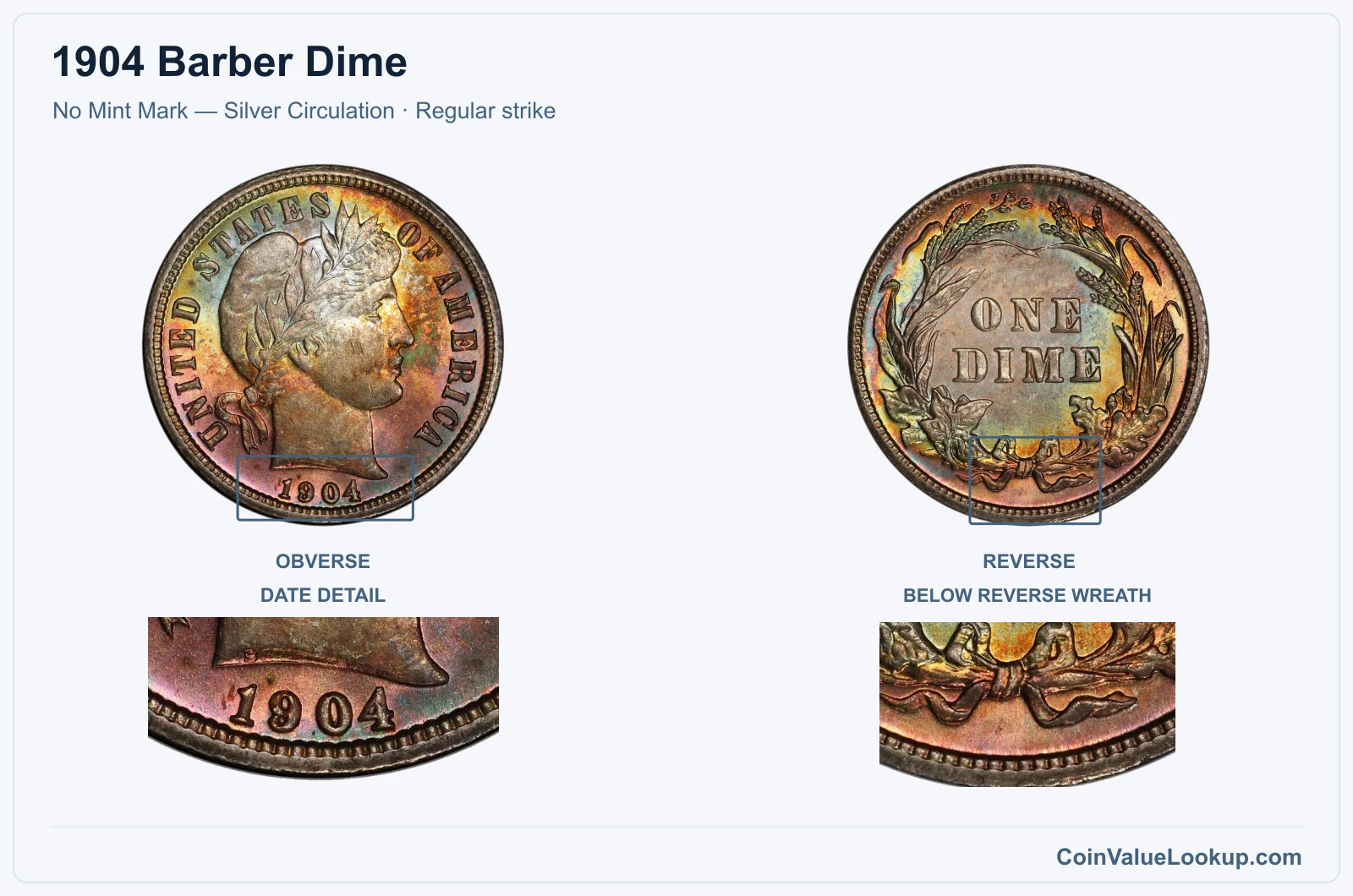
The Philadelphia issue carries no mintmark and is the more common of the two business-strike mints for 1904. Guide estimates place it at roughly $12.26 in G4 and around $253 in MS63.
Most survivors you will encounter are well-circulated, so a piece with full LIBERTY and original luster stands out.
Look below the reverse wreath bow — if you see nothing there, you have the Philadelphia coin. Confirm the date is clear and the reeded edge is intact.
A weak lip or soft detail from tired dies does not make it a rare variety; it just means the die was getting old.
Range Grade
Price Auction Records Appraisal PO PO 1
—
Coin Identifier FR FR 2
—
Coin Identifier AG AG 3
—
Coin Identifier G G 4
—
Coin Identifier
G 6
—
Coin Identifier VG VG 8
—
Coin Identifier
VG 10
—
Coin Identifier F F 12
—
Coin Identifier
F 15
—
Coin Identifier VF VF 20
Coin Identifier
VF 25
—
Coin Identifier
VF 30
—
Coin Identifier
VF 35
—
Coin Identifier XF XF 40
—
Coin Identifier
XF 45
Coin Identifier AU AU 50
—
Coin Identifier
AU 53
—
Coin Identifier
AU 55
Coin Identifier
AU 58
Coin Identifier MS MS 60
—
Coin Identifier
MS 61
Coin Identifier
MS 62
Coin Identifier
MS 63
Coin Identifier
MS 64
Coin Identifier
MS 65
Coin Identifier
MS 66
Coin Identifier
MS 67
Coin Identifier
MS 68
—
—
—
MS 69
—
—
—
MS 70
—
—
—
1904 Barber Dime — S — Silver Circulation
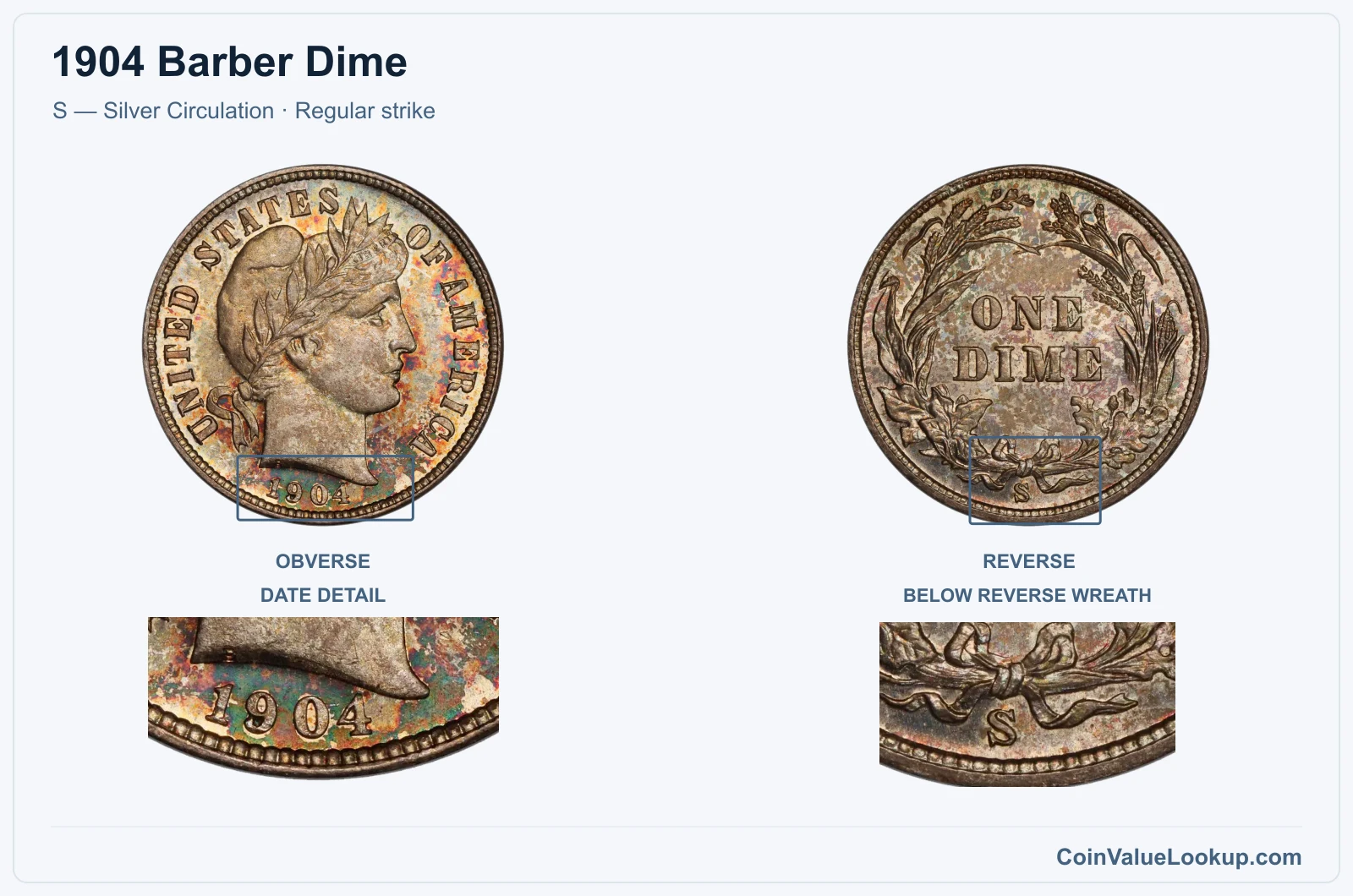
San Francisco struck 1904 dimes with an "S" mintmark below the wreath bow on the reverse. This is the scarcer business-strike issue for the year, and the price gap shows it: guide estimates run from about $60 at G4 to roughly $1,939 at MS63.
That jump means condition matters enormously. A worn 1904-S is worth checking, but an unworn example with original surfaces is where the real premium lives.
Make sure the S mintmark is genuine and not tooled — look for consistent metal flow around the letter. If you can find one of these in Mint State with clean surfaces, you are holding a genuinely desirable coin.
Coin Value Lookup is a good starting point if you want to compare this dime against other Barber dates and mints before making any decisions.
Range Grade
Price Auction Records Appraisal PO PO 1
—
Coin Identifier FR FR 2
—
Coin Identifier AG AG 3
—
Coin Identifier G G 4
—
Coin Identifier
G 6
Coin Identifier VG VG 8
Coin Identifier
VG 10
Coin Identifier F F 12
Coin Identifier
F 15
Coin Identifier VF VF 20
Coin Identifier
VF 25
Coin Identifier
VF 30
Coin Identifier
VF 35
Coin Identifier XF XF 40
Coin Identifier
XF 45
Coin Identifier AU AU 50
Coin Identifier
AU 53
Coin Identifier
AU 55
Coin Identifier
AU 58
Coin Identifier MS MS 60
Coin Identifier
MS 61
Coin Identifier
MS 62
Coin Identifier
MS 63
Coin Identifier
MS 64
Coin Identifier
MS 65
Coin Identifier
MS 66
Coin Identifier
MS 67
—
Coin Identifier
MS 68
—
—
—
MS 69
—
—
—
MS 70
—
—
—
1904 Barber Dime — No Mint Mark — Brilliant Silver Proof
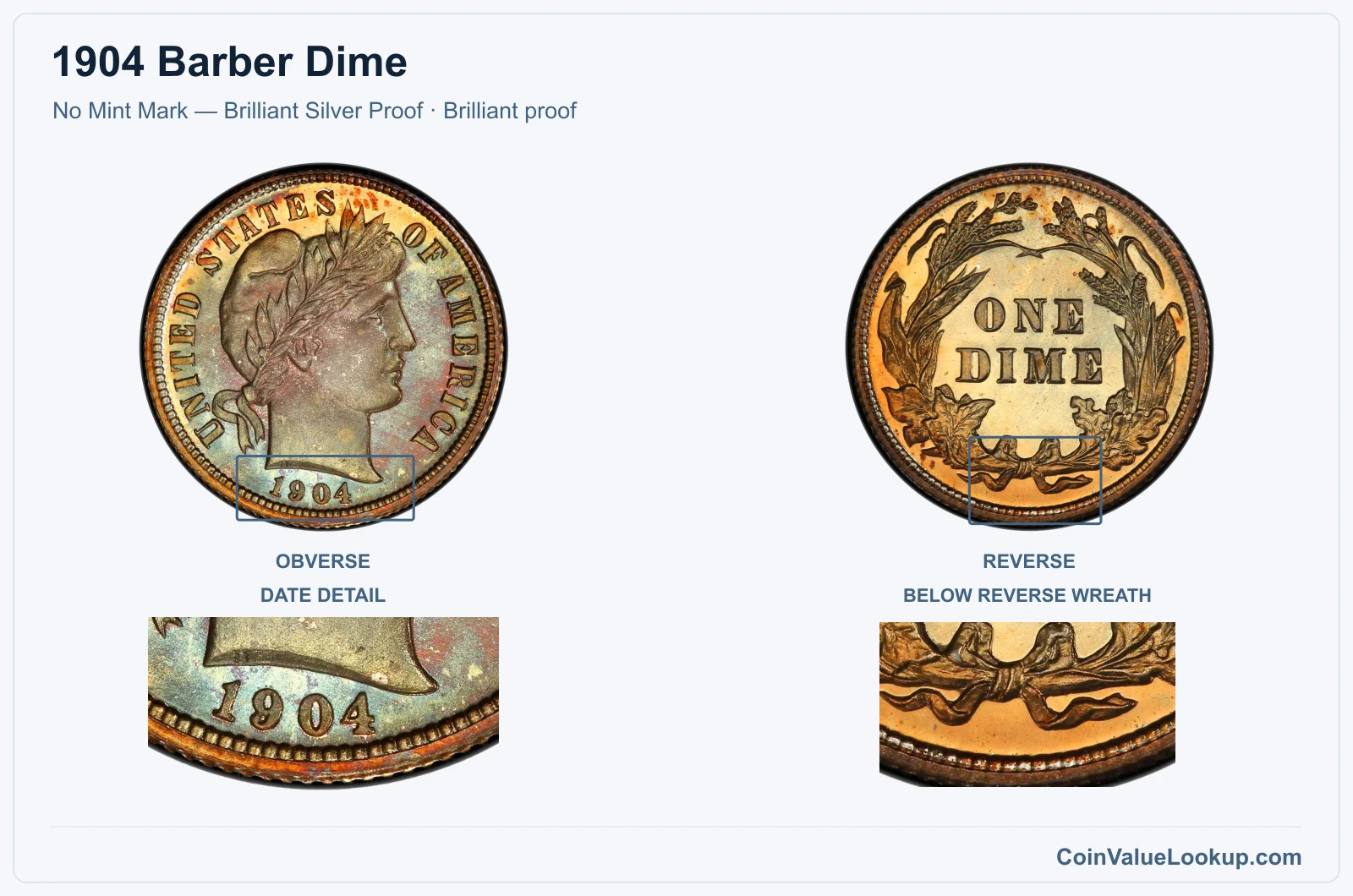
Philadelphia produced brilliant proof Barber Dimes for collectors, and the 1904 is part of that run. These coins show deeply mirrored fields and sharply struck rims that business strikes simply cannot match.
A guide estimate puts the PR63 around $616.
Cameo and Deep Cameo designations reflect contrast between frosted devices and mirrored fields — they are not the same as a basic PR63, and pricing differs accordingly. Do not assume a bright proof automatically qualifies for a contrast designation.
Look for the telltale mirror finish and crisp, squared-off edges that separate a genuine proof from a high-grade business strike.
Range Grade
Price Auction Records Appraisal PR PR 1
—
Coin Identifier
PR 2
—
Coin Identifier
PR 3
—
Coin Identifier
PR 4
—
Coin Identifier
PR 6
—
Coin Identifier
PR 8
—
Coin Identifier
PR 10
—
Coin Identifier
PR 12
—
Coin Identifier
PR 15
—
Coin Identifier
PR 20
—
Coin Identifier
PR 25
—
Coin Identifier
PR 30
—
Coin Identifier
PR 35
—
Coin Identifier
PR 40
—
Coin Identifier
PR 45
—
Coin Identifier
PR 50
—
Coin Identifier
PR 53
—
Coin Identifier
PR 55
—
Coin Identifier
PR 58
—
Coin Identifier
PR 60
Coin Identifier
PR 61
Coin Identifier
PR 62
Coin Identifier
PR 63
Coin Identifier
PR 64
Coin Identifier
PR 65
Coin Identifier
PR 66
Coin Identifier
PR 67
Coin Identifier
PR 68
Coin Identifier
PR 69
—
—
—
PR 70
—
—
—
1904 Barber Dime Error List
1. 1904 Barber Dime — Clashed Dies
A die clash happens when the obverse and reverse dies strike each other without a planchet between them. The result is faint, ghostly traces of the opposite design transferred onto each die, which then show up on subsequent coins as raised impressions in the wrong places.
On a 1904 Barber Dime, look for partial outlines of the wreath appearing on Liberty's cheek or neck area, or traces of Liberty's profile showing up inside the wreath on the reverse. These impressions should align with where the opposing design would logically contact the die face.
Do not confuse random scratches, contact marks, or raised lines from damage with a genuine clash. Real clash marks follow the geometry of the opposing die.
The value of a clashed-die example depends on how visible and dramatic the transferred design is, along with the coin's overall condition.
2. 1904 Barber Dime — Repunched Date
A repunched date occurs when the date numerals were punched into the working die more than once, with a slight shift between impressions. On a 1904 dime, you would see faint remnants of one or more digits — often the 9 or 4 — slightly offset from the final position.
This is different from machine doubling, which produces flat, shelf-like doubling across the entire design rather than isolated to the date area. It is also different from a damaged or worn date, where metal loss creates the illusion of extra lines.
Use magnification and look for clear secondary impressions that show the shape of an actual numeral sitting beside or beneath the primary strike. The value depends on how distinct the repunching is and the coin's overall grade — subtle examples are less desirable than bold, obvious ones.
3. 1904 Barber Dime — Struck-Through Error
A struck-through error happens when foreign material — grease, a fragment of metal, thread, or debris — gets trapped between the die and the planchet during striking. The result is a localized depression or incomplete area in the design where the obstruction blocked the die's impression.
On a 1904 Barber Dime, look for a distinct, sharply bounded area of missing or depressed detail that does not match normal wear patterns. Grease-filled dies tend to produce smooth, rounded areas of missing detail, while a retained foreign object may leave a visible impression or texture in the affected zone.
Do not confuse ordinary wear, cleaning damage, or a weakly struck area with a struck-through. Genuine examples show a clear interruption in the design that does not extend uniformly across the coin.
Value depends on the size, location, and visibility of the obstruction mark, plus the coin's condition.