1794 Flowing Hair Half Dollar Coin Value: How Much Is It Worth?
The 1794 Flowing Hair Half Dollar is one of the earliest coins struck by the United States Mint, and even heavily worn examples carry serious value. A USA Coin Book guide estimate places a G4 example around $4,262, climbing to roughly $86,986 at AU50.
Collector demand far exceeds both face value and silver content, and special varieties or higher grades can push prices well beyond those anchors.
Fast Way to Identify Your 1794 Flowing Hair Half Dollar
Upload clear photos of both the front and back of your coin, and if possible, the edge. The identifier can offer a preliminary identification based on those images, helping you confirm the date, denomination, and general type.
This is not a substitute for professional authentication, but it is a solid starting point.
1794 Flowing Hair Half Dollar Value
Upload both sides of your 1794 Flowing Hair Half Dollar.
Front Obverse
Upload photo
Back Reverse
Upload photo
Which 1794 Flowing Hair Half Dollar Versions Are Worth Money?
- Philadelphia Flowing Hair — the sole version for 1794 — carries guide estimates from about $4,262 at G4 to roughly $86,986 at AU50, making even low-grade genuine survivors worth careful inspection.
- Coins with original, problem-free surfaces command stronger prices than cleaned or damaged examples at the same apparent wear level; confirming genuine surfaces and a clear date is the first priority.
Step 1: Identify Your 1794 Flowing Hair Half Dollar Mint Mark and Version
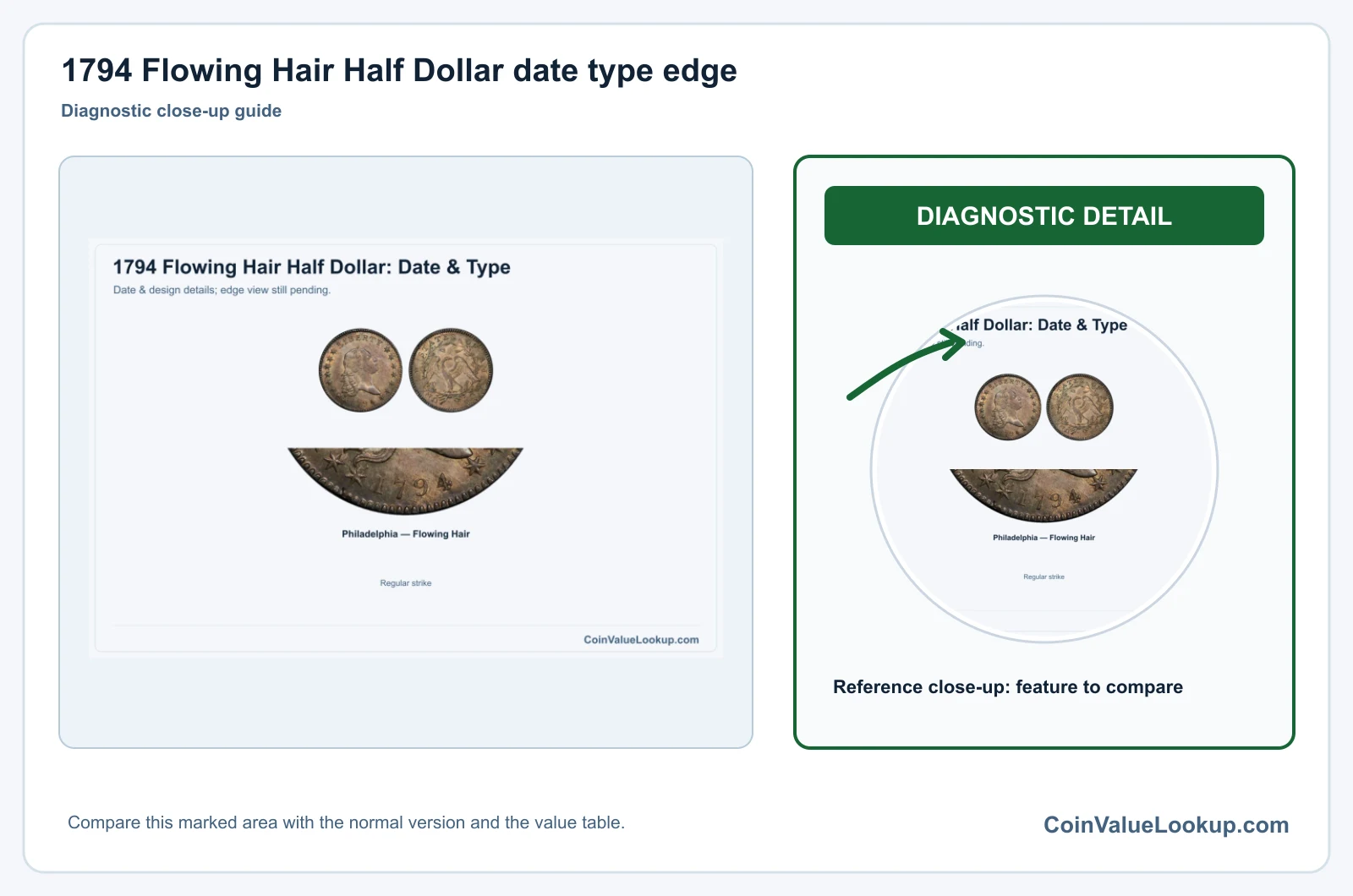
Every 1794 Half Dollar was struck at the Philadelphia Mint, so the absence of a mintmark is completely normal. There is no D, S, or O branch to hunt for.
Confirm the date reads 1794 and that both sides match the Flowing Hair design: Liberty with flowing hair on the obverse and a small eagle within a wreath on the reverse.
The edge is a critical checkpoint. Genuine pieces carry the lettered inscription FIFTY CENTS OR HALF A DOLLAR with small ornaments between the words.
If the edge is reeded or blank, you have a different coin or a problem.
Nominal specifications are roughly 32.5 mm in diameter and about 13.48 g in weight. Weight is a useful screening tool, but it alone does not authenticate the coin.
The expected composition is a silver-copper alloy at approximately 89% silver under the early federal standard.
The only major identity for this date is the Philadelphia Flowing Hair type. Individual die pairings exist and matter to specialists, but for a beginner the key task is confirming the coin is genuine and noting its overall condition.
Step 2: Check Your 1794 Flowing Hair Half Dollar Grade
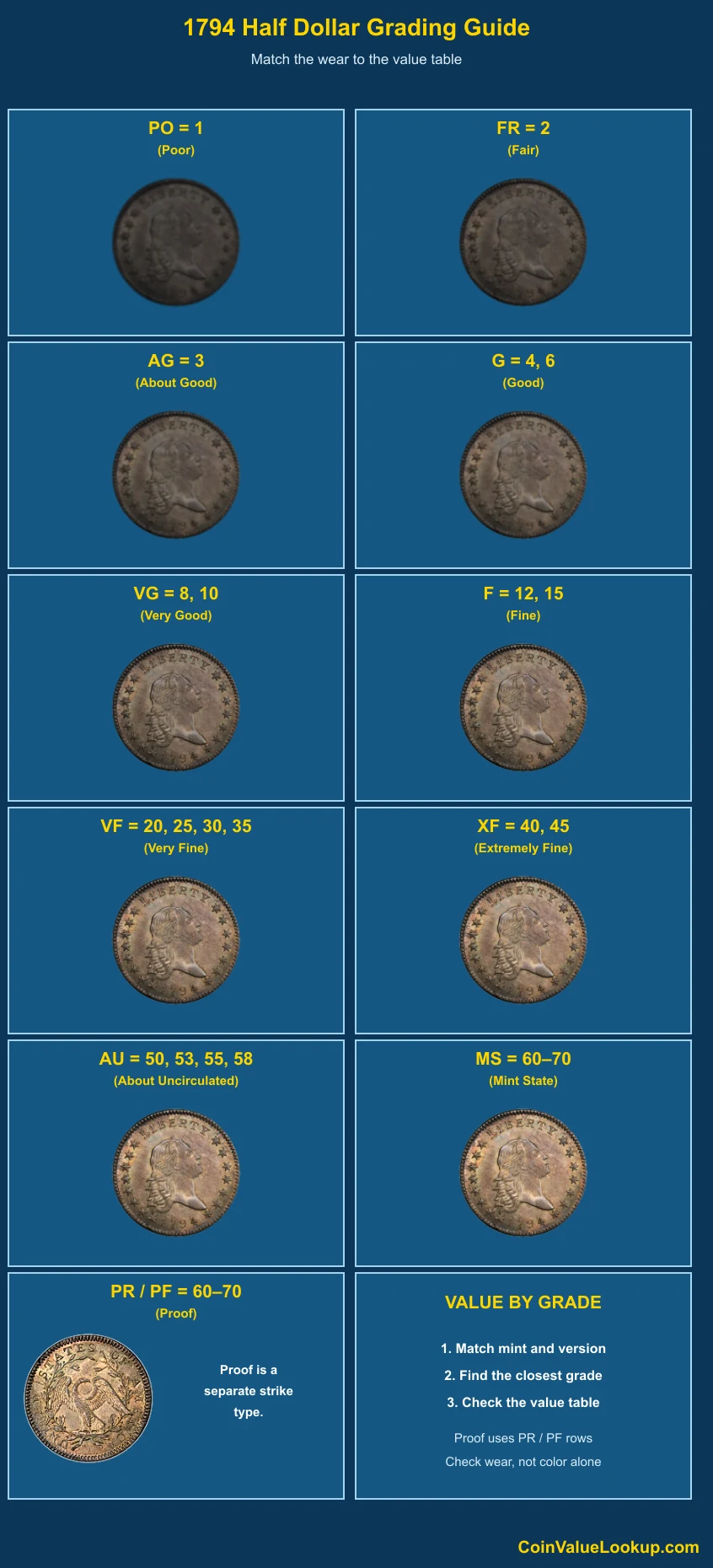
Start with Liberty's hair above the forehead. On a well-circulated piece, those strands merge into a flat mass.
A coin in the VF range still shows individual locks, though some softness is expected.
Check the cheek and the shoulder or drapery area next. These are high points that lose detail first.
Compare your coin to a same-type reference image, not a modern Kennedy Half Dollar, because the strike characteristics are completely different.
On the reverse, examine the eagle's breast feathers and wing detail. Some 1794 halves left the press with incomplete strikes in those areas, so not every soft spot means heavy wear.
Try to distinguish actual friction and lost luster from areas the dies simply did not fully impress.
Finally, look hard for cleaning, holes, plugs, tooling, and deep scratches. A coin with these problems typically receives a "Details" grade from major grading services and does not follow the straight-grade price curve.
That distinction matters a lot at these price levels.
Step 3: Check 1794 Flowing Hair Half Dollar Value by Mint and Version
1794 Flowing Hair Half Dollar — Philadelphia — Flowing Hair
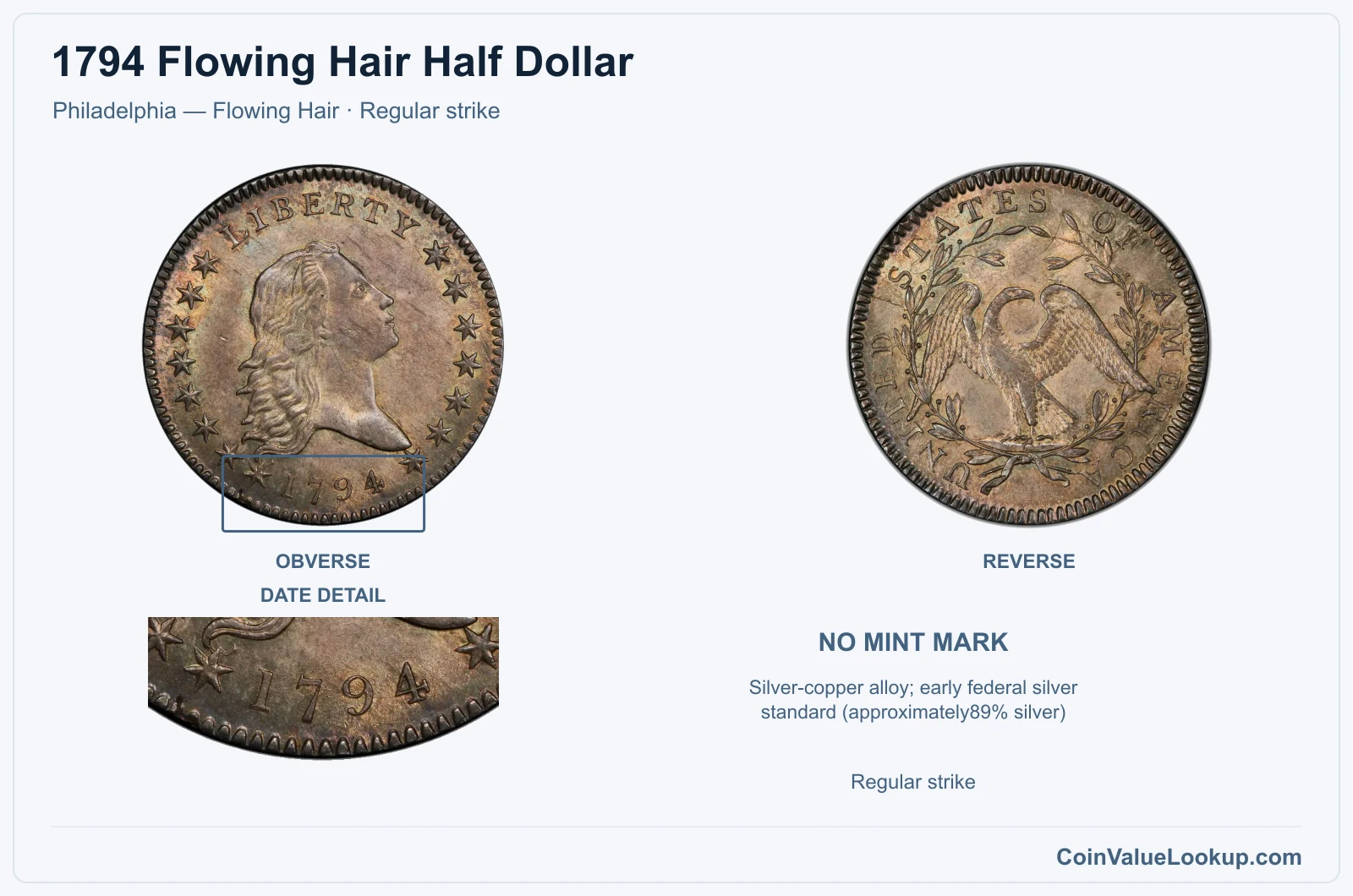
The 1794 Philadelphia Flowing Hair Half Dollar is the only version for this date. It was struck in a silver-copper alloy of approximately 89% silver, carries no mintmark, and features the small-eagle reverse paired with the Flowing Hair obverse.
USA Coin Book guide estimates place a G4 around $4,262, a VF20 near $14,894, and an AU50 near $86,986. Even a well-worn example with a readable date holds substantial value because this is a first-year type from the earliest days of U.S. coinage.
Coin Value Lookup is a good place to start when you want to look up guides for other early U.S. coins alongside this one. Individual die marriages exist for 1794 and attract specialists, but they are not separate beginner-level mint versions.
Focus on confirming the coin is genuine, checking for problems, and assessing overall wear before worrying about die varieties.
Range Grade
Price Auction Records Appraisal PO PO 1
—
Coin Identifier FR FR 2
Coin Identifier AG AG 3
Coin Identifier G G 4
Coin Identifier
G 6
Coin Identifier VG VG 8
Coin Identifier
VG 10
Coin Identifier F F 12
Coin Identifier
F 15
Coin Identifier VF VF 20
Coin Identifier
VF 25
Coin Identifier
VF 30
Coin Identifier
VF 35
Coin Identifier XF XF 40
Coin Identifier
XF 45
Coin Identifier AU AU 50
Coin Identifier
AU 53
Coin Identifier
AU 55
Coin Identifier
AU 58
Coin Identifier MS MS 60
—
Coin Identifier
MS 61
Coin Identifier
MS 62
—
Coin Identifier
MS 63
—
Coin Identifier
MS 64
—
Coin Identifier
MS 65
—
—
—
MS 66
—
—
—
MS 67
—
—
—
MS 68
—
—
—
MS 69
—
—
—
MS 70
—
—
—
1794 Flowing Hair Half Dollar Error List
1. 1794 Flowing Hair Half Dollar — Die Break / Cud
A cud is a raised, featureless blob connected to the rim, caused when a piece of the die breaks away entirely. On the 1794 Half Dollar, the documented example appears above the letters ER in AMERICA on the reverse, forming a rim-connected lump of extra metal.
Look carefully at the rim in that area. A true cud will be raised and shapeless, blending into the rim without any design detail.
It is not the same as a rim dent or bump from post-mint damage, which usually shows displaced metal going inward. Corrosion buildup and interior die chips can also mimic a cud at first glance, but neither will have that characteristic flat, raised connection to the rim.
No specific price premium has been established here. The value of any cud depends on its size, visibility, and the overall condition of the coin, so individual assessment is necessary.
2. 1794 Flowing Hair Half Dollar — Die Crack / Die Chip
Die cracks appear as thin, raised lines on the coin's surface, caused by fractures spreading through the steel die during use. On a documented late-state 1794 Half Dollar, a raised fracture crosses the portrait from the area near the left stars toward the right stars, running across Liberty's face or hair.
To spot it, examine the obverse under good light and mild magnification. The line will be raised, not incised.
That is the key distinction from a scratch, which cuts into the surface. Corrosion trails and foreign material stuck to the surface can also create linear marks, but they lack the sharp, consistent relief of a genuine die crack.
No numerical price premium is adopted for this category. The crack's length, prominence, and the coin's overall grade all influence any additional collector interest, so each piece needs to be evaluated on its own merits.
3. 1794 Flowing Hair Half Dollar — Overlapping Edge Lettering
The 1794 Half Dollar received its edge lettering from a separate device before the obverse and reverse were struck. Occasionally the blank shifted during this process, resulting in overlapping edge ornaments and partially doubled lettering.
The reported 1794 example shows this slippage clearly along the edge.
To check, roll the coin slowly along its edge under magnification. Normal pieces show evenly spaced words and ornaments with consistent depth.
On an overlapping example, you will see letters or star-shaped ornaments crowding into each other or appearing twice at slightly different positions.
Do not confuse this with ordinary edge wear that softens lettering, a visible seam on a cast counterfeit, or post-mint edge damage from a coin being dropped or squeezed. Genuine overlapping lettering is uniform in character and follows the curvature of the edge naturally.
No specific price data is available for this variety. Condition, the degree of overlap, and overall desirability all factor into any premium, making individual evaluation essential.