1825 Capped Bust Half Dollar Coin Value: How Much Is It Worth?
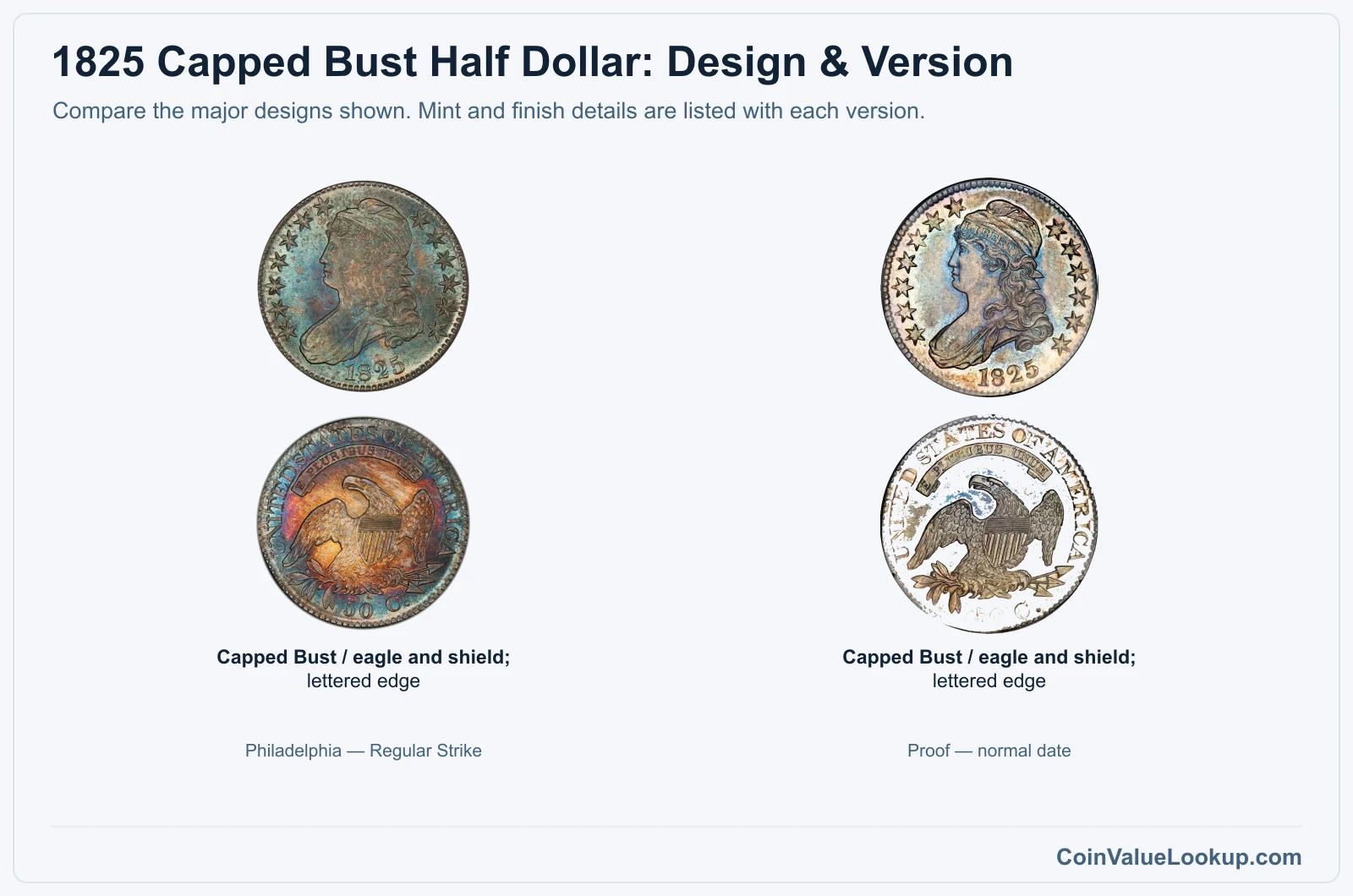
A regular-strike 1825 Capped Bust Half Dollar in circulated condition carries guide estimates from about $111 at G4 to $546 at AU50, according to USA Coin Book. Actual value depends heavily on the coin's condition and whether it belongs to a scarcer die variety or the rare early Proof issue, which is a separate category entirely.
Fast Way to Identify Your 1825 Capped Bust Half Dollar
Snap clear, well-lit photos of both the front and back of your coin and upload them here. Our identifier can give you a preliminary read on the version and general condition of your 1825 half dollar.
It is not a substitute for professional certification, but it is a solid first step.
1825 Capped Bust Half Dollar Value
Upload both sides of your 1825 Capped Bust Half Dollar.
Front Obverse
Upload photo
Back Reverse
Upload photo
Which 1825 Capped Bust Half Dollar Versions Are Worth Money?
- Philadelphia Regular Strike — the standard issue, with guide estimates of $111 (G4) to $546 (AU50); higher grades bring more.
- Early Proof — a rare, professionally attributed finish; a single PR66 example sold for $54,050 at Stack's Bowers in February 2016.
- Die varieties and errors such as double strikes, repunched denominations, and die gouges can add a premium depending on visibility and demand.
Step 1: Identify Your 1825 Capped Bust Half Dollar Mint Mark and Version
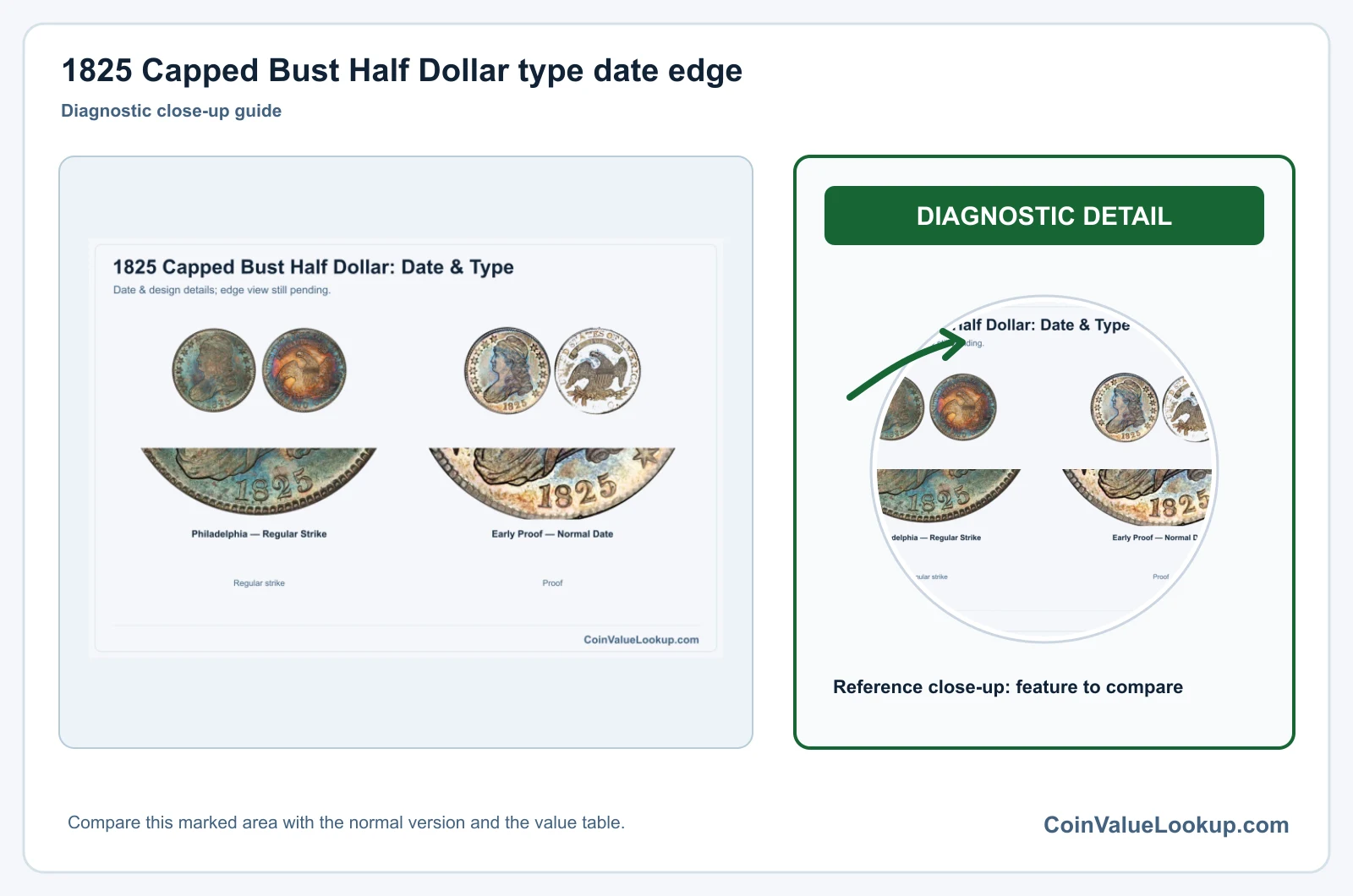
Every 1825 Capped Bust Half Dollar was struck at Philadelphia, so there is no mintmark to look for. The obverse shows a left-facing Liberty wearing a cap, and the reverse displays an eagle with a shield and the denomination 50C.
The edge is lettered: FIFTY CENTS OR HALF A DOLLAR. A genuine example weighs nominally 13.48 grams and measures 32.5 mm, struck in a silver-copper alloy of approximately 89.24% silver.
Weight alone does not authenticate a coin, so check the design details carefully.
The main identity you will encounter is the Philadelphia regular strike. Specialist die pairings exist, but most coins fall along the ordinary value curve.
Some regular strikes show reflective fields that can fool you into thinking you have a Proof. They are not the same thing.
Early Proof attribution requires specialist analysis of die identity, surface characteristics, and provenance. A shiny or polished coin is not automatically a Proof.
Step 2: Check Your 1825 Capped Bust Half Dollar Grade
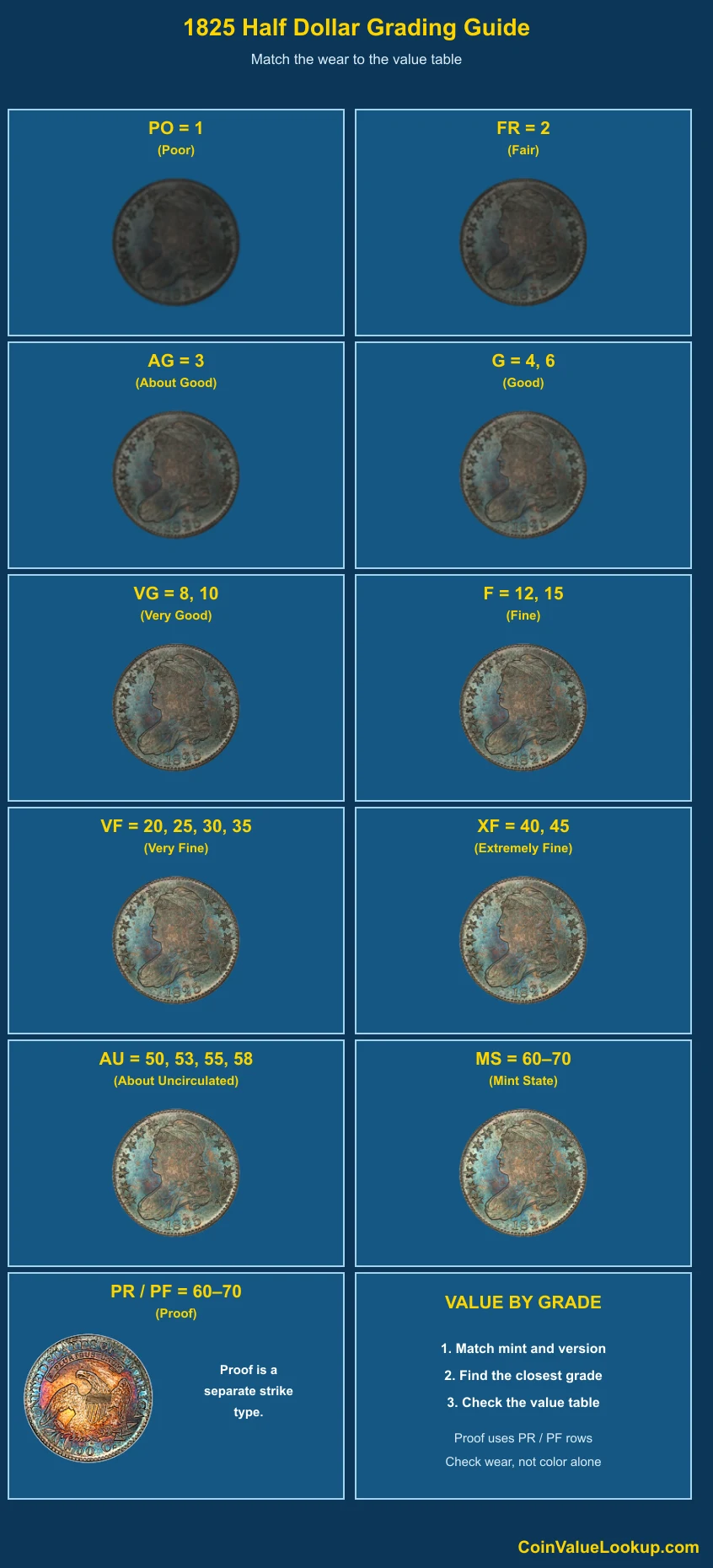
Start by examining the hair above Liberty's forehead, around the ear, and along the cheek. These are the first areas to lose detail as a coin circulates.
The cap and shoulder drapery follow soon after.
On the reverse, check the eagle's breast feathers and wing tips. Some 1825 half dollars were softly struck to begin with, so a lack of sharp detail does not always mean heavy wear.
Look for breaks in the original mint luster before you call it lightly worn.
Use the comparison image to match your coin's overall sharpness to known grade benchmarks. The difference between VF20 and AU50 often comes down to whether luster survives in protected areas around devices.
Coins that have been cleaned, holed, tooled, or visibly scratched fall into the "Details" category and do not command the same prices as straight-graded examples. If you are tempted to clean your coin, don't.
Step 3: Check 1825 Capped Bust Half Dollar Value by Mint and Version
1825 Capped Bust Half Dollar — Philadelphia — Regular Strike
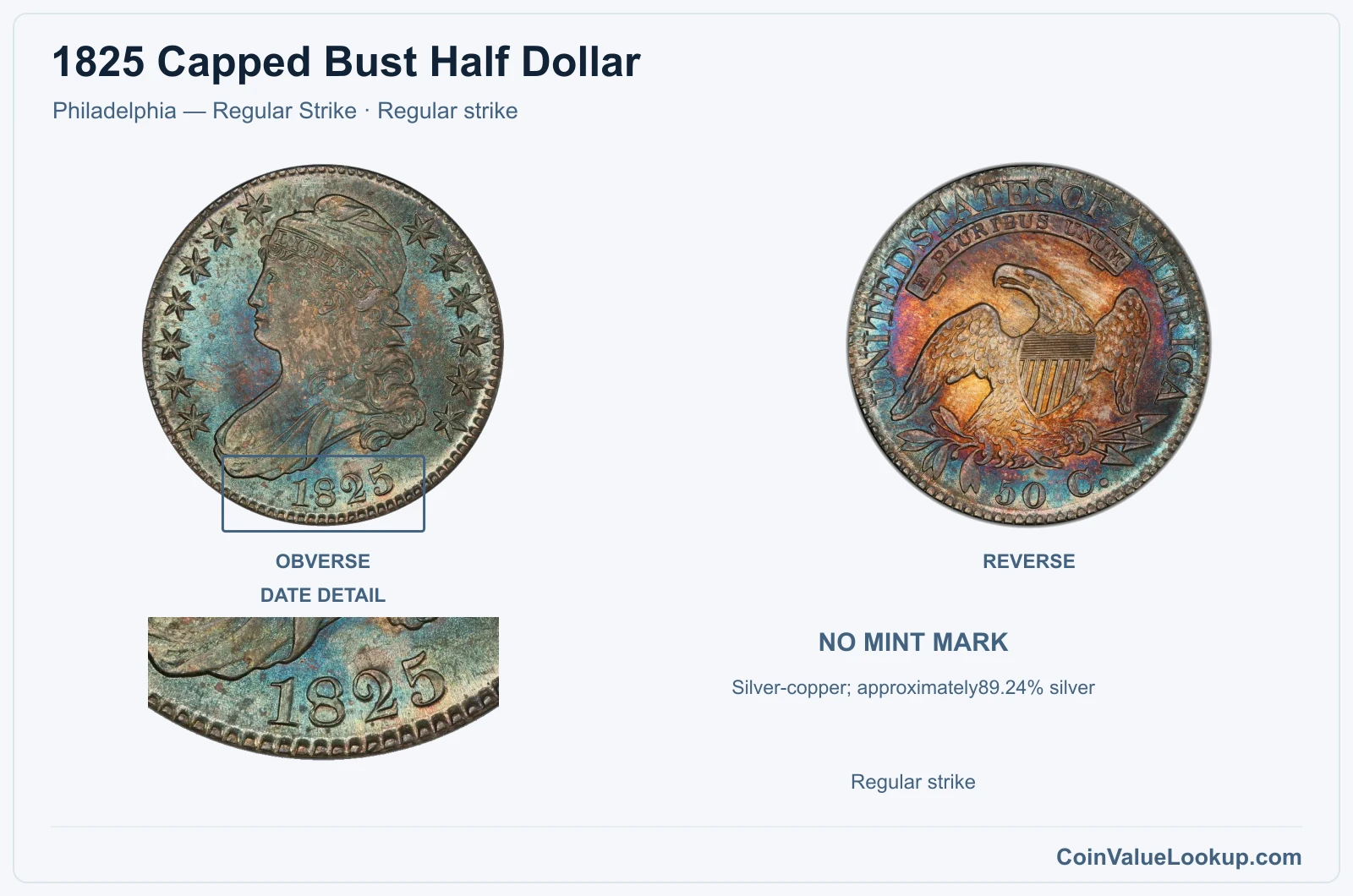
This is the coin most collectors will find. Struck for circulation at Philadelphia with no mintmark, it features the standard Capped Bust design on a lettered-edge planchet of approximately 89.24% silver.
USA Coin Book guide estimates place it at $111 in G4, $163 in VF20, and $546 in AU50.
Specialist die pairings do exist within this issue, and some command premiums among variety collectors. Reflective fields occasionally appear on regular strikes due to freshly polished dies, but that mirror-like look does not make it a Proof.
If your coin is well-worn and clearly circulated, this is almost certainly the version you have.
Coin Value Lookup is a good starting point if you want to compare this half dollar against other dates and denominations in the Capped Bust series.
Range Grade
Price Auction Records Appraisal PO PO 1
—
Coin Identifier FR FR 2
—
Coin Identifier AG AG 3
Coin Identifier G G 4
—
Coin Identifier
G 6
Coin Identifier VG VG 8
—
Coin Identifier
VG 10
Coin Identifier F F 12
Coin Identifier
F 15
Coin Identifier VF VF 20
Coin Identifier
VF 25
Coin Identifier
VF 30
Coin Identifier
VF 35
Coin Identifier XF XF 40
Coin Identifier
XF 45
Coin Identifier AU AU 50
Coin Identifier
AU 53
Coin Identifier
AU 55
Coin Identifier
AU 58
Coin Identifier MS MS 60
Coin Identifier
MS 61
Coin Identifier
MS 62
Coin Identifier
MS 63
Coin Identifier
MS 64
Coin Identifier
MS 65
Coin Identifier
MS 66
Coin Identifier
MS 67
Coin Identifier
MS 68
—
—
—
MS 69
—
—
—
MS 70
—
—
—
1825 Capped Bust Half Dollar — Early Proof — Normal Date
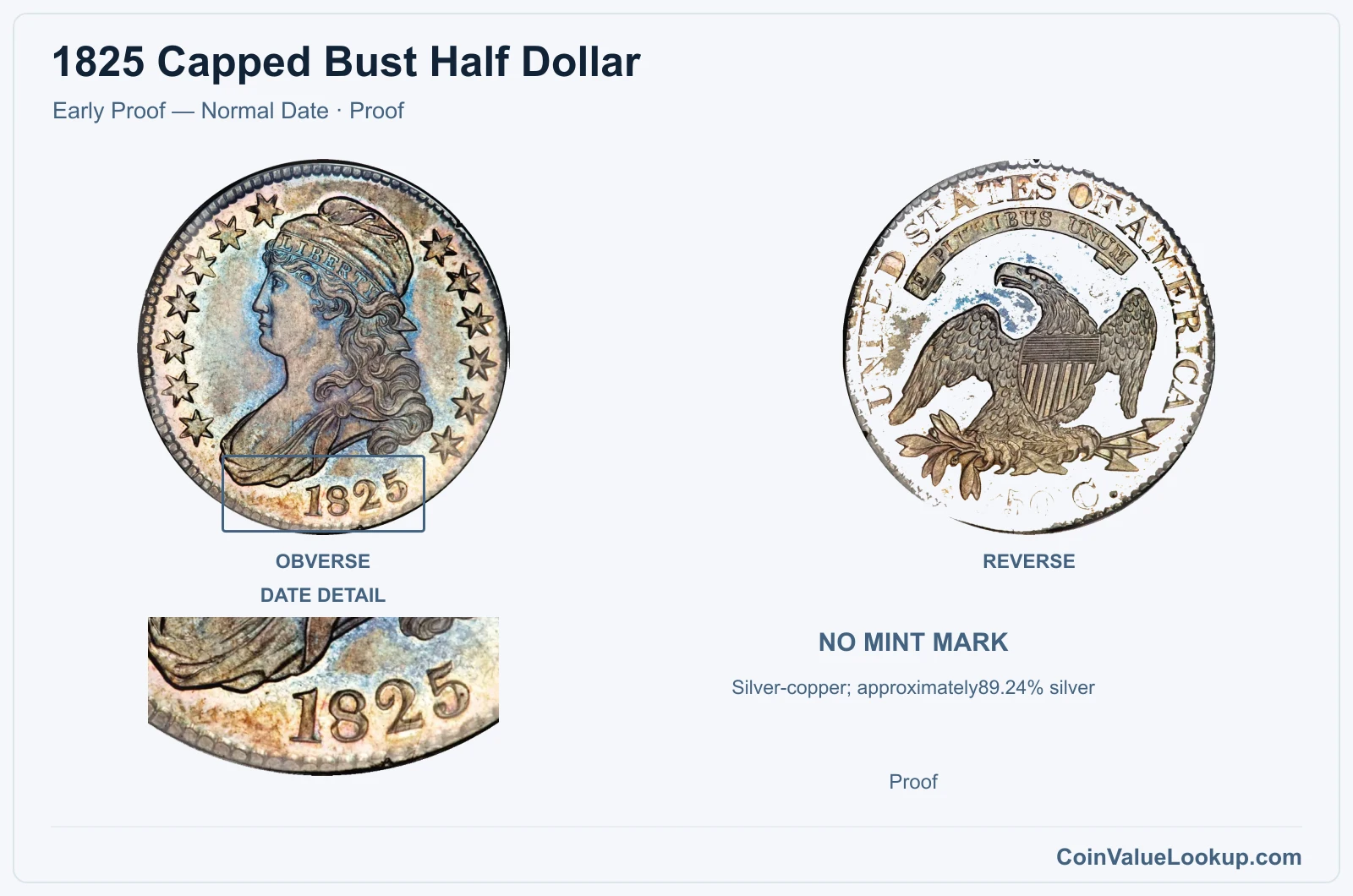
The 1825 early Proof is a genuinely rare coin, produced in very small numbers using specially prepared dies and planchets. It shares the same silver-copper composition and lettered edge as the regular strike, but the surfaces and die characteristics are distinct under professional examination.
Do not assume your coin is a Proof because it looks shiny or has mirror-like fields. Regular strikes can exhibit prooflike surfaces, and cleaned coins can mimic reflectivity.
Proof attribution for coins of this era requires expert analysis of die identity, rim finish, and documented provenance.
The best-known recent sale is a PR66 example that brought $54,050 at a Stack's Bowers auction in February 2016. That is a single historical result for one exceptional specimen, not a current market range across grades.
If you believe you have a Proof 1825 half dollar, professional third-party certification is essential before drawing any value conclusions.
Range Grade
Price Auction Records Appraisal PR PR 1
—
Coin Identifier
PR 2
—
Coin Identifier
PR 3
—
Coin Identifier
PR 4
—
Coin Identifier
PR 6
—
Coin Identifier
PR 8
—
Coin Identifier
PR 10
—
Coin Identifier
PR 12
—
Coin Identifier
PR 15
—
Coin Identifier
PR 20
—
Coin Identifier
PR 25
—
Coin Identifier
PR 30
—
Coin Identifier
PR 35
—
Coin Identifier
PR 40
—
Coin Identifier
PR 45
—
Coin Identifier
PR 50
—
Coin Identifier
PR 53
—
Coin Identifier
PR 55
—
Coin Identifier
PR 58
—
Coin Identifier
PR 60
—
Coin Identifier
PR 61
—
Coin Identifier
PR 62
Coin Identifier
PR 63
—
Coin Identifier
PR 64
—
Coin Identifier
PR 65
—
Coin Identifier
PR 66
Coin Identifier
PR 67
—
—
—
PR 68
—
—
—
PR 69
—
—
—
PR 70
—
—
—
1825 Capped Bust Half Dollar Error List
1. 1825 Capped Bust Half Dollar — Double / Multiple Strike
A double-struck or multiple-strike 1825 Half Dollar shows a displaced second impression of the design, most visibly on Liberty's profile. The displacement creates a ghosted or shifted outline alongside the intended portrait.
This is different from a doubled die, where the doubling originates in the die itself and repeats identically across every coin struck from that die. A double strike happens to an individual planchet that was struck more than once, often slightly off-axis the second time.
Look for a clear second profile overlapping or offset from the primary one. Post-mint damage, such as a coin being hit after leaving the mint, can sometimes mimic the appearance.
On a genuine double strike the second impression will carry full or partial design detail consistent with a die, not random dents.
No specific price range has been adopted for this error. Value depends on the degree of displacement, overall condition, and collector demand for the particular piece.
2. 1825 Capped Bust Half Dollar — Die Crack / Die Chip
Die cracks on the 1825 Half Dollar appear as raised lines on the coin's surface, created when the steel die itself fractured during use. On the reverse, look for raised cracks running from the area near the letters ICA through the base of the 50C denomination, and from the border below the olive leaves up through UNITED.
These lines are raised because the crack in the die created a recessed channel that filled with metal during striking. That is the key distinction from scratches, which are incuse — pressed into the surface.
If you can feel a line sitting above the field rather than cut into it, you are likely looking at a die crack.
Corrosion, encrusted dirt, or foreign material on the surface can also resemble cracks. Compare your coin's line to the specific crack paths described above.
No numerical price has been adopted for this variety; value depends on the prominence of the cracks and the coin's overall grade.
3. 1825 Capped Bust Half Dollar — Repunched 50 C Denomination
On this variety the 50C denomination on the reverse was punched into the die more than once, with the first impression sitting higher than the final corrected position. You can see remnants of both impressions if you look carefully at the numerals and letter.
The traces of the first, misplaced punch appear as faint outlines or partial serifs above or offset from the final 50C. A loupe helps considerably here.
Compare against a normal 1825 half dollar to see the difference.
Do not confuse ordinary wear, post-mint scratches, or design details for repunching. The doubled remnants should be consistent and match the font of the denomination.
Using an attributed same-year example for comparison is the most reliable method.
No specific price range has been established for this variety in the supplied data. Condition, clarity of the repunching, and collector interest in the specific attribution all play into what a given example might bring.
4. 1825 Capped Bust Half Dollar — Die Gouge / Named Raised-Line Variety
This variety features a vertical raised line running through the upper crossbars on the right side of the shield on the reverse. The line was caused by a gouge or defect in the die itself, so it transferred as a raised feature onto every coin struck from that die.
The critical word is raised. A scratch inflicted after minting would be incuse, sitting below the surrounding surface.
Tilt your coin under a light source and check whether the line stands above the shield's crossbar detail. If it does, you may have the die-gouge variety.
Do not confuse this with unrelated die cracks, which tend to follow different paths and have a thinner, more linear profile. Random post-strike damage or contact marks can also leave lines on the shield area but will not be perfectly consistent across multiple examples from the same die.
No numerical value has been adopted for this variety. As with most die-defect varieties, what it brings depends on the visibility of the gouge and the coin's overall condition.