1834 Coronet Head Cent Coin Value: How Much Is It Worth?
The 1834 Coronet Head Cent is one of those early copper large cents that rewards careful variety attribution. Guide estimates from USA Coin Book range from about $38 in Good-4 to $18,695 in MS-63, depending on which of four major die varieties your coin turns out to be.
That spread is wide, so identifying the exact combination of date-punch size, star size and letter size on your coin is the essential first step.
Fast Way to Identify Your 1834 Coronet Head Cent
Snap a clear photo of the front and back of your 1834 cent and upload both images to our identifier. It provides a preliminary identification based on design details visible in your photos, helping you figure out which variety branch you may have.
This is not a substitute for professional authentication, but it gives you a solid starting point.
1834 Coronet Head Cent Value
Upload both sides of your 1834 Coronet Head Cent.
Front Obverse
Upload photo
Back Reverse
Upload photo
Which 1834 Coronet Head Cent Versions Are Worth Money?
- The Large 8, Large Stars, Medium Letters variety guides at $437 in G-4 and $18,695 in MS-63, far above the other three branches at the same grades.
- Four distinct die-variety combinations exist for 1834; misidentifying your variety could mean overlooking significant value.
- Mint-state examples of any variety carry strong premiums over circulated pieces, with the jump from VF to MS grades being especially steep.
- Reported mint errors such as clipped planchets, rotated dies and doubled profiles can add further value when authenticated.
Step 1: Identify Your 1834 Coronet Head Cent Mint Mark and Version
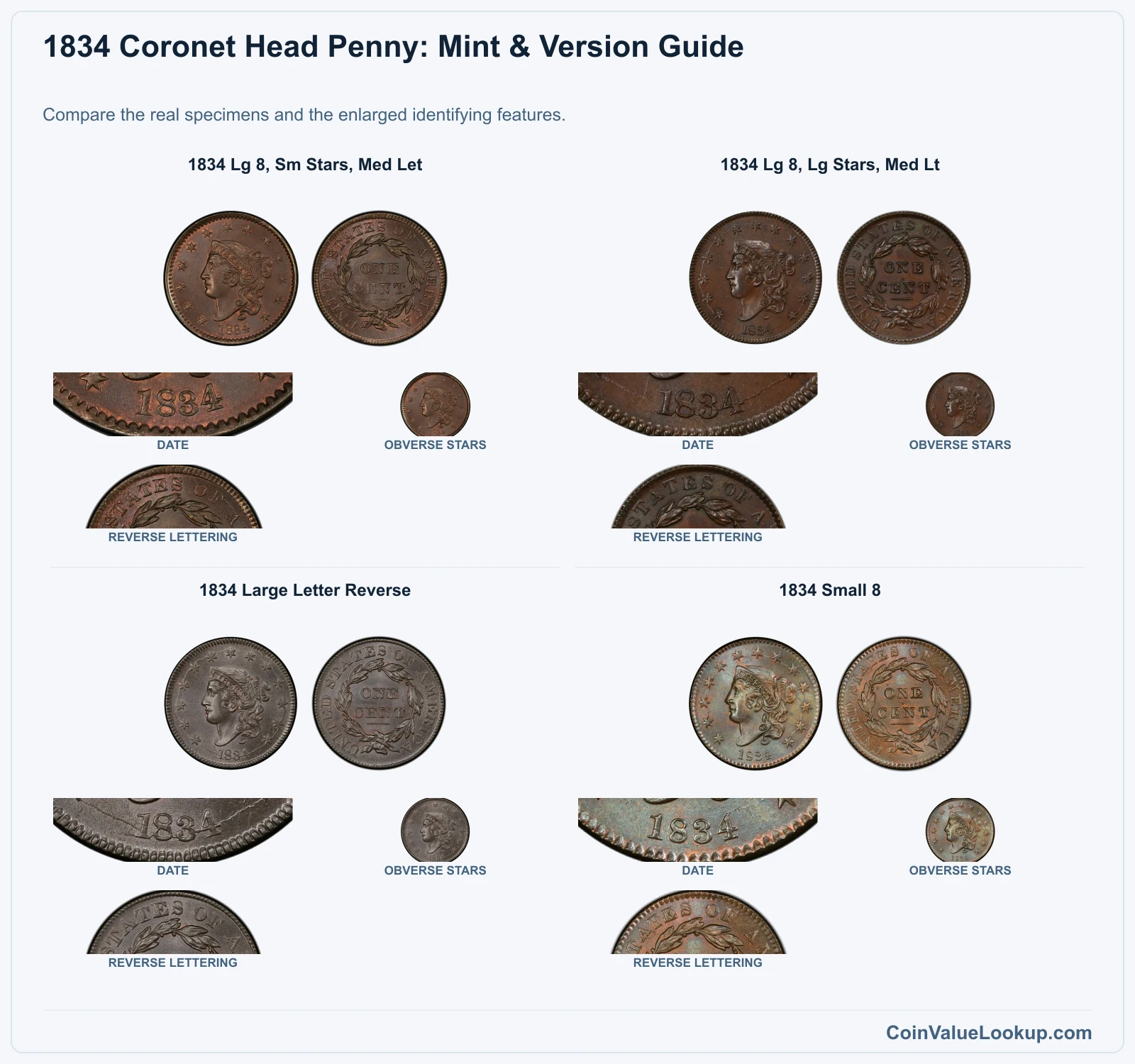
All 1834 Coronet Head Cents were struck at Philadelphia, so there is no mintmark to look for. Attribution comes down to three features you compare independently: the size of the "8" in the date, the size of the obverse stars, and the size of the reverse letters.
For the date, compare the top loop of the 8 to a known reference. A Large 8 has a noticeably bigger, rounder top loop than a Small 8.
This distinction is subtle at first but becomes obvious once you see both side by side.
Next, look at the thirteen obverse stars surrounding Liberty's head. Small Stars are more compact and sit closer together; Large Stars are broader and fill more space between the rim and the portrait.
Finally, flip the coin and check "ONE CENT" and the wreath legend. Medium Letters are the most common reverse style, while Large Letters are taller and more boldly cut.
Matching these three features places your coin into one of four listed combinations.
Weight and material can support your identification. The nominal spec is copper at about 10.89 grams, but wear, corrosion and period production tolerances mean weight alone cannot prove authenticity.
Always inspect both faces and the edge together.
Step 2: Check Your 1834 Coronet Head Cent Grade
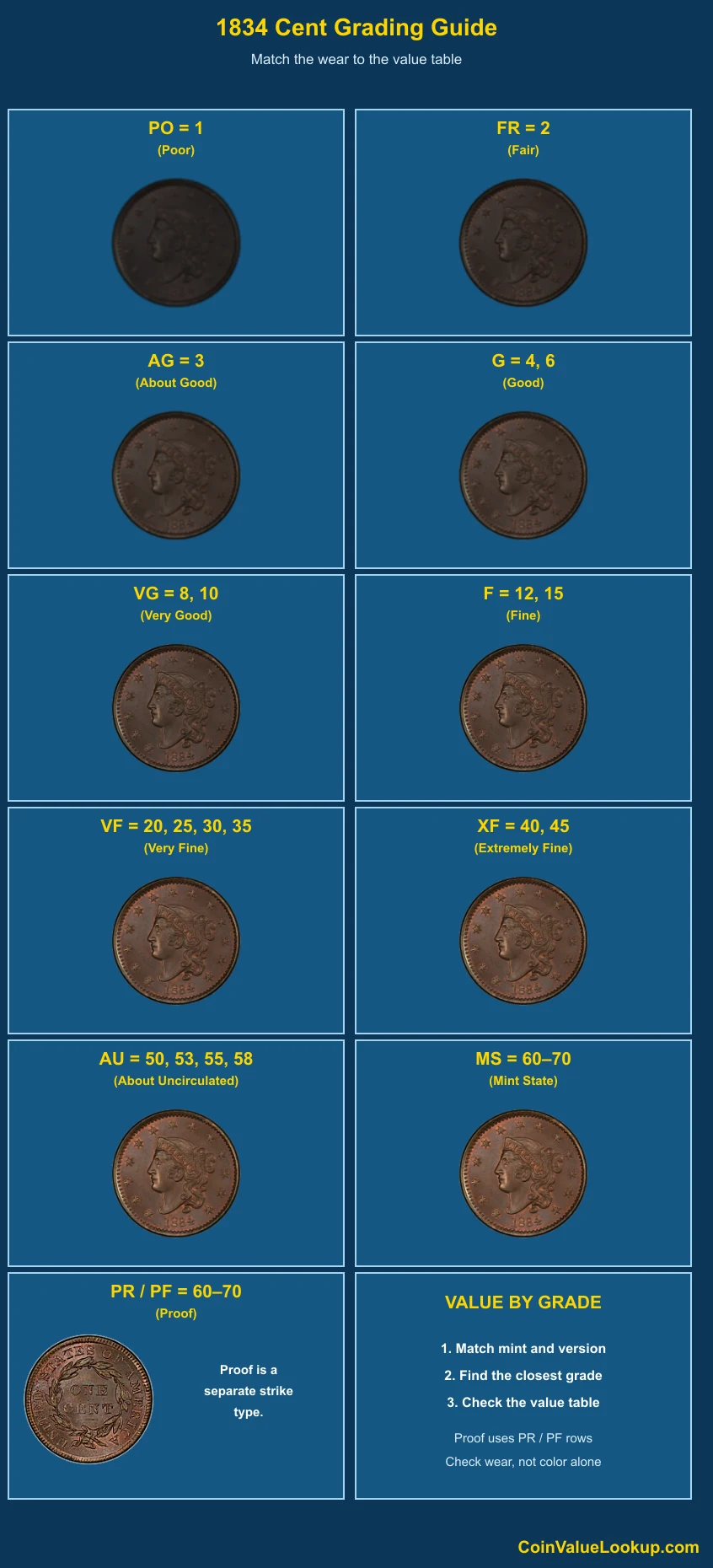
Focus on Liberty's hair detail first. On a well-struck example, individual curls above the ear and along the forehead should be sharp.
As wear progresses, the hair merges into a flat mass starting at the highest points near the cheek and temple.
The wreath on the reverse tells a similar story. Leaf veins vanish early, then the individual leaf outlines flatten.
Lettering edges soften from crisp to mushy.
Do not confuse a weak original strike with honest wear. Some 1834 cents left the press with soft detail in localized areas, especially at the star tips or wreath center.
Corrosion and porosity also eat surface detail in ways that look nothing like normal circulation loss. These surface problems can substantially lower market value even when the remaining design looks sharp.
Copper cents are graded with color designations: BN (brown), RB (red-brown) and RD (red). These describe how much original mint color survives, not different metals.
Most surviving 1834 cents are fully brown. Use the comparison image alongside your coin to match overall sharpness, and remember that a proof is a manufacturing finish, not a grade above Mint State.
Step 3: Check 1834 Coronet Head Cent Value by Mint and Version
1834 Coronet Head Cent — Lg 8, Sm Stars, Med Let
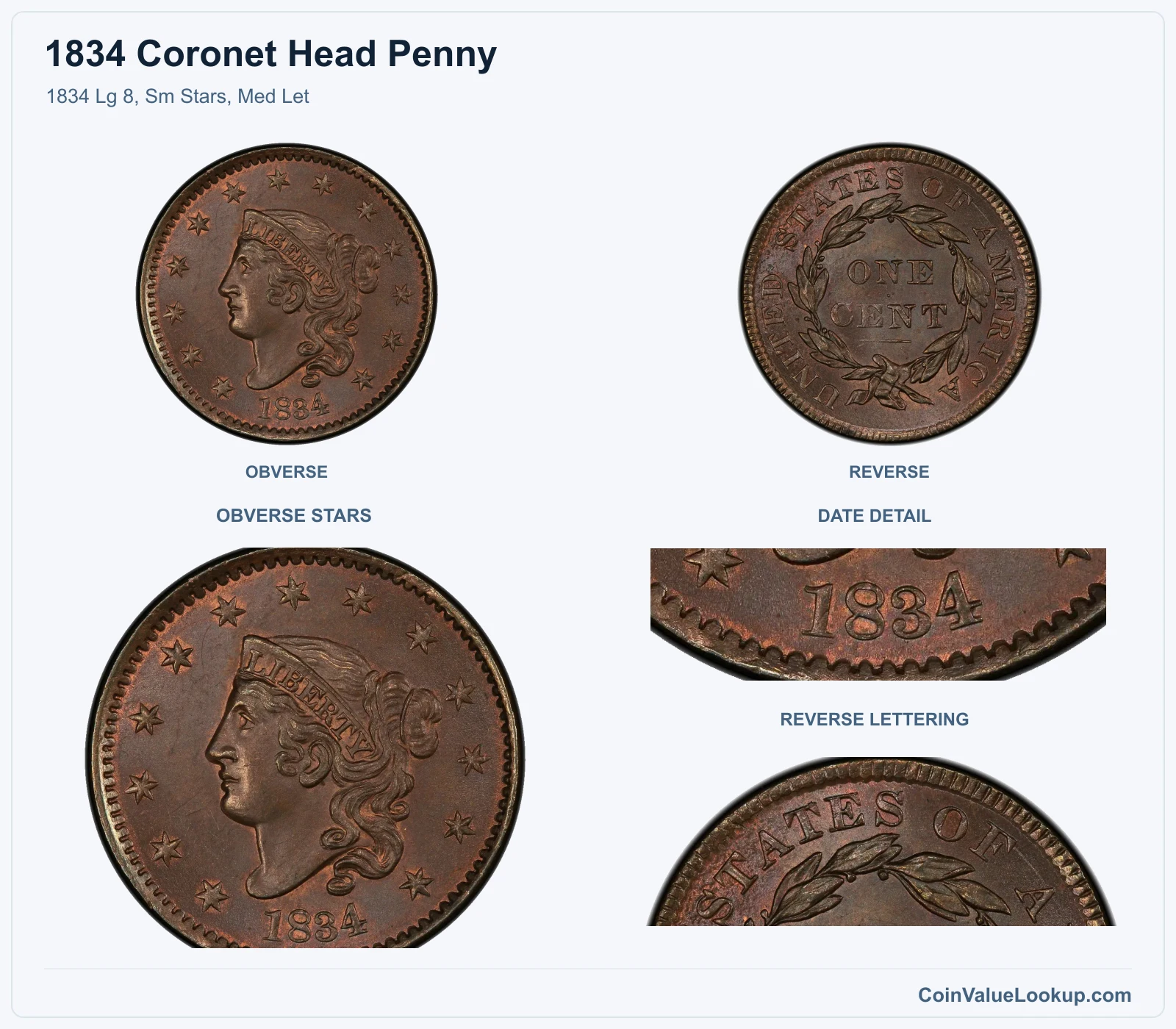
This is the Large 8, Small Stars, Medium Letters variety. Look for a bold, round top loop on the 8 in the date, compact obverse stars, and moderately sized reverse lettering.
It is one of the more available 1834 die marriages.
USA Coin Book guides this variety at roughly $38 in Good-4, climbing to around $1,243 in MS-63. Circulated examples are affordable by early large-cent standards.
Copper at a nominal 10.89 grams, struck at Philadelphia with no mintmark. A solid entry point for collectors exploring 1834 varieties.
| Range | Grade | Price | Auction Records | Appraisal |
|---|---|---|---|---|
| PO | PO 1 | — | Coin Identifier | |
| FR | FR 2 | — | Coin Identifier | |
| AG | AG 3 | — | Coin Identifier | |
| G | G 4 | — | Coin Identifier | |
| G 6 | — | Coin Identifier | ||
| VG | VG 8 | — | Coin Identifier | |
| VG 10 | Coin Identifier | |||
| F | F 12 | — | Coin Identifier | |
| F 15 | Coin Identifier | |||
| VF | VF 20 | Coin Identifier | ||
| VF 25 | Coin Identifier | |||
| VF 30 | Coin Identifier | |||
| VF 35 | — | Coin Identifier | ||
| XF | XF 40 | Coin Identifier | ||
| XF 45 | Coin Identifier | |||
| AU | AU 50 | Coin Identifier | ||
| AU 53 | Coin Identifier | |||
| AU 55 | Coin Identifier | |||
| AU 58 | Coin Identifier | |||
| MS | MS 60 | — | Coin Identifier | |
| MS 61 | Coin Identifier | |||
| MS 62 | Coin Identifier | |||
| MS 63 | Coin Identifier | |||
| MS 64 | Coin Identifier | |||
| MS 65 | Coin Identifier | |||
| MS 66 | Coin Identifier | |||
| MS 67 | Coin Identifier | |||
| MS 68 | — | — | — | |
| MS 69 | — | — | — | |
| MS 70 | — | — | — |
1834 Coronet Head Cent — Lg 8, Lg Stars, Med Lt
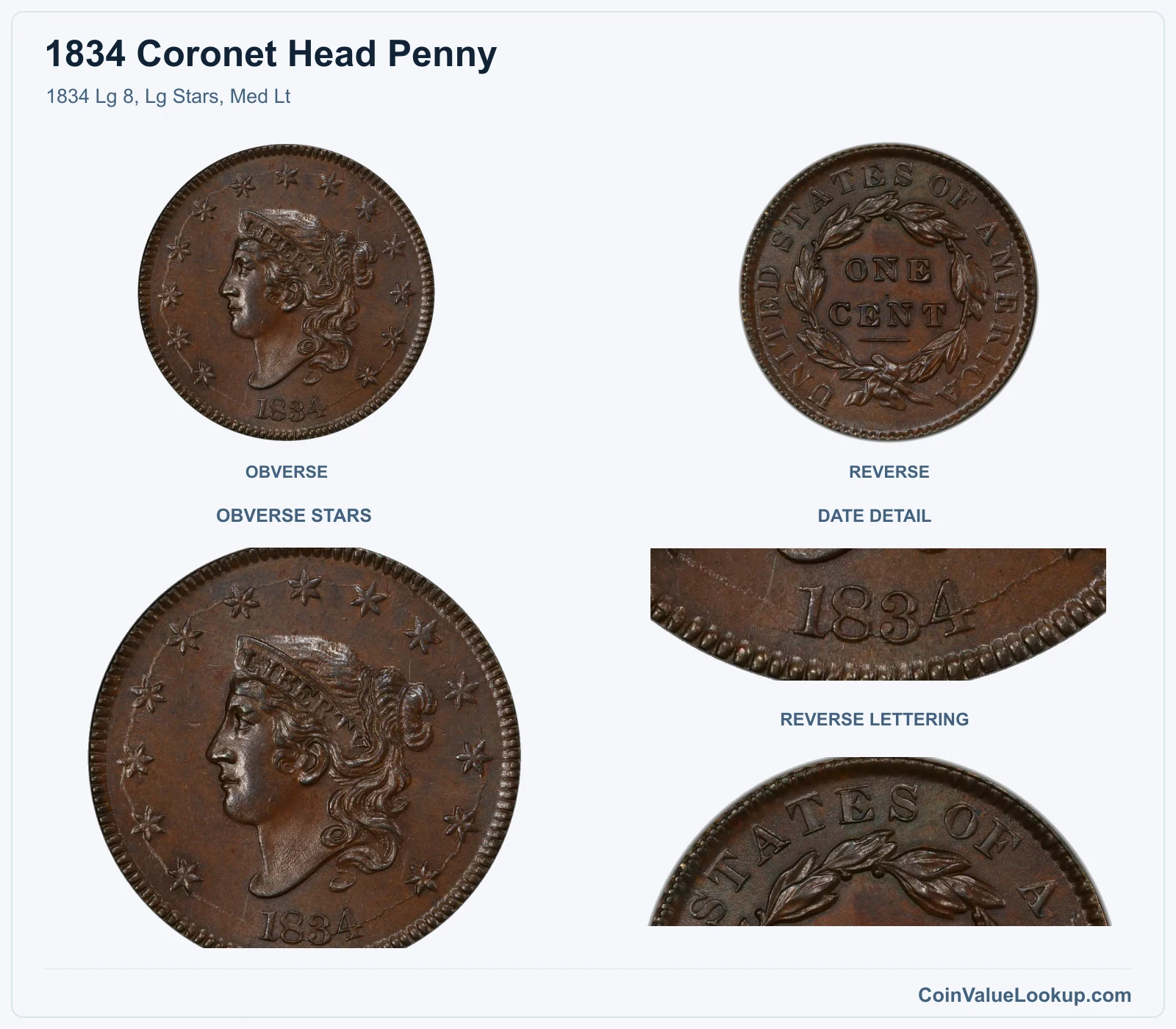
The Large 8, Large Stars, Medium Letters combination is the scarce standout of 1834. It pairs the same large date punch and medium reverse letters as the previous variety, but the obverse stars are noticeably broader and bolder.
That single difference in star size separates a common coin from a genuinely elusive one.
USA Coin Book guides this variety at about $437 in Good-4 and approximately $18,695 in MS-63. Even heavily worn examples carry a substantial premium.
If your coin has a Large 8 and medium-size reverse letters, pay very close attention to those stars. Misattributing Large Stars as Small Stars would mean overlooking a variety that guides at more than ten times the price of its small-star sibling at the same grade.
Coin Value Lookup can help you start narrowing down which variety you might have. Browse the large-cent guides there for additional context on Coronet Head dates and their values.
| Range | Grade | Price | Auction Records | Appraisal |
|---|---|---|---|---|
| PO | PO 1 | — | Coin Identifier | |
| FR | FR 2 | — | Coin Identifier | |
| AG | AG 3 | Coin Identifier | ||
| G | G 4 | — | Coin Identifier | |
| G 6 | — | Coin Identifier | ||
| VG | VG 8 | Coin Identifier | ||
| VG 10 | — | Coin Identifier | ||
| F | F 12 | Coin Identifier | ||
| F 15 | — | Coin Identifier | ||
| VF | VF 20 | Coin Identifier | ||
| VF 25 | — | Coin Identifier | ||
| VF 30 | Coin Identifier | |||
| VF 35 | Coin Identifier | |||
| XF | XF 40 | Coin Identifier | ||
| XF 45 | — | Coin Identifier | ||
| AU | AU 50 | Coin Identifier | ||
| AU 53 | Coin Identifier | |||
| AU 55 | Coin Identifier | |||
| AU 58 | Coin Identifier | |||
| MS | MS 60 | — | Coin Identifier | |
| MS 61 | — | Coin Identifier | ||
| MS 62 | — | Coin Identifier | ||
| MS 63 | Coin Identifier | |||
| MS 64 | — | Coin Identifier | ||
| MS 65 | Coin Identifier | |||
| MS 66 | — | — | — | |
| MS 67 | — | — | — | |
| MS 68 | — | — | — | |
| MS 69 | — | — | — | |
| MS 70 | — | — | — |
1834 Coronet Head Cent — Large Letter Reverse
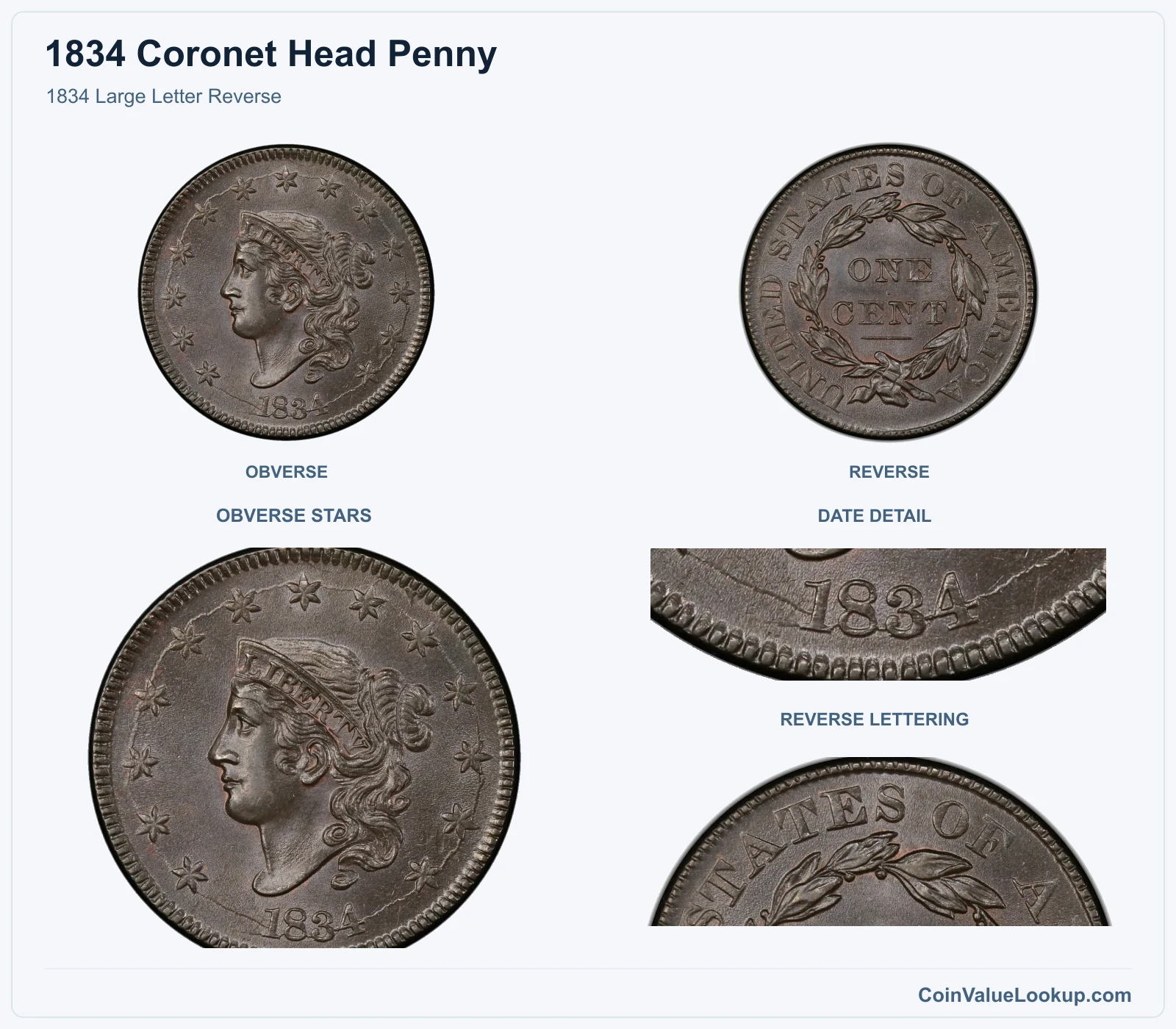
Known as the Large Letter Reverse variety, this combines a Large 8 date punch, Large Stars on the obverse, and distinctly taller, bolder letters on the reverse wreath side. The reverse lettering is the key: compare "ONE CENT" and "UNITED STATES" to a medium-letter example and the height difference is clear.
USA Coin Book places this variety at around $38 in Good-4, rising to roughly $4,941 in MS-63. In lower circulated grades it trades at a similar level to the common varieties, but the mint-state premium is significantly stronger.
All 1834 cents are copper struck at Philadelphia. Check all three features carefully before settling on this attribution.
| Range | Grade | Price | Auction Records | Appraisal |
|---|---|---|---|---|
| PO | PO 1 | — | Coin Identifier | |
| FR | FR 2 | — | Coin Identifier | |
| AG | AG 3 | — | Coin Identifier | |
| G | G 4 | — | Coin Identifier | |
| G 6 | — | Coin Identifier | ||
| VG | VG 8 | Coin Identifier | ||
| VG 10 | — | Coin Identifier | ||
| F | F 12 | Coin Identifier | ||
| F 15 | — | Coin Identifier | ||
| VF | VF 20 | — | Coin Identifier | |
| VF 25 | Coin Identifier | |||
| VF 30 | Coin Identifier | |||
| VF 35 | Coin Identifier | |||
| XF | XF 40 | Coin Identifier | ||
| XF 45 | Coin Identifier | |||
| AU | AU 50 | Coin Identifier | ||
| AU 53 | Coin Identifier | |||
| AU 55 | Coin Identifier | |||
| AU 58 | Coin Identifier | |||
| MS | MS 60 | — | Coin Identifier | |
| MS 61 | — | Coin Identifier | ||
| MS 62 | Coin Identifier | |||
| MS 63 | — | Coin Identifier | ||
| MS 64 | — | Coin Identifier | ||
| MS 65 | — | — | — | |
| MS 66 | — | — | — | |
| MS 67 | — | — | — | |
| MS 68 | — | — | — | |
| MS 69 | — | — | — | |
| MS 70 | — | — | — |
1834 Coronet Head Cent — Small 8
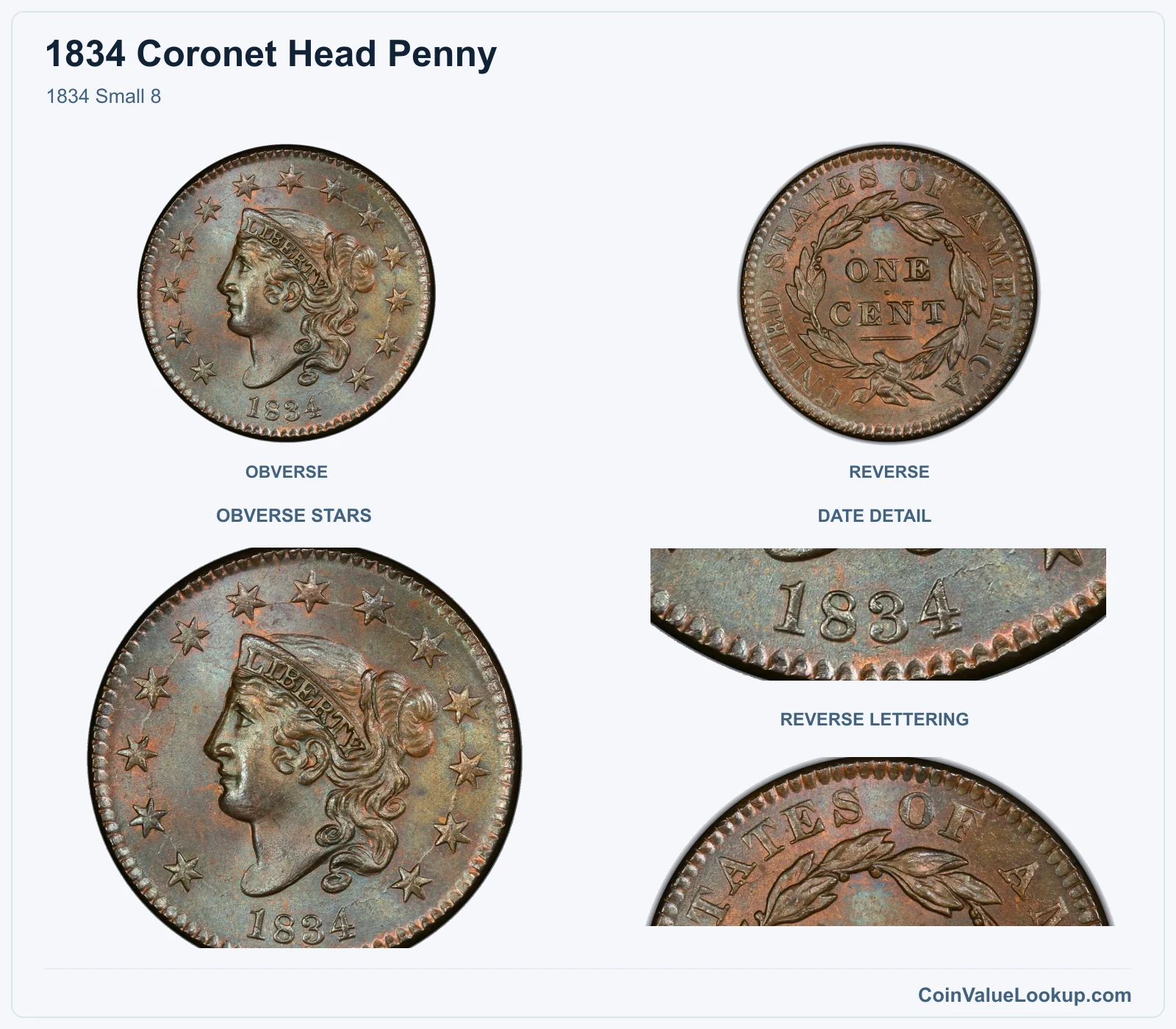
The Small 8 variety stands apart because the date punch itself is different. The top loop of the 8 is smaller and more compressed compared to the Large 8 used on the other three varieties.
The obverse carries Large Stars and the reverse has Medium Letters.
USA Coin Book guides this at about $38 in Good-4 and around $1,127 in MS-63. In well-worn grades it is priced similarly to the two common Large 8 varieties.
Date-punch size can be tricky to judge on a worn coin, so compare directly against reference images whenever possible. Copper, nominal 10.89 grams, Philadelphia mint, no mintmark.
| Range | Grade | Price | Auction Records | Appraisal |
|---|---|---|---|---|
| PO | PO 1 | — | Coin Identifier | |
| FR | FR 2 | — | Coin Identifier | |
| AG | AG 3 | — | Coin Identifier | |
| G | G 4 | — | Coin Identifier | |
| G 6 | Coin Identifier | |||
| VG | VG 8 | Coin Identifier | ||
| VG 10 | — | Coin Identifier | ||
| F | F 12 | Coin Identifier | ||
| F 15 | — | Coin Identifier | ||
| VF | VF 20 | Coin Identifier | ||
| VF 25 | Coin Identifier | |||
| VF 30 | Coin Identifier | |||
| VF 35 | Coin Identifier | |||
| XF | XF 40 | Coin Identifier | ||
| XF 45 | Coin Identifier | |||
| AU | AU 50 | Coin Identifier | ||
| AU 53 | Coin Identifier | |||
| AU 55 | Coin Identifier | |||
| AU 58 | Coin Identifier | |||
| MS | MS 60 | Coin Identifier | ||
| MS 61 | Coin Identifier | |||
| MS 62 | Coin Identifier | |||
| MS 63 | Coin Identifier | |||
| MS 64 | Coin Identifier | |||
| MS 65 | Coin Identifier | |||
| MS 66 | Coin Identifier | |||
| MS 67 | — | — | — | |
| MS 68 | — | — | — | |
| MS 69 | — | — | — | |
| MS 70 | — | — | — |
1834 Coronet Head Cent Error List
1. 1834 Coronet Head Cent — Clipped Planchet
A clipped planchet means a portion of the original copper blank was missing before the coin was struck. The result is a coin with a curved, straight or ragged section of missing metal along the edge.
Look for a corresponding area of weakness on the opposite side of the coin, where metal could not flow fully into the die.
Do not confuse a clip with post-mint damage. A filed notch, deliberate edge cut or corrosion-eaten rim will lack that telltale opposite-side weakness and will usually show tool marks or uneven surface texture.
Genuine clips also tend to have smooth, natural-looking edges at the missing area because the blank was already incomplete when struck.
No specific price range is adopted for clipped 1834 cents. Value depends on the authenticated identity of the variety, the severity and type of clip, and the coin's overall condition.
Professional authentication is the safest route for confirming this type of error.
2. 1834 Coronet Head Cent — Rotated Dies
On a normally aligned U.S. coin, if you hold the obverse upright and flip the coin top to bottom, the reverse should also appear upright. A rotated-die error means the reverse is turned some number of degrees off that standard orientation.
The greater the rotation, the more visually dramatic the error.
Be careful with photographs. A picture can be rotated digitally without the coin itself being an error, and simply turning a coin sideways in your hand does not make it rotated.
You need to physically flip the coin along its vertical axis while holding one side upright to test alignment.
No adopted price range exists for rotated-die 1834 cents. The premium depends on the degree of rotation, the coin's authenticated variety, and its condition.
Minor rotations of just a few degrees attract far less interest than near-180-degree examples.
3. 1834 Coronet Head Cent — Double Profile / Strike Doubling
This error shows a visible second outline of Liberty's profile alongside the normal one, giving the portrait a shadowed or shifted appearance. Compare the affected coin directly to a normal 1834 cent to see the offset clearly.
The doubling may also appear on lettering, stars or the wreath.
Not every doubled-looking feature is a genuine mint error. Die wear can produce a mushy, spread appearance that mimics doubling.
Post-mint tooling or environmental damage can also create false outlines. Reflections in photographs sometimes exaggerate what is actually a flat, normal surface.
No specific price range is adopted for this category on 1834 Coronet Head Cents. Value hinges on the strength and location of the doubling, the coin's authenticated identity and its overall condition.
If you suspect a doubled profile, professional examination is the most reliable way to confirm or rule it out.