1823 Coronet Head Cent Coin Value: How Much Is It Worth?
The 1823 Coronet Head Cent is a scarce early copper issue that draws serious attention from collectors. Guide estimates for the ordinary business-strike versions range from about $163 in G4 condition up to roughly $42,554 in MS63, depending on the exact variety.
Identifying which variety you hold is critical, because the 1823 comes in several distinct forms with very different values.
Fast Way to Identify Your 1823 Coronet Head Cent
The quickest way to start figuring out what you have is to upload clear photos of the front and back of your coin. That gives a preliminary identification of the variety, date style and overall condition.
Snap both sides in even lighting, and include a shot of the edge if possible.
1823 Coronet Head Cent Value
Upload both sides of your 1823 Coronet Head Cent.
Front Obverse
Upload photo
Back Reverse
Upload photo
Which 1823 Coronet Head Cent Versions Are Worth Money?
- The 1823/2 overdate in higher grades can command strong premiums; a G4 starts around $163 while an MS60 reaches roughly $27,011 per guide estimates.
- The normal-date 1823 business strike is itself scarce, with guide values from about $207 in G4 to approximately $42,554 in MS63.
- Private copper restrikes carry their own collector following, with guides from around $73 (G4) to about $2,767 (MS63).
- The 1823 Private Restrike in silver and the 1823/2 Proof are rare enough that no standard guide range applies; each requires individual expert assessment.
- Source-reported die cracks, cuds, rotated dies and overdate features can add further interest, though no standard error premiums are established for this date.
Step 1: Identify Your 1823 Coronet Head Cent Mint Mark and Version
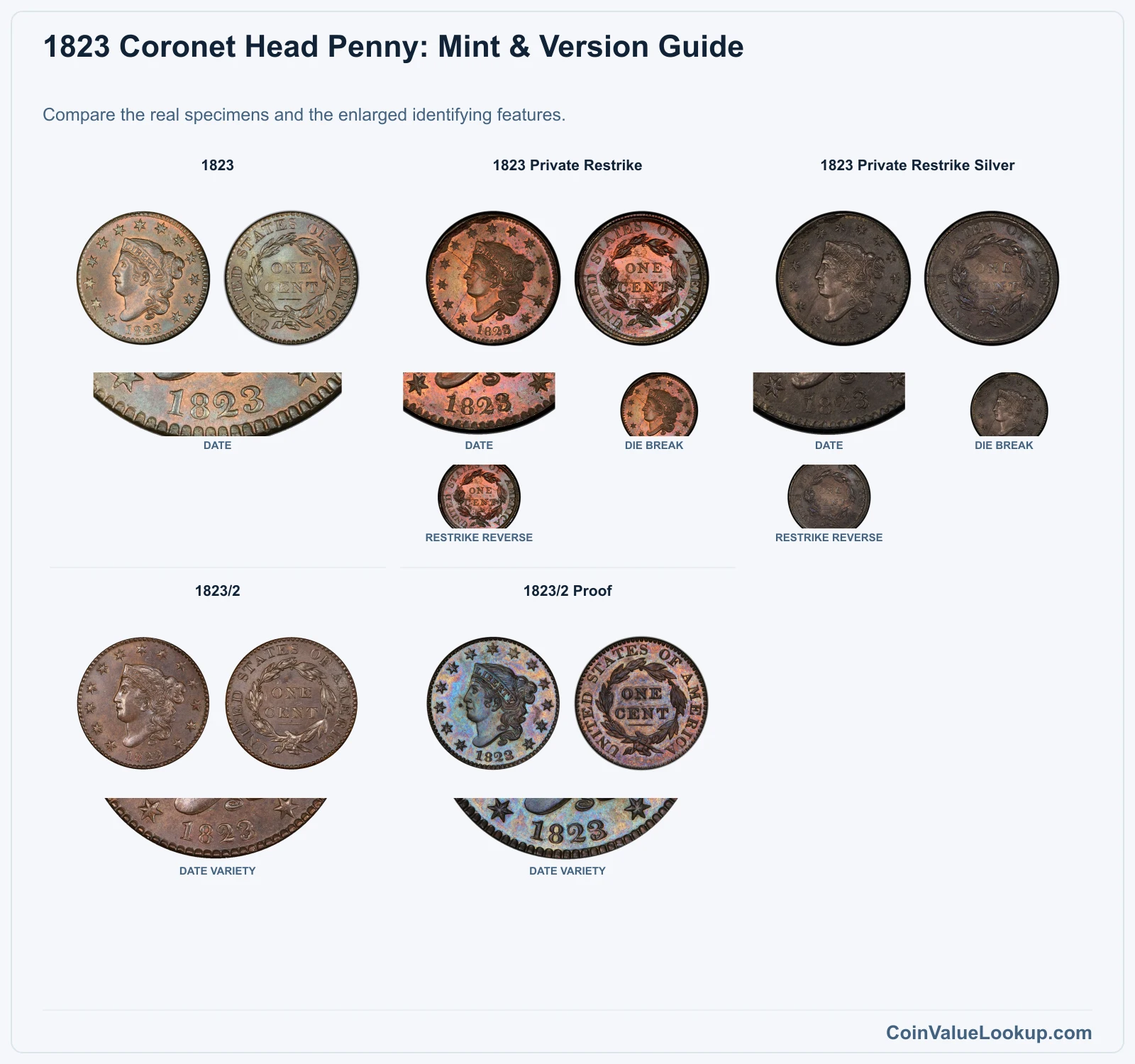
All original 1823 Coronet Head Cents were struck at Philadelphia with no mintmark. Do not assume a branch-mint version exists for this date.
The first thing to check is the date itself. Look closely at the "3" in 1823: does it show traces of a "2" underneath?
If so, you likely have the 1823/2 overdate variety, which is a separate branch from the normal-date coin.
Next, consider whether the coin is an original Mint product or a later private restrike. Restrikes exist in both copper and silver.
A silver example is not a wrong-planchet error from the Mint; it is a separate collector production made outside official channels. The die characteristics on restrikes typically show a broken obverse die, which is a key diagnostic.
Inspect both faces and the edge carefully. Weight and material can offer supporting clues, but wear, corrosion and normal production tolerances from the 1820s mean weight alone will not prove authenticity.
If anything feels off, professional authentication is the safest next step.
Step 2: Check Your 1823 Coronet Head Cent Grade
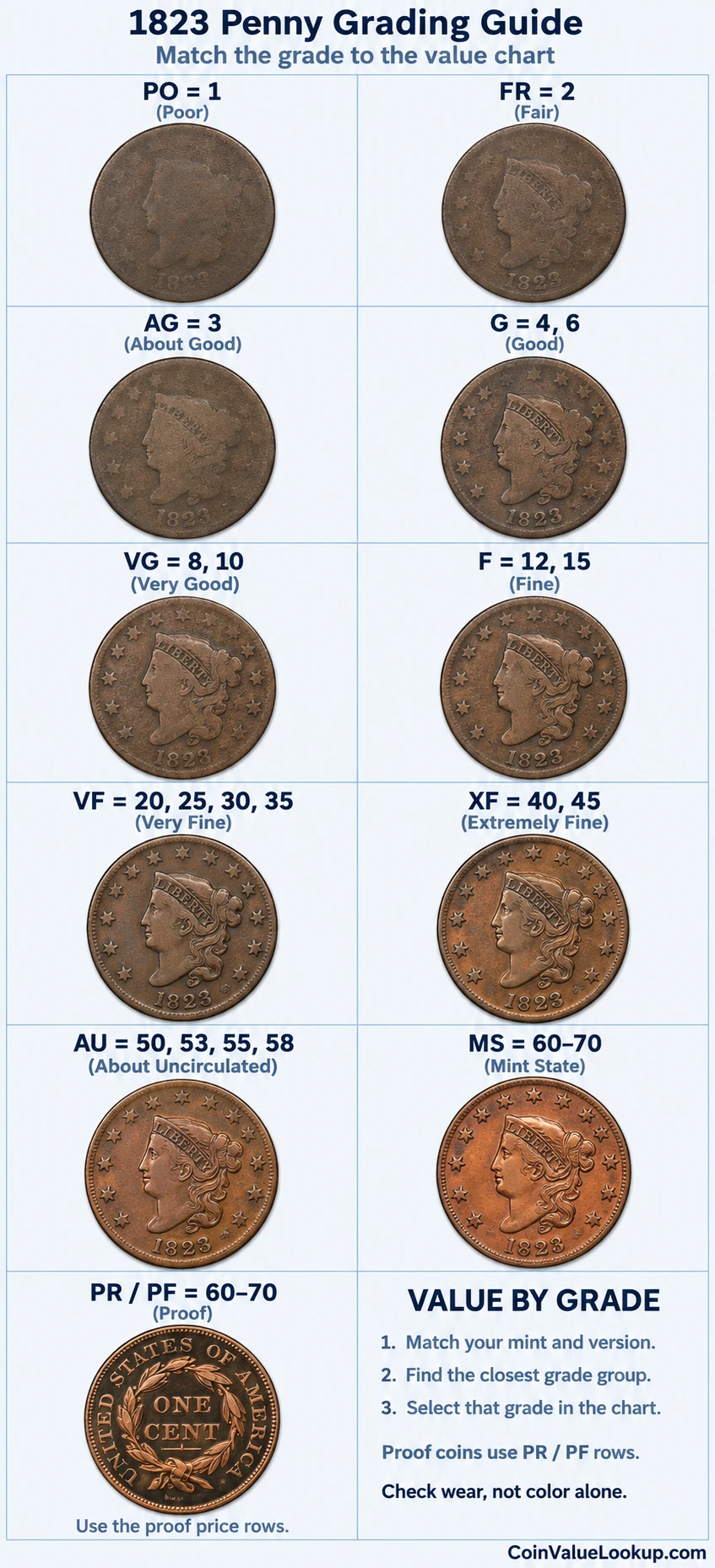
Compare your coin's portrait to known grade examples of the same type. Focus on the hair detail above Liberty's ear and along the forehead curls; these are the first areas to lose definition.
On the reverse, check the individual leaf tips in the wreath and the sharpness of the lettering around the rim.
Do not confuse a weakly struck area with actual wear from circulation. Weak strikes were common on early copper, and the difference matters for accurate grading.
Surface problems like porosity, corrosion, cleaning or environmental damage can reduce a coin's market appeal well below what the grade alone might suggest. A coin graded VF for sharpness but showing heavy cleaning will not command VF money.
Color designations like BN (brown), RB (red-brown) and RD (red) describe the remaining original copper color, not different alloys. More original red generally means higher value in uncirculated grades.
And remember: Proof is a method of manufacture involving specially prepared dies and planchets, not a grade above Mint State. A polished business strike is not a proof.
Use the comparison image alongside your coin for a realistic self-assessment.
Step 3: Check 1823 Coronet Head Cent Value by Mint and Version
1823 Coronet Head Cent
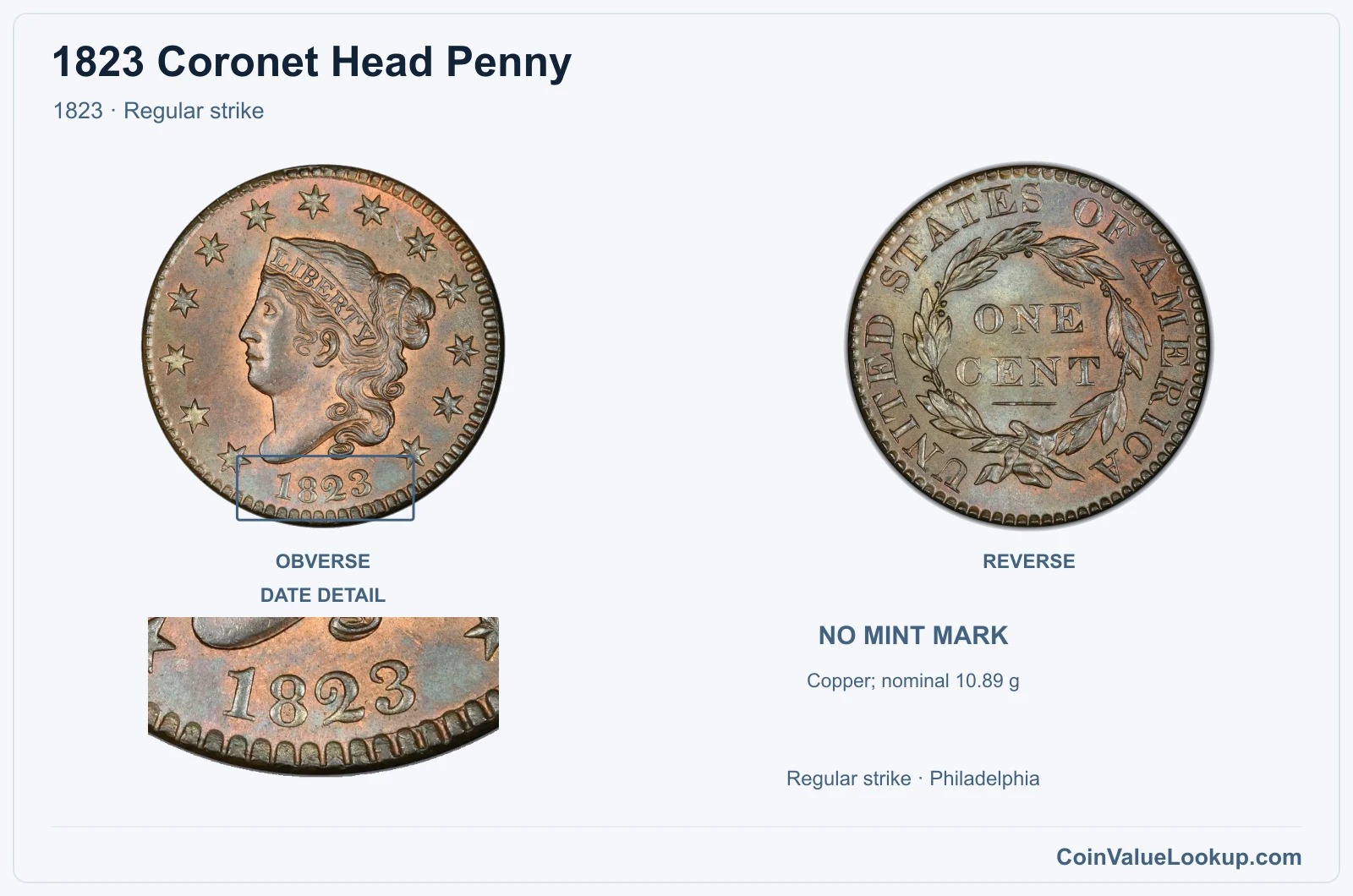
This is the standard 1823 Coronet Head Cent, struck in copper at Philadelphia with no mintmark. It features Liberty wearing a coronet on the obverse and a wreath with denomination on the reverse.
The normal date shows a cleanly punched "1823" with no underlying digits.
Guide estimates place this coin at roughly $207 in G4 and up to about $42,554 in MS63 according to USA Coin Book. Even well-worn examples carry real value because the 1823 is a genuinely scarce date in this series.
Confirm the date has no overdate traces before slotting it here.
| Range | Grade | Price | Auction Records | Appraisal |
|---|---|---|---|---|
| PO | PO 1 | — | Coin Identifier | |
| FR | FR 2 | — | Coin Identifier | |
| AG | AG 3 | Coin Identifier | ||
| G | G 4 | Coin Identifier | ||
| G 6 | Coin Identifier | |||
| VG | VG 8 | Coin Identifier | ||
| VG 10 | Coin Identifier | |||
| F | F 12 | Coin Identifier | ||
| F 15 | Coin Identifier | |||
| VF | VF 20 | Coin Identifier | ||
| VF 25 | Coin Identifier | |||
| VF 30 | Coin Identifier | |||
| VF 35 | Coin Identifier | |||
| XF | XF 40 | Coin Identifier | ||
| XF 45 | Coin Identifier | |||
| AU | AU 50 | Coin Identifier | ||
| AU 53 | — | Coin Identifier | ||
| AU 55 | Coin Identifier | |||
| AU 58 | Coin Identifier | |||
| MS | MS 60 | — | Coin Identifier | |
| MS 61 | Coin Identifier | |||
| MS 62 | Coin Identifier | |||
| MS 63 | — | — | — | |
| MS 64 | — | Coin Identifier | ||
| MS 65 | — | Coin Identifier | ||
| MS 66 | — | Coin Identifier | ||
| MS 67 | — | — | — | |
| MS 68 | — | — | — | |
| MS 69 | — | — | — | |
| MS 70 | — | — | — |
1823 Coronet Head Cent — Private Restrike
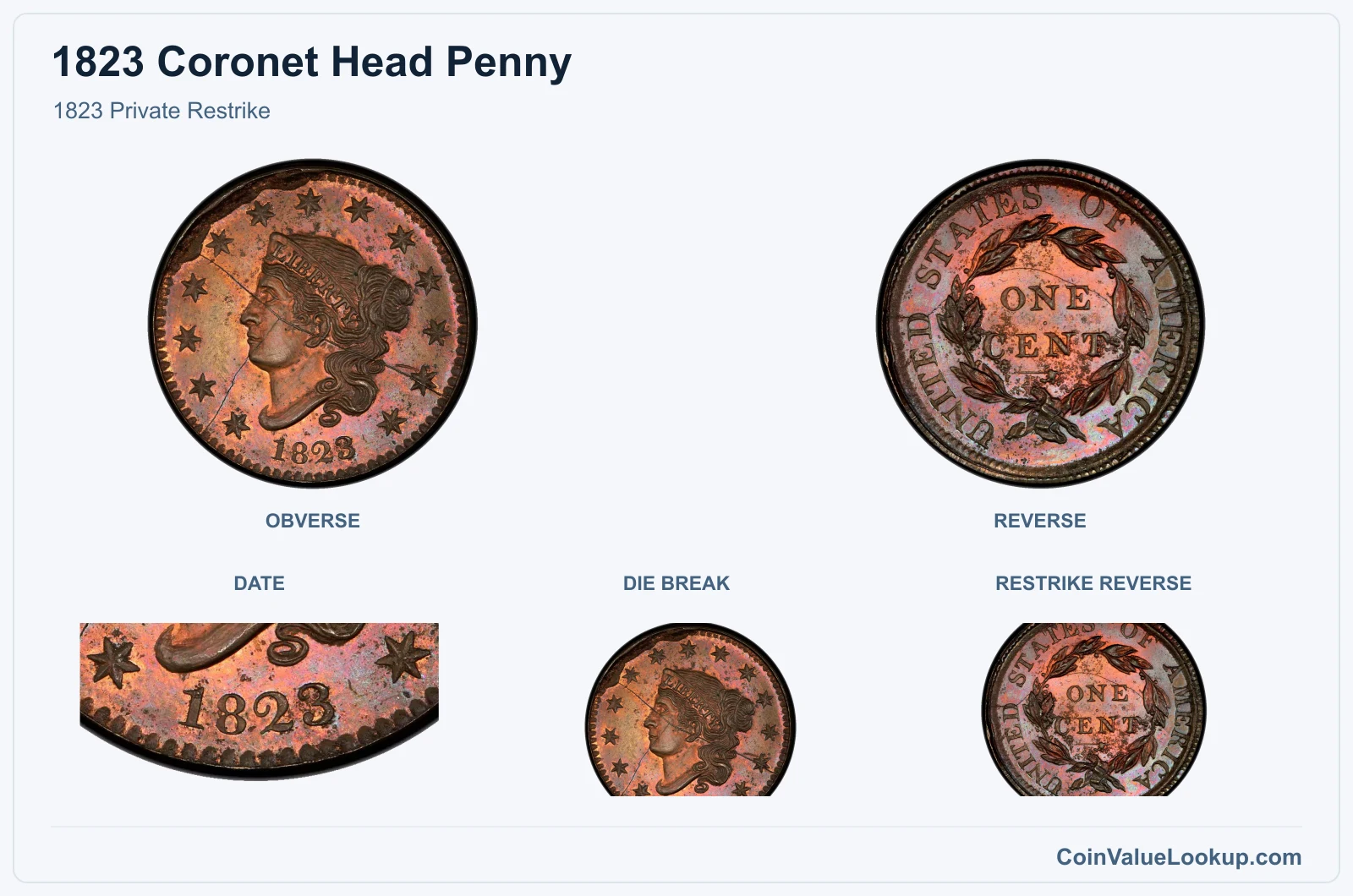
The 1823 Private Restrike in copper uses original or reproduction dies but was produced outside normal Mint operations as a later collector production. The telltale diagnostic is a broken obverse die, which distinguishes it from an original striking.
Do not confuse this with the original-date business strike. It has its own identity and its own market.
Guide estimates from USA Coin Book run from about $73 in G4 to approximately $2,767 in MS63. Those numbers are considerably lower than the original, which makes correct identification essential before assuming you have a high-value piece.
Coin Value Lookup can help you start looking up values for different varieties of early large cents and other series when you are trying to sort out what you have.
| Range | Grade | Price | Auction Records | Appraisal |
|---|---|---|---|---|
| PO | PO 1 | — | Coin Identifier | |
| FR | FR 2 | — | Coin Identifier | |
| AG | AG 3 | — | Coin Identifier | |
| G | G 4 | — | Coin Identifier | |
| G 6 | — | Coin Identifier | ||
| VG | VG 8 | — | Coin Identifier | |
| VG 10 | — | Coin Identifier | ||
| F | F 12 | — | Coin Identifier | |
| F 15 | — | Coin Identifier | ||
| VF | VF 20 | — | Coin Identifier | |
| VF 25 | — | Coin Identifier | ||
| VF 30 | — | Coin Identifier | ||
| VF 35 | — | Coin Identifier | ||
| XF | XF 40 | — | Coin Identifier | |
| XF 45 | — | Coin Identifier | ||
| AU | AU 50 | Coin Identifier | ||
| AU 53 | Coin Identifier | |||
| AU 55 | — | Coin Identifier | ||
| AU 58 | Coin Identifier | |||
| MS | MS 60 | Coin Identifier | ||
| MS 61 | — | Coin Identifier | ||
| MS 62 | Coin Identifier | |||
| MS 63 | Coin Identifier | |||
| MS 64 | Coin Identifier | |||
| MS 65 | Coin Identifier | |||
| MS 66 | Coin Identifier | |||
| MS 67 | — | — | — | |
| MS 68 | — | — | — | |
| MS 69 | — | — | — | |
| MS 70 | — | — | — |
1823 Coronet Head Cent — Private Restrike Silver
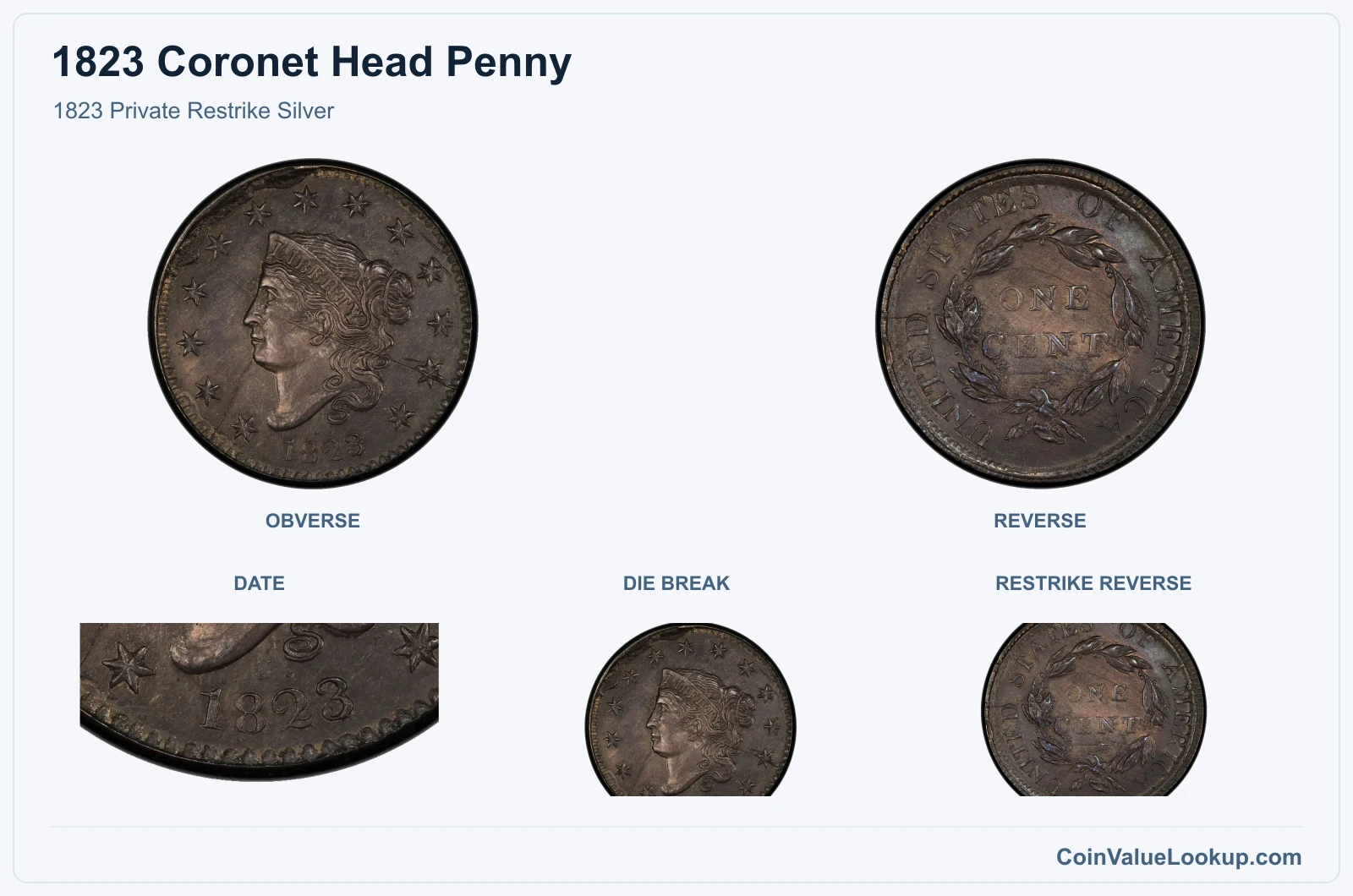
This is the silver version of the 1823 private restrike. It was not struck on a wrong planchet at the Mint; it is a deliberate later production in silver, made for collectors.
That distinction matters because it changes how the coin is categorized and valued.
No standard guide price range has been adopted for this variety. Each example needs individual assessment based on its authenticated identity, surfaces and overall condition.
Professional attribution and third-party certification are strongly recommended before buying or selling one of these, as the market for off-metal restrikes depends heavily on provenance and expert confirmation.
| Range | Grade | Price | Auction Records | Appraisal |
|---|---|---|---|---|
| PO | PO 1 | — | Coin Identifier | |
| FR | FR 2 | — | Coin Identifier | |
| AG | AG 3 | — | Coin Identifier | |
| G | G 4 | — | Coin Identifier | |
| G 6 | — | Coin Identifier | ||
| VG | VG 8 | — | Coin Identifier | |
| VG 10 | — | Coin Identifier | ||
| F | F 12 | — | Coin Identifier | |
| F 15 | — | Coin Identifier | ||
| VF | VF 20 | — | Coin Identifier | |
| VF 25 | — | Coin Identifier | ||
| VF 30 | — | Coin Identifier | ||
| VF 35 | — | Coin Identifier | ||
| XF | XF 40 | — | Coin Identifier | |
| XF 45 | — | Coin Identifier | ||
| AU | AU 50 | — | Coin Identifier | |
| AU 53 | — | Coin Identifier | ||
| AU 55 | — | Coin Identifier | ||
| AU 58 | — | Coin Identifier | ||
| MS | MS 60 | — | Coin Identifier | |
| MS 61 | — | Coin Identifier | ||
| MS 62 | Coin Identifier | |||
| MS 63 | Coin Identifier | |||
| MS 64 | — | — | — | |
| MS 65 | — | — | — | |
| MS 66 | — | — | — | |
| MS 67 | — | — | — | |
| MS 68 | — | — | — | |
| MS 69 | — | — | — | |
| MS 70 | — | — | — |
1823 Coronet Head Cent — /2
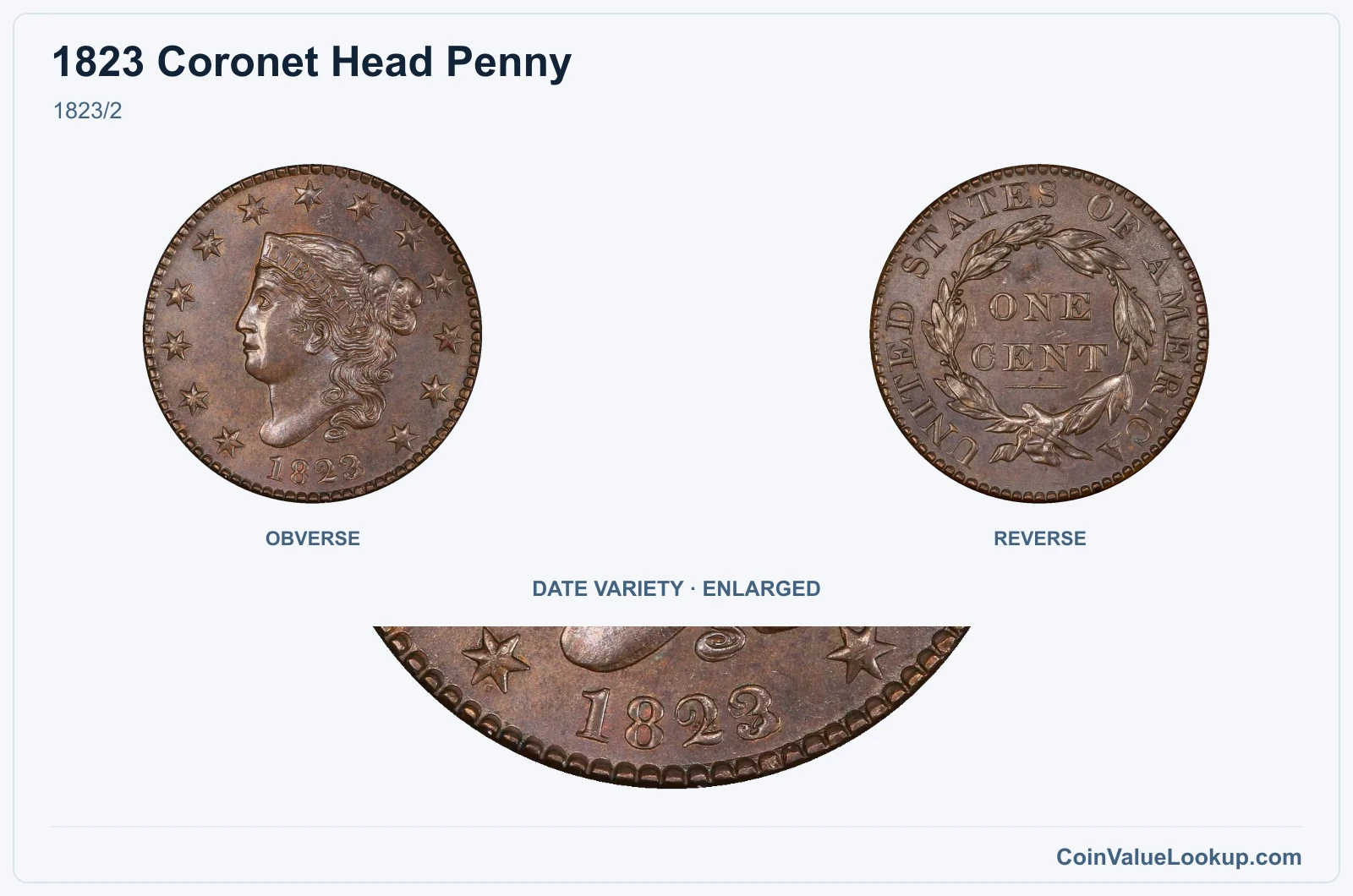
The 1823/2 shows the remnants of a "2" beneath the final "3" in the date. Look carefully at the lower curve of the 3; you should see traces of the earlier digit peeking through.
This is a genuine die variety, not damage.
Guide estimates from USA Coin Book start at about $163 in G4 and climb to roughly $27,011 in MS60. The overdate is separately tracked from the normal date and carries its own collector demand.
Even in low grades, the visible overdate feature keeps this coin desirable. Check under magnification in good lighting to confirm the underlying digit before attributing it.
| Range | Grade | Price | Auction Records | Appraisal |
|---|---|---|---|---|
| PO | PO 1 | — | Coin Identifier | |
| FR | FR 2 | — | Coin Identifier | |
| AG | AG 3 | — | Coin Identifier | |
| G | G 4 | Coin Identifier | ||
| G 6 | Coin Identifier | |||
| VG | VG 8 | Coin Identifier | ||
| VG 10 | Coin Identifier | |||
| F | F 12 | Coin Identifier | ||
| F 15 | Coin Identifier | |||
| VF | VF 20 | Coin Identifier | ||
| VF 25 | Coin Identifier | |||
| VF 30 | Coin Identifier | |||
| VF 35 | Coin Identifier | |||
| XF | XF 40 | Coin Identifier | ||
| XF 45 | Coin Identifier | |||
| AU | AU 50 | Coin Identifier | ||
| AU 53 | Coin Identifier | |||
| AU 55 | Coin Identifier | |||
| AU 58 | Coin Identifier | |||
| MS | MS 60 | — | Coin Identifier | |
| MS 61 | Coin Identifier | |||
| MS 62 | — | Coin Identifier | ||
| MS 63 | — | — | — | |
| MS 64 | — | — | — | |
| MS 65 | — | — | — | |
| MS 66 | — | — | — | |
| MS 67 | — | — | — | |
| MS 68 | — | — | — | |
| MS 69 | — | — | — | |
| MS 70 | — | — | — |
1823 Coronet Head Cent — /2 Proof
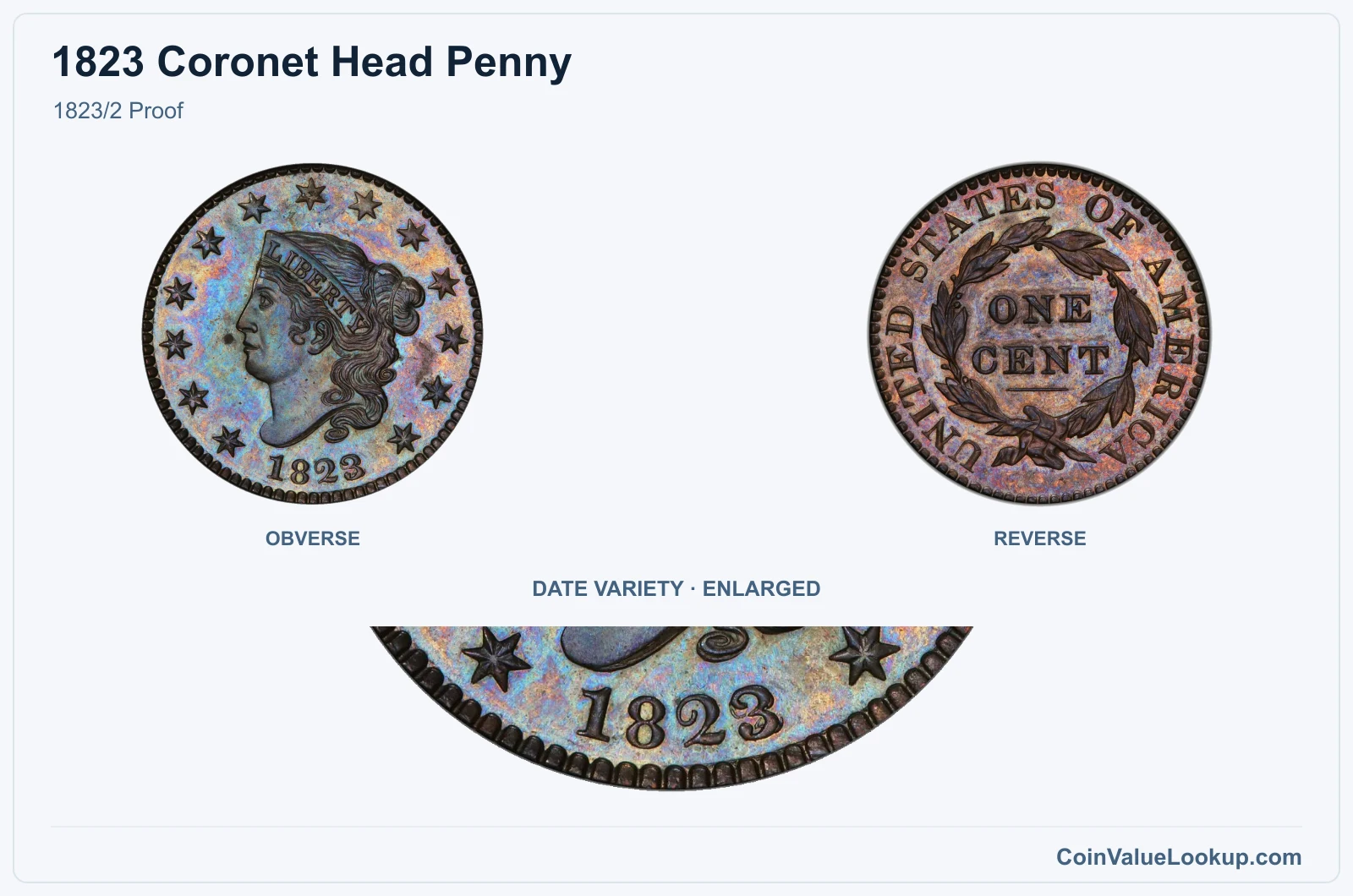
The 1823/2 Proof is a cataloged early proof striking of the overdate die pair. Proof status on an 1820s large cent requires careful attribution of the die characteristics, surfaces, rims and overall finish.
A business strike that has been polished or whizzed is not a proof, no matter how shiny it looks.
PCGS lists this as a recognized branch. No standard guide price range is adopted here; each example requires individual expert assessment based on its authenticated identity and condition.
If you believe you have one, third-party certification by a major grading service is essential. These are extremely rare coins, and the stakes are high enough to justify professional handling.
| Range | Grade | Price | Auction Records | Appraisal |
|---|---|---|---|---|
| PR | PR 1 | — | Coin Identifier | |
| PR 2 | — | Coin Identifier | ||
| PR 3 | — | Coin Identifier | ||
| PR 4 | — | Coin Identifier | ||
| PR 6 | — | Coin Identifier | ||
| PR 8 | — | Coin Identifier | ||
| PR 10 | — | Coin Identifier | ||
| PR 12 | — | Coin Identifier | ||
| PR 15 | — | Coin Identifier | ||
| PR 20 | — | Coin Identifier | ||
| PR 25 | — | Coin Identifier | ||
| PR 30 | — | Coin Identifier | ||
| PR 35 | — | Coin Identifier | ||
| PR 40 | — | Coin Identifier | ||
| PR 45 | — | Coin Identifier | ||
| PR 50 | — | Coin Identifier | ||
| PR 53 | — | Coin Identifier | ||
| PR 55 | — | Coin Identifier | ||
| PR 58 | — | Coin Identifier | ||
| PR 60 | — | Coin Identifier | ||
| PR 61 | — | Coin Identifier | ||
| PR 62 | — | Coin Identifier | ||
| PR 63 | — | Coin Identifier | ||
| PR 64 | Coin Identifier | |||
| PR 65 | — | — | — | |
| PR 66 | — | — | — | |
| PR 67 | — | — | — | |
| PR 68 | — | — | — | |
| PR 69 | — | — | — | |
| PR 70 | — | — | — |
1823 Coronet Head Cent Error List
1. 1823 Coronet Head Cent — Rotated Dies
A rotated-die error means the obverse and reverse are not aligned in the normal orientation. On standard US coins, if you hold the obverse upright and flip the coin top to bottom, the reverse should also appear upright.
If the reverse is tilted at an angle, you may have a die rotation.
Be careful with photos: a picture taken at an angle or a coin casually turned sideways can mimic a rotation. Confirm by physically holding and flipping the coin.
The degree of rotation matters for collector interest; slight rotations are less dramatic than, say, a 90-degree or 180-degree turn.
No standard price premium has been adopted for rotated-die examples of this date. Value depends on the degree of rotation, the coin's grade and authenticated identity.
2. 1823 Coronet Head Cent — Die Crack
Die cracks appear as thin raised lines running across the coin's surface, cutting through fields and sometimes through design elements. They formed when the steel die fractured during use, and the crack transferred as a raised ridge onto every coin struck afterward.
The key word is raised. If the line on your coin is incuse, meaning it sits below the surface, you are likely looking at a scratch, a tool mark or corrosion, not a die crack.
Examine the line under magnification; a genuine die crack will follow a consistent path and appear on multiple examples from the same die.
No standard price premium is adopted for die cracks on this date. The size, location and visual impact of the crack all factor into what a buyer might pay.
Authentication helps confirm the feature is die-origin rather than post-strike damage.
3. 1823 Coronet Head Cent — Die Break / Cud
A cud is a specific type of die break that connects to the rim, leaving a raised blob of featureless metal where part of the design should be. It happens when a chunk of the die breaks away entirely, so the corresponding area on the coin fills with metal under striking pressure.
Do not confuse a cud with a rim dent, a corrosion bump or a small interior die chip. A true cud will have a smooth, raised surface that merges into the rim and obliterates whatever design detail was underneath.
Interior die chips that do not touch the rim are a related but separate category.
No standard price premium has been adopted for cuds on this date. Value depends on the cud's size, location and the coin's overall condition.
Larger cuds that displace prominent design features tend to draw more collector interest.
4. 1823 Coronet Head Cent — Overdate
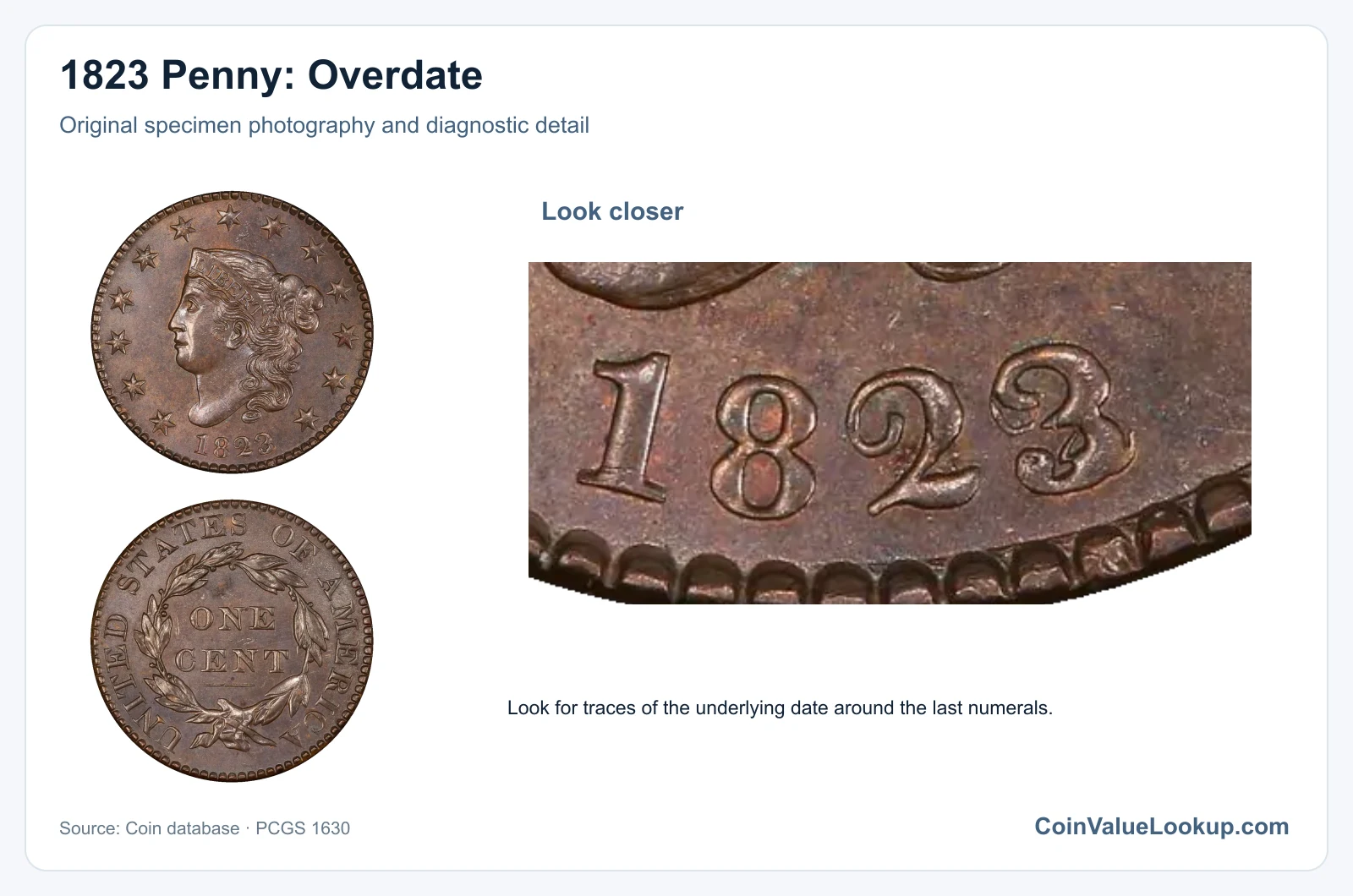
The overdate category on the 1823 Coronet Head Cent refers primarily to the well-known 1823/2 variety, where the final digit "3" was punched over an earlier "2" in the die. You can see surviving contours of the underlying "2" beneath and around the base of the "3," especially under magnification.
Do not mistake a damaged or corroded date for an overdate. Ordinary machine doubling, which shows flat shelf-like doubling, is also not the same thing.
A true overdate shows distinct remnants of a differently shaped numeral underneath the top digit.
The 1823/2 overdate is tracked as its own version with its own guide values, so check the version details above for pricing. If you think you see a different overdate combination, professional attribution is warranted before drawing conclusions.