2004 Kennedy Half Dollar Coin Value: How Much Is It Worth?
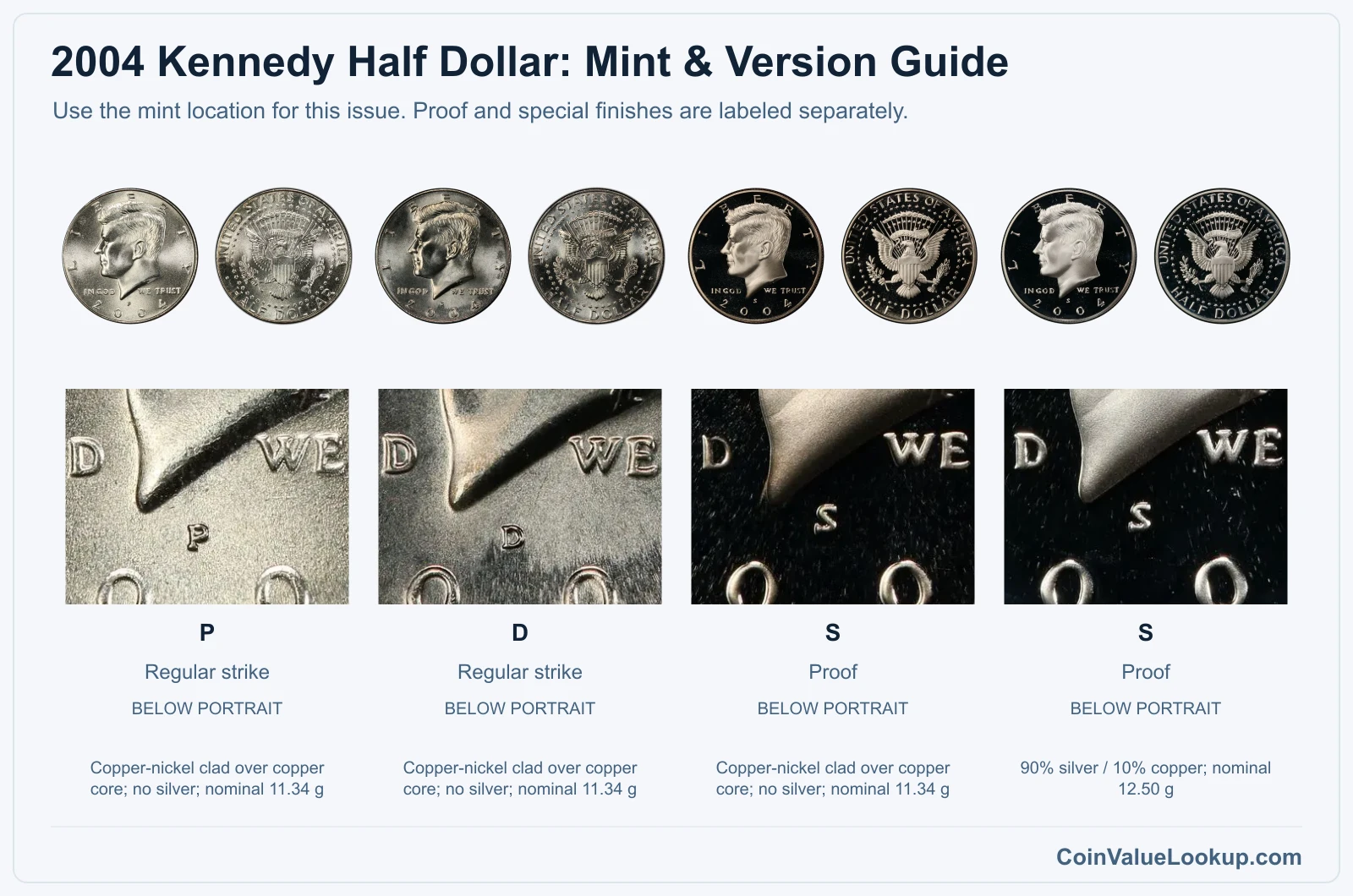
The 2004 Kennedy half dollar carries a face value of fifty cents, and most worn clad examples are worth exactly that. Collector guide estimates for specific mint, finish and grade combinations range from about $3.62 to $42.00.
Before you check a price chart, you need to know whether your coin is an ordinary clad strike, a clad proof or a silver proof, because those branches land in very different value territory.
Fast Way to Identify Your 2004 Kennedy Half Dollar
The quickest way to start sorting out what you have is to upload clear photos of both the front and back of your coin. Our identifier can give you a preliminary read on the mint, finish and general type.
It is not a substitute for professional authentication or grading, but it points you in the right direction before you dig deeper.
2004 Kennedy Half Dollar Value
Upload both sides of your 2004 Kennedy Half Dollar.
Front Obverse
Upload photo
Back Reverse
Upload photo
Which 2004 Kennedy Half Dollar Versions Are Worth Money?
- The 2004-S silver proof commands the highest listed guide value at $42.00 in PR65, thanks to its 90% silver composition.
- Clad proofs from San Francisco carry a PR65 guide estimate of $16.00, well above ordinary business strikes.
- Business-strike P and D coins in MS65 condition list at $3.62; worn examples are generally face-value coins.
- Mint-made errors such as broadstrikes or missing clad layers can add collector interest, though pricing depends on each coin's specifics.
Step 1: Identify Your 2004 Kennedy Half Dollar Mint Mark and Version
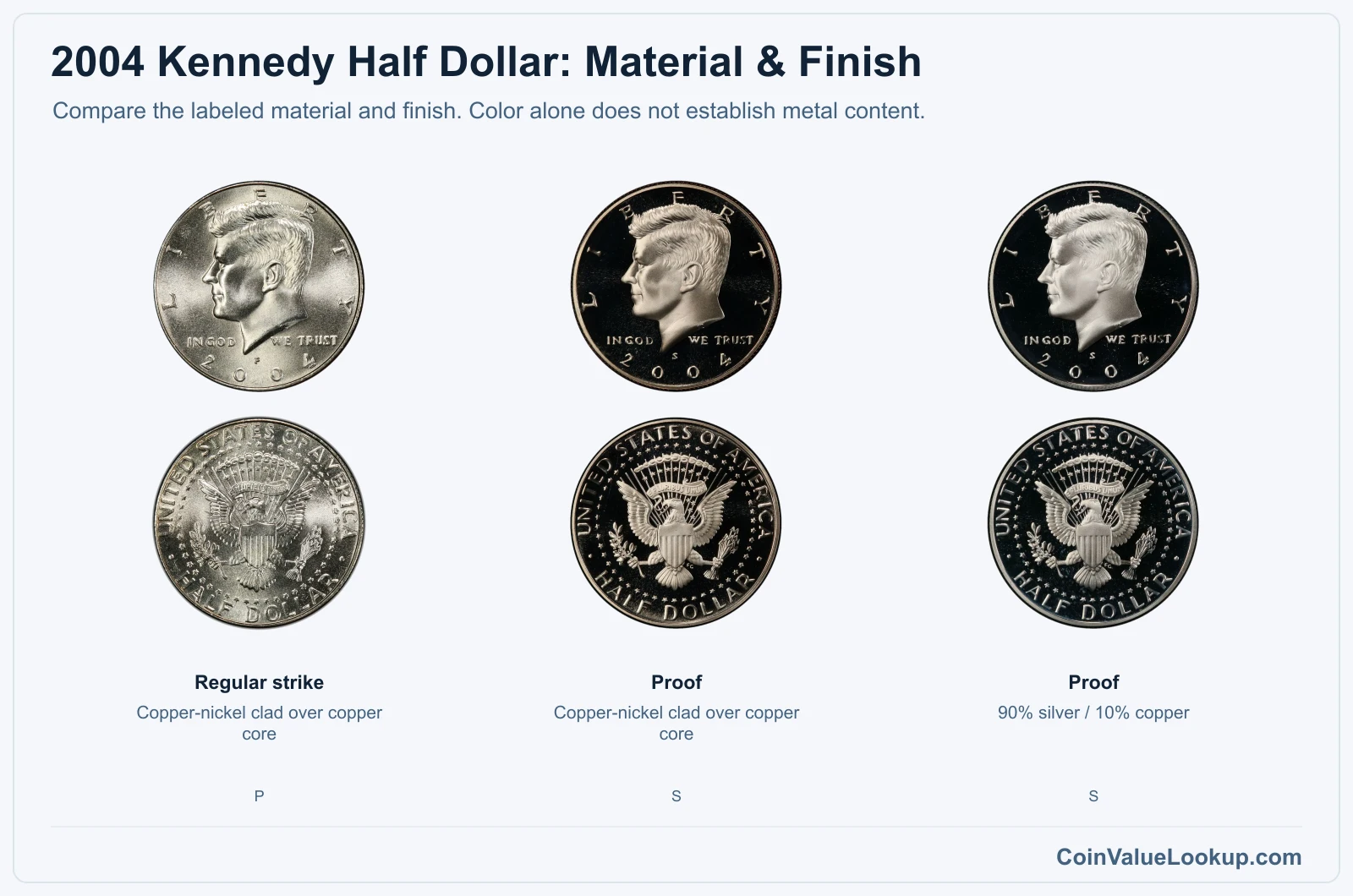
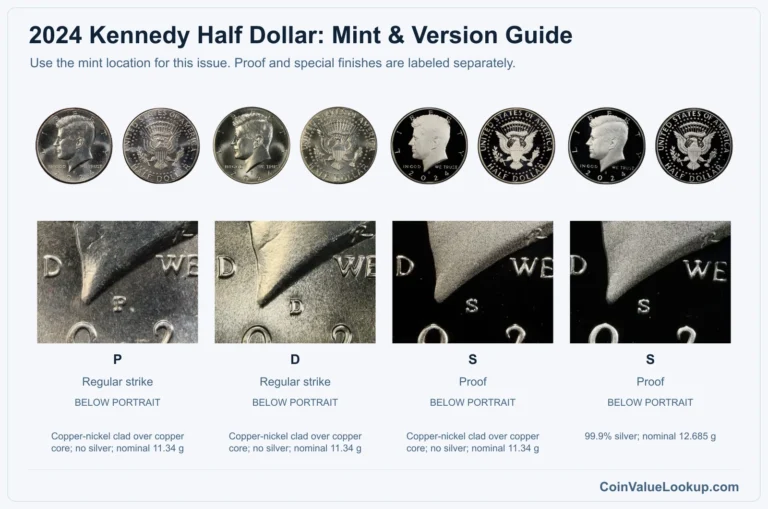
Flip the coin face-up and look just beneath Kennedy's portrait, above the date. That is where the mintmark lives.
A "P" means Philadelphia, a "D" means Denver, and an "S" means San Francisco. Before 1980, Philadelphia coins carried no mintmark at all, but your 2004 will show a P.
The P and D strikes are copper-nickel clad business coins. The S mint produced two different proof versions this year: one clad and one in 90% silver.
Both carry the same S mintmark, so the letter alone will not tell you which alloy you hold.
To separate the silver proof from the clad proof, check the edge. A clad coin shows a visible copper-toned stripe sandwiched between nickel layers.
A silver proof has a uniform silver-colored edge. Weight also helps: the silver version is nominally 12.50 grams versus 11.34 grams for clad.
Original government packaging is the easiest confirmation of all.
Be cautious with color alone. Toning, environmental damage and household plating can make a clad coin look golden or unusually silvery.
Edge inspection and a precise scale are more reliable than eyeballing the surface.
Step 2: Check Your 2004 Kennedy Half Dollar Grade
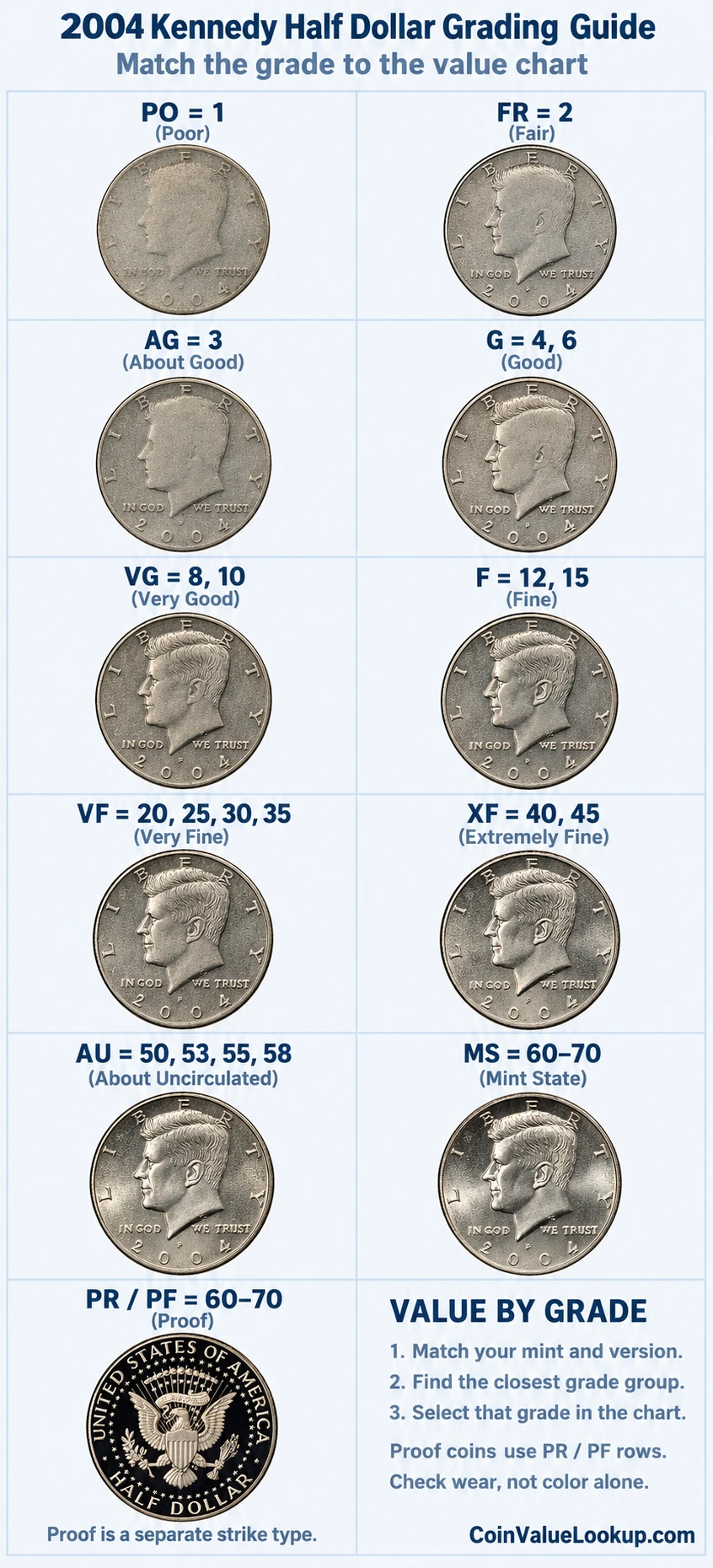
Start with Kennedy's cheek and jawline on the obverse. These high points lose detail first, so any smooth, flattened areas there signal circulation wear.
The hair just above the ear is another early-wear checkpoint.
On the reverse, look at the eagle's breast feathers and the tops of the wings. Flattened feather detail confirms a coin has seen use.
Mint State coins can still look rough. Bag marks, which are small nicks from coins banging together in bulk storage, lower the technical grade even though the coin never circulated.
A coin riddled with bag marks might technically be uncirculated yet grade lower than a lightly handled example.
Proofs deserve their own lens. Grade proof coins by checking for hairlines from improper handling, haze from humidity or PVC exposure, and contact marks on mirrored fields.
These flaws stand out more on proof surfaces than on business strikes. Use the comparison image to calibrate your eye against known grade examples of the same type.
Step 3: Check 2004 Kennedy Half Dollar Value by Mint and Version
2004 Kennedy Half Dollar — P — clad business
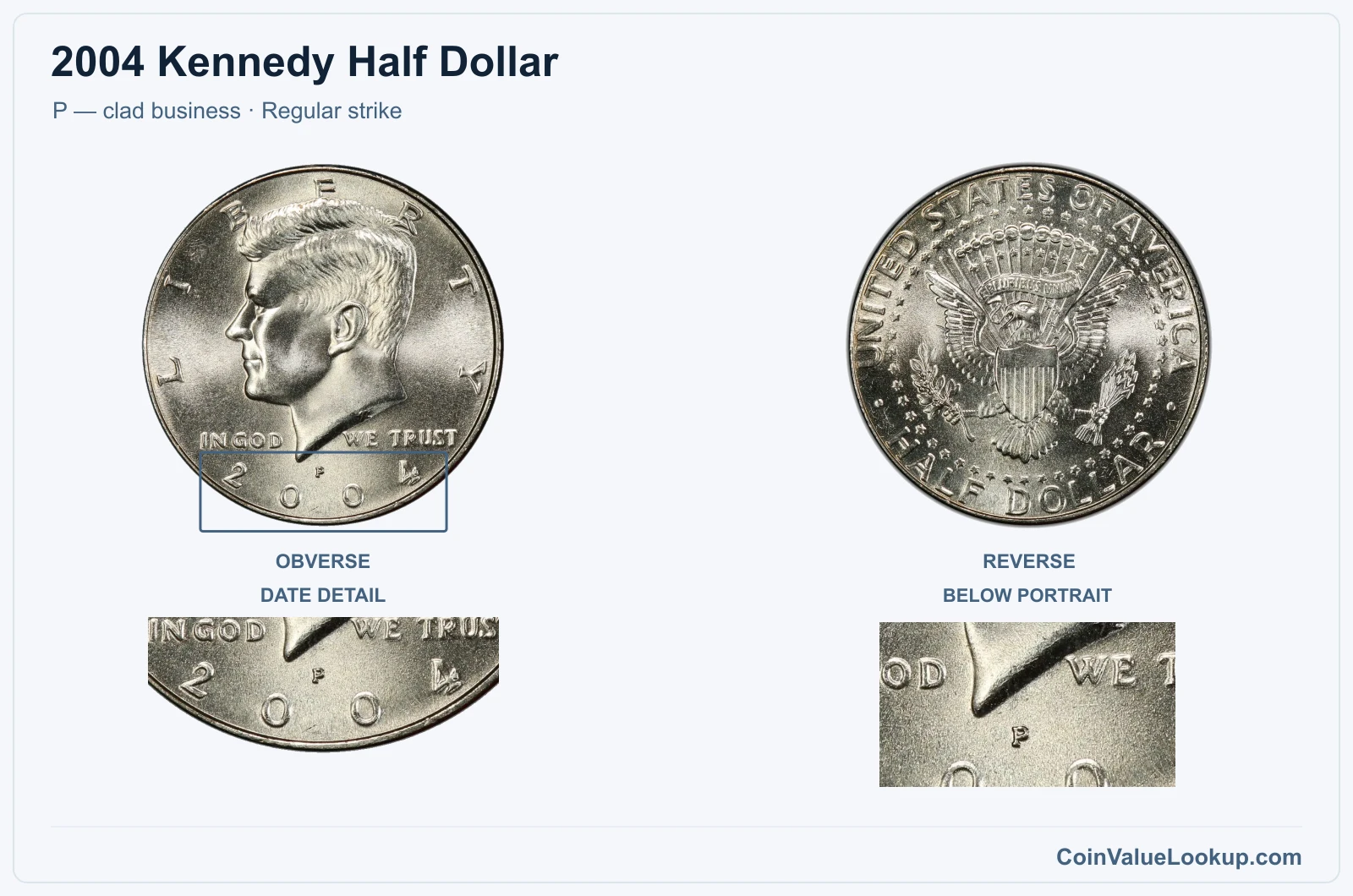
The 2004-P is a copper-nickel clad business strike with a "P" mintmark beneath Kennedy's portrait. Most of these were sold in mint sets rather than released into everyday pocket change.
That means truly circulated examples were often spent out of broken-up sets.
Worn coins are worth fifty cents. In MS65 condition, the USA Coin Book guide estimate is $3.62.
If you find one in original mint-set packaging with clean surfaces and minimal bag marks, that is the version worth grading carefully against the chart.
Range Grade
Price Auction Records Appraisal PO PO 1
—
Coin Identifier FR FR 2
—
Coin Identifier AG AG 3
—
Coin Identifier G G 4
—
Coin Identifier
G 6
—
Coin Identifier VG VG 8
—
Coin Identifier
VG 10
—
Coin Identifier F F 12
—
Coin Identifier
F 15
—
Coin Identifier VF VF 20
—
Coin Identifier
VF 25
—
Coin Identifier
VF 30
—
Coin Identifier
VF 35
—
Coin Identifier XF XF 40
—
Coin Identifier
XF 45
—
Coin Identifier AU AU 50
—
Coin Identifier
AU 53
—
Coin Identifier
AU 55
—
Coin Identifier
AU 58
—
Coin Identifier MS MS 60
—
Coin Identifier
MS 61
—
Coin Identifier
MS 62
—
Coin Identifier
MS 63
—
Coin Identifier
MS 64
—
Coin Identifier
MS 65
—
Coin Identifier
MS 66
Coin Identifier
MS 67
Coin Identifier
MS 68
—
Coin Identifier
MS 69
—
—
—
MS 70
—
—
—
2004 Kennedy Half Dollar — D — clad business
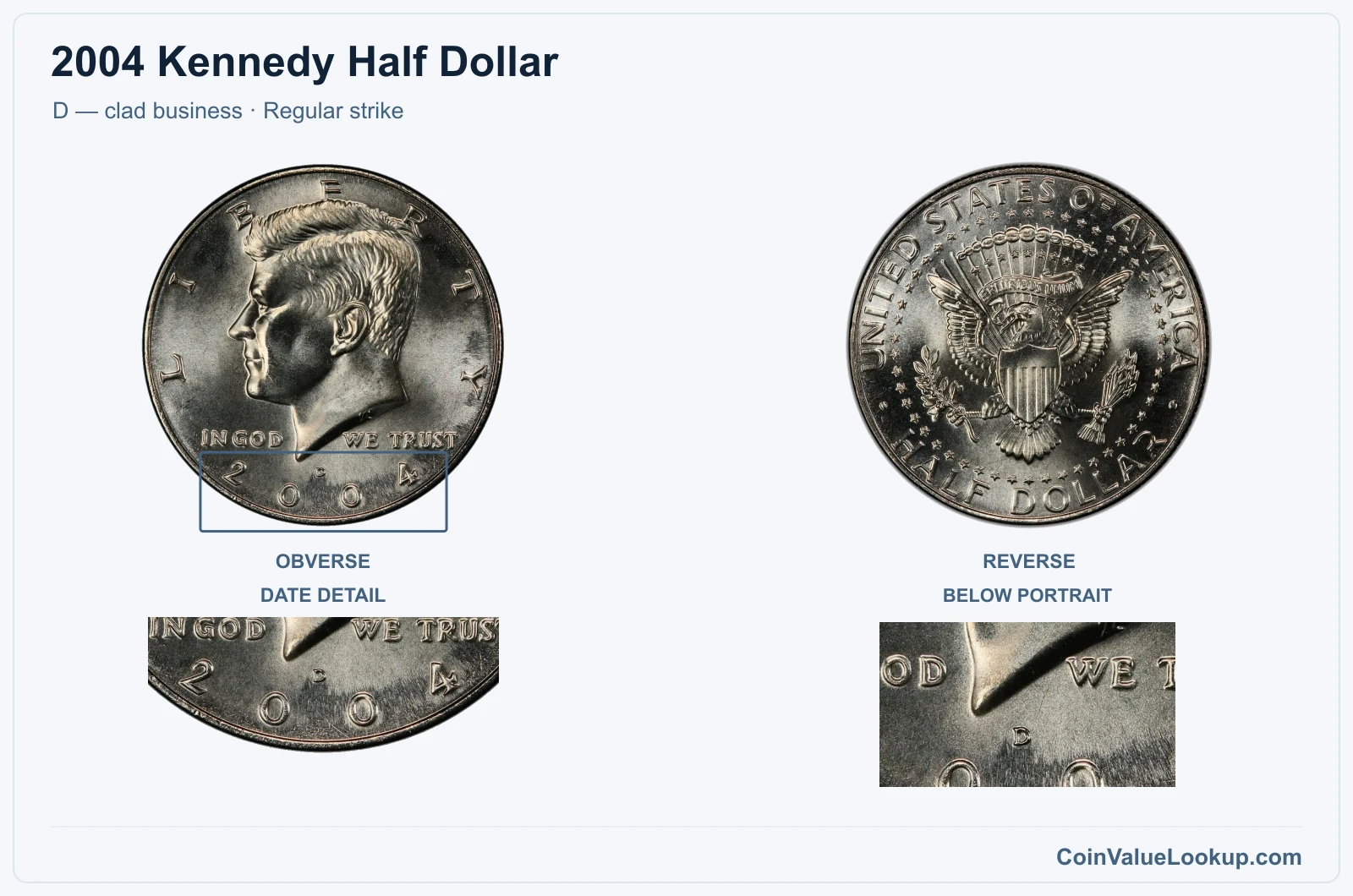
The 2004-D is the Denver counterpart, same copper-nickel clad composition at a nominal 11.34 grams. Look for the "D" mintmark in the usual spot beneath Kennedy's portrait.
Like the Philadelphia issue, these were primarily distributed through mint sets rather than bank rolls. A circulated example is a face-value coin.
The MS65 guide estimate from USA Coin Book sits at $3.62. Original mint-set coins with strong luster and few contact marks are the ones worth a second look.
Coin Value Lookup is a good starting point if you want to compare this year's values against other Kennedy half dollar dates in one place.
Range Grade
Price Auction Records Appraisal PO PO 1
—
Coin Identifier FR FR 2
—
Coin Identifier AG AG 3
—
Coin Identifier G G 4
—
Coin Identifier
G 6
—
Coin Identifier VG VG 8
—
Coin Identifier
VG 10
—
Coin Identifier F F 12
—
Coin Identifier
F 15
—
Coin Identifier VF VF 20
—
Coin Identifier
VF 25
—
Coin Identifier
VF 30
—
Coin Identifier
VF 35
—
Coin Identifier XF XF 40
—
Coin Identifier
XF 45
—
Coin Identifier AU AU 50
—
Coin Identifier
AU 53
—
Coin Identifier
AU 55
—
Coin Identifier
AU 58
—
Coin Identifier MS MS 60
—
Coin Identifier
MS 61
—
Coin Identifier
MS 62
—
Coin Identifier
MS 63
—
Coin Identifier
MS 64
—
Coin Identifier
MS 65
Coin Identifier
MS 66
Coin Identifier
MS 67
Coin Identifier
MS 68
Coin Identifier
MS 69
—
—
—
MS 70
—
—
—
2004 Kennedy Half Dollar — S — clad proof
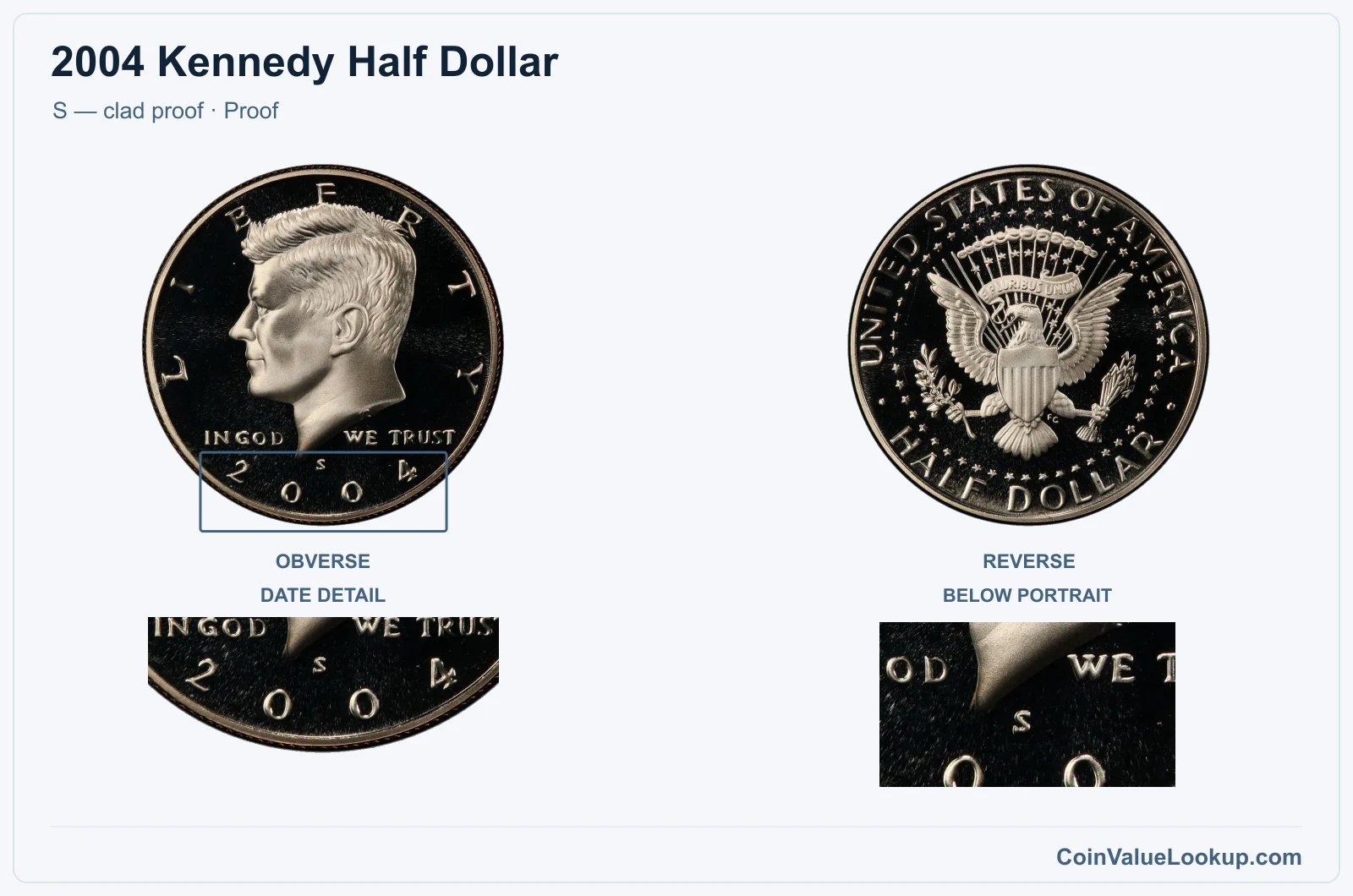
The 2004-S clad proof was struck at San Francisco on copper-nickel clad planchets with the same 11.34-gram weight as business strikes. The difference is the finish: mirror-like fields with frosted raised devices.
Do not assume every S-mint coin is silver. This clad proof shares the same mintmark as the silver version.
Check the edge for that telltale copper stripe between nickel layers. If you see it, you have the clad proof.
The USA Coin Book guide estimate is $16.00 in PR65. Hairlines from mishandling and haze from storage are the usual grade-killers on proof Kennedys.
Keep the original government capsule sealed when possible.
Range Grade
Price Auction Records Appraisal PR PR 1
—
Coin Identifier
PR 2
—
Coin Identifier
PR 3
—
Coin Identifier
PR 4
—
Coin Identifier
PR 6
—
Coin Identifier
PR 8
—
Coin Identifier
PR 10
—
Coin Identifier
PR 12
—
Coin Identifier
PR 15
—
Coin Identifier
PR 20
—
Coin Identifier
PR 25
—
Coin Identifier
PR 30
—
Coin Identifier
PR 35
—
Coin Identifier
PR 40
—
Coin Identifier
PR 45
—
Coin Identifier
PR 50
—
Coin Identifier
PR 53
—
Coin Identifier
PR 55
—
Coin Identifier
PR 58
—
Coin Identifier
PR 60
—
Coin Identifier
PR 61
—
Coin Identifier
PR 62
—
Coin Identifier
PR 63
—
Coin Identifier
PR 64
—
Coin Identifier
PR 65
—
Coin Identifier
PR 66
—
Coin Identifier
PR 67
—
Coin Identifier
PR 68
Coin Identifier
PR 69
Coin Identifier
PR 70
Coin Identifier
2004 Kennedy Half Dollar — S — silver proof
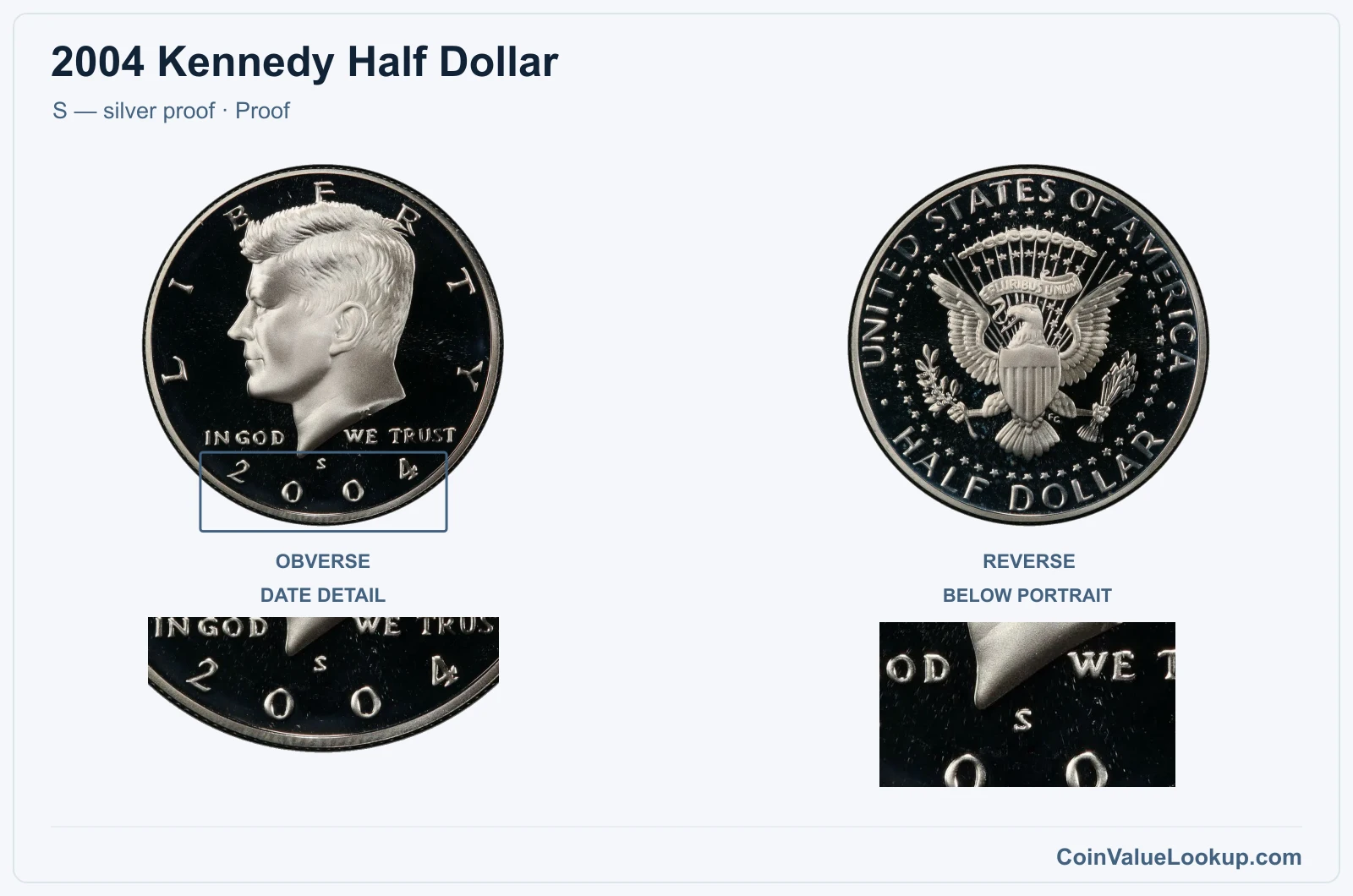
This is the one collectors pay attention to. The 2004-S silver proof is struck on a 90% silver, 10% copper planchet weighing a nominal 12.50 grams.
That extra gram-plus of weight compared to clad is noticeable on a good scale.
The edge is your best visual clue: it should look uniformly silver-toned with no copper sandwich line. Original mint packaging confirms the alloy beyond any doubt.
USA Coin Book lists the PR65 guide estimate at $42.00, the highest of all four 2004 Kennedy branches at their listed grades. Handle these carefully.
Even minor hairlines on those deep mirror fields can drop the grade and reduce collector appeal. Note that the silver fineness for Kennedy proofs changed to .999 starting in 2019; the 2004 version is the traditional .900 fine alloy.
Range Grade
Price Auction Records Appraisal PR PR 1
—
Coin Identifier
PR 2
—
Coin Identifier
PR 3
—
Coin Identifier
PR 4
—
Coin Identifier
PR 6
—
Coin Identifier
PR 8
—
Coin Identifier
PR 10
—
Coin Identifier
PR 12
—
Coin Identifier
PR 15
—
Coin Identifier
PR 20
—
Coin Identifier
PR 25
—
Coin Identifier
PR 30
—
Coin Identifier
PR 35
—
Coin Identifier
PR 40
—
Coin Identifier
PR 45
—
Coin Identifier
PR 50
—
Coin Identifier
PR 53
—
Coin Identifier
PR 55
—
Coin Identifier
PR 58
—
Coin Identifier
PR 60
—
Coin Identifier
PR 61
—
Coin Identifier
PR 62
—
Coin Identifier
PR 63
—
Coin Identifier
PR 64
—
Coin Identifier
PR 65
—
Coin Identifier
PR 66
—
Coin Identifier
PR 67
—
Coin Identifier
PR 68
Coin Identifier
PR 69
Coin Identifier
PR 70
Coin Identifier
2004 Kennedy Half Dollar Error List
1. 2004 Kennedy Half Dollar — Struck-Through Error
A struck-through error happens when foreign material, often grease or a small fragment, sits on the die or planchet during striking. The result is a localized depression or an area of incomplete design where the obstruction blocked the metal from fully forming.
On a 2004 Kennedy half dollar, look for a distinct soft spot, sometimes with a faint outline of the intruding material, that does not match normal wear. Grease fills tend to produce smooth, shallow depressions, while retained foreign objects may leave a sharper impression.
Do not confuse this with ordinary weak strikes, post-mint scratches or cleaned surfaces. Wear gradually flattens high points across the design; a struck-through defect is usually isolated to one area.
Value depends on size, location and overall coin condition. No reliable numerical range is available for this year, so individual assessment matters.
2. 2004 Kennedy Half Dollar — Clashed Dies
Die clash errors occur when the obverse and reverse dies strike each other without a planchet between them. Each die picks up a partial impression of the opposite design.
When the next coin is struck, those ghost images transfer onto the coin's surface.
On a 2004 Kennedy half, look for faint traces of the eagle design ghosted onto Kennedy's portrait, or elements of Kennedy's profile appearing in the reverse fields. The transferred features should align with where the opposing die would naturally contact.
Do not mistake random scratches, raised lines from die polishing, or post-mint damage for a clash. True clash marks follow a predictable pattern tied to die orientation.
The value of a clashed-die Kennedy depends on how visible and dramatic the transferred design is. No adopted price range is available for this date, so each example needs to be evaluated individually.
3. 2004 Kennedy Half Dollar — Broadstrike
A broadstrike occurs when a coin is struck without proper collar confinement. The collar die normally restrains the planchet's edge and forms the reeded or plain rim profile.
Without it, the metal spreads outward, producing a coin that is wider than normal with a distorted or absent rim.
On a 2004 Kennedy half, the full design should still be present, just spread slightly toward the edges. The coin will look noticeably larger or flatter at the rim compared to a normal example.
Check the edge profile carefully.
This is different from an off-center strike, where part of the design is missing entirely. It is also different from a coin that was squashed or flattened after it left the mint.
Post-mint damage lacks the uniform radial spread and will often show tool marks. No adopted price range exists for this year; condition and degree of spread determine collector interest.
4. 2004 Kennedy Half Dollar — Missing Clad Layer
A missing clad layer error means one of the outer nickel-alloy layers was absent from the planchet before striking. The exposed side shows the copper core directly, giving that face a distinctly copper-colored appearance instead of the usual silvery tone.
To check a 2004 Kennedy half, compare the suspect face to a normal coin. Also examine the edge: a coin missing one clad layer will show an asymmetric sandwich, with copper visible on one face and normal cladding on the other.
The coin should also weigh less than the standard 11.34 grams.
Do not confuse this with environmental toning, corrosion or coins where someone chemically stripped the surface after minting. Post-mint damage tends to look uneven and rough, while a genuine missing-clad error produces a smooth copper surface with full design detail.
No numerical price range is available for this date; the value depends on which side is affected, overall condition and visual impact.