1925 Mercury Dime Coin Value: How Much Is It Worth?
A 1925 Mercury Dime in well-worn condition starts around $7 to $9 depending on the mint, while uncirculated examples can climb into the hundreds or even thousands. USA Coin Book guide estimates place the Philadelphia issue at roughly $7.16 in G4 up to $316 in MS65, and the Denver mint coin reaches about $2,078 in MS65.
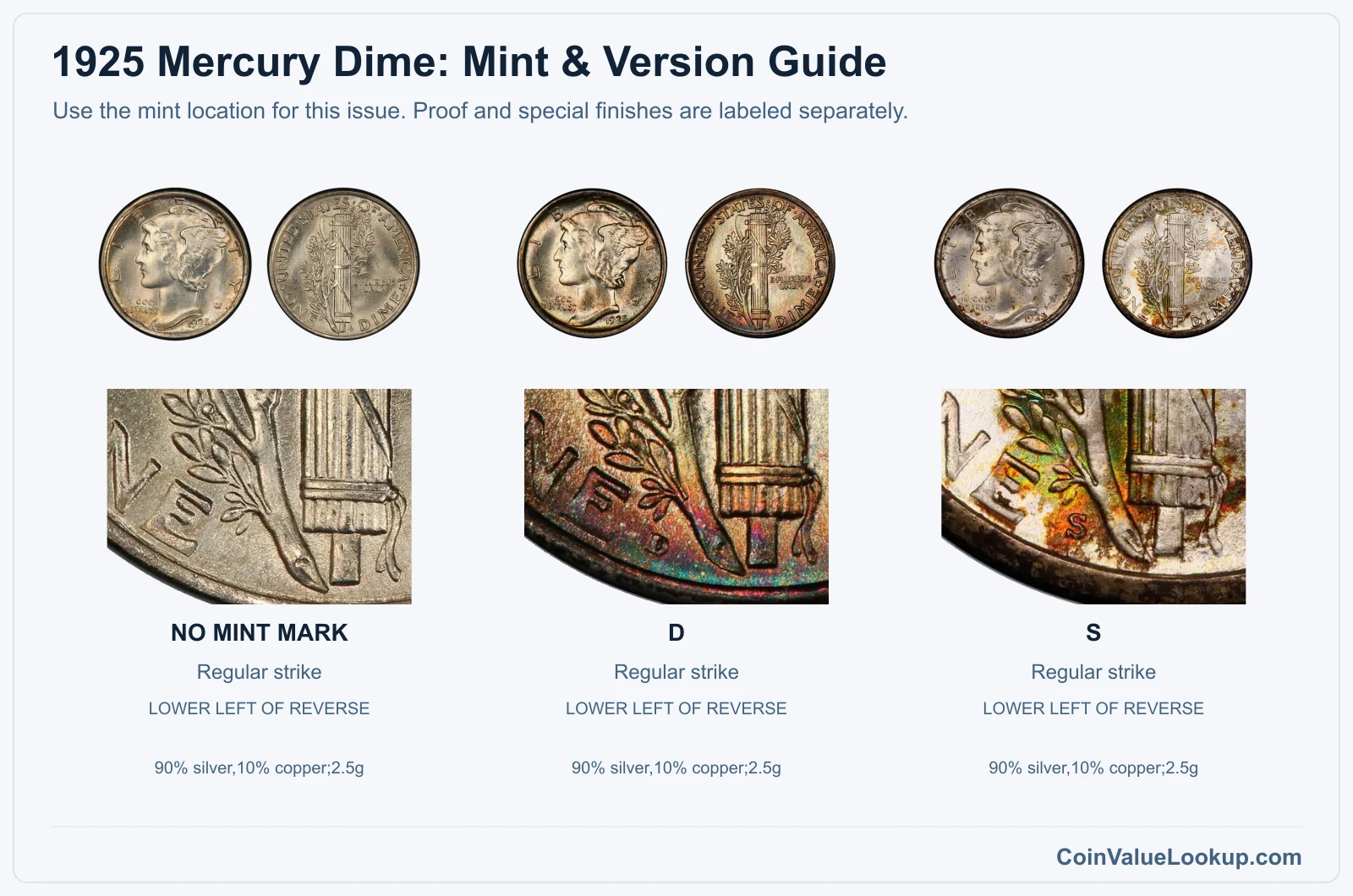
Three mints produced this date — Philadelphia, Denver, and San Francisco — so the first step is checking for a mintmark.
Fast Way to Identify Your 1925 Mercury Dime
The quickest way to get a preliminary read on your 1925 Mercury Dime is to upload clear photos of both sides. A front shot shows the date and condition of Liberty's details, while the back reveals the mintmark and fasces bands.
Snap both in good light and upload them for a starting-point identification.
1925 Mercury Dime Value
Upload both sides of your 1925 Mercury Dime.
Front Obverse
Upload photo
Back Reverse
Upload photo
Which 1925 Mercury Dime Versions Are Worth Money?
- The 1925-D (Denver) in MS65 carries a USA Coin Book guide estimate of about $2,078, the highest listed figure among the three mints at that grade.
- The 1925-S (San Francisco) in MS65 is estimated around $1,526 by the same guide, making high-grade survivors from that mint worth checking carefully.
- Coins with fully separated fasces bands — the Full Bands designation — can command premiums above standard Mint State prices across all three mints.
- Mint State examples from any facility with original, unimpaired luster are considerably more valuable than circulated pieces, which cluster near silver-melt levels.
Step 1: Identify Your 1925 Mercury Dime Mint Mark and Version
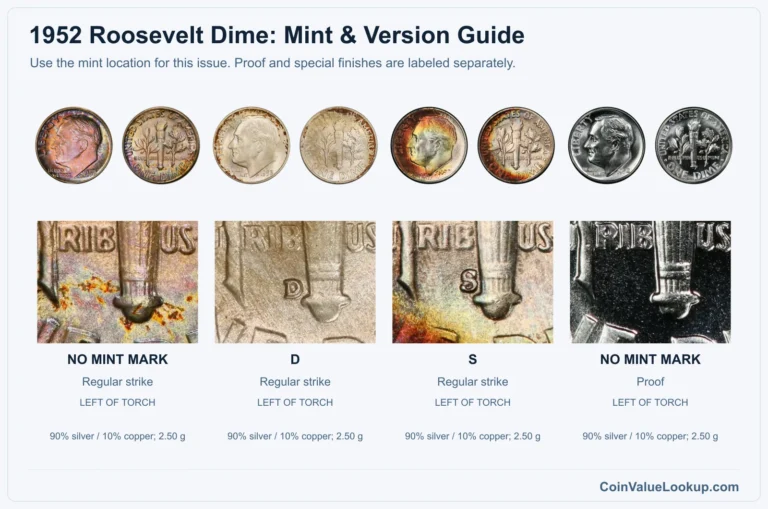
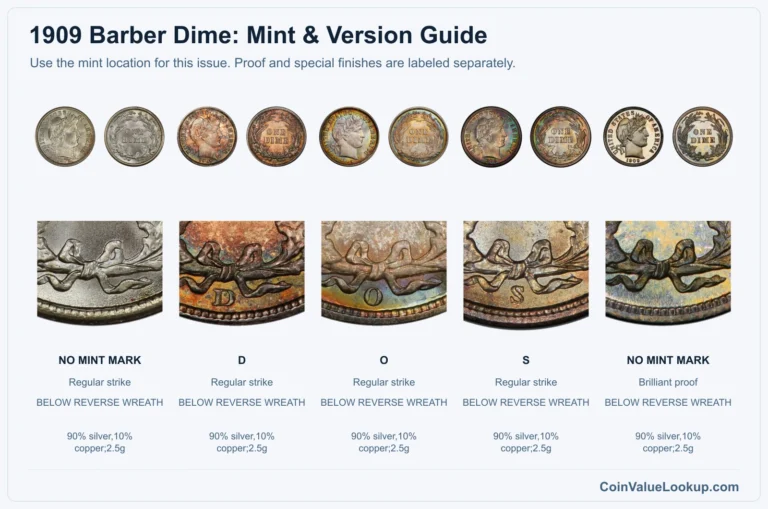
The 1925 Mercury Dime was struck at three facilities: Philadelphia, Denver, and San Francisco. Philadelphia coins carry no mintmark at all.
Denver coins show a small "D" and San Francisco coins show an "S," both located on the reverse at the lower left, just beside the word ONE.
Don't confuse the "AW" monogram on the obverse with a mintmark — those are the initials of designer Adolph Weinman. There is no proof issue for 1925 and no major overdate variety for this year.
All three versions are struck in 90% silver and 10% copper, weigh about 2.5 grams, and measure 17.9 mm with a reeded edge. The silver content alone gives every 1925 dime a baseline melt value, so even a heavily worn example is worth more than face value.
Step 2: Check Your 1925 Mercury Dime Grade
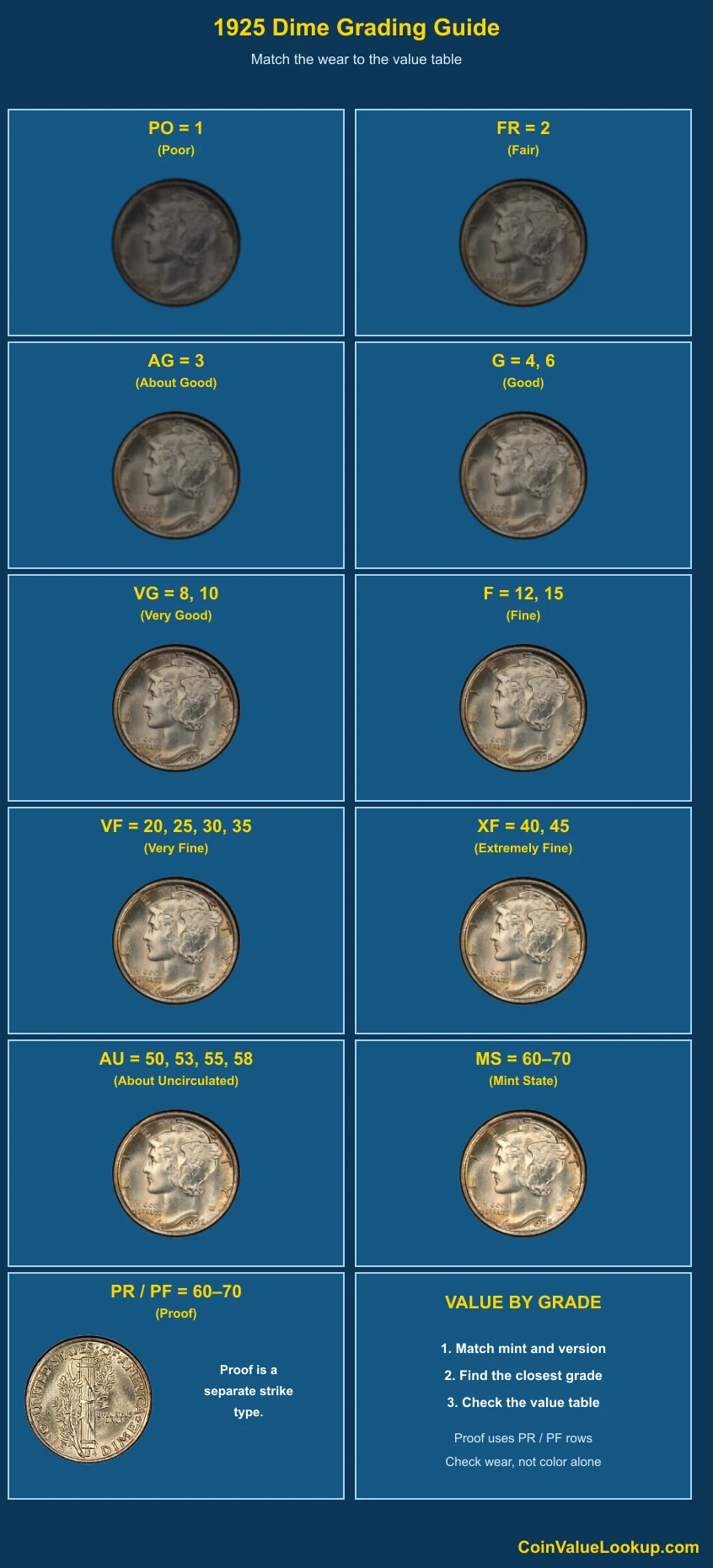
Start by looking at Liberty's hair just above and in front of her ear. On a lightly circulated coin, you'll see the strands beginning to merge; on a well-worn piece, that area is flat.
The wings on the cap and the feather detail tell a similar story.
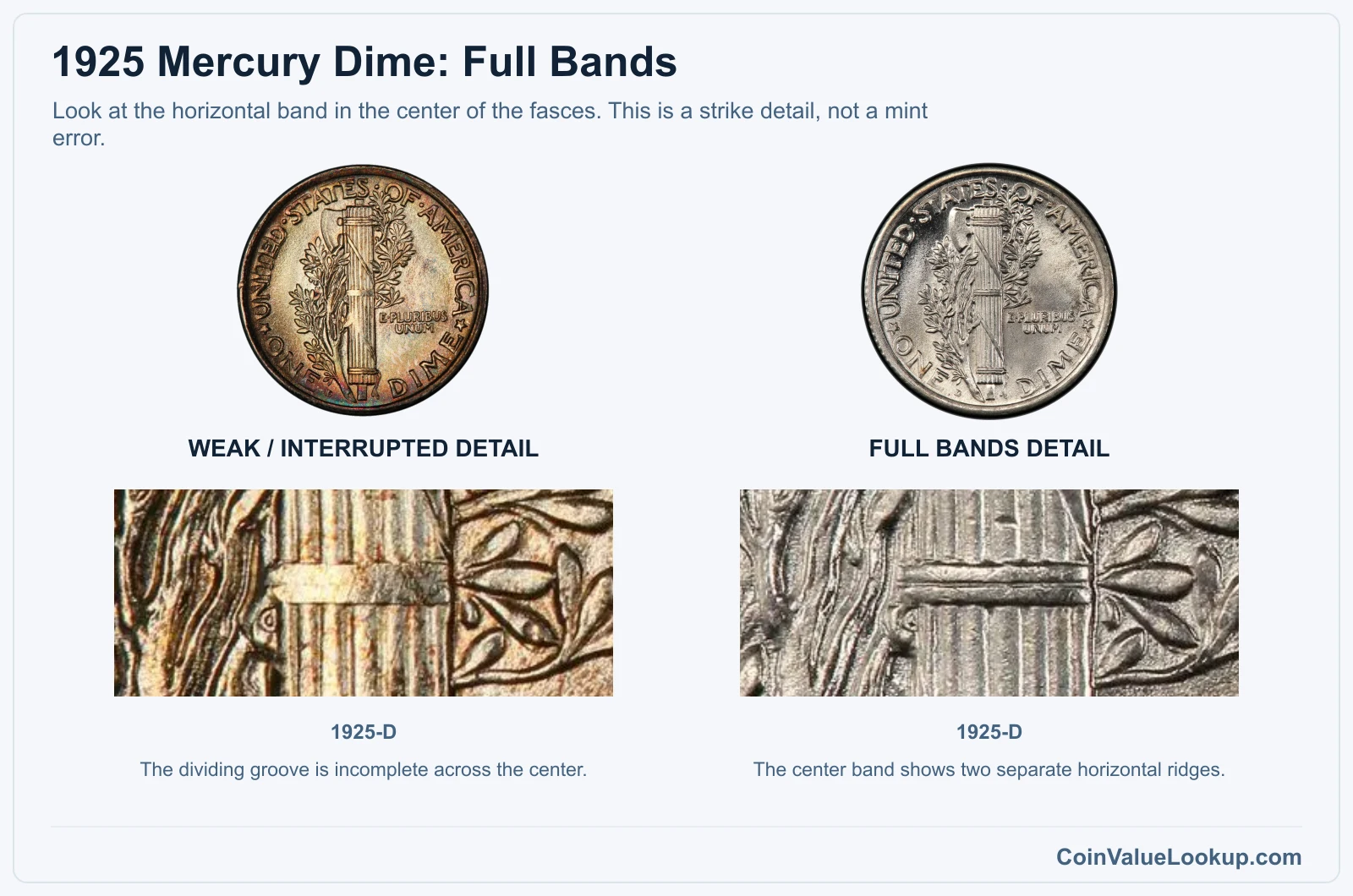
Flip to the reverse and examine the fasces — the bundle of rods and bands. Wear hits those horizontal bands early, so they're a good barometer.
A coin with full, sharp band separation may qualify for a Full Bands designation, which is a strike quality label, not an error or a higher grade category.
Compare your coin to the reference image to gauge where it falls. Watch for signs of cleaning such as unnatural shine or hairline scratches; a cleaned coin grades lower than a naturally toned one at the same wear level.
Also note that some branch-mint 1925 dimes came weakly struck from the press, so soft details on a lustrous coin may reflect the original strike rather than wear.
Step 3: Check 1925 Mercury Dime Value by Mint and Version
1925 Mercury Dime — No Mint Mark — Silver Circulation
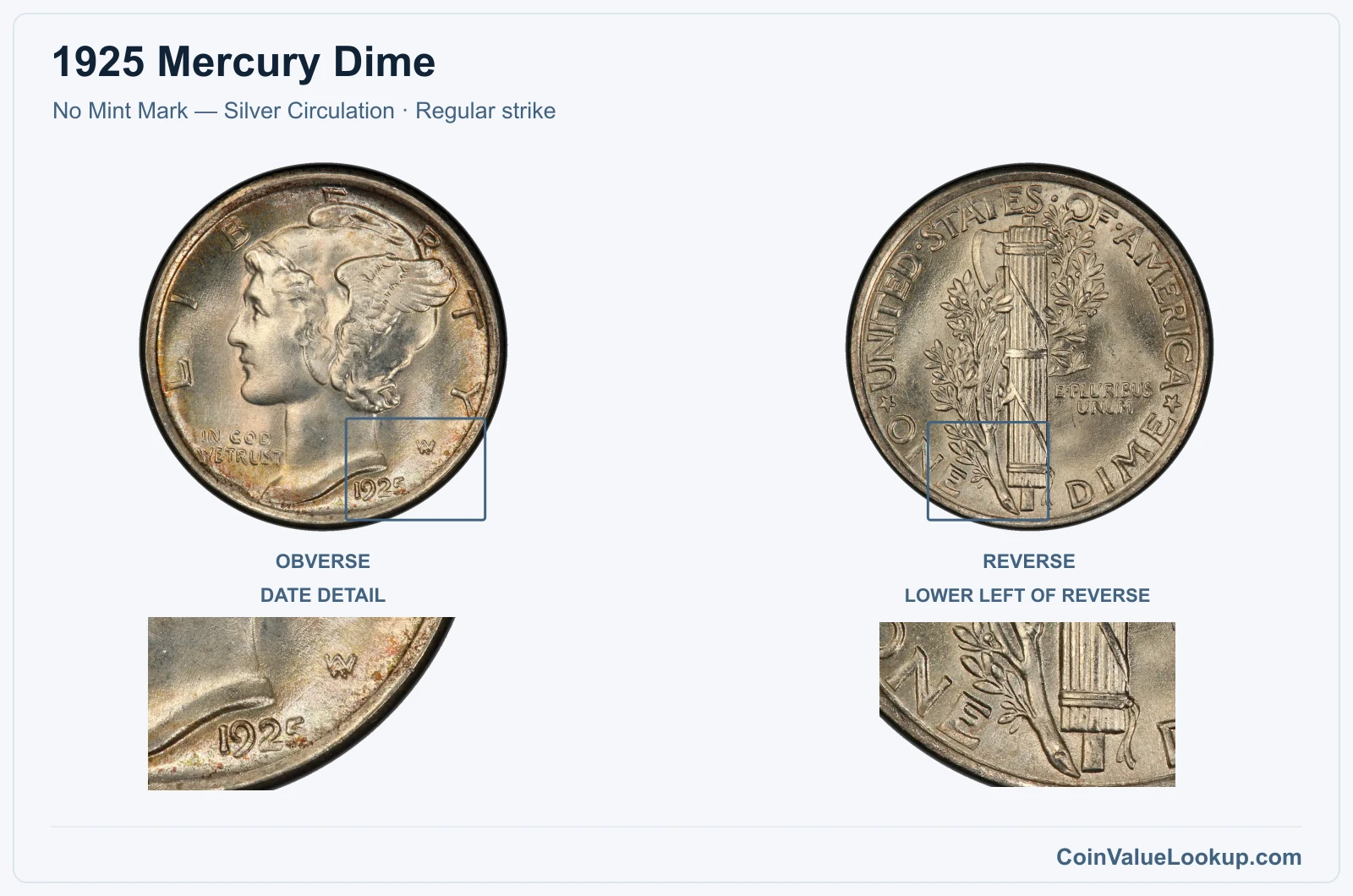
The 1925 Philadelphia dime has no mintmark. Look at both sides of the reverse near the base of the fasces — if you see blank space where a "D" or "S" would sit, you've got the Philly coin.
This is the most common issue of the three for 1925. USA Coin Book estimates place it at about $7.16 in G4 and around $316 in MS65.
Those are guide figures, not guaranteed sale prices, and actual transactions vary with eye appeal and market conditions.
Coin Value Lookup is a handy starting point when you want to look up guides for other dates and denominations in the Mercury Dime series. Bookmark it for your next pocket find.
Range Grade
Price Auction Records Appraisal PO PO 1
—
Coin Identifier FR FR 2
—
Coin Identifier AG AG 3
—
Coin Identifier G G 4
—
Coin Identifier
G 6
—
Coin Identifier VG VG 8
—
Coin Identifier
VG 10
—
Coin Identifier F F 12
—
Coin Identifier
F 15
—
Coin Identifier VF VF 20
—
Coin Identifier
VF 25
—
Coin Identifier
VF 30
—
Coin Identifier
VF 35
—
Coin Identifier XF XF 40
—
Coin Identifier
XF 45
—
Coin Identifier AU AU 50
—
Coin Identifier
AU 53
—
Coin Identifier
AU 55
—
Coin Identifier
AU 58
Coin Identifier MS MS 60
—
Coin Identifier
MS 61
Coin Identifier
MS 62
Coin Identifier
MS 63
Coin Identifier
MS 64
Coin Identifier
MS 65
Coin Identifier
MS 66
Coin Identifier
MS 67
Coin Identifier
MS 68
—
—
—
MS 69
—
—
—
MS 70
—
—
—
1925 Mercury Dime — D — Silver Circulation
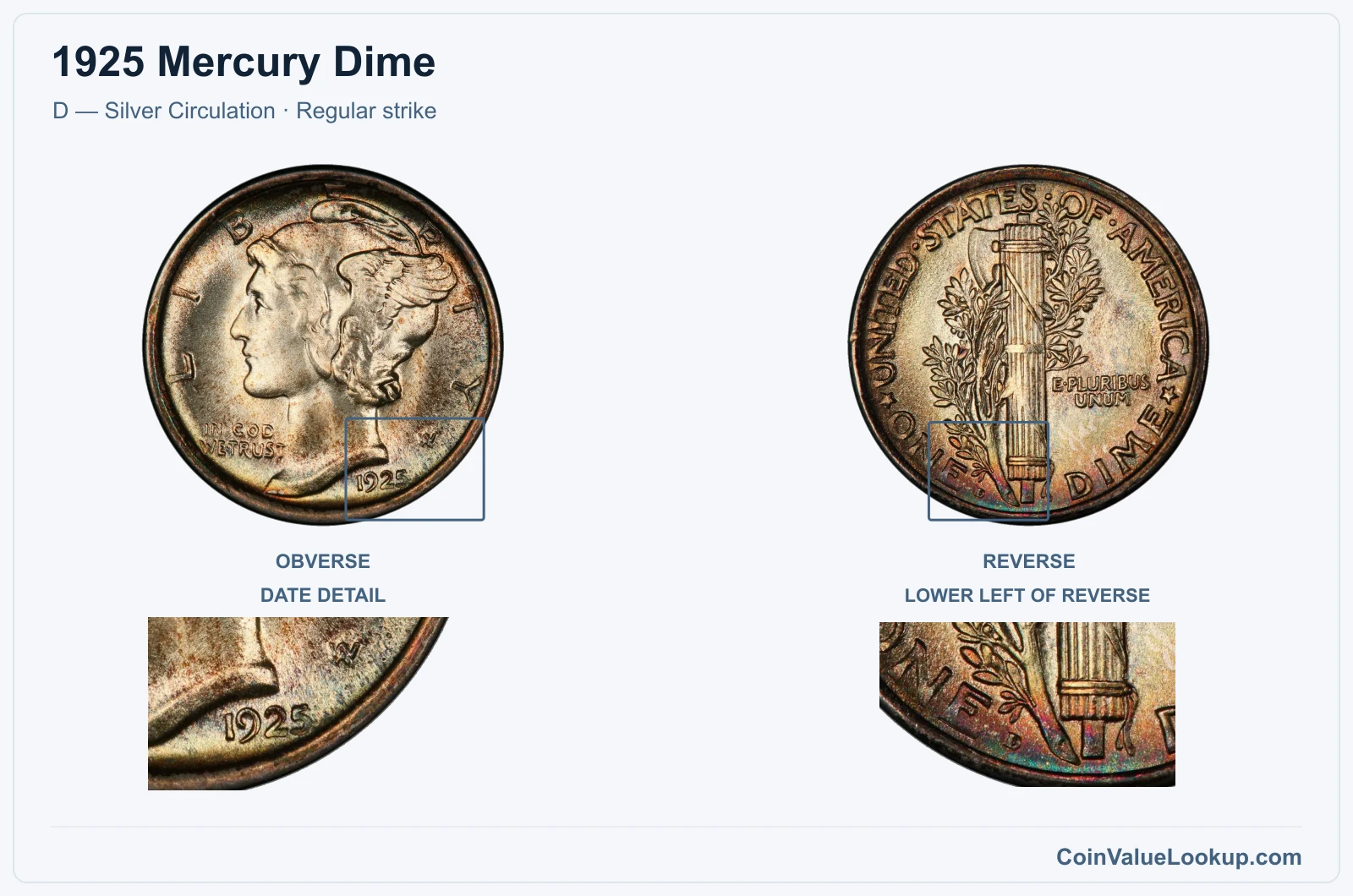
The Denver issue carries a small "D" mintmark on the lower-left reverse beside the word ONE. In lower grades this coin starts around $8.50 in G4 according to USA Coin Book, but things get interesting at the top end: the same guide lists MS65 at roughly $2,078.
That jump reflects the relative scarcity of well-preserved Denver strikes compared to Philadelphia. The 1925-D is the priciest of the three mints at the MS65 level in this guide snapshot.
If your coin is uncirculated with strong luster and clean surfaces, it's worth a careful evaluation. Full Bands examples may carry additional premiums, though no separate Full Bands price is adopted here.
Range Grade
Price Auction Records Appraisal PO PO 1
—
Coin Identifier FR FR 2
—
Coin Identifier AG AG 3
—
Coin Identifier G G 4
—
Coin Identifier
G 6
—
Coin Identifier VG VG 8
Coin Identifier
VG 10
—
Coin Identifier F F 12
—
Coin Identifier
F 15
—
Coin Identifier VF VF 20
Coin Identifier
VF 25
Coin Identifier
VF 30
—
Coin Identifier
VF 35
Coin Identifier XF XF 40
Coin Identifier
XF 45
Coin Identifier AU AU 50
Coin Identifier
AU 53
Coin Identifier
AU 55
Coin Identifier
AU 58
Coin Identifier MS MS 60
—
Coin Identifier
MS 61
Coin Identifier
MS 62
Coin Identifier
MS 63
Coin Identifier
MS 64
Coin Identifier
MS 65
Coin Identifier
MS 66
Coin Identifier
MS 67
—
—
—
MS 68
—
—
—
MS 69
—
—
—
MS 70
—
—
—
1925 Mercury Dime — S — Silver Circulation
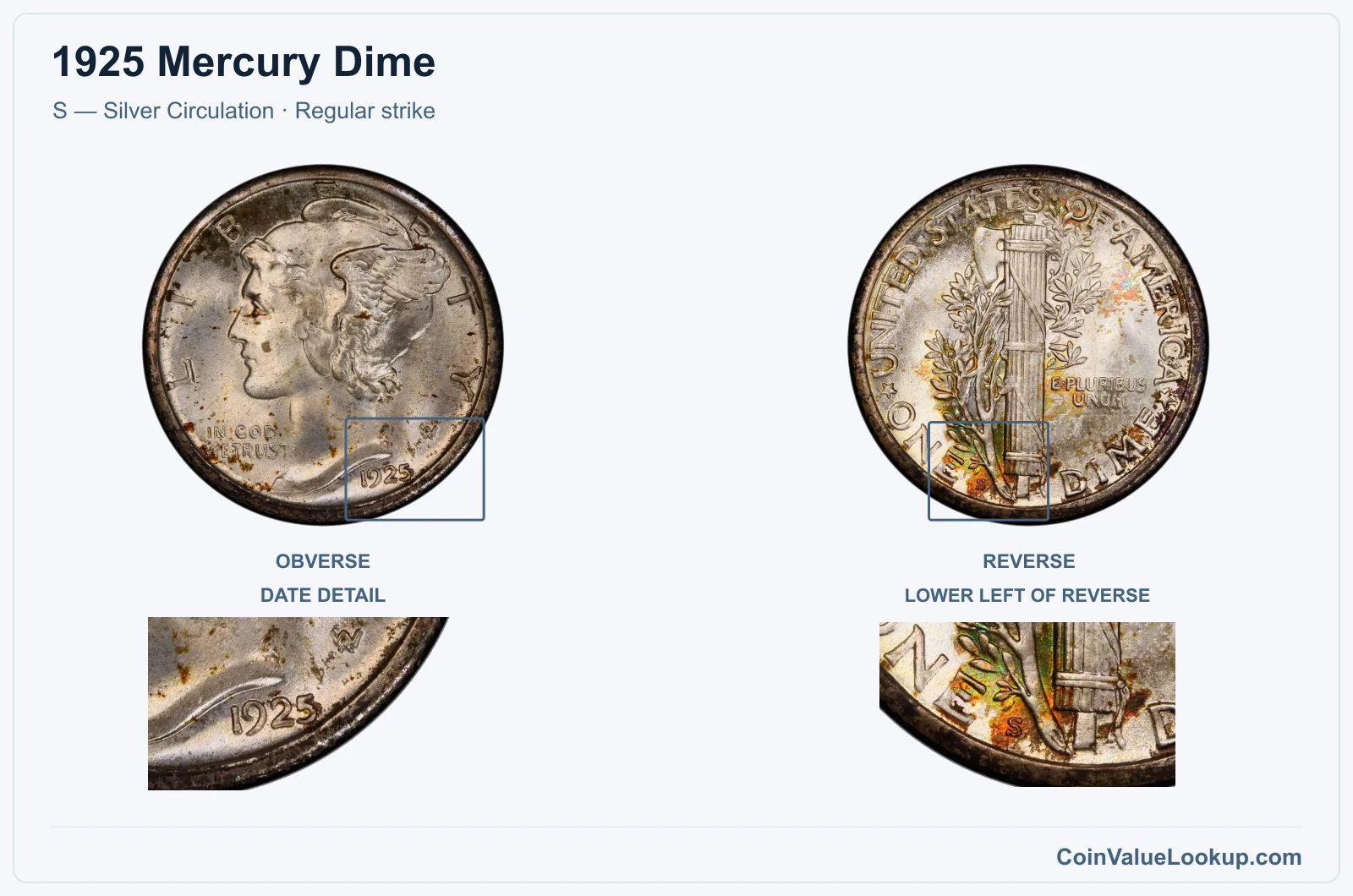
San Francisco's contribution to 1925 carries an "S" mintmark in the same lower-left reverse position. Guide estimates from USA Coin Book put a G4 example at about $7.46 and an MS65 at roughly $1,526.
Like the Denver coin, the spread between low-grade and Mint State reflects how few survived without wear or cleaning. If your 1925-S still has full cartwheel luster and sharp detail on the fasces bands, you're holding something worth examining closely.
Weak strikes are known on San Francisco issues of this era, so compare carefully against the grading image before assuming wear.
Range Grade
Price Auction Records Appraisal PO PO 1
—
Coin Identifier FR FR 2
—
Coin Identifier AG AG 3
—
Coin Identifier G G 4
—
Coin Identifier
G 6
—
Coin Identifier VG VG 8
—
Coin Identifier
VG 10
—
Coin Identifier F F 12
—
Coin Identifier
F 15
Coin Identifier VF VF 20
—
Coin Identifier
VF 25
—
Coin Identifier
VF 30
—
Coin Identifier
VF 35
—
Coin Identifier XF XF 40
Coin Identifier
XF 45
Coin Identifier AU AU 50
Coin Identifier
AU 53
Coin Identifier
AU 55
Coin Identifier
AU 58
Coin Identifier MS MS 60
Coin Identifier
MS 61
Coin Identifier
MS 62
Coin Identifier
MS 63
Coin Identifier
MS 64
Coin Identifier
MS 65
Coin Identifier
MS 66
Coin Identifier
MS 67
—
—
—
MS 68
—
—
—
MS 69
—
—
—
MS 70
—
—
—
1925 Mercury Dime Error List
1. 1925 Mercury Dime — Off-Center Strike
An off-center strike happens when the planchet isn't seated properly in the press, producing a displaced design and an unstruck crescent of blank metal on one side. On a 1925 dime, the key is whether the date remains fully visible — collectors pay far more when it does.
The percentage of off-center shift matters too. A 5% misalignment is minor and adds modest interest; a dramatic 20%+ shift with a readable date is a different story entirely.
Condition, the degree of displacement, and date visibility all factor into value, so no single price covers the category.
Don't confuse an off-center strike with a clipped planchet, one-sided die misalignment, or post-mint damage from being squeezed or flattened outside the Mint. A genuine off-center coin shows the design cleanly shifted, not distorted.
2. 1925 Mercury Dime — Broadstrike
A broadstrike occurs when the coin is struck without the normal collar that constrains its diameter. The result is a dime that spreads outward, appearing slightly wider than normal with a distorted or absent reeded edge.
The full design is present — it just extends farther than it should.
On a 1925 dime, look at the rim and edge profile. A broadstruck coin typically has a smooth or irregular edge instead of the usual reeding, and the design elements near the rim may appear stretched.
The overall condition of the coin and the severity of the spread determine how much additional value the error adds.
Be careful not to confuse a broadstrike with an off-center strike, which shifts the design and leaves a blank crescent, or with a coin that was simply flattened after it left the Mint.
3. 1925 Mercury Dime — Lamination / Split Planchet
A lamination error shows up as a peeling flap, a crack within the metal layers, or a section of the planchet that has partially separated. On a 90% silver dime like the 1925, this typically results from impurities or gas pockets trapped during the alloy preparation.
When examining a suspected lamination, photograph the edge of the coin alongside the affected face. Genuine laminations reveal clean separation planes within the metal itself, not surface scraping.
The size, location, and whether the flap is still retained all influence collector interest.
This can be confused with corrosion pitting, deliberate scraping, or a coin that was cut or filed down after leaving the Mint. True laminations follow the metal's internal structure rather than looking like surface damage.
No specific price is adopted for this category; individual assessment is needed.
4. 1925 Mercury Dime — Die Crack / Die Chip
Die cracks appear as thin raised lines on the coin's surface, transferred from a fracture in the steel die. Die chips are small raised blobs — little lumps of metal filling a void where a piece of the die broke away.
Both are raised features, which distinguishes them from scratches, which are incuse.
On a 1925 dime, run your fingernail across a suspected crack. If it catches slightly because the line sits above the field, that's a good sign.
A scratch digs into the surface and feels opposite. Interior die chips look like tiny raised dots or irregular bumps.
The location and size matter for value. A crack running through a major design element like Liberty's face draws more attention than one in an empty field area.
Corrosion or foreign material stuck to the surface can mimic small die chips, so clean comparison is important.
5. 1925 Mercury Dime — Die Break / Cud
A cud is a specific type of die break where a chunk of the die along the rim breaks away entirely. The coin then shows a raised, featureless blob connected to the rim where that missing piece was.
It's essentially a die chip's bigger, more dramatic cousin.
On a 1925 dime, look along the entire rim on both sides. A genuine cud will interrupt the normal design and rim flow with a smooth, raised lump.
The boundary between the cud and the surviving design should be fairly sharp.
Don't mistake a rim dent or contact ding for a cud — damage from being dropped or hit creates a depressed area, while a cud is raised. Interior die breaks that don't connect to the rim are classified differently.
The size and placement of the cud influence collector interest, but no specific price is adopted for this error on the 1925 dime.