1925 Standing Liberty Quarter Coin Value: How Much Is It Worth?
The 1925 Standing Liberty Quarter is a 90% silver coin that draws steady collector interest nearly a century after it left the press. Guide estimates for this year range from about $17.23 in well-worn condition up to $290.00 at the MS63 grade level, according to USA Coin Book.
Where your coin falls in that spread depends on its condition, strike quality and whether the surfaces are original. Mint, wear and design details all matter, so let's walk through what to look for.
Fast Way to Identify Your 1925 Standing Liberty Quarter
The quickest way to start figuring out what your 1925 quarter is worth is to upload clear photos of both sides. Our identifier can give you a preliminary read on the coin's version and general condition from front and back images.
It is not a substitute for professional grading or authentication, but it gets you pointed in the right direction fast.
1925 Standing Liberty Quarter Value
Upload both sides of your 1925 Standing Liberty Quarter.
Front Obverse
Upload photo
Back Reverse
Upload photo
Which 1925 Standing Liberty Quarter Versions Are Worth Money?
- 1925 Philadelphia — the sole mint for this date; guide estimates reach $290.00 at MS63, making high-grade survivors the ones to watch.
- Check condition and strike carefully; a coin with a Full Head strike in uncirculated condition commands stronger demand than a typical soft-struck example.
Step 1: Identify Your 1925 Standing Liberty Quarter Mint Mark and Version
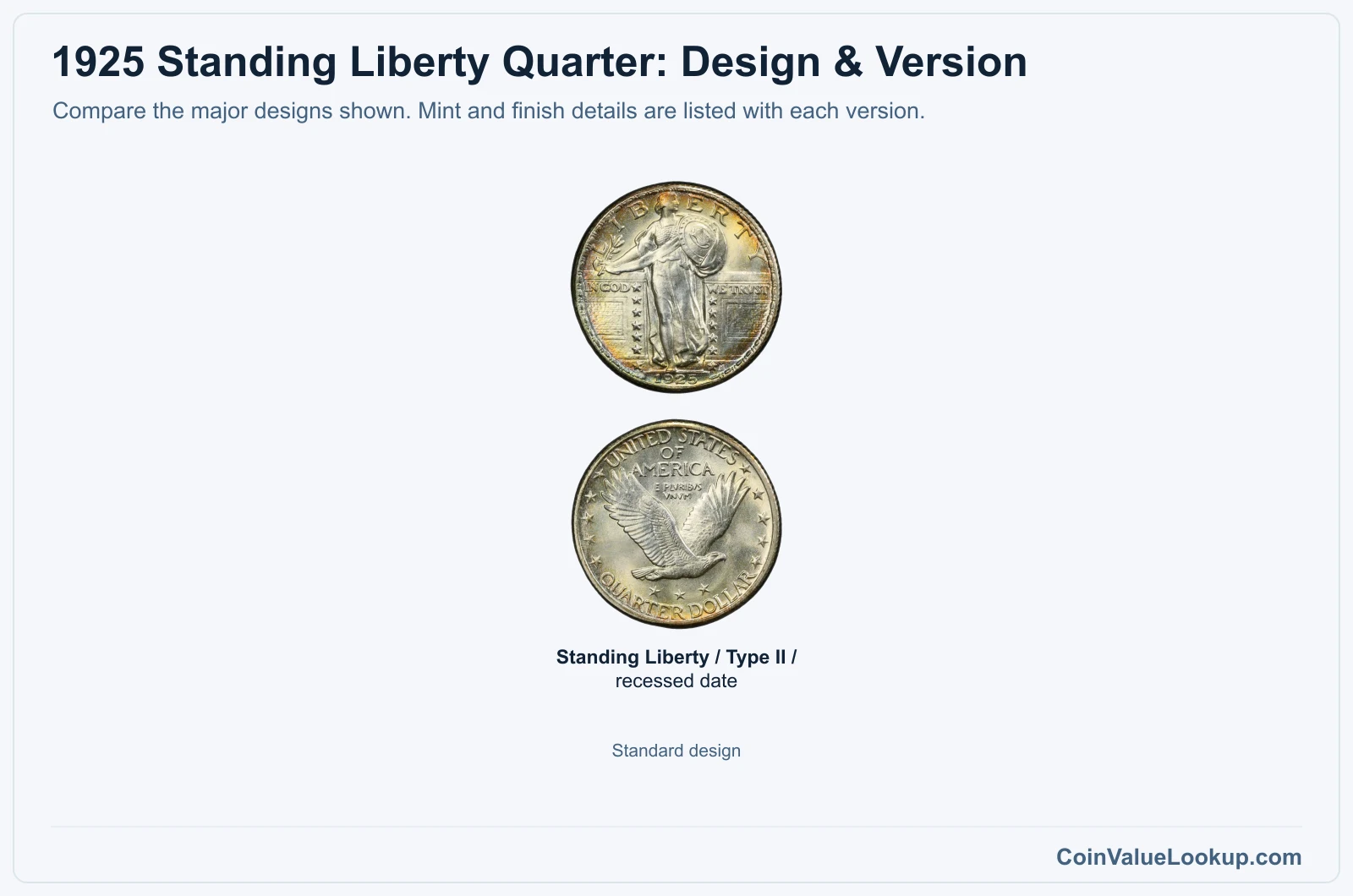
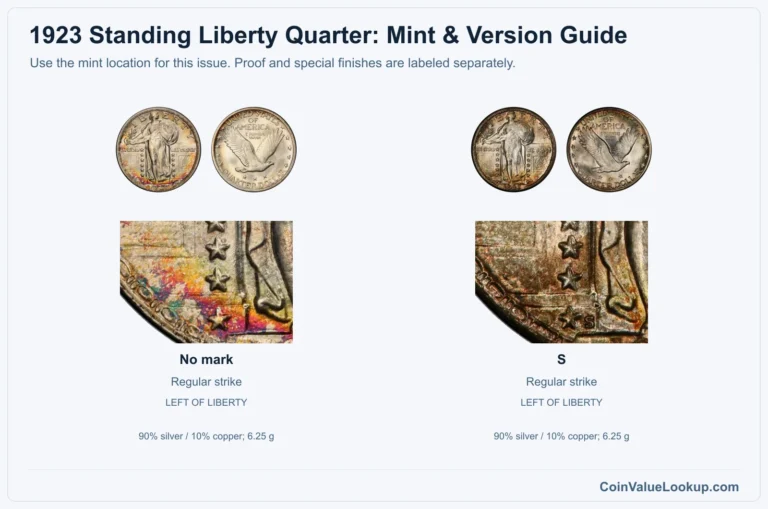
The 1925 Standing Liberty Quarter was struck only at the Philadelphia Mint, so there is no mintmark on a genuine example. If you see a D or S near the left base of the wall beside Liberty on the obverse, you are looking at a different year.
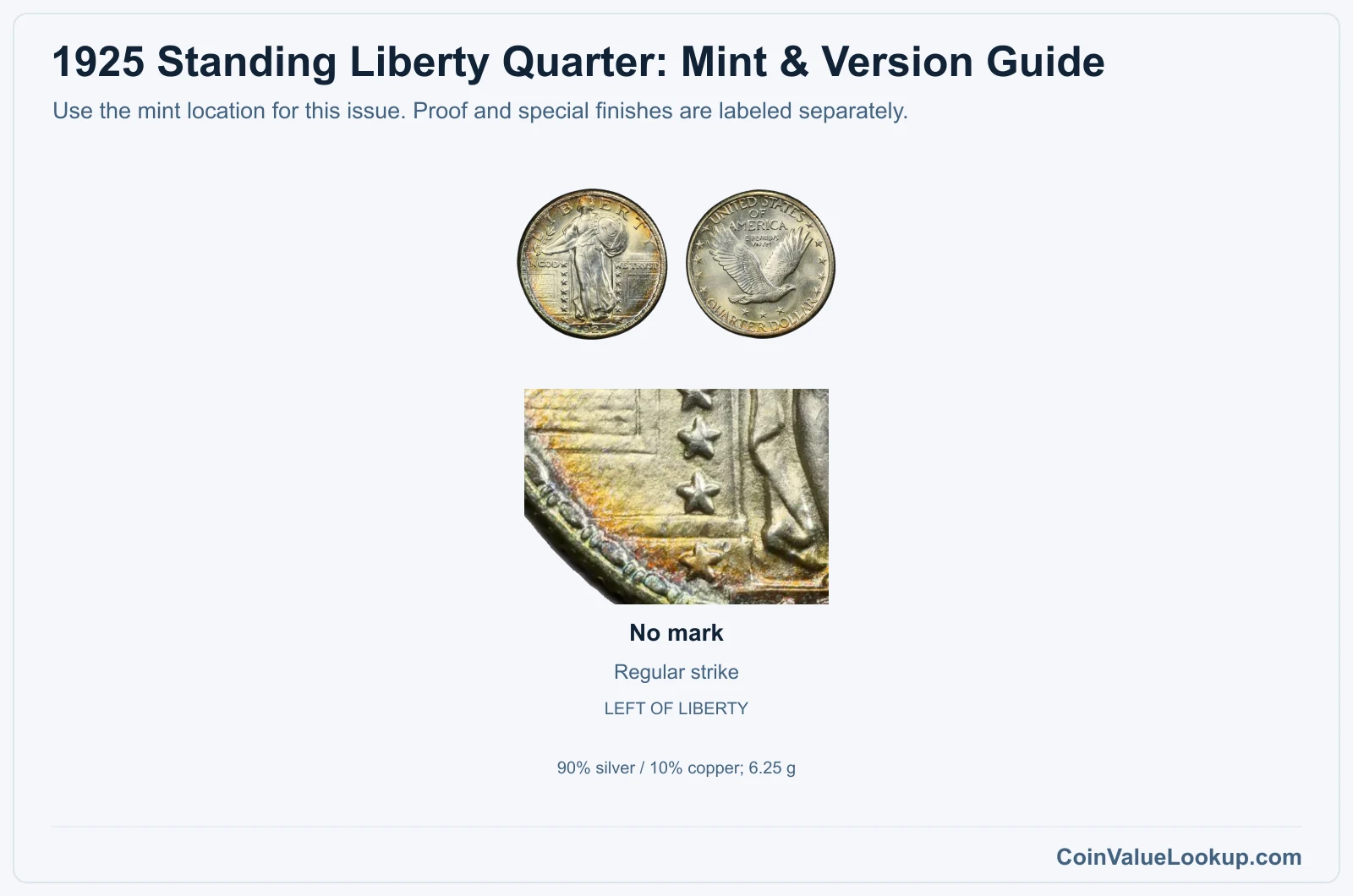
This coin uses the Type II design. The easy tell: Liberty wears a coat of chain mail across her chest, and three small stars appear beneath the eagle on the reverse.
Type I coins, used from 1916 to partway through 1917, show an exposed breast and no stars below the eagle.
The 1925 also features the recessed date, a change introduced to help the date survive in circulation. Earlier Standing Liberty Quarters had a raised date that wore flat quickly, which is why dateless quarters from the series are so common.
The coin weighs 6.25 grams and is struck in 90% silver with 10% copper. A magnet should not stick.
If it does, something is wrong.
Step 2: Check Your 1925 Standing Liberty Quarter Grade
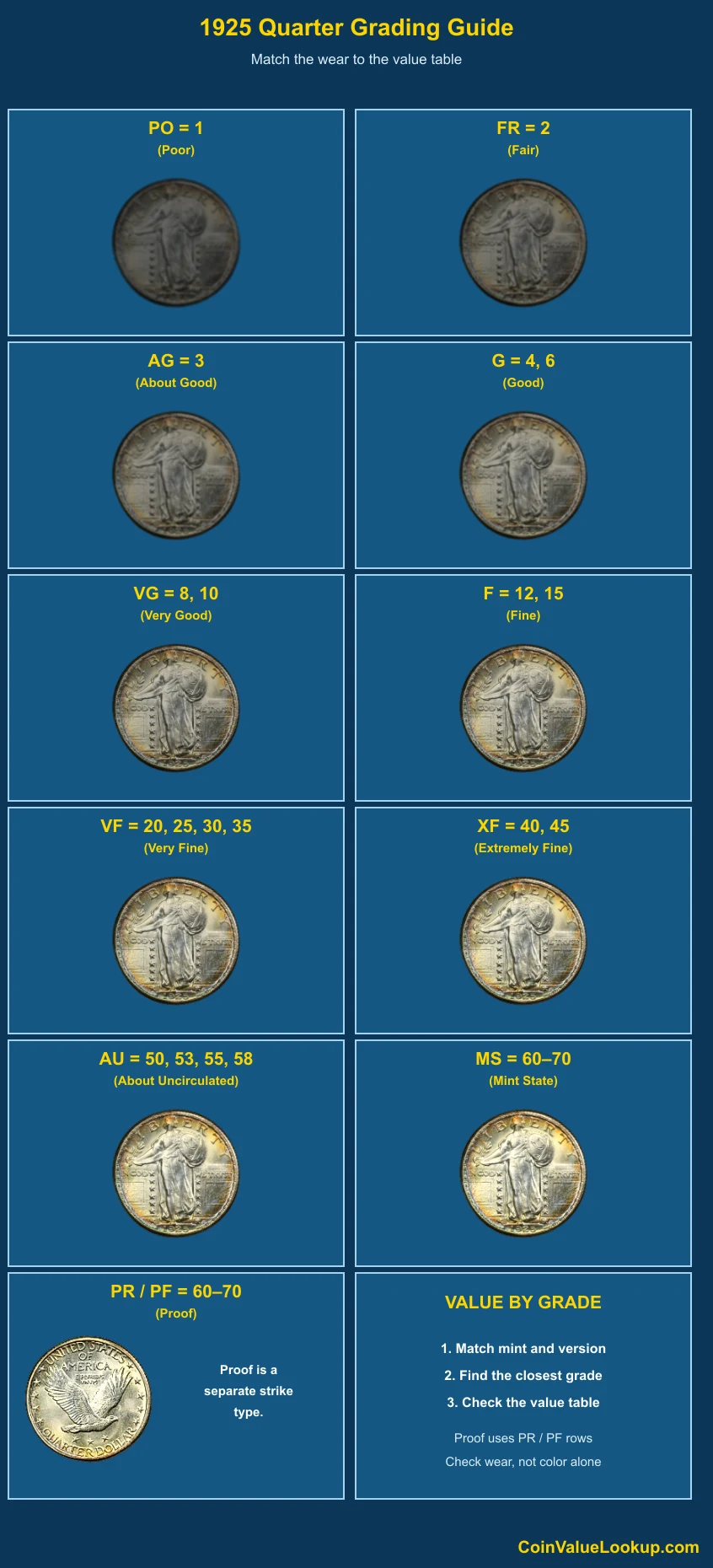
Start by checking Liberty's head. On a well-struck coin, you can see three leaves in the hair and the ear is distinct.
As the coin wears, the head goes soft first, then the shield center, the breast area and finally the knee and leg drapery.
On the reverse, the eagle's breast feathers and wing tips are the wear checkpoints. Compare your coin against the reference image side by side, matching the same areas.
A common trap with this series is confusing a weak strike with wear. Many 1925 quarters came off the press with a mushy head even when brand new.
Full Head is a strike designation meaning the hair detail is sharp and complete. It does not mean the coin is a higher grade than Mint State, and you should not assume a coin is uncirculated just because part of the design looks crisp.
Luster matters too. An uncirculated coin has unbroken cartwheel shine when you tilt it under a single light source.
A cleaned coin might look bright, but the surface will have a network of tiny hairlines instead of that natural flow.
Step 3: Check 1925 Standing Liberty Quarter Value by Mint and Version
1925 Standing Liberty Quarter
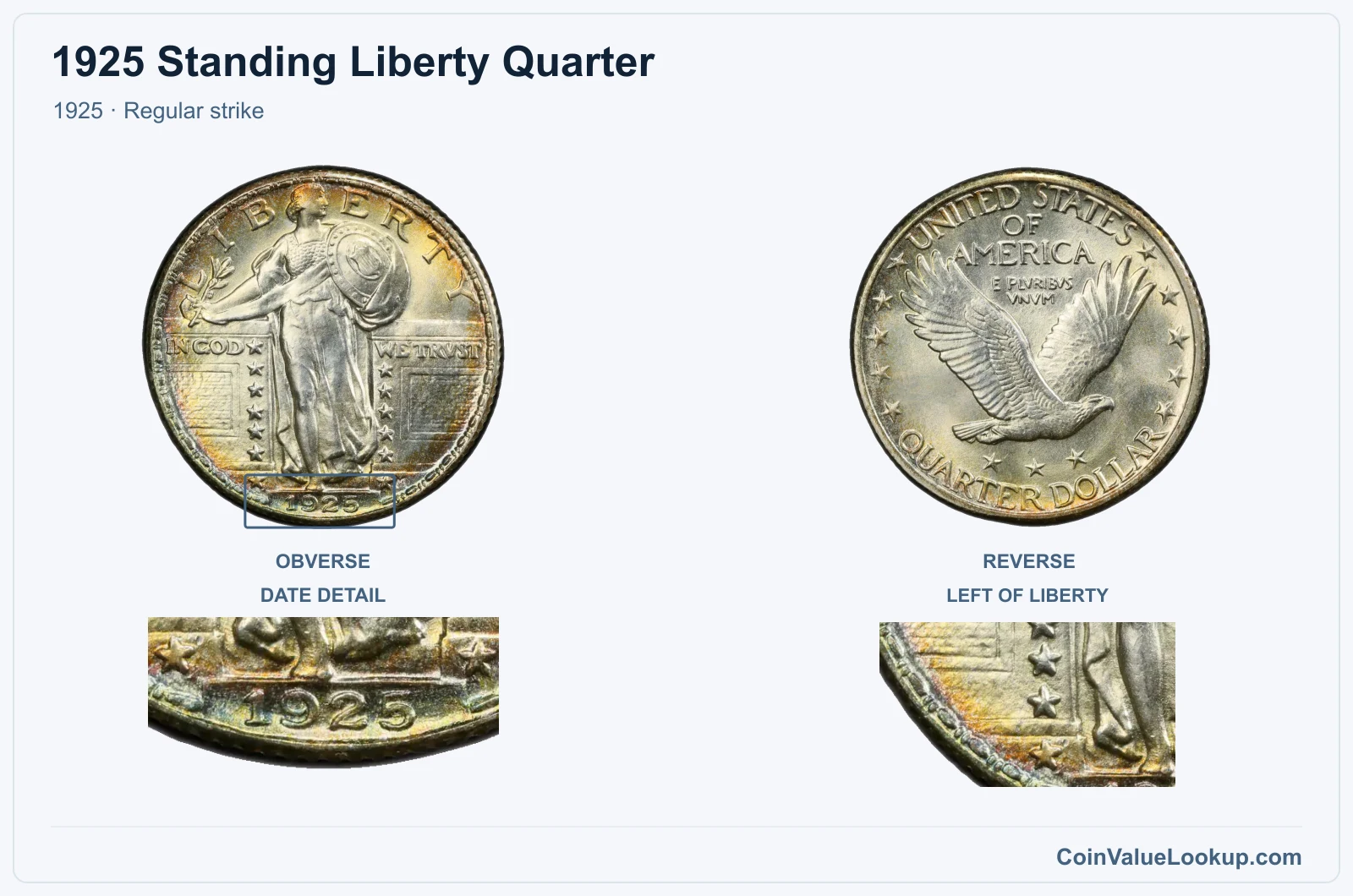
The 1925 quarter was produced only at Philadelphia, so there is no mintmark to hunt for. It is a Type II Standing Liberty design with chain mail on Liberty's chest and three stars beneath the reverse eagle.
The date is recessed into the field, a change from the earlier raised-date style that wore off in pocket change.
USA Coin Book guide estimates place this coin at about $17.23 in G4 (a heavily worn but readable coin), $171.00 at MS60 (uncirculated with contact marks) and $290.00 at MS63 (uncirculated with moderate marks). These are retail guide estimates, not guaranteed sale prices.
Original, untouched surfaces matter. Cleaning or damage can push a coin well below these benchmarks even if the wear level seems right.
Coin Value Lookup is a good starting point if you want to check values for other dates and mints in the Standing Liberty series or any other U.S. coin type. You can browse guides organized by denomination and year.
Range Grade
Price Auction Records Appraisal PO PO 1
—
Coin Identifier FR FR 2
—
Coin Identifier AG AG 3
—
Coin Identifier G G 4
—
Coin Identifier
G 6
—
Coin Identifier VG VG 8
—
Coin Identifier
VG 10
—
Coin Identifier F F 12
—
Coin Identifier
F 15
—
Coin Identifier VF VF 20
—
Coin Identifier
VF 25
—
Coin Identifier
VF 30
—
Coin Identifier
VF 35
—
Coin Identifier XF XF 40
—
Coin Identifier
XF 45
Coin Identifier AU AU 50
Coin Identifier
AU 53
Coin Identifier
AU 55
Coin Identifier
AU 58
Coin Identifier MS MS 60
—
Coin Identifier
MS 61
Coin Identifier
MS 62
Coin Identifier
MS 63
Coin Identifier
MS 64
Coin Identifier
MS 65
Coin Identifier
MS 66
Coin Identifier
MS 67
Coin Identifier
MS 68
—
—
—
MS 69
—
—
—
MS 70
—
—
—
1925 Standing Liberty Quarter Error List
1. 1925 Standing Liberty Quarter — Clashed Dies
A die clash happens when the obverse and reverse dies strike each other with no planchet between them. The impact leaves ghost impressions of the opposite design on each die, and those traces then appear on every coin struck afterward until the die is replaced or polished.
On 1925 quarters, a reported clashed-die variety shows a transferred letter "E" from the opposite die. Look for faint, raised design elements that do not belong on the side where you see them.
The ghost image should line up with where the opposite die's features would sit during a normal strike.
Do not confuse random scratches or raised lines from contact damage with a die clash. Clash marks are consistent, repeating across multiple coins from the same die pair, and they mirror the opposing design in the expected position.
No specific price data is available for this variety, so the value of any example depends on how visible the clash is and the coin's overall condition.
2. 1925 Standing Liberty Quarter — Off-Center Strike
An off-center strike occurs when the planchet is not seated properly between the dies. The result is a design that is shifted to one side, leaving a blank crescent of unstruck metal on the opposite edge.
For the 1925 quarter, the key to value is whether the date is still visible. A 5% off-center coin is a curiosity; a 15–20% shift with a readable date starts getting real attention.
The larger the shift with the date intact, the more desirable the error.
Be careful not to mistake a clipped edge, a misaligned die (where the design is complete but slightly offset) or post-mint damage like a vise mark for a genuine off-center strike. A true off-center coin has an unstruck crescent with a natural blank edge, not a rough or filed one.
No adopted price range is available; value depends on the percentage of offset, date visibility and the coin's overall preservation.
3. 1925 Standing Liberty Quarter — Clipped Planchet
A clipped planchet error means part of the metal blank was missing before the coin was struck. The clip can be curved, straight or irregular, depending on what went wrong during the blanking process.
On a genuine clip, the missing area has a smooth, natural edge consistent with the original blank. You will often see slight design weakness on the side directly opposite the clip, caused by the metal not fully filling the die in that area.
That opposite weakness is a strong authenticity indicator.
Watch out for coins that have been filed, cut or corroded after striking. A post-mint gouge will not produce that characteristic opposite-side weakness, and the edge texture will look different under magnification.
There is no adopted price for clipped 1925 quarters specifically, so the value of a given example depends on the size and type of clip, how much design is affected and the coin's condition.
4. 1925 Standing Liberty Quarter — Lamination / Split Planchet
Lamination errors result from impurities or gas trapped in the alloy during production. The metal separates into layers, and you may see a peeling flap, a missing patch of surface metal or a crack where the planchet is splitting apart.
On a 1925 Standing Liberty Quarter, photograph both the affected face and the coin's edge together. Edge shots can reveal internal separation that is not obvious from straight on.
A retained flap — where the peeling metal is still attached — is generally more collectible than a missing-layer example, because it shows the error more dramatically.
Do not confuse scraping damage, corrosion pitting or a deliberately cut coin with a lamination. Genuine lamination follows the metal's internal structure and does not show tool marks or sharp, artificial edges.
No specific price data is available for this error on the 1925 date; value depends on the size, location and visual impact of the separation as well as the coin's overall condition.
5. 1925 Standing Liberty Quarter — Doubled Die Obverse
A doubled die obverse on the 1925 quarter means the die itself received a doubled impression during its manufacturing, and that doubling transferred to every coin it struck. The result is consistent separation or notching on obverse design elements — letters, the date or parts of Liberty's figure.
To check, compare the obverse lettering and date digits against a known normal example under the same lighting. True die doubling shows a distinct second image with uniform direction and spacing.
It looks deliberate, almost like a shadow cast the same way on every affected element.
Machine doubling is the common lookalike. It produces flat, shelf-like distortion rather than a crisp second image, and it happens during the striking process rather than during die creation.
Worn die contours and light reflections can also mimic doubling at first glance. No adopted price is available for this variety, so value depends on how pronounced the doubling is and the coin's grade and surface quality.