1895 Liberty Nickel Coin Value: How Much Is It Worth?
The 1895 Liberty Nickel is a Philadelphia-only issue that still turns up in old collections and junk boxes. A guide estimate from USA Coin Book places a well-worn G4 example around $7.29, rising to about $283 in MS63 for business strikes.
Proofs carry their own price structure, with a PR63 anchor near $344. Condition and version matter a lot here, so read on before you price yours.
Fast Way to Identify Your 1895 Liberty Nickel
The quickest way to get a preliminary identification of your 1895 Liberty Nickel is to upload clear photos of both the front and back. Good lighting and a steady hand help.
Our identifier can assist with recognizing the basic version and general condition from your images, though it does not substitute for professional grading or authentication.
1895 Liberty Nickel Value
Upload both sides of your 1895 Liberty Nickel.
Front Obverse
Upload photo
Back Reverse
Upload photo
Which 1895 Liberty Nickel Versions Are Worth Money?
- Business strikes climb from roughly $7.29 at G4 to about $283 at MS63 per USA Coin Book, making original mint-state examples the ones to watch.
- Proof examples carry a separate premium, with a PR63 guide estimate around $344, and fully original surfaces add appeal.
- Certain error types such as off-center strikes, repunched dates, and die cracks have been reported for this date and can affect value depending on visibility and condition.
Step 1: Identify Your 1895 Liberty Nickel Mint Mark and Version
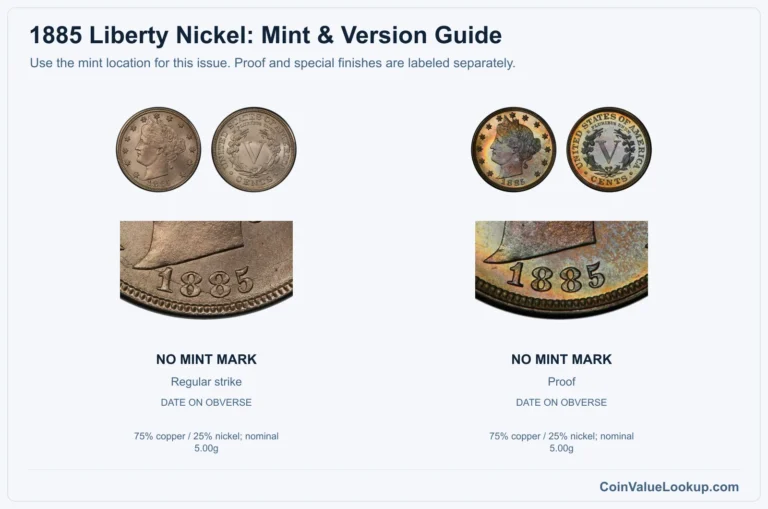
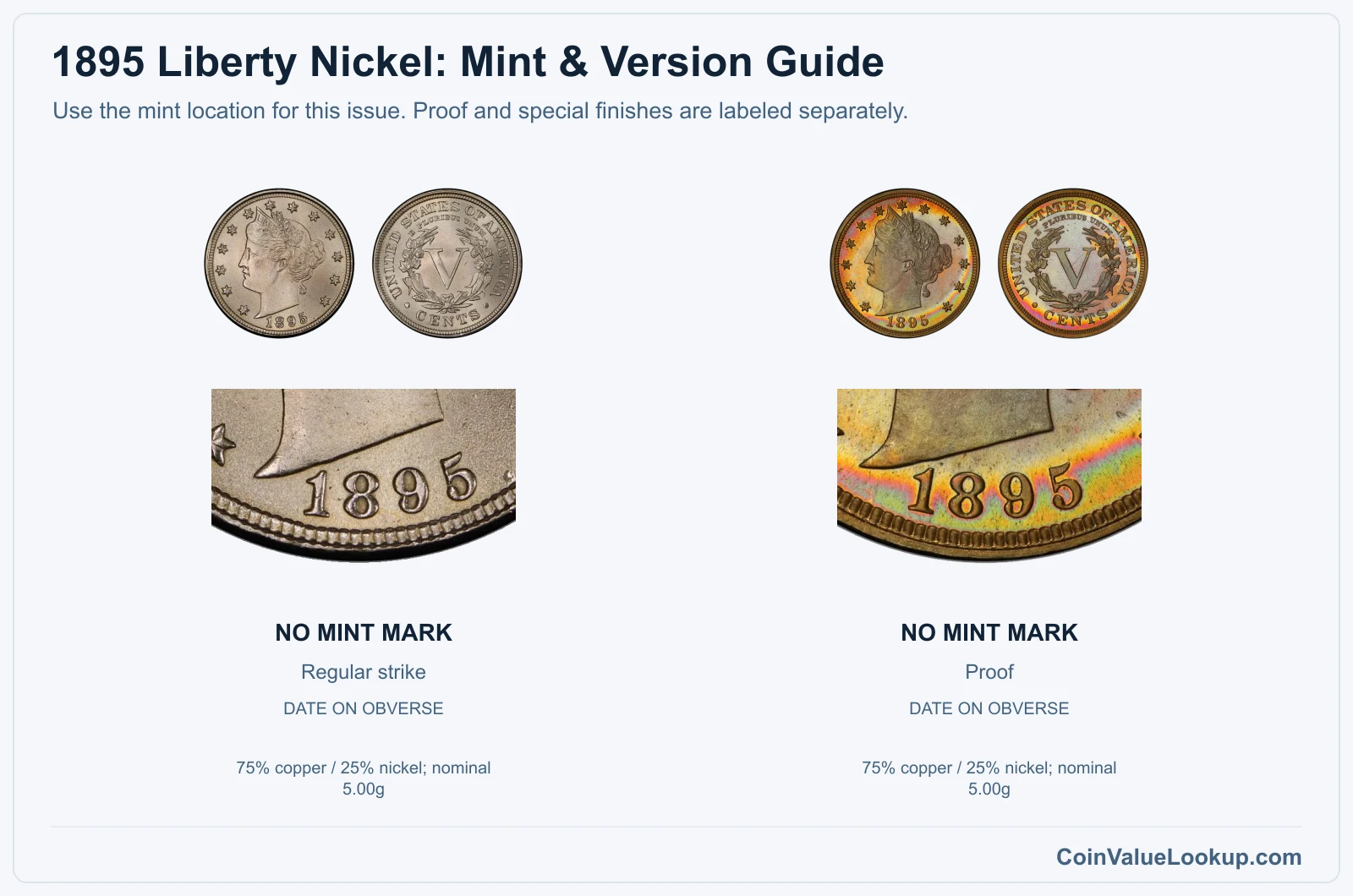
Every genuine 1895 Liberty Nickel was struck at Philadelphia. There is no mintmark to look for, and no branch-mint version exists for this date.
The coin is 75% copper and 25% nickel, weighs about 5 grams, and measures 21.2 mm with a plain edge.
All regular 1895 nickels carry the "CENTS" denomination on the reverse, inside the wreath at the bottom. The earlier "No CENTS" variety applies only to the 1883 issue, so if your 1895 shows CENTS, that is perfectly normal.
Two manufacturing formats exist: business strikes intended for circulation and proofs made for collectors. A proof is not a higher grade than mint state.
It is a separate production method with mirrored fields and sharp rims. Telling them apart requires examining the surface finish, not just the level of detail.
Step 2: Check Your 1895 Liberty Nickel Grade
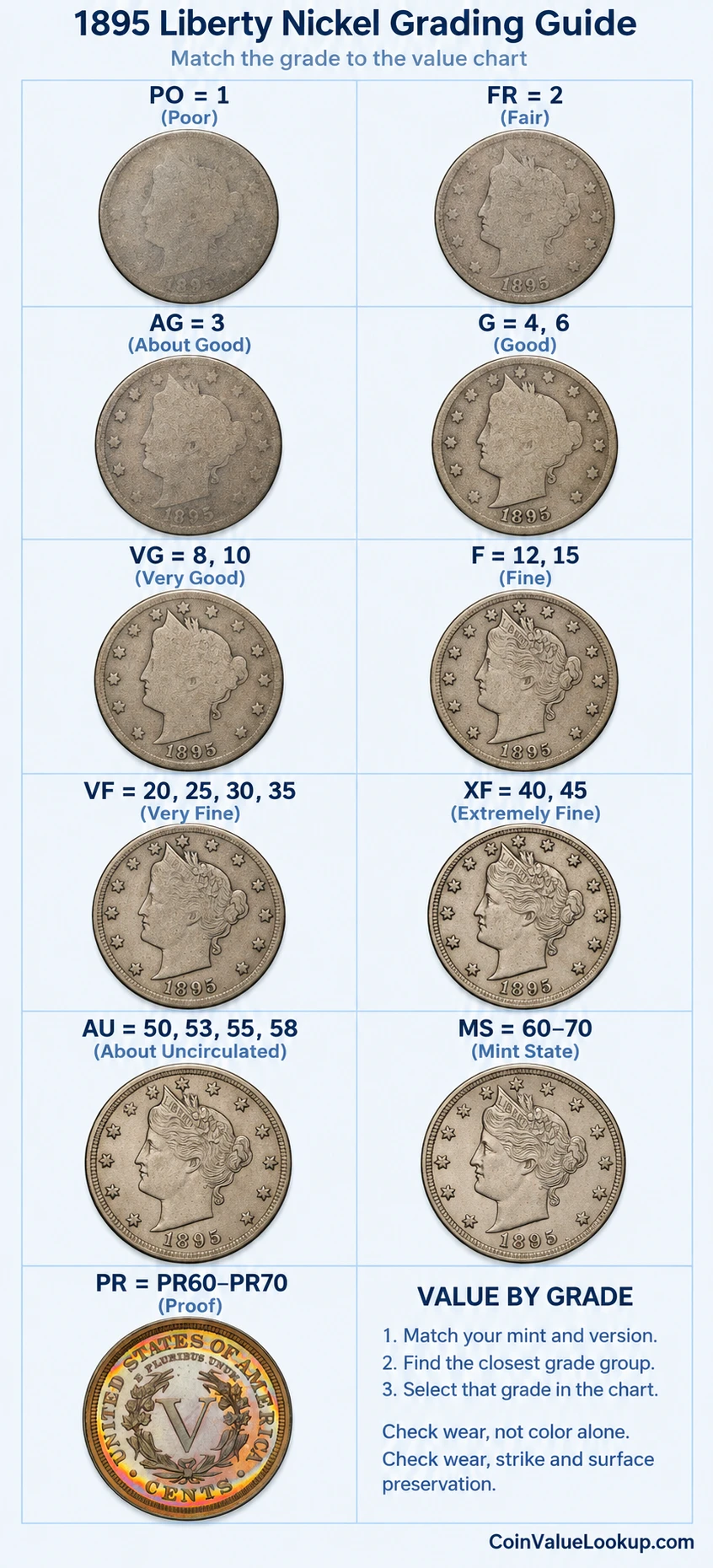
Start with the word LIBERTY on the coronet above the forehead. On a well-circulated coin the letters merge into the headband early, so partial LIBERTY means moderate wear.
A full, sharp LIBERTY with no flatness is a good sign.
Check the high hair curls just above the ear and the cheek below the eye. These are the first areas to show friction.
On the reverse, look at the top of the corn ears and the wreath tips.
Weak details do not automatically mean a worn coin. Strike weakness at the hair and corn ear is common on Liberty Nickels and should not be confused with circulation wear.
Instead, look at the fields for luster and contact marks. Use the comparison image to match your coin against known grade examples.
For proofs, inspect the flat fields for hairlines and the rims for handling marks. A proof can be lightly cleaned or heavily hairlined and still show full design sharpness, so surface quality is the main grading driver.
Step 3: Check 1895 Liberty Nickel Value by Mint and Version
1895 Liberty Nickel — No Mint Mark — With CENTS Circulation
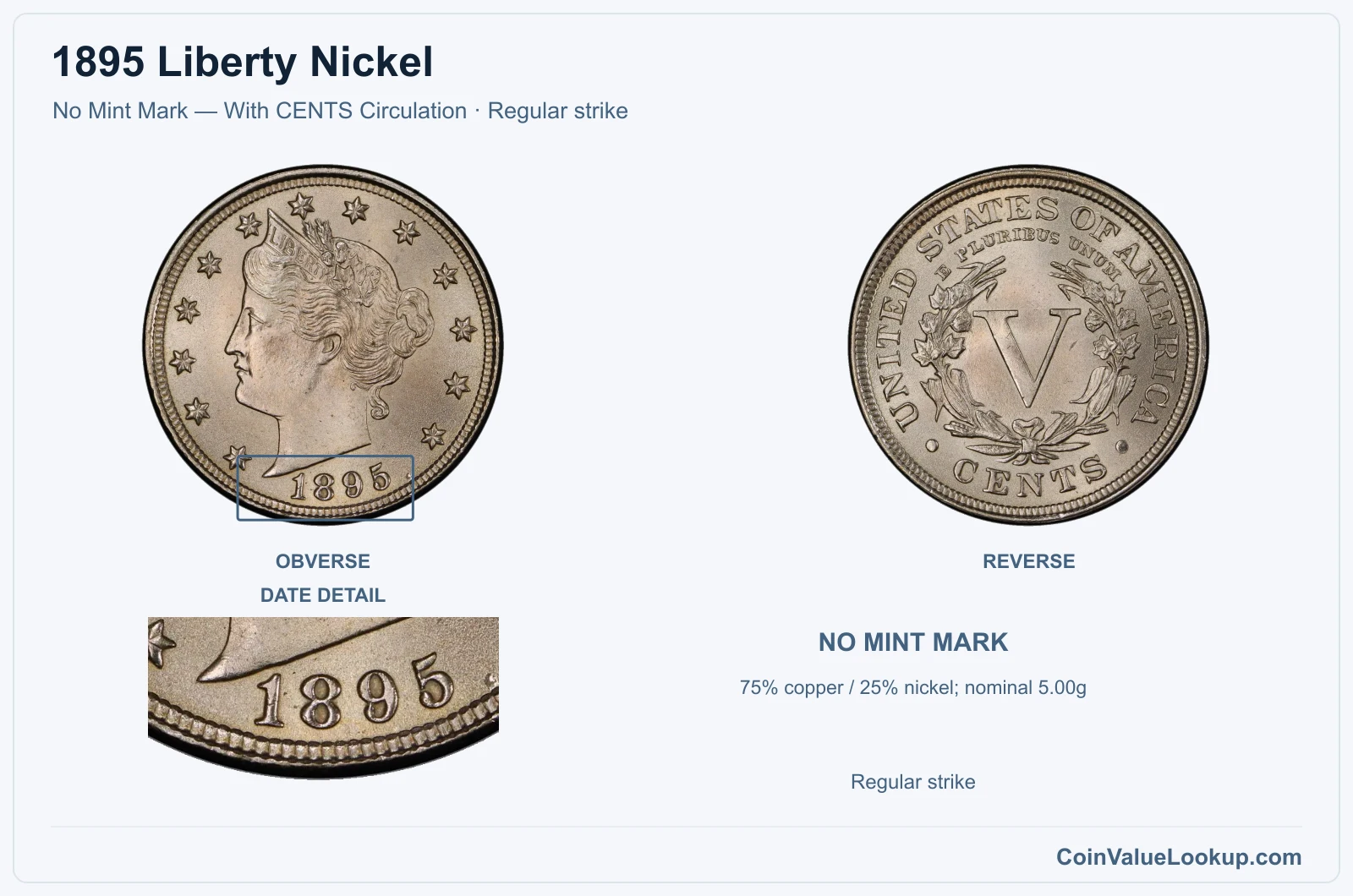
This is the standard 1895 Liberty Nickel struck for everyday commerce at Philadelphia. No mintmark appears on the coin.
The reverse reads CENTS inside the wreath, which is normal for every Liberty Nickel after 1883.
USA Coin Book places a February 2026 guide estimate at about $7.29 in G4 and roughly $283 in MS63. These are retail estimates, not guaranteed sale prices.
The jump between low grades and mint state is steep because most surviving examples saw heavy use. A fully struck coin with original, unimpaired luster in the MS63 range is a different animal from a worn pocket piece.
Coin Value Lookup is a good starting point if you want to compare your coin's date and condition against other Liberty Nickel years. You can look up guides for the full series there.
Range Grade
Price Auction Records Appraisal PO PO 1
—
Coin Identifier FR FR 2
—
Coin Identifier AG AG 3
—
Coin Identifier G G 4
—
Coin Identifier
G 6
—
Coin Identifier VG VG 8
—
Coin Identifier
VG 10
—
Coin Identifier F F 12
—
Coin Identifier
F 15
—
Coin Identifier VF VF 20
—
Coin Identifier
VF 25
—
Coin Identifier
VF 30
—
Coin Identifier
VF 35
—
Coin Identifier XF XF 40
Coin Identifier
XF 45
Coin Identifier AU AU 50
Coin Identifier
AU 53
—
Coin Identifier
AU 55
Coin Identifier
AU 58
Coin Identifier MS MS 60
—
Coin Identifier
MS 61
Coin Identifier
MS 62
Coin Identifier
MS 63
Coin Identifier
MS 64
Coin Identifier
MS 65
Coin Identifier
MS 66
Coin Identifier
MS 67
Coin Identifier
MS 68
—
—
—
MS 69
—
—
—
MS 70
—
—
—
1895 Liberty Nickel — No Mint Mark — With CENTS Proof
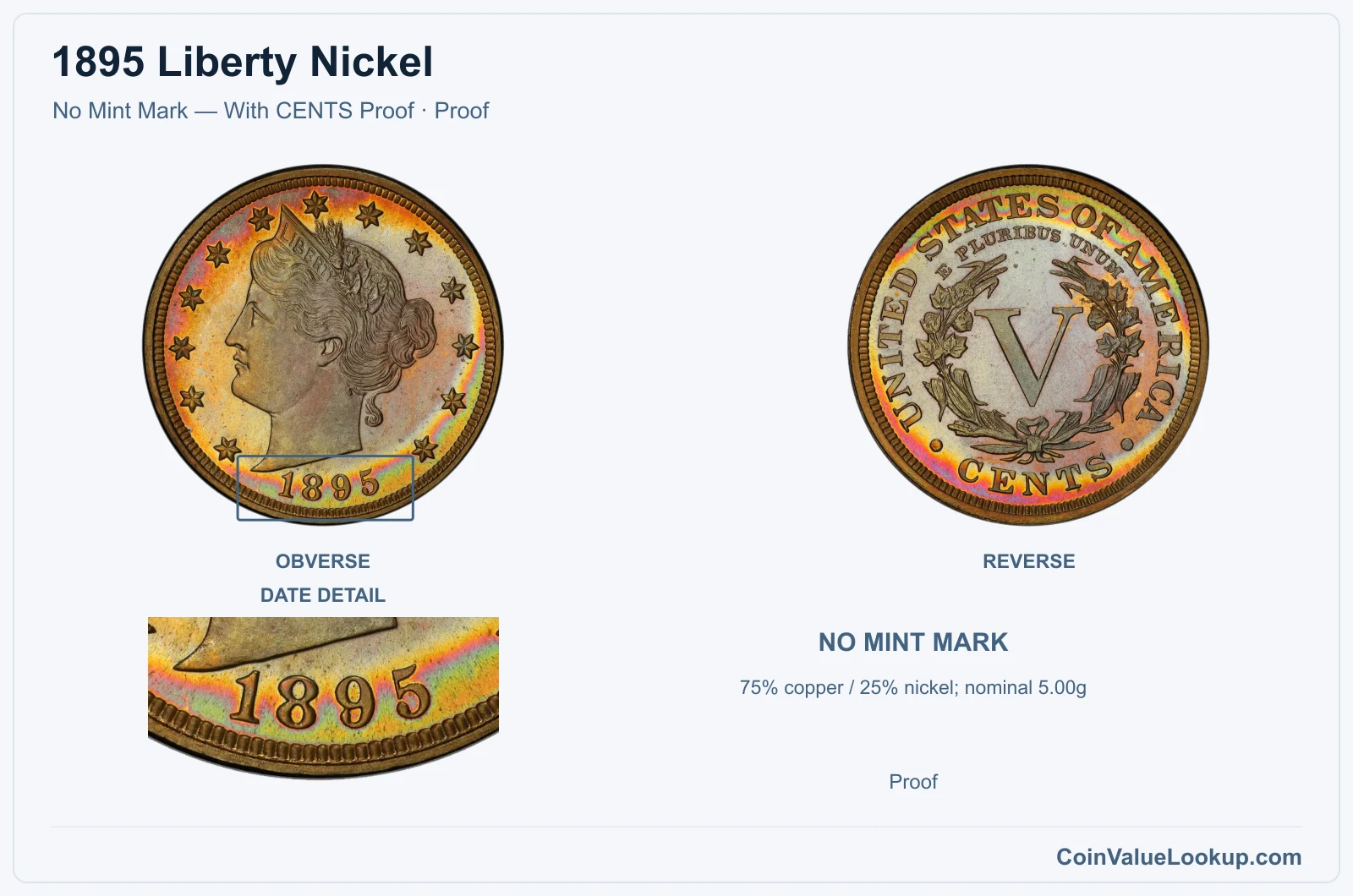
The 1895 proof Liberty Nickel was a collector-oriented product from the Philadelphia Mint, struck with polished dies on prepared planchets. The fields should appear deeply reflective, and the rims tend to be sharper and more squared-off than on a business strike.
A USA Coin Book guide estimate puts the PR63 level at about $344. That figure is a single-snapshot retail estimate from February 2026, not a guaranteed offer.
When evaluating a proof, focus on hairlines in the mirrored fields and any rim contact. A proof with heavy hairlines from improper cleaning will grade lower regardless of how sharp the design looks.
Both faces and the rim detail matter when having a proof assessed by a professional grading service.
Range Grade
Price Auction Records Appraisal PR PR 1
—
Coin Identifier
PR 2
—
Coin Identifier
PR 3
—
Coin Identifier
PR 4
—
Coin Identifier
PR 6
—
Coin Identifier
PR 8
—
Coin Identifier
PR 10
—
Coin Identifier
PR 12
—
Coin Identifier
PR 15
—
Coin Identifier
PR 20
—
Coin Identifier
PR 25
—
Coin Identifier
PR 30
—
Coin Identifier
PR 35
—
Coin Identifier
PR 40
—
Coin Identifier
PR 45
—
Coin Identifier
PR 50
—
Coin Identifier
PR 53
—
Coin Identifier
PR 55
—
Coin Identifier
PR 58
—
Coin Identifier
PR 60
—
Coin Identifier
PR 61
Coin Identifier
PR 62
Coin Identifier
PR 63
Coin Identifier
PR 64
Coin Identifier
PR 65
Coin Identifier
PR 66
Coin Identifier
PR 67
Coin Identifier
PR 68
Coin Identifier
PR 69
—
—
—
PR 70
—
—
—
1895 Liberty Nickel Error List
1. 1895 Liberty Nickel — Off-Center Strike
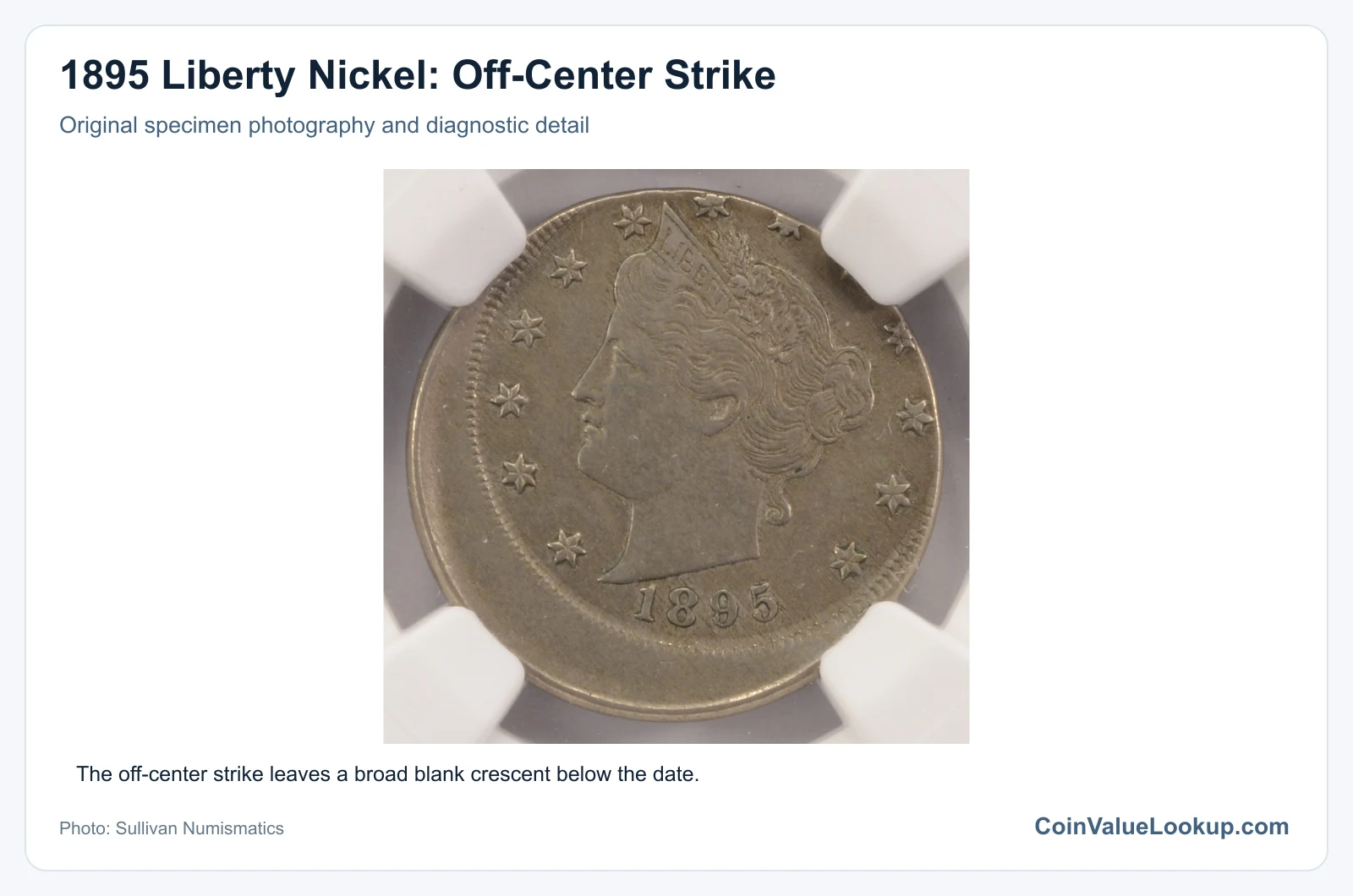
An off-center strike happens when the planchet is not seated properly in the collar before the dies come together. The result is a design that is shifted to one side, leaving an unstruck crescent of blank metal on the opposite edge.
On an 1895 Liberty Nickel, this error has been documented at around 5% off center in at least one auction catalog lot.
The date must remain visible for the coin to be attributed to 1895, which is critical for value. A small percentage off center with a full date is the collectible combination.
Condition and the degree of displacement both influence what a buyer will pay, so there is no fixed premium.
Do not confuse an off-center strike with a clipped planchet, a misaligned die that only shifts one side of the design, or post-mint flattening from damage. The off-center coin will show a consistent shift of the entire design relative to the blank.
2. 1895 Liberty Nickel — Repunched Date
A repunched date occurs when the date digits were punched into the working die more than once in slightly different positions. On an 1895 nickel, look for faint remnants of an earlier numeral position peeking out beside or beneath the final date digits.
This is easiest to spot under magnification around the base or tops of the 1, 8, 9, and 5.
This is a die variety, not a strike error. It happened during die preparation, not during the coin's striking.
Every coin struck from that particular die carries the same repunching.
Do not confuse a repunched date with machine doubling, which produces flat, shelf-like doubling across the entire design, or with a damaged date caused by post-mint contact. A true repunched date shows distinct, slightly offset impressions of one or more numerals.
The value depends on the clarity of the extra punch and the coin's overall condition.
3. 1895 Liberty Nickel — Die Crack / Die Chip
Die cracks appear as thin raised lines on the coin's surface, caused by fractures in the steel die during production. A die chip shows up as a small raised blob where a piece of the die face broke away.
Both are varieties of die failure, and they have been reported on 1895 Liberty Nickels.
A crack that runs from the rim inward is the most common form. When a large section of the die near the rim breaks away and fills with metal, it produces a raised, flat area called a cud, which is generally more desirable to collectors than a simple hairline crack.
Be careful not to mistake incuse scratches, surface corrosion, or foreign material stuck to the coin for a die crack. A genuine die crack is raised above the field, follows a path consistent with metal stress, and appears on every coin struck from that die.
Condition and the size and location of the crack all affect collector interest, so no single price applies.