1919 Buffalo Nickel Coin Value: How Much Is It Worth?
A 1919 Buffalo Nickel in well-worn condition can start around $2.79 according to USA Coin Book estimates, while uncirculated examples from branch mints may reach into the low four figures. All three mints produced this date with the Type 2 recessed reverse, and no regular proof was struck.
Your coin's specific value depends on its mint, grade, and whether it carries a recognized error.
Fast Way to Identify Your 1919 Buffalo Nickel
The quickest way to start figuring out what you have is to snap clear photos of both the front and back of your coin. Upload them here for a preliminary identification that can help you zero in on the mint, general condition, and design type.
Good lighting and a steady hand go a long way.
1919 Buffalo Nickel Value
Upload both sides of your 1919 Buffalo Nickel.
Front Obverse
Upload photo
Back Reverse
Upload photo
Which 1919 Buffalo Nickel Versions Are Worth Money?
- The 1919-D (Denver) nickel carries the highest guide values, reaching an estimated $2,033 at MS63 versus $154 for the same grade Philadelphia coin.
- The 1919-S (San Francisco) is close behind, with a USA Coin Book estimate of $1,987 at MS63, making mint-state survivors from either branch mint worth careful inspection.
- Several recognized errors exist across this date, including the Two Feathers variety, Doubled Die Obverse, and Missing Designer Initial F, each of which can add a premium depending on condition and visibility.
Step 1: Identify Your 1919 Buffalo Nickel Mint Mark and Version
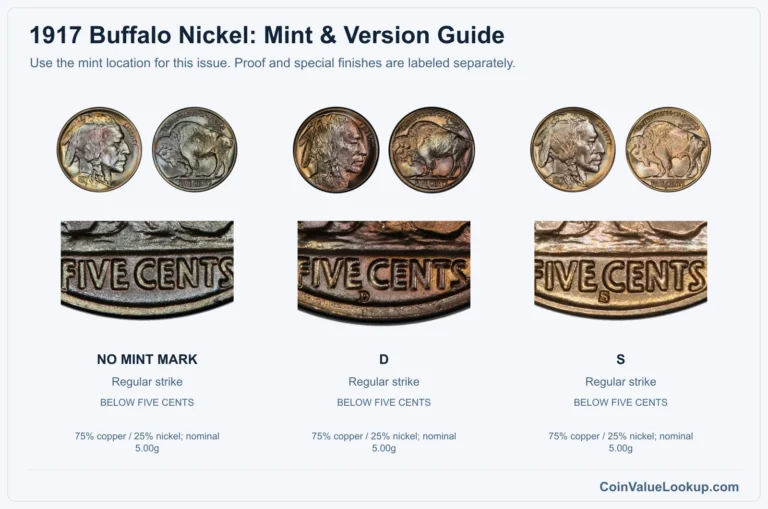
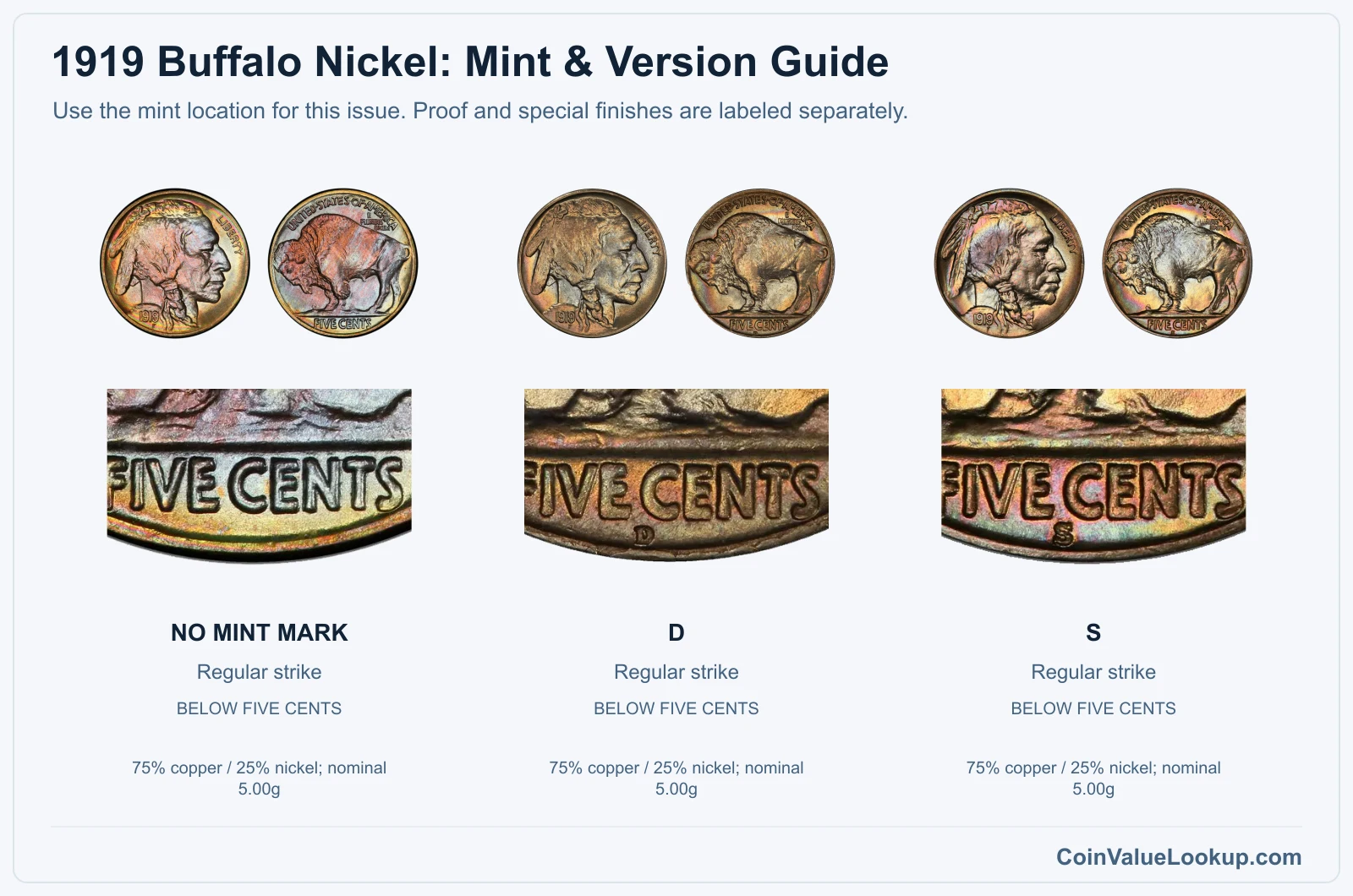
Three mints struck the 1919 Buffalo Nickel: Philadelphia, Denver, and San Francisco. Philadelphia coins carry no mintmark.
Denver coins show a small D, and San Francisco coins show an S, both located on the reverse below the words FIVE CENTS.
Every 1919 nickel uses the Type 2 reverse, where FIVE CENTS sits in a recessed area below the bison. There is no intentional Type 1 branch for this year; that raised-mound design was only used in 1913.
The coin is struck in 75% copper and 25% nickel, weighs about 5 grams, measures 21.2 mm across, and has a plain edge. There is no silver version, despite what the color might suggest on a freshly uncirculated piece.
Flip your coin to the reverse, look just below FIVE CENTS, and check for that mintmark. It is the single fastest way to narrow down which version you hold.
Step 2: Check Your 1919 Buffalo Nickel Grade
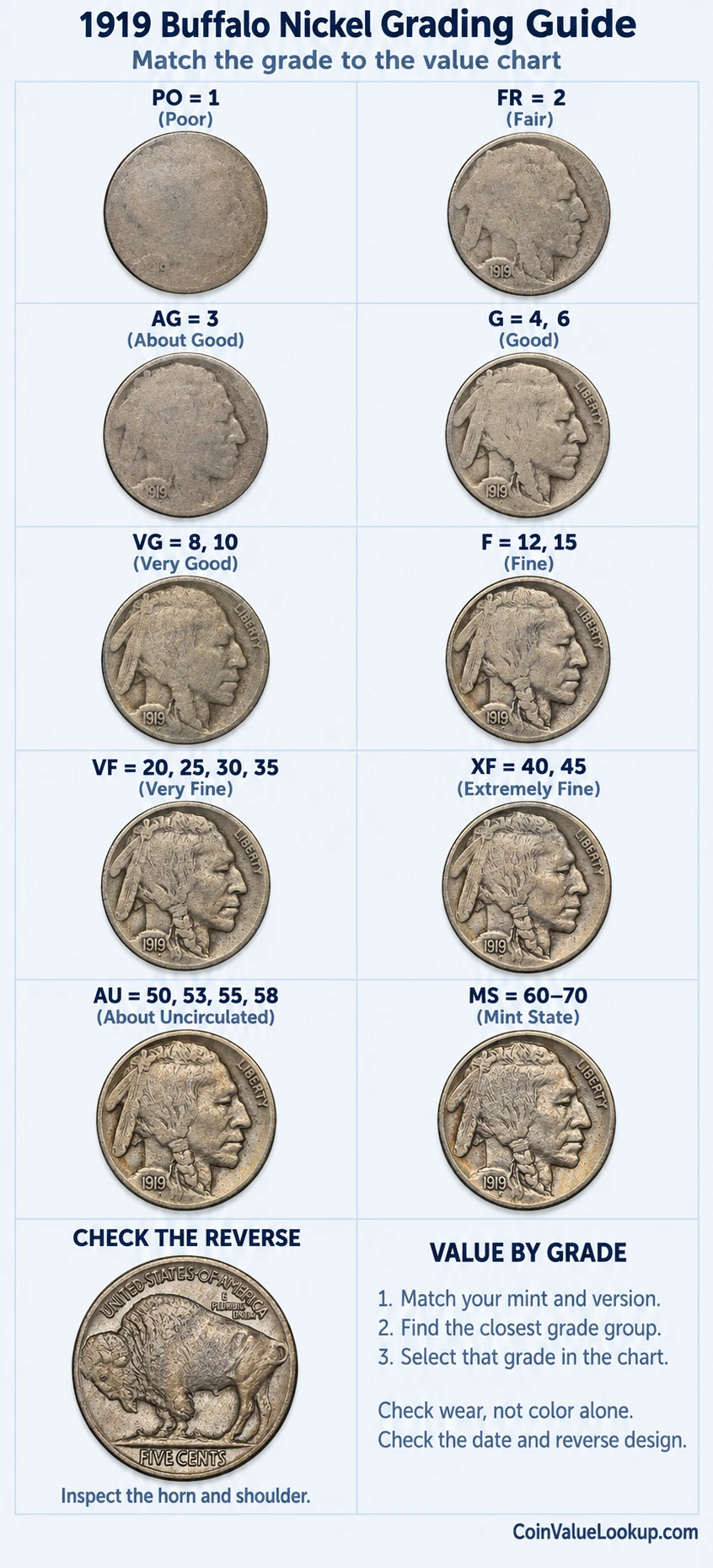
Start with the Native American portrait on the obverse. In higher grades the hair braid shows full, distinct strands, and the cheek retains a smooth, rounded contour.
As wear progresses those details flatten first.
On the reverse, check the bison's shoulder and horn. A sharp horn with visible texture usually signals light wear or better.
But here is the catch: Buffalo Nickels from branch mints sometimes left the press with a weak horn due to striking pressure, not circulation. So a soft horn alone does not settle the grade.
Look at overall luster next. Original mint luster on a nickel surface has a cartwheel effect under a single light source.
If that shimmer is gone across the high points but present in the fields, you are likely in the AU range.
Use the comparison image to match your coin's wear pattern against known grade examples. Surface problems like scratches, corrosion, or environmental damage will lower the effective grade even if the detail looks sharp.
And never acid-treat a dateless Buffalo Nickel to read the date; it destroys the surface and the coin's collectible value.
Step 3: Check 1919 Buffalo Nickel Value by Mint and Version
1919 Buffalo Nickel — No Mint Mark — Type2 Circulation
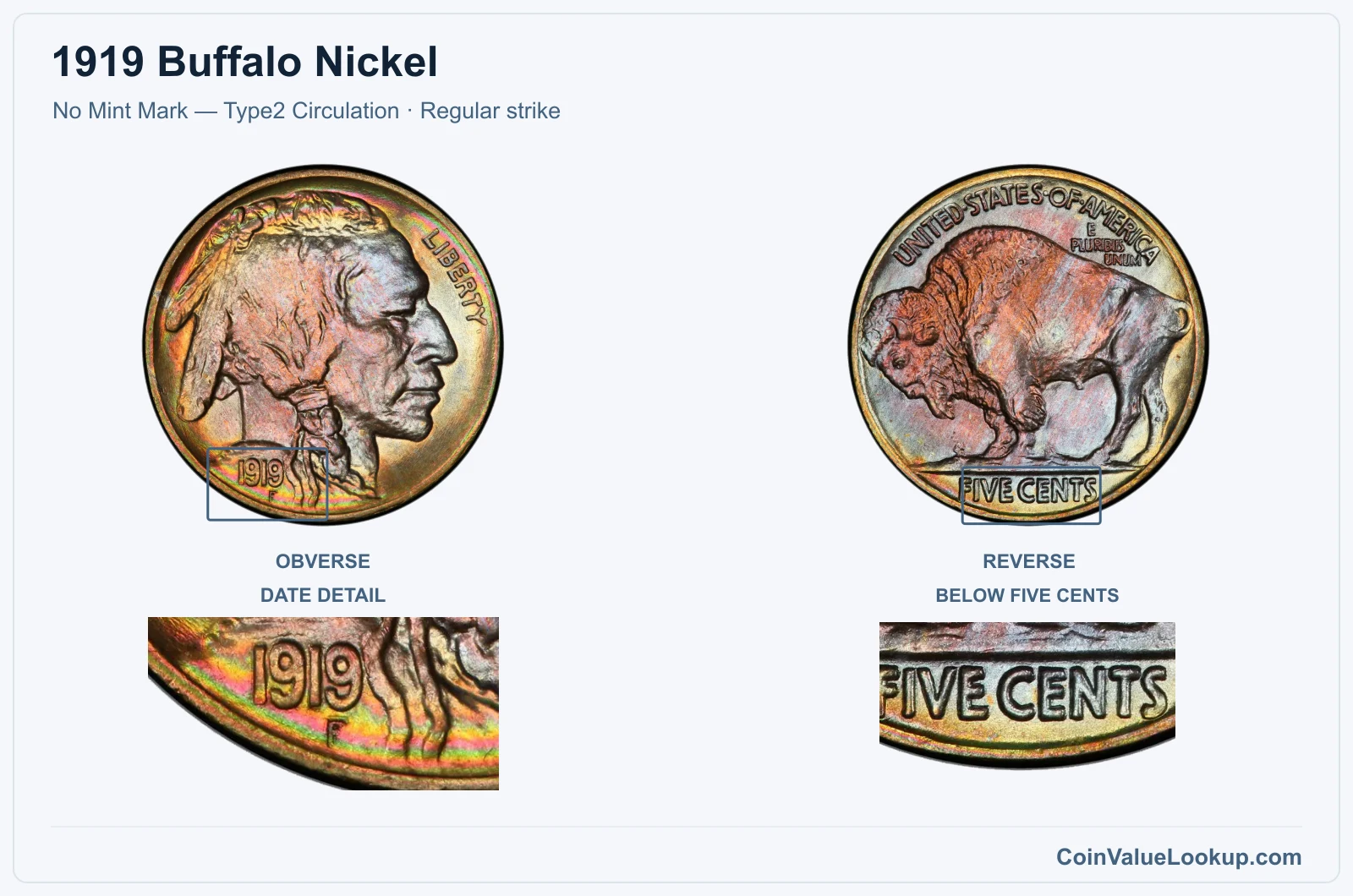
The 1919 Philadelphia nickel has no mintmark. Look at the reverse below FIVE CENTS: if the space is empty, this is your coin.
It is the most common of the three mints for this year.
USA Coin Book estimates place a well-worn G4 example at about $2.79 and an MS63 uncirculated piece around $154. Those are guide figures, not guaranteed sale prices, and actual transactions depend on eye appeal and surface quality.
Still, even a modest circulated Philadelphia example belongs in a type set.
Range Grade
Price Auction Records Appraisal PO PO 1
—
Coin Identifier FR FR 2
—
Coin Identifier AG AG 3
—
Coin Identifier G G 4
—
Coin Identifier
G 6
—
Coin Identifier VG VG 8
—
Coin Identifier
VG 10
—
Coin Identifier F F 12
—
Coin Identifier
F 15
—
Coin Identifier VF VF 20
—
Coin Identifier
VF 25
Coin Identifier
VF 30
—
Coin Identifier
VF 35
—
Coin Identifier XF XF 40
—
Coin Identifier
XF 45
Coin Identifier AU AU 50
Coin Identifier
AU 53
Coin Identifier
AU 55
Coin Identifier
AU 58
Coin Identifier MS MS 60
—
Coin Identifier
MS 61
Coin Identifier
MS 62
Coin Identifier
MS 63
Coin Identifier
MS 64
Coin Identifier
MS 65
Coin Identifier
MS 66
Coin Identifier
MS 67
Coin Identifier
MS 68
Coin Identifier
MS 69
—
—
—
MS 70
—
—
—
1919 Buffalo Nickel — D — Type2 Circulation
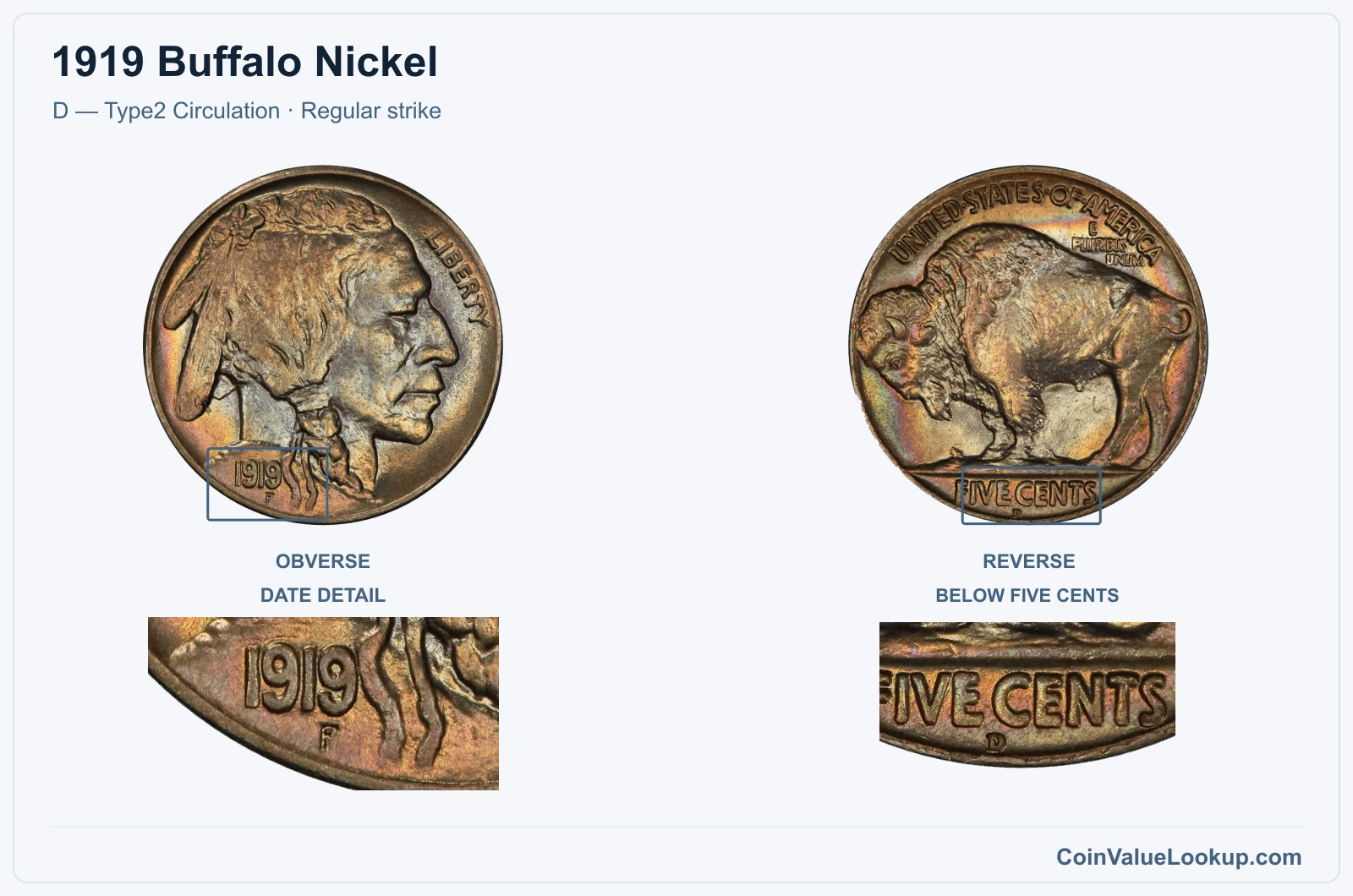
The 1919-D carries a small D mintmark on the reverse, just below FIVE CENTS. Denver production for this date was lower, and surviving mint-state coins are genuinely scarce.
USA Coin Book estimates range from roughly $26 at G4 to about $2,033 at MS63. That steep jump tells you most of these coins saw heavy pocket time.
If yours still has visible horn detail, sharp braid lines, and original luster, you should seriously consider professional grading.
Coin Value Lookup is a good starting point if you want to compare this date against other Buffalo Nickel years and mints before deciding on next steps.
Range Grade
Price Auction Records Appraisal PO PO 1
—
Coin Identifier FR FR 2
—
Coin Identifier AG AG 3
Coin Identifier G G 4
—
Coin Identifier
G 6
—
Coin Identifier VG VG 8
—
Coin Identifier
VG 10
Coin Identifier F F 12
Coin Identifier
F 15
Coin Identifier VF VF 20
Coin Identifier
VF 25
Coin Identifier
VF 30
Coin Identifier
VF 35
Coin Identifier XF XF 40
Coin Identifier
XF 45
Coin Identifier AU AU 50
Coin Identifier
AU 53
Coin Identifier
AU 55
Coin Identifier
AU 58
Coin Identifier MS MS 60
Coin Identifier
MS 61
Coin Identifier
MS 62
Coin Identifier
MS 63
Coin Identifier
MS 64
Coin Identifier
MS 65
Coin Identifier
MS 66
Coin Identifier
MS 67
—
—
—
MS 68
—
—
—
MS 69
—
—
—
MS 70
—
—
—
1919 Buffalo Nickel — S — Type2 Circulation
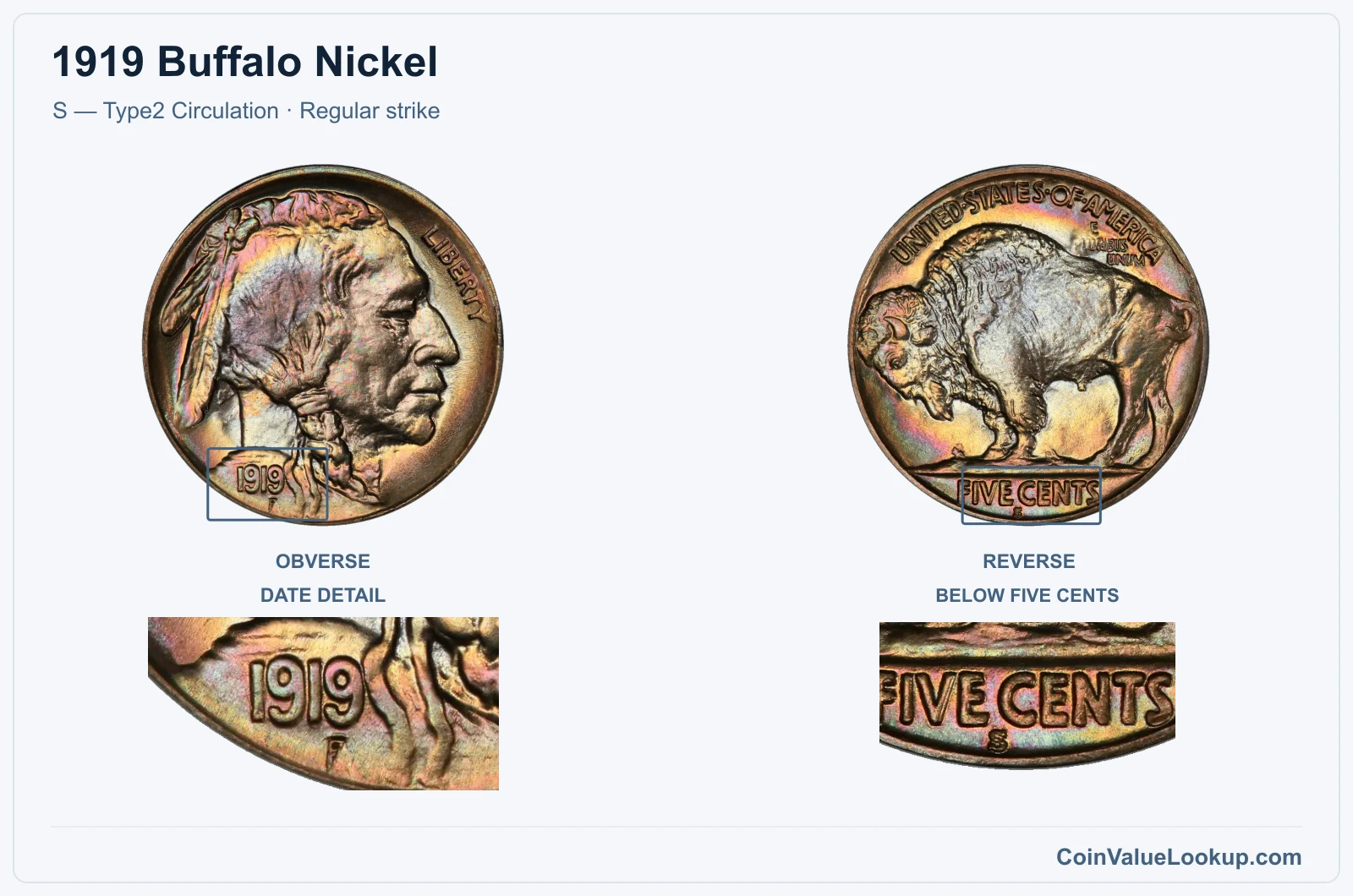
San Francisco's 1919-S shows an S mintmark below FIVE CENTS on the reverse. Like the Denver issue, well-preserved examples are tough to find.
Guide estimates from USA Coin Book put a G4 around $15 and an MS63 near $1,987. Weak strikes are common on San Francisco Buffalo Nickels of this era, so separate a mushy horn caused by die pressure from one worn down by use.
Check the surrounding fields: if they still carry luster but the horn looks flat, the strike is the likely culprit, not wear.
Range Grade
Price Auction Records Appraisal PO PO 1
—
Coin Identifier FR FR 2
—
Coin Identifier AG AG 3
—
Coin Identifier G G 4
—
Coin Identifier
G 6
—
Coin Identifier VG VG 8
—
Coin Identifier
VG 10
—
Coin Identifier F F 12
Coin Identifier
F 15
Coin Identifier VF VF 20
Coin Identifier
VF 25
Coin Identifier
VF 30
Coin Identifier
VF 35
Coin Identifier XF XF 40
Coin Identifier
XF 45
Coin Identifier AU AU 50
Coin Identifier
AU 53
Coin Identifier
AU 55
Coin Identifier
AU 58
Coin Identifier MS MS 60
Coin Identifier
MS 61
Coin Identifier
MS 62
Coin Identifier
MS 63
Coin Identifier
MS 64
Coin Identifier
MS 65
Coin Identifier
MS 66
Coin Identifier
MS 67
—
—
—
MS 68
—
—
—
MS 69
—
—
—
MS 70
—
—
—
1919 Buffalo Nickel Error List
1. 1919 Buffalo Nickel — Struck-Through Error
A struck-through error happens when foreign material sits between the die and the planchet during striking. On a 1919 Philadelphia nickel, look for a localized depression or an impression of something — a thread, grease fill, or metal fragment — pressed into the coin's surface.
Grease-filled dies tend to produce smooth, featureless patches where design should be, while a retained foreign object leaves a sharper, more defined impression. The two look different and are treated as distinct subcategories by grading services.
Do not confuse a struck-through with ordinary wear, post-mint scratches, or cleaning marks. The key difference is that a genuine struck-through is recessed into the design in a way consistent with the striking process.
Value depends on the size, location, and visual drama of the obstruction. No specific price range is established here; individual assessment by a grading service matters.
2. 1919 Buffalo Nickel — Off-Center Strike
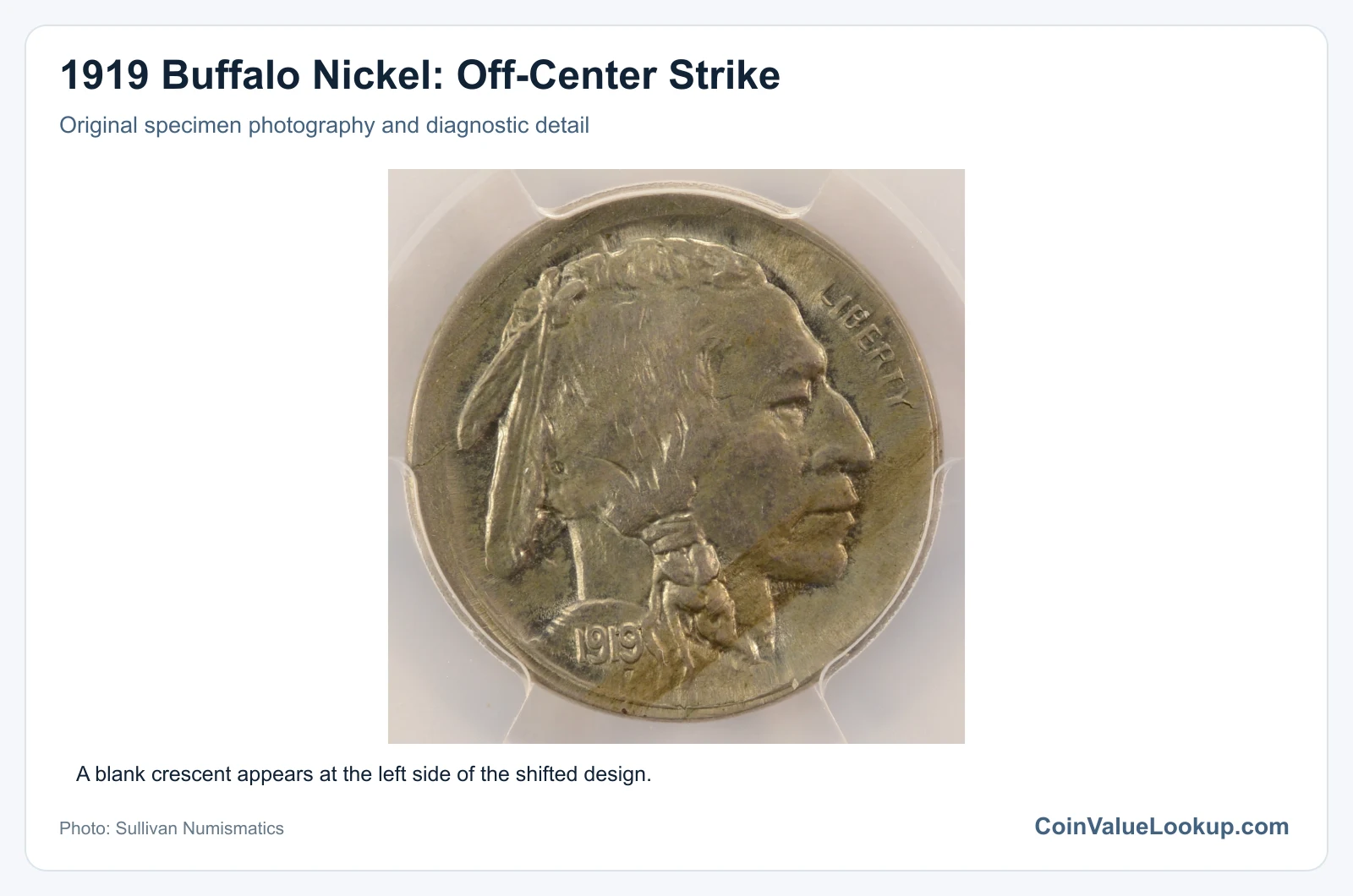
An off-center strike occurs when the planchet is not seated properly between the dies. The result is a displaced design with an unstruck crescent of blank metal along one edge.
For a 1919 Philadelphia Buffalo Nickel, the most collectible off-center errors keep the date fully visible on the obverse. Without the date, identification becomes difficult and value drops sharply.
Do not mistake a clipped planchet, which removes a small curved section of metal, for an off-center strike. Post-mint damage that flattens one side of the coin can also mimic the look.
A genuine off-center piece will have design elements that shift uniformly in one direction. Value depends on the percentage of off-center displacement, date visibility, and overall condition.
3. 1919 Buffalo Nickel — Lamination / Split Planchet
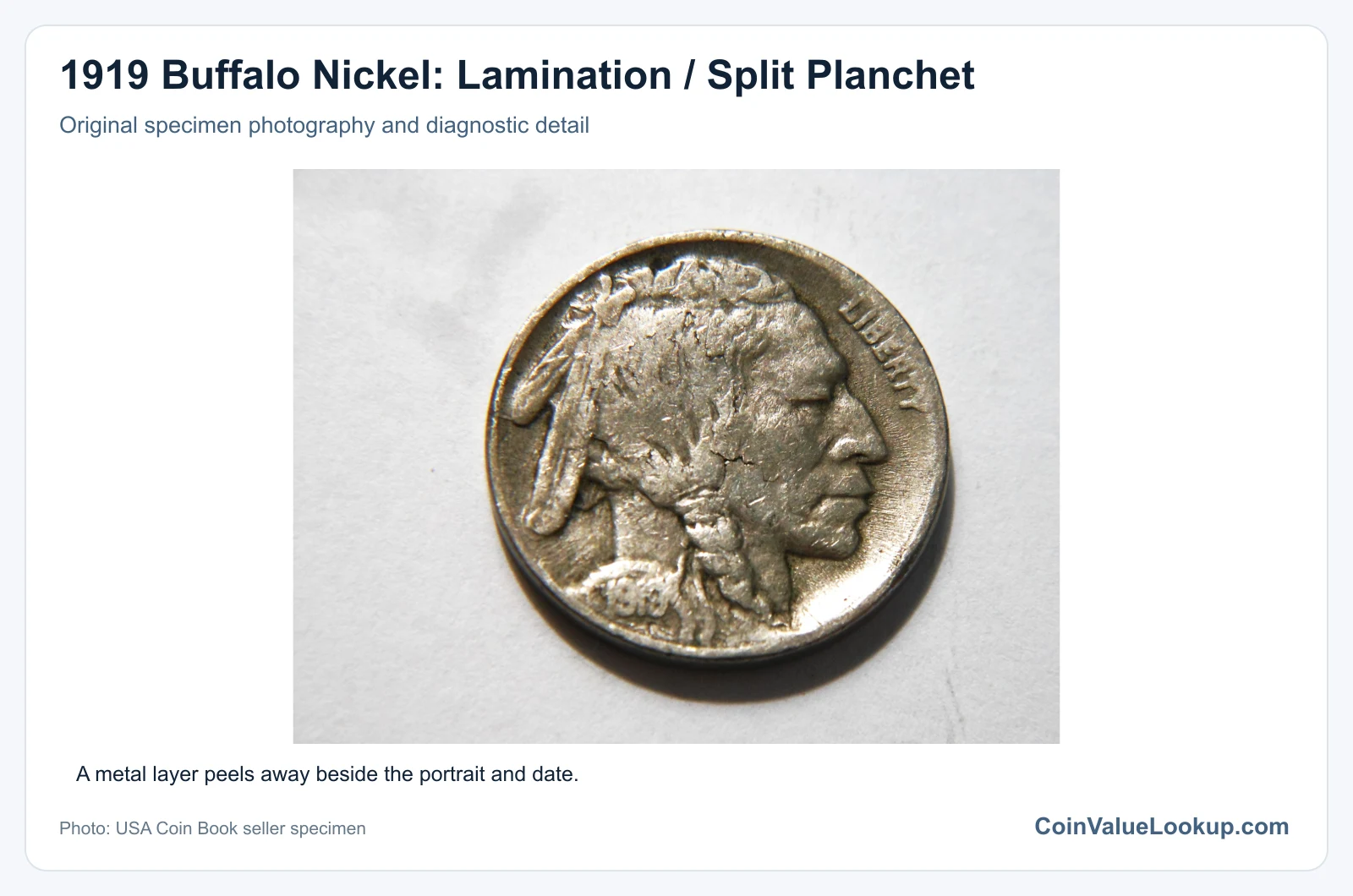
Lamination errors appear when the coin's metal separates into layers, creating a visible flap, peel, or split. These have been reported on both 1919 Philadelphia and Denver nickels.
Look for a raised section of metal that lifts away from the surface, or a missing patch where a flap has broken off entirely. Photograph the edge alongside the affected face, because the separation is often most obvious in profile.
Corrosion, deliberate scraping, or a coin that has been cut or filed can look superficially similar. The difference is that a genuine lamination follows the metal's internal structure and typically has smooth, rounded edges at the separation point rather than sharp tool marks.
Value varies with size and visual impact; no fixed price range applies.
4. 1919 Buffalo Nickel — Broadstrike
A broadstrike occurs when the coin is struck without the retaining collar that normally constrains its diameter. The result is a coin that spreads outward, appearing slightly larger than normal with a missing or distorted rim.
On a 1919 Philadelphia nickel, check the edge profile carefully. A broadstruck coin retains its full design — both obverse and reverse — but the rim will look flat or absent, and the coin may feel wider between your fingers.
Do not confuse this with an off-center strike, which shifts the design to one side and leaves blank metal. Also watch out for coins that were flattened after leaving the mint, for instance by being placed on a railroad track.
Those show distorted design and surface damage inconsistent with a single press strike. Value depends on how dramatic the spread is and the coin's overall condition.
5. 1919 Buffalo Nickel — Two Feathers / Abraded Third Feather
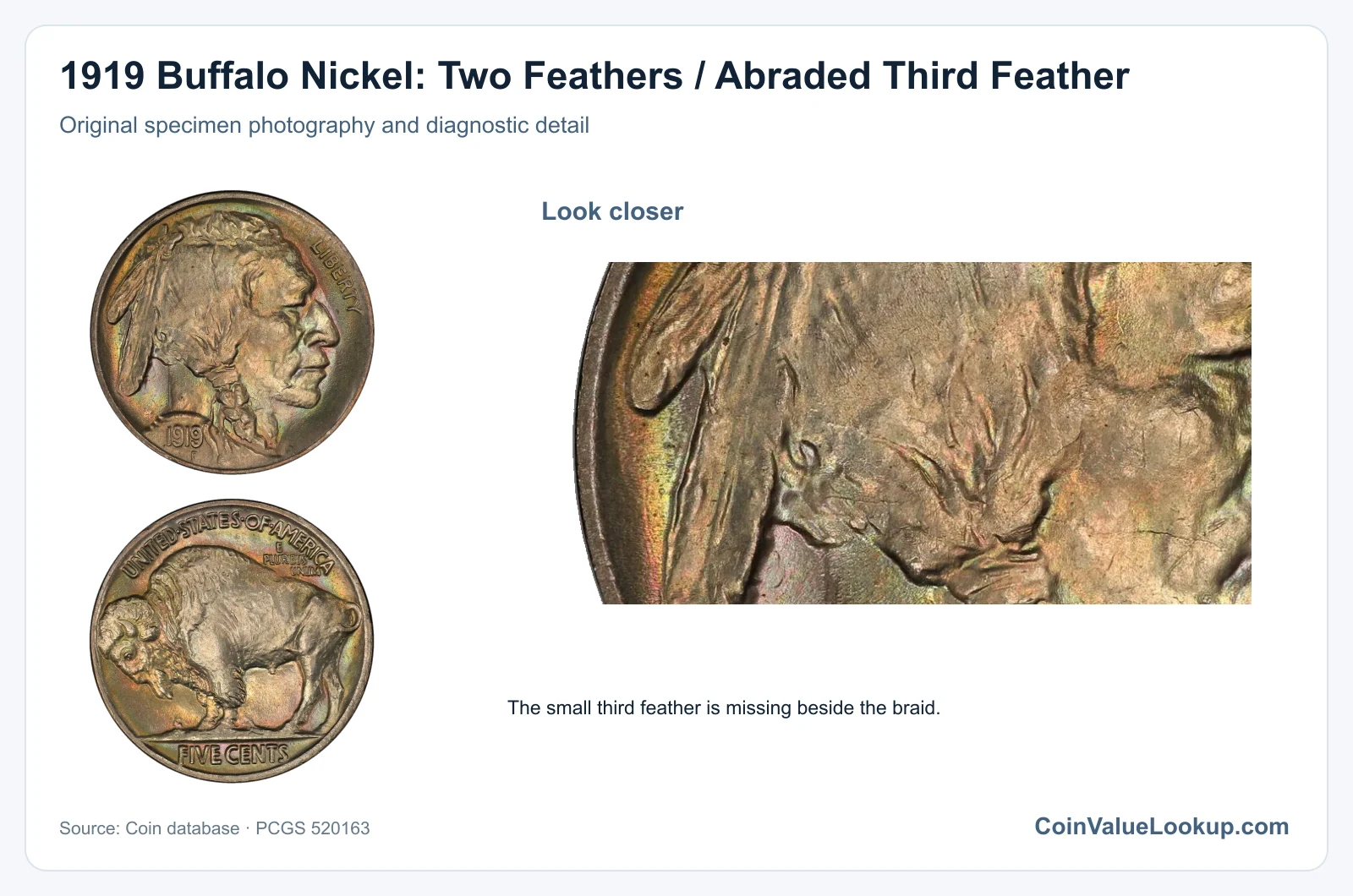
The normal Buffalo Nickel obverse shows three feathers trailing from the Native American portrait's hair. On the Two Feathers variety, the smallest feather closest to the neck is missing or shows only a faint remnant.
This variety has been reported across all three 1919 mints: Philadelphia, Denver, and San Francisco. To check yours, compare the feather area against a known three-feather example under good light.
You are looking for a clean absence or a distinct partial outline, not just a fuzzy feather.
Heavy wear, grease fills, weak strikes, and deliberate scraping can all make a feather look gone. The distinction is that a genuine Two Feathers example shows the absence consistently with an attributed die, not just generalized softness across the whole design.
Value varies with confirmation and grade.
6. 1919 Buffalo Nickel — Missing Designer Initial F
James Earle Fraser's designer initial, a small F, normally appears below the date on the obverse. On the Missing F variety of the 1919 Philadelphia nickel, that letter is absent or barely detectable.
The cause is attributed to die polishing that removed the shallow letter from the working die. Look at the area just below and to the right of the date.
On a normal coin the F is small but visible under magnification.
Wear, grease, a weak strike, or intentional removal can all erase the F. The difference is that a die-polished example will show clean, undisturbed fields in the F area rather than the rough, uneven surface left by wear or tampering.
Value depends on how convincingly the variety can be attributed and the coin's overall condition.
7. 1919 Buffalo Nickel — Doubled Die Obverse
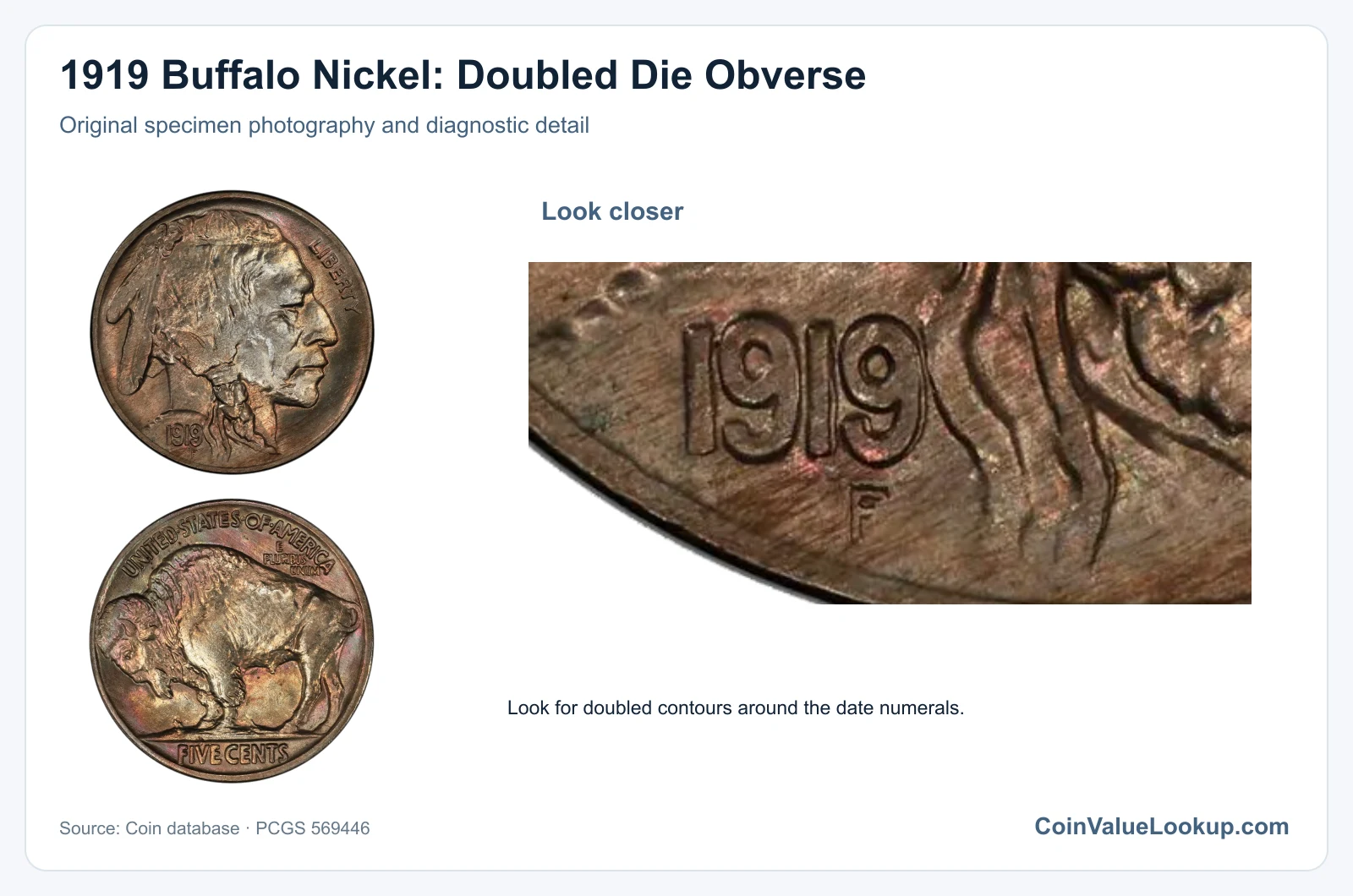
A Doubled Die Obverse on the 1919 nickel shows consistent doubling on obverse design elements such as lettering or profile details. Under magnification, look for separation or notching on features like LIBERTY or the date digits.
Genuine hub doubling produces a secondary image that is uniform across affected areas. It should appear the same way on every coin struck from that die.
This is different from machine doubling, which creates a flat, shelf-like distortion usually visible on just one side of the raised elements.
Reflections from lighting angles or worn die contours can also mimic doubling to the untrained eye. Compare your coin against a confirmed normal example under identical light.
Value depends on the strength and location of the doubling as well as the coin's overall grade; no specific price range is established here.