1919 Wheat Penny Coin Value: How Much Is It Worth?
A 1919 Wheat penny in circulated condition starts around $0.30 in Good-4 grade for a Philadelphia issue, while an uncirculated MS63 Denver mint coin can reach about $154 according to USA Coin Book guide estimates. Original surfaces, color and the specific mint branch all affect what your coin is actually worth.
Proofs were not made for this date, and major errors are priced separately.
Fast Way to Identify Your 1919 Wheat Penny
The quickest way to start figuring out what you have is to upload clear photos of both sides of your coin. A front shot captures wear on Lincoln's portrait and the mintmark location, while the back shows the wheat ear detail.
Use our identifier for a preliminary look at your coin's mint and condition before diving deeper.
1919 Wheat Penny Value
Upload both sides of your 1919 Wheat Penny.
Front Obverse
Upload photo
Back Reverse
Upload photo
Which 1919 Wheat Penny Versions Are Worth Money?
- The 1919-D in MS63 reaches about $154 per guide estimates, making the Denver mint the key branch in uncirculated grades.
- A 1919-S in MS63 guides near $144, close behind Denver; even a circulated Good-4 example at $0.61 is worth double the Philadelphia issue.
- Philadelphia 1919 cents are common in low grades at around $0.30, but jump to about $30 in MS63 — original surfaces matter.
- Authenticated error coins such as doubled die reverses or off-center strikes can carry individual premiums beyond standard guide values.
Step 1: Identify Your 1919 Wheat Penny Mint Mark and Version
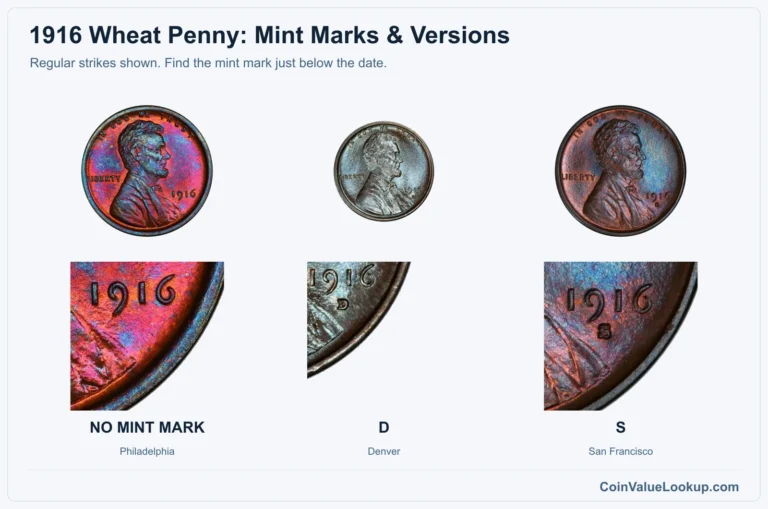
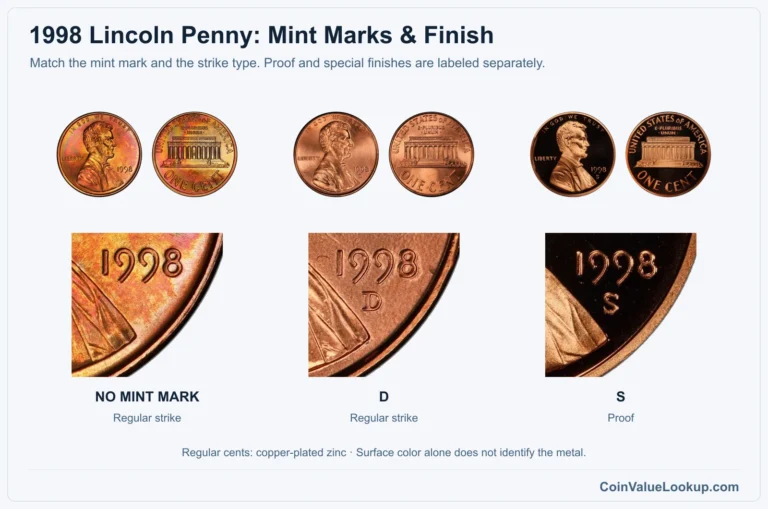
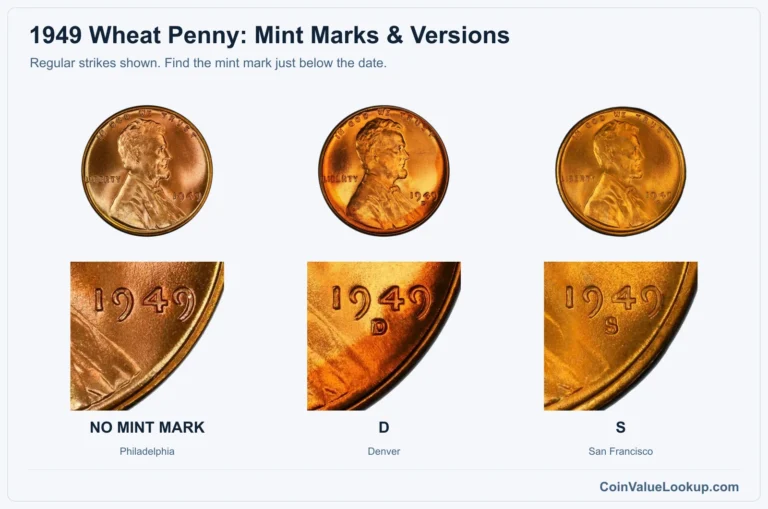
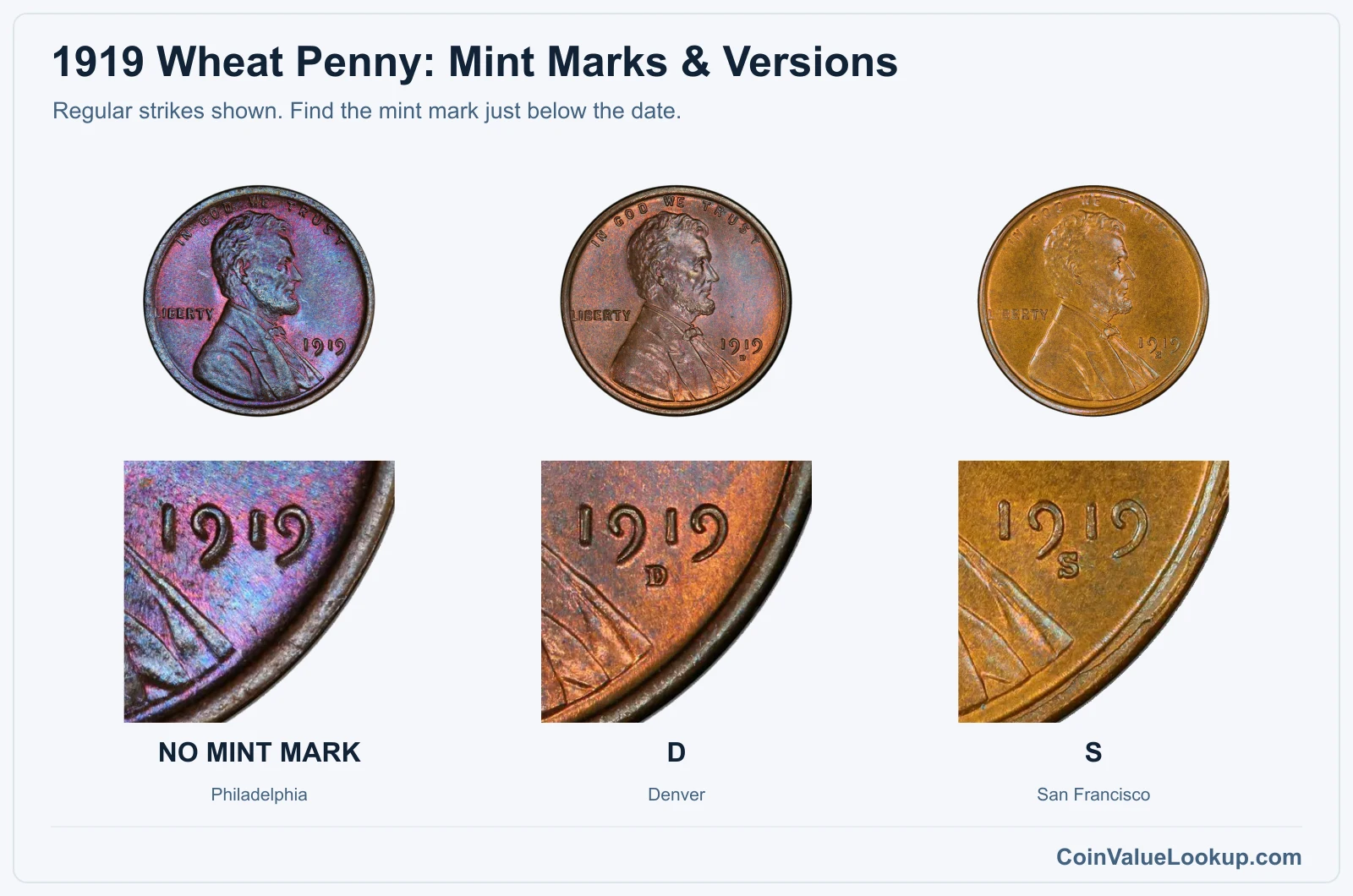
Flip your coin over so you are looking at Lincoln's portrait. Below the date on the obverse, look for a small letter.
No letter means Philadelphia. A "D" means Denver.
An "S" means San Francisco. That single detail changes the coin's value significantly.
All three mints struck business-strike cents this year — no proofs exist for the 1919 date. The coin is 95% copper with 5% tin and zinc, weighs about 3.11 grams, and has a plain edge.
If yours feels lighter or has a reeded edge, it is not a genuine 1919 cent.
Branch-mint coins from Denver and San Francisco sometimes show a weaker original strike, especially on the hair detail above Lincoln's ear. Do not confuse a soft strike with heavy wear — they look similar but mean very different things for value.
A weakly struck coin still has full luster in the fields around the soft areas, while a worn coin loses that luster entirely.
Step 2: Check Your 1919 Wheat Penny Grade
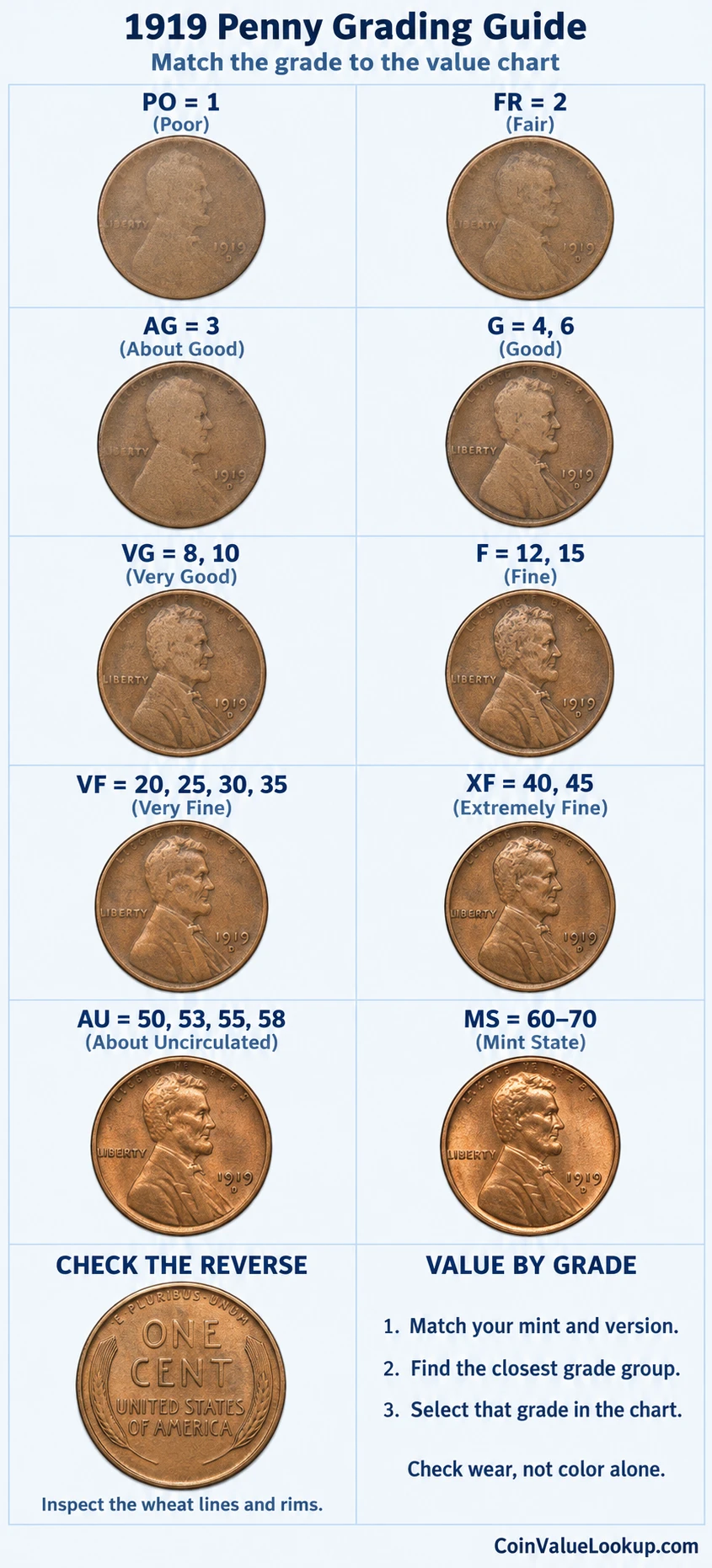
Start with Lincoln's cheekbone, jawline and the fine hair strands above his ear. These are the highest points and the first places wear shows up.
A coin grading Good-4 will have a visible outline of Lincoln but almost no hair detail. Move up to Fine and you will see partial hair lines returning.
On the reverse, check the individual wheat grains and the horizontal lines between the stalks. Higher-grade coins keep those lines crisp and separated.
At lower grades they merge into flat bands.
Luster matters a lot on this date. A coin with original mint bloom across the fields — even with minor contact marks — will grade much higher than a cleaned coin with apparently sharp detail.
Look for unnatural brightness or hairline scratches that indicate past cleaning.
Color on copper cents falls into Red, Red-Brown and Brown categories. These are separate descriptors from the numerical grade and each commands a different premium.
The guide estimates referenced here do not specify color, so do not assume they reflect certified Red pricing.
Use the comparison image to match your coin's wear pattern against known grade benchmarks. Pay special attention to the wheat ear detail, since that is often the easiest area for a beginner to compare.
Step 3: Check 1919 Wheat Penny Value by Mint and Version
1919 Wheat Penny
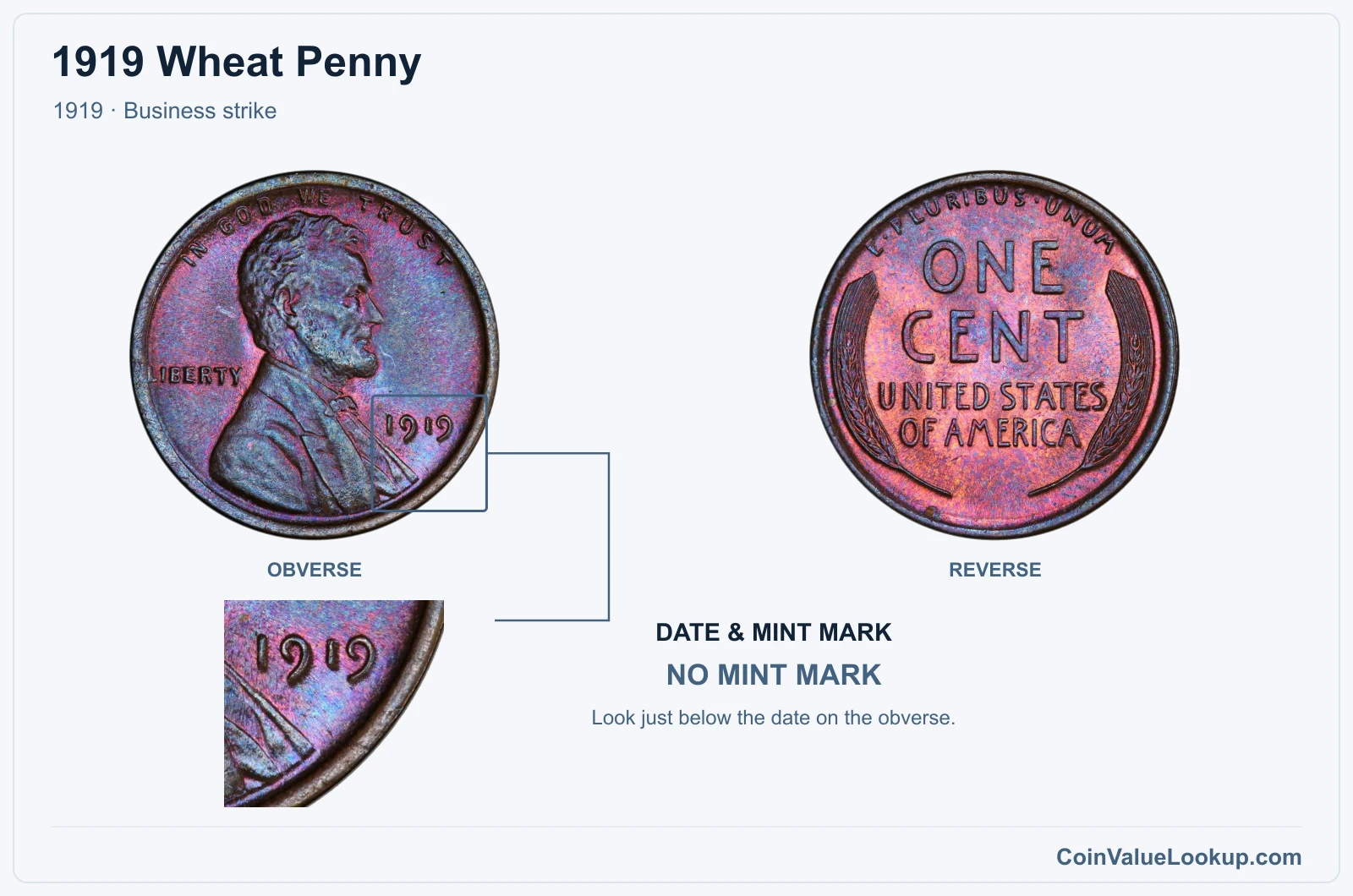
The 1919 Philadelphia cent has no mintmark below the date. It is the most common branch for this year and guides at roughly $0.30 in Good-4 circulated condition, rising to about $30 in MS63 uncirculated.
That is a big jump, and the reason is survival rate — plenty were saved in low grades, but finding one with full original luster is another story.
Look for strong hair detail above Lincoln's ear and complete wheat lines on the reverse. A weak strike is less of an issue with Philadelphia coins than with the branch mints, but cleaning is rampant on this date.
If the surfaces look unnaturally bright or show fine parallel scratches, the coin has likely been cleaned, which lowers its appeal to collectors.
| Range | Grade | Price | Auction Records | Appraisal |
|---|---|---|---|---|
| PO | PO 1 | — | Coin Identifier | |
| FR | FR 2 | — | Coin Identifier | |
| AG | AG 3 | — | Coin Identifier | |
| G | G 4 | — | Coin Identifier | |
| G 6 | — | Coin Identifier | ||
| VG | VG 8 | — | Coin Identifier | |
| VG 10 | — | Coin Identifier | ||
| F | F 12 | — | Coin Identifier | |
| F 15 | — | Coin Identifier | ||
| VF | VF 20 | — | Coin Identifier | |
| VF 25 | — | Coin Identifier | ||
| VF 30 | — | Coin Identifier | ||
| VF 35 | — | Coin Identifier | ||
| XF | XF 40 | — | Coin Identifier | |
| XF 45 | — | Coin Identifier | ||
| AU | AU 50 | — | Coin Identifier | |
| AU 53 | — | Coin Identifier | ||
| AU 55 | Coin Identifier | |||
| AU 58 | Coin Identifier | |||
| MS | MS 60 | — | Coin Identifier | |
| MS 61 | — | Coin Identifier | ||
| MS 62 | — | Coin Identifier | ||
| MS 63 | Coin Identifier | |||
| MS 64 | Coin Identifier | |||
| MS 65 | Coin Identifier | |||
| MS 66 | — | — | — | |
| MS 67 | — | — | — | |
| MS 68 | — | — | — | |
| MS 69 | — | — | — | |
| MS 70 | — | — | — |
1919 Wheat Penny — D
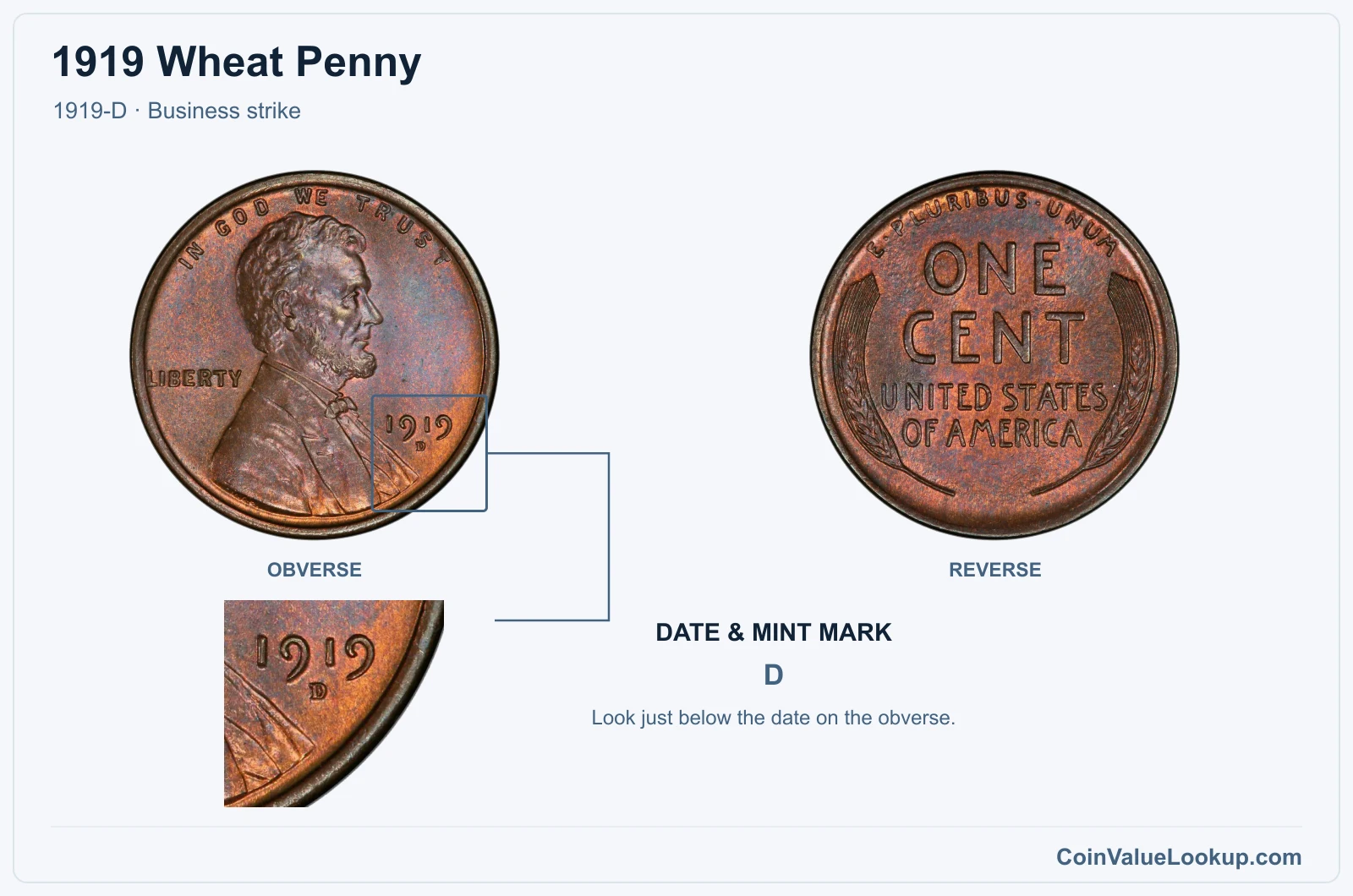
The 1919-D carries a small "D" mintmark below the date. It guides at about $1.24 in Good-4, roughly four times the Philadelphia issue at the same grade.
In MS63 it reaches approximately $154, the highest guide figure among the three mints for this year.
Denver strikes from this era can show softness on the high points even on uncirculated coins. Do not mistake a weak original strike for wear.
Check the fields around the portrait — if they still carry full cartwheel luster, the coin may be better than it first appears. Original brown surfaces with no problems will always outsell a cleaned coin that looks shinier.
Coin Value Lookup is a good starting point if you want to compare your 1919-D against other dates and mints in the Wheat penny series. You can look up guide values across the full Lincoln cent run.
| Range | Grade | Price | Auction Records | Appraisal |
|---|---|---|---|---|
| PO | PO 1 | — | Coin Identifier | |
| FR | FR 2 | — | Coin Identifier | |
| AG | AG 3 | — | Coin Identifier | |
| G | G 4 | — | Coin Identifier | |
| G 6 | — | Coin Identifier | ||
| VG | VG 8 | — | Coin Identifier | |
| VG 10 | — | Coin Identifier | ||
| F | F 12 | — | Coin Identifier | |
| F 15 | — | Coin Identifier | ||
| VF | VF 20 | — | Coin Identifier | |
| VF 25 | — | Coin Identifier | ||
| VF 30 | — | Coin Identifier | ||
| VF 35 | — | Coin Identifier | ||
| XF | XF 40 | — | Coin Identifier | |
| XF 45 | — | Coin Identifier | ||
| AU | AU 50 | Coin Identifier | ||
| AU 53 | Coin Identifier | |||
| AU 55 | Coin Identifier | |||
| AU 58 | Coin Identifier | |||
| MS | MS 60 | Coin Identifier | ||
| MS 61 | — | Coin Identifier | ||
| MS 62 | Coin Identifier | |||
| MS 63 | Coin Identifier | |||
| MS 64 | Coin Identifier | |||
| MS 65 | Coin Identifier | |||
| MS 66 | Coin Identifier | |||
| MS 67 | — | — | — | |
| MS 68 | — | — | — | |
| MS 69 | — | — | — | |
| MS 70 | — | — | — |
1919 Wheat Penny — S
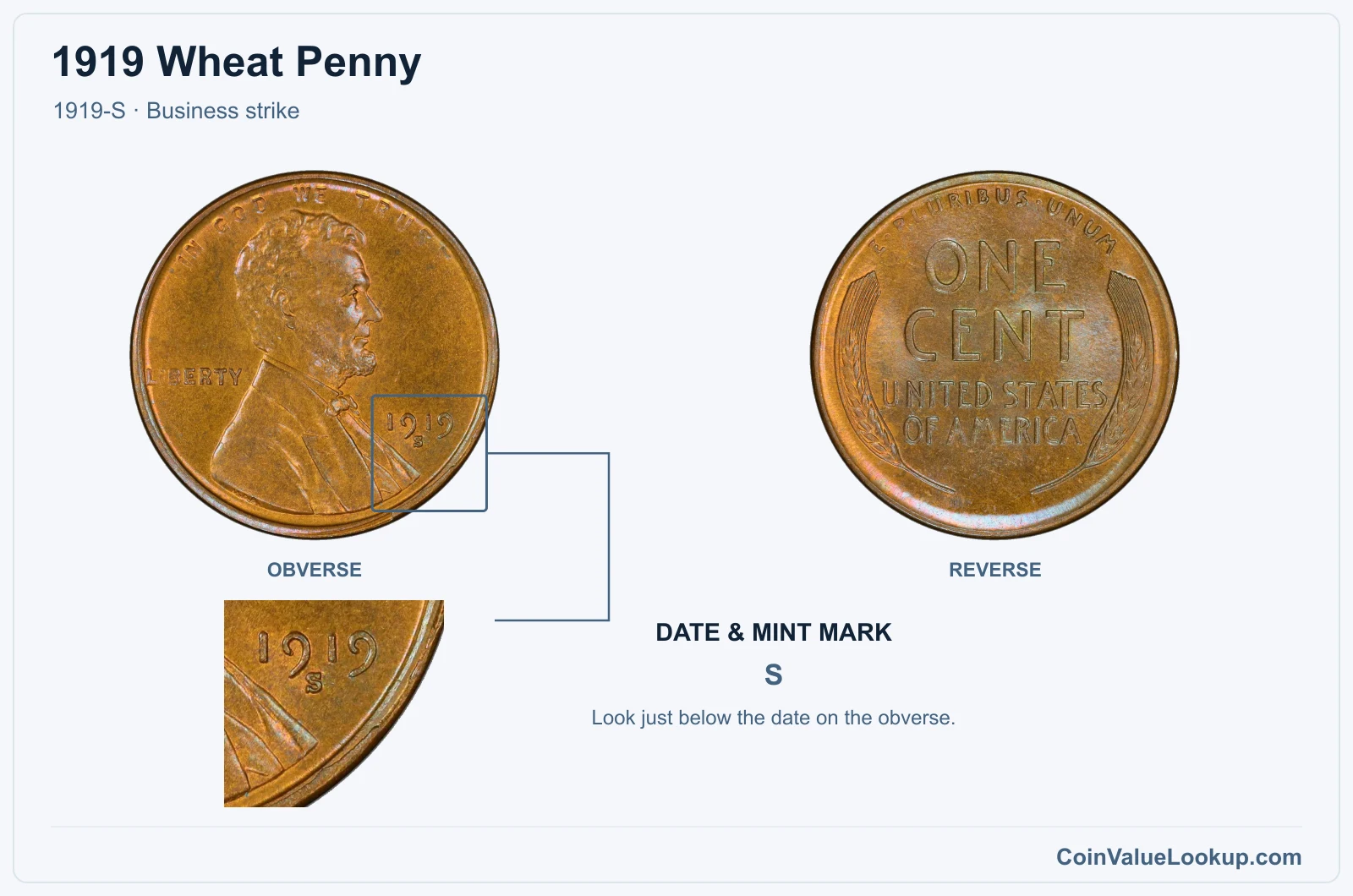
The 1919-S shows a small "S" mintmark below the date, struck at the San Francisco mint. In Good-4 it guides around $0.61, and in MS63 it climbs to about $144 — very close to the Denver issue at the same grade.
San Francisco cents of this period are often weakly struck, particularly on the hair detail and the reverse wheat lines. This is a known characteristic of the mint, not damage.
Compare the fields for luster before downgrading your coin based on soft detail alone.
Because the 1919-S and 1919-D guide so closely in MS63, the practical difference between them often comes down to eye appeal, color and surface quality rather than the mintmark itself. A problem-free original example of either mint in uncirculated condition is worth careful grading.
| Range | Grade | Price | Auction Records | Appraisal |
|---|---|---|---|---|
| PO | PO 1 | — | Coin Identifier | |
| FR | FR 2 | — | Coin Identifier | |
| AG | AG 3 | — | Coin Identifier | |
| G | G 4 | — | Coin Identifier | |
| G 6 | — | Coin Identifier | ||
| VG | VG 8 | — | Coin Identifier | |
| VG 10 | — | Coin Identifier | ||
| F | F 12 | — | Coin Identifier | |
| F 15 | Coin Identifier | |||
| VF | VF 20 | — | Coin Identifier | |
| VF 25 | — | Coin Identifier | ||
| VF 30 | Coin Identifier | |||
| VF 35 | — | Coin Identifier | ||
| XF | XF 40 | Coin Identifier | ||
| XF 45 | Coin Identifier | |||
| AU | AU 50 | Coin Identifier | ||
| AU 53 | — | Coin Identifier | ||
| AU 55 | Coin Identifier | |||
| AU 58 | Coin Identifier | |||
| MS | MS 60 | — | Coin Identifier | |
| MS 61 | Coin Identifier | |||
| MS 62 | Coin Identifier | |||
| MS 63 | Coin Identifier | |||
| MS 64 | Coin Identifier | |||
| MS 65 | Coin Identifier | |||
| MS 66 | — | — | — | |
| MS 67 | — | — | — | |
| MS 68 | — | — | — | |
| MS 69 | — | — | — | |
| MS 70 | — | — | — |
1919 Wheat Penny Error List
1. 1919 Wheat Penny — Doubled Die Reverse
A doubled die reverse on a 1919 Wheat cent shows doubling on the reverse legends or design elements — the wheat ears, lettering, or denomination. To check, compare your reverse closely against a known normal example under magnification.
Look for a secondary, slightly offset impression on the letters of ONE CENT or UNITED STATES OF AMERICA.
The key distinction is that a true doubled die affects every coin struck from that die in the same way, so the doubling is consistent and sharp. Machine doubling, by contrast, tends to look flat, shelf-like and mushy.
Random scratches or damage will not follow the contours of the design the way a genuine doubled die does.
No specific price range is supported for this variety. Value depends on the severity of the doubling, the coin's grade and authentication by a recognized grading service.
2. 1919 Wheat Penny — Repunched Mintmark
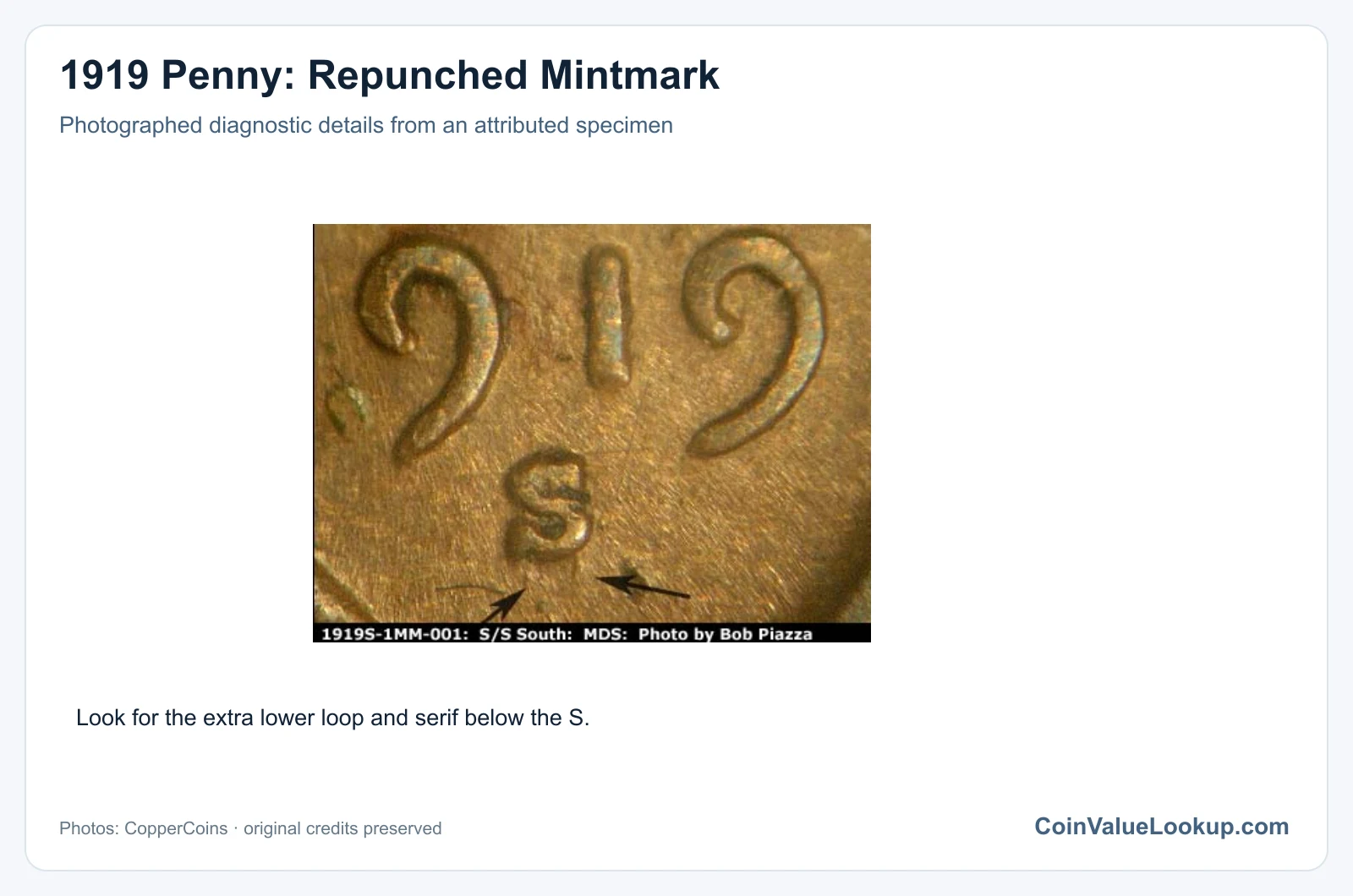
A repunched mintmark appears on branch-mint coins only — the 1919-D and 1919-S. Philadelphia coins have no mintmark to repunch.
Look at the D or S below the date under magnification. You are searching for remnants of an earlier, differently positioned punch — a shadow letter slightly offset from the final mintmark.
This is different from machine doubling, which produces a flat shelf around the letter. A genuine repunched mintmark shows a distinctly separate impression, sometimes at a noticeably different angle.
Die chips or corrosion around the mintmark can also mimic the look, so compare carefully at matching magnification against a normal example.
Pricing depends on the specific variety, its visual strength and the coin's overall condition. Professional authentication is the safest route to confirm what you have.
3. 1919 Wheat Penny — Broadstrike
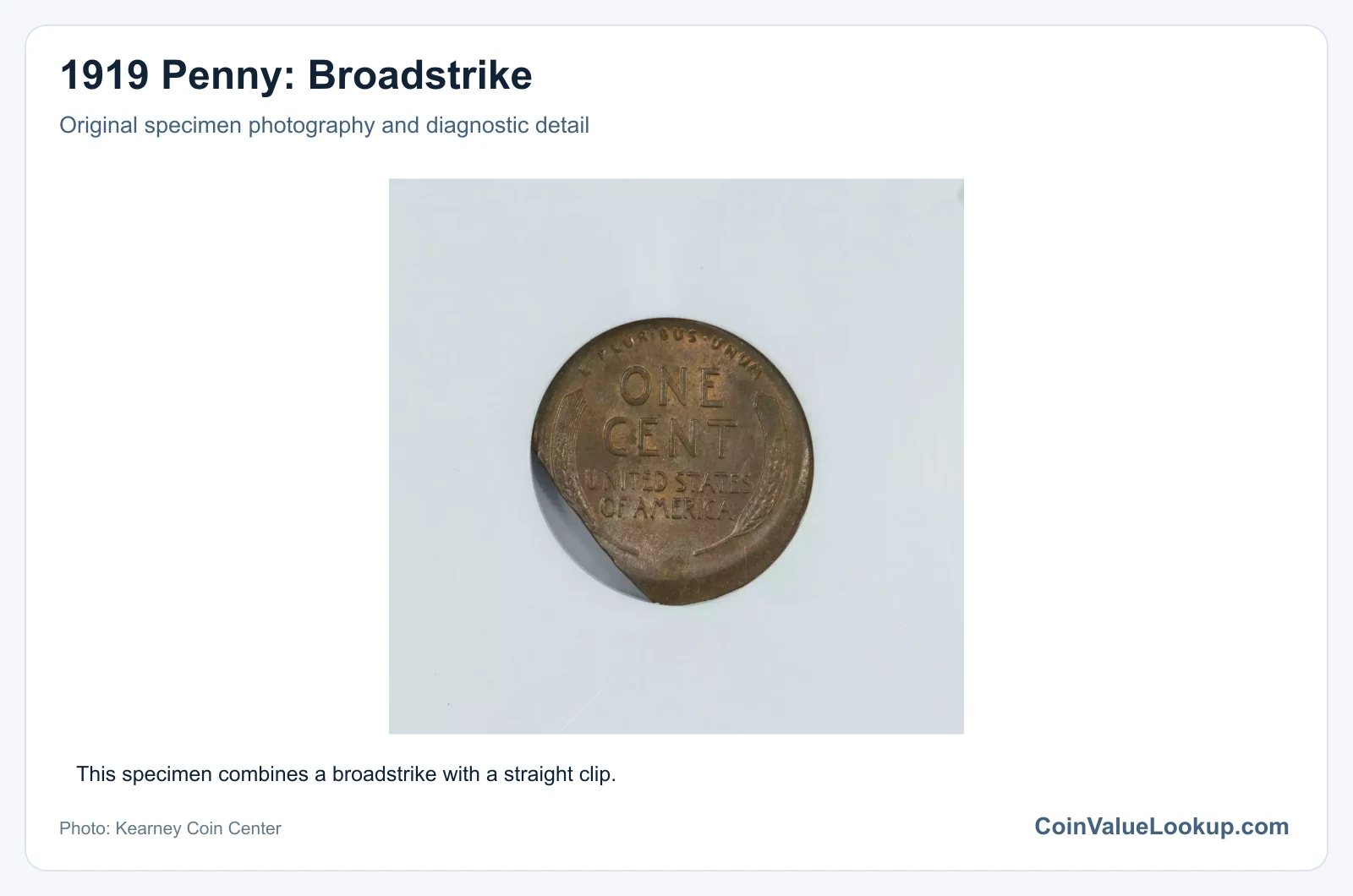
A broadstrike happens when the coin is struck without the retaining collar that normally forms the rim and controls the diameter. The result is a cent that spreads outward, appearing slightly larger than normal with a weak or missing rim.
The full design is still present, just expanded.
Do not confuse this with an off-center strike, which shifts the design and leaves a blank crescent. A broadstrike keeps the design centered but loses the crisp rim definition.
Also rule out post-mint damage — a coin hammered flat after leaving the mint will show distorted detail and lack the uniform metal flow of a genuine broadstrike.
Value for a 1919 broadstrike cent depends on the degree of spread, overall condition and professional authentication. No specific price range is available for this error.
4. 1919 Wheat Penny — Rotated Dies
On a normal U.S. coin, if you hold the obverse upright and flip it top to bottom, the reverse should also appear upright. A rotated die error means the reverse is turned at an angle relative to the obverse.
Small rotations of a few degrees are common and not particularly collectible. Larger rotations — 45 degrees, 90 degrees, or especially 180 degrees — draw serious attention.
Be careful with photographs. A picture can be rotated digitally or the coin can simply be turned in hand, so this is not something you can verify from a single image.
You need to physically hold the coin and flip it.
Pricing depends on the degree of rotation, the coin's condition and authentication. No specific price range is supported for this error on the 1919 cent.
5. 1919 Wheat Penny — Lamination / Split Planchet
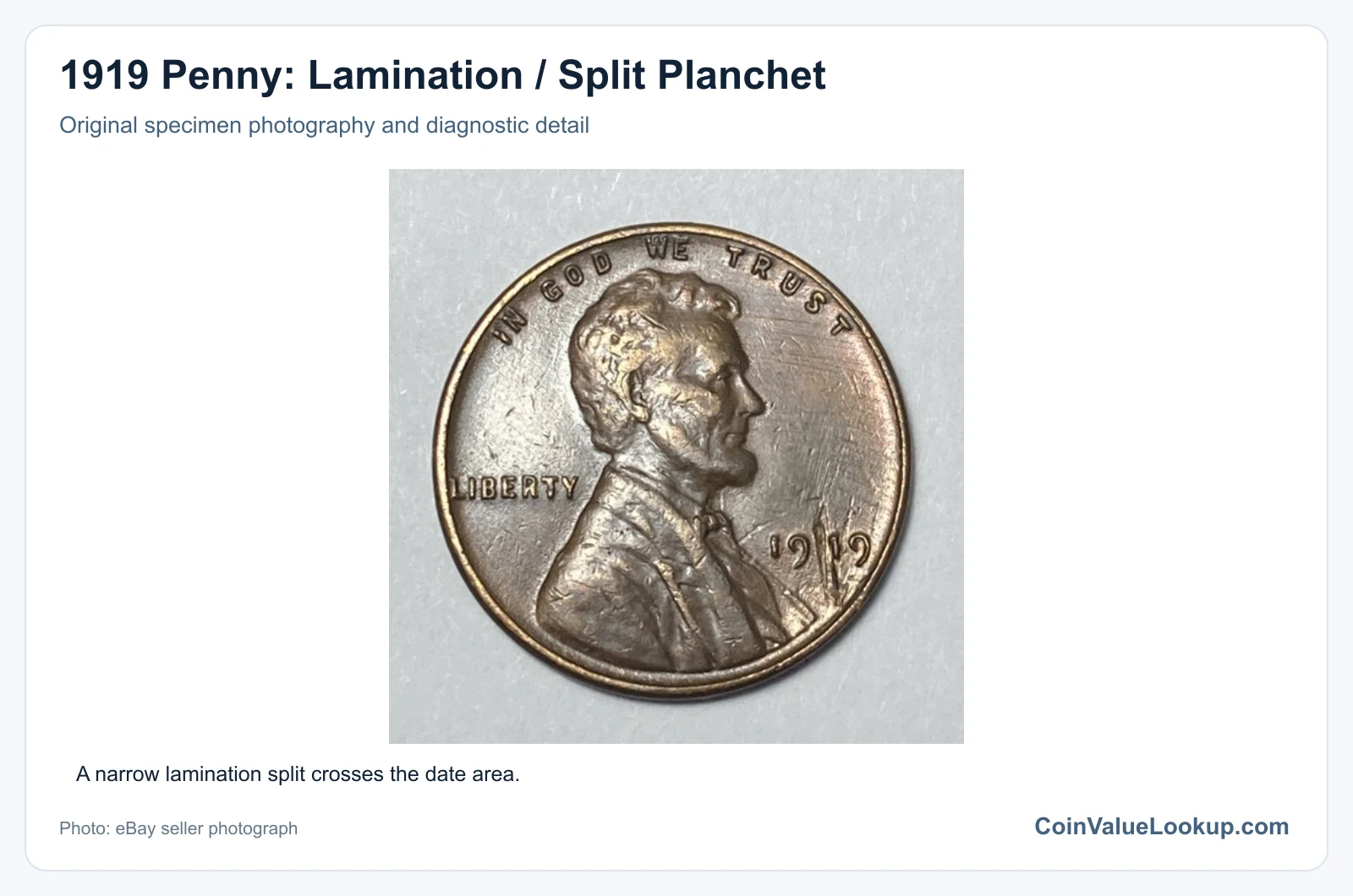
A lamination error shows as peeling, flaking or separating metal on the coin's surface. It occurs when impurities or gas pockets in the planchet cause layers to split apart during or after striking.
On a 1919 cent, look for a raised flap of metal, a missing chunk that reveals a lower layer, or a crack running parallel to the surface.
Photograph both the affected face and the edge together — the edge profile often tells the whole story. Post-mint scraping, corrosion pitting and deliberately cut coins can all mimic a lamination at first glance.
Genuine laminations follow the natural contour of the planchet and do not show tool marks.
Value varies by size, location and whether the flap is retained. No supported price range exists for this error, so individual assessment through a grading service is the practical approach.
6. 1919 Wheat Penny — Off-Center Strike
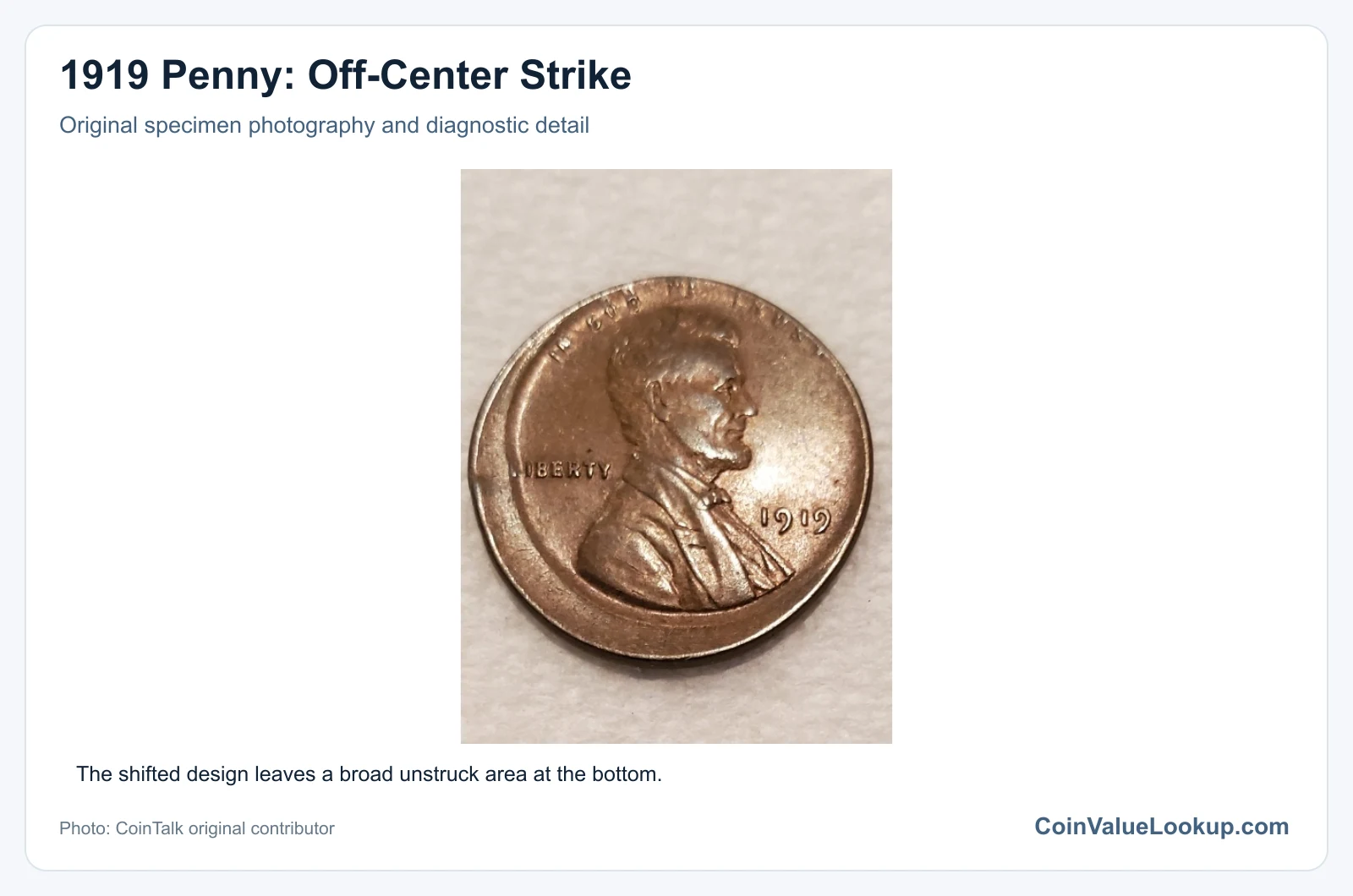
An off-center strike shifts the entire design to one side, leaving an unstruck crescent of blank planchet on the opposite edge. On a 1919 Wheat cent, the most desirable off-center errors show a significant percentage of displacement while still keeping the date fully visible — date visibility is the single biggest factor in collectibility.
Do not confuse this with a clipped planchet, which removes a curved bite from the edge but keeps the design centered. Also watch out for coins that were flattened or damaged after minting; those will show distorted detail rather than a clean unstruck area.
No specific price range is available for 1919 off-center strikes. The value depends on the percentage off-center, date visibility, overall condition and professional authentication.
7. 1919 Wheat Penny — Double / Multiple Strike
A double or multiple strike error means the coin was hit by the dies more than once, with the coin shifting between impacts. The result is two or more overlapping but visibly separate impressions of the design.
This is not subtle — a genuine double strike usually shows a dramatically displaced second image.
Do not confuse this with a doubled die, where the doubling comes from the die itself and appears identical on every coin from that die. A double strike is unique to the individual coin.
Post-mint impressions — someone pressing the coin against another object — can fake the appearance, but they lack the sharp definition of a mint-produced strike.
Pricing depends on the number of strikes, the degree of separation, and whether key design elements like the date remain readable. Professional authentication is essential for a coin like this.
8. 1919 Wheat Penny — Clashed Dies
Clashed dies leave ghost-like traces of the opposite design on one or both sides of the coin. This happens when the dies strike each other without a planchet between them, transferring a partial mirror image.
On a 1919 Wheat cent, you might see faint traces of the wheat ears on Lincoln's portrait or hints of Lincoln's profile among the reverse lettering.
These impressions line up with where the opposite design would normally sit during striking. Random scratches, raised lines from a damaged die or a brockage error will not align the same way.
Use magnification and compare the location of the ghost image to the expected position of the opposite design.
No supported price range exists for clashed die examples of this date. Value depends on the clarity of the clash, the coin's grade and third-party authentication.