1956 Jefferson Nickel Coin Value: How Much Is It Worth?
A 1956 Jefferson Nickel in typical circulated condition carries little premium over face value. Uncirculated examples, however, tell a different story: USA Coin Book guide estimates range from about $0.61 at MS60 to $25 at MS65 for business strikes.
Proofs, Full Steps designations, and authenticated mint errors each occupy their own price tiers worth investigating separately.
Fast Way to Identify Your 1956 Jefferson Nickel
The quickest way to start figuring out what you have is to upload clear photos of both sides of your coin. Our identifier can offer a preliminary identification based on those images, helping you determine the mint, finish, and general version.
It does not authenticate errors or assign a certified grade, but it gives you a solid starting point.
1956 Jefferson Nickel Value
Upload both sides of your 1956 Jefferson Nickel.
Front Obverse
Upload photo
Back Reverse
Upload photo
Which 1956 Jefferson Nickel Versions Are Worth Money?
- Uncirculated Philadelphia and Denver business strikes graded MS65 can reach around $25 according to USA Coin Book guide estimates — well above the roughly $0.61 at MS60.
- Philadelphia proofs with mirrored fields are a separate collectible category, with a PR65 guide estimate of about $6.25; cameo contrast examples are assessed individually beyond that baseline.
Step 1: Identify Your 1956 Jefferson Nickel Mint Mark and Version
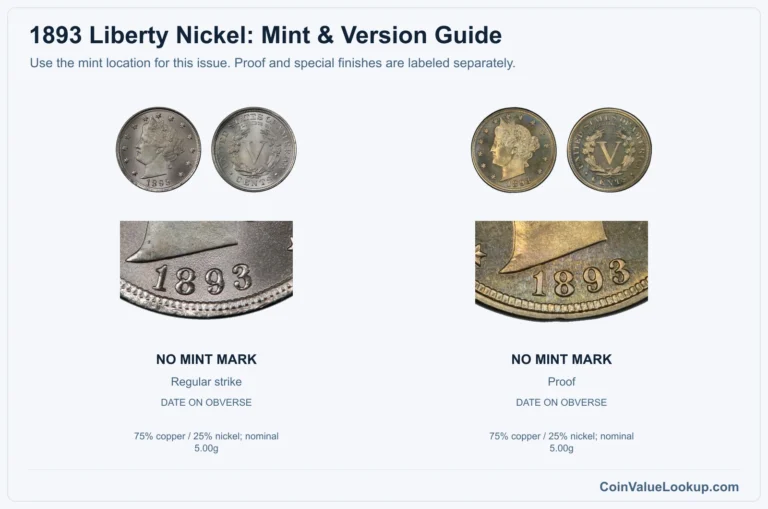
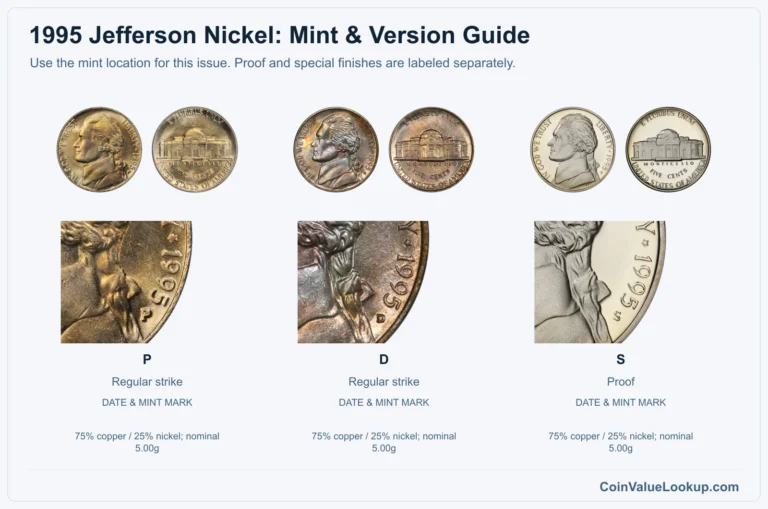
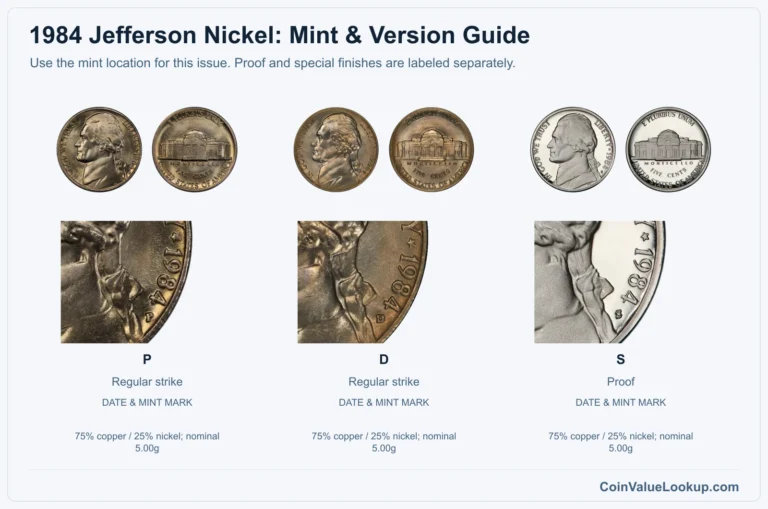
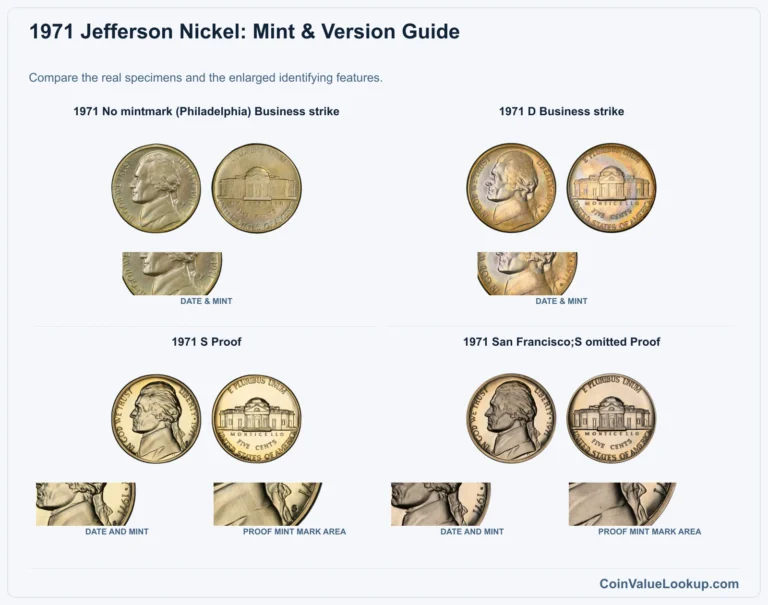
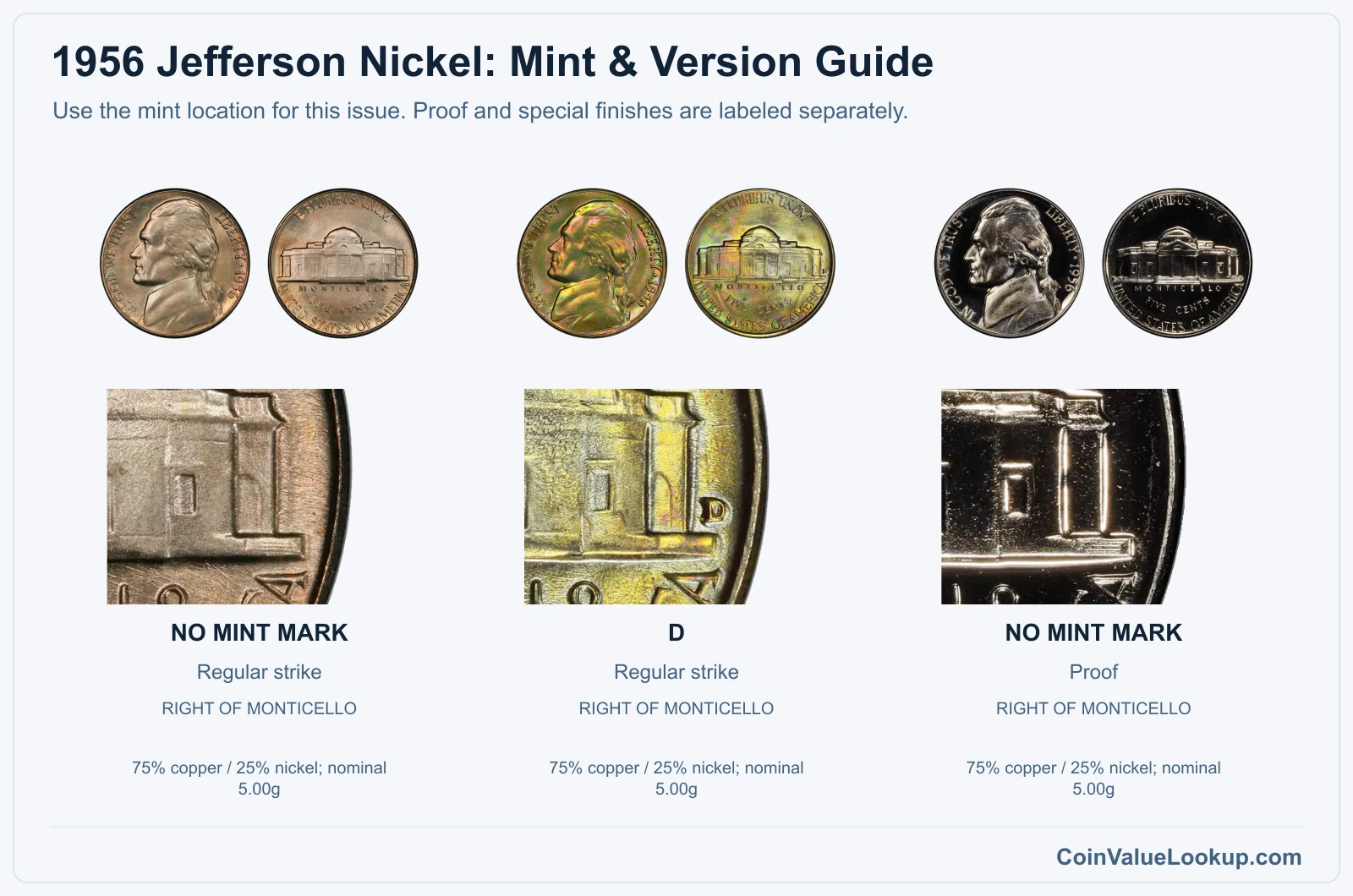
Look at the obverse for the date, 1956, below Jefferson's bust. Philadelphia strikes carry no mintmark at all.
Denver coins show a small "D" on the reverse, to the right of Monticello.
All standard 1956 nickels are struck in 75% copper and 25% nickel, weigh about 5.00 grams, and measure 21.2 mm with a plain edge. There is no silver content in these coins, so unusual toning alone does not indicate an off-metal error.
Separate your coins into three groups: circulated business strikes, uncirculated business strikes, and proofs. A polished business strike is not a proof.
Genuine proofs display deeply mirrored fields and were produced specifically for collectors at the Philadelphia Mint.
Step 2: Check Your 1956 Jefferson Nickel Grade
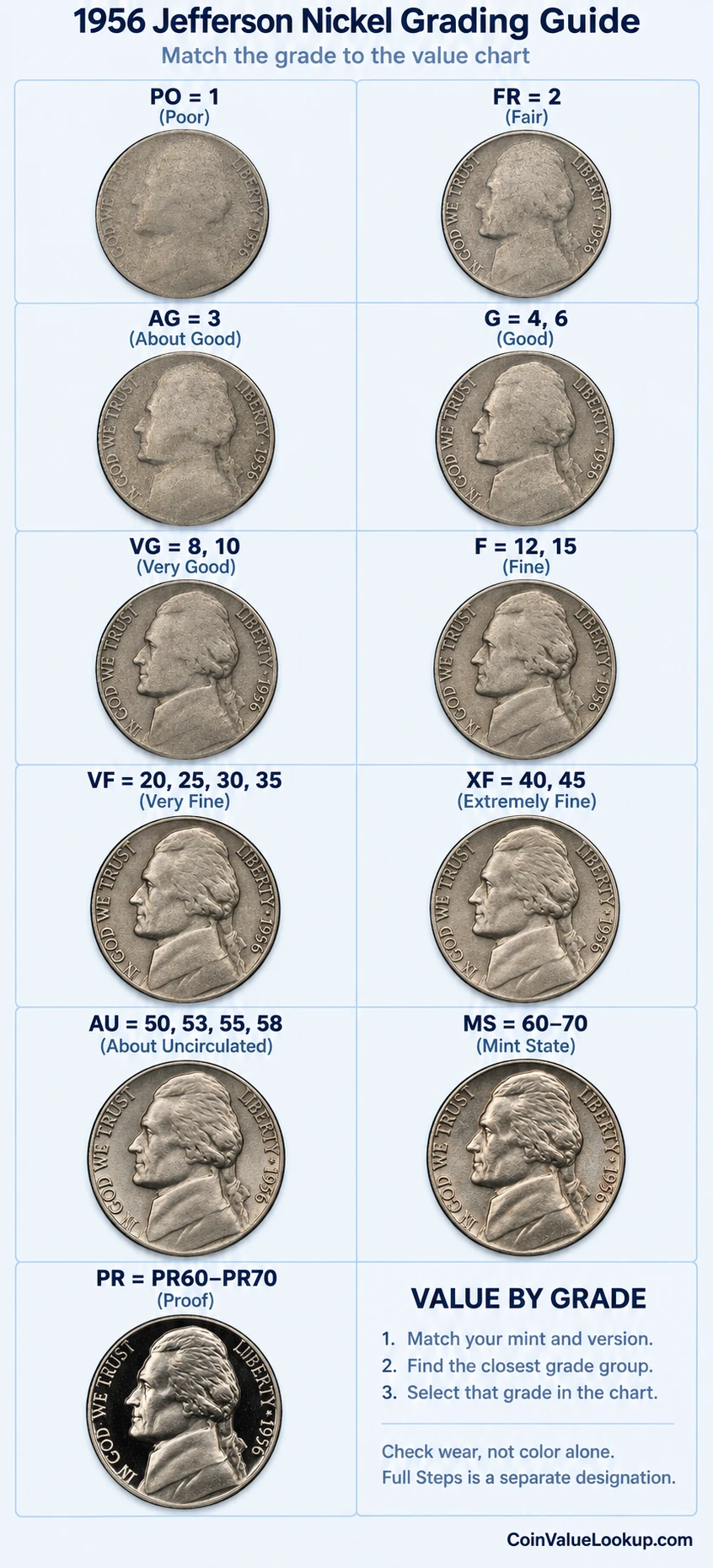
Start with Jefferson's cheek and the hair detail just above his ear. On a well-worn coin, the cheek flattens out first, followed by the hair strands merging together.
Flip the coin over and check the Monticello roof and the four columns: they lose sharpness progressively with wear.
Luster matters as much as detail. A coin with full design but dull, lifeless surfaces grades lower than one with original cartwheel shine and light contact marks.
Compare your coin against the reference image to see how these features change across grades.
The steps at the base of Monticello deserve special attention. PCGS awards a Full Steps designation when at least five steps are clearly separated on a Mint State coin.
Weak strike can mimic wear on the steps, so a coin with mushy steps is not necessarily circulated — it just will not qualify for that premium designation.
Step 3: Check 1956 Jefferson Nickel Value by Mint and Version
1956 Jefferson Nickel — No mintmark (Philadelphia)
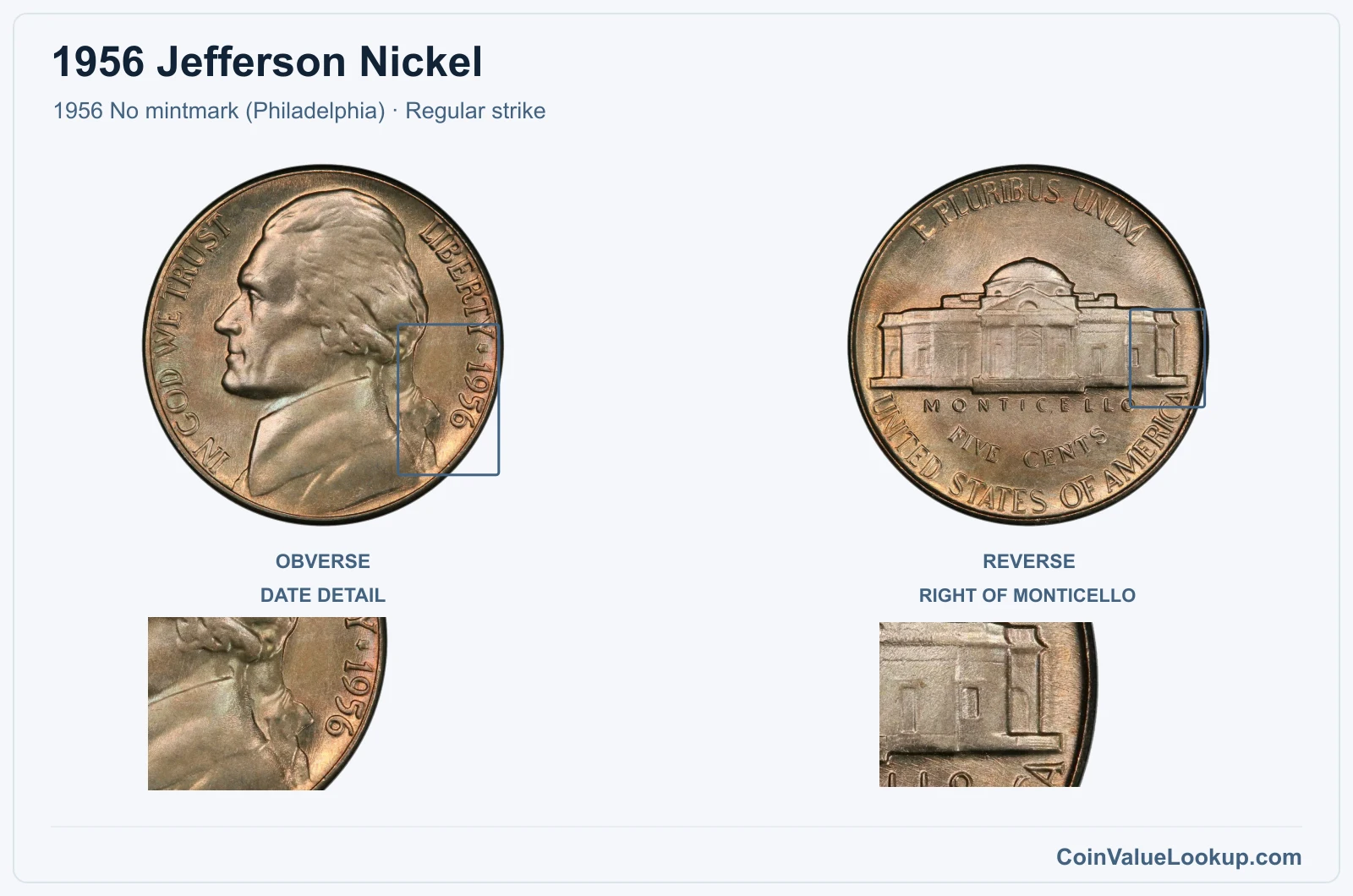
The 1956 Philadelphia nickel has no mintmark. You will see a blank space on the reverse to the right of Monticello where a Denver coin would show a "D." Struck in 75% copper and 25% nickel at 5.00 grams, this is a bread-and-butter issue.
USA Coin Book estimates about $0.61 at MS60 and around $25 at MS65. Worn examples should not be valued from the MS65 column; those prices assume full original mint luster and minimal contact marks.
Full Steps coins command their own premium above these standard uncirculated figures.
| Range | Grade | Price | Auction Records | Appraisal |
|---|---|---|---|---|
| PO | PO 1 | — | Coin Identifier | |
| FR | FR 2 | — | — | — |
| AG | AG 3 | — | — | — |
| G | G 4 | — | — | — |
| G 6 | — | — | — | |
| VG | VG 8 | — | — | — |
| VG 10 | — | — | — | |
| F | F 12 | — | — | — |
| F 15 | — | — | — | |
| VF | VF 20 | — | — | — |
| VF 25 | — | — | — | |
| VF 30 | — | — | — | |
| VF 35 | — | — | — | |
| XF | XF 40 | — | Coin Identifier | |
| XF 45 | — | Coin Identifier | ||
| AU | AU 50 | — | Coin Identifier | |
| AU 53 | — | Coin Identifier | ||
| AU 55 | — | Coin Identifier | ||
| AU 58 | — | Coin Identifier | ||
| MS | MS 60 | — | Coin Identifier | |
| MS 61 | — | Coin Identifier | ||
| MS 62 | — | Coin Identifier | ||
| MS 63 | — | Coin Identifier | ||
| MS 64 | Coin Identifier | |||
| MS 65 | Coin Identifier | |||
| MS 66 | Coin Identifier | |||
| MS 67 | Coin Identifier | |||
| MS 68 | — | — | — | |
| MS 69 | — | — | — | |
| MS 70 | — | — | — |
1956 Jefferson Nickel — No mintmark (Philadelphia) Proof
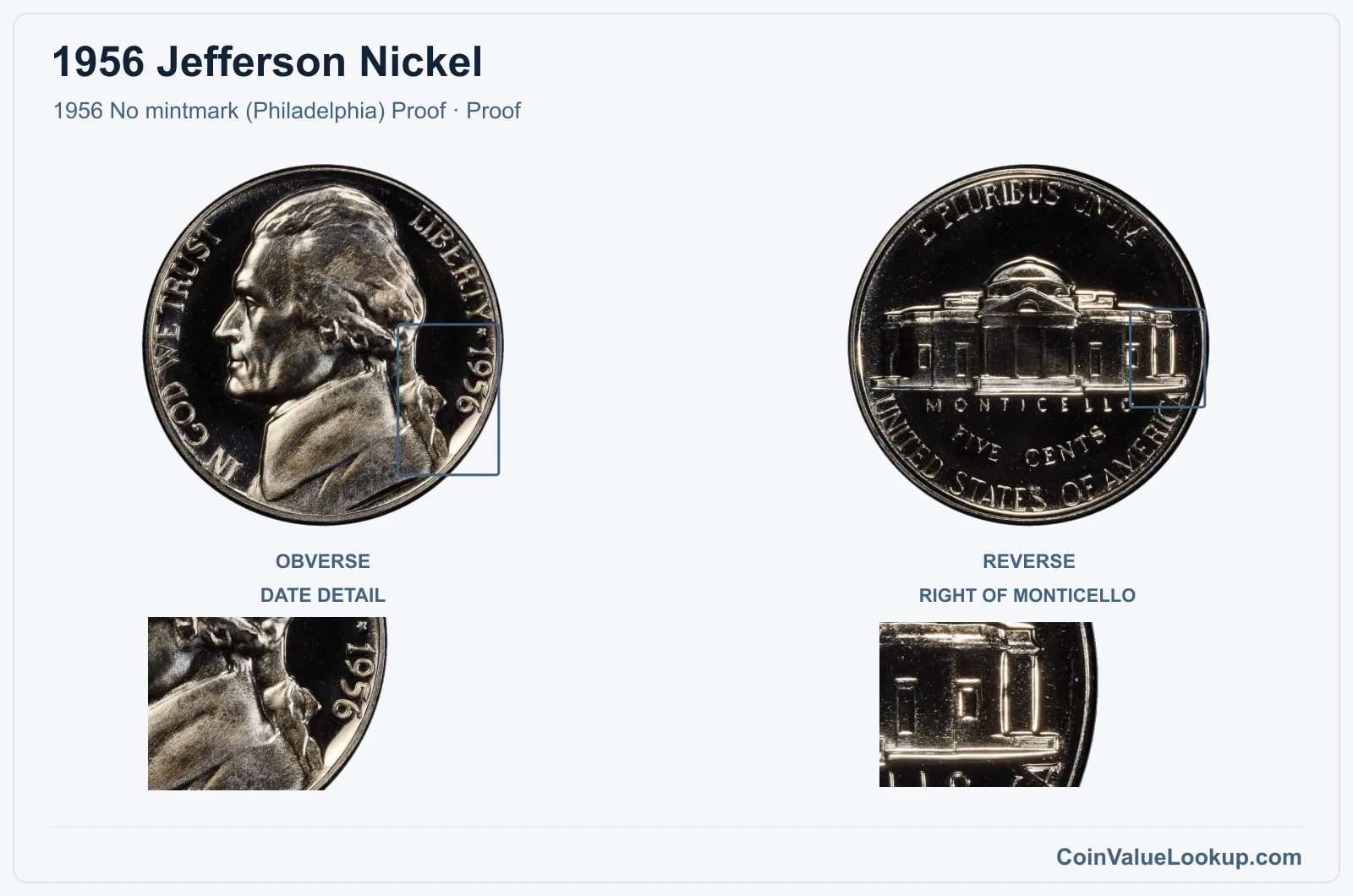
Philadelphia also produced collector proofs in 1956, and they carry no mintmark just like business strikes. The difference is immediately visible: proofs have deeply mirrored fields and sharply struck devices.
A polished circulation strike is not a proof, no matter how shiny it looks.
USA Coin Book lists a guide estimate of about $6.25 at PR65. Coins with cameo or deep cameo contrast — frosted devices against mirror fields — and those with varying degrees of hairlines are assessed individually.
Do not confuse a proof with a high-grade Mint State coin; the manufacturing method is fundamentally different.
Coin Value Lookup is a handy place to look up guides for other Jefferson Nickel dates and mints if you are working through a collection.
| Range | Grade | Price | Auction Records | Appraisal |
|---|---|---|---|---|
| PR | PR 1 | — | Coin Identifier | |
| PR 2 | — | Coin Identifier | ||
| PR 3 | — | Coin Identifier | ||
| PR 4 | — | Coin Identifier | ||
| PR 6 | — | Coin Identifier | ||
| PR 8 | — | Coin Identifier | ||
| PR 10 | — | Coin Identifier | ||
| PR 12 | — | Coin Identifier | ||
| PR 15 | — | Coin Identifier | ||
| PR 20 | — | Coin Identifier | ||
| PR 25 | — | Coin Identifier | ||
| PR 30 | — | Coin Identifier | ||
| PR 35 | — | Coin Identifier | ||
| PR 40 | — | Coin Identifier | ||
| PR 45 | — | Coin Identifier | ||
| PR 50 | — | Coin Identifier | ||
| PR 53 | — | Coin Identifier | ||
| PR 55 | — | Coin Identifier | ||
| PR 58 | — | Coin Identifier | ||
| PR 60 | — | Coin Identifier | ||
| PR 61 | — | — | — | |
| PR 62 | — | — | — | |
| PR 63 | — | Coin Identifier | ||
| PR 64 | Coin Identifier | |||
| PR 65 | Coin Identifier | |||
| PR 66 | Coin Identifier | |||
| PR 67 | Coin Identifier | |||
| PR 68 | Coin Identifier | |||
| PR 69 | Coin Identifier | |||
| PR 70 | — | — | — |
1956 Jefferson Nickel — D
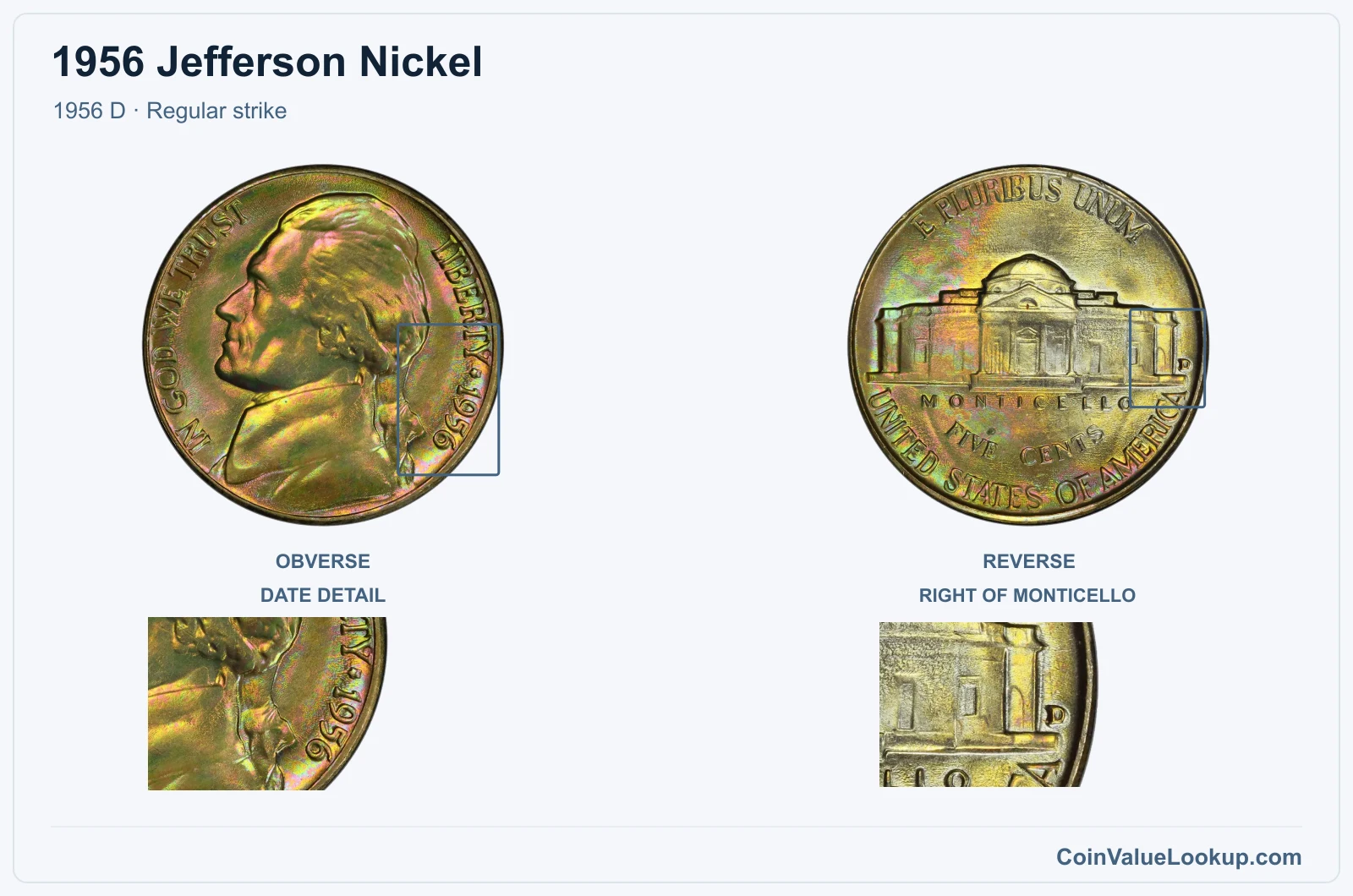
The 1956-D was struck at the Denver Mint and carries a small "D" mintmark on the reverse, to the right of Monticello's building. Same alloy, same weight, same design as the Philadelphia issue.
Guide estimates from USA Coin Book place the 1956-D at about $0.61 in MS60 and around $25 in MS65. As with the Philadelphia version, worn coins should be evaluated on their own terms and not priced from uncirculated columns.
Full Steps examples are a separate tier entirely — the strike quality at Denver varied, so clean, uninterrupted steps carry a distinct premium.
| Range | Grade | Price | Auction Records | Appraisal |
|---|---|---|---|---|
| PO | PO 1 | — | Coin Identifier | |
| FR | FR 2 | — | — | — |
| AG | AG 3 | — | — | — |
| G | G 4 | — | — | — |
| G 6 | — | — | — | |
| VG | VG 8 | — | — | — |
| VG 10 | — | — | — | |
| F | F 12 | — | — | — |
| F 15 | — | — | — | |
| VF | VF 20 | — | — | — |
| VF 25 | — | — | — | |
| VF 30 | — | — | — | |
| VF 35 | — | — | — | |
| XF | XF 40 | — | Coin Identifier | |
| XF 45 | — | Coin Identifier | ||
| AU | AU 50 | — | Coin Identifier | |
| AU 53 | — | Coin Identifier | ||
| AU 55 | Coin Identifier | |||
| AU 58 | — | Coin Identifier | ||
| MS | MS 60 | — | Coin Identifier | |
| MS 61 | — | Coin Identifier | ||
| MS 62 | — | Coin Identifier | ||
| MS 63 | — | Coin Identifier | ||
| MS 64 | Coin Identifier | |||
| MS 65 | Coin Identifier | |||
| MS 66 | Coin Identifier | |||
| MS 67 | Coin Identifier | |||
| MS 68 | — | — | — | |
| MS 69 | — | — | — | |
| MS 70 | — | — | — |
1956 Jefferson Nickel Error List
1. 1956 Jefferson Nickel — Struck on a cent planchet
A 1956 nickel struck on a cent planchet is a wrong-planchet error. The coin will be noticeably lighter and possibly slightly smaller than a normal 5-gram nickel, since a cent blank is thinner and composed of a different alloy.
Peripheral lettering may appear cropped or stretched because the smaller planchet cannot accommodate the full nickel design.
The copper color is a clue but not proof by itself — chemical toning, copper plating, or environmental damage can mimic the appearance. Authentication requires confirming the correct alloy, weight, and that the coin genuinely carries the Jefferson nickel design on an undersized blank.
A Philadelphia example graded PCGS MS62 Brown sold through Heritage Auctions in September 2019 for $348.
2. 1956 Jefferson Nickel — Curved clipped planchet
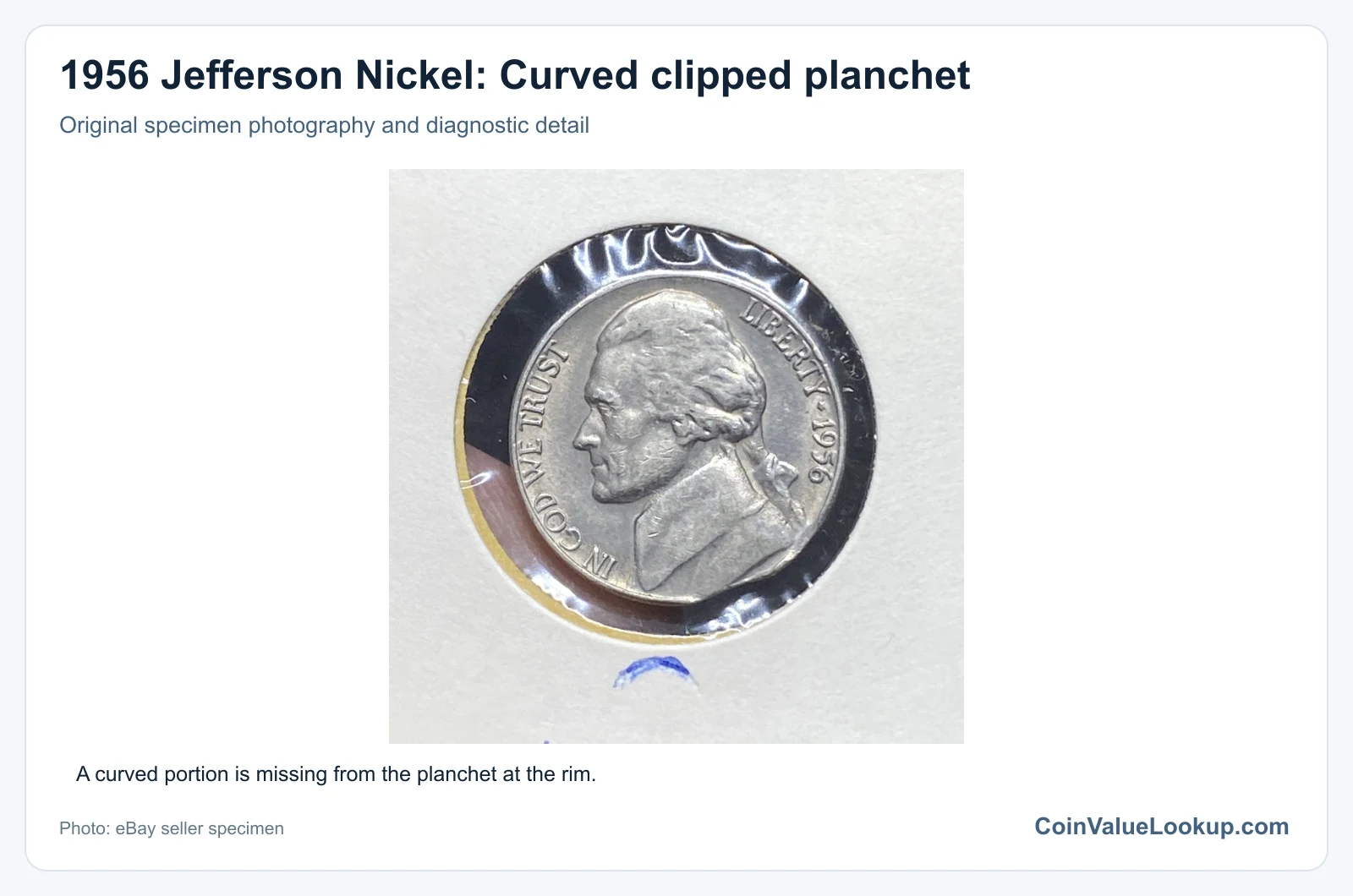
A curved clipped planchet results when the blanking press punches overlapping areas of the metal strip, leaving one blank with a curved bite missing from its edge. On a 1956 nickel, look for a smooth, curved indentation along the rim with a characteristic area of metal flow — the Blakesley effect — showing weakness on the rim directly opposite the clip.
Do not confuse this with a crescent cut made by a tool after the coin left the mint. Post-mint damage typically shows sharp, unnatural edges and no corresponding rim weakness on the opposite side.
A Philadelphia example with an approximate 15% clip was certified NGC MS65 and appeared in a Heritage Auctions multiple-coin lot. Value depends on clip size, condition, and authenticated identity.
3. 1956 Jefferson Nickel — Rolled-thin planchet
A rolled-thin planchet error occurs when the strip of metal fed into the blanking press is thinner than specification. The resulting coin has normal diameter and a proper edge but weighs less and feels noticeably lighter in hand.
Strike detail may appear slightly spread or shallow because the dies could not fully compress the thinner blank.
The key distinction from a coin thinned after minting — by acid etching or grinding — is that an authentic rolled-thin error retains proper edge reeding (or plain edge, in the nickel's case) and consistent strike evidence across both sides. A Philadelphia example at approximately 10% thin, graded PCGS MS64, sold at Heritage Auctions in July 2021 for $111.
4. 1956 Jefferson Nickel — Doubled / Multiple-Hubbed Reverse
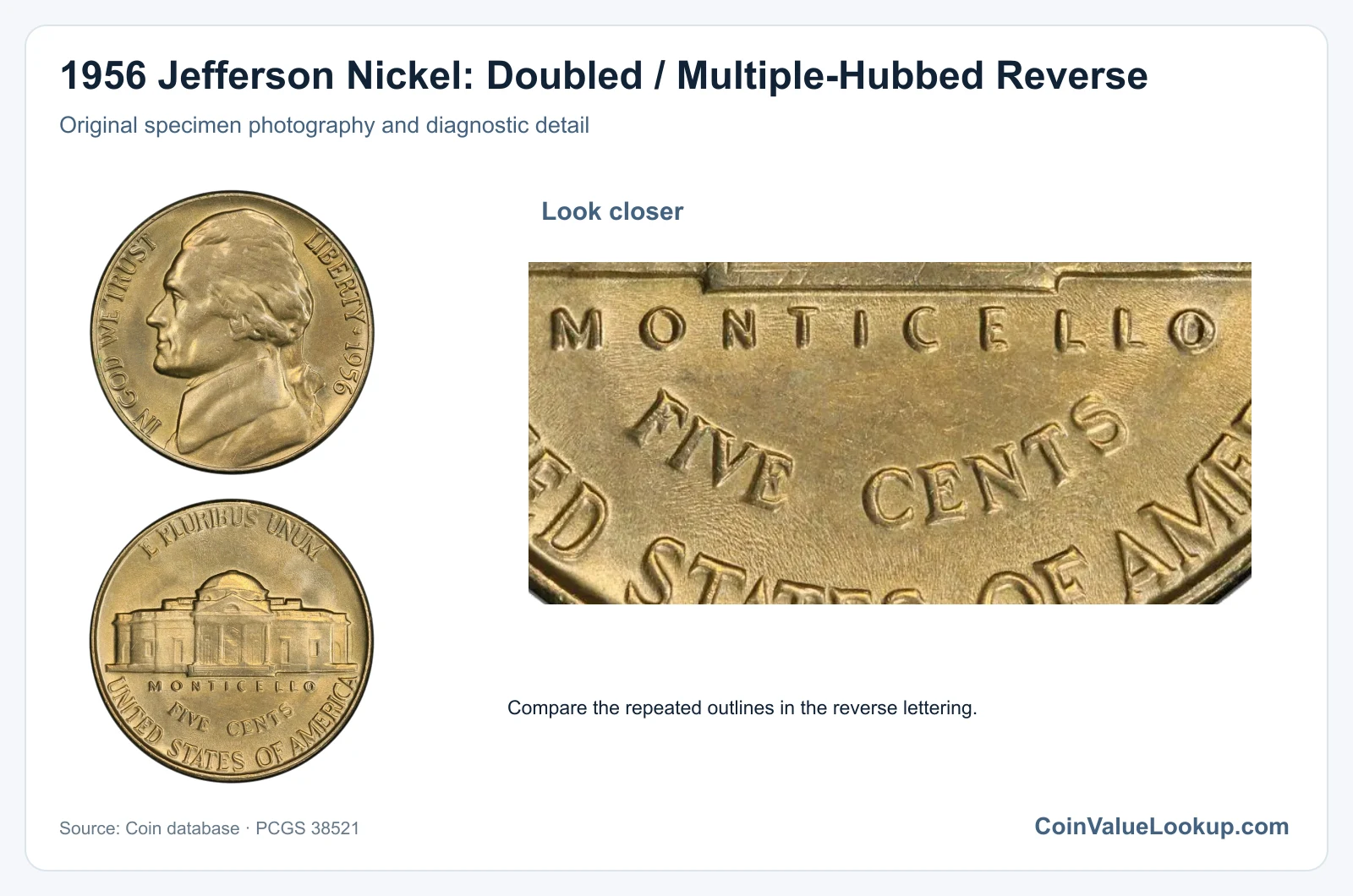
The 1956 Jefferson Nickel has a reported quadrupled die reverse variety. On this type of error, the reverse hub impressed the die multiple times in slightly different positions, producing visible doubling or multiplying of design elements such as lettering or architectural details on Monticello.
To check, compare your coin's reverse legends and contours carefully against a known normal 1956 nickel under good lighting. Look for consistent separation or notching on letters — not just a flat, shelf-like distortion.
Machine doubling creates a different look: flat and shelf-like rather than rounded and separated. Condition and the visibility of the doubling both affect value, so each coin must be assessed individually.
5. 1956 Jefferson Nickel — Doubled Die Obverse
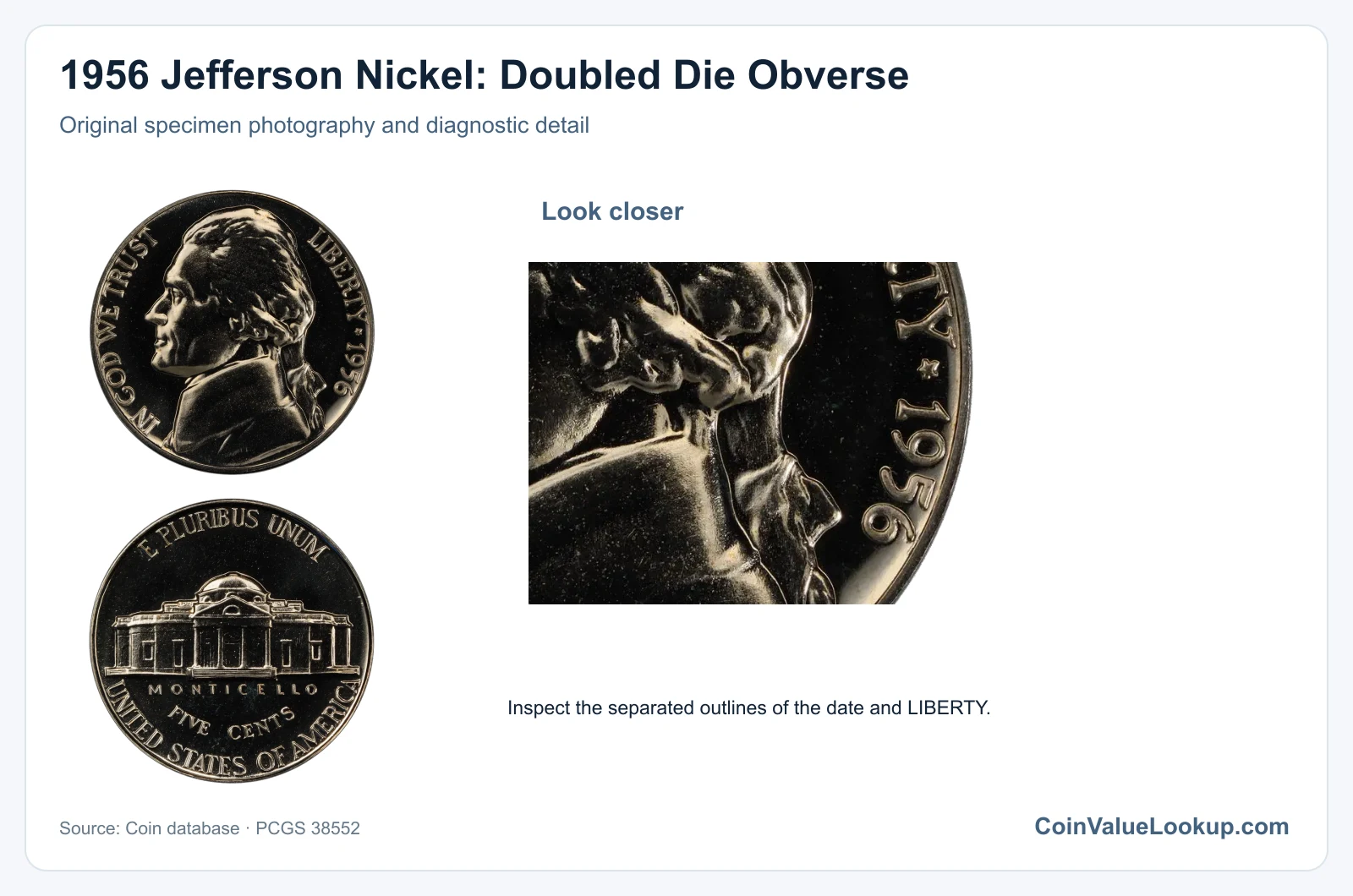
A doubled die obverse variety has been reported for the 1956 Jefferson Nickel. This occurs when the obverse hub impresses the die at slightly offset positions, leaving visible doubling on letters, the date, or design features on the portrait side.
Examine obverse inscriptions under magnification and compare them to a normal 1956 nickel under the same lighting. Genuine hub doubling produces rounded, separated notching on affected letters.
Machine doubling — caused during the striking process — looks flat and shelf-like, almost like a shadow, and carries far less collector interest. Worn die contours can also mimic doubling.
No specific price range is established here; value depends on the clarity of the doubling and the coin's overall condition.
6. 1956 Jefferson Nickel — Repunched Mintmark
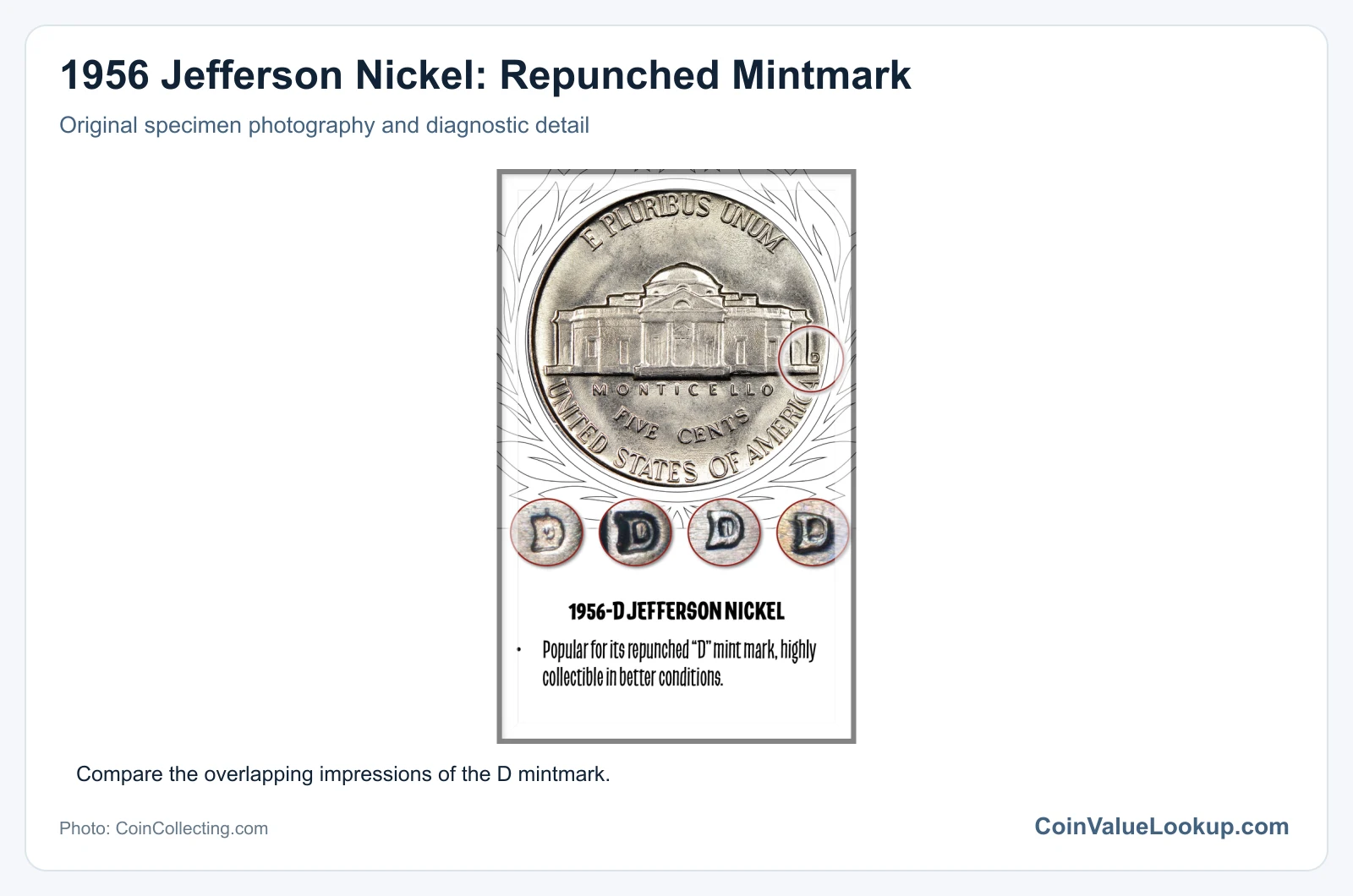
Repunched mintmark errors have been reported on 1956-D Jefferson Nickels. During production, the mintmark punch was applied more than once in slightly different positions, leaving traces of an earlier placement visible near the final "D" on the reverse.
To spot this, examine the mintmark area under magnification. You are looking for remnants — a partial letter, a notch, or a shadow — that indicate a second impression.
Compare against a normal 1956-D at the same magnification so you know what baseline looks like. Die chips, corrosion around the mark, or machine doubling can create similar illusions.
Value depends on how prominently the repunching shows and the coin's grade.
7. 1956 Jefferson Nickel — Die Crack / Die Chip
Die cracks and die chips are reported on 1956 Jefferson Nickels. These appear as raised lines or small raised blobs on the coin's surface, caused by fractures or breaks in the steel die used during striking.
A crack connecting to the rim may develop into a larger retained cud if the die continues in use.
These raised features are the opposite of scratches, which are incuse — pressed into the surface. Corrosion pitting or foreign material stuck to a coin can also mimic a die chip under casual inspection.
Look for a continuous raised line or a distinct raised blob that follows a logical stress pattern across the design. Value depends on the size, location, and visual impact of the crack, along with the coin's condition.
8. 1956 Jefferson Nickel — Off-Center Strike
Off-center strikes occur when the planchet is not properly seated between the dies, resulting in a design shifted to one side and an unstruck crescent of blank metal on the opposite edge. These have been reported on 1956 Jefferson Nickels.
The date must be visible for the coin to be attributed to 1956. Collectors generally prize strikes that are significantly off-center while still showing the full date — that combination is harder to find.
Do not confuse an off-center strike with a curved clip or one-sided die misalignment, which produce different visual signatures. Post-mint flattening of a normal coin can also create a misleading impression.
Value varies based on the percentage of displacement, date visibility, and grade.