1940 Jefferson Nickel Coin Value: How Much Is It Worth?
A typical 1940 Jefferson nickel in circulated condition carries a guide estimate of roughly $0.30–$0.43 at VF20, depending on mint. Push into uncirculated territory and the numbers climb: around $19 at MS65 for ordinary business strikes according to USA Coin Book retail estimates.
Proof strikes, Full Steps designations, and authenticated error coins each occupy their own price category. Condition and mint identity matter, so read on before you assume yours is just pocket change.
Fast Way to Identify Your 1940 Jefferson Nickel
The quickest way to start figuring out what you have is to upload clear photos of both sides of your coin. Snap the obverse (Jefferson's portrait) and the reverse (Monticello) in good light, and our identifier can give you a preliminary read on the mint, version, and general condition.
It is not a substitute for professional certification, but it points you in the right direction.
1940 Jefferson Nickel Value
Upload both sides of your 1940 Jefferson Nickel.
Front Obverse
Upload photo
Back Reverse
Upload photo
Which 1940 Jefferson Nickel Versions Are Worth Money?
- Uncirculated examples with full, undisturbed luster and strong Monticello steps can command premiums, but a Full Steps designation should be confirmed by a grading service before assuming higher value.
- Philadelphia proof strikes are a distinct manufacturing finish with mirror fields and are valued separately from business strikes of any mint.
Step 1: Identify Your 1940 Jefferson Nickel Mint Mark and Version
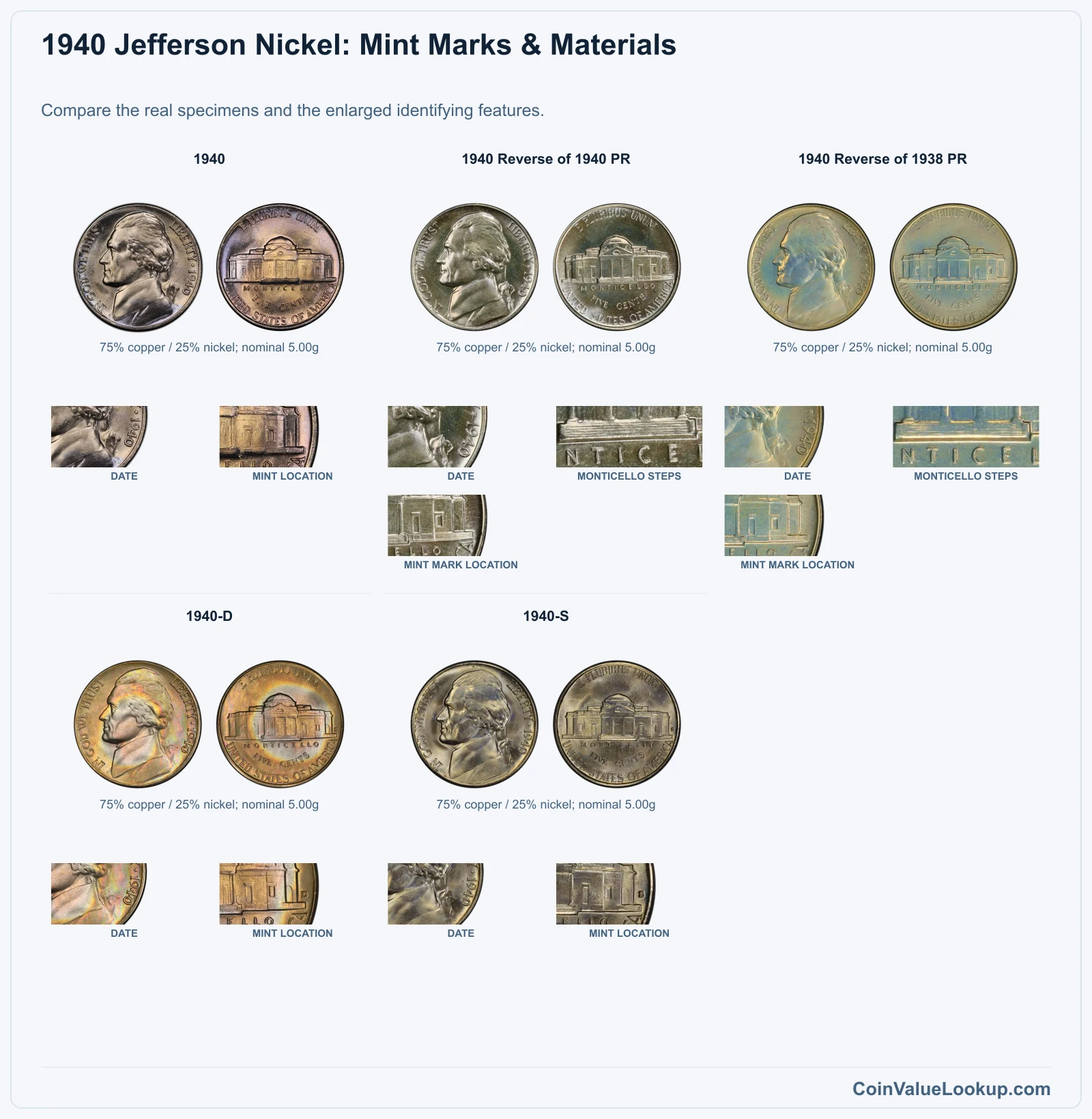
Start with the mintmark. Philadelphia coins carry no mintmark at all.
Denver (D) and San Francisco (S) examples show a small letter to the right of Monticello on the reverse. Do not confuse this position with the large mintmark above the dome found on wartime silver-alloy nickels from 1942–1945; the 1940 is a standard copper-nickel coin.
All 1940 nickels should weigh about 5.00 grams and measure 21.2 mm across. If yours is noticeably lighter or smaller, you may have something unusual, like a wrong-planchet strike.
Color alone cannot confirm composition, so weigh the coin if you suspect an anomaly.
Proof versions were struck only at Philadelphia. They have mirror-like fields and sharp detail that no amount of polishing a business strike can replicate.
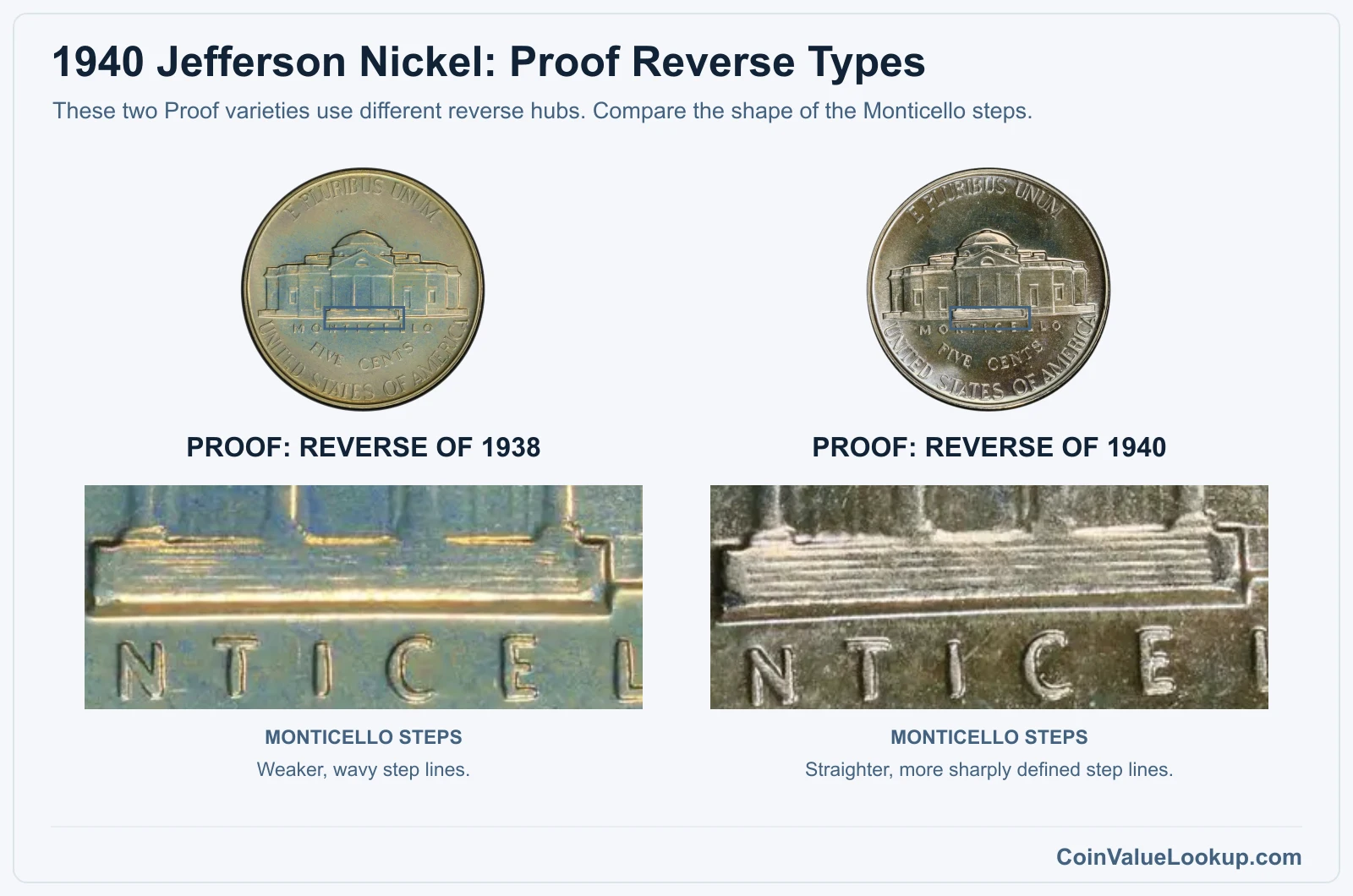
Two proof reverse hub varieties exist for 1940: the Reverse of 1940 and the Reverse of 1938. Telling them apart requires comparing the Monticello steps; the older hub shows softer, slightly curved steps while the newer hub has stronger, straighter ones.
Separate normal wear from corrosion, polishing, and mounting damage before drawing any conclusions about grade or variety.
Step 2: Check Your 1940 Jefferson Nickel Grade
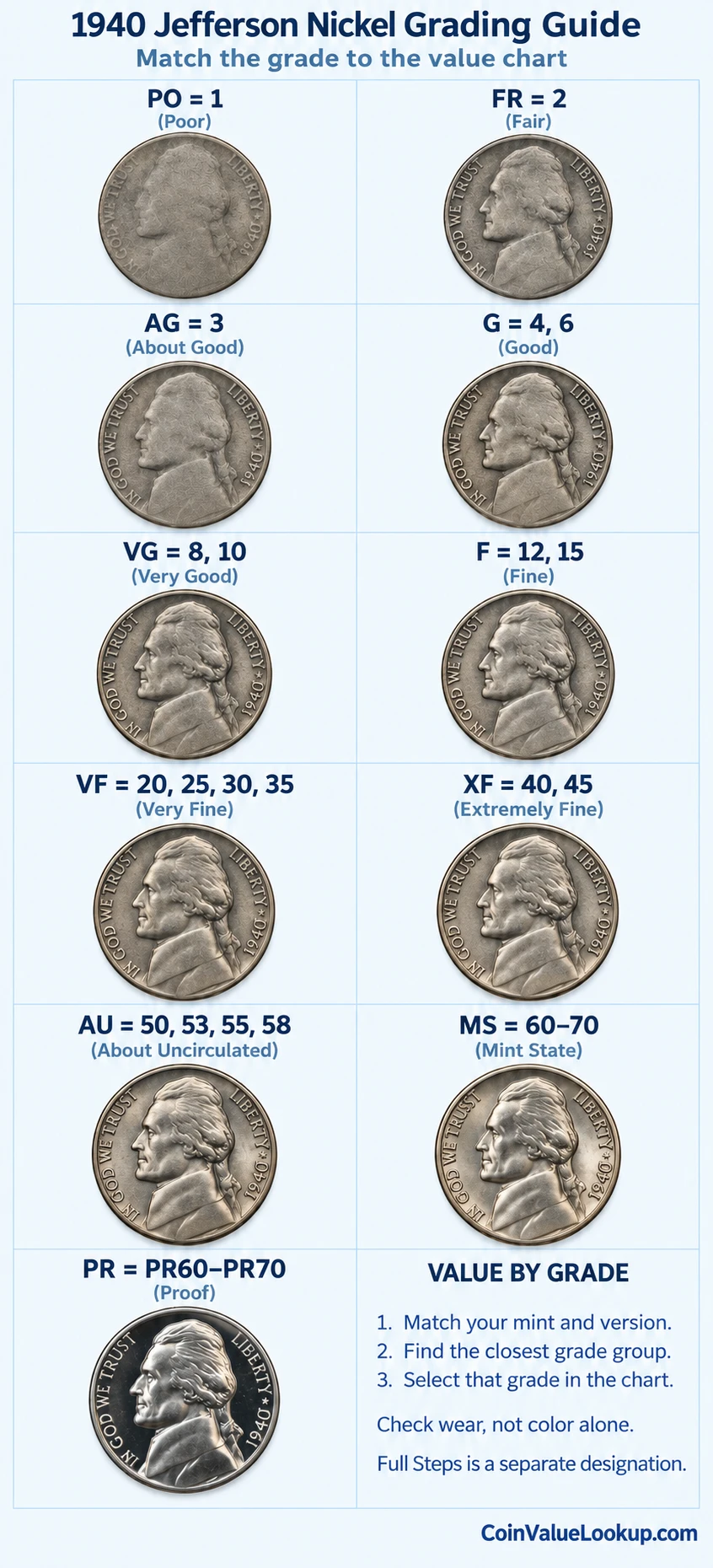
Look first at Jefferson's cheekbone and the hair detail just above his ear. These are the highest points and show wear first.
On the reverse, check the roof and columns of Monticello. If luster is unbroken across the entire surface with no rub, you are likely looking at a Mint State coin.
Use the comparison image to match your coin against known grade benchmarks. A VF20 coin will have moderate wear on the cheekbone and hair but clear overall design.
An MS60 coin is uncirculated but may show bag marks and contact from storage.
Full Steps is a separate designation applied to Mint State coins where at least five steps on Monticello's base are clearly separated. Weak steps can result from a soft strike rather than wear, so do not use step clarity as a standalone shortcut for grading the rest of the coin.
If you believe your coin qualifies for Full Steps, professional certification is the way to confirm it.
Step 3: Check 1940 Jefferson Nickel Value by Mint and Version
1940 Jefferson Nickel
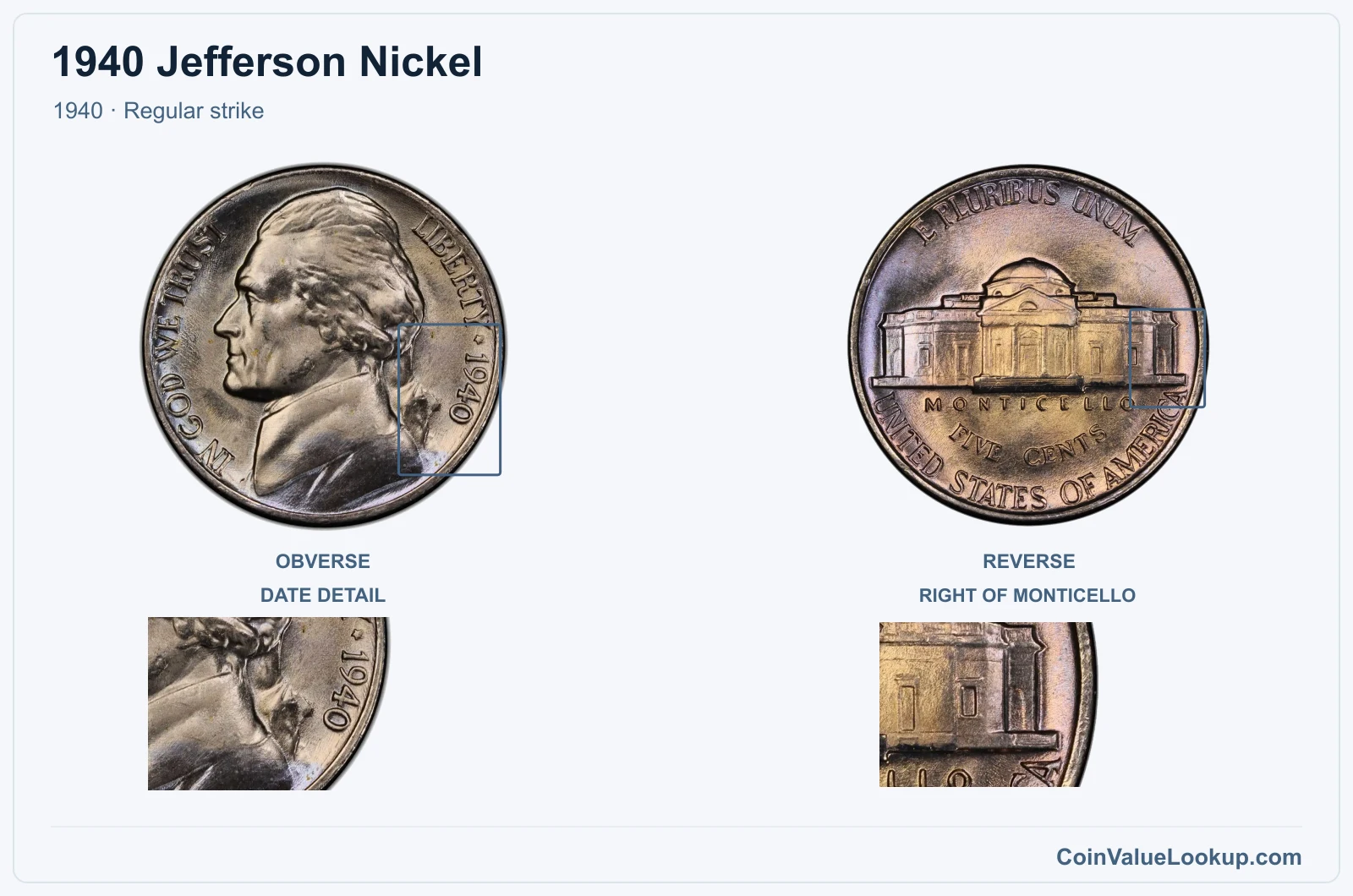
The 1940 Philadelphia nickel has no mintmark. It is a business strike in 75% copper and 25% nickel, weighing 5.00 grams.
USA Coin Book retail estimates place it around $0.30 at VF20, about $1.88 at MS60, and roughly $19 at MS65. These are guide figures, not guaranteed offers.
Circulated coins are extremely common. The jump in value comes at the Mint State level, particularly if the coin qualifies for a Full Steps designation.
Confirm that any mintmark-bearing coin you find is actually a different issue; the D or S should sit to the right of Monticello on the reverse.
| Range | Grade | Price | Auction Records | Appraisal |
|---|---|---|---|---|
| PO | PO 1 | — | Coin Identifier | |
| FR | FR 2 | — | Coin Identifier | |
| AG | AG 3 | — | Coin Identifier | |
| G | G 4 | — | Coin Identifier | |
| G 6 | — | Coin Identifier | ||
| VG | VG 8 | — | Coin Identifier | |
| VG 10 | — | Coin Identifier | ||
| F | F 12 | — | Coin Identifier | |
| F 15 | — | Coin Identifier | ||
| VF | VF 20 | — | Coin Identifier | |
| VF 25 | — | Coin Identifier | ||
| VF 30 | — | Coin Identifier | ||
| VF 35 | — | Coin Identifier | ||
| XF | XF 40 | — | Coin Identifier | |
| XF 45 | — | Coin Identifier | ||
| AU | AU 50 | — | Coin Identifier | |
| AU 53 | — | Coin Identifier | ||
| AU 55 | — | Coin Identifier | ||
| AU 58 | — | Coin Identifier | ||
| MS | MS 60 | — | Coin Identifier | |
| MS 61 | — | Coin Identifier | ||
| MS 62 | — | Coin Identifier | ||
| MS 63 | — | Coin Identifier | ||
| MS 64 | — | Coin Identifier | ||
| MS 65 | Coin Identifier | |||
| MS 66 | Coin Identifier | |||
| MS 67 | Coin Identifier | |||
| MS 68 | Coin Identifier | |||
| MS 69 | — | Coin Identifier | ||
| MS 70 | — | — | — |
1940 Jefferson Nickel — Reverse of 1940 PR
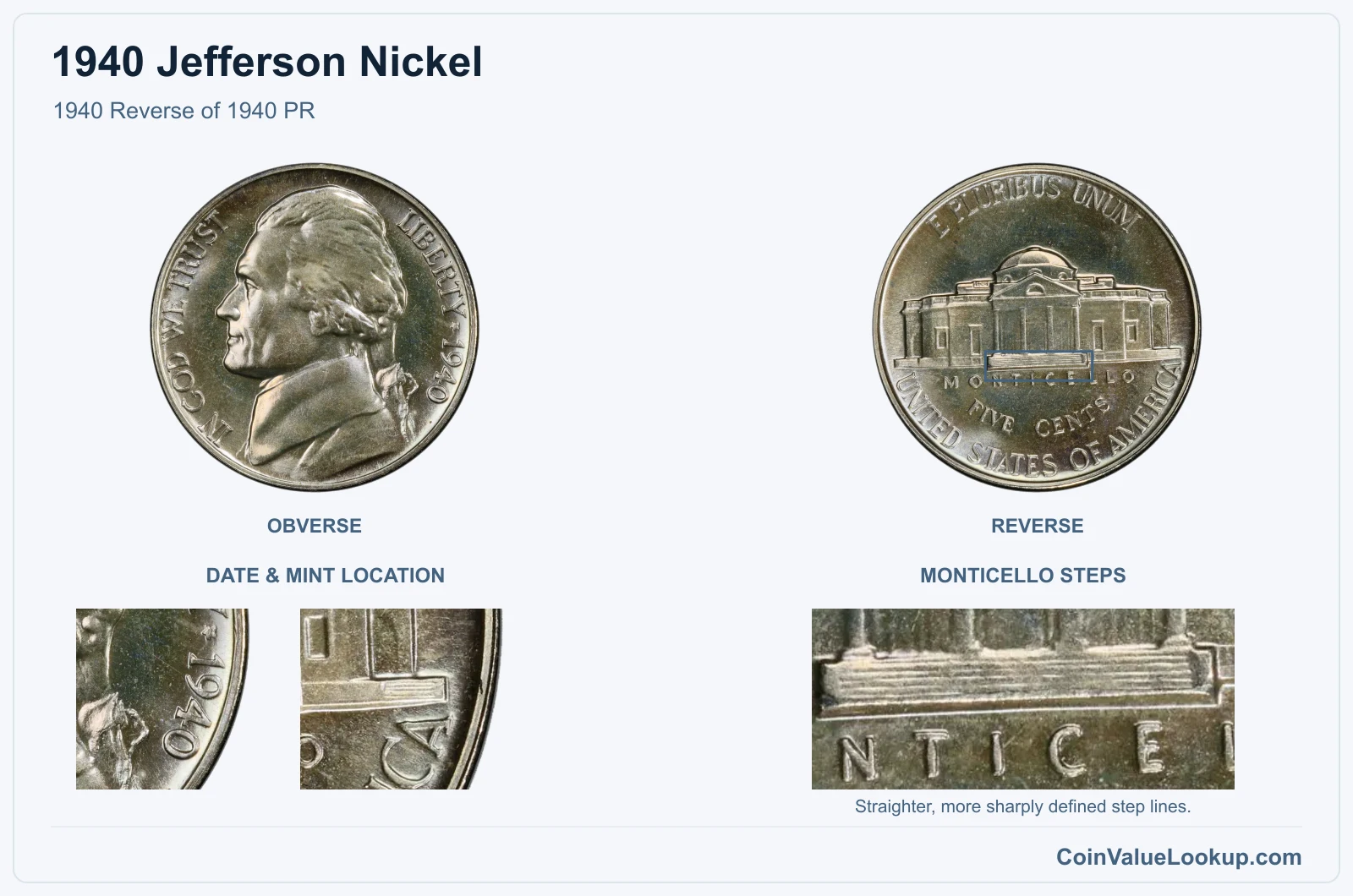
This is a proof struck at Philadelphia using the Reverse of 1940 hub. Proof coins have mirrored fields and crisp detail that cannot be duplicated by cleaning or polishing a business strike.
The steps on this reverse hub tend to appear stronger and straighter than the older design.
A broad guide baseline for 1940 proofs sits near $131 at PR65, but that figure is a general year estimate and should not be treated as a precise value for this specific attributed reverse variety. Condition, surface quality, and correct reverse attribution all influence what a collector will pay.
Professional authentication is the standard way to confirm a proof reverse variety.
Coin Value Lookup is a good starting point if you want to explore value guides for other Jefferson nickel dates and mints.
| Range | Grade | Price | Auction Records | Appraisal |
|---|---|---|---|---|
| PR | PR 1 | — | Coin Identifier | |
| PR 2 | — | Coin Identifier | ||
| PR 3 | — | Coin Identifier | ||
| PR 4 | — | Coin Identifier | ||
| PR 6 | — | Coin Identifier | ||
| PR 8 | — | Coin Identifier | ||
| PR 10 | — | Coin Identifier | ||
| PR 12 | — | Coin Identifier | ||
| PR 15 | — | Coin Identifier | ||
| PR 20 | — | Coin Identifier | ||
| PR 25 | — | Coin Identifier | ||
| PR 30 | — | Coin Identifier | ||
| PR 35 | — | Coin Identifier | ||
| PR 40 | — | Coin Identifier | ||
| PR 45 | — | Coin Identifier | ||
| PR 50 | — | Coin Identifier | ||
| PR 53 | — | Coin Identifier | ||
| PR 55 | — | Coin Identifier | ||
| PR 58 | — | Coin Identifier | ||
| PR 60 | Coin Identifier | |||
| PR 61 | — | Coin Identifier | ||
| PR 62 | — | Coin Identifier | ||
| PR 63 | Coin Identifier | |||
| PR 64 | Coin Identifier | |||
| PR 65 | Coin Identifier | |||
| PR 66 | Coin Identifier | |||
| PR 67 | Coin Identifier | |||
| PR 68 | Coin Identifier | |||
| PR 69 | — | — | — | |
| PR 70 | — | — | — |
1940 Jefferson Nickel — Reverse of 1938 PR
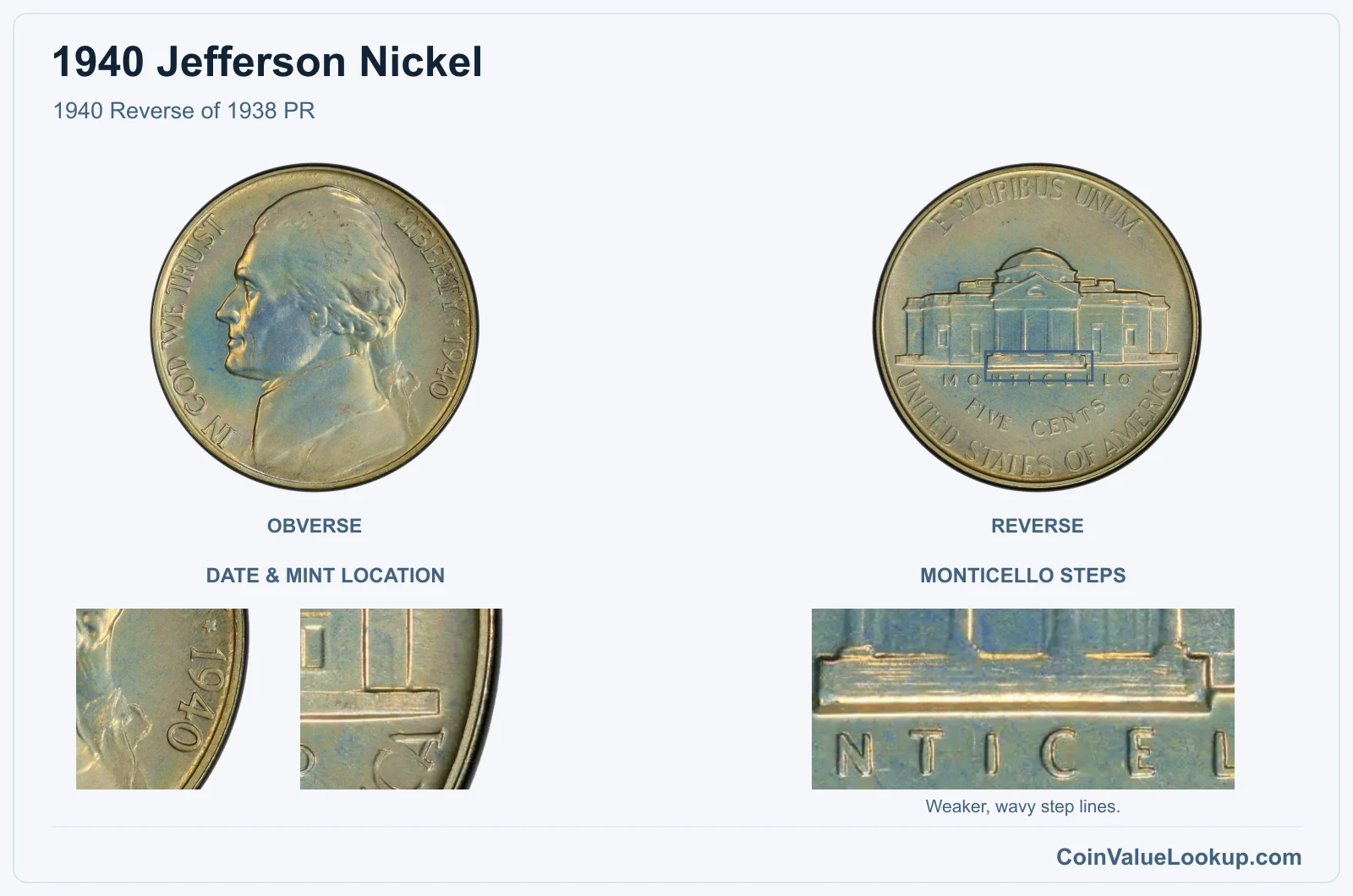
This is the companion proof variety, struck at Philadelphia with the earlier Reverse of 1938 hub. The key visual difference is in the Monticello steps: the 1938-style hub shows softer, slightly curved steps compared to the sharper, straighter lines of the 1940 hub.
As with the Reverse of 1940 proof, the broad guide baseline near $131 at PR65 covers proofs generally and should not be taken as a specific price for this attributed reverse. Correct identification of the hub is essential.
Compare your coin's steps to known examples of each reverse under the same lighting before drawing conclusions. Professional attribution matters here because the difference is subtle enough to fool a casual look.
| Range | Grade | Price | Auction Records | Appraisal |
|---|---|---|---|---|
| PR | PR 1 | — | Coin Identifier | |
| PR 2 | — | Coin Identifier | ||
| PR 3 | — | Coin Identifier | ||
| PR 4 | — | Coin Identifier | ||
| PR 6 | — | Coin Identifier | ||
| PR 8 | — | Coin Identifier | ||
| PR 10 | — | Coin Identifier | ||
| PR 12 | — | Coin Identifier | ||
| PR 15 | — | Coin Identifier | ||
| PR 20 | — | Coin Identifier | ||
| PR 25 | — | Coin Identifier | ||
| PR 30 | — | Coin Identifier | ||
| PR 35 | — | Coin Identifier | ||
| PR 40 | — | Coin Identifier | ||
| PR 45 | — | Coin Identifier | ||
| PR 50 | — | Coin Identifier | ||
| PR 53 | — | Coin Identifier | ||
| PR 55 | — | Coin Identifier | ||
| PR 58 | — | Coin Identifier | ||
| PR 60 | — | Coin Identifier | ||
| PR 61 | — | Coin Identifier | ||
| PR 62 | Coin Identifier | |||
| PR 63 | Coin Identifier | |||
| PR 64 | Coin Identifier | |||
| PR 65 | Coin Identifier | |||
| PR 66 | Coin Identifier | |||
| PR 67 | Coin Identifier | |||
| PR 68 | Coin Identifier | |||
| PR 69 | — | — | — | |
| PR 70 | — | — | — |
1940 Jefferson Nickel — D
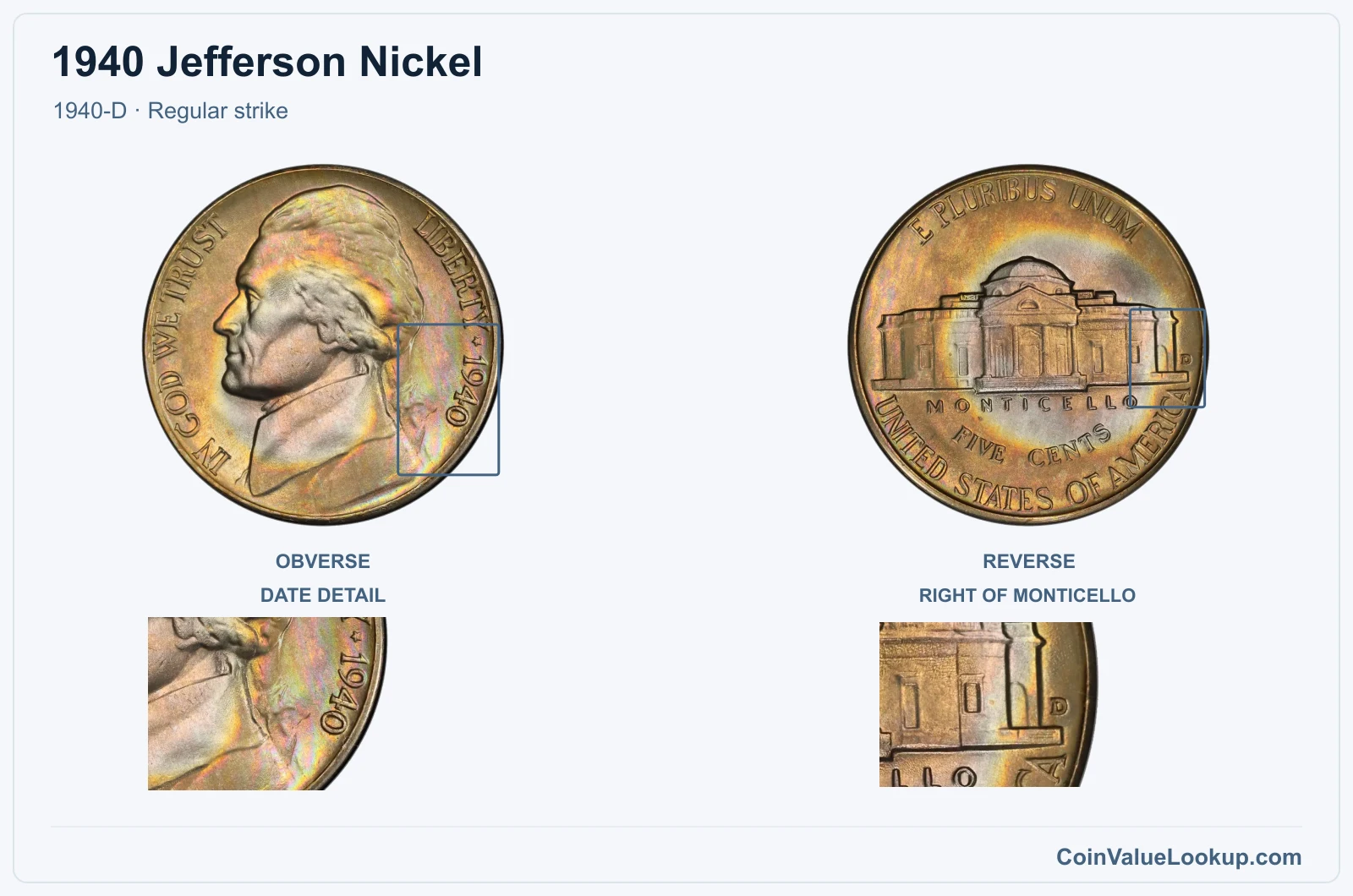
The 1940-D carries a small D mintmark to the right of Monticello on the reverse. Same copper-nickel composition, same 5.00-gram weight.
USA Coin Book estimates put it at about $0.43 at VF20, approximately $3.08 at MS60, and around $19 at MS65.
Circulated examples are plentiful and worth close to face value. The real action is in high-grade Mint State pieces, especially those that might earn a Full Steps designation.
If your D mintmark looks unusually large or sits above the dome, you are probably looking at a wartime nickel from a different year.
| Range | Grade | Price | Auction Records | Appraisal |
|---|---|---|---|---|
| PO | PO 1 | — | Coin Identifier | |
| FR | FR 2 | — | — | — |
| AG | AG 3 | — | — | — |
| G | G 4 | — | — | — |
| G 6 | — | — | — | |
| VG | VG 8 | — | — | — |
| VG 10 | — | — | — | |
| F | F 12 | — | — | — |
| F 15 | — | — | — | |
| VF | VF 20 | — | — | — |
| VF 25 | — | — | — | |
| VF 30 | — | — | — | |
| VF 35 | — | — | — | |
| XF | XF 40 | — | Coin Identifier | |
| XF 45 | — | Coin Identifier | ||
| AU | AU 50 | — | Coin Identifier | |
| AU 53 | — | Coin Identifier | ||
| AU 55 | — | Coin Identifier | ||
| AU 58 | Coin Identifier | |||
| MS | MS 60 | — | Coin Identifier | |
| MS 61 | — | Coin Identifier | ||
| MS 62 | — | Coin Identifier | ||
| MS 63 | — | Coin Identifier | ||
| MS 64 | — | Coin Identifier | ||
| MS 65 | Coin Identifier | |||
| MS 66 | Coin Identifier | |||
| MS 67 | Coin Identifier | |||
| MS 68 | — | — | — | |
| MS 69 | — | — | — | |
| MS 70 | — | — | — |
1940 Jefferson Nickel — S
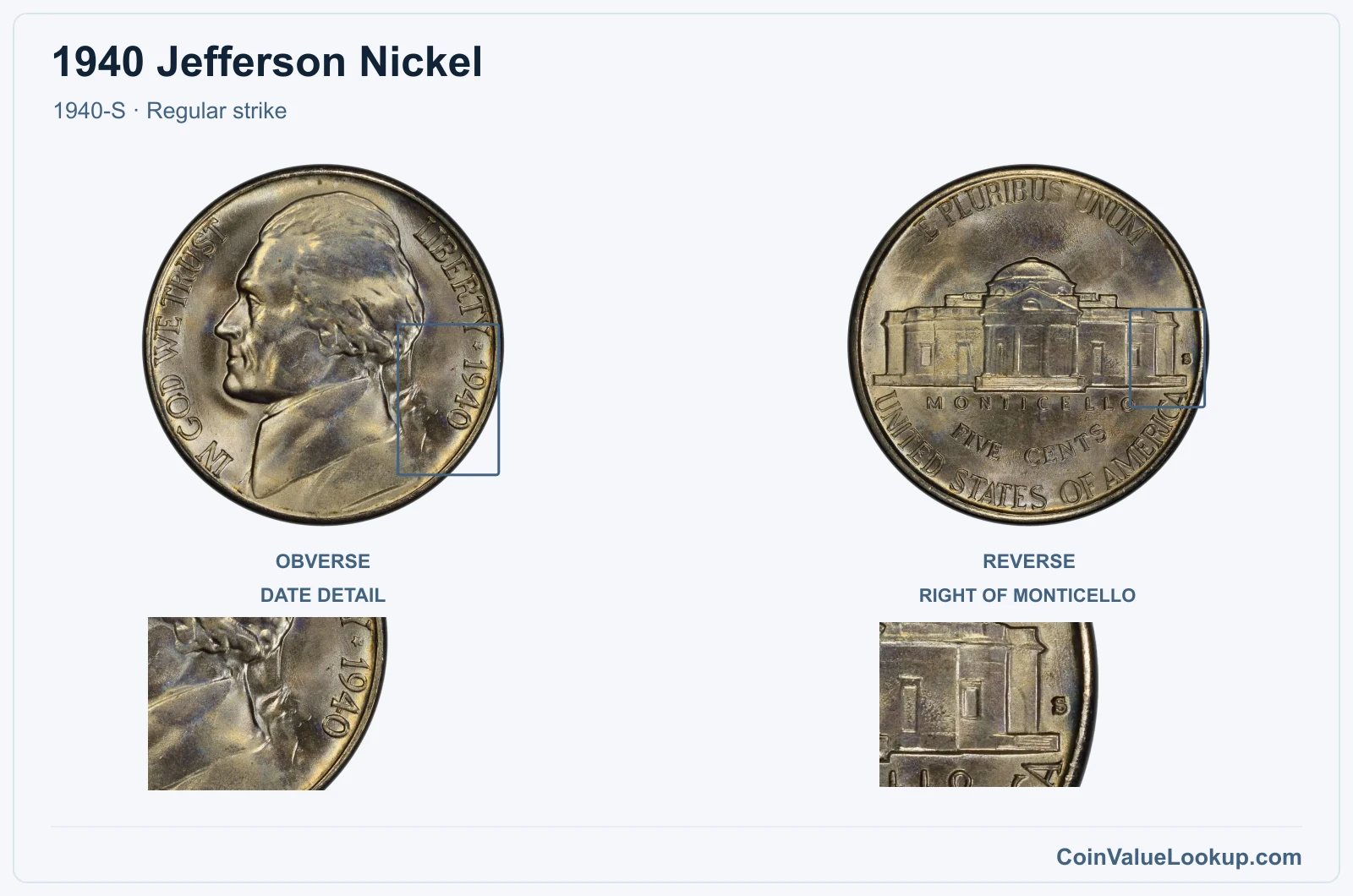
The 1940-S shows a small S mintmark to the right of Monticello. It shares the same copper-nickel alloy and 5.00-gram standard weight as the other business strikes.
USA Coin Book estimates are about $0.43 at VF20, roughly $2.79 at MS60, and approximately $19 at MS65.
This mint is also the source of a reported repunched mintmark variety. If your S looks doubled or shows a trace of a second punch position, that could be significant.
San Francisco strikes vary in sharpness, so check the steps carefully if the coin appears uncirculated.
| Range | Grade | Price | Auction Records | Appraisal |
|---|---|---|---|---|
| PO | PO 1 | — | Coin Identifier | |
| FR | FR 2 | — | Coin Identifier | |
| AG | AG 3 | — | Coin Identifier | |
| G | G 4 | — | Coin Identifier | |
| G 6 | — | Coin Identifier | ||
| VG | VG 8 | — | Coin Identifier | |
| VG 10 | — | Coin Identifier | ||
| F | F 12 | — | Coin Identifier | |
| F 15 | — | Coin Identifier | ||
| VF | VF 20 | — | Coin Identifier | |
| VF 25 | — | Coin Identifier | ||
| VF 30 | — | Coin Identifier | ||
| VF 35 | — | Coin Identifier | ||
| XF | XF 40 | — | Coin Identifier | |
| XF 45 | — | Coin Identifier | ||
| AU | AU 50 | — | Coin Identifier | |
| AU 53 | — | Coin Identifier | ||
| AU 55 | — | Coin Identifier | ||
| AU 58 | — | Coin Identifier | ||
| MS | MS 60 | — | Coin Identifier | |
| MS 61 | — | Coin Identifier | ||
| MS 62 | — | Coin Identifier | ||
| MS 63 | — | Coin Identifier | ||
| MS 64 | Coin Identifier | |||
| MS 65 | Coin Identifier | |||
| MS 66 | Coin Identifier | |||
| MS 67 | Coin Identifier | |||
| MS 68 | — | — | — | |
| MS 69 | — | — | — | |
| MS 70 | — | — | — |
1940 Jefferson Nickel Error List
1. 1940 Jefferson Nickel — Struck on a cent planchet
A 1940 nickel struck on a cent planchet is a dramatic wrong-planchet error. The coin received the full Jefferson nickel design, but on a smaller, lighter copper-alloy blank meant for a Lincoln cent.
The result is a noticeably undersized coin with cropped or stretched lettering around the rim.
To spot one, weigh the coin. A normal nickel is 5.00 grams; a cent planchet is lighter and the diameter is visibly smaller.
The copper color is obvious, but do not confuse this with copper plating, environmental toning, a nickel someone ground down, or a novelty souvenir piece. Certification is critical for this type of error.
A Heritage Auctions sale in September 2019 brought $990 for a PCGS MS63 Brown example. That is a single recorded result for one certified coin, not a market range.
2. 1940 Jefferson Nickel — Obverse die break
An obverse die break on a 1940 nickel shows up as raised, irregular metal on the portrait side. This happens when a section of the die fractures and falls away, leaving a void that fills with metal during striking.
The result is a blob or ridge of extra metal that follows no design element.
Do not confuse a die break with an incuse gouge, a solder blob from someone mounting the coin, or corrosion buildup. A genuine die break produces raised metal that is part of the strike, not added afterward.
One documented example is a 1940-S attributed as MS64 with Five Full Steps that appeared as part of a multi-coin lot at Heritage Auctions.
Value depends on the size and location of the break, the coin's overall condition, and professional authentication. Each die break is unique, so individual assessment applies.
3. 1940 Jefferson Nickel — Repunched Mintmark
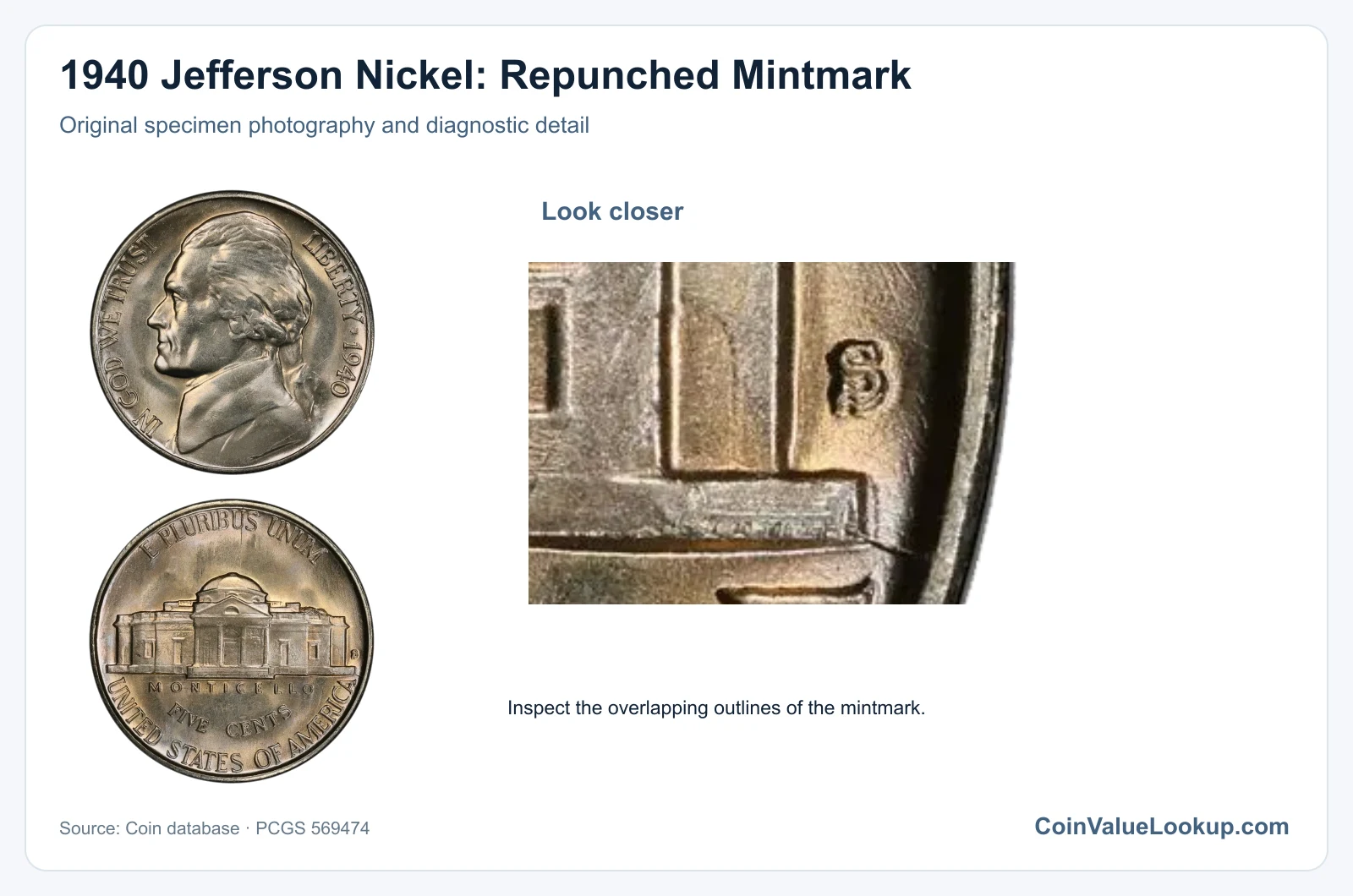
A repunched mintmark variety has been reported for the 1940-S nickel. The diagnostic is remnants of a second mintmark punch position visible near or overlapping the primary S.
Under magnification, you may see doubling, a notch, or a partial second letter that does not match the final placement.
Compare your mintmark carefully against a normal 1940-S at the same magnification. Machine doubling can produce a flat shelf near the letter that looks superficially similar, and die chips or corrosion around the mark can also mimic repunching.
True repunching shows a consistently positioned secondary image.
Value depends on the visibility of the repunching, the coin's condition, and professional attribution. No specific price range is adopted here.
4. 1940 Jefferson Nickel — Doubled Die Obverse
Doubled die obverse varieties have been reported for the 1940 nickel. The diagnostic involves comparing obverse lettering and design elements against a normal coin under consistent lighting and magnification.
Genuine hub doubling produces consistent separation or notching on affected design elements.
The key distinction is between true hub doubling and machine doubling. Machine doubling creates a flat, shelf-like distortion and is far less collectible.
Reflections and worn die contours can also fool you under certain lighting angles. Look for repeatable, directional separation that appears on multiple lettering elements rather than isolated spots.
Condition, the strength of the doubling, and professional attribution all affect value. No specific price range is adopted for this variety.
5. 1940 Jefferson Nickel — Doubled Die Reverse
Doubled die reverse varieties have also been reported for the 1940 nickel. The process is the same: compare reverse legends and design contours with a normal example.
Focus on lettering like MONTICELLO, E PLURIBUS UNUM, and FIVE CENTS for signs of consistent separation.
Machine doubling is the most common lookalike on the reverse and produces flat, shelf-like distortions rather than the rounded, separated profiles of true hub doubling. Random damage and odd reflections can also mislead you, especially on well-circulated coins where the design is already soft.
Value varies with the specific die, the visibility of the doubling, and the coin's overall grade. Professional authentication is the standard for confirming a doubled die variety.
No specific price range is adopted.
6. 1940 Jefferson Nickel — Off-Center Strike
Off-center strikes have been reported for the 1940 nickel. An off-center coin shows a displaced design with an unstruck crescent of blank metal along one edge.
The more dramatic the shift and the more of the date that remains visible, the more desirable the error tends to be.
Do not confuse an off-center strike with a clipped planchet, which removes a curved bite from the blank before striking, or with one-sided die misalignment that shifts only one side's design. Post-mint flattening from damage can also create misleading edge irregularities.
Value depends on the percentage of off-center shift, whether the date is fully readable, and the coin's condition. No specific price range is adopted for this error category.
7. 1940 Jefferson Nickel — Clashed Dies
Die clash errors have been reported for the 1940 nickel. A clash occurs when the obverse and reverse dies strike each other without a planchet between them, transferring faint traces of the opposite design onto each die.
The next coins struck from those dies carry ghost-like impressions of the wrong design in the fields.
Look for traces of Monticello's outline on the obverse fields or Jefferson's portrait outline on the reverse, aligned with where the opposite die would naturally contact. These impressions are shallow and consistent.
Do not mistake random scratches, raised lines from die polishing, or brockage transfers for a die clash. True clash marks align predictably with the opposing design.
Value depends on the clarity of the clash, the coin's condition, and professional confirmation. No specific price range is adopted.