1867 Shield Nickel Coin Value: How Much Is It Worth?
An 1867 Shield Nickel in circulated condition is worth roughly $25 in G4 for the common No Rays type, while the scarcer With Rays variety starts around $50 in the same grade. Mint State examples climb higher, with a No Rays coin reaching about $281 in MS63 and a With Rays piece listed near $721 in MS63, per USA Coin Book retail estimates.
Proof coins carry their own separate pricing, and one particular proof variety is exceptionally rare. These guide figures are not guaranteed sale prices — actual value depends on the specific coin, its condition, and the buyer.
Fast Way to Identify Your 1867 Shield Nickel
The quickest way to start figuring out what your 1867 Shield Nickel is worth is to upload clear photos of both the front and back of your coin. Our identifier can give you a preliminary read on which variety you have — rays or no rays, circulation strike or proof — so you know where to focus your research.
Sharp, well-lit images help the most.
1867 Shield Nickel Value
Upload both sides of your 1867 Shield Nickel.
Front Obverse
Upload photo
Back Reverse
Upload photo
Which 1867 Shield Nickel Versions Are Worth Money?
- 1867 With Rays business strikes are the scarcer reverse type for this date, valued around $50 in G4 up to roughly $721 in MS63 per the retail guide.
- 1867 With Rays Proof is an exceptional rarity; a single PR63 example is listed near $37,254 — professional authentication is essential before assuming you hold one.
- 1867 No Rays Proof coins are a separate collectible proof issue, listed around $584 in PR63, and should not be confused with high-grade circulation strikes.
- Recognized mint errors such as doubled die obverse, repunched date, die cracks, clashed dies, and misplaced date varieties can add value depending on visibility and condition.
Step 1: Identify Your 1867 Shield Nickel Mint Mark and Version
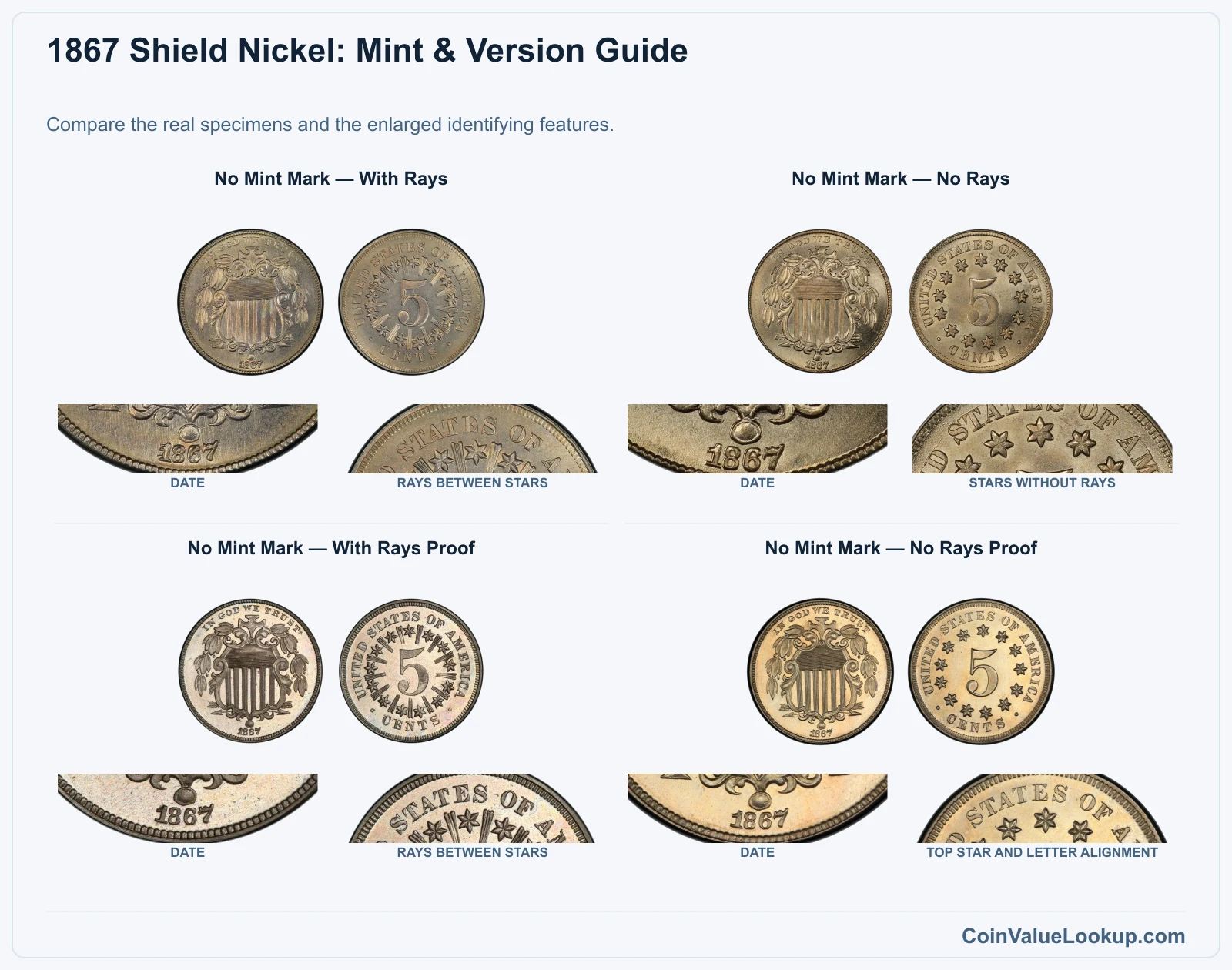
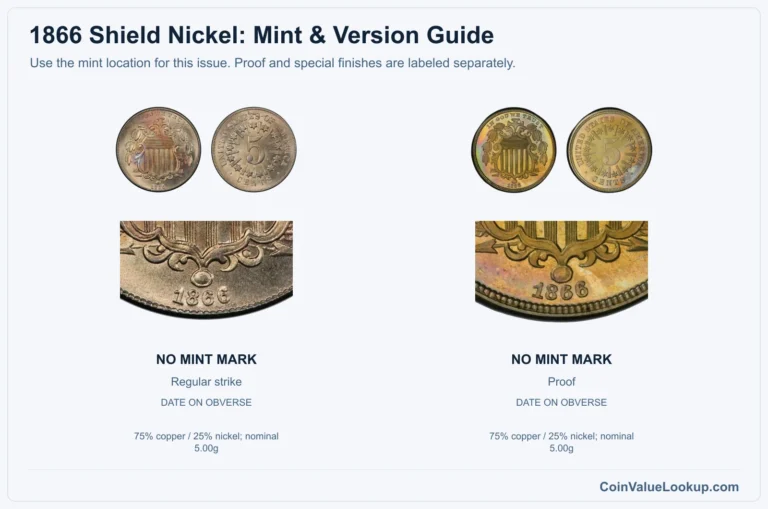
Every 1867 Shield Nickel was struck at the Philadelphia Mint, so there is no mintmark anywhere on the coin. A missing letter below the wreath or near the date is completely normal — it does not indicate a rare variety.
The coin is copper-nickel (75% copper, 25% nickel), weighs about 5 grams, measures 20.5 mm across, and has a plain edge. There is no legitimate silver version of this date.
Your first job is to check the reverse for rays. The With Rays design shows thin lines radiating outward between the stars that surround the large numeral 5.
If those rays are absent, you have the more common No Rays type. This matters because the rays were removed partway through 1867 production, making it a transition year.
Once you know the reverse type, decide whether your coin is a business strike or a proof. Proofs have mirrored fields and sharp, squared-off rims.
If you are uncertain, professional authentication is the safest path — especially for the With Rays proof, which is an exceptional rarity. Never clean the coin before evaluating it; cleaning destroys luster and lowers value.
Step 2: Check Your 1867 Shield Nickel Grade
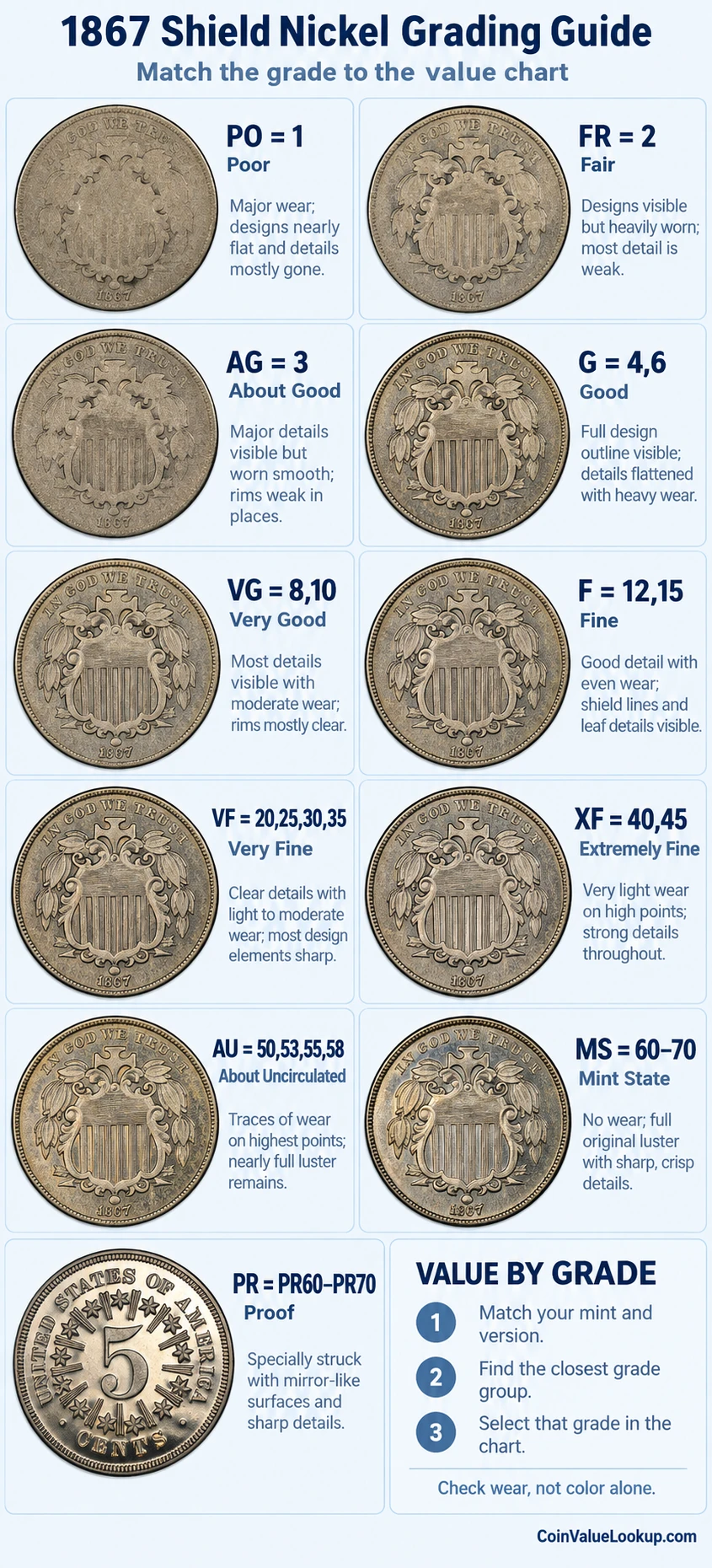
Start by looking at the shield on the obverse. In higher grades, all horizontal and vertical lines within the shield are distinct and separated.
As a coin wears, the horizontal lines in the upper shield merge first, then the cross loses definition.
On the reverse, check the leaves and the numeral 5 for smoothing. A coin grading G4 will have a readable date and an outlined shield, but most interior detail is gone.
Here is the tricky part: Shield Nickels are notorious for weak strikes. Mushy shield lines do not always mean heavy wear.
Compare both sides — if the fields still show cartwheel luster but the shield seems flat, the die may simply not have impressed the design fully. The comparison image can help you separate strike softness from genuine friction.
Problem-free coins are what the guide values assume. Cleaned, corroded, scratched, or bent pieces trade well below those numbers, sometimes dramatically so.
Step 3: Check 1867 Shield Nickel Value by Mint and Version
1867 Shield Nickel — No Mint Mark — With Rays
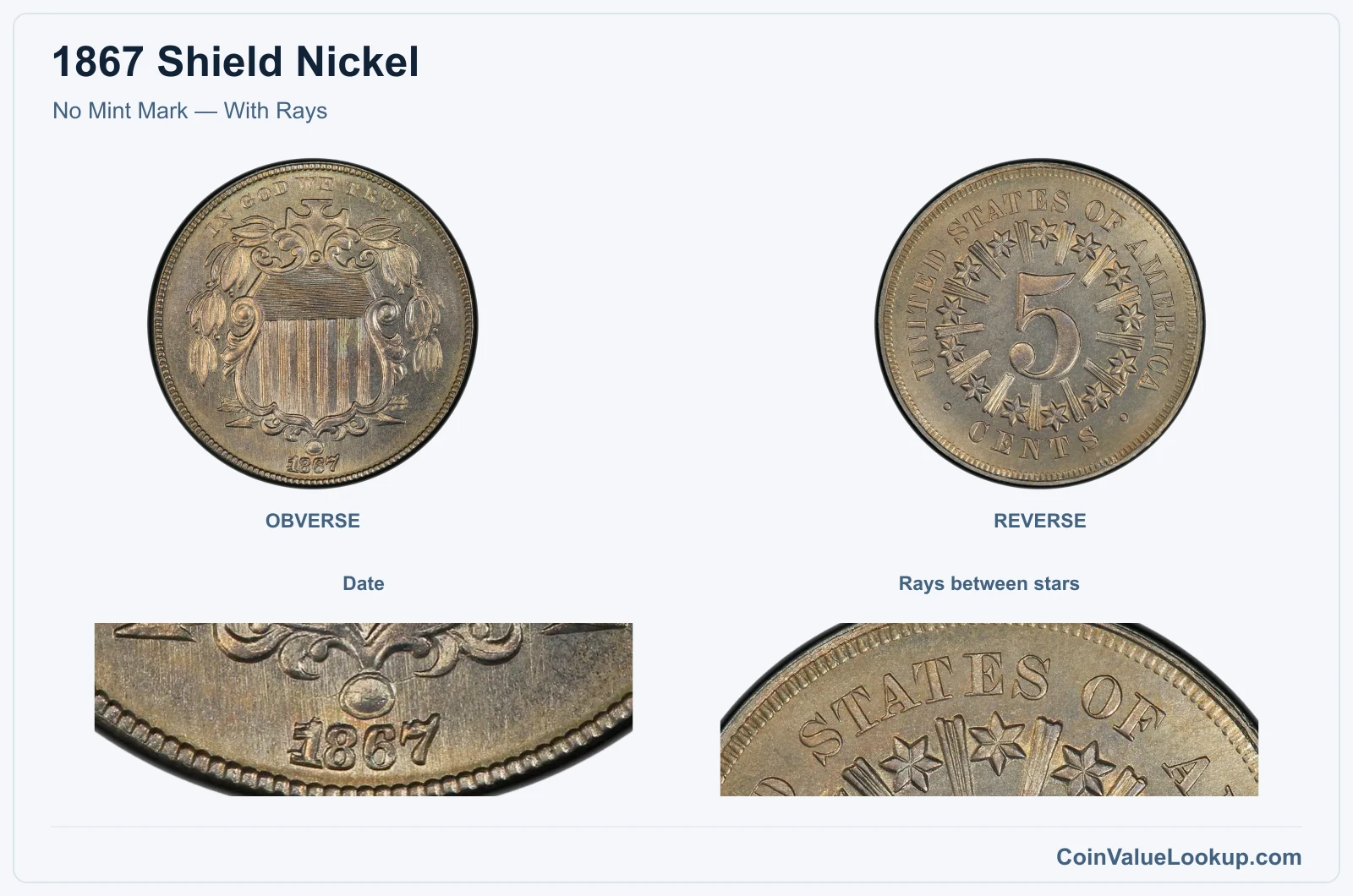
The With Rays business strike is the variety to check for first. Flip the coin over and look between the stars surrounding the large 5 — thin raised lines radiating outward confirm the rays design.
Philadelphia removed these rays during 1867, so fewer With Rays coins exist compared to the No Rays type.
USA Coin Book lists this version at about $50 in G4 and around $721 in MS63. Those are retail guide estimates, not guaranteed offers.
Even well-circulated examples carry a meaningful premium over the No Rays counterpart, so correct identification pays off. Check both faces for signs of cleaning or damage, which would pull the value below guide levels.
Range Grade
Price Auction Records Appraisal PO PO 1
—
Coin Identifier FR FR 2
—
Coin Identifier AG AG 3
—
Coin Identifier G G 4
—
Coin Identifier
G 6
—
Coin Identifier VG VG 8
Coin Identifier
VG 10
Coin Identifier F F 12
—
Coin Identifier
F 15
Coin Identifier VF VF 20
Coin Identifier
VF 25
—
Coin Identifier
VF 30
Coin Identifier
VF 35
Coin Identifier XF XF 40
Coin Identifier
XF 45
Coin Identifier AU AU 50
Coin Identifier
AU 53
Coin Identifier
AU 55
Coin Identifier
AU 58
Coin Identifier MS MS 60
—
Coin Identifier
MS 61
Coin Identifier
MS 62
Coin Identifier
MS 63
Coin Identifier
MS 64
Coin Identifier
MS 65
Coin Identifier
MS 66
Coin Identifier
MS 67
Coin Identifier
MS 68
—
—
—
MS 69
—
—
—
MS 70
—
—
—
1867 Shield Nickel — No Mint Mark — No Rays
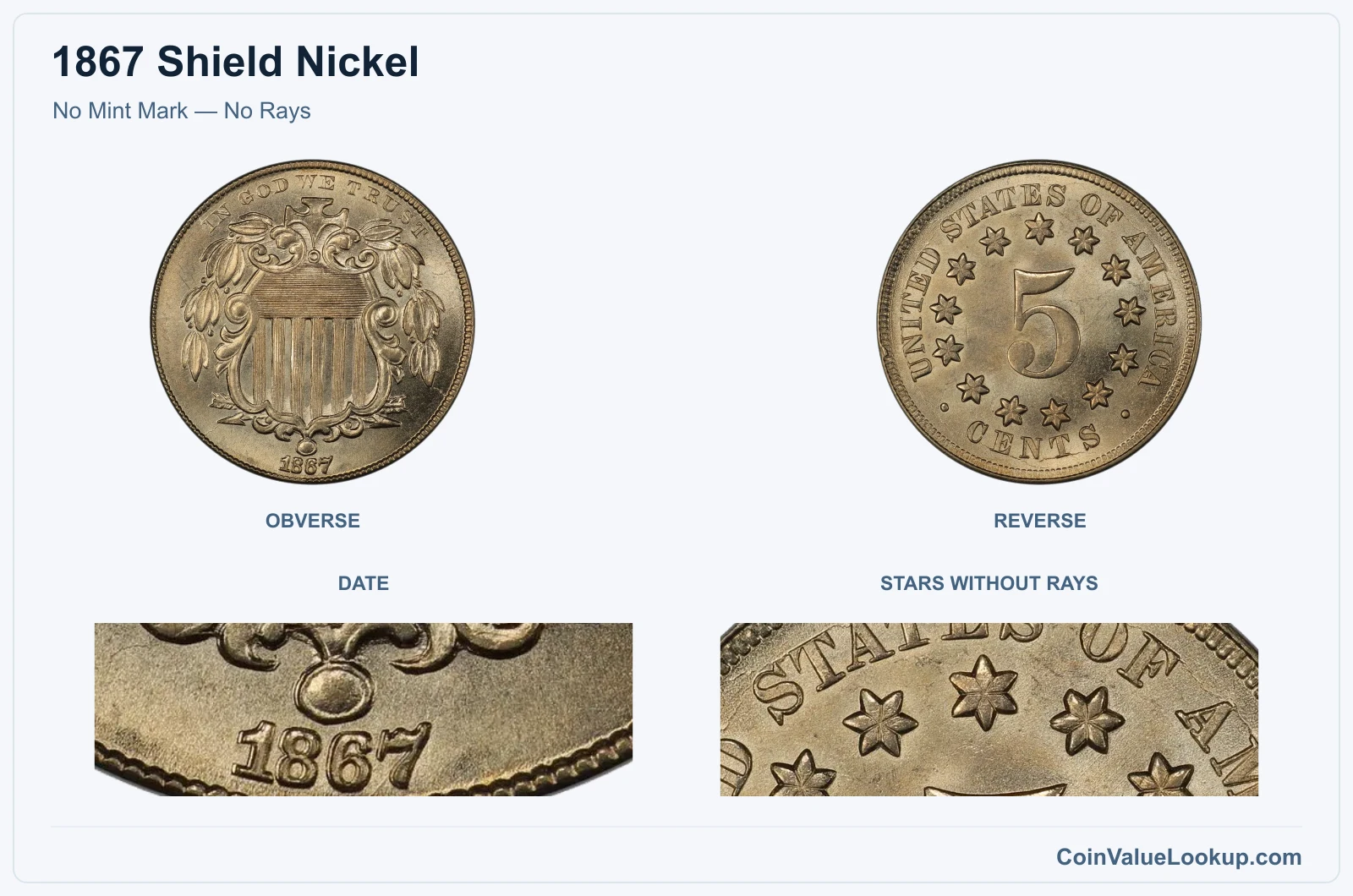
This is the standard 1867 Shield Nickel most collectors encounter. The reverse shows stars around the numeral 5 with no rays between them.
It is the more common of the two business-strike varieties for this year.
Retail guide estimates from USA Coin Book place a G4 example at roughly $25 and an MS63 coin near $281. Circulated pieces in the VG to VF range are affordable enough to be a solid entry point for type collectors.
Full, undamaged luster in Mint State adds real value, so handle uncirculated coins by the edges.
Coin Value Lookup is a handy starting point if you want to look up guides for other dates in the Shield Nickel series or compare values across different denominations.
Range Grade
Price Auction Records Appraisal PO PO 1
—
Coin Identifier FR FR 2
—
Coin Identifier AG AG 3
—
Coin Identifier G G 4
—
Coin Identifier
G 6
—
Coin Identifier VG VG 8
Coin Identifier
VG 10
Coin Identifier F F 12
—
Coin Identifier
F 15
Coin Identifier VF VF 20
Coin Identifier
VF 25
—
Coin Identifier
VF 30
Coin Identifier
VF 35
Coin Identifier XF XF 40
Coin Identifier
XF 45
Coin Identifier AU AU 50
Coin Identifier
AU 53
Coin Identifier
AU 55
Coin Identifier
AU 58
Coin Identifier MS MS 60
—
Coin Identifier
MS 61
Coin Identifier
MS 62
Coin Identifier
MS 63
Coin Identifier
MS 64
Coin Identifier
MS 65
Coin Identifier
MS 66
Coin Identifier
MS 67
Coin Identifier
MS 68
—
—
—
MS 69
—
—
—
MS 70
—
—
—
1867 Shield Nickel — No Mint Mark — With Rays Proof
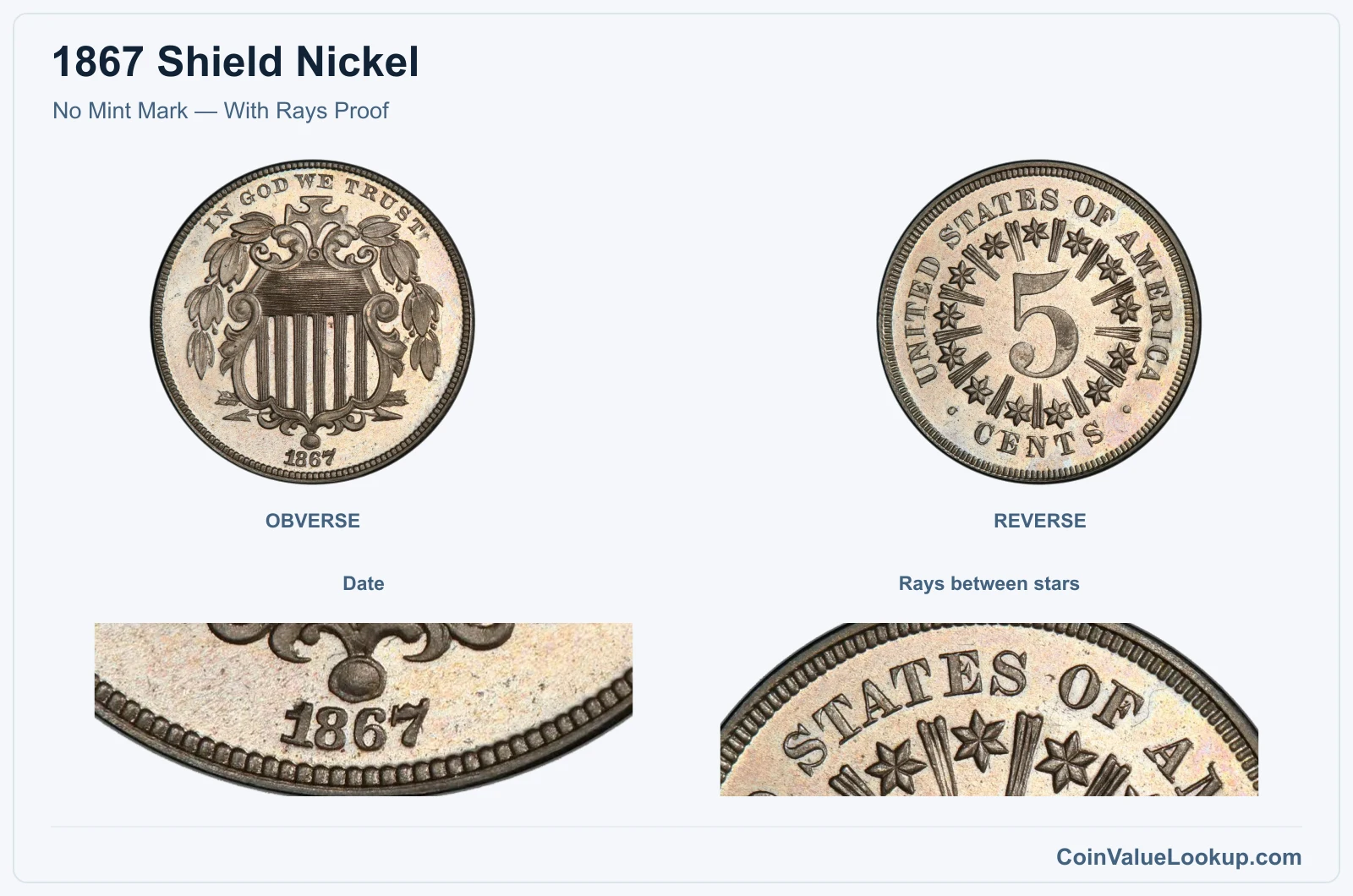
This is the coin that warps the price chart for 1867. The With Rays Proof Shield Nickel is an exceptional rarity — only a tiny number were produced before Philadelphia switched to the No Rays reverse design.
USA Coin Book lists a PR63 example at approximately $37,254.
Do not assume you own one just because your coin looks nice. Genuine proofs display deeply mirrored fields, razor-sharp device edges, and squared rims that business strikes simply do not replicate.
The rays between the stars must be present and the overall finish must be consistent with proof manufacture.
Professional third-party authentication is not optional here. The gap between a high-grade business strike and a confirmed proof is tens of thousands of dollars, so guessing is expensive in both directions.
If you suspect you have one, get it into a holder from a major grading service before drawing conclusions.
Range Grade
Price Auction Records Appraisal PR PR 1
—
Coin Identifier
PR 2
—
Coin Identifier
PR 3
—
Coin Identifier
PR 4
—
Coin Identifier
PR 6
—
Coin Identifier
PR 8
—
Coin Identifier
PR 10
—
Coin Identifier
PR 12
—
Coin Identifier
PR 15
—
Coin Identifier
PR 20
—
Coin Identifier
PR 25
—
Coin Identifier
PR 30
—
Coin Identifier
PR 35
—
Coin Identifier
PR 40
—
Coin Identifier
PR 45
—
Coin Identifier
PR 50
—
Coin Identifier
PR 53
—
Coin Identifier
PR 55
—
Coin Identifier
PR 58
—
Coin Identifier
PR 60
—
Coin Identifier
PR 61
—
Coin Identifier
PR 62
Coin Identifier
PR 63
Coin Identifier
PR 64
Coin Identifier
PR 65
Coin Identifier
PR 66
Coin Identifier
PR 67
—
—
—
PR 68
—
—
—
PR 69
—
—
—
PR 70
—
—
—
1867 Shield Nickel — No Mint Mark — No Rays Proof
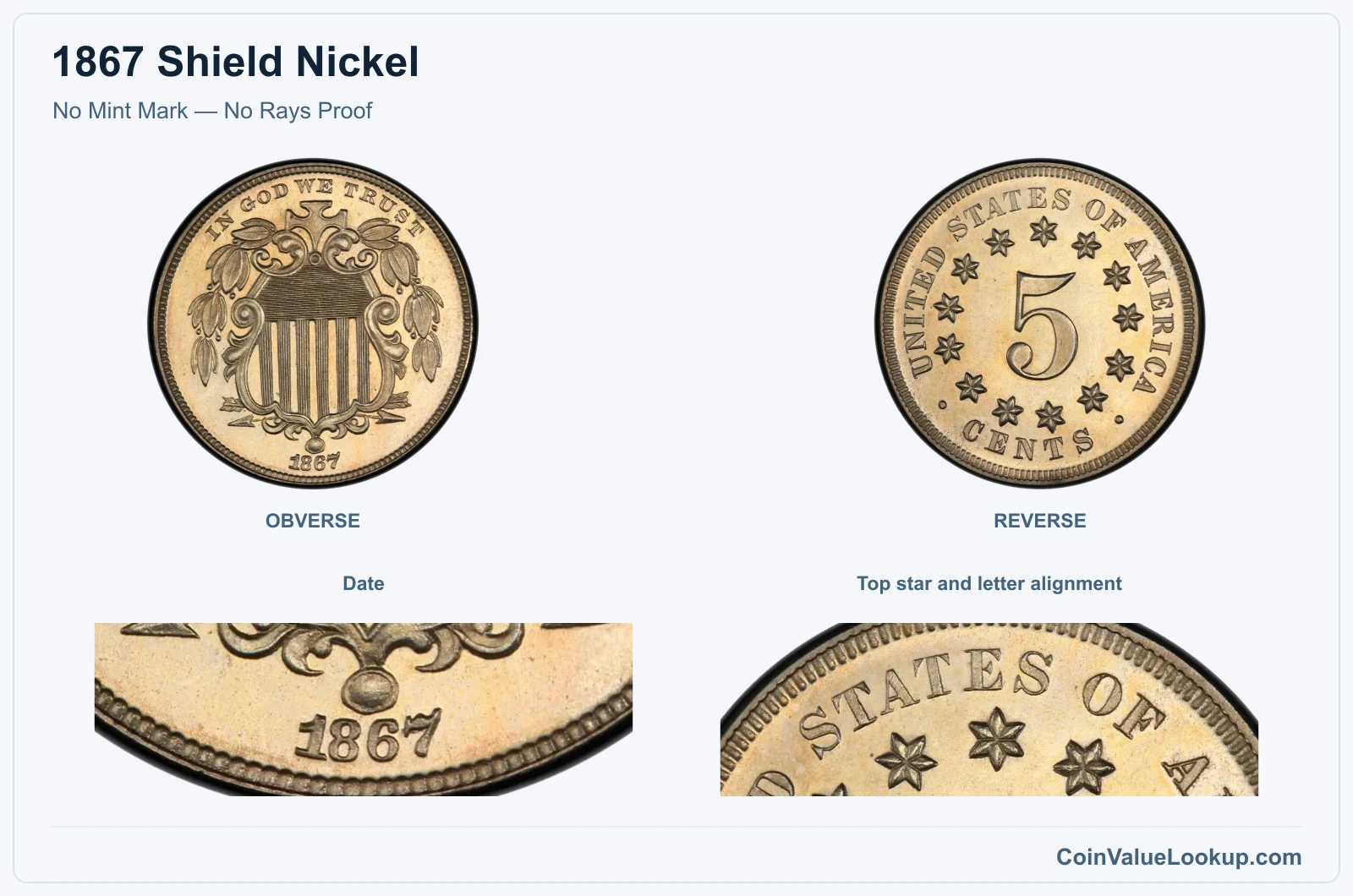
The No Rays Proof is the more available proof variety for 1867, though "available" is relative — proof Shield Nickels are uncommon across the board. USA Coin Book lists PR63 at about $584.
Look for fully mirrored fields on both sides, sharply defined shield lines, and precise, squared rims. The reverse will show stars around the numeral 5 with no rays.
Proof surfaces are also more susceptible to visible hairlines from mishandling, so condition matters a great deal even within the proof category. A coin with heavy hairlines or haze will trade below a clean, original example at the same technical grade.
Range Grade
Price Auction Records Appraisal PR PR 1
—
Coin Identifier
PR 2
—
Coin Identifier
PR 3
—
Coin Identifier
PR 4
—
Coin Identifier
PR 6
—
Coin Identifier
PR 8
—
Coin Identifier
PR 10
—
Coin Identifier
PR 12
—
Coin Identifier
PR 15
—
Coin Identifier
PR 20
—
Coin Identifier
PR 25
—
Coin Identifier
PR 30
—
Coin Identifier
PR 35
—
Coin Identifier
PR 40
—
Coin Identifier
PR 45
—
Coin Identifier
PR 50
—
Coin Identifier
PR 53
—
Coin Identifier
PR 55
—
Coin Identifier
PR 58
—
Coin Identifier
PR 60
—
Coin Identifier
PR 61
—
Coin Identifier
PR 62
Coin Identifier
PR 63
Coin Identifier
PR 64
Coin Identifier
PR 65
Coin Identifier
PR 66
Coin Identifier
PR 67
—
—
—
PR 68
—
—
—
PR 69
—
—
—
PR 70
—
—
—
1867 Shield Nickel Error List
1. 1867 Shield Nickel — Doubled Die Obverse
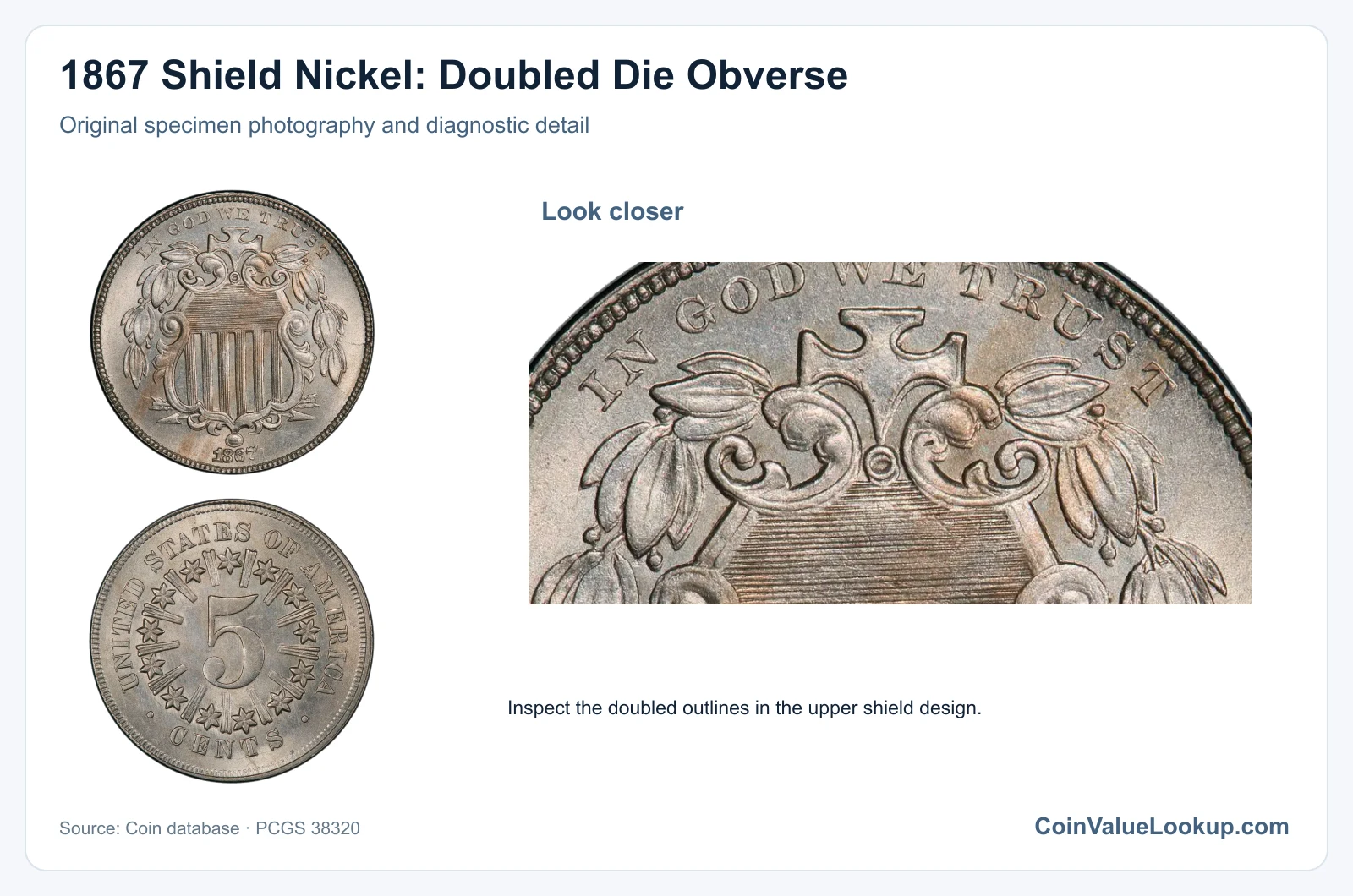
A Doubled Die Obverse on an 1867 Shield Nickel shows consistent doubling on obverse design elements — letters, the date, or portions of the shield — visible as separation or notching when compared to a normal example under the same lighting.
The key word is consistent. True die doubling repeats in the same direction across affected devices because the doubling was in the die itself, not the striking process.
Machine doubling, by contrast, tends to produce flat, shelf-like distortion without the crisp secondary image.
Reflections from the coin's surface and worn die contours can also mimic doubling to an untrained eye. Use magnification and a single directional light source.
No specific price range has been established for this variety in the research — value depends on the particular die marriage, the strength of the doubling, and the coin's overall condition.
2. 1867 Shield Nickel — Repunched Date
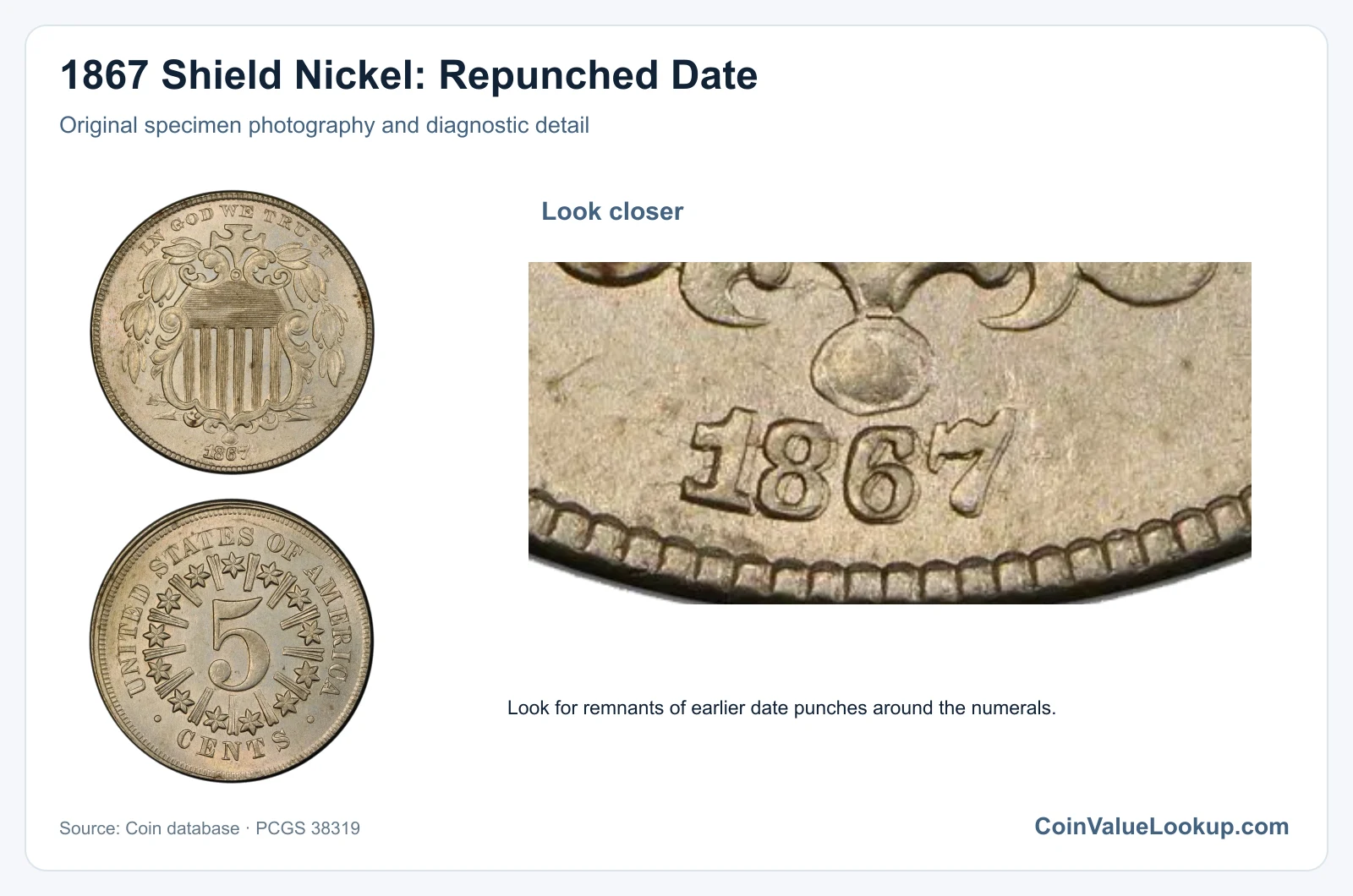
A Repunched Date on an 1867 Shield Nickel occurs when remnants of an earlier date-punch position are visible alongside the final numerals. You might see traces of a misaligned 1, 8, 6, or 7 peeking out from behind or beside the correctly placed digit.
This is a different animal from doubled die varieties. Repunching happened when a date punch was applied more than once to a working die, with a slight shift between impressions.
It affects only the date, not the entire obverse design.
Lookalikes include damaged digits from post-mint hits and flat machine doubling. Genuine repunching shows the extra digit remnants embedded in the die — they will be consistent across all known examples struck from that die.
No adopted price range is available; premiums depend on how dramatic the repunching is and the coin's grade.
3. 1867 Shield Nickel — Die Crack / Die Chip
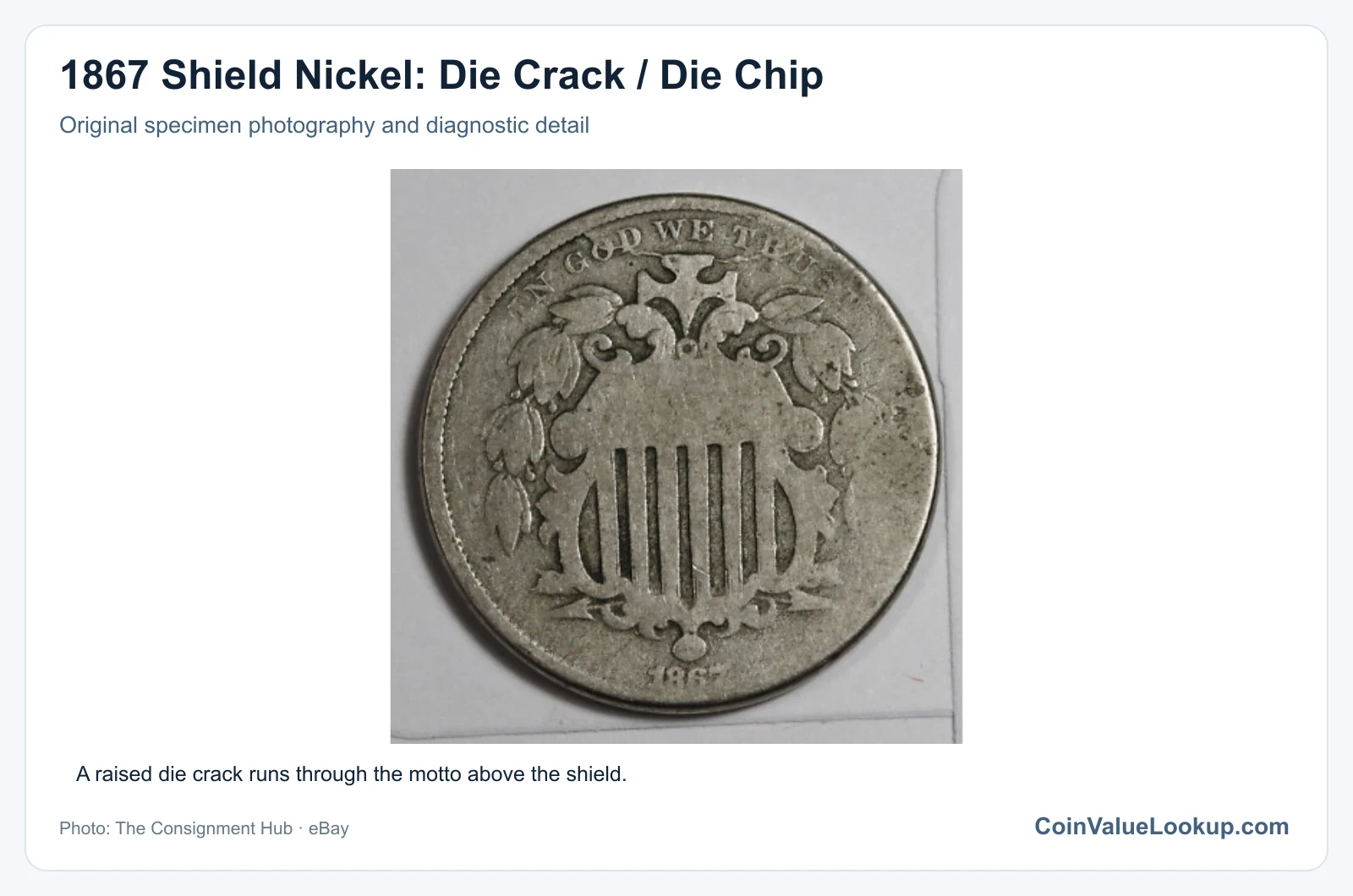
Die cracks on an 1867 Shield Nickel appear as thin raised lines running across the coin's surface. They form because the steel die literally cracked during use, and the crack filled with metal during striking.
Small raised blobs, called die chips, happen when a tiny piece of the die face breaks away.
A crack that reaches from an interior design element to the rim is a standard die crack. A larger break at the rim that leaves a raised blob of metal is sometimes called a cud — a more dramatic and generally more collectible form.
Do not confuse these with incuse scratches, which are pressed into the surface rather than raised above it. Corrosion bumps and debris stuck to the surface can also look similar at first glance.
No specific price data was established for this variety — value depends on size, location, and the coin's condition.
4. 1867 Shield Nickel — Clashed Dies
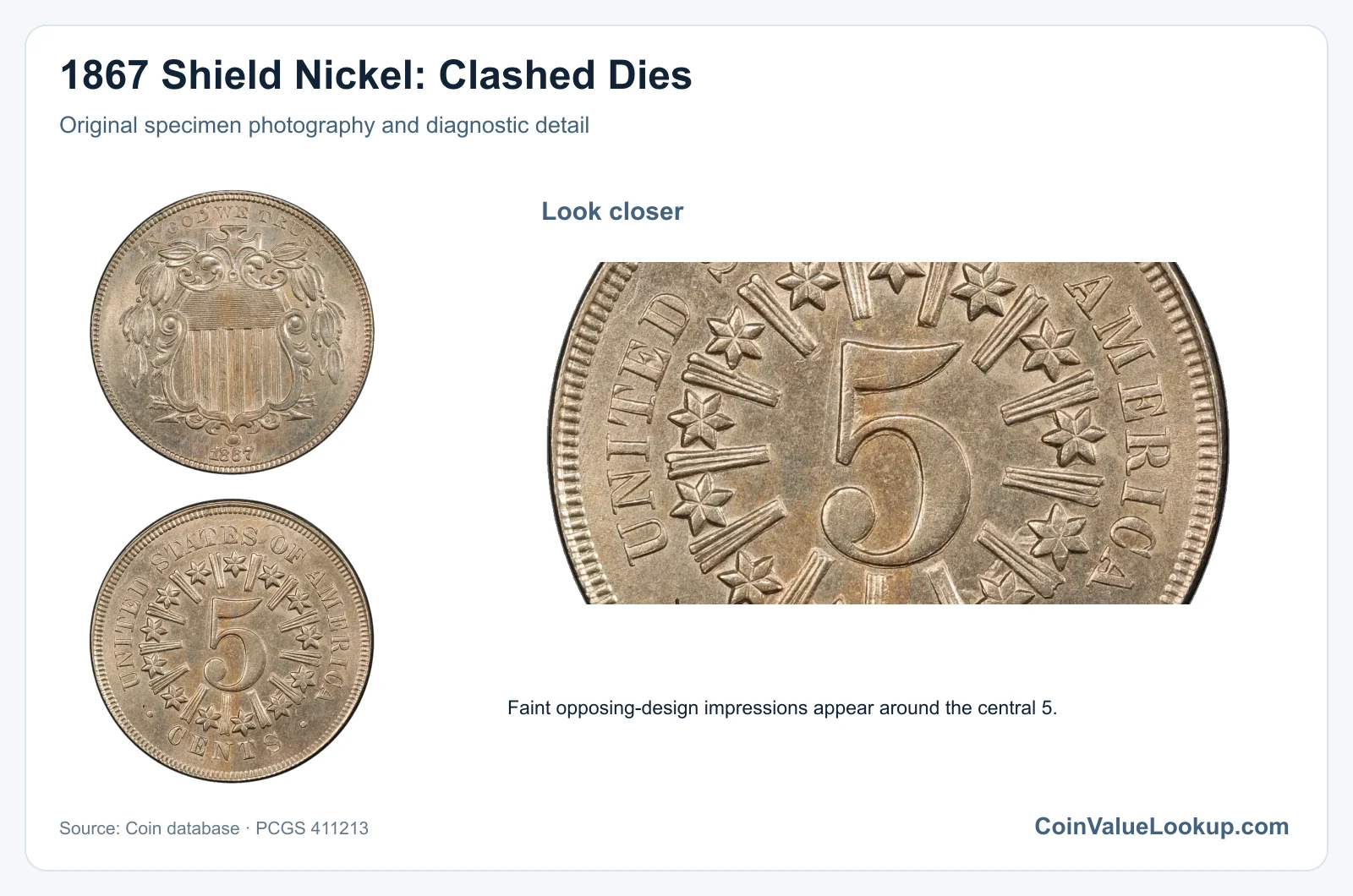
Clashed dies result when the obverse and reverse dies strike each other without a planchet between them. The impact transfers faint traces of each die's design onto the opposing die, and those ghost impressions then appear on subsequent coins.
On an 1867 Shield Nickel, look for unexplained design elements in the open fields — perhaps faint shield lines on the reverse or traces of the numeral 5 or stars on the obverse. The transferred images should align with where the opposite die's features would logically appear.
Do not mistake random scratches, raised lines from die polishing, or surface contamination for clash marks. True clash evidence is symmetrical and repeatable across coins from the same die pair.
No adopted price range exists for this category; value depends on the clarity of the clash, which side shows it, and the coin's overall grade.
5. 1867 Shield Nickel — Misplaced Date
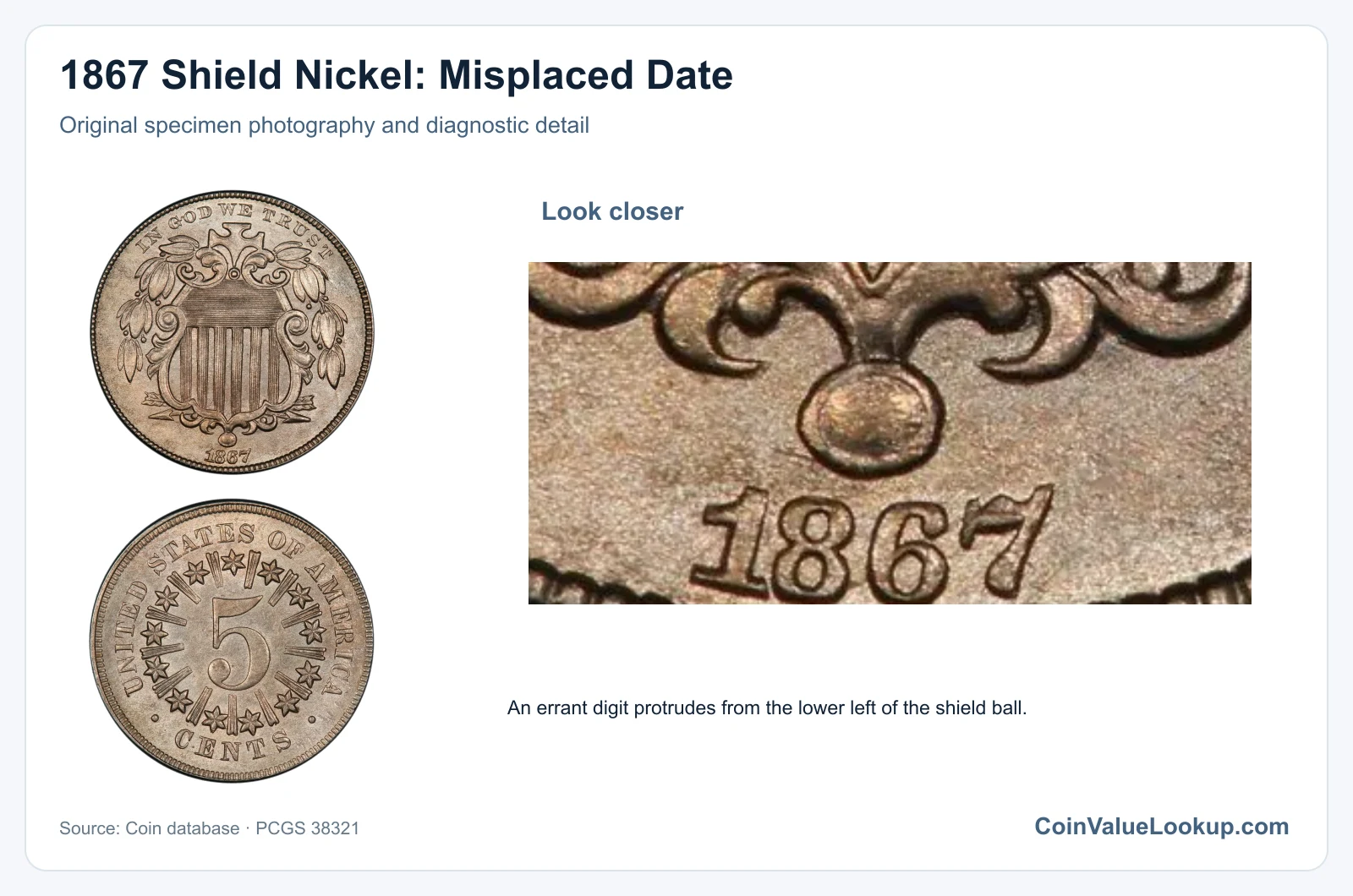
A Misplaced Date variety on an 1867 Shield Nickel shows a fragment of one or more date digits in an unexpected location — typically partially impressed into the denticles, the bust truncation, or another area away from the normal date position.
This happened when the date punch accidentally contacted the die in the wrong spot before being correctly positioned. The stray impression was not fully effaced and survived into production strikes.
These fragments can be subtle. Normal denticle shapes and random scratches near the date are the most common lookalikes.
A genuine misplaced date fragment will match the style and curvature of the date digits and will appear in the same spot on every coin struck from that die. No numerical price range has been established — premiums vary with the size and visibility of the displaced fragment and the coin's condition.