1931 Buffalo Nickel Coin Value: How Much Is It Worth?
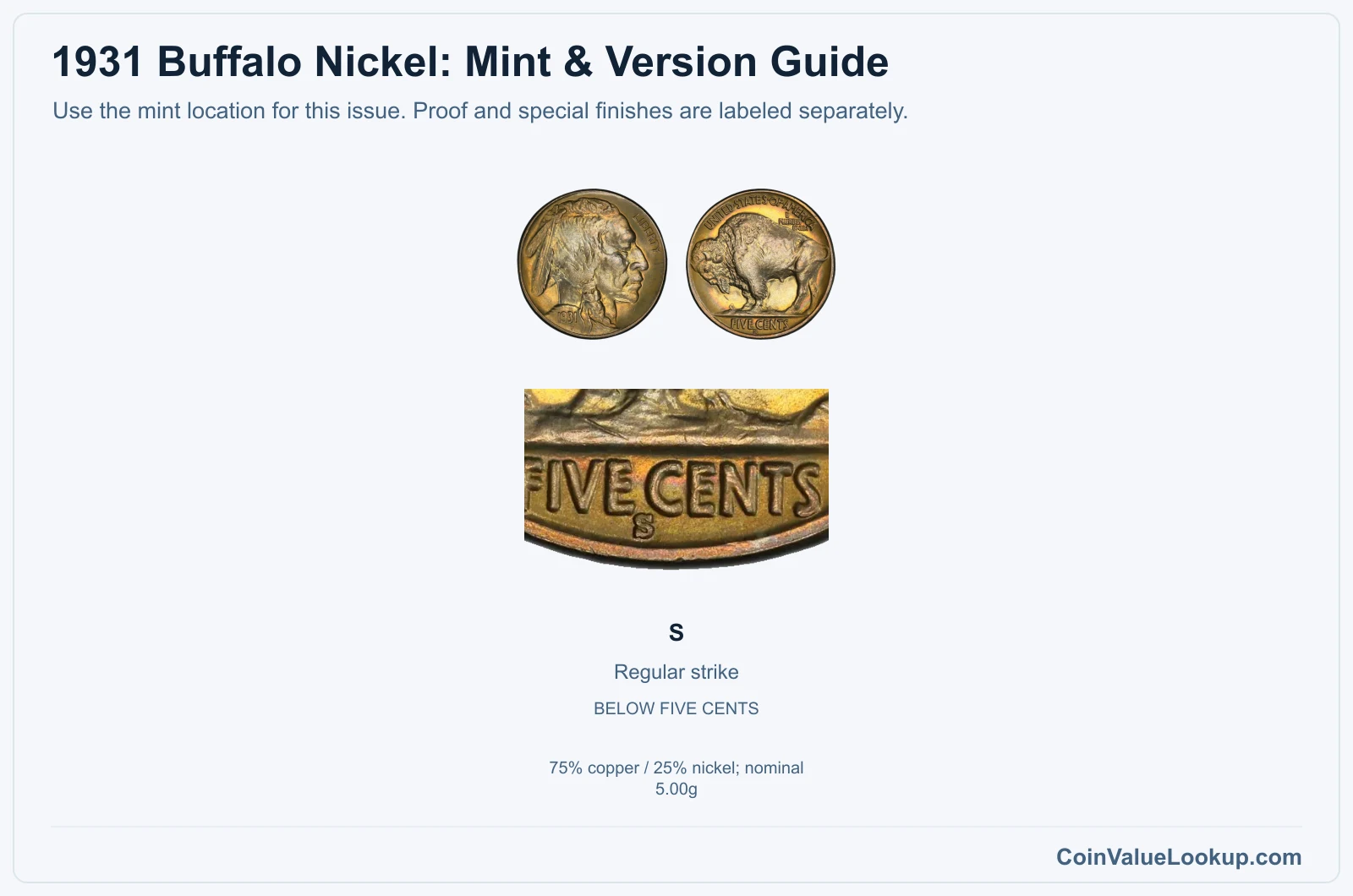
The 1931 Buffalo Nickel is a San Francisco-only issue, which makes it a bit of a standout in the series. Guide estimates for circulation examples range from about $21 in G4 to $123 in MS63, according to USA Coin Book.
Higher grades or error coins can exceed those figures. There were no regular proof nickels struck this year, so every genuine 1931 Buffalo Nickel you encounter is a business strike.
Fast Way to Identify Your 1931 Buffalo Nickel
Want a quick read on what you have? Upload clear photos of the front and back of your coin.
Make sure the date is legible and the area below FIVE CENTS on the reverse is in focus so the mintmark can be checked. This preliminary identification from photos can help point you in the right direction before seeking professional grading.
1931 Buffalo Nickel Value
Upload both sides of your 1931 Buffalo Nickel.
Front Obverse
Upload photo
Back Reverse
Upload photo
Which 1931 Buffalo Nickel Versions Are Worth Money?
- The 1931-S Type 2 is the only regular-issue version this year; guide values run $21 in G4 up to $123 in MS63 per USA Coin Book.
- Original mint-state surfaces with full luster command a significant premium over circulated examples.
- Repunched mintmark, lamination, and off-center strike errors have been reported and can affect value depending on severity and condition.
- Since San Francisco was the sole mint, confirming the S mintmark is key to authenticating any 1931 Buffalo Nickel.
Step 1: Identify Your 1931 Buffalo Nickel Mint Mark and Version
Every 1931 Buffalo Nickel was struck at the San Francisco Mint, so you should see a small "S" mintmark on the reverse, sitting below the words FIVE CENTS. No Philadelphia or Denver issues exist for this date.
The coin is 75% copper and 25% nickel, weighing about 5 grams with a 21.2 mm diameter and a plain edge. There is no silver version.
All 1931 nickels carry the Type 2 reverse design, where the denomination FIVE CENTS sits in a recessed area below the bison. The earlier Type 1 design, with FIVE CENTS on a raised mound, was only used in 1913.
So if your coin says 1931, it is automatically Type 2. Don't overthink that part.
Step 2: Check Your 1931 Buffalo Nickel Grade
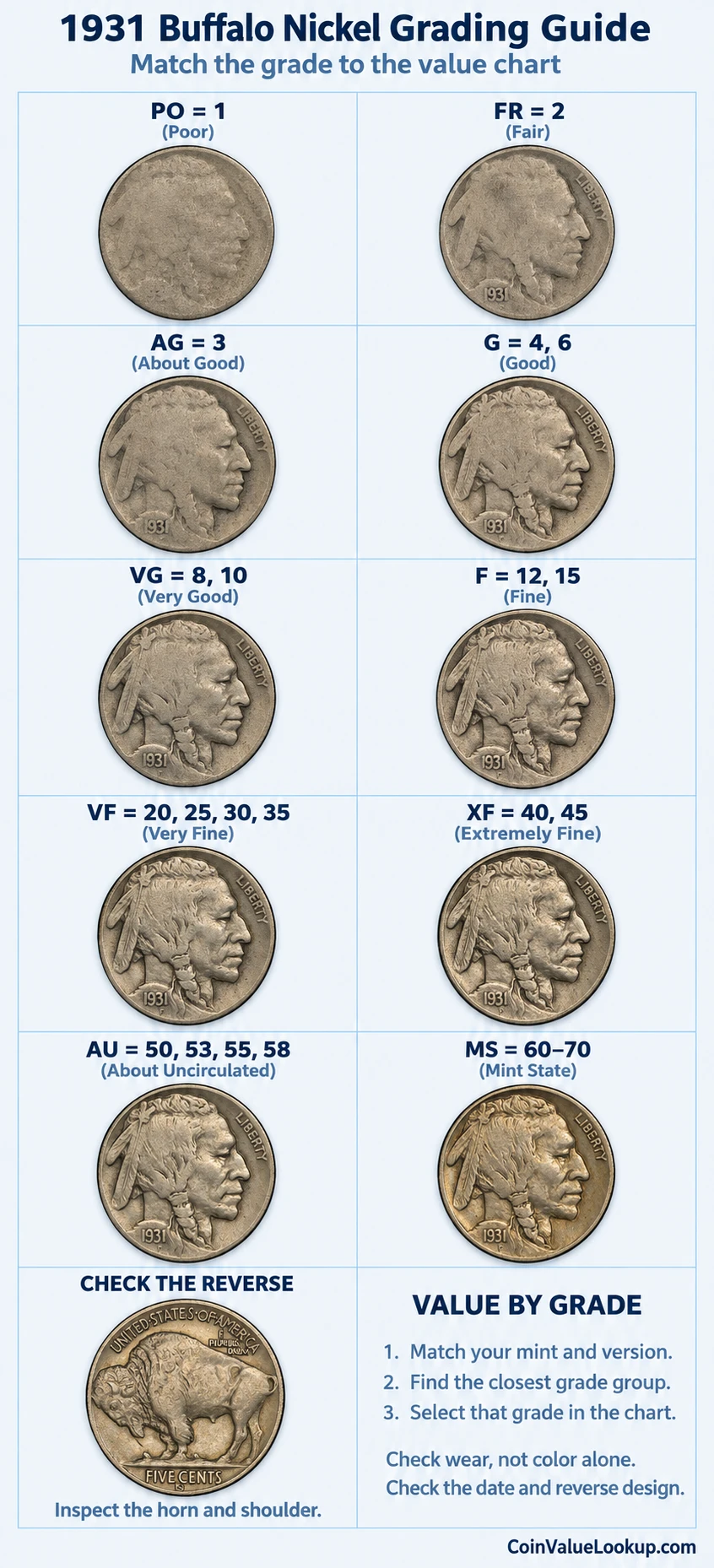
When grading a 1931-S Buffalo Nickel, focus on the Native American portrait's hair braid, the cheekbone, and the bison's shoulder and horn on the reverse. These are the first areas to show honest wear from circulation.
Here is the tricky part: branch-mint Buffalo Nickels from this era were sometimes weakly struck. A soft horn or mushy braid does not always mean the coin is heavily worn.
Compare your coin against the grading comparison image to separate a weak strike from actual friction.
Original luster matters a lot once you get into the uncirculated range. Look for unbroken cartwheel luster across the fields.
Surface marks, scratches, and cleaning all reduce the grade and desirability.
Never use acid or any chemical to restore a faded date. It destroys the coin's surfaces and tanks its value.
If the date is worn smooth, that is what it is.
Step 3: Check 1931 Buffalo Nickel Value by Mint and Version
1931 Buffalo Nickel — S — Type2 Circulation
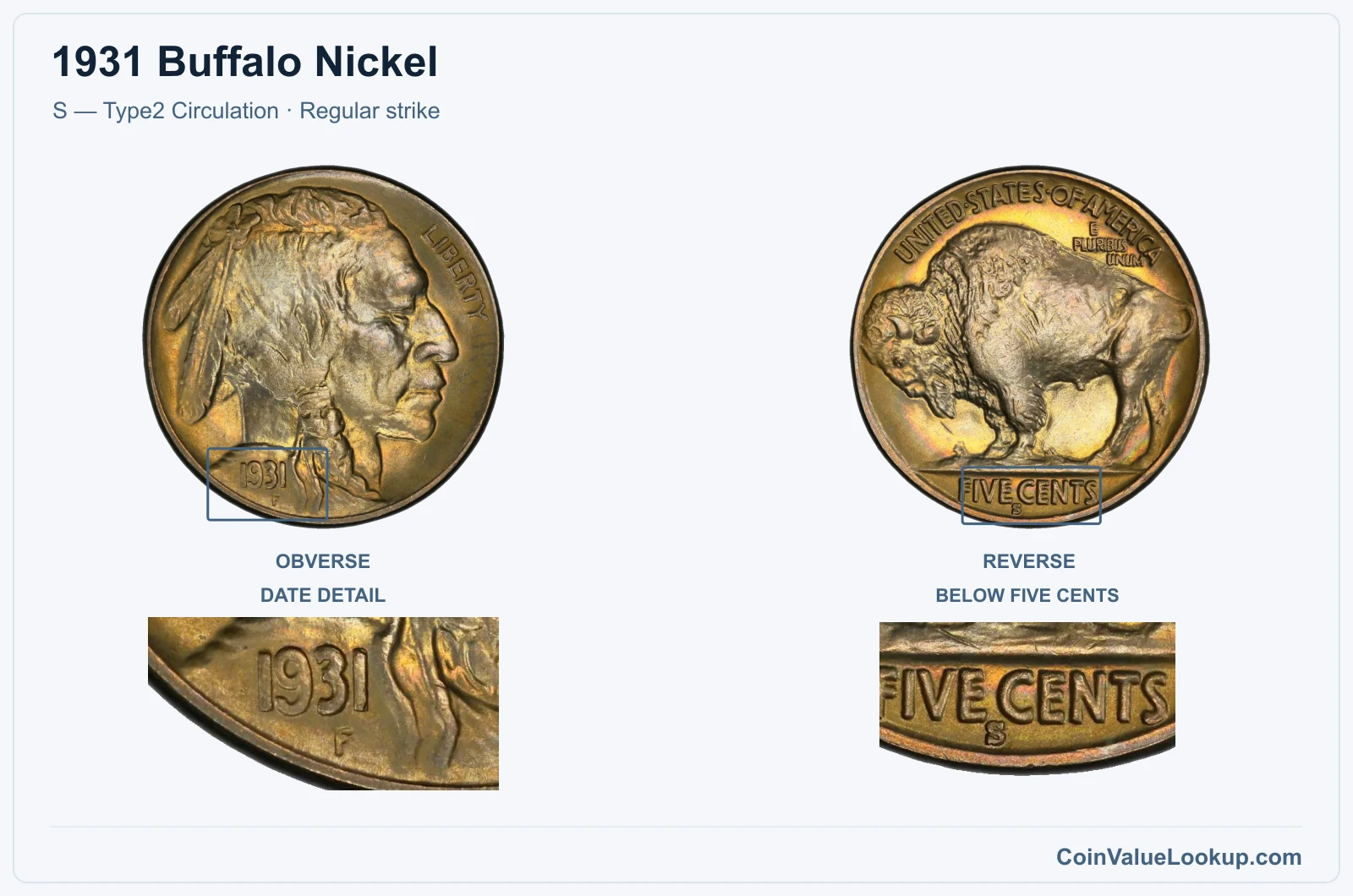
This is the only game in town for 1931. San Francisco struck every regular-issue Buffalo Nickel this year, bearing a small "S" below FIVE CENTS on the recessed Type 2 reverse.
USA Coin Book estimates place a worn G4 example around $21 and an MS63 near $123.
When photographing your coin for identification, capture both faces clearly, making sure the date and the mintmark area are readable. The denomination level on the reverse should also be visible.
Mint-state pieces with strong strikes and original surfaces will always outperform the guide floor.
Coin Value Lookup is a good starting point if you want to look up values for other dates and mints in the Buffalo Nickel series or explore different coin types entirely.
Range Grade
Price Auction Records Appraisal PO PO 1
—
Coin Identifier FR FR 2
—
Coin Identifier AG AG 3
—
Coin Identifier G G 4
—
Coin Identifier
G 6
—
Coin Identifier VG VG 8
—
Coin Identifier
VG 10
—
Coin Identifier F F 12
—
Coin Identifier
F 15
—
Coin Identifier VF VF 20
—
Coin Identifier
VF 25
—
Coin Identifier
VF 30
—
Coin Identifier
VF 35
Coin Identifier XF XF 40
—
Coin Identifier
XF 45
Coin Identifier AU AU 50
Coin Identifier
AU 53
—
Coin Identifier
AU 55
Coin Identifier
AU 58
Coin Identifier MS MS 60
—
Coin Identifier
MS 61
—
Coin Identifier
MS 62
Coin Identifier
MS 63
Coin Identifier
MS 64
Coin Identifier
MS 65
Coin Identifier
MS 66
Coin Identifier
MS 67
Coin Identifier
MS 68
—
—
—
MS 69
—
—
—
MS 70
—
—
—
1931 Buffalo Nickel Error List
1. 1931 Buffalo Nickel — Repunched Mintmark
A repunched mintmark occurs when the S was punched into the die more than once, leaving a visible trace of the earlier, misaligned impression. On a 1931-S Buffalo Nickel, inspect the mintmark closely under magnification.
You may see a second partial S slightly offset from the primary mark, often peeking out to one side or below.
Don't confuse this with machine doubling, which tends to produce a flat, shelf-like shadow rather than a distinctly shaped second letter. Die chips and corrosion near the mintmark can also mimic a repunched appearance, so compare your coin against a normal 1931-S at the same magnification.
No specific price range is adopted here because value depends on the particular repunched variety, its visibility, and the coin's overall condition.
2. 1931 Buffalo Nickel — Lamination / Split Planchet
Lamination errors happen when the metal layers in the planchet fail to bond properly, causing peeling, flaking, or a visible split in the surface. On a 1931-S Buffalo Nickel, look for a raised flap of metal or a section where the surface has separated and lifted away from the body of the coin.
Photograph both the affected face and the edge together so the depth of the separation is clear. Post-mint damage like scraping, corrosion pitting, or someone deliberately gouging the surface can look similar at first glance, but a genuine lamination follows the coin's contour and typically has a smooth interior rather than rough tool marks.
The value of a lamination error depends on how dramatic the separation is and the coin's overall grade, so no fixed price range applies here.
3. 1931 Buffalo Nickel — Off-Center Strike
An off-center strike means the planchet was not seated properly in the collar when the dies came together, leaving part of the design missing and a blank crescent along one edge. On a 1931-S, this creates a shifted Native American portrait or bison with an unstruck area on the opposite side.
The date needs to remain visible for the coin to be attributed to 1931, which is a major factor in desirability. A 10% off-center piece is mildly interesting; a 30% or greater shift with a full date draws considerably more attention.
Watch out for lookalikes: a straight-clipped planchet, one-sided die misalignment, or post-mint flattening from a vise can all mimic an off-center appearance. Value varies with the percentage of displacement and the coin's condition, so no specific price range is listed.