1931 Wheat Penny Coin Value: How Much Is It Worth?
A 1931 Wheat Penny can be worth anywhere from about $1.24 in well-worn Good-4 condition up to around $249 at the MS63 grade level, depending on which mint struck it. The 1931-S is the standout here — it commands serious premiums even in low grades.
Proofs were not produced for regular issue this year, and major varieties or mint errors are priced separately. Original surfaces, color and the degree of wear all affect what a specific coin will bring.
Fast Way to Identify Your 1931 Wheat Penny
The quickest way to get a preliminary read on your 1931 Wheat Penny is to upload clear photos of both the front and the back. A well-lit image helps identify the mintmark, surface condition and any unusual features.
This is not a substitute for professional authentication, but it gives you a solid starting point for understanding what you have.
1931 Wheat Penny Value
Upload both sides of your 1931 Wheat Penny.
Front Obverse
Upload photo
Back Reverse
Upload photo
Which 1931 Wheat Penny Versions Are Worth Money?
- The 1931-S is the key mint branch for this date, starting around $92 even in Good-4 and reaching approximately $249 at MS63 — far above the other two mints.
- The 1931-D carries a meaningful premium over Philadelphia, with guide values of roughly $8.64 in Good-4 and $87 at MS63.
- The 1931 Philadelphia issue is the most affordable entry point at about $1.24 in Good-4, climbing to around $43 at MS63.
- Coins with strong original surfaces and no cleaning bring stronger offers across all three mints.
- Authenticated mint errors such as repunched mintmarks or off-center strikes on any 1931 cent can add value beyond standard guide figures.
Step 1: Identify Your 1931 Wheat Penny Mint Mark and Version
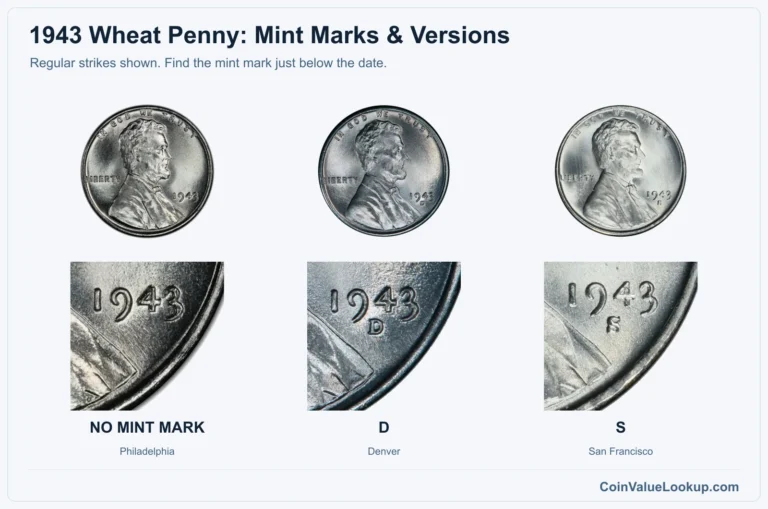
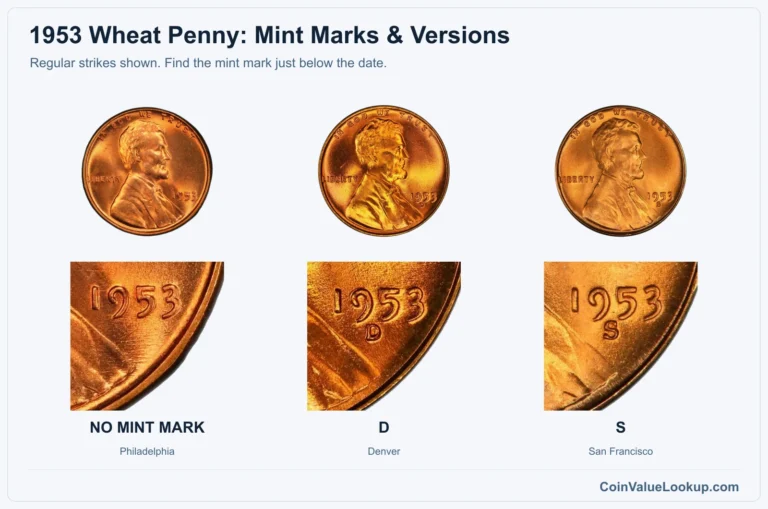
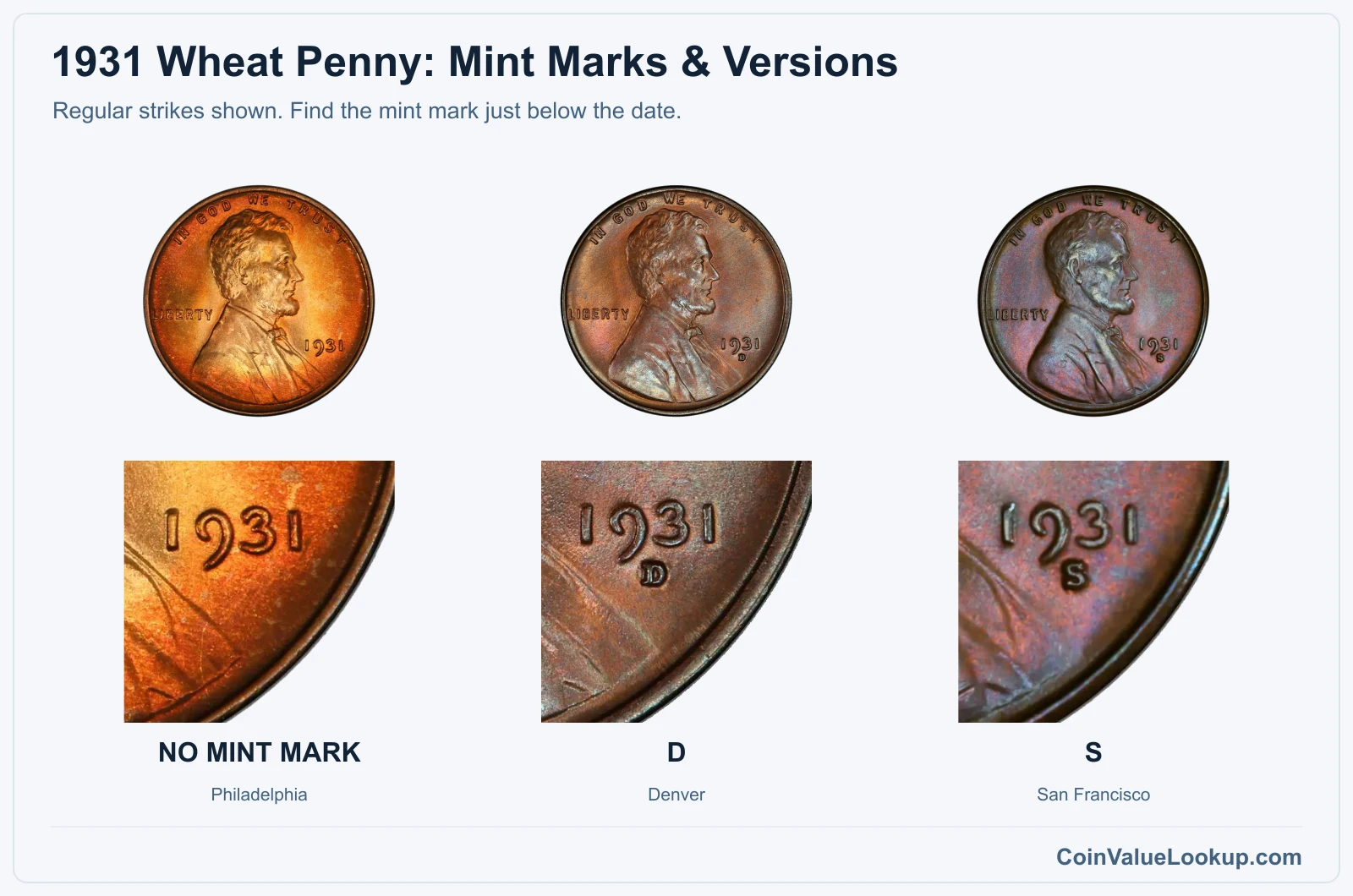
Flip your coin to the obverse and look just below the date. If you see no letter at all, it was struck at Philadelphia.
A small "D" means Denver, and a small "S" means San Francisco. All three mints produced cents this year, and the San Francisco issue is the key date of the group.
Every 1931 cent shares the same basic specs: Lincoln's portrait on the front, two wheat ears on the reverse, a plain (smooth) edge, and a composition of 95% copper with 5% tin and zinc at roughly 3.11 grams. There are no regular proof issues for this date.
Do not confuse color with grade. A coin can be brown and still uncirculated, or reddish and still show wear.
Color — red, red-brown or brown — is a separate value factor from the actual wear on the coin's high points.
Step 2: Check Your 1931 Wheat Penny Grade
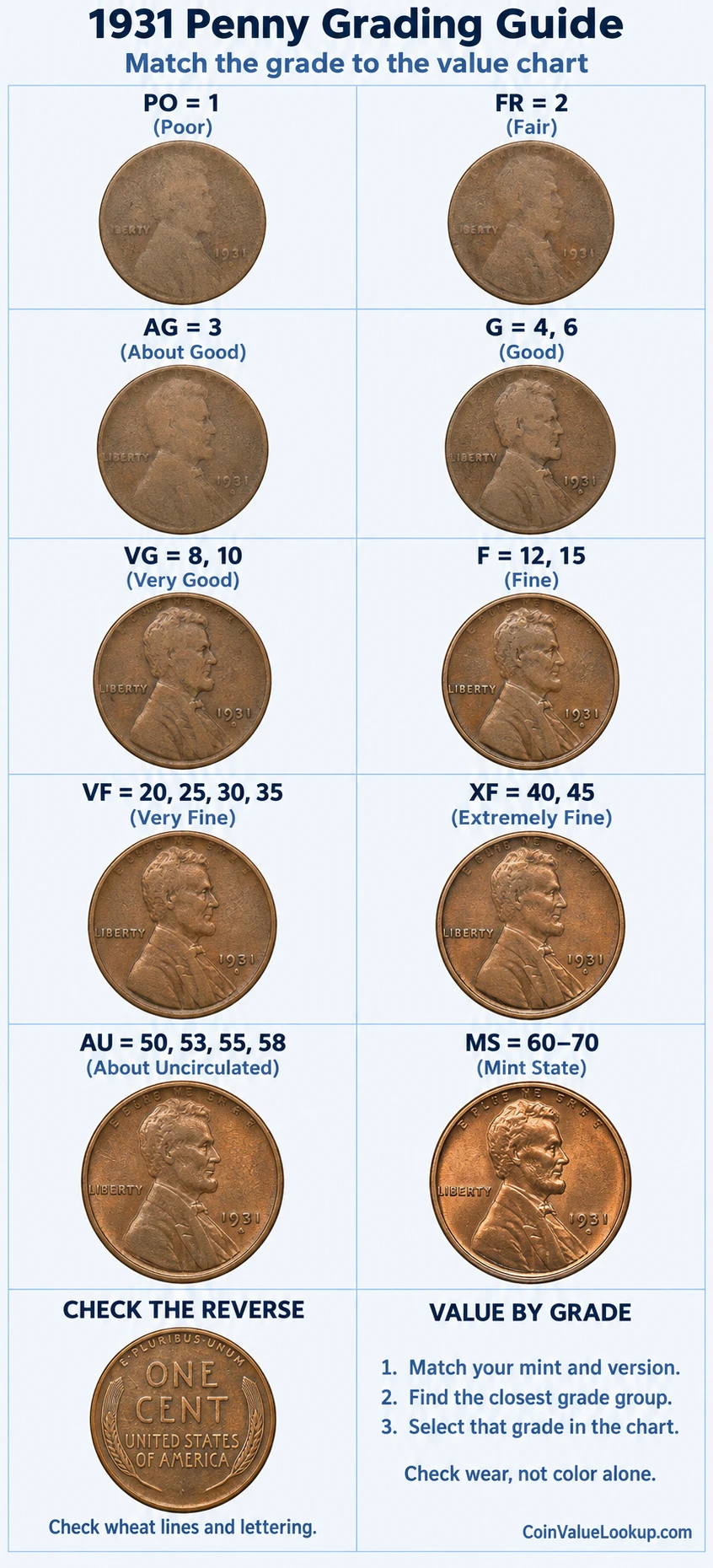
Start with Lincoln's cheekbone, jawline and the fine hair detail above his ear. These are the highest points of the design and the first places that show friction.
On the reverse, look at the individual wheat grains and the horizontal lines between the stalks — they wear away in a predictable sequence.
A coin in Good-4 condition will have a visible outline of Lincoln but almost no interior detail. By Fine-12 you can see partial hair strands and a clearer ear.
Mint State coins retain full original luster with no wear at all on those high points.
Use the comparison image to match your coin's wear pattern. Keep in mind that a weakly struck coin can look worn even when it is not — the difference is that a weak strike affects an entire area evenly, while wear creates a smooth, flattened spot surrounded by sharper detail.
Spots, cleaning, corrosion and environmental damage are separate deductions. A cleaned coin with the detail of an MS63 will not bring MS63 money.
Step 3: Check 1931 Wheat Penny Value by Mint and Version
1931 Wheat Penny
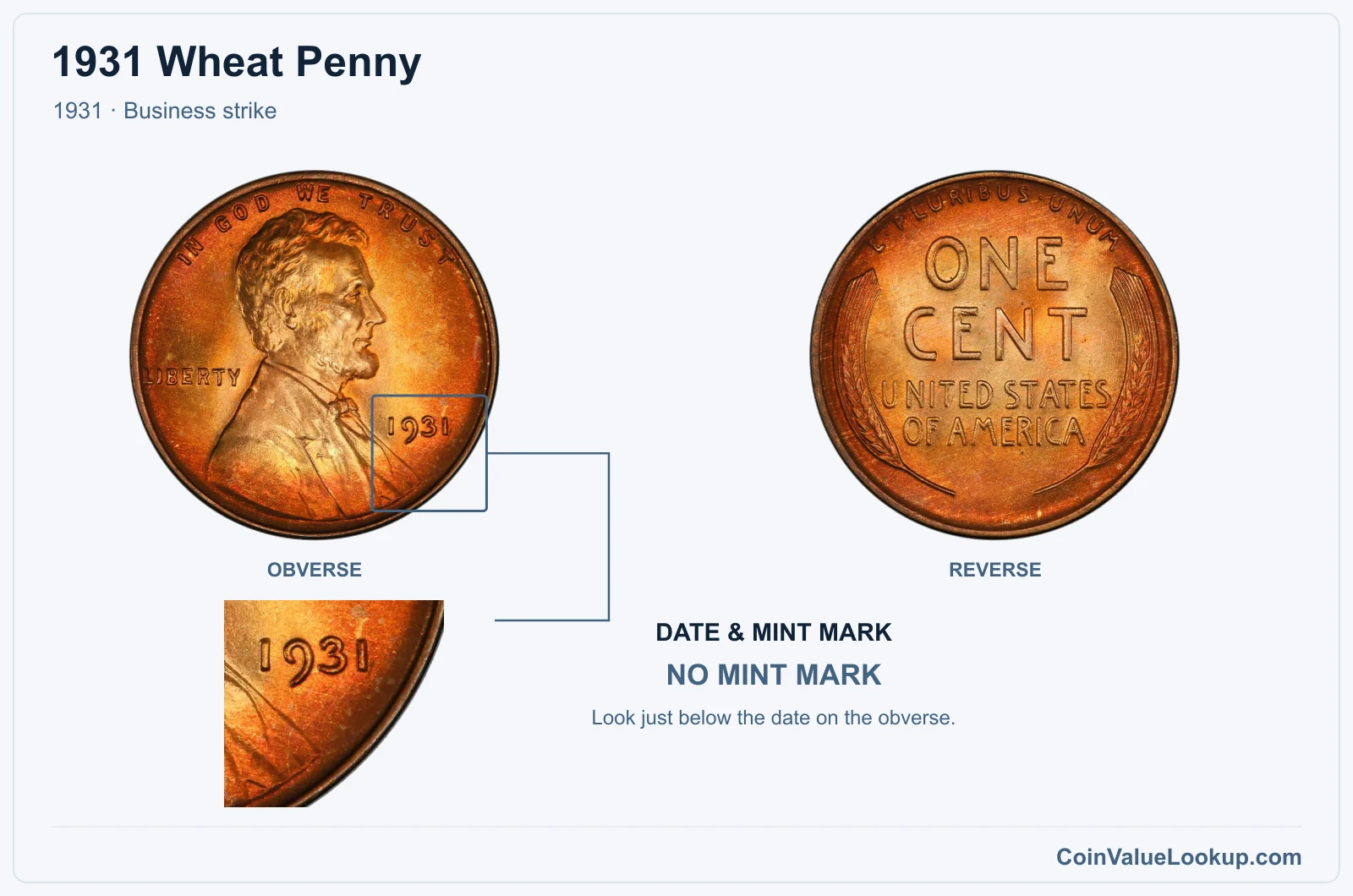
The 1931 Philadelphia cent has no mintmark below the date. It is the most common of the three mint issues this year, and guide estimates place it at roughly $1.24 in Good-4 condition and about $43 at the MS63 level.
These figures from USA Coin Book are retail estimates and do not specify coin color, so do not treat them as certified red-designation prices.
Original, problem-free examples with good eye appeal will always trade better than dull or cleaned pieces at the same technical grade. If your coin has no mintmark, check the surfaces carefully — a coin that looks "too bright" may have been cleaned, which reduces its desirability.
| Range | Grade | Price | Auction Records | Appraisal |
|---|---|---|---|---|
| PO | PO 1 | — | Coin Identifier | |
| FR | FR 2 | — | Coin Identifier | |
| AG | AG 3 | — | Coin Identifier | |
| G | G 4 | — | Coin Identifier | |
| G 6 | — | Coin Identifier | ||
| VG | VG 8 | — | Coin Identifier | |
| VG 10 | — | Coin Identifier | ||
| F | F 12 | — | Coin Identifier | |
| F 15 | — | Coin Identifier | ||
| VF | VF 20 | — | Coin Identifier | |
| VF 25 | — | Coin Identifier | ||
| VF 30 | — | Coin Identifier | ||
| VF 35 | — | Coin Identifier | ||
| XF | XF 40 | — | Coin Identifier | |
| XF 45 | — | Coin Identifier | ||
| AU | AU 50 | — | Coin Identifier | |
| AU 53 | — | Coin Identifier | ||
| AU 55 | — | Coin Identifier | ||
| AU 58 | — | Coin Identifier | ||
| MS | MS 60 | — | Coin Identifier | |
| MS 61 | — | Coin Identifier | ||
| MS 62 | — | Coin Identifier | ||
| MS 63 | Coin Identifier | |||
| MS 64 | Coin Identifier | |||
| MS 65 | Coin Identifier | |||
| MS 66 | Coin Identifier | |||
| MS 67 | Coin Identifier | |||
| MS 68 | — | — | — | |
| MS 69 | — | — | — | |
| MS 70 | — | — | — |
1931 Wheat Penny — D
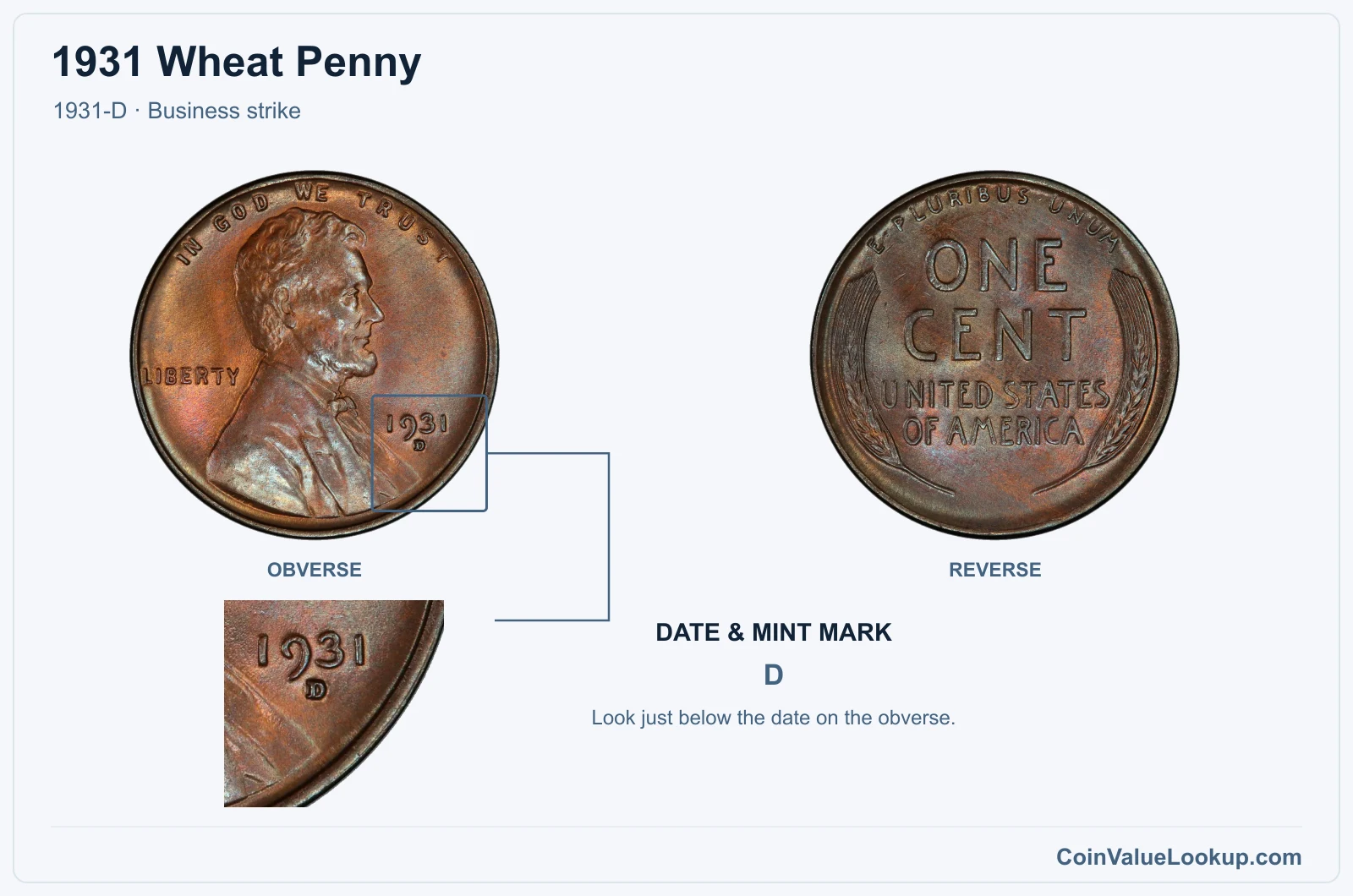
Look for a small "D" mintmark below the date to confirm a Denver strike. The 1931-D trades at a noticeable step above the Philadelphia issue: USA Coin Book guide estimates run about $8.64 in Good-4 and around $87 at the MS63 level.
Denver's 1931 output was lower than Philadelphia's, and that relative scarcity shows in the pricing. Even so, the 1931-D sits in the shadow of its San Francisco sibling.
Coins with original brown or red-brown surfaces and sharp detail are the ones that hold collector interest.
Coin Value Lookup is a handy place to look up guide values for other dates in the Wheat cent series, so you can compare your 1931-D against the rest of your collection.
| Range | Grade | Price | Auction Records | Appraisal |
|---|---|---|---|---|
| PO | PO 1 | — | Coin Identifier | |
| FR | FR 2 | — | Coin Identifier | |
| AG | AG 3 | — | Coin Identifier | |
| G | G 4 | — | Coin Identifier | |
| G 6 | — | Coin Identifier | ||
| VG | VG 8 | — | Coin Identifier | |
| VG 10 | — | Coin Identifier | ||
| F | F 12 | — | Coin Identifier | |
| F 15 | — | Coin Identifier | ||
| VF | VF 20 | — | Coin Identifier | |
| VF 25 | — | Coin Identifier | ||
| VF 30 | — | Coin Identifier | ||
| VF 35 | Coin Identifier | |||
| XF | XF 40 | Coin Identifier | ||
| XF 45 | — | Coin Identifier | ||
| AU | AU 50 | Coin Identifier | ||
| AU 53 | Coin Identifier | |||
| AU 55 | Coin Identifier | |||
| AU 58 | Coin Identifier | |||
| MS | MS 60 | — | Coin Identifier | |
| MS 61 | Coin Identifier | |||
| MS 62 | Coin Identifier | |||
| MS 63 | Coin Identifier | |||
| MS 64 | Coin Identifier | |||
| MS 65 | Coin Identifier | |||
| MS 66 | Coin Identifier | |||
| MS 67 | — | — | — | |
| MS 68 | — | — | — | |
| MS 69 | — | — | — | |
| MS 70 | — | — | — |
1931 Wheat Penny — S
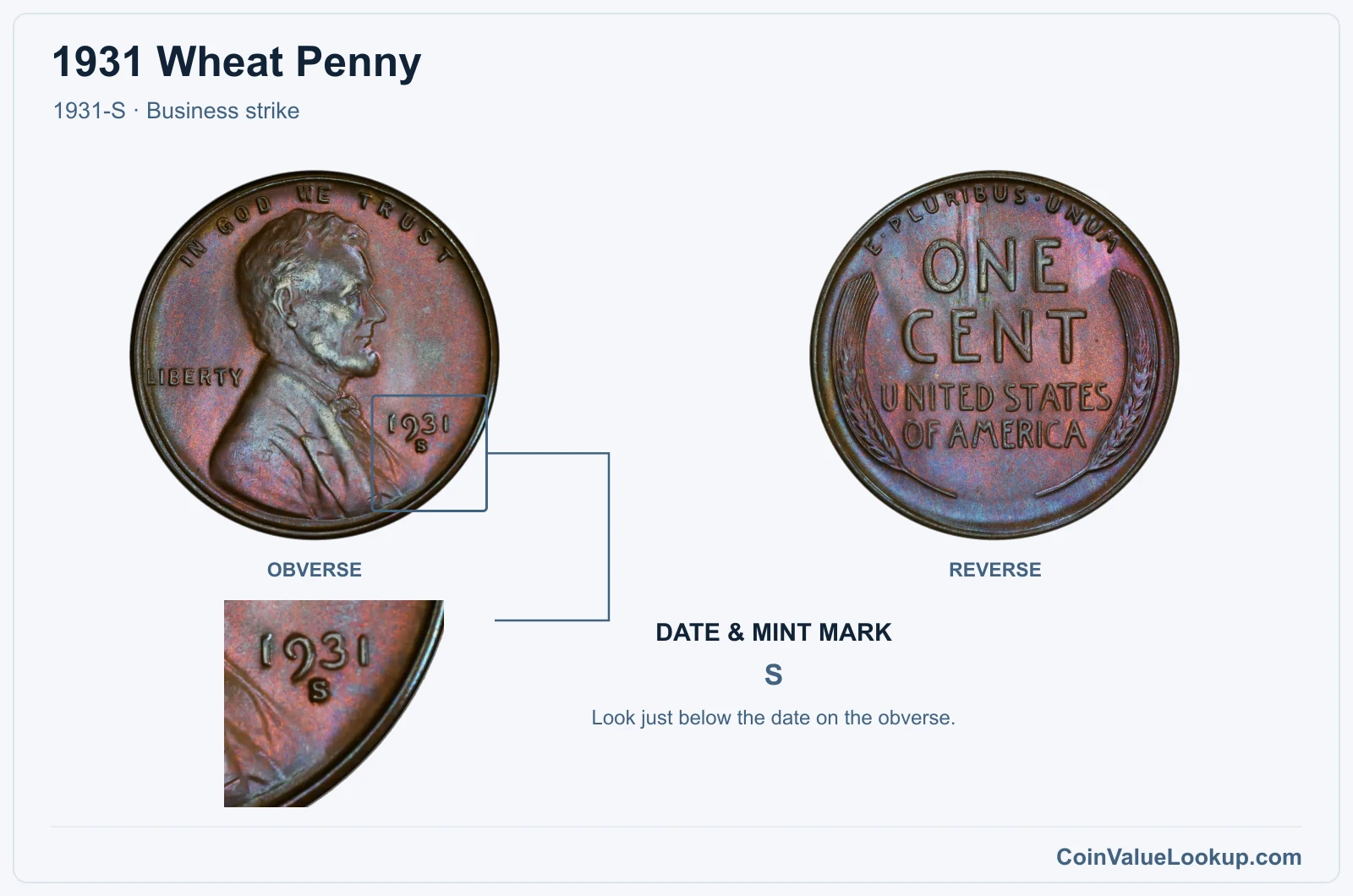
This is the one everyone checks for. A small "S" below the date identifies the San Francisco mint, and the 1931-S is the key date of this year's trio.
Guide estimates from USA Coin Book start at approximately $92 in Good-4 — already higher than the other two mints at MS63 — and climb to about $249 at the MS63 grade.
Because of its premium, counterfeits and altered mintmarks exist. Look at the shape and position of the "S" carefully, and compare it to known genuine examples.
A professionally authenticated example from a recognized grading service will always command stronger confidence from buyers.
Condition matters enormously here. The jump from a well-worn coin to one with sharp detail is steep, and original surfaces without cleaning or corrosion amplify the premium further.
| Range | Grade | Price | Auction Records | Appraisal |
|---|---|---|---|---|
| PO | PO 1 | — | Coin Identifier | |
| FR | FR 2 | — | Coin Identifier | |
| AG | AG 3 | — | Coin Identifier | |
| G | G 4 | — | Coin Identifier | |
| G 6 | — | Coin Identifier | ||
| VG | VG 8 | Coin Identifier | ||
| VG 10 | — | Coin Identifier | ||
| F | F 12 | Coin Identifier | ||
| F 15 | Coin Identifier | |||
| VF | VF 20 | Coin Identifier | ||
| VF 25 | Coin Identifier | |||
| VF 30 | Coin Identifier | |||
| VF 35 | Coin Identifier | |||
| XF | XF 40 | Coin Identifier | ||
| XF 45 | Coin Identifier | |||
| AU | AU 50 | Coin Identifier | ||
| AU 53 | Coin Identifier | |||
| AU 55 | Coin Identifier | |||
| AU 58 | Coin Identifier | |||
| MS | MS 60 | Coin Identifier | ||
| MS 61 | Coin Identifier | |||
| MS 62 | Coin Identifier | |||
| MS 63 | Coin Identifier | |||
| MS 64 | Coin Identifier | |||
| MS 65 | Coin Identifier | |||
| MS 66 | Coin Identifier | |||
| MS 67 | — | — | — | |
| MS 68 | — | — | — | |
| MS 69 | — | — | — | |
| MS 70 | — | — | — |
1931 Wheat Penny Error List
1. 1931 Wheat Penny — Repunched Mintmark
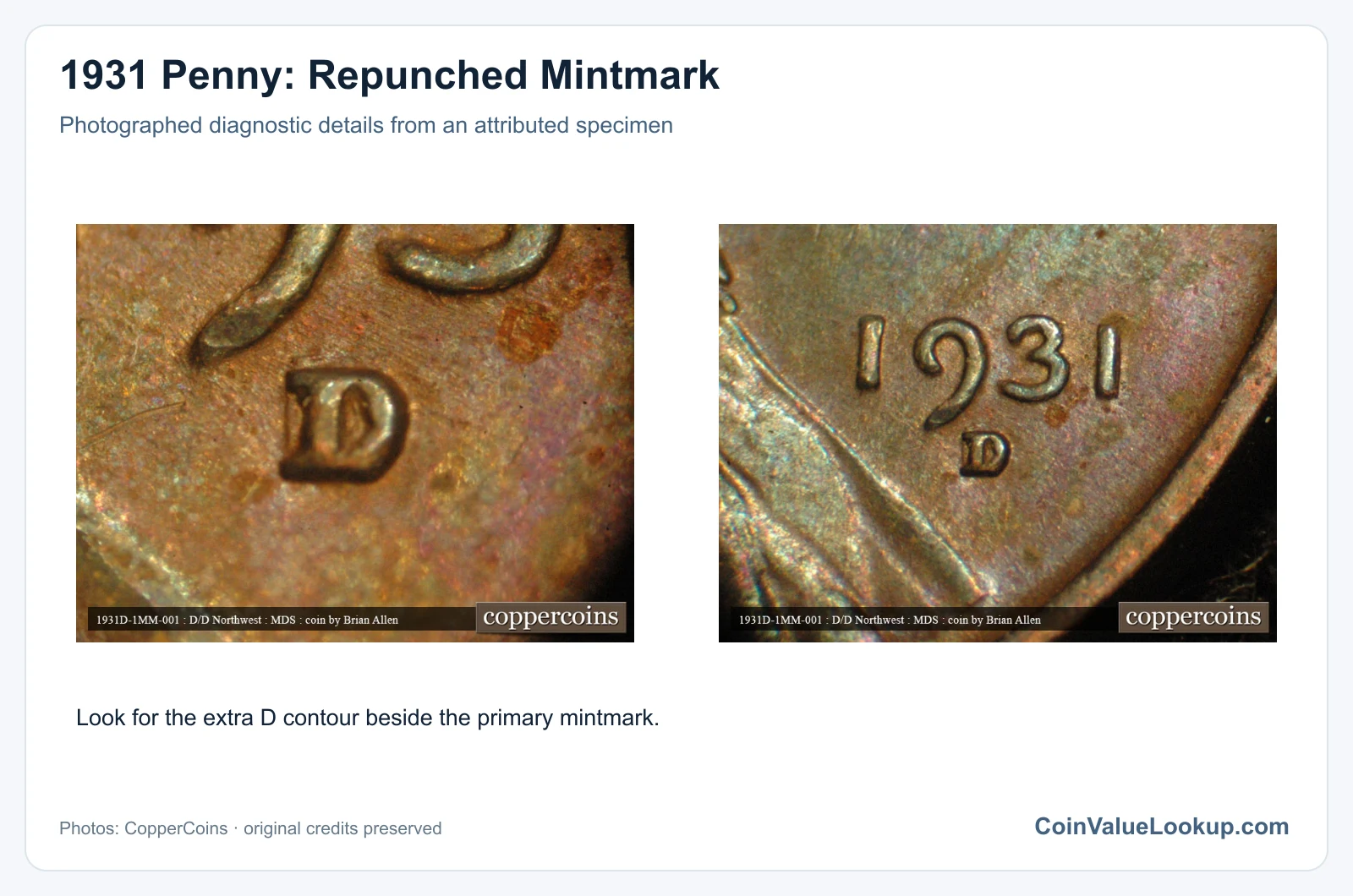
A repunched mintmark occurs when the mintmark punch was applied more than once in slightly different positions, leaving traces of the earlier impression alongside the final one. On a 1931 Wheat cent, this applies only to the D and S mint issues — Philadelphia coins have no mintmark to repunch.
To check, examine the mintmark under magnification and look for a secondary outline, a notch or a shadow of a second letter slightly offset from the primary one. Compare your coin's mintmark to a normal example at the same magnification to see if extra metal is genuinely part of the die impression.
Do not confuse this with machine doubling, which produces flat, shelf-like outlines, or with a die chip or corrosion filling in around the letter. No specific price range is supported for these; value depends on the authenticated identity of the variety, the severity of the repunching, and the coin's overall condition.
2. 1931 Wheat Penny — Die Crack / Die Chip
Die cracks show up as thin raised lines running across the coin's surface, caused by fractures in the steel die during production. A die chip is a small raised blob where a piece of the die face broke away.
If a crack reaches the rim and removes a chunk of design, that is sometimes called a cud.
On a 1931 Wheat cent, look for raised irregular lines that follow no part of the normal design. They may cross letters, the portrait or the wheat stalks.
The key word is "raised" — a scratch or corrosion line is incuse, pressed into the surface rather than standing above it.
Foreign material stuck to the coin or surface corrosion can mimic a chip. Check whether the feature is actually part of the metal flow.
No specific price range is adopted for die cracks on this date; value depends on the crack's size, location and the coin's authenticated condition.
3. 1931 Wheat Penny — Off-Center Strike
An off-center strike happens when the planchet is not properly seated between the dies, so part of the design is missing and a blank crescent of unstruck metal appears on one side. The percentage of off-center displacement and whether the date remains visible are the two biggest factors collectors care about.
On a 1931 Wheat cent, look for a shifted design with a smooth, featureless arc along one edge. The design elements nearest the blank area will fade gradually rather than being cut off sharply.
Do not confuse this with a clipped planchet, which removes metal before striking, or with post-mint damage like a coin flattened unevenly after it left the press. A one-sided die misalignment can also shift the image but will not produce the telltale unstruck crescent.
No supported price range exists for this error on the 1931 date; each coin's value depends on the degree of displacement and its authenticated grade.
4. 1931 Wheat Penny — Clipped Planchet
A clipped planchet error means the blank was incompletely punched from the copper strip before striking, leaving a missing curved, straight or irregular section. The Blakesly effect — a weak area of the rim directly opposite the clip — is a useful confirmation that the missing metal was absent before the coin was struck.
On a 1931 Wheat cent, examine the edge carefully. A genuine clip will show natural metal flow and a rim that fades into the missing area.
The edge texture at the clip boundary differs from a sharp post-mint cut or a filed notch, which leave tool marks and abrupt transitions.
Corrosion eating away an edge can also mimic a clip, so look at the surrounding surface for pitting. No specific price data is adopted for clipped 1931 cents; value hinges on the clip's size, type and the coin's overall authenticated condition.
5. 1931 Wheat Penny — Lamination / Split Planchet
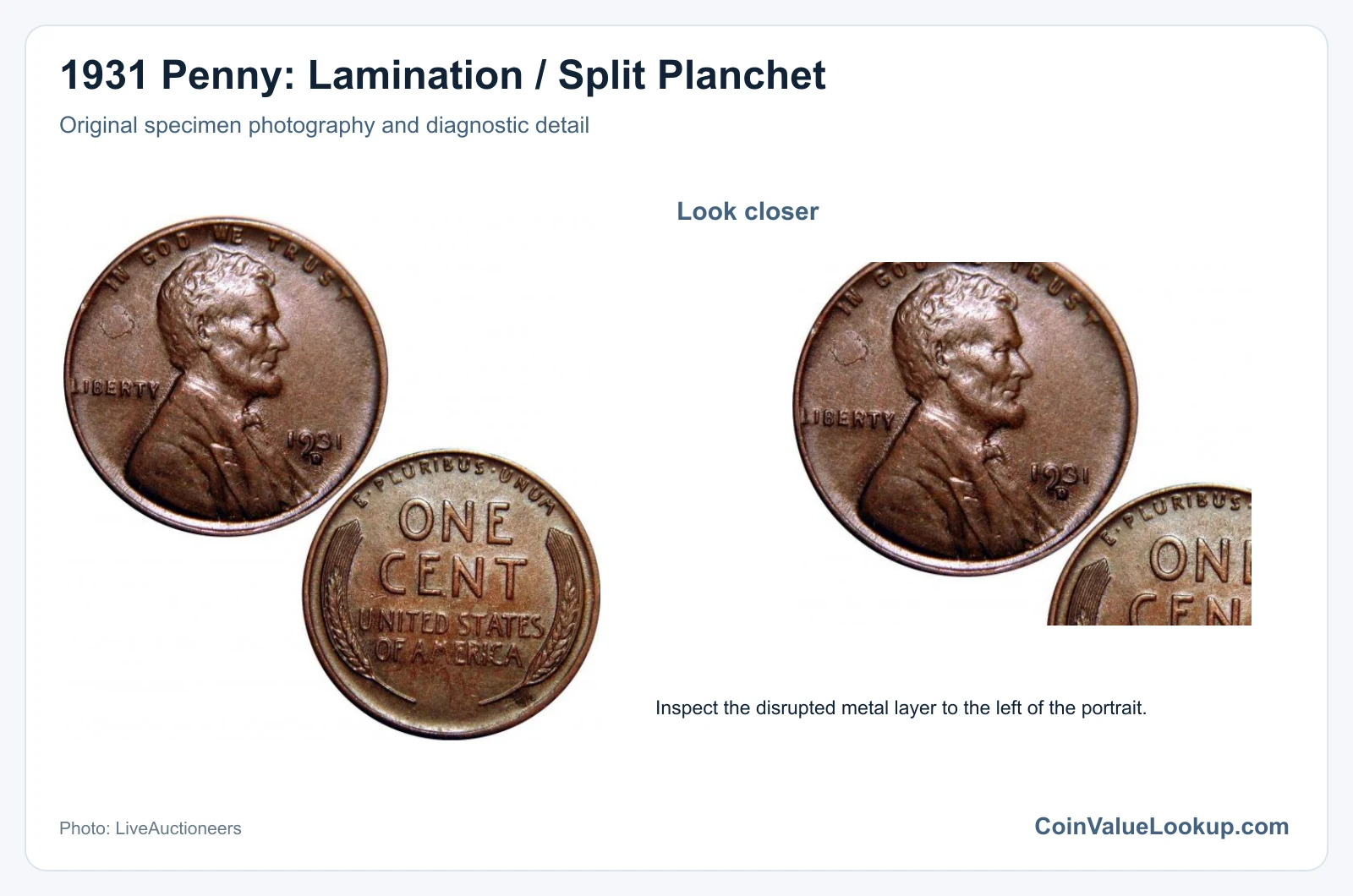
A lamination error results from impurities or gas trapped within the copper alloy during production. The metal separates into layers, producing a peeling flap, a raised blister or an outright split through the planchet's thickness.
On a 1931 Wheat cent, look for a section where the surface appears to lift away from the coin or where a thin piece of metal has partially detached. Photographing the edge alongside the affected face helps show whether the separation runs through the coin's interior rather than sitting on top.
This can be confused with post-mint scraping, deliberate cutting or heavy corrosion that eats into the surface. A genuine lamination follows the metal's internal structure and typically has smooth, slightly curved edges rather than sharp gouges.
No supported price range is available for lamination errors on this date; value depends on size, visual impact and the coin's authenticated condition.