1958 Washington Quarter Coin Value: How Much Is It Worth?
A 1958 Washington quarter in circulated condition starts around $16.43 in well-worn grades, driven partly by its 90% silver content. Uncirculated examples graded MS65 reach roughly $31 to $37 depending on the mint, per USA Coin Book guide estimates.
Certain varieties and authenticated errors can push values well beyond those ordinary figures, so the specific version you hold matters.
Fast Way to Identify Your 1958 Washington Quarter
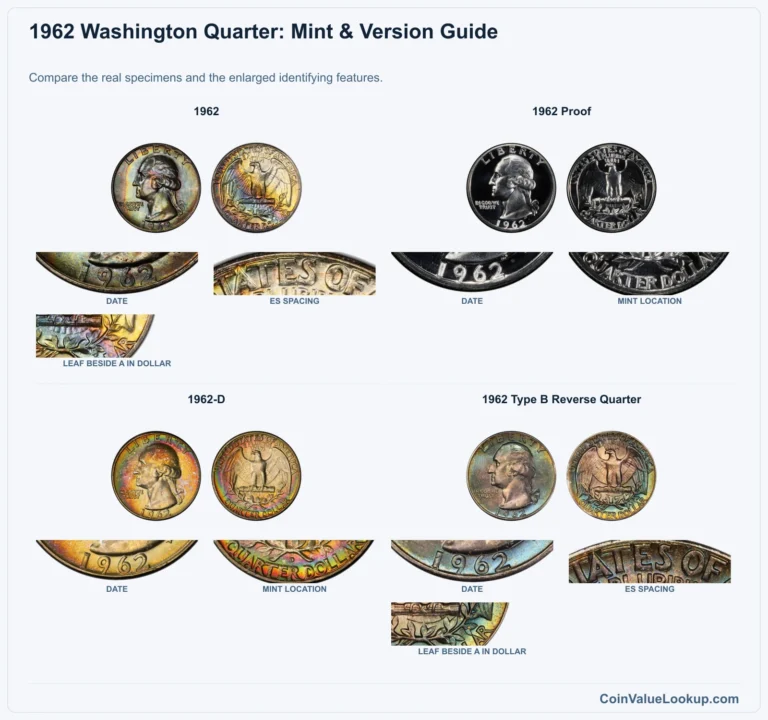
The quickest way to figure out what you have is to upload clear photos of both sides of your coin. A front and back image lets you get a preliminary identification of the mint, finish, and any obvious variety markers.
Snap both sides in good light and compare what you see against the details below.
1958 Washington Quarter Value
Upload both sides of your 1958 Washington Quarter.
Front Obverse
Upload photo
Back Reverse
Upload photo
Which 1958 Washington Quarter Versions Are Worth Money?
- The 1958 Type B reverse, a circulation strike with proof-style reverse hub, sold for $4,800 at MS67+ — identified by the separated E and S in STATES.
- A 1958-D quarter struck on a bronze cent planchet brought $1,380 at MS65 Brown, recognizable by its copper-colored surfaces and lighter weight of about 3.05 grams.
- A 1958 proof reverse brockage, showing an incuse mirror-image obverse on the reverse, sold for $12,337.50 at PR62.
- High-grade Denver mint examples at MS65 guide around $37, the highest ordinary circulation-strike guide figure for the year.
Step 1: Identify Your 1958 Washington Quarter Mint Mark and Version
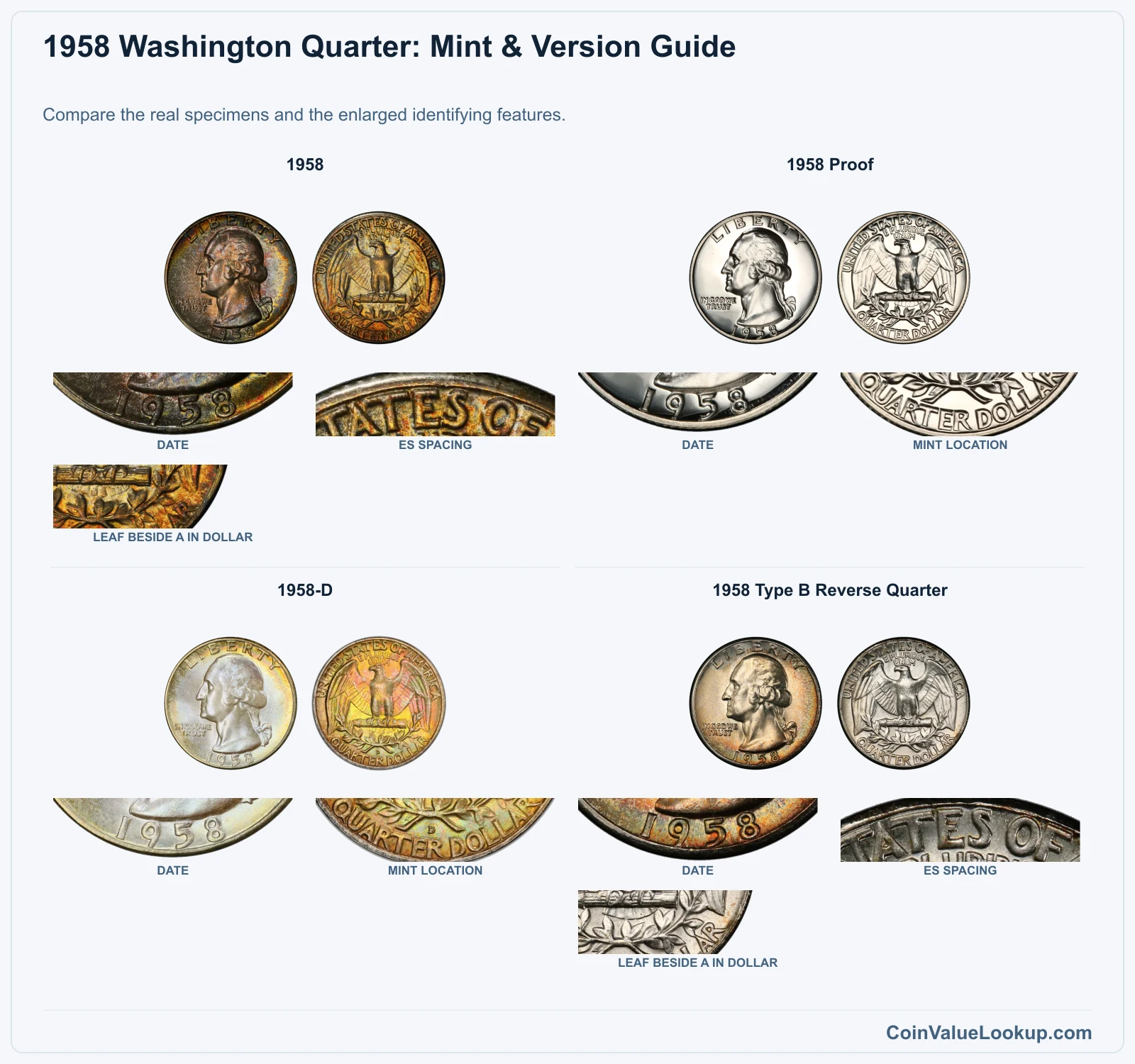
The date sits on the obverse beneath Washington's bust. Flip the coin over and look below the wreath on the reverse for a small D mintmark, which indicates Denver.
No mintmark at all means Philadelphia — that blank space is normal for this era, not a mistake.
Every regular 1958 quarter is struck in 90% silver and 10% copper, weighing about 6.25 grams and measuring roughly 24.3 mm across. Both Philadelphia and Denver circulation strikes share the same alloy and basic design: Washington facing left on the obverse, an eagle with arrows and olive branches on the reverse.
Philadelphia also produced proof quarters this year, using the same silver alloy. A proof has mirror-like fields and sharply defined details from a special manufacturing process — it is a finish, not a higher grade.
Proof quarters came in sealed sets and are easily distinguished from business strikes by their reflective surfaces.
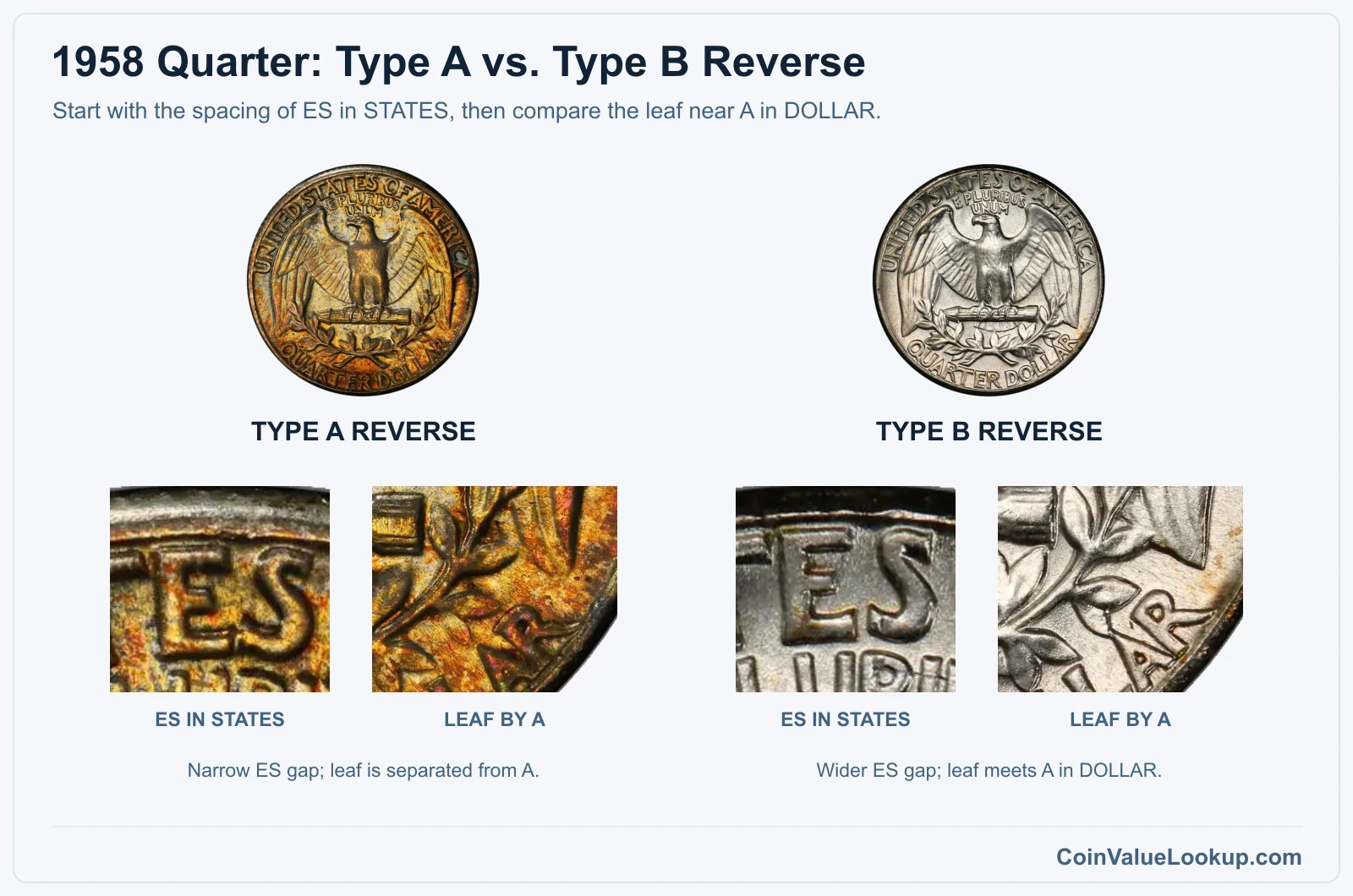
One additional Philadelphia variety exists: the Type B reverse. This uses a proof-style reverse hub on a regular circulation strike.
To tell them apart, examine the letters E and S in STATES on the reverse. On a normal circulation coin, those letters nearly touch.
On a Type B, there is a clear gap between them. A proof with that same reverse spacing is just a normal proof — the Type B designation applies only to circulation strikes.
Philadelphia had relatively low mintage this year, but mint-set survivors were saved in quantity. Original toning on silver is natural aging, not damage or an error.
Step 2: Check Your 1958 Washington Quarter Grade
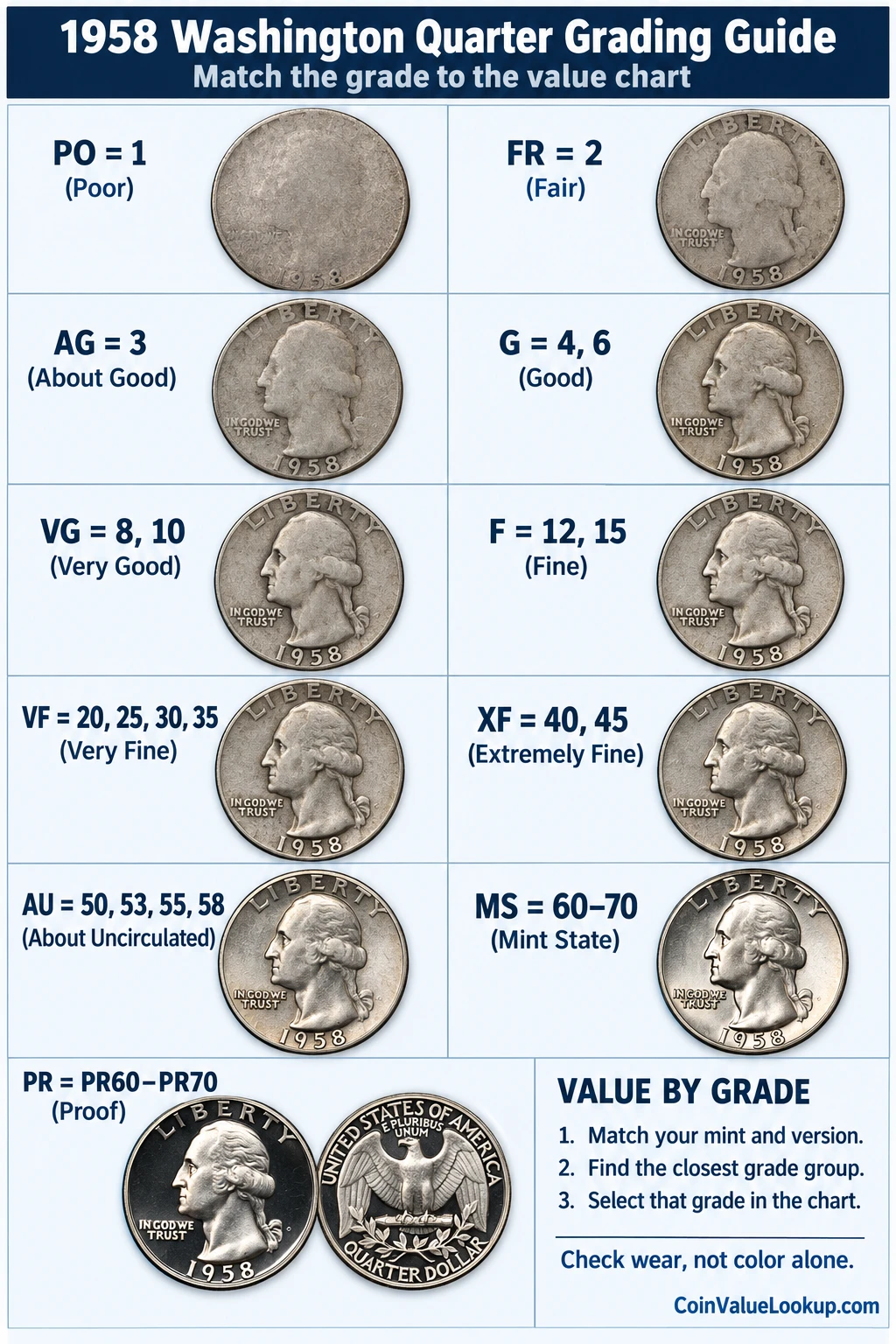
Start on the obverse. Washington's cheek and the hair directly above his ear show friction first.
Even light wear kills the original mint luster in those spots, so tilt the coin under a single light source and watch for breaks in the cartwheel shine.
On the reverse, check the eagle's breast feathers and wing tips. These high points lose definition early in circulation.
Compare what you see with the reference comparison image to gauge where your coin falls on the wear scale.
A coin graded G4 (Good) will have a smooth cheek and flattened hair detail but a readable date and outline. An MS60 (Mint State) coin has no wear but may show contact marks and bag scuffs from storage.
MS65 is a much cleaner Mint State coin with strong luster and minimal marks.
Also look for hairline scratches from old cleanings — they run in parallel lines across the surface and seriously reduce value. Rim dings and heavy contact marks count against the grade too.
On proofs, contrast between frosted devices and mirrored fields is a separate designation (like Cameo), not a substitute for the numerical grade itself.
Step 3: Check 1958 Washington Quarter Value by Mint and Version
1958 Washington Quarter
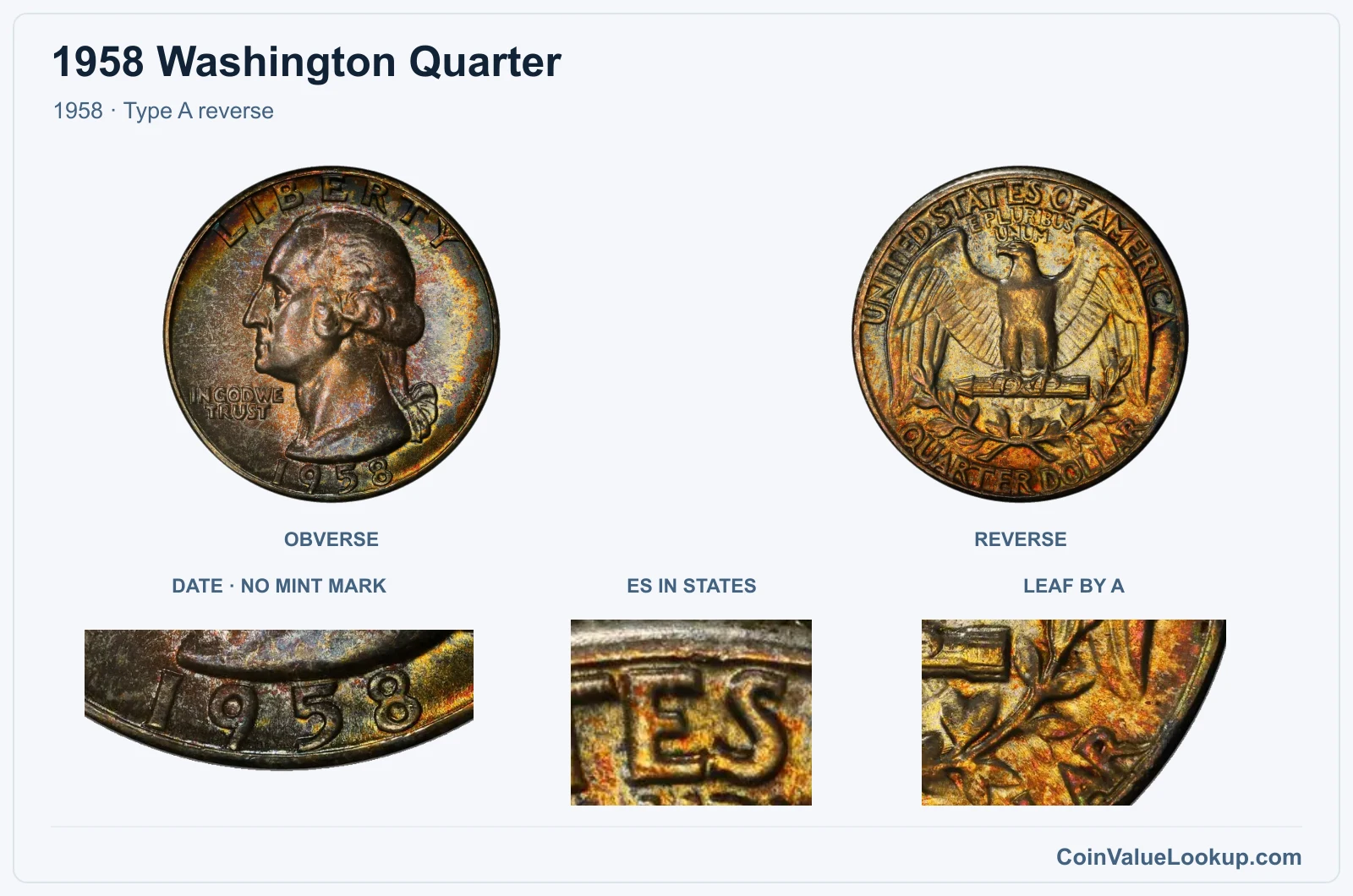
The 1958 Philadelphia quarter has no mintmark — look below the wreath on the reverse and you will see a blank space. That is correct and expected.
This is the standard Type A circulation reverse, where the E and S in STATES nearly touch.
USA Coin Book guide estimates place a well-worn G4 example at about $16.43, an MS60 around $20, and an MS65 at roughly $31. These are retail guide figures, not guaranteed offers, and they reflect the coin's silver content as a floor.
Philadelphia output was lower than Denver this year, but plenty of coins were tucked into mint sets and survived in high grades.
| Range | Grade | Price | Auction Records | Appraisal |
|---|---|---|---|---|
| PO | PO 1 | — | Coin Identifier | |
| FR | FR 2 | — | Coin Identifier | |
| AG | AG 3 | — | Coin Identifier | |
| G | G 4 | — | Coin Identifier | |
| G 6 | — | Coin Identifier | ||
| VG | VG 8 | — | Coin Identifier | |
| VG 10 | — | Coin Identifier | ||
| F | F 12 | — | Coin Identifier | |
| F 15 | — | Coin Identifier | ||
| VF | VF 20 | — | Coin Identifier | |
| VF 25 | — | Coin Identifier | ||
| VF 30 | — | Coin Identifier | ||
| VF 35 | — | Coin Identifier | ||
| XF | XF 40 | — | Coin Identifier | |
| XF 45 | — | Coin Identifier | ||
| AU | AU 50 | — | Coin Identifier | |
| AU 53 | — | Coin Identifier | ||
| AU 55 | — | Coin Identifier | ||
| AU 58 | — | Coin Identifier | ||
| MS | MS 60 | — | Coin Identifier | |
| MS 61 | — | Coin Identifier | ||
| MS 62 | — | Coin Identifier | ||
| MS 63 | Coin Identifier | |||
| MS 64 | Coin Identifier | |||
| MS 65 | Coin Identifier | |||
| MS 66 | Coin Identifier | |||
| MS 67 | Coin Identifier | |||
| MS 68 | — | — | — | |
| MS 69 | — | — | — | |
| MS 70 | — | — | — |
1958 Washington Quarter — Proof
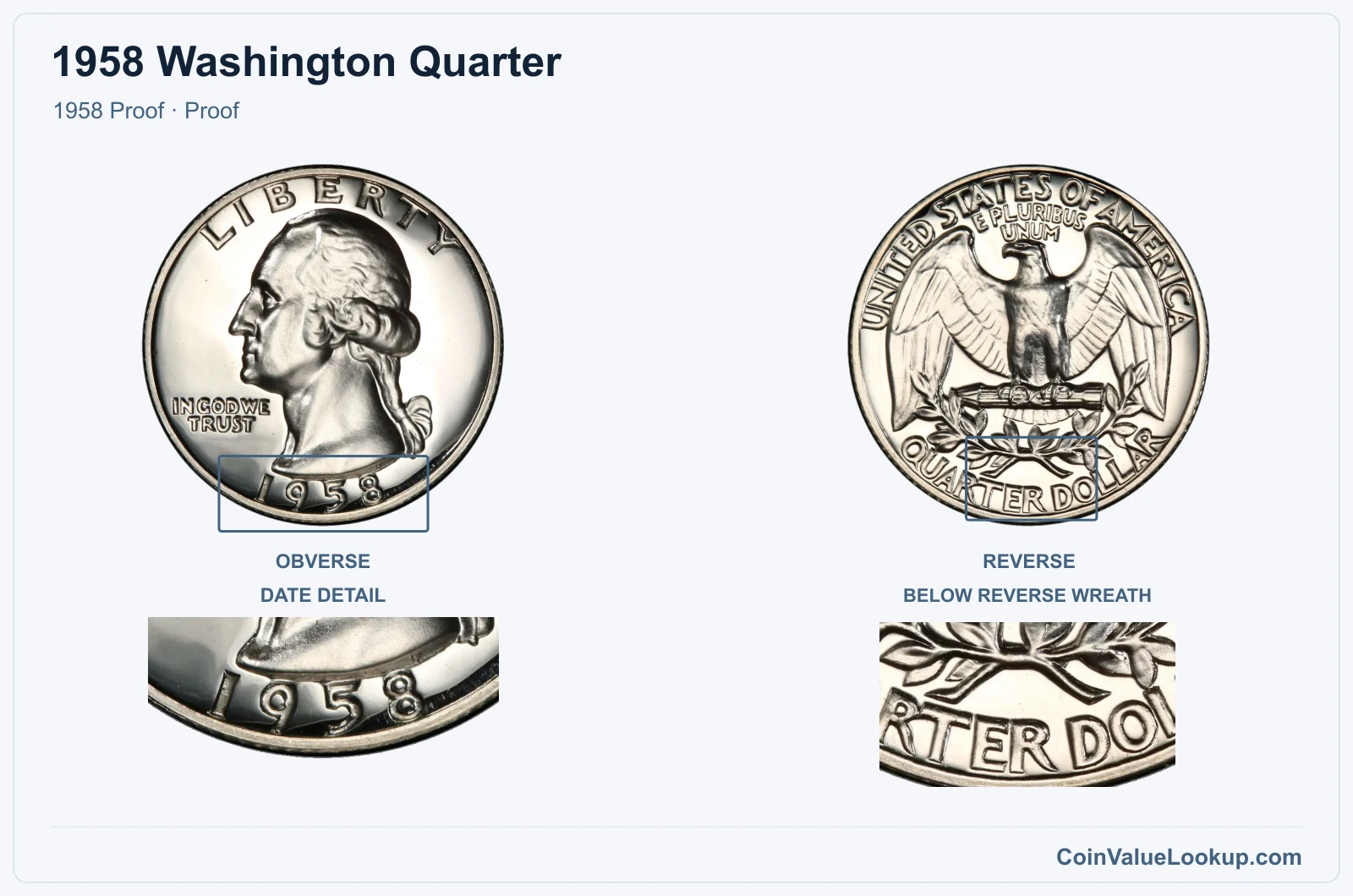
The 1958 proof quarter was struck only at Philadelphia with no mintmark, using the same 90% silver alloy as circulation issues. Proofs were produced with polished dies and specially prepared planchets, giving them mirror-like fields and crisp detail that a business strike cannot match.
A PR65 example is estimated at about $30 per USA Coin Book. Proof contrast designations like Cameo or Deep Cameo are separate from the numerical grade and can affect desirability.
These came in sealed proof sets, so most survivors are well preserved. Do not confuse a proof's mirrored finish with a particularly shiny circulation strike — the manufacturing process is fundamentally different.
| Range | Grade | Price | Auction Records | Appraisal |
|---|---|---|---|---|
| PR | PR 1 | — | Coin Identifier | |
| PR 2 | — | Coin Identifier | ||
| PR 3 | — | Coin Identifier | ||
| PR 4 | — | Coin Identifier | ||
| PR 6 | — | Coin Identifier | ||
| PR 8 | — | Coin Identifier | ||
| PR 10 | — | Coin Identifier | ||
| PR 12 | — | Coin Identifier | ||
| PR 15 | — | Coin Identifier | ||
| PR 20 | — | Coin Identifier | ||
| PR 25 | — | Coin Identifier | ||
| PR 30 | — | Coin Identifier | ||
| PR 35 | — | Coin Identifier | ||
| PR 40 | — | Coin Identifier | ||
| PR 45 | — | Coin Identifier | ||
| PR 50 | — | Coin Identifier | ||
| PR 53 | — | Coin Identifier | ||
| PR 55 | — | Coin Identifier | ||
| PR 58 | — | Coin Identifier | ||
| PR 60 | — | Coin Identifier | ||
| PR 61 | — | Coin Identifier | ||
| PR 62 | — | Coin Identifier | ||
| PR 63 | — | Coin Identifier | ||
| PR 64 | Coin Identifier | |||
| PR 65 | Coin Identifier | |||
| PR 66 | Coin Identifier | |||
| PR 67 | Coin Identifier | |||
| PR 68 | Coin Identifier | |||
| PR 69 | Coin Identifier | |||
| PR 70 | — | — | — |
1958 Washington Quarter — D
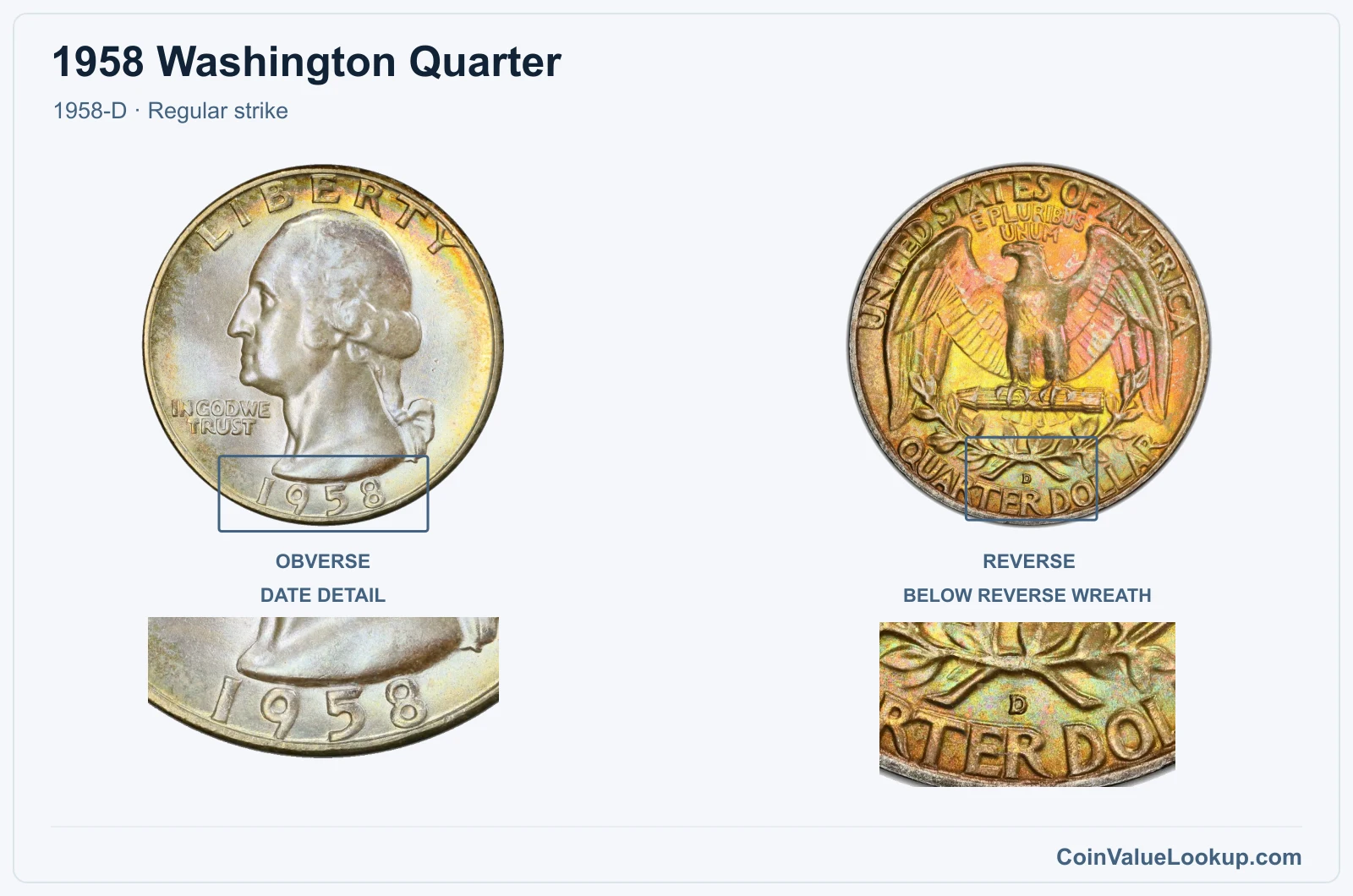
The 1958-D quarter carries a small D mintmark below the wreath on the reverse. Denver produced these in larger numbers than Philadelphia, and survivors are common across most grades.
Coin Value Lookup is a handy starting point if you want to check values for other dates and mints in the Washington quarter series.
USA Coin Book guide estimates list G4 at about $16.43, MS60 at $20, and MS65 at approximately $37 — the highest ordinary guide figure among 1958 circulation strikes. That MS65 premium reflects the difficulty of finding truly clean, lustrous survivors even from a large mintage.
Prices shift with the silver market, so the worn-grade floor moves over time.
| Range | Grade | Price | Auction Records | Appraisal |
|---|---|---|---|---|
| PO | PO 1 | — | Coin Identifier | |
| FR | FR 2 | — | Coin Identifier | |
| AG | AG 3 | — | Coin Identifier | |
| G | G 4 | — | Coin Identifier | |
| G 6 | — | Coin Identifier | ||
| VG | VG 8 | — | Coin Identifier | |
| VG 10 | — | Coin Identifier | ||
| F | F 12 | — | Coin Identifier | |
| F 15 | — | Coin Identifier | ||
| VF | VF 20 | — | Coin Identifier | |
| VF 25 | — | Coin Identifier | ||
| VF 30 | — | Coin Identifier | ||
| VF 35 | — | Coin Identifier | ||
| XF | XF 40 | — | Coin Identifier | |
| XF 45 | — | Coin Identifier | ||
| AU | AU 50 | — | Coin Identifier | |
| AU 53 | — | Coin Identifier | ||
| AU 55 | — | Coin Identifier | ||
| AU 58 | — | Coin Identifier | ||
| MS | MS 60 | — | Coin Identifier | |
| MS 61 | — | Coin Identifier | ||
| MS 62 | — | Coin Identifier | ||
| MS 63 | Coin Identifier | |||
| MS 64 | Coin Identifier | |||
| MS 65 | Coin Identifier | |||
| MS 66 | Coin Identifier | |||
| MS 67 | Coin Identifier | |||
| MS 68 | Coin Identifier | |||
| MS 69 | — | — | — | |
| MS 70 | — | — | — |
1958 Washington Quarter — Type B Reverse Quarter
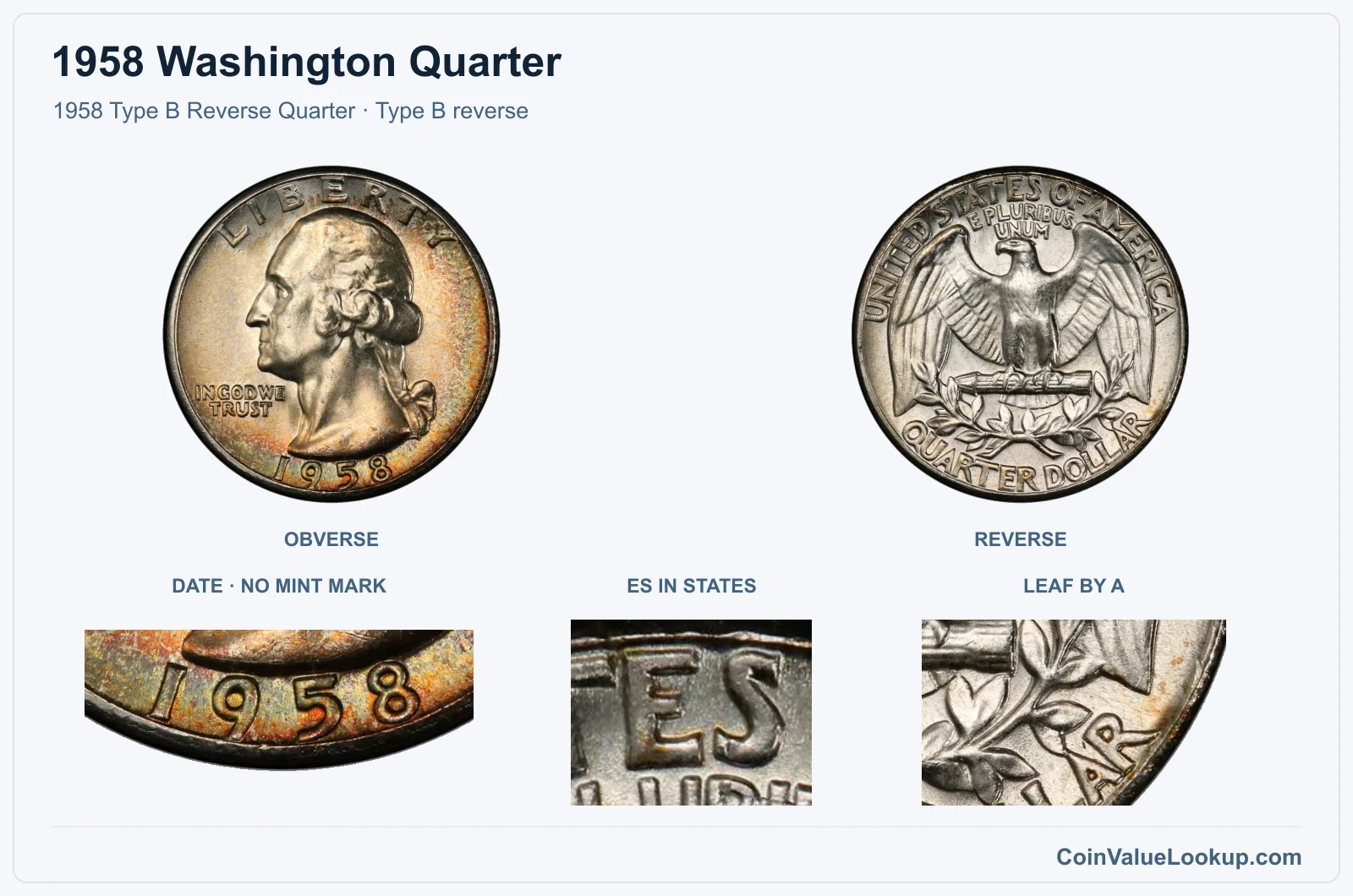
This is the one that gets collectors excited for good reason. The 1958 Type B reverse is a Philadelphia circulation strike that was accidentally produced using a proof-style reverse hub.
It carries no mintmark, just like a regular 1958 Philadelphia quarter, so the key diagnostic is the spacing between E and S in STATES on the reverse.
On an ordinary circulation reverse, those two letters nearly touch. On the Type B, there is a distinct, visible gap.
You will want magnification — a 5x loupe or better — to be sure. Confirm that the coin has business-strike surfaces (satiny luster, not mirrored fields), because a normal proof naturally has that same letter spacing and is not this variety.
A single example graded MS67+ sold for $4,800 at Heritage Auctions in March 2019. That is one historical sale at an exceptional grade, not a baseline for every Type B found.
Still, even lower-grade confirmed examples attract strong collector interest because many go unnoticed in circulation-strike rolls.
Range Grade
Price Auction Records Appraisal PO PO 1
—
Coin Identifier FR FR 2
—
Coin Identifier AG AG 3
—
Coin Identifier G G 4
—
Coin Identifier
G 6
—
Coin Identifier VG VG 8
—
Coin Identifier
VG 10
—
Coin Identifier F F 12
—
Coin Identifier
F 15
—
Coin Identifier VF VF 20
—
Coin Identifier
VF 25
—
Coin Identifier
VF 30
—
Coin Identifier
VF 35
—
Coin Identifier XF XF 40
—
Coin Identifier
XF 45
—
Coin Identifier AU AU 50
—
Coin Identifier
AU 53
—
Coin Identifier
AU 55
—
Coin Identifier
AU 58
—
Coin Identifier MS MS 60
—
Coin Identifier
MS 61
—
Coin Identifier
MS 62
—
Coin Identifier
MS 63
—
Coin Identifier
MS 64
Coin Identifier
MS 65
Coin Identifier
MS 66
Coin Identifier
MS 67
—
Coin Identifier
MS 68
—
—
—
MS 69
—
—
—
MS 70
—
—
—
1958 Washington Quarter Error List
1. 1958 Washington Quarter — Struck on a Bronze Cent Planchet
A documented 1958-D quarter was struck on a bronze cent planchet instead of the correct silver blank. The result is a coin with full quarter designs — date, Washington, eagle, and D mintmark — but on a copper-colored blank weighing only about 3.05 grams instead of the normal 6.25 grams.
The rim may appear partial or incomplete because the smaller planchet could not fill the collar entirely.
This specific specimen, graded NGC MS65 Brown, sold for $1,380 at Heritage Auctions in February 2011. That is a single realized price at a stated grade.
If you find a quarter-sized coin with obviously brown or copper surfaces and correct 1958-D designs, weigh it first. A normal quarter that has been plated or chemically altered will still weigh around 6.25 grams, and close inspection will reveal coating edges or uneven color.
2. 1958 Washington Quarter — Proof Reverse Brockage
A 1958 Philadelphia proof quarter exists with a full reverse brockage — meaning a previously struck obverse physically contacted this coin during the proof striking process, leaving a complete incuse (sunken), mirror-image impression of Washington's portrait on the reverse instead of the normal eagle design. Both sides show proof-quality mirrored surfaces, and the reversed lettering on the affected side is the primary diagnostic.
Graded PCGS PR62, this piece realized $12,337.50 at Heritage Auctions in January 2017. Hairlines on the surfaces were noted at grading, which accounts for the relatively modest proof grade despite the spectacular error.
This is an exceptional proof manufacturing mistake. Any claimed brockage should show strike-made surfaces, not evidence of post-mint hammering, cutting, or grinding.
3. 1958 Washington Quarter — Type B Reverse Variety
The Type B reverse variety on a 1958 Philadelphia circulation-strike quarter results from a proof-style reverse hub being used during regular production. The diagnostic is straightforward: look at the letters E and S in STATES on the reverse under magnification.
If those letters are clearly separated by a gap, you have the Type B hub. If they nearly touch, it is the ordinary circulation reverse.
Confirm that the coin has business-strike surfaces — satiny, not mirrored. A normal proof will naturally show the same letter spacing and does not qualify.
Also rule out mechanical or strike doubling, which can create misleading shadows near letters but will not produce the consistent, clean separation of the Type B hub design. A Heritage Auctions sale in March 2019 recorded $4,800 for an MS67+ example.
4. 1958 Washington Quarter — Repunched Mintmark
A repunched mintmark on a 1958 quarter shows traces of a second, slightly offset mintmark impression beneath or beside the primary D. Under magnification, you may see a faint remnant of the earlier punch — often appearing as a shadow, notch, or partial letter overlapping the final position.
Compare your coin's mintmark area directly against a normal example at the same magnification. Machine doubling can mimic a repunched mintmark, but it typically produces a flat, shelf-like distortion rather than a rounded secondary impression.
Die chips and corrosion around the mintmark area can also create confusing shapes. Value depends on the specific variety, how visible the repunching is, and the coin's overall condition.
5. 1958 Washington Quarter — Doubled Die Obverse
A doubled die obverse on a 1958 quarter shows consistent doubling on obverse design elements — letters, the date, or parts of Washington's profile — caused by a misaligned hub impression during die production. The doubling appears as separation or notching on affected features and should be visible under moderate magnification.
Do not confuse this with machine doubling, which is far more common and far less valuable. Machine doubling typically shows a flat, shelf-like displacement on one side of a letter or device, while a true doubled die produces rounded, raised secondary contours.
Reflections and worn die contours can also fool the eye. Condition, the specific die variety, and the strength of visible doubling all affect value.
6. 1958 Washington Quarter — Doubled Die Reverse
A doubled die reverse on a 1958 quarter displays consistent doubling on reverse legends, the eagle, or other design contours. Like its obverse counterpart, the doubling comes from a misaligned hub impression during die creation, not from the striking process itself.
Examine reverse lettering under magnification and compare closely against a known normal coin. True hub doubling shows rounded, raised secondary images that are consistent across multiple design elements.
Machine doubling, by contrast, tends to appear as flat shelving on one side of letters. Random damage, reflections, and surface corrosion can also mimic doubling at first glance.
The specific die pair, strength of the doubling, and coin condition all influence collector interest and value.
7. 1958 Washington Quarter — Clipped Planchet
A clipped planchet error on a 1958 quarter means the blank was incompletely punched from the metal strip before striking. The result is a missing section — usually a curved bite along the rim — where metal simply was not present when the coin was struck.
You may also notice design weakness on the opposite side of the coin from the clip, caused by incomplete metal flow.
Look at the edge texture near the missing area. A genuine clip will show a smooth, consistent edge that blends into the coin's surface, and the area opposite may display a characteristic weakness called the Blakesley effect.
A filed notch, post-mint cut, or corrosion pit will leave tool marks, rough edges, or irregular profiles that do not match a genuine pre-strike clip. Condition, clip size, and date visibility all affect value.
8. 1958 Washington Quarter — Off-Center Strike
An off-center strike happens when the planchet is not properly seated in the collar before the dies come together. The result is a displaced design with a crescent of blank, unstruck metal on one side.
The more dramatic the displacement, the more visually striking the error — but collectors also want the date to remain visible, which keeps the coin identifiable.
To distinguish a genuine off-center strike from a clipped planchet or post-mint damage, check that the design is uniformly shifted in one direction and that the blank crescent has a natural, unstruck surface. A coin flattened or bent after minting will not show clean, strike-made displacement.
Value depends on the percentage off center, date visibility, and overall condition.
9. 1958 Washington Quarter — Broadstrike
A broadstrike occurs when the coin is struck without proper collar confinement, allowing metal to spread outward beyond the normal diameter. The design is complete and centered, but the rim is absent or very weak, and the coin appears slightly larger and thinner than normal.
To verify a broadstrike, look at the edge profile — it should show outward metal flow from the strike rather than a machined or reeded edge. The entire design should still be present, just spread slightly.
Compare this to an off-center strike, where the design is displaced to one side and part of the planchet is blank. A coin that was simply flattened after minting may look similar, but it will lack the even radial spread and consistent edge character of a genuine broadstrike.
Condition and visual appeal affect value.
10. 1958 Washington Quarter — Die Crack / Die Chip
Die cracks appear as raised lines on the coin's surface, transferred from fractures that developed in the steel die during use. Small raised blobs are die chips.
When a crack reaches the rim and breaks away a chunk of the die face, the result is a cud — a raised, featureless blob at the edge of the coin.
These are raised features, which is the key distinction. Scratches and surface damage are incuse — cut into the metal.
Under magnification, a die crack will follow a consistent path and may appear on multiple coins struck from the same die. Corrosion pitting and foreign material stuck to the surface can also mimic small die chips, so compare carefully.
Value depends on the size, location, and visual prominence of the crack or cud, plus the coin's overall condition.
11. 1958 Washington Quarter — Struck-Through Error
A struck-through error occurs when foreign material — such as grease, a thread, or a small metal fragment — sits between the die and the planchet during striking. The result is a localized depression or incomplete area in the design where the obstruction blocked the die's impression.
Grease-filled dies are the most common version, producing smooth, slightly sunken areas where detail is simply missing. A retained foreign object can leave a more distinct impression or outline.
To tell a struck-through from ordinary wear or cleaning, note that wear removes high points evenly across the design, while a struck-through affects a specific, often irregular area regardless of relief. Scratches from cleaning run in parallel lines and cut into the surface.
Value varies with the size, location, and distinctness of the struck-through impression, as well as overall coin condition.